

12mm Film Faced Plywood — Factory-Direct from QDPlywood.com
12mm film faced plywood built for concrete formwork — phenolic film overlay, WBP bonding, dimensionally stable at export moisture spec. Thinner than the 18mm standard, lighter per panel, and still rated for multiple pours when the core and film are done right.
The 12mm thickness is the go-to for wall forms, column boxes, and elevated deck systems where dead load matters.
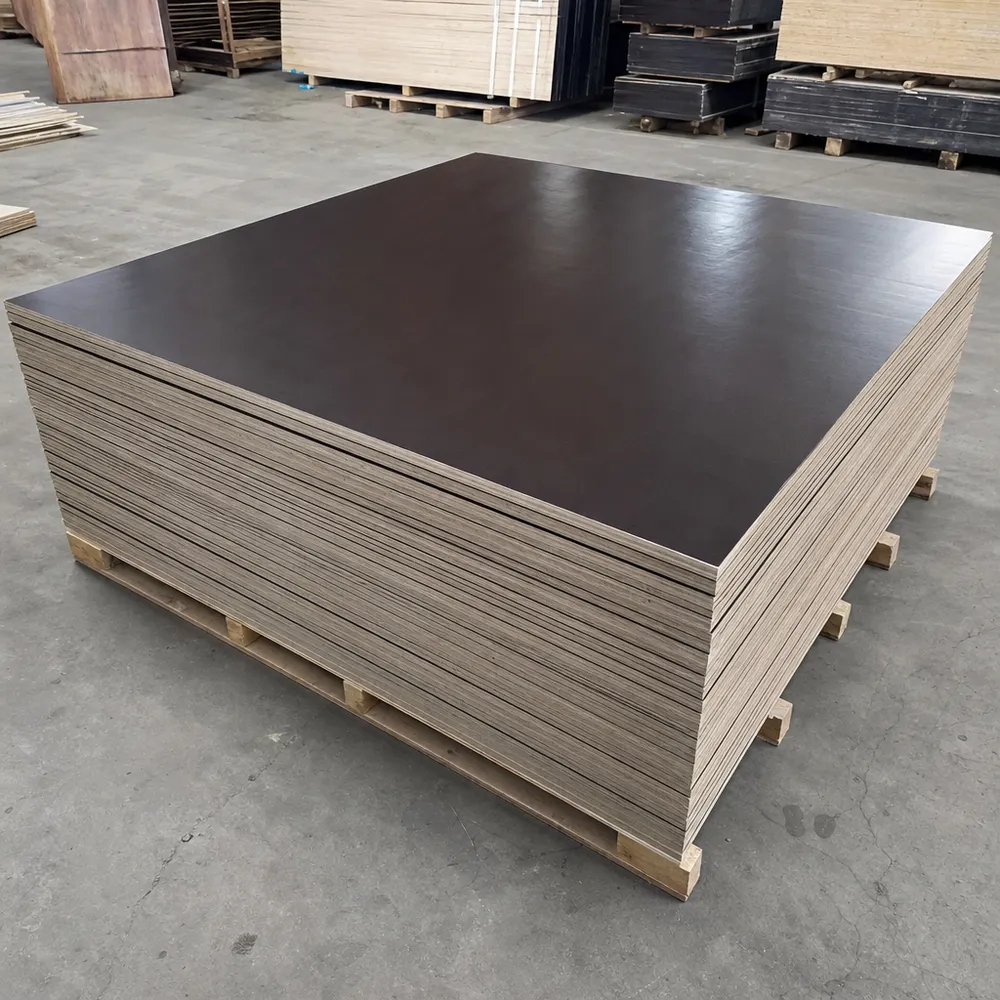
What Makes 12mm the Right Thickness for Your Formwork Market
The 12mm specification sits at a specific intersection in the formwork market: light enough to reduce labor cost on elevated pours, stiff enough to hold concrete pressure across standard stud spacing, and thin enough to stack more panels per container.
That combination is why 12mm film faced plywood moves well in markets where contractors are cost-sensitive and labor rates are high — Southeast Asia, the Gulf, and increasingly in Eastern European construction supply chains.
Where 18mm is the default for heavy slab work and ground-level foundations, 12mm is the preferred spec for wall shuttering, column forms, and any application where the form panel is being lifted, repositioned, and reused across multiple pours. At roughly 15–17 kg per standard 1220×2440mm panel (depending on core species and density), it's a meaningful weight reduction versus 18mm — and on a job site where a crew is handling hundreds of panels per day, that difference shows up in productivity and injury rates.
Film Overlay Determines Reuse Count
A 12mm panel with a properly bonded 120 g/m² phenolic film will typically yield 8–15 pours before the surface degrades to the point where concrete finish quality drops. We've seen buyers in the Middle East push past 20 pours on panels stored and handled correctly — but 8–15 is the honest commercial expectation for most site conditions.
The film weight and bonding process matter more than the plywood thickness for reuse count — a 12mm panel with a well-bonded film outlasts a 15mm panel with a poorly laminated one.
View our full film faced plywood range for thickness comparisons and application guidance across the series.
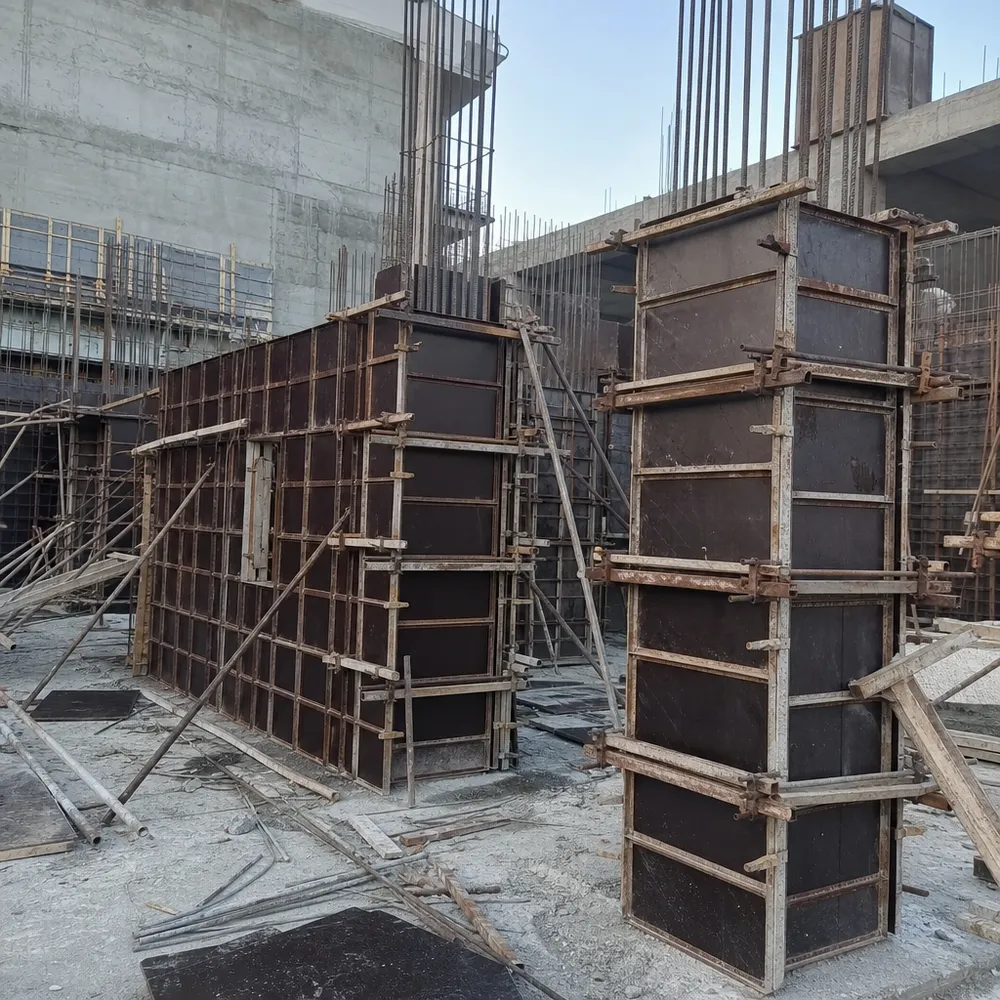
Wall Shuttering
Preferred spec for vertical wall forms — lighter handling, faster repositioning between pours.
Column Boxes
Tight radius column forms benefit from 12mm flex tolerance without sacrificing surface finish.
Elevated Deck Systems
Dead load reduction on elevated pours — meaningful when crews handle hundreds of panels per shift.
Container Efficiency
Thinner panels stack more per container — direct impact on landed cost per panel for importers.
12mm Film Faced Plywood — Full Specification
Standard values for this product. Actual parameters may vary by order specification. Contact us for a detailed data sheet matched to your project requirements.
Technical Parameters
Specifications shown are standard values for this product. Actual parameters may vary by order specification. Contact us for a detailed data sheet matched to your project requirements.
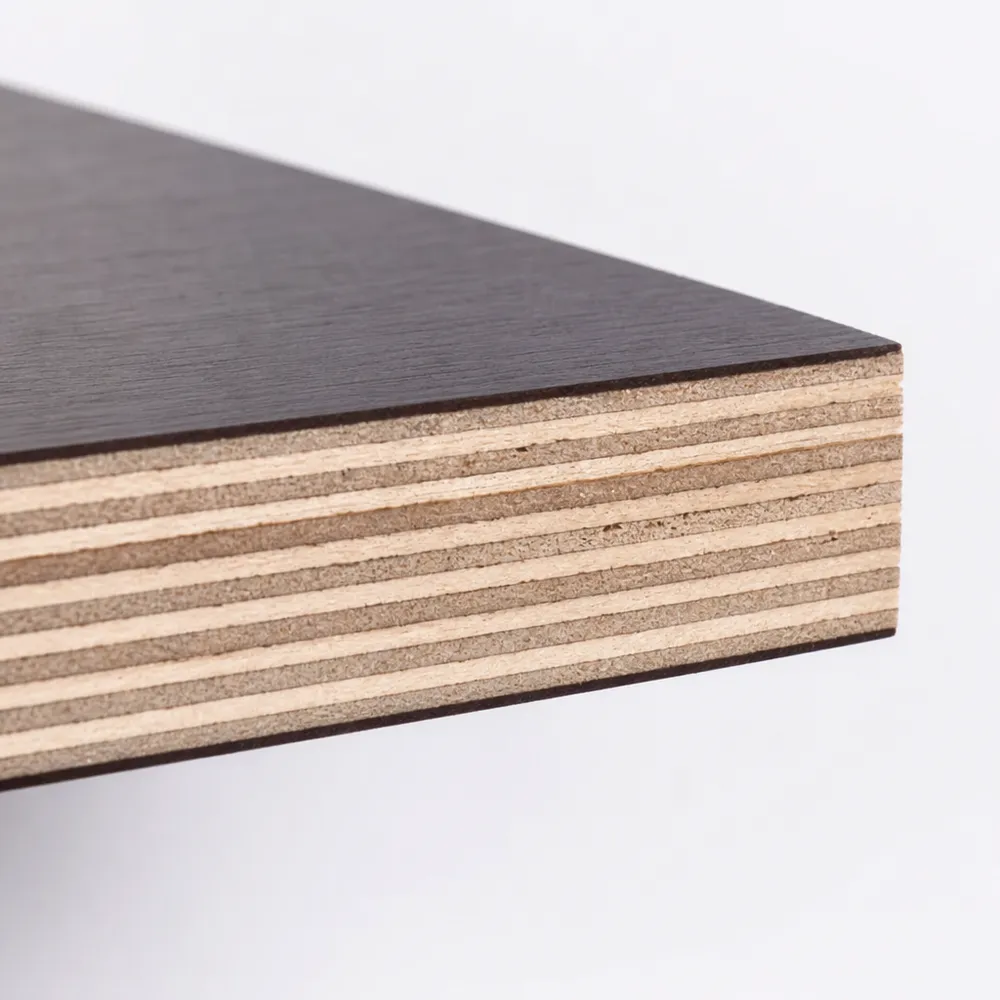
Key Specification Highlights
-
WBP phenolic glue bond
Passes boil test — panels hold together under repeated wet/dry cycling on site.
-
120 g/m² phenolic film standard
Sufficient for 8–15 pours with correct release agent use. 220 g/m² available for higher-cycle projects.
-
Sealed edges as standard
Waterproof edge paint on all export orders — reduces moisture ingress at cut edges during site use.
-
9-ply or 11-ply core options
More plies at 12mm means tighter veneer grades and better dimensional stability across the panel face.
-
E1 formaldehyde as standard; CARB P2 available
Meets European and North American indoor air quality requirements where specified.
How Many Pours Should You Expect?
Cycle life is the number buyers ask about most — and the one most often misrepresented. Here is an honest breakdown of what drives reuse on 12mm panels.
Film Weight
Film weight is the single biggest lever. 120 g/m² is the commercial standard — honest expectation is 8–15 pours. 220 g/m² extends this to 20+ under the same conditions.
Release Agent Use
Consistent release agent application before every pour is the most controllable site variable. Skipping even one application accelerates film degradation and concrete adhesion.
Stripping Method
Mechanical stripping with pry bars damages edges and film surface. Panels stripped carefully — especially at corners — consistently outlast those stripped aggressively.
Storage Between Pours
Panels stored flat, off the ground, and under cover between pours retain dimensional stability. Panels left standing upright in sun and rain warp and delaminate faster.
Climate & Curing Conditions
High-temperature steam curing accelerates film degradation. Panels used in ambient-cure pours in moderate climates consistently achieve higher cycle counts than those in steam-cured precast.
Cutting & Trimming
Cut edges must be resealed immediately after trimming. Unsealed edges absorb moisture within hours on a wet site, causing edge swell that shortens panel life regardless of film quality.
Realistic Cycle Expectations by Use Case
| Application | Film Weight | Expected Cycles |
|---|---|---|
| Slab formwork — site cast | 120 g/m² | 10–15 |
| Wall & column formwork | 120 g/m² | 8–12 |
| Elevated deck — crane-handled | 120 g/m² | 12–18 |
| Precast — ambient cure | 220 g/m² | 20–30 |
| Precast — steam cure | 220 g/m² | 10–18 |
| General site — mixed use | 120 g/m² | 6–10 |
Claims of 30–50 pours from 12mm panels with 120 g/m² film are not realistic under normal site conditions. If a supplier quotes these figures without specifying film weight, handling protocol, and curing method, treat them as marketing rather than engineering data. We quote conservative ranges and let site performance speak.
12mm vs 15mm vs 18mm — Which Thickness Is Right?
Thickness selection affects weight, span capacity, cycle life, and landed cost. Here is how 12mm positions against the two most common alternatives.
| Parameter |
12mm
|
15mm Mid-range
|
18mm Standard heavy
|
|---|---|---|---|
| Panel weight (1220×2440mm) | 15–17 kg | 19–21 kg | 22–26 kg |
| Max unsupported span | 400–500mm | 500–600mm | 600–750mm |
| Typical cycle life (120 g/m²) | 8–15 | 10–18 | 12–20 |
| Panels per 20ft container | ~600–650 | ~500–550 | ~420–460 |
| Relative cost per panel | Lower | Mid | Higher |
| Best for | Close-spaced joists, column boxes, elevated decks | General slab & wall formwork | Wide-span slabs, heavy-duty reuse |
| Not ideal for | Wide joist spacing without additional support | Weight-critical elevated pours | Tight column forms, container cost sensitivity |
Choose 12mm when…
- Joist spacing is 400mm or less
- Dead load reduction matters on elevated pours
- Column or beam box forms with tight radius
- Container cost per panel is a key metric
- Crew handles panels manually without crane
Consider 15mm when…
- Joist spacing is 450–550mm
- Mixed slab and wall formwork on same project
- Moderate reuse target of 12–18 pours
- Balance between weight and span is needed
Specify 18mm when…
- Joist spacing exceeds 600mm
- High-cycle precast factory environment
- Heavy concrete pours with high lateral pressure
- Maximum reuse is the primary cost driver
How We Produce 12mm Film Faced Plywood —
The Process Behind the Spec
The 12mm thickness creates a specific production challenge that thicker panels don't have: with fewer veneer layers, any variation in individual veneer thickness or moisture content has a proportionally larger effect on the finished panel's flatness and dimensional stability.
Veneer Moisture Control
6–8% Pre-Press TargetCore veneers for 12mm panels are dried to a tighter moisture window — we target 6–8% pre-press moisture on the core veneers, slightly drier than what we run for thicker panels, because the hot press has less thermal mass to work with and residual moisture has less room to equalize.
Each veneer layer is checked with a pin-type moisture meter before layup; any veneer outside the target range is pulled and re-dried rather than pressed through. A 0.3mm moisture-driven movement in one core veneer is a minor issue in an 18mm panel; in a 12mm panel, it's a visible bow.
This adds time to the layup process, but the alternative is a batch of panels that arrive flat and bow after the first humidity cycle — which is a much more expensive problem for your customer.
Hot Press Parameters
130–140°C Calibrated CycleHot press parameters for 12mm are calibrated separately from our thicker panel runs. Press temperature runs at 130–140°C with a press time adjusted for the thinner stack — too long and you risk over-curing the phenolic glue at the face veneers, which affects film adhesion.
The press cycle is logged per batch, so if a bonding issue surfaces in a shipment, we can trace it back to the specific production run and identify whether it was a press parameter deviation or a veneer quality issue.
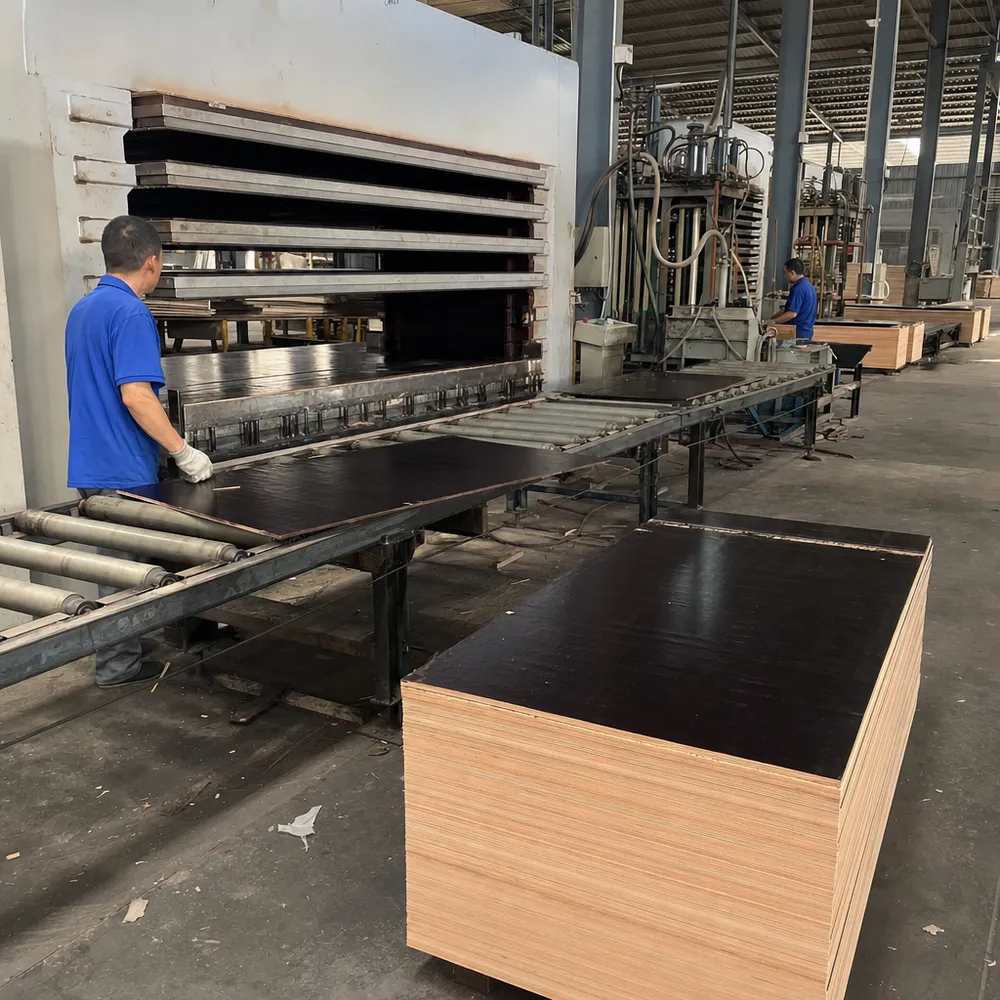
Film Lamination & Adhesion Testing
Cross-Cut Grid Test Per BatchFilm lamination runs on a dedicated overlay line. The phenolic film is applied under heat and pressure in a separate pressing stage after the base panel is produced and cooled. Film adhesion is tested by cross-cut grid test on samples from each production batch — we're looking for zero film lift at the cut intersections.
Any batch that shows adhesion failure at this stage is rejected before it reaches the sanding and trimming line.
Sanding, Thickness Tolerance & Edge Sealing
±0.5mm Tolerance — Tighter Than Industry StandardFinished panels are sanded to thickness tolerance on a calibrated wide-belt sander. For 12mm, we hold ±0.5mm across the panel — tighter than the ±1.0mm that some buyers accept, because thickness variation in formwork panels causes concrete bleed at panel joints and uneven form face profiles.
Edges are sealed with waterproof paint on all export orders to prevent moisture ingress during ocean transit and on-site storage.
Market Segments Where 12mm Film Faced Plywood Earns Margin
Four buyer categories where the 12mm spec creates repeatable, defensible margin — and what each segment actually buys on.
Residential & Mid-Rise Construction Supply
Core Volume Segment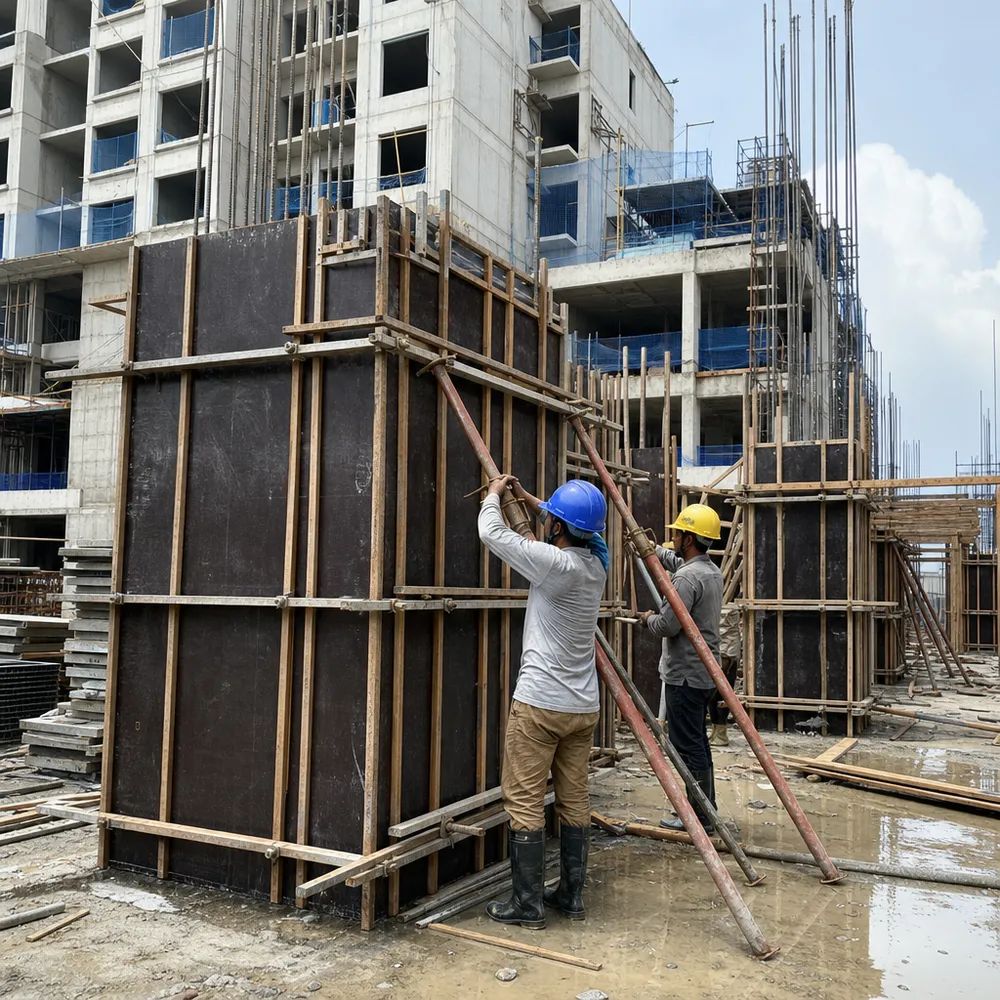
Contractors building 4–20 story residential projects in Southeast Asia and the Middle East are the core volume buyers for 12mm formwork plywood. A typical mid-rise project consumes 2,000–5,000 panels across wall forms and column boxes.
Distributors supplying these contractors can build a repeatable reorder cycle — projects run in phases, and a contractor who trusts a panel spec will reorder from the same source for each phase.
The 12mm spec is often the entry point for a contractor relationship that expands to 18mm slab panels and accessories.
Formwork Rental & Leasing Operations
Buys on Cost-Per-PourFormwork rental companies in the Gulf and Southeast Asia maintain panel inventories of 10,000–50,000 units and replace worn panels on a rolling basis. They buy on reuse count, not unit price — a panel that yields 12 pours at a slightly higher landed cost beats a panel that yields 6 pours at a lower price.
This is where the film quality and bonding process translate directly into your buyer's margin: they're calculating cost-per-pour, and a well-made 12mm panel with a properly bonded 120 g/m² film competes on that metric.
Rental operators in the UAE have run panel-by-panel reuse tracking and come back with data showing our panels averaging 14 pours versus 9 for their previous supplier — that's a 55% reduction in panel replacement cost.
Prefab & Modular Construction Manufacturers
Predictable Standing Orders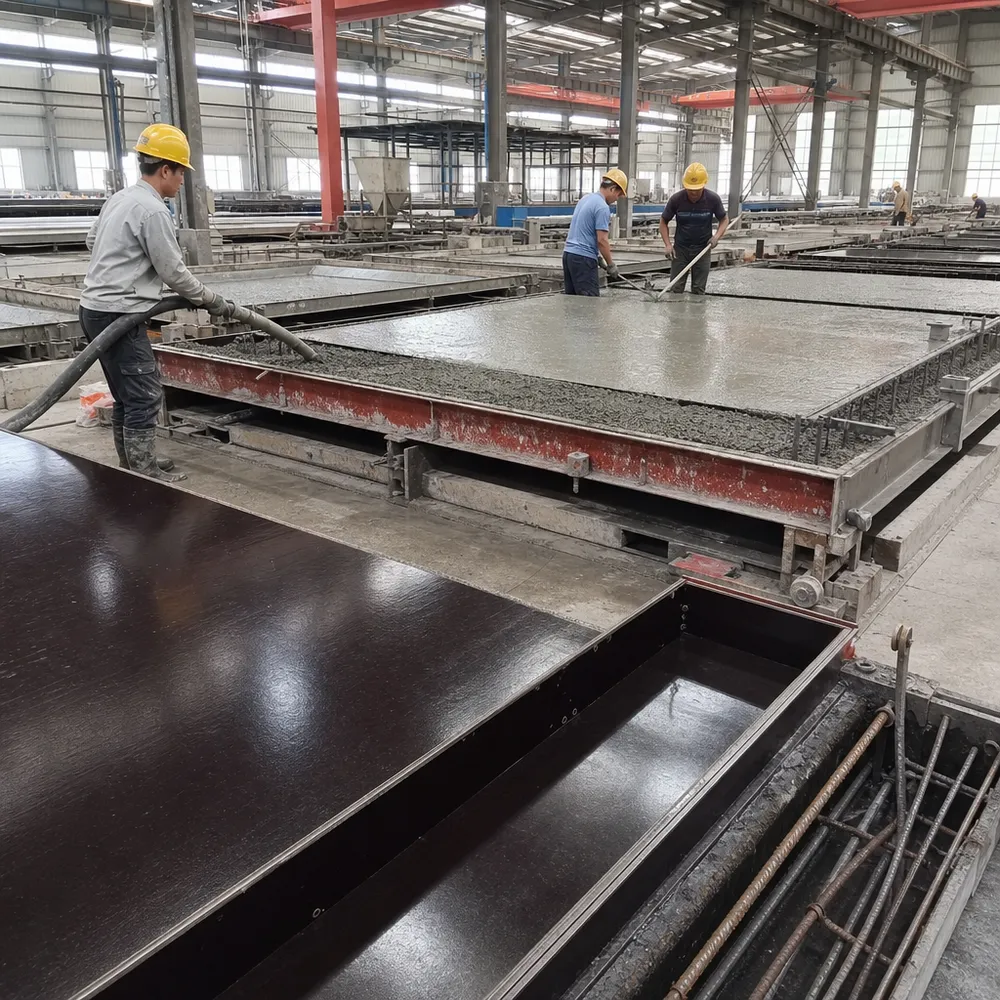
Prefab panel manufacturers use film faced plywood as the form surface for precast concrete elements — wall panels, stair flights, balcony slabs. The 12mm thickness is common in these applications because the forms are handled by crane rather than by hand, so weight is less critical than it is on a manual-labor site, but the smooth film surface is essential for the concrete finish quality that prefab buyers demand.
Order patterns here tend to be larger and more predictable — a prefab manufacturer running a production line will order 500–2,000 panels per month on a standing schedule.
Export Distribution into Construction Supply Chains
North America · Europe · AustraliaDistributors importing into North America, Europe, and Australia for resale to concrete contractors and rental companies need a product that clears customs without documentation issues and arrives dimensionally stable.
Our CARB P2 certification covers US import requirements; CE covers European construction product regulations; FSC chain-of-custody satisfies sustainability sourcing policies that are increasingly standard in European public procurement.
A distributor who can offer certified 12mm formwork plywood to contractors working on public projects has a meaningful competitive advantage over importers who can't provide the documentation.
Ready to discuss your market segment?
Whether you're supplying mid-rise contractors, stocking a rental fleet, or building a certified import program, we can structure pricing and documentation around your buyer's actual decision criteria.
Customization Options for 12mm Film Faced Plywood
The 12mm spec is a starting point, not a fixed product. Here's what can be adjusted on confirmed orders.
Core Species
Structural performance variableFilm Weight
Surface durability and reuse countPhenolic film on both faces. Standard stock for most formwork applications.
Higher reuse counts or more aggressive concrete release. Adds cost but meaningfully extends surface life — worth specifying for high-cycle rental operations.
Film Color
Branding and market differentiationRed, green, yellow available. Useful for distributors who want a branded or market-specific product that's visually distinct from commodity panels.
Anti-Slip Surface
Safety-critical applicationsMesh-pattern anti-slip film available as an alternative to smooth film on one face.
Relevant for: Elevated work platforms and scaffold decking applications where slip resistance is a safety requirement.
Panel Dimensions
Market-specific sizingCustom dimensions: A scheduling question, not a tooling question — we cut to size on precision saws. Minimum order for non-standard dimensions is typically 200 panels.
Formaldehyde Specification
Import complianceStandard production. Meets most international market requirements.
Requires a separate production run with CARB-compliant resin. Specify at order placement, not after production.
Ready to configure your order?
Customization lead times and MOQ vary by specification. Contact us with your target spec and volume — we'll confirm feasibility and lead time within 24 hours.
Container Loading and Landed Cost Planning
Concrete numbers for freight planning — container utilization, transit times, and documentation that ships with every order.
40HQ Container Capacity
Optimization note: At 15–17 kg per panel, you're well within standard container weight limits — so you're optimizing for cubic utilization, not weight. Loading plan provided with every shipment.
Packaging and Bundle Marking
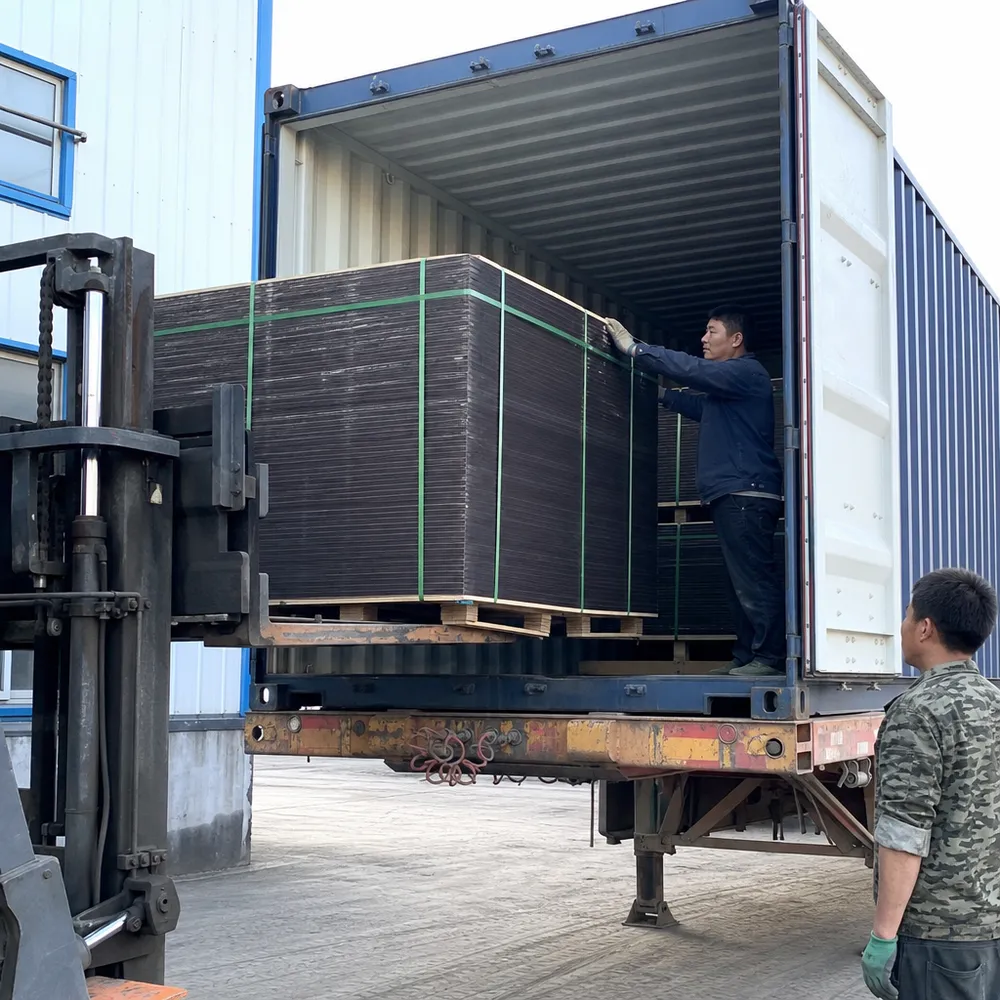
Panels bundled in stacks of 50–100 sheets, strapped, edge-protected with corner boards
Wrapped in moisture-resistant film for transit protection
Each bundle marked with product specification, batch number, quantity, and destination port
Panel edge sealing provides additional protection against moisture ingress during transit — relevant for shipments to humid destination ports where containers can sit on the dock for several days before customs clearance
FCL and LCL Coordination
We coordinate with freight forwarders for both FCL and LCL shipments. For buyers consolidating mixed product types, we can coordinate combined loads of 12mm and 18mm film faced plywood or other panel products to reduce per-unit freight cost.
View 18mm Film Faced PlywoodTransit Times from Xuzhou
Via Qingdao or Shanghai
Export Documentation — Standard Package
Export documentation is prepared as standard with every shipment. No separate request required for most documents.
US-bound shipments: The CARB documentation package is included without a separate request when CARB P2 spec is confirmed at order placement.
Certifications That Clear Your Import Market
For buyers supplying into regulated markets, these certifications are procurement gates — your customer's purchasing department will ask for them before approving a new supplier. We prepare the relevant documentation package as part of every export shipment; you don't need to chase it separately.
Scope: Quality management system — production process and QC
Scope: Construction product conformity — structural and formwork applications
Scope: Verified sustainable wood fiber sourcing — EU public procurement, sustainability-audited buyers globally
Scope: Formaldehyde emission compliance — most stringent US standard, including California
Documentation Included With Every Shipment
We prepare the relevant certification documentation package as part of every export shipment. You don't need to chase it separately — test reports, chain-of-custody records, and compliance certificates ship with the order.
Frequently Asked Questions — 12mm Film Faced Plywood
Practical answers to the specification, performance, and sourcing questions we hear most from importers and distributors.
With standard 120 g/m² phenolic film and proper site handling — cleaning after each pour, storing flat off the ground, avoiding impact damage to edges — 8–15 pours is a realistic commercial expectation.
The main variables are concrete mix aggressiveness (high-alkali mixes degrade film faster), release agent application consistency, and how the panels are cleaned between pours. Upgrading to 220 g/m² film extends surface life meaningfully for high-cycle applications.
Key point: The 12mm thickness itself doesn't limit reuse count — the film weight and bonding quality do.
At standard stud spacing of 400–600mm, 12mm film faced plywood handles typical wall pour pressures for residential and mid-rise construction.
High-pressure applications — deep foundation walls, retaining walls with high concrete head, or accelerated pour rates — specify 18mm or request a structural calculation based on your specific pour parameters.
We can provide bending strength data for our 12mm panels to support your engineering review.
- Lighter — roughly 15–17 kg per panel
- Reduces labor cost on manual-handling sites
- Preferred for wall and column forms
- Lower dead load on elevated form systems
- Heavier — roughly 22–25 kg per panel
- Higher bending stiffness
- Standard spec for slab forms
- Handles high-pressure wall pours
Most contractors use both: 12mm for wall and column forms, 18mm for slab decking. If you're building a formwork product line, stocking both thicknesses covers the full project scope.
View 18mm Film Faced PlywoodFor mixed orders combining 12mm with other thicknesses or film faced plywood variants, we can consolidate into a single container. Sample orders are available for specification testing before committing to a container order.
Yes. CARB P2 production uses a low-formaldehyde resin system and requires a separate production run — specify at order placement.
Included with US-bound shipments as standard:
- CARB documentation package
- Formaldehyde test reports
- Chain-of-custody records
Third-party pre-shipment inspection through SGS or Bureau Veritas can be arranged on request.
Lighter, cost-efficient, adequate for most formwork applications.
Denser and stiffer — better for high-pressure pours or where panel deflection under load is a concern.
Eucalyptus faces, poplar center — improves surface hardness and screw-holding at edges without full eucalyptus weight and cost.
Available for premium specifications where maximum surface quality and dimensional stability are required.
Buyer note: Core choice affects both performance and landed cost. Worth discussing with us based on your target application and price point.
Other Film Faced Plywood Thicknesses and Variants
If 12mm doesn't match your project spec, the rest of the film faced plywood range covers the full thickness and application spectrum.
18mm Film Faced Plywood
Heavy-Duty FormworkThe standard slab and heavy-duty formwork spec. Higher bending stiffness for high-pressure pours where 12mm deflects beyond tolerance.
Brown Film Faced Plywood
Market DifferentiationBrown phenolic film variant. Same structural spec as standard black film, different film color for market differentiation and regional buyer preference.
Phenolic Film Faced Plywood
Premium Reuse CountPremium phenolic overlay for maximum reuse count and concrete surface finish quality. Specified where pour finish grade is a contract requirement.
Waterproof Film Faced Plywood
High-Humidity SitesEnhanced edge and core waterproofing for high-humidity site conditions. Specified for tropical markets and below-grade or marine-adjacent pours.
Birch Film Faced Plywood
Premium Core DensityBirch core for premium density and strength specifications. Higher face-to-face uniformity and tighter void tolerance than mixed-hardwood cores.
Structural Film Faced Plywood
Load-Bearing RatedEngineered for load-bearing structural applications with defined performance ratings. Carries the documentation trail required for structural sign-off.
Get a Quote for 12mm Film Faced Plywood
Send us your target specification — thickness, core species preference, film weight, panel dimensions, destination market, and volume — and we'll come back with a detailed FOB quote and the relevant certification documentation for your import requirements.
If you're not sure which spec fits your market, tell us the application and destination and we'll recommend the configuration that protects your margin.