

Glossy Melamine Plywood
Factory-Direct from Xuzhou
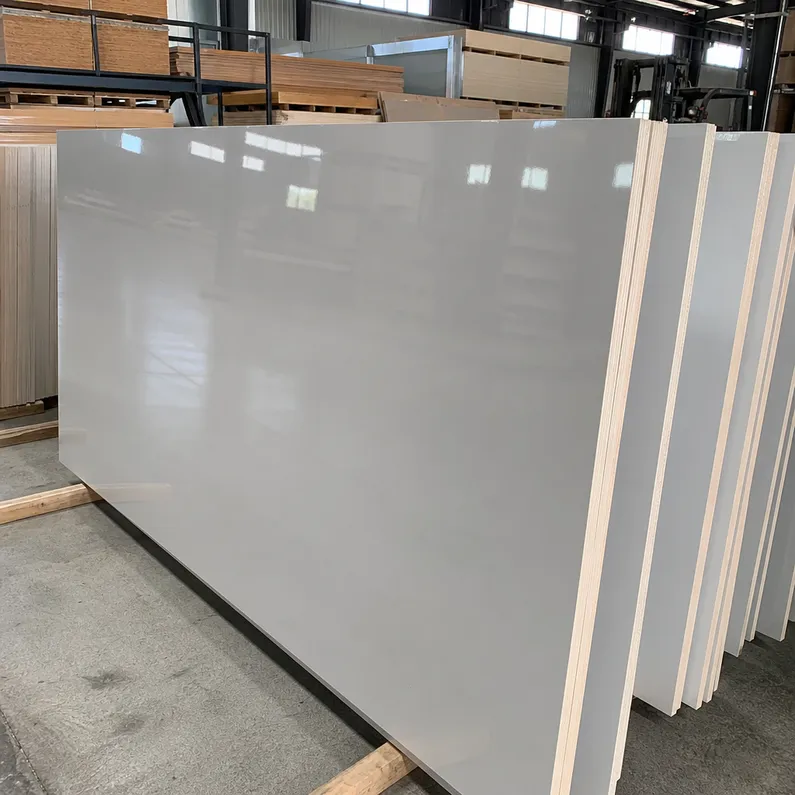
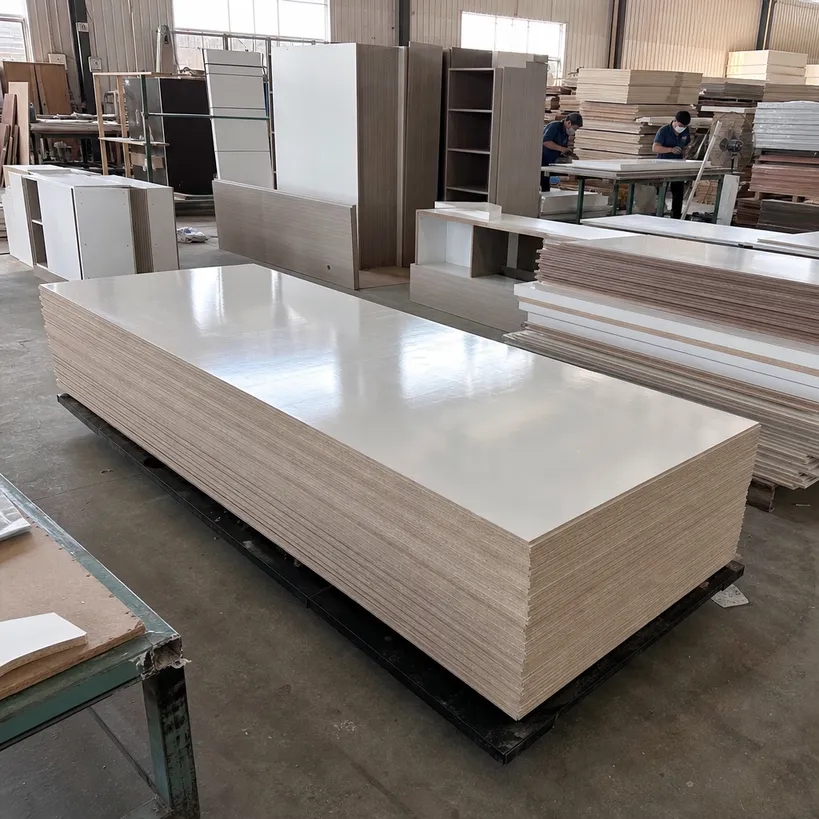
High-gloss melamine plywood with a plywood core — mirror-finish surface, structural substrate. Pressed using high-polish steel caul plates for batch-consistent gloss. Available in custom colors and dimensions.
18+ years manufacturing · Exported to North America, Europe, Middle East, Southeast Asia, Australia
What Makes Glossy Melamine Plywood Different from Standard Melamine Panels
Glossy melamine plywood is a specific production variant within the melamine plywood range — not just a shinier version of the standard product.
How the Gloss Surface Is Made
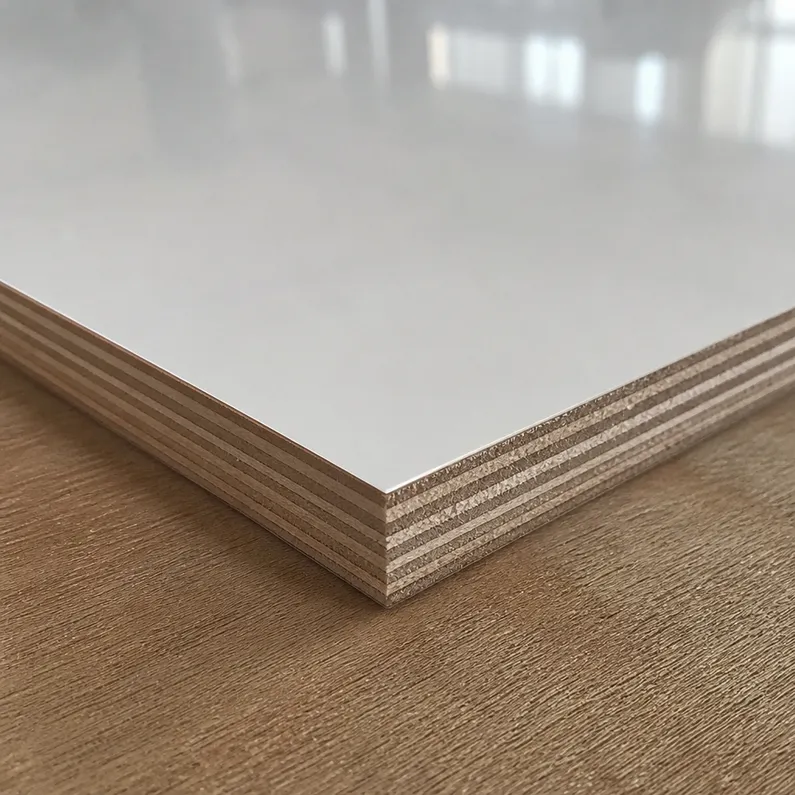
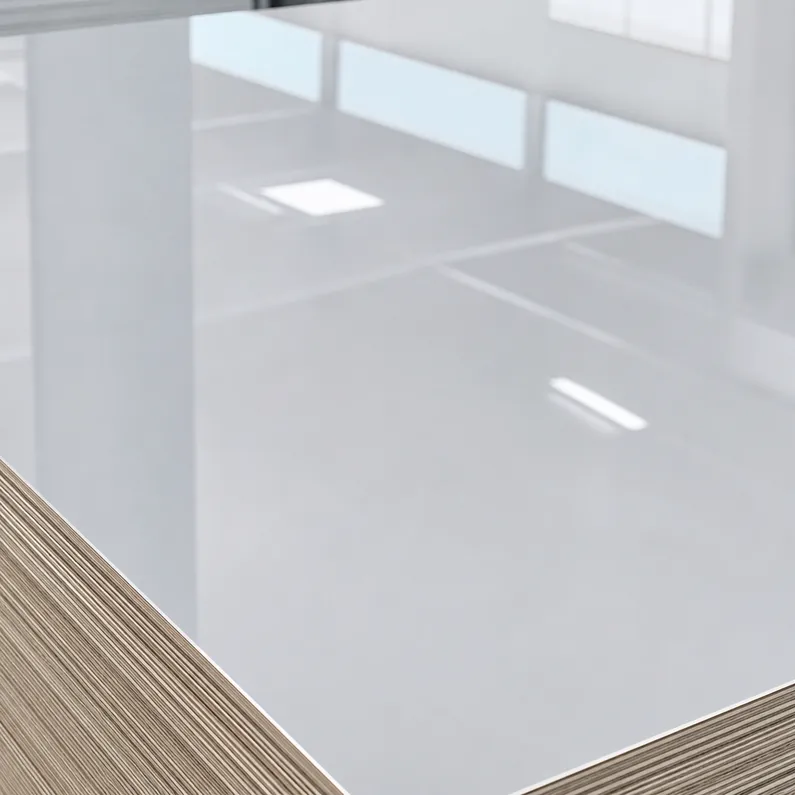
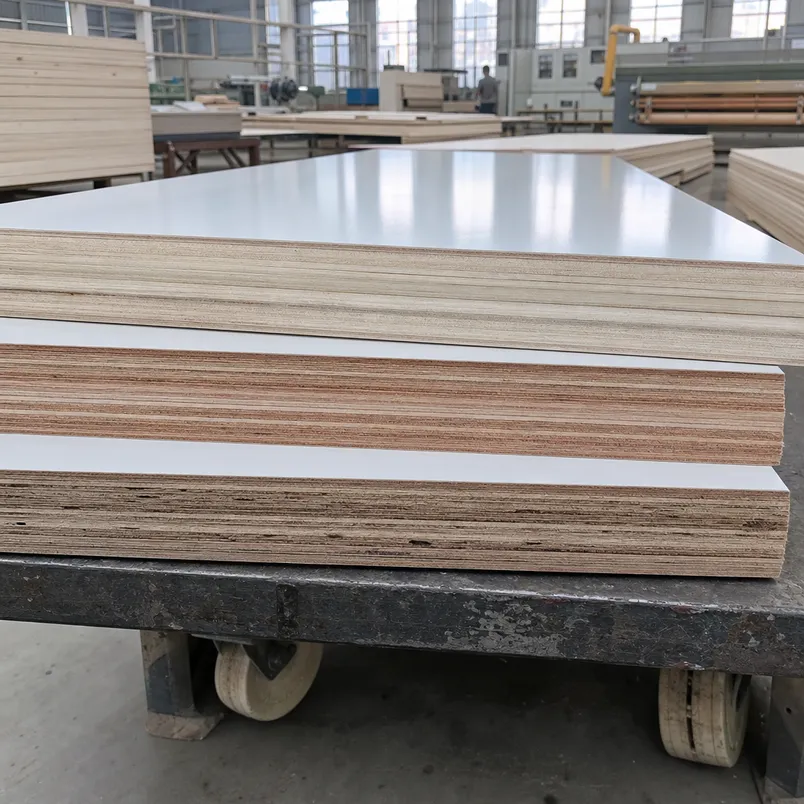
The surface finish is achieved by pressing the melamine paper against a high-polish steel caul plate rather than a textured or matte plate. That caul plate contact is what produces the mirror-like surface. The substrate underneath is the same cross-grain veneer plywood core we run across our melamine range — poplar or eucalyptus core, odd-number ply construction, moisture-controlled pressing.
The Commercial Distinction
Glossy melamine plywood commands a price premium in retail furniture markets because the surface finish is visible and part of the product's design language. Your downstream buyers — furniture manufacturers, cabinet makers, interior fit-out contractors — are selling the look as much as the function. That's a margin argument you can make at the point of sale that you can't make with a matte or satin panel.
Glossy Melamine Plywood vs. Related Products
Understanding where each specification fits helps you match the right panel to the right application.
vs. High Gloss Melamine MDF
- Denser, heavier panel
- Sharper routed edge
- Preferred for door fronts & decorative panels
- Better screw-holding strength
- Lighter weight per panel
- Better dimensional stability under load
Where Glossy Melamine Plywood Fits Best
Glossy melamine plywood sits at the intersection: structural performance with a premium surface finish. That combination makes it the right specification for visible structural components.
Technical Specifications
Industry-standard values for this product type. Contact us for detailed product data sheets and to confirm specifications for your application.
Glossy Melamine Plywood — Full Specification Table
| Parameter | Specification |
|---|---|
| Surface Finish | High-gloss melamine paper, mirror finish |
| Gloss Level | 80–100 GU (60° gloss meter) |
| Core Material | Poplar or eucalyptus veneer (hardwood core available on request) |
| Core Construction | Cross-grain veneer layup, odd-number plies |
| Glue System | MR standard WBP available |
| Melamine Paper Weight | 100–120 g/m² (heavier overlay for gloss surface durability) |
| Standard Thickness |
9mm 12mm 15mm 18mm 21mm 25mm
|
| Standard Sheet Size | 1220×2440mm |
| Custom Dimensions | Available on confirmed orders |
| Thickness Tolerance | ±0.2mm (calibrated sanding) |
| Moisture Content | 8–12% (export-grade target range) |
| Formaldehyde Emission | E1 standard CARB P2 available |
| Surface Colors |
White Black Grey Cream Custom (MOQ applies)
|
| Certifications |
CARB P2 FSC ISO 9001:2015 CE
|
| Surface Abrasion | IP 20 (EN 438 equivalent) |
| Bond Strength | ≥ 0.8 N/mm² (internal bond, dry) |
| Bending Strength | ≥ 30 N/mm² (parallel to face grain) |
| Screw-Holding Strength | ≥ 900 N (face, 18mm panel) |
| Packing | Interleaved with protective film; palletized and stretch-wrapped |
| MOQ | 1 × 20ft container (mixed thickness/color available) |
Understanding Gloss Units
Gloss is measured in GU (Gloss Units) at a 60° angle. The scale runs from 0 (dead matte) to 100 (mirror finish).
Thickness Selection Guide
- 9mm Cabinet backs, lightweight drawer bottoms
- 12mm Shelf dividers, light-duty shelving
- 15mm Standard shelving, wardrobe carcasses
- 18mm Cabinet sides, structural panels — most common spec
- 21–25mm Heavy-duty shelving, worktops, load-bearing components
Need the Full Data Sheet?
We can provide detailed product data sheets, test reports, and certification documents for your specification or compliance review.
Request Data SheetSurface Finish & Color Range
The high-gloss surface is the defining characteristic of this product. Understanding how it behaves — and what colors are available — helps you specify correctly and set accurate expectations with end clients.
How the Gloss Surface Performs
The fused melamine layer is non-porous. Liquids bead on the surface and wipe clean without penetrating. Resistant to common household chemicals, coffee, and food stains.
Suitable for ambient interior environments. Not rated for direct contact with hot cookware. Avoid sustained exposure above 70°C to prevent surface dulling or delamination.
High-gloss surfaces show fingerprints and smudges more readily than matte or satin finishes. This is a characteristic of the finish, not a defect. Microfibre cloths restore the surface quickly.
More scratch-visible than matte surfaces due to light reflection. Use sharp, fine-tooth blades when cutting. Protect surfaces during transit and installation with the factory film until final fit-out.
Standard melamine has moderate UV resistance. For installations with prolonged direct sunlight exposure, specify UV-stabilised melamine paper. Darker colors may show fading faster than whites and neutrals.
Standard Color Range
Color accuracy on screen varies by display calibration. Request physical samples before confirming color specifications for production orders.
Glossy melamine plywood is supplied with raw plywood edges. Exposed edges require edge banding — typically 0.4–2mm PVC or ABS tape in a matching gloss finish. Unfinished edges absorb moisture and compromise the panel's appearance and longevity.
Applications & Project Types
Glossy melamine plywood is specified wherever a panel needs to carry structural load and present a finished surface simultaneously. These are the project types where it consistently delivers.
Kitchen Cabinetry
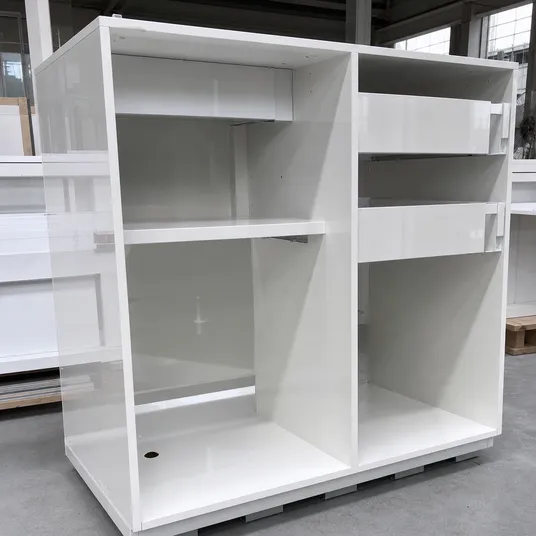
Cabinet carcasses, interior shelving, and drawer boxes where the interior surface is visible when doors are open. The gloss white interior is a standard specification in contemporary kitchen design.
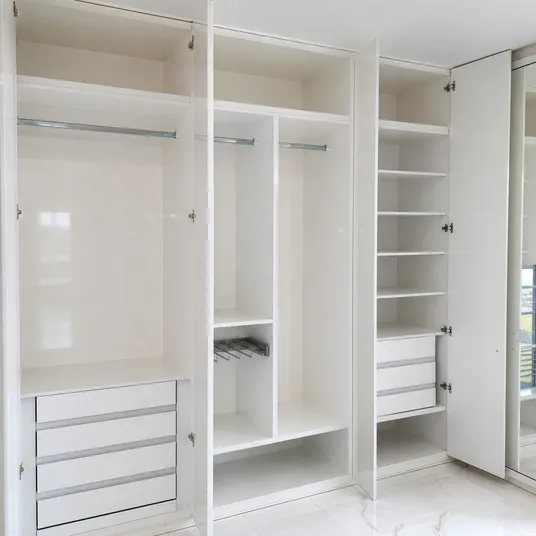
Wardrobe Systems
Walk-in wardrobes and fitted wardrobe interiors where the full interior is on display. Gloss white or cream panels create a clean, bright interior that makes the space feel larger.
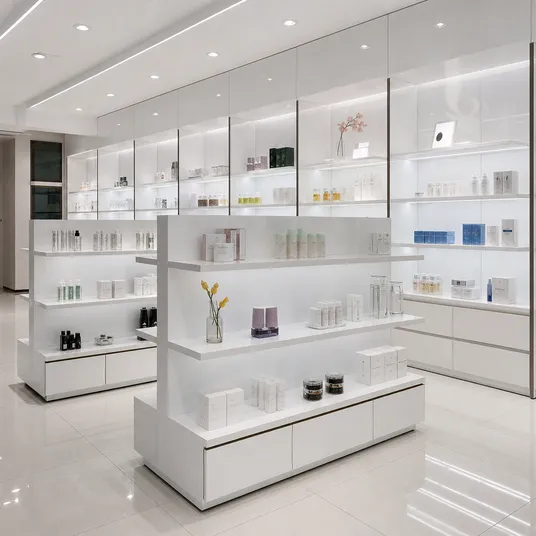
Retail Display & Shopfitting
Display shelving, gondola units, and feature walls where the panel surface is the backdrop for merchandise. The reflective surface enhances product presentation under retail lighting.
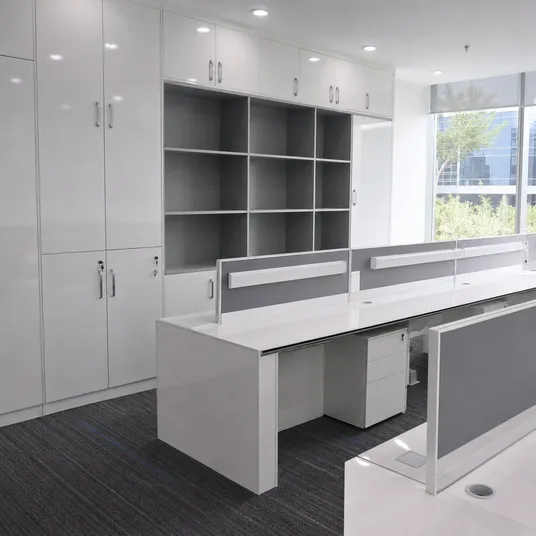
Office Furniture
Desking systems, storage walls, and open shelving in commercial office environments. The durable surface handles daily use while maintaining a professional appearance.
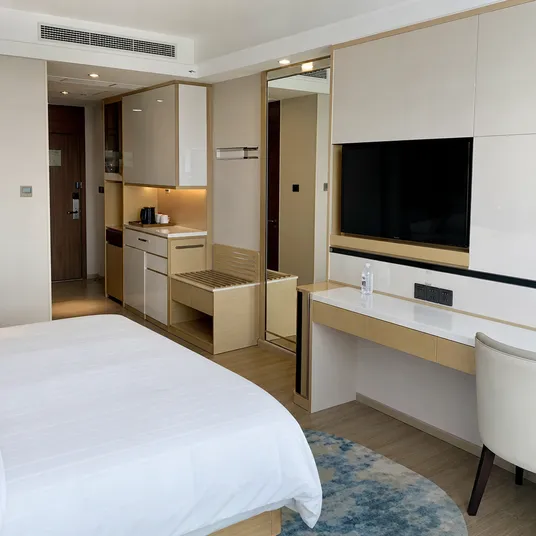
Hospitality Joinery
Hotel room furniture, restaurant booth seating structures, and bar back-of-house cabinetry. The easy-clean surface is practical in high-turnover environments.
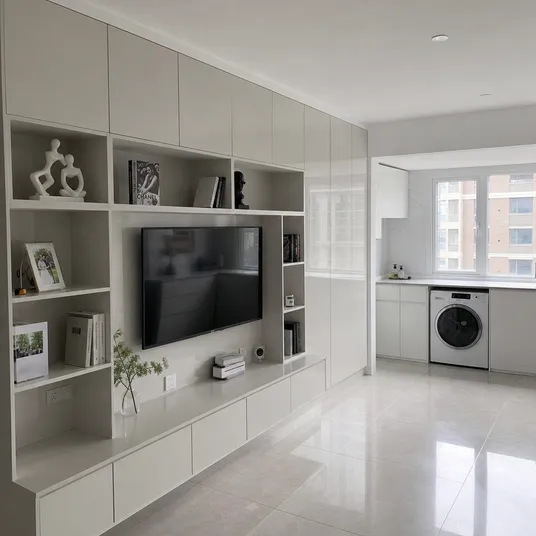
Residential Interiors
Built-in shelving, media units, laundry cabinetry, and home office storage where a clean, modern finish is required without the cost of solid timber or lacquered MDF.
Where Glossy Melamine Plywood Is Not Recommended
UV and moisture will degrade the melamine film and delaminate the plywood core. Use marine or exterior-grade panels instead.
Shower recesses, pool surrounds, and areas with standing water require fully waterproof substrates. Moisture-resistant variants exist but are not a substitute for waterproof panels.
Foot traffic will scratch and dull the gloss surface. Flooring-grade panels with wear-layer overlays are the correct specification for floor applications.
Not rated for primary structural applications such as floor joists, roof framing, or load-bearing walls. Consult an engineer for structural panel specifications.
The melamine film will crack if the panel is bent beyond its natural flex tolerance. Flexible or thin-core bending ply is required for curved joinery applications.
Panels installed directly adjacent to ovens, cooktops, or other high-heat sources without adequate thermal shielding risk surface blistering and delamination.
Technical Specifications
Standard dimensions, thickness options, and surface performance data for our glossy melamine plywood range. Custom dimensions and specifications are available on request.
Standard Dimensions
| Parameter | Standard Range | Notes |
|---|---|---|
| Sheet size | 1220 × 2440 mm | 4′ × 8′ standard |
| Oversize sheet | 1220 × 2745 mm | 4′ × 9′ available |
| Thickness range | 3 – 25 mm | Common: 9, 12, 15, 18 mm |
| Thickness tolerance | ± 0.5 mm | Per sheet |
| Squareness tolerance | ≤ 2 mm / 2 m | Diagonal measurement |
| Custom sizes | On request | MOQ applies |
Surface Performance
| Property | Rating / Value | Test Standard |
|---|---|---|
| Gloss level | ≥ 80 GU @ 60° | ISO 2813 |
| Scratch resistance | ≥ 1.5 N | EN 438-2 |
| Abrasion resistance | IP 20 – IP 40 | EN 438-2 §6 |
| Stain resistance | Class 5 | EN 438-2 §26 |
| Impact resistance | ≥ 20 N·cm | EN 438-2 §21 |
| Formaldehyde emission | E0 / E1 | EN 717-1 |
Core Construction Options
Lightweight, consistent grain, good screw-holding. Standard choice for furniture and cabinetry. Typically 9–13 plies at 18 mm.
Higher density, superior screw retention, better load-bearing. Preferred for shelving with heavy loads and commercial joinery.
Hardwood face veneers with poplar inner plies. Balances weight and strength. Common in export-grade panels where weight is a shipping consideration.
Complete mechanical properties, bond classification, emission certifications, and test reports available on request.
Fabrication & Installation Notes
Glossy melamine plywood machines well with standard woodworking equipment, but the surface requires specific handling to avoid chipping, scratching, and delamination during fabrication.
Cutting
- Use a fine-tooth TCT (tungsten carbide tipped) blade — minimum 60 teeth for panel saws, 80+ teeth for circular saws cutting gloss surfaces.
- Score the face side before cutting, or use a scoring blade on a panel saw, to prevent chip-out on the gloss surface.
- Cut with the gloss face upward on table saws; face downward on jigsaws and circular saws where the blade cuts on the upstroke.
- CNC routing with compression spiral bits produces the cleanest edges on both faces simultaneously.
Edge Banding
- Apply 0.4–2 mm PVC or ABS edge tape in a matching high-gloss finish using a hot-melt edge bander for a seamless appearance.
- Laser edge banding (zero-joint technology) eliminates the visible glue line for the most refined finish on gloss panels.
- Ensure the plywood edge is clean and dust-free before applying tape. Sanding the edge lightly with 120-grit improves adhesion.
- Solid timber lipping is an alternative for thicker panels where a more substantial edge profile is desired.
Drilling & Hardware
- Use sharp brad-point or Forstner bits for clean entry holes. Blunt bits tear the melamine film around the hole perimeter.
- Pre-drill pilot holes for screws near edges to prevent splitting. Maintain a minimum 25 mm edge distance for fasteners.
- Confirmat screws and cam-lock fittings are the standard hardware for flat-pack and RTA furniture construction with melamine panels.
- Avoid over-torquing screws — the melamine surface will crack around the fastener head if countersunk too aggressively.
Surface Protection & Cleaning
- Keep protective film on panels until installation is complete. Remove film carefully to avoid static charge attracting dust to the gloss surface.
- Clean with a damp microfibre cloth and mild detergent. Avoid abrasive cleaners, scouring pads, and solvent-based products.
- Store panels flat on a level surface, face-to-face with protective interleaving, in a dry environment away from direct sunlight.
- Acclimatise panels in the installation environment for 48 hours before cutting to minimise movement after installation.
High-gloss surfaces show fingerprints readily — this is inherent to the finish, not a defect. During installation, handle panels with clean cotton gloves. After installation, a light application of a non-silicone furniture polish helps repel fingerprints and makes routine cleaning easier.
The Gloss Consistency Problem — and How We Solve It in Production
Gloss consistency across a batch is the technical challenge that separates reliable glossy melamine plywood from the commodity version. When panels are installed side by side — wardrobe interiors, display cabinet shelving, retail fixture panels — any variation in gloss level between sheets is immediately visible.
The Three Variables That Cause Gloss Failure
It's the failure mode that generates the most complaints from furniture manufacturers and fit-out contractors, and it's entirely a production process problem. Gloss level is determined by three variables:
Caul Plate Surface Condition
A caul plate with micro-scratches or contamination will produce a hazy surface on the panels it contacts. Even minor surface degradation transfers directly to the panel finish.
Press Temperature
Temperature too low produces incomplete resin flow — the melamine paper doesn't fully conform to the caul plate surface. The result is a semi-gloss finish instead of a mirror surface.
Press Cycle Time
Cycle time too short produces the same incomplete resin flow problem as low temperature. Both variables must be held at the upper end of the melamine bonding range for glossy production.
How We Manage This in Production
We manage this specifically for our glossy melamine production runs with a dedicated process that adds cost per panel — and is worth every part of it for visible-application buyers.
Dedicated high-polish caul plates — maintained separately from plates used for matte and satin runs. Inspected before each production run and re-polished on a scheduled maintenance cycle.
Extended press parameters — temperature runs at the upper end of the melamine bonding range; cycle time is extended compared to standard melamine production.
Gloss meter batch sampling — panels from each production batch are sampled across the sheet and across multiple sheets in the run. Batches outside tolerance are pulled before packing.
Batches that fall outside this tolerance are pulled before packing. For buyers supplying into furniture manufacturing operations where batch-to-batch consistency is a production requirement, gloss meter readings are available with shipment documentation on request.
Why Glossy Melamine Plywood Carries a Higher Price Point
The dedicated caul plate maintenance, extended press parameters, and gloss meter QC all add cost per panel compared to standard melamine production. That's the cost that's worth paying if your buyers are installing panels in visible applications where surface consistency matters — and it's the cost that justifies the margin premium in the segments below.
Market Segments Where High Gloss Melamine Plywood Drives Margin
The commercial logic is straightforward: glossy melamine plywood is a premium-positioned product in markets where surface aesthetics drive purchase decisions. These are the segments where our buyers have built profitable order patterns around it.
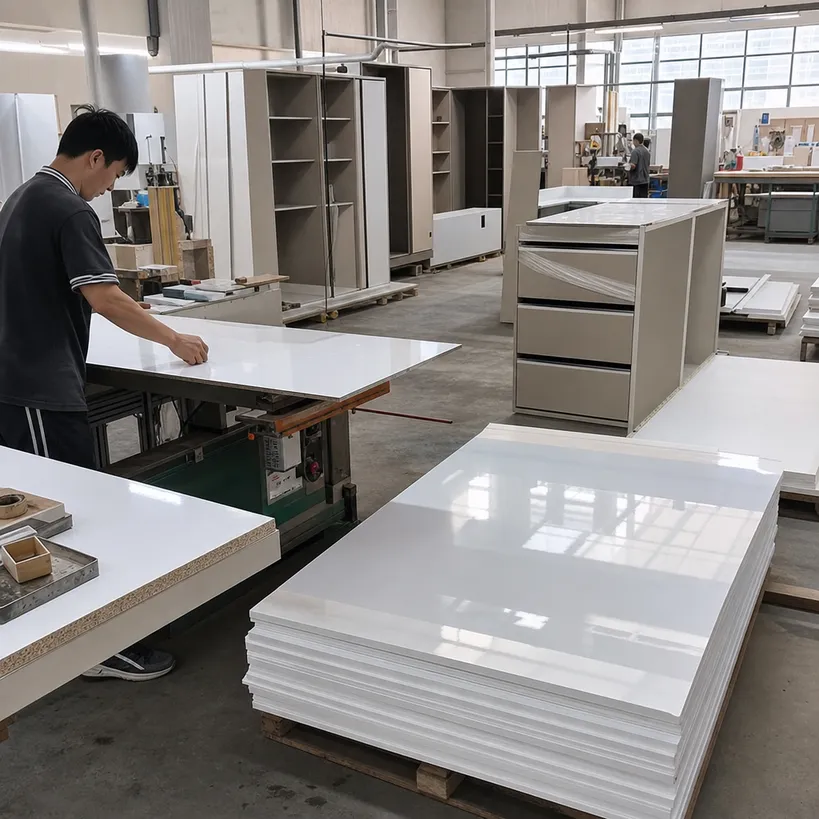
Contemporary Furniture Manufacturing
RTA and flat-pack furniture manufacturers producing bedroom, living room, and home office furniture for mid-to-premium retail channels use high gloss melamine plywood for visible panel components — wardrobe sides, bookcase backs, TV unit carcasses.
Margin logic: The gloss surface is a design feature that justifies a higher retail price point for the furniture manufacturer, which means they can absorb a higher panel cost and still protect their margin. For distributors supplying into this segment, glossy melamine plywood is a margin-accretive SKU compared to standard melamine board.
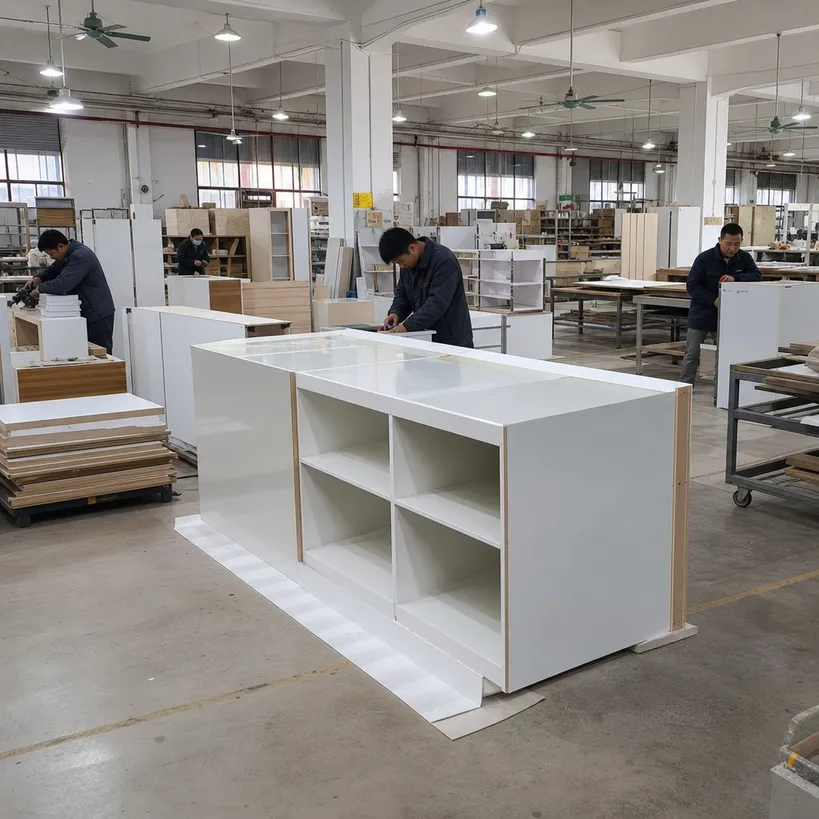
Display and Retail Fixture Fabrication
Retail fixture manufacturers — shop fittings, display cases, point-of-sale units — use glossy melamine plywood for shelving and carcass components in high-visibility retail environments. The order pattern tends to be project-based rather than continuous.
Volume opportunity: Individual project orders can be substantial — a single retail rollout across 50–100 stores generates significant panel volume. Specification requirements are consistent enough that a qualified supplier gets repeat business across multiple rollouts.
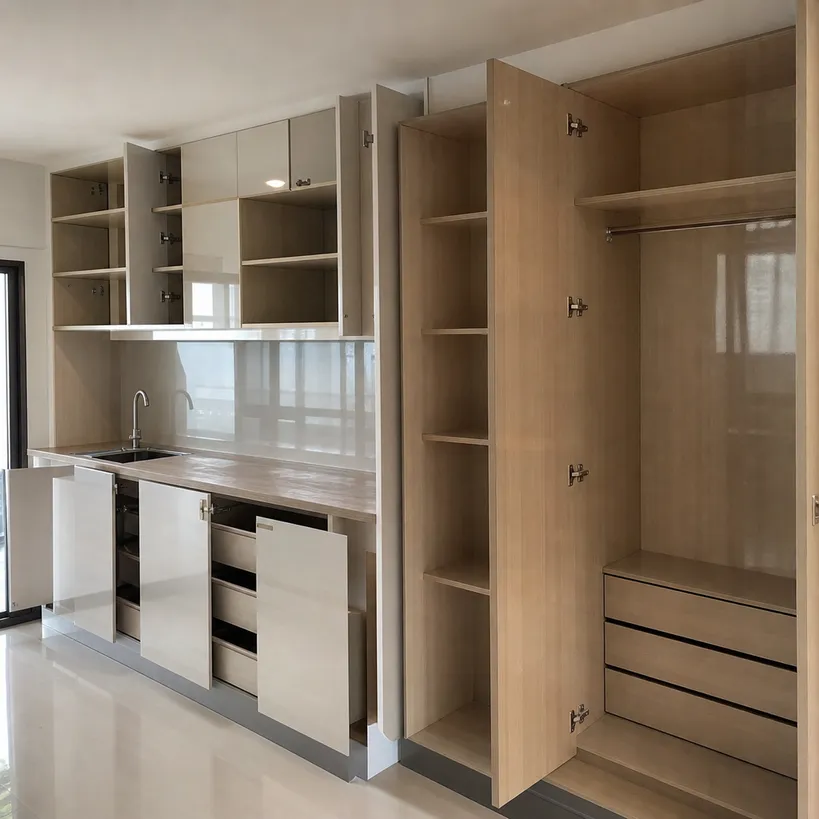
Kitchen and Wardrobe Interior Fit-Out
Interior designers and fit-out contractors specify gloss panels for wardrobe interiors, kitchen cabinet interiors, and built-in furniture where the inside of the cabinet is visible when doors are open. Glossy melamine plywood competes directly with lacquered MDF and acrylic panels.
Selling argument: Glossy melamine plywood arrives ready to install without secondary finishing, which reduces the contractor's labor cost. That's a cost argument your buyers can use directly with their own customers.
Hospitality and Commercial Interior Projects
Hotel room furniture, restaurant fit-out, serviced apartment furnishing — glossy melamine plywood is used for headboards, wardrobe carcasses, and built-in furniture components. Project volumes in this segment are typically 500–2,000 panels per project.
Supply reliability: Tight delivery schedules tied to construction timelines require a factory that can commit without supply gaps. Our 6 production lines and 450,000 m³ annual capacity mean we can commit to project delivery schedules without the gaps that come from a factory running at full utilization.
Discuss Your Market Requirements
Tell us which segment you're supplying into and your typical order volumes. We'll confirm lead times, available decors, and whether a dedicated batch run makes sense for your program.
Customization Parameters for Glossy Melamine Plywood
The customization dimensions that matter most are surface color, sheet dimensions, and core specification. Here's what's available and what the constraints are.
Surface Color & Decor
Standard catalog colors — white, off-white, light grey, dark grey, black, cream — are available at standard MOQs (typically 200–300 sheets per color per thickness).
Custom colors outside the standard catalog require sourcing specific melamine paper, which adds lead time and increases the minimum order quantity to 500–1,000 sheets per color.
Buyer guidance: Start with catalog colors to establish the program. Move to custom colors once volume justifies the paper sourcing commitment.
Sheet Dimensions
Standard 1220×2440mm is the default. Custom dimensions are available on confirmed orders.
Custom dimensions are a scheduling and yield question, not a tooling investment — the cost premium is modest on confirmed orders.
Thickness
Standard range is 9mm through 25mm. 18mm is the most-ordered thickness in this product.
For weight-sensitive applications — overhead cabinet components, sliding wardrobe panels — 12mm or 15mm in a denser core construction can be specified. We can discuss the right thickness based on your structural requirements.
Core Species & Construction
Default for glossy melamine production
Higher density, better screw-holding performance
Structural applications
Glue system: Defaults to MR (moisture-resistant) — appropriate for kitchen and wardrobe applications where this product is most commonly used.
OEM & Private Label
Bundle marking, panel stamping, and documentation under your brand are available for OEM programs. We've run OEM programs for distributors in North America and Europe who supply glossy melamine panels under their own brand to furniture manufacturers and trade customers.
Lead Time from Specification Confirmation
15–20 working days to first production sample for standard catalog specifications. Custom paper colors add sourcing lead time — confirm with us at the inquiry stage.
Certification Coverage for Your Import Market
Documentation is included in the standard shipment package — you don't need to chase it. Here's what's covered and for which markets.
Quality Management System
Process consistency and batch traceability across production runs.
Formaldehyde Emission Limit
Required for California market access. Documentation package included as standard on US-bound shipments — no separate request needed.
Wood Fiber Traceability
Chain-of-custody records traceable to certified forests. Available on confirmed FSC orders for buyers with sustainability sourcing policies.
Construction Product Compliance
EU market compliance. Declaration of conformity included as standard on EU-bound shipments.
Certification Quick Reference
| Certification | Market | Included |
|---|---|---|
| ISO 9001:2015 | Global | Standard |
| CARB P2 | USA | US shipments |
| FSC CoC | Global | FSC orders |
| CE | EU | EU shipments |
Documentation Policy
Audit reports and certification documents are available on request. We don't make buyers chase documentation — if your import market requires specific paperwork, tell us at the inquiry stage and we'll confirm what's included in the standard package.
Manufacturing & Certification Infrastructure
Full details on our production capabilities, quality control processes, and certification infrastructure are available on our about page.
Learn about our manufacturing capabilitiesPackaging and Container Loading for Export Shipments
Glossy melamine plywood requires more careful packaging than standard melamine board — the mirror surface scratches if panels are not properly protected during transit. Here's our full protocol.
Packaging Protocol for Glossy Production
-
Interleaved protective paper
Each panel is interleaved with a protective paper slip between sheets to prevent surface contact during transit.
-
Bundle packing with edge protection
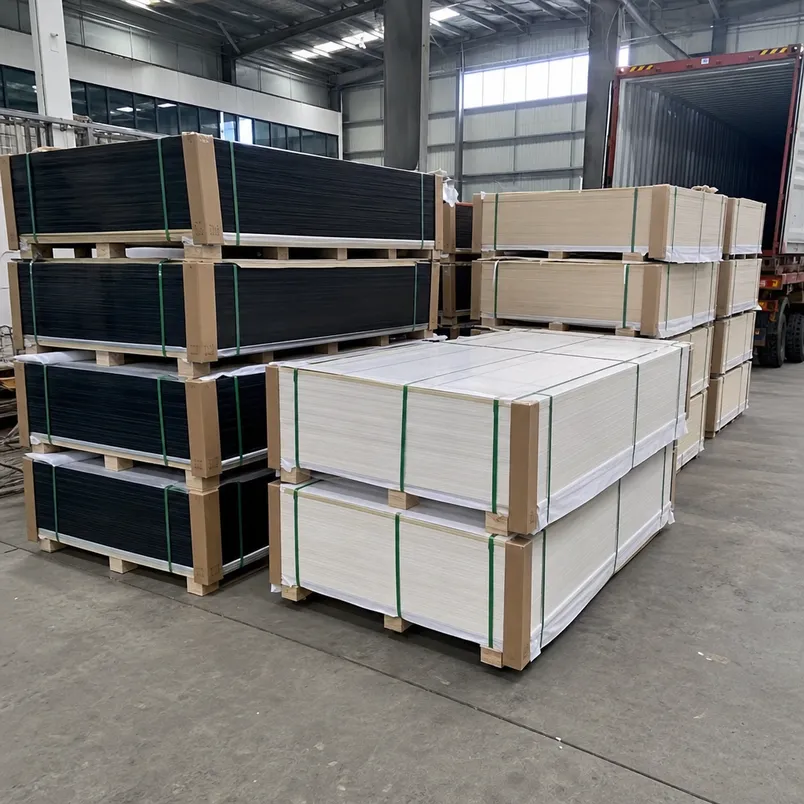
Bundles are packed in 50–100 sheet packs depending on thickness, strapped and edge-protected with corner boards.
-
Moisture-resistant film wrap
The top sheet of each bundle is covered with a moisture-resistant film wrap.
-
Full bundle marking
Bundle marking includes product specification, color code, thickness, quantity, batch number, and destination port.
Why We Added Interleaving Paper
We added the interleaving paper to our glossy packaging after seeing surface scratching on a shipment where panels had shifted during transit — the standard melamine packaging protocol wasn't sufficient for the gloss surface. It adds a small cost to the packaging, but it's the right call for a product where surface condition is the whole point.
Mixed-Color Container Coordination
For buyers ordering mixed colors or thicknesses in a single container, we coordinate the loading plan to keep colors and specifications separated for easy unloading. Your receiving team gets the exact bundle count and stacking arrangement in advance.
Glossy Melamine Plywood vs. Sibling Products: Choosing the Right Specification
Glossy melamine plywood is one of five variants in our melamine plywood range. Here's how it positions against the others so you can direct buyers to the right specification.
| Product | Core | Surface | Best For |
|---|---|---|---|
| Melamine Board | Poplar/eucalyptus | Matte / satin | Standard furniture, shelving, flat-pack |
| Melamine Cabinet Board | Dense core | Matte / satin | Cabinet carcass, high fastener load |
| 18mm Melamine Plywood | Poplar/eucalyptus | Matte / satin | Standard cabinet thickness, volume reorders |
| Kitchen Melamine Plywood | MR/WBP glue | Matte / satin | Sustained moisture exposure, kitchen environments |
| Glossy Melamine Plywood | Poplar/eucalyptus | High-gloss | Visible surfaces, premium furniture, display fixtures |
Need standard furniture panels without the gloss premium?
Melamine Board is the right specification — same plywood core, matte or satin surface, lower cost per sheet.
View Melamine BoardBuilding kitchen cabinets where moisture resistance is the priority?
Kitchen Melamine Plywood is the better fit — MR/WBP glue line rated for sustained moisture exposure.
View Kitchen Melamine PlywoodGlossy melamine plywood is specifically for applications where the surface finish is visible and part of the product's value proposition.
If that's your buyer's requirement, this is the right specification. If not, we'll point you to the right variant.
Frequently Asked Questions
Technical and commercial questions we receive regularly from furniture manufacturers, importers, and OEM buyers.
What gloss level does your glossy melamine plywood achieve?
Our standard glossy melamine plywood runs at 80–100 GU measured at 60° (gloss units on a standard gloss meter). This is the range typically described as "high gloss" or "mirror finish" in the furniture industry. We run a gloss meter check on each production batch and can provide the measurement data with shipment documentation on request.
If you have a specific gloss level requirement — for example, matching an existing product in your range — send us a sample or specify the target GU value and we'll confirm whether we can match it before production.
High gloss melamine plywood vs. acrylic panels: which is better for furniture applications?
They serve different market positions. The right specification depends on your application and price point.
| Specification Factor | Glossy Melamine Plywood | Acrylic Panels |
|---|---|---|
| Gloss depth | High gloss visual effect | Deeper, more reflective gloss |
| Scratch resistance | Standard surface hardness | Higher scratch resistance |
| Market position | Mid-market | Premium / High-end |
| Price point | Cost-effective alternative | Higher cost |
| Structural use | Suitable — carcass, shelving, cabinet sides | Too expensive and fragile for structural use |
| Best application | Furniture where gloss is a design feature; wardrobe interiors, cabinet sides, shelving | High-end kitchen doors and furniture fronts where premium finish is the primary selling point |
For carcass components — wardrobe interiors, cabinet sides, shelving — where structural performance matters alongside surface finish, glossy melamine plywood is the better specification. Acrylic panels are typically too expensive and too fragile for structural use.
Gloss variation between sheets in the same batch is a press process problem — inconsistent caul plate condition, temperature variation across the press platen, or insufficient cycle time. To identify it before ordering, ask the supplier for gloss meter readings across multiple sheets from a recent production batch, not just a single sample.
A supplier who can provide batch-level gloss data is running a controlled process. If you can only get a single sample panel, check the surface under raking light — haze or variation in reflectivity is visible at a low angle even without a meter.
- Inconsistent caul plate condition
- Temperature variation across press platen
- Insufficient press cycle time
- Request batch-level gloss meter readings (not a single sample)
- Inspect sample panel under raking light for haze or reflectivity variation
For standard catalog colors (white, grey, black, cream), MOQ is typically 200–300 sheets per color per thickness. For custom colors outside the standard catalog, MOQ increases to 500–1,000 sheets per color due to paper sourcing requirements.
Mixed-color orders can be combined to meet container minimums — if you're ordering multiple colors, the total container volume is the practical minimum rather than a per-color MOQ. Contact us with your color and thickness requirements and we'll confirm the MOQ for your specific combination.
Mixed-color orders: Total container volume is the practical minimum. Multiple colors can be combined to reach container minimums rather than meeting per-color MOQ independently.
The gloss surface is more susceptible to scratching than matte or satin melamine during handling and installation. Standard precautions: keep the protective interleaving paper between sheets until the panel is ready to install, handle panels with clean gloves or clean cloth, and avoid dragging panels across rough surfaces.
For CNC routing and panel saw cutting, use sharp tooling and a slow feed rate on the first pass — the melamine surface can chip at cut edges if the tooling is dull or the feed rate is too aggressive. Edge-banding adhesion on gloss surfaces is the same as standard melamine — no special adhesive is required.
- Keep protective interleaving paper between sheets until ready to install
- Handle with clean gloves or clean cloth
- Avoid dragging panels across rough surfaces
- Use sharp tooling — dull blades cause edge chipping
- Slow feed rate on first pass
- Edge-banding: standard adhesive — no special product required
It can, but it's not the optimal specification for door fronts. For kitchen cabinet doors, most manufacturers prefer melamine MDF — the MDF core machines with a sharper routed edge and holds a cleaner profile on shaped door styles.
Glossy melamine plywood is better suited for flat-panel door applications and for carcass components (cabinet sides, shelving, wardrobe interiors) where the structural performance of the plywood core is an advantage.
If your buyers are building slab-door kitchens with flat panel fronts, glossy melamine plywood works well. If they're building shaker or routed-profile doors, specify glossy melamine MDF instead.
- Flat-panel / slab-door fronts
- Cabinet carcass sides
- Shelving & wardrobe interiors
- Shaker-style doors
- Routed-profile door styles
- Shaped edge profiles
MDF core machines with a sharper routed edge and holds a cleaner profile on shaped door styles.
Get a Quote for Glossy Melamine Plywood
Most buyers start with a sample order — two or three colors in 18mm is enough to run through your own quality check and show your customers before committing to a full container.
Start with a Sample Order
Recommended for first-time buyers
Two or three colors in 18mm is enough to run through your own quality check and show your customers before committing to a full container. We can ship samples within 7–10 working days.
What to include in your sample request:
- Target colors or decor references (RAL, Pantone, or photo)
- Preferred thickness (18mm is the standard starting point)
- Destination country for certification pre-check
Send a Full Specification
For buyers with defined requirements
If you already have a specification, send it directly and we'll come back with a detailed quote and the relevant certification documentation for your import requirements.
Include as many of these as you have:
New to This Product Category?
Tell us your target market and the furniture segments your buyers serve — we'll suggest a starter SKU mix based on what's moving for our existing distributors in that region.
Xuzhou QD Wood Industry Co., Ltd.
Phone / WhatsApp
+8615852005272Address
No. 88 Sanbao Industrial Park, Tongshan District, Xuzhou, Jiangsu Province, 221116, China