

Blockboard Furniture Board Manufacturer
Furniture-grade blockboard with solid wood core — built for the dimensional stability your downstream customers expect from wardrobes, cabinets, and case goods.
Factory-direct from Xuzhou, China. Custom sizes, face veneer species, and emission grades available on confirmed orders. No trading company markup on your landed cost.
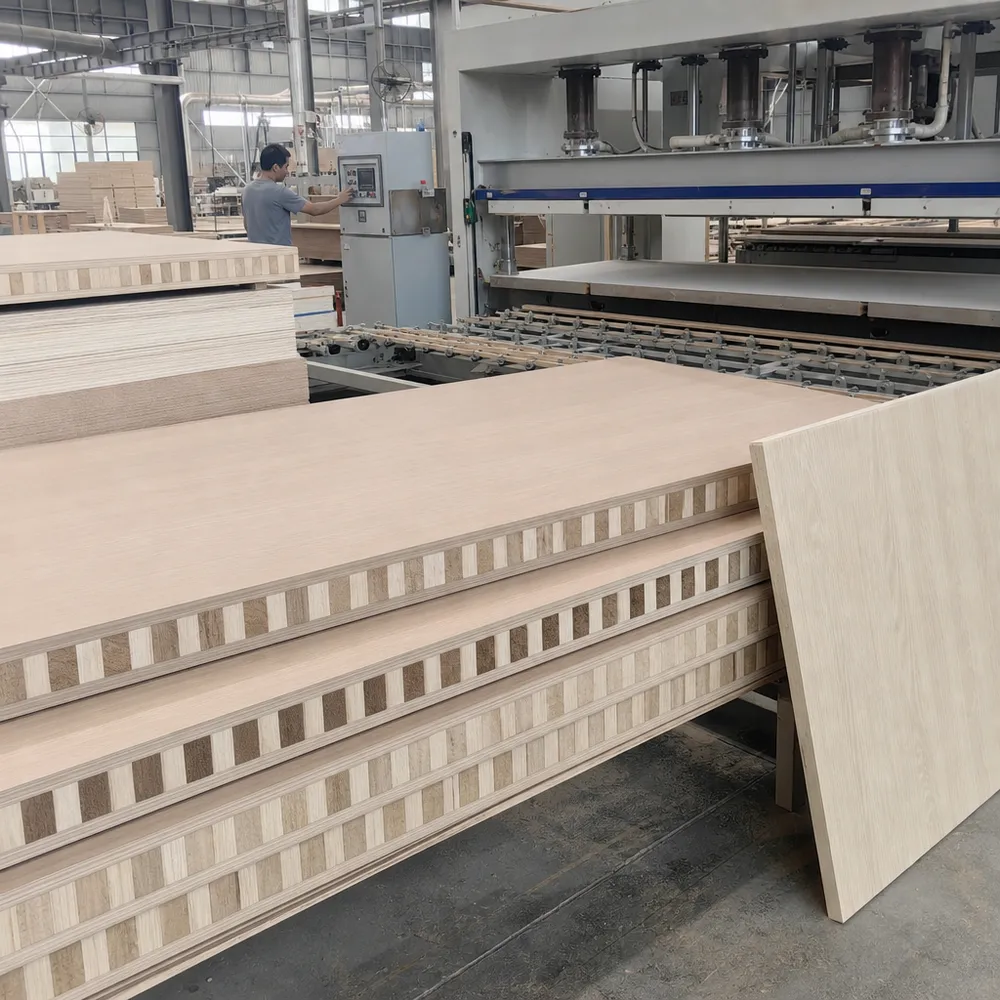
What Makes Furniture Blockboard Different from Standard Blockboard
Blockboard furniture board is the structural workhorse of the flat-pack and assembled furniture industry — wardrobes, bed frames, TV units, shelving carcasses, and door panels all rely on it.
The core is built from solid wood strips — typically poplar, pine, or eucalyptus depending on the specification — bonded edge-to-edge and sandwiched between cross-grain veneer layers, then faced with a decorative or paintable surface veneer. That construction gives it something thin plywood and MDF can't match at the same thickness: genuine screw-holding strength in the core, combined with a flat, stable panel that resists warping under load.
The Core Strip Quality Distinction
The distinction that matters for furniture production is the core strip quality. We run our furniture blockboard with core strips dried to 8–10% moisture content before layup — tighter than the 12% ceiling we allow on structural grades.
Furniture panels live indoors in climate-controlled environments, but they also get machined, edge-banded, and assembled under tension. A core strip that's even slightly wet will move after the panel is cut, and that movement shows up as edge-banding gaps and drawer misalignment six months after delivery.
The strip width in our standard furniture grade runs 20–30mm, which keeps the surface flat without the telegraphing you sometimes see on wider-strip boards when humidity cycles.
This page covers our furniture-specific blockboard range. For kitchen cabinetry applications, see Blockboard Cabinet Board. For surface-finished options with melamine overlay, see Melamine Blockboard. For the full category overview, view all blockboard products.
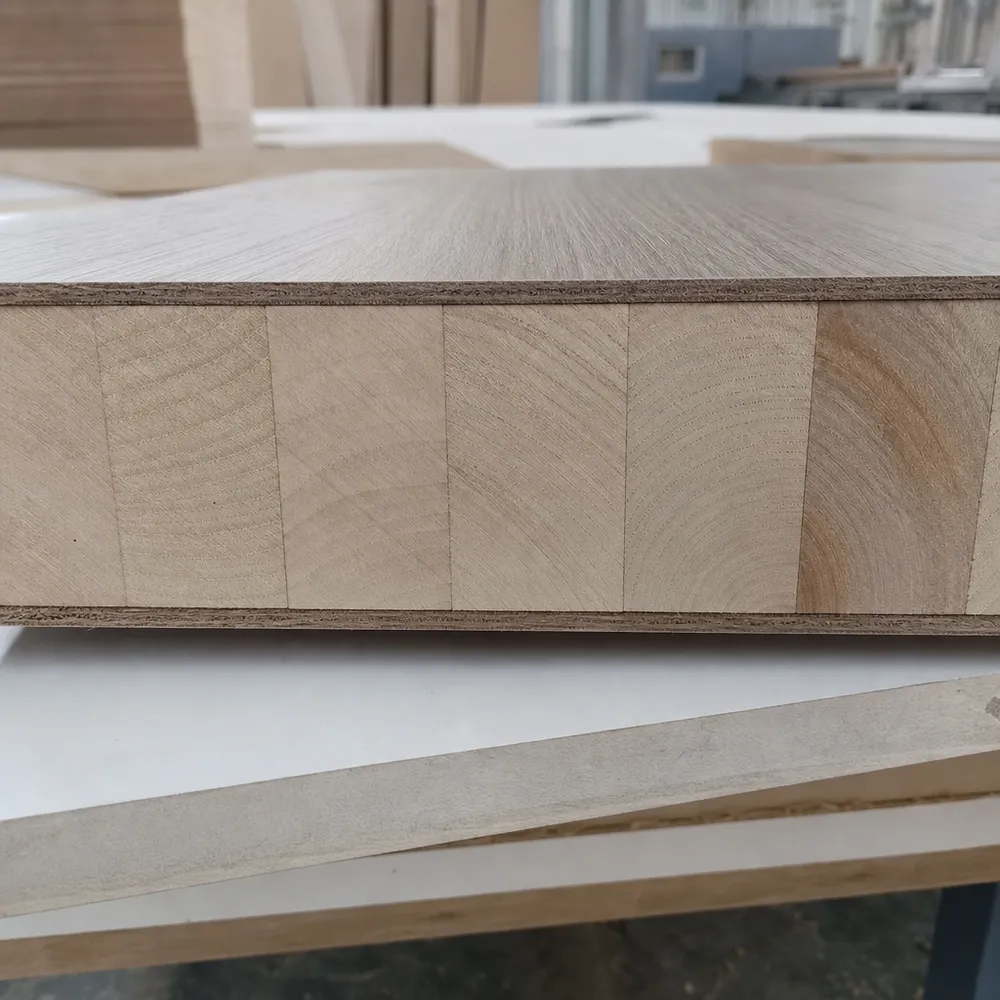
8–10% MC Core
Tighter than the 12% ceiling on structural grades. Prevents post-assembly movement and edge-banding failure.
20–30mm Strip Width
Furniture-grade strip width keeps the surface flat and eliminates telegraphing during humidity cycles.
Genuine Screw-Holding
Solid wood core delivers screw retention that thin plywood and MDF can't match at the same panel thickness.
Warping Resistance
Cross-grain veneer sandwich construction resists warping under load — critical for wardrobe carcasses and door panels.
Technical Specifications
Industry-standard values for furniture-grade blockboard. Contact us for detailed product data sheets and confirmation of exact parameters for your project.
Furniture Blockboard — Standard Parameters
| Parameter | Specification |
|---|---|
| Panel Size (Standard) | 1220 × 2440mm |
| Panel Size (Custom) | Available on confirmed orders |
| Thickness Range | 16mm 18mm 25mm other on request |
| Core Material | Poplar Pine Eucalyptus |
| Core Strip Width | 20–30mm (furniture grade) |
| Face Veneer | Poplar Birch Okoume or custom species |
| Glue Type | MR (moisture-resistant) WBP (waterproof boiling proof) |
| Formaldehyde Emission | E1 ≤1.5 mg/L (standard) E0 ≤0.5 mg/L (available) |
| CARB P2 Compliance | Available — specify at order |
| Moisture Content | 8–10% (core strips, pre-press) |
| Surface Finish | Sanded (ready for veneer, paint, or laminate) |
| Thickness Tolerance | ±0.5mm |
| Certifications |
ISO 9001:2015 FSC CARB P2 CE
|
Which Thickness?
- 16 Drawer bottoms, cabinet backs, lightweight shelving where weight matters.
- 18 Standard carcass panels, wardrobe sides, door blanks — the most common furniture choice.
- 25 Worktops, heavy shelving, and structural panels where rigidity under load is critical.
Emission Grades Explained
Need a full data sheet?
We can provide mill test reports, formaldehyde test certificates, and FSC chain-of-custody documentation for confirmed orders.
Request DocumentationFurniture Applications
Furniture-grade blockboard is the structural backbone of most flat-pack and custom cabinet furniture. Here's where it performs best — and where to consider alternatives.
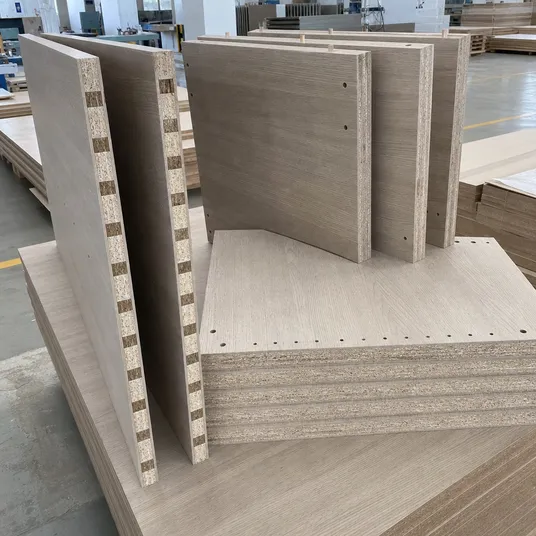
Wardrobe Carcasses
Side panels, top and bottom boards, and internal dividers. The solid core handles hinge and rail loads that MDF struggles with over time.
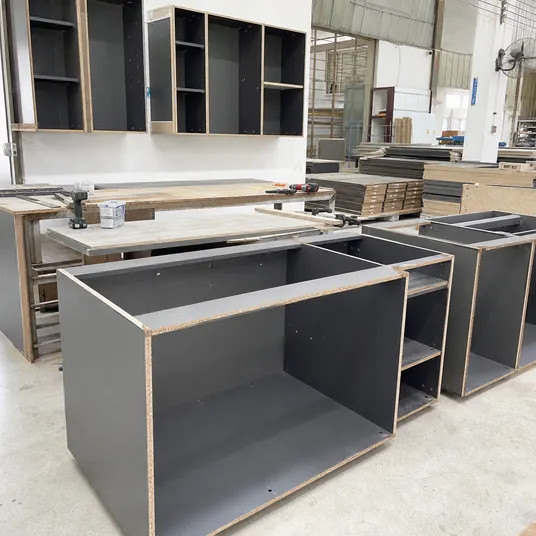
Kitchen Cabinets
Base and wall unit carcasses where moisture resistance and screw-holding for hinges and drawer runners are non-negotiable.
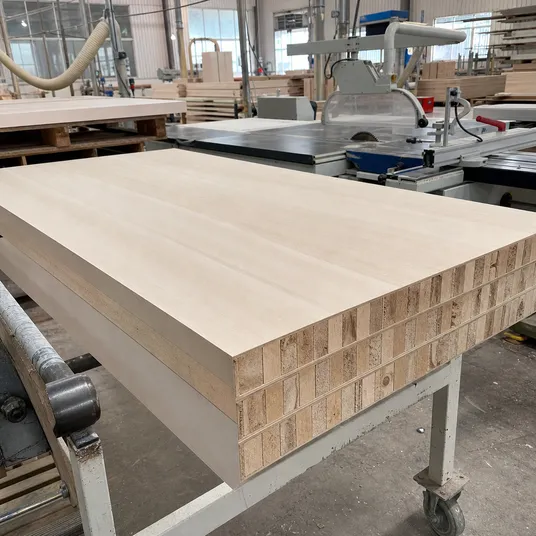
Flush Door Blanks
Blockboard's light weight relative to solid timber makes it the standard core for interior flush doors. Accepts edge lipping cleanly.
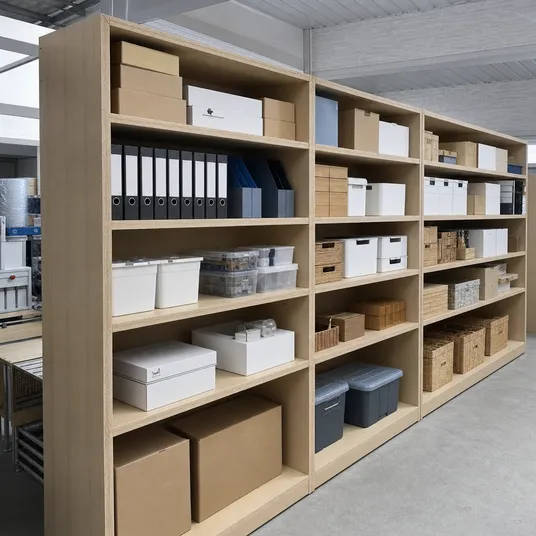
Shelving & Bookcases
Long spans under sustained load benefit from blockboard's stiffness. Less mid-span sag than MDF at equivalent thickness.
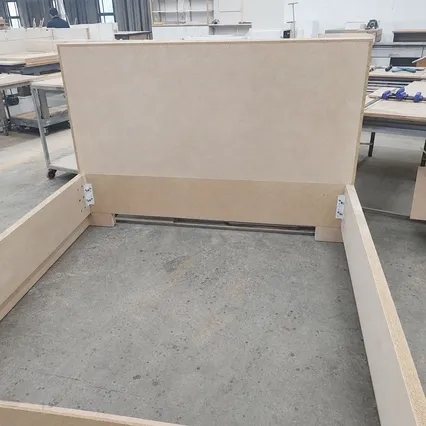
Bed Frames & Headboards
Headboard panels and platform bases where a flat, stable substrate for upholstery or veneer is needed without the weight of solid timber.
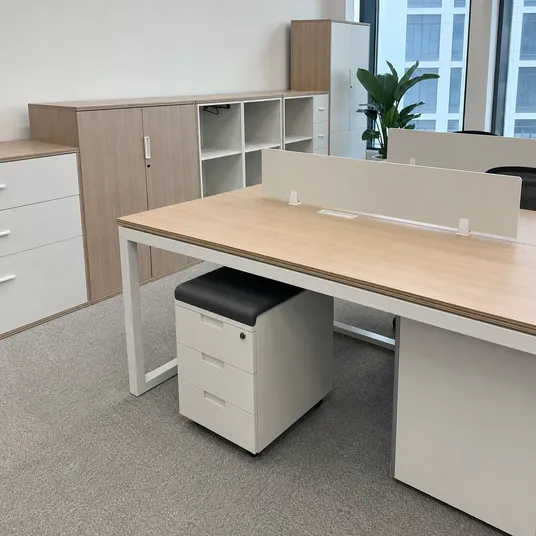
Office Desks & Storage
Desk tops, pedestal units, and filing cabinets. E0 or CARB P2 compliance is often required for commercial office fit-outs.
When to Consider Alternatives
Blockboard is the right call for most furniture carcass work, but there are situations where another panel product is a better fit.
Curved or routed profiles
MDF machines more cleanly for complex routed edges and curved forms. Blockboard's core strips can telegraph on tight radii.
Exterior or wet environments
Even WBP-glued blockboard is not a marine product. For outdoor furniture or high-humidity enclosures, marine plywood or HDPE is more appropriate.
Very thin panels (<12mm)
Below 12mm, plywood is structurally superior. Blockboard's minimum practical thickness for furniture is 16mm.
Core Construction: Where Screw-Holding Strength Comes From
The commercial case for furniture blockboard over MDF or thin plywood comes down to one thing: screw retention in the core. Hinge screws, shelf pin holes, cam lock fittings — all of them depend on the substrate holding under repeated load and assembly cycles.
Why MDF Fails at Reassembly
MDF holds screws adequately in a single-assembly context, but the fiber matrix degrades around the fastener hole after a few disassembly-reassembly cycles. Solid wood core strips don't have that problem. The grain structure of the wood holds the thread, and the panel can be disassembled and reassembled without the hole enlarging.
Core Species and Density
We source core strips from poplar and pine grown in Jiangsu and neighboring provinces — both are fast-growing species with consistent density in the 350–450 kg/m³ range, which is the sweet spot for furniture applications. Dense enough to hold fasteners, light enough that a 1220×2440×18mm panel stays manageable on the assembly line.
Eucalyptus core is available for buyers who need higher density (typically 500–550 kg/m³) for applications where the panel takes direct load, like bed slat supports or heavy shelving.
Buyer note: We've had buyers switch from poplar to eucalyptus core specifically for bed frame side rails — the difference in screw pull-out resistance is measurable, and it shows up in fewer warranty claims from their retail customers.
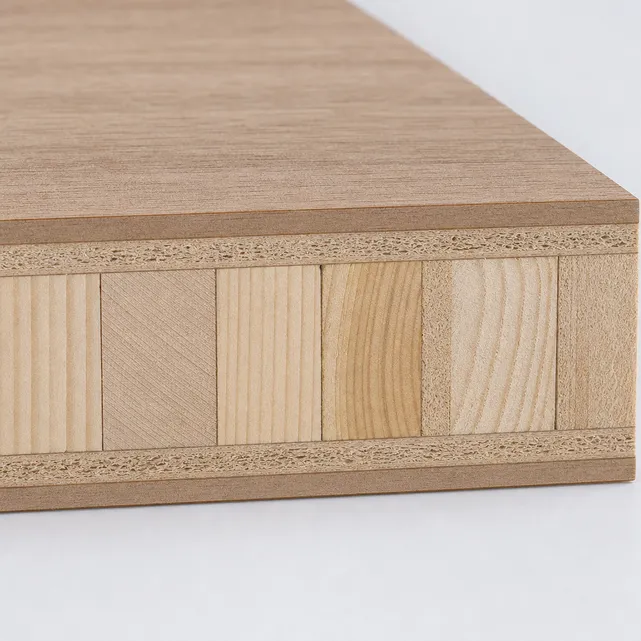
Cross-Grain Veneer and Face Grading
The cross-grain veneer layers above and below the core — typically two layers of 1.5–2.0mm rotary-cut veneer — lock the core strips in place and prevent the panel from cupping along the strip direction.
The face veneer is graded separately: furniture-grade panels get face veneers with no open knots, no splits, and consistent color within a batch. We run face veneer grading as a separate step before pressing, not as a post-press sort — panels that don't meet face grade get redirected to structural applications rather than shipped as furniture grade with defects.
Core Species at a Glance
- 350–450 kg/m³ density
- Jiangsu & neighboring provinces
- Lightweight — manageable on assembly line
- Cabinets, shelving, standard furniture
- 350–450 kg/m³ density
- Consistent grain structure
- Good thread retention
- General furniture applications
- 500–550 kg/m³ density
- Higher screw pull-out resistance
- Direct-load applications
- Bed frame rails, heavy shelving
Emission Standards and Market Compliance
Formaldehyde emission is the compliance gate for furniture blockboard in every major import market. The resin system used in the glue layers determines the emission level, and the emission level determines which markets the panel can legally enter.
Clears European EN 13986 requirements and most Southeast Asian and Middle Eastern market standards. Ships as our production default.
- Europe (EN 13986)
- Southeast Asia
- Middle East
The most stringent formaldehyde limit in our export markets. Formulated as a production-line standard — same lead time and MOQ as E1. Required for California and CARB-compliant retailers.
- California (CARB)
- US retail compliance
- Canada
For buyers targeting premium furniture segments or markets where E0 is becoming a de facto standard. Uses a different resin formulation — specify at order and we confirm availability at inquiry.
- Japan
- South Korea
- Northern Europe (premium)
Additional Compliance Documentation
Covers the wood fiber in our panels. If your buyers or retail customers have sustainability sourcing requirements, the documentation is available.
Included as standard on export shipments to EU buyers. No separate request required.
CARB P2 as a Production Standard
We formulate to CARB P2 as a production-line standard rather than a special run. This means:
- Same lead time as standard E1 orders
- Same MOQ — no minimum uplift for CARB compliance
- No special-run surcharge or extended scheduling
- Test reports available on request for each production batch
Market Segments Where Furniture Blockboard Earns Margin
Four segments drive the majority of furniture blockboard volume. Each has distinct purchasing patterns, specification requirements, and margin dynamics worth understanding before you position your order.
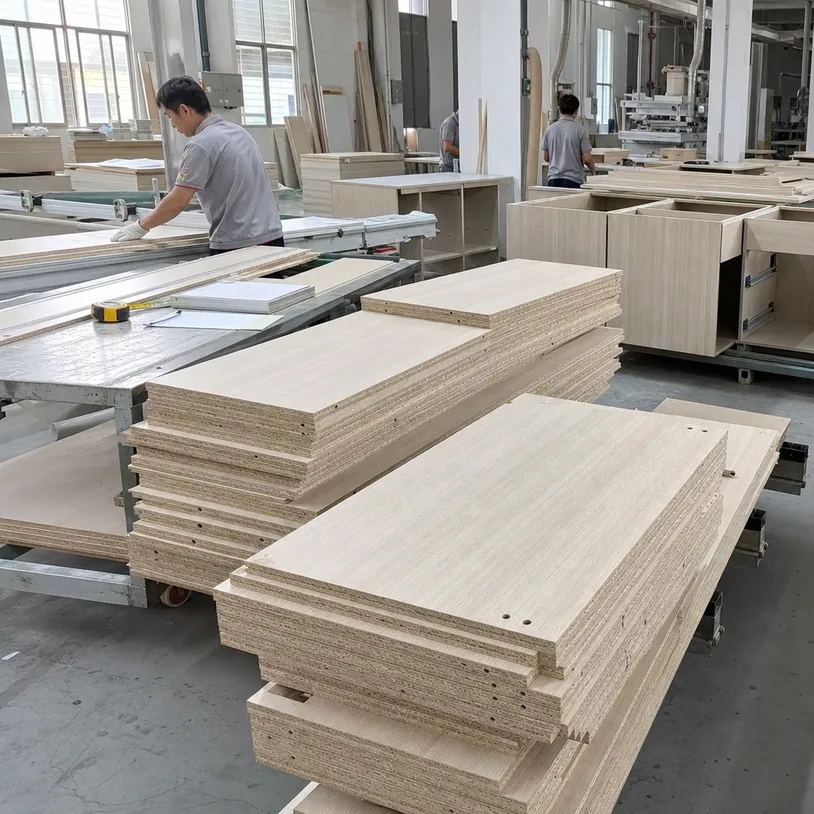
Wardrobe and Closet Systems
Highest Volume SegmentThe highest-volume application for furniture blockboard in most markets. A standard 3-door sliding wardrobe uses 8–12 panels of 18mm blockboard for the carcass, plus thinner panels for the back. Furniture manufacturers and flat-pack brands ordering at this scale typically run 500–2,000 panels per SKU per month — a repeatable, forecastable volume that suits container-load purchasing.
The blockboard wardrobe segment is particularly active in the Middle East and Southeast Asia, where local furniture assembly operations source panels in bulk and finish them locally with edge-banding and hardware.
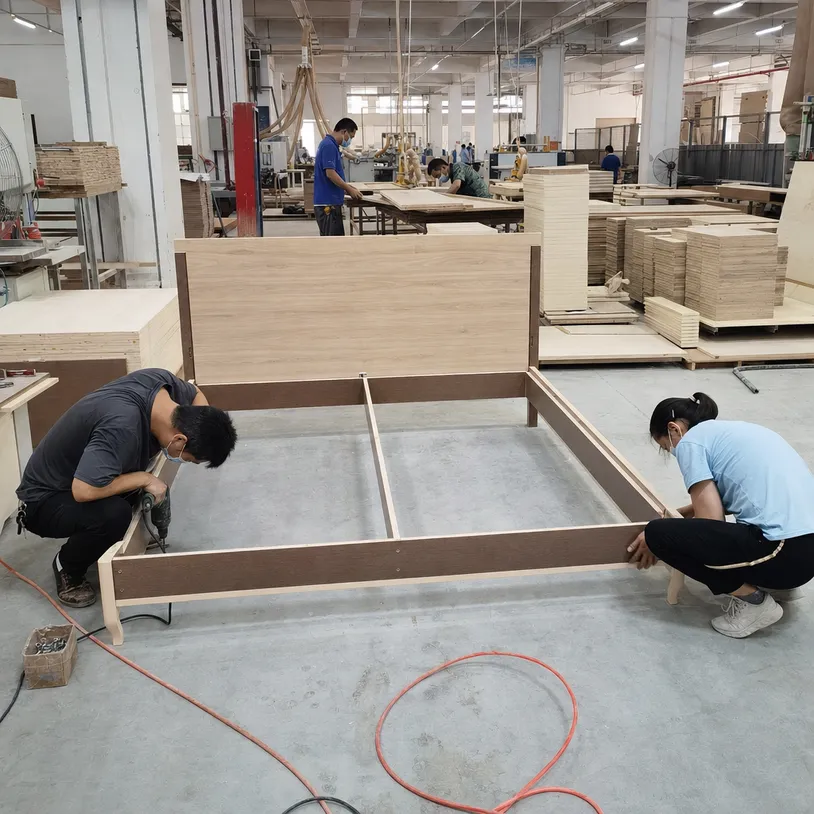
Bed Frames and Bedroom Casegoods
Contract & Hotel SpecBed side rails, headboard panels, and under-bed storage carcasses all use 18–25mm furniture blockboard. The screw-holding requirement here is non-negotiable — bed frames take dynamic load and repeated assembly cycles, and the fastener integrity has to hold.
Buyers supplying hotel procurement programs or contract furniture channels typically specify blockboard over MDF for this reason, and the price premium is absorbed by the end customer without resistance.
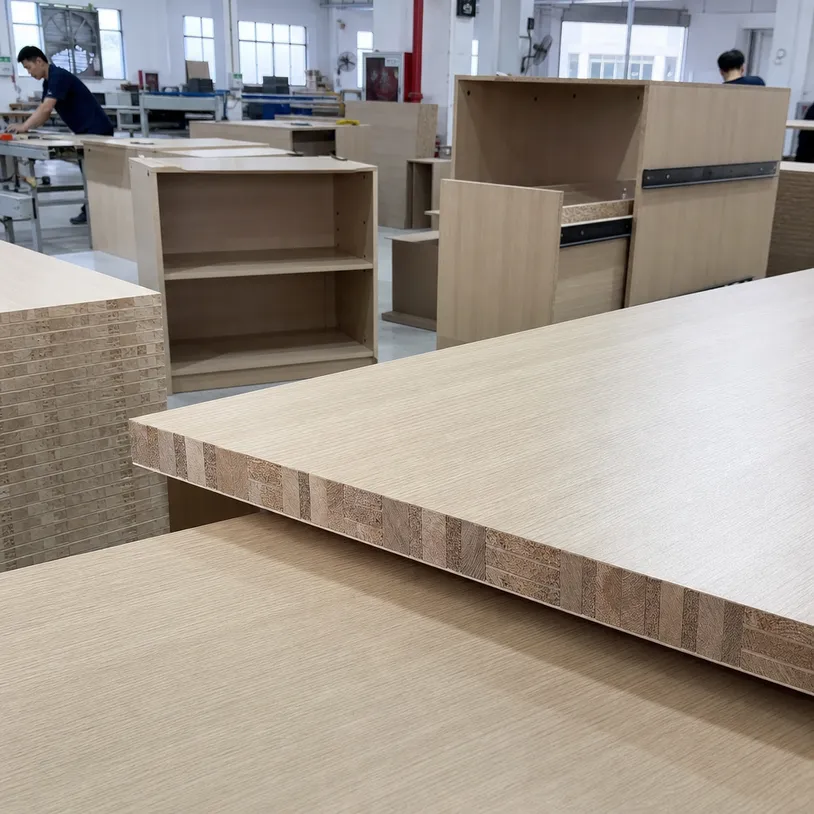
Office Furniture and Storage
Deflection-CriticalFiling cabinets, bookcase carcasses, and reception desk panels use furniture blockboard where the panel needs to carry load without deflection over time. The performance gap versus MDF is measurable and documentable.
Distributors supplying office furniture manufacturers in North America and Europe have found this a useful differentiation point when competing against lower-cost MDF-based alternatives.
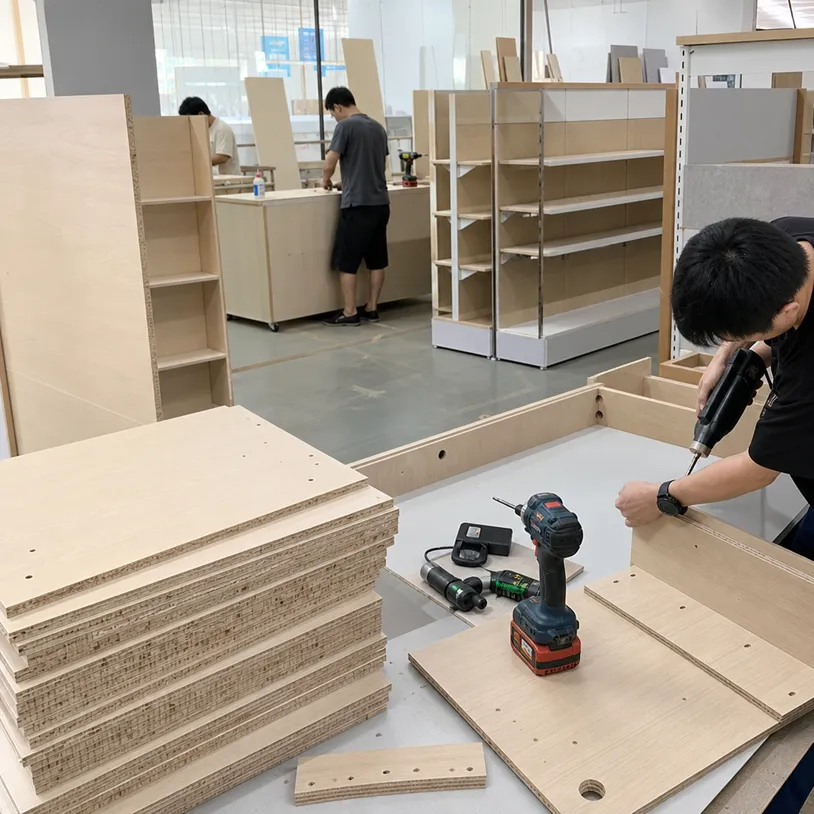
Retail Display and Shopfitting
Higher Margin SegmentA smaller but higher-margin segment. Display fixtures, gondola shelving, and counter units built from furniture blockboard carry a premium over MDF equivalents because the panels can be drilled, routed, and re-fitted without the substrate degrading.
Shopfitting contractors who build for retail chains with frequent store refreshes value this — the fixture can be modified on-site without replacing the panel. That reworkability is the margin justification.
Drill, route, and re-fit on-site without substrate degradation — the key advantage over MDF for store refresh cycles.
Customization Parameters and What They Mean for Your Order
The standard furniture blockboard specification covers most applications, but we handle custom orders regularly. Here's what can be adjusted and what the practical limits are.
Panel Dimensions
Standard and custom cut options
Standard is 1220×2440mm. We cut to custom dimensions on confirmed orders.
Custom cutting is a yield and scheduling question, not a tooling cost. MOQ for custom dimensions is the same as standard.
Thickness
Standard runs and available options
16mm, 18mm, and 25mm are our standard runs. 12mm furniture blockboard is available for door panel applications where weight matters. Thicknesses outside this range are possible on larger orders — confirm at inquiry.
Core Species
Poplar default — alternatives available
Mixed-species core is not available. Consistency within a batch matters for machining — mixed core creates unpredictable density variation.
Face Veneer Species
Surface options by market and application
Surface Treatment
Ready for your downstream process
Sanded (ready for further processing) is standard on this product line. We do not apply melamine or laminate overlay here.
Emission Grade
Formaldehyde compliance by destination market
Specify your target market at inquiry so we can confirm the correct adhesive system. Mixing grades within a shipment is not recommended.
Glue Type
Adhesive system by application environment
MR (moisture-resistant) urea-formaldehyde is standard for interior furniture. WBP phenol-formaldehyde is available for applications requiring higher moisture resistance.
WBP glue affects the emission grade calculation. Confirm both glue type and emission target together at inquiry.
MOQ and Lead Time
Minimums and production scheduling
Lead time runs from deposit confirmation, not inquiry date. Peak season (Q4) may add 5–7 days — confirm at order placement.
Ready to specify your order?
Send us your thickness, dimensions, core species, face veneer, emission grade, and destination port. We'll confirm availability, lead time, and pricing within one business day.
How We Press Furniture Blockboard: Process Details That Affect Your Downstream Quality
Press parameters for furniture blockboard differ from structural grades — and those differences directly determine whether your edge-banding machine runs clean or your CNC router produces visible defects.
Why ±0.5mm Thickness Tolerance Matters
Edge-banding machines and CNC routers are calibrated to a specific panel thickness. A panel that's 18.7mm on one end and 17.9mm on the other causes edge-banding adhesion failures and router depth inconsistencies — both show up as visible defects in the finished piece. Furniture-grade panels require ±0.5mm tolerance across the full panel surface.
Hot Press Parameters
The hot press runs at 130–140°C with hydraulic pressure calibrated to panel thickness. Furniture-grade panels receive a longer press cycle than structural grades to ensure full resin cure through the core — not just surface adhesion.
Post-Press Calibrated Sanding
After pressing, panels go through a wide-belt sander calibrated to ±0.3mm. This step brings final thickness into tolerance and removes surface irregularities from the press. Many factories press to nominal thickness and skip calibration sanding — you can tell the difference when you run panels through an edge-bander and the tape starts lifting at the corners.
Glue Spread Control and Defect Inspection
Glue spread is controlled by automated spreaders rather than manual application. Consistent resin weight across the veneer surface prevents delamination and blister defects that cause returns. Spread weight is checked at the start of each production run and after any line stoppage. Post-press inspection pulls panels with visible delamination, blister, or core gap before they reach the sanding line.
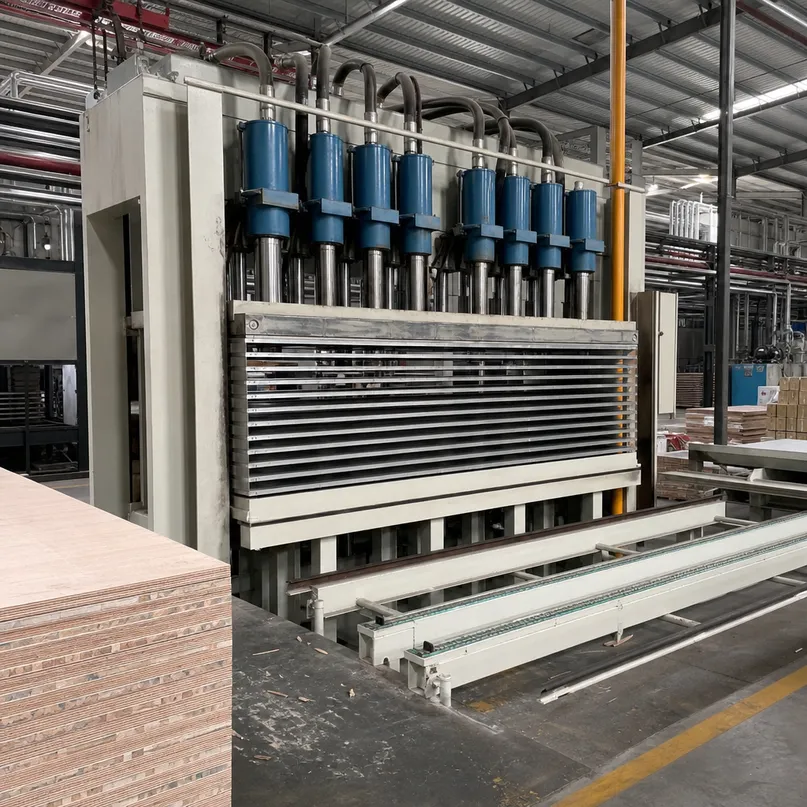
Two-Step Tolerance Control
The sanding step is where many factories cut corners on furniture-grade panels. Skipping calibration sanding is the primary cause of edge-banding tape lift at corners.
What to Look for When Evaluating a Supplier's Press Quality
Request a sample panel and run it through your edge-bander before committing to a container order. Tape lift at corners is the clearest indicator of thickness inconsistency from skipped calibration sanding. A panel that measures within tolerance at the center but drifts at the edges indicates press pressure distribution problems. Both defects are invisible in a static visual inspection — they only show up under production conditions.
Container Loading and Export Logistics
A standard 40HQ container loads approximately 18–22 m³ of furniture blockboard depending on panel thickness and stacking configuration. For 18mm panels at 1220×2440mm, that's roughly 280–320 panels per 40HQ.
Container Capacity Reference
We provide a loading plan with each shipment so your receiving team knows the exact count and stacking order.
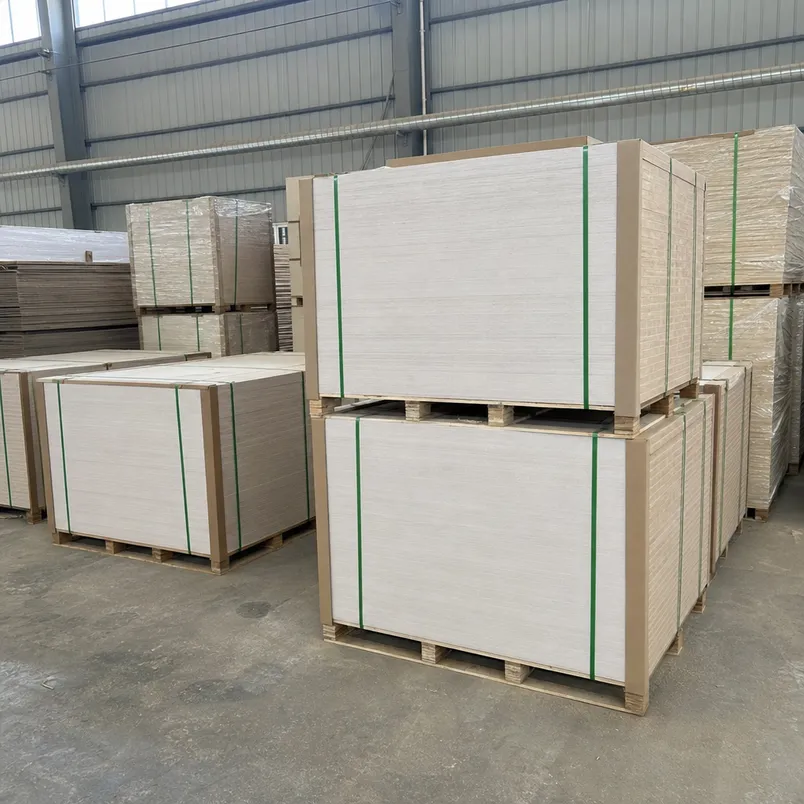
Packaging Specification
CARB P2 Documentation Package (US Shipments)
CARB documentation package is prepared as standard for all US-bound shipments. No additional request required.
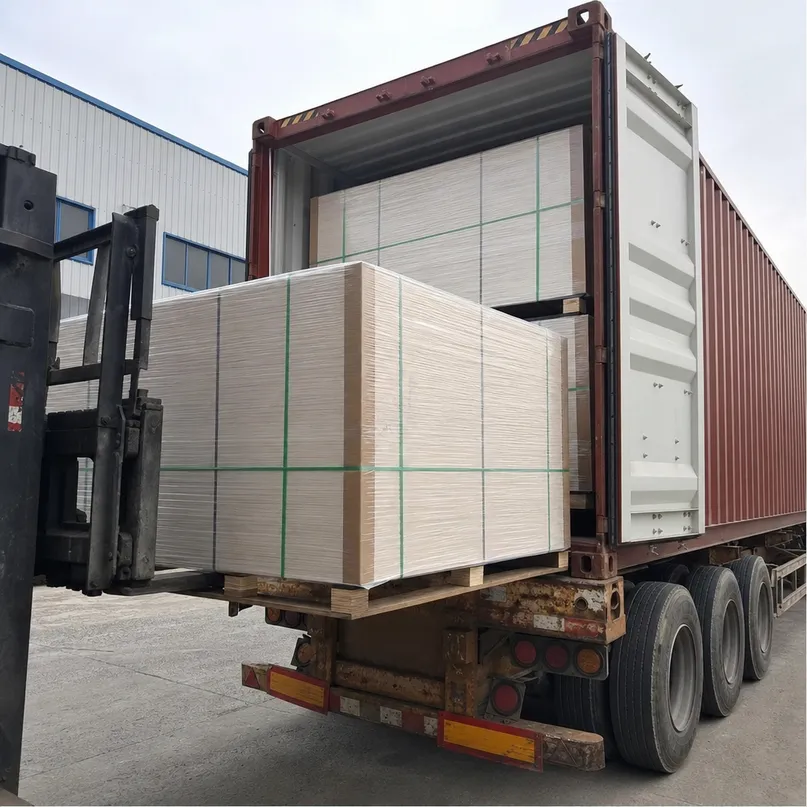
Transit Times from Xuzhou
We ship through Qingdao, Shanghai, and Lianyungang depending on routing and schedule.
Mixed-Product Container Loads
For buyers running furniture blockboard alongside other panel products, we coordinate consolidated loads to reduce per-unit freight cost. Most buyers in this category run mixed loads once they've established the product range.
Sibling Products in the Blockboard Range
Not every application calls for the same configuration. If your spec or end-use points to a different product, these are the closest alternatives in our blockboard range.
18mm Blockboard
Standard thickness specification for structural and furniture applications — if your spec calls out 18mm specifically.
View productBlockboard Cabinet Board
Kitchen and bathroom cabinet carcasses — moisture-resistant glue, tighter surface grade for visible interior panels.
View productMelamine Blockboard
Surface-finished panels ready for assembly — melamine overlay eliminates the edge-banding and painting step for your customer.
View productLaminate Blockboard
High-pressure laminate surface for commercial and contract furniture applications requiring scratch and abrasion resistance.
View productNot sure which product fits your application? Send us your end-use specification and target market — we'll recommend the right configuration.
Browse full rangeFrequently Asked Questions
Specification and sourcing questions we hear from furniture manufacturers, importers, and procurement teams.
18mm is the industry standard for wardrobe side panels, top, and bottom. 16mm is used for internal shelves and dividers where load is lighter. 25mm is specified for base panels and applications where the panel takes direct floor load or heavy hanging weight.
Most wardrobe manufacturers run 18mm as their primary SKU and supplement with 16mm for internal components.
Standard furniture blockboard with MR (moisture-resistant) glue handles normal indoor humidity variation — seasonal changes, air conditioning cycling, and similar conditions. It is not suitable for direct water exposure or consistently high-humidity environments like bathrooms without additional surface sealing.
For bathroom vanity carcasses, specify WBP glue and a fully sealed surface treatment. If the application involves regular moisture contact, our Blockboard Cabinet Board with WBP glue is the more appropriate specification.
E1 (≤1.5 mg/L by perforator method) is the European standard and is accepted in most global markets. CARB P2 (≤0.05 ppm continuous emission) is the California Air Resources Board standard — the most stringent in our export markets and required for furniture sold in California or through US retailers with CARB compliance policies.
The two standards use different test methods, so they're not directly comparable by number, but CARB P2 is significantly more restrictive.
If you're selling into the US market, specify CARB P2 at order.
For custom panel dimensions, the practical minimum is one container load (approximately 18–22 m³ depending on thickness). Below that, the yield loss from custom cutting makes the per-panel cost uncompetitive.
For standard dimensions (1220×2440mm) in standard thicknesses, MOQ is lower — confirm at inquiry based on your target volume and destination.
Blockboard holds screws significantly better than MDF, particularly in edge-grain applications (hinge screws, cam lock fittings in panel edges). MDF's fiber matrix compresses around the fastener under repeated load, and the hole enlarges after a few assembly cycles.
Solid wood core strips in blockboard hold the thread mechanically, and the panel can be disassembled and reassembled without fastener degradation.
Practical implication: For furniture that ships flat-pack and gets assembled by the end customer — or for contract furniture that gets reconfigured — blockboard's screw retention is a meaningful quality advantage that reduces warranty claims.
Yes. FSC chain-of-custody certification covers our production, so FSC-certified furniture blockboard is available on confirmed orders. Specify FSC at order; the documentation is included with the shipment.
Learn more about our certifications and manufacturing capabilitiesGet a Quote for Furniture Blockboard
Send us your panel specification and we'll return a detailed FOB quote with the relevant certification documentation for your import requirements.
What to Include in Your Enquiry
The more detail you provide upfront, the faster we can return an accurate FOB quote. Include the following in your message:
-
Thickness — e.g. 18mm, 25mm, or custom
-
Panel Size — standard 1220×2440mm or custom dimensions
-
Core Species — poplar, pine, eucalyptus, or mixed
-
Face Veneer — poplar, birch, or decorative species
-
Emission Grade — E1, E0, CARB P2, or F★★★★
-
Target Volume — number of sheets or container quantity
-
Destination Market — country and port of discharge
New Buyer? Start with a Sample Order
Most new buyers in this category start with a sample order to test the panels through their own machining and assembly process before committing to container volumes. We can arrange samples — contact us to discuss.
Certification Documentation Available
Xuzhou QD Wood Industry Co., Ltd.
Tongshan District, Xuzhou, Jiangsu Province, China
[email protected]
Phone / WhatsApp
+8615852005272
Address
No. 88 Sanbao Industrial Park, Tongshan District, Xuzhou, Jiangsu Province, 221116, China
Browse All Blockboard Products
See the full range of blockboard panels, thicknesses, and surface options available from our factory.
Also in the Blockboard Range
Standard structural thickness for shelving, cabinet carcasses, and partition panels.
View ProductOptimised for kitchen and wardrobe cabinet construction with tight dimensional tolerances.
View ProductHPL or CPL surface-finished panels ready for direct use in furniture and joinery.
View ProductMelamine-faced blockboard for flat-pack furniture and retail-ready panel products.
View Product