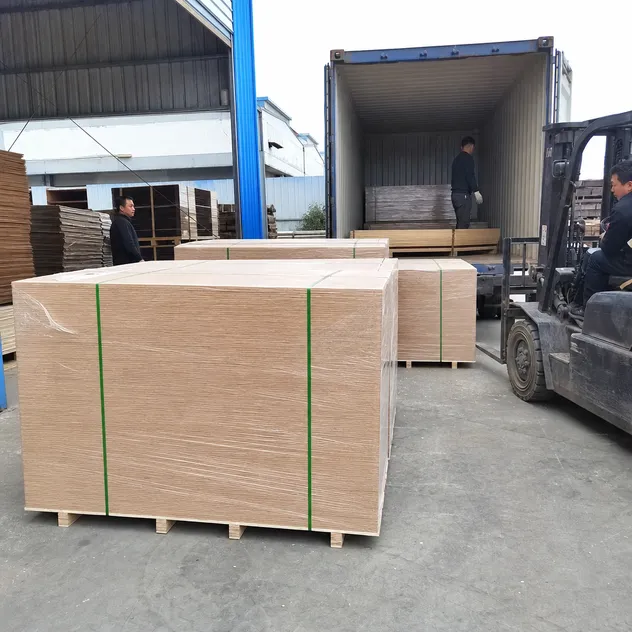
Blockboard Manufacturer Since 2008
Solid wood core blockboard — manufactured to export grade at our 18,000 m² facility in Xuzhou, China.
Five product variants covering furniture, cabinetry, laminate, and melamine-faced applications. Direct from factory — no trading company markup on your landed cost.
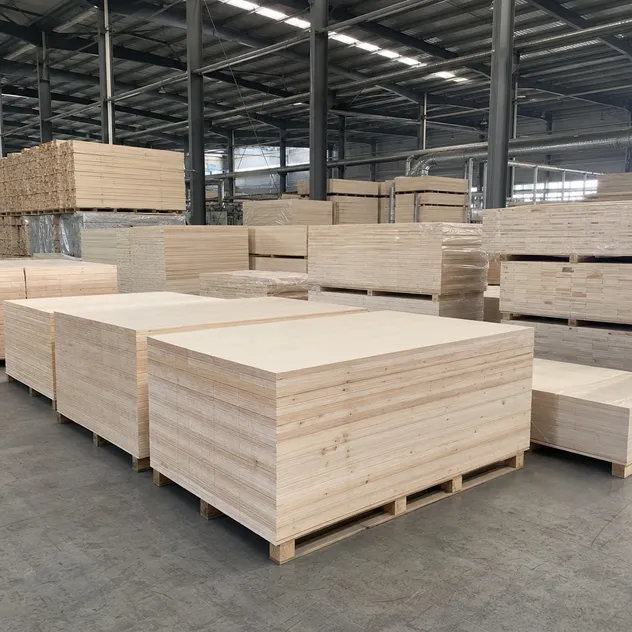
What Blockboard Is and Why the Core Construction Decides Everything
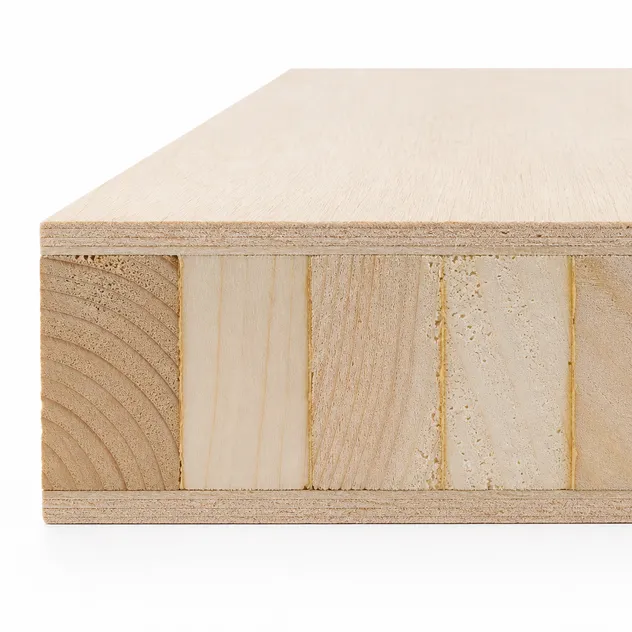
Blockboard is a sandwich panel: a solid wood core of edge-glued timber strips, faced on both sides with veneer plies. Understanding the construction is how you evaluate a supplier — not the price sheet.
The Sandwich Construction
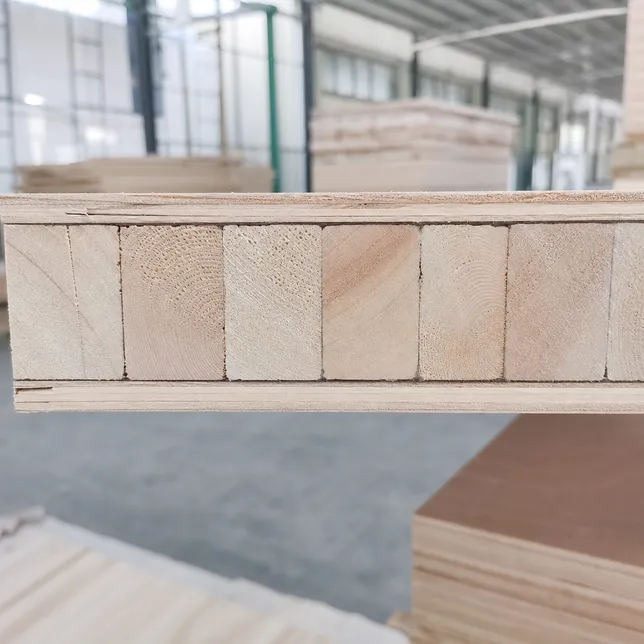
The core strips run parallel, typically 25–30mm wide, and the face veneers are laid perpendicular to the core grain. That cross-grain construction is what gives blockboard its dimensional stability and resistance to warping under load.
Why Blockboard Stays in the Spec
The commercial case for blockboard sits between solid timber and standard plywood. It's lighter than an equivalent-thickness solid wood panel, machines cleanly on CNC and panel saws, holds screws and fasteners well at the edges — which plywood and MDF don't do as reliably — and takes surface finishes without the telegraphing issues you sometimes get with MDF at higher moisture exposure.
For furniture manufacturers and cabinet shops, that combination of machinability, edge-fastening strength, and surface-readiness is the reason blockboard stays in the spec even when cheaper substrates are available.
| Property | Blockboard | Plywood | MDF |
|---|---|---|---|
| Edge screw-holding | Strong | Moderate | Weak |
| Weight vs. solid wood | Lighter | Similar | Heavier |
| CNC machinability | Clean | Good | Good |
| Surface finish telegraphing | Low risk | Low risk | Risk at humidity |
| Dimensional stability | High | High | Moderate |
The Variable That Separates Reliable from Problem Shipments
Core strip quality and glue line consistency.
We use kiln-dried poplar and pine core strips — both dimensionally stable species with low resin content that bonds predictably under hot press conditions. Core strips are dried to 8–10% moisture before layup.
If you press wet core material, the panel will move after it leaves the press, and no amount of face veneer will hold it flat. We've seen containers of blockboard from other suppliers arrive with panels that had bowed 4–6mm across a 2440mm length — that's a core moisture problem, and it's entirely preventable.
Glue lines between core strips and face veneers are pressed under calibrated hydraulic pressure and temperature, logged per batch, so bonding consistency is traceable rather than assumed.
Blockboard Product Line
Five variants, organized by surface treatment and end application. Each links to its product page for full specifications.
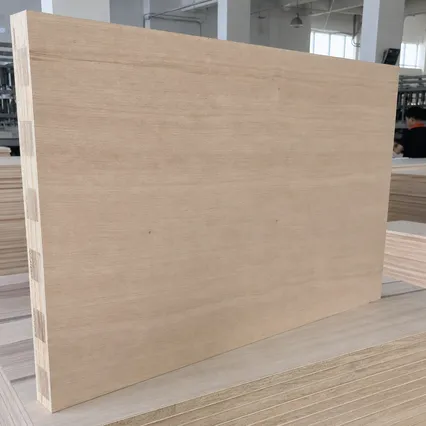
Blockboard Furniture Board
The base-grade variant — poplar or pine core, hardwood face veneers, sanded to a consistent surface for paint or stain finishing. The workhorse SKU for furniture OEMs and cabinet manufacturers who apply their own surface treatment downstream.
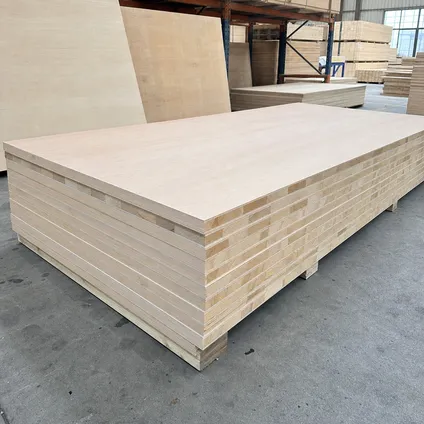
18mm Blockboard
The most-ordered thickness in our blockboard range, covering the majority of furniture carcass and cabinet panel applications. We also produce 15mm, 25mm, and non-standard thicknesses — 18mm is called out separately because it's what most buyers specify first and what we carry in the deepest stock position.
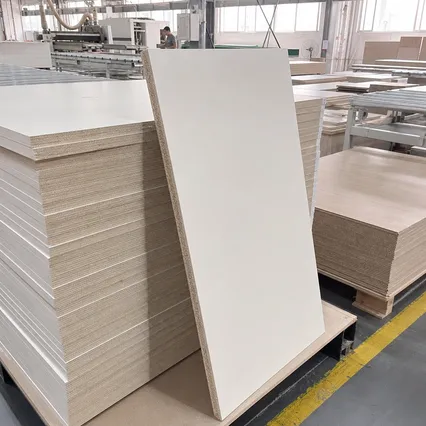
Blockboard Cabinet Board
Melamine-faced blockboard for kitchen cabinets, wardrobes, and storage units where a ready-to-assemble surface is required. Face film is bonded under calibrated press conditions — no delamination risk at normal humidity ranges. Available in white, woodgrain, and solid colour decors.
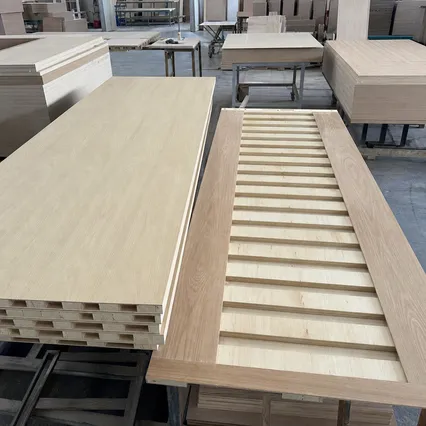
Blockboard for Doors
Specified for flush door cores and solid door panels where screw-holding at the lock block and hinge positions is critical. Core strip orientation is aligned to the door's vertical axis to maximise edge fastener performance. Supplied in door-blank dimensions or cut-to-size.
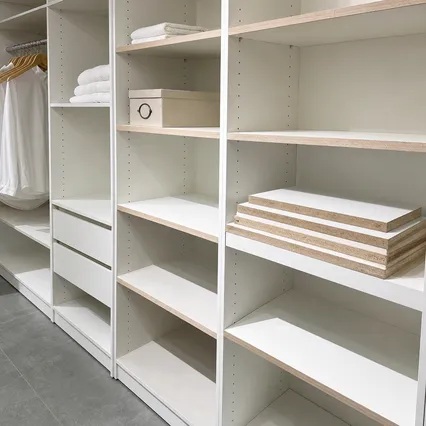
Blockboard Shelving Board
Optimised for load-bearing shelf spans where sag resistance matters more than panel weight. The solid wood core resists mid-span deflection better than particleboard or hollow-core alternatives at equivalent thickness. Used in retail fit-out, library shelving, and residential storage.
Blockboard–Plywood Hybrid
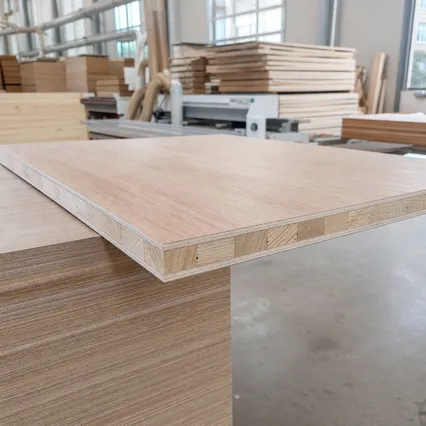
A composite construction that combines a solid wood strip core with additional cross-laminated veneer plies on each face. The result is a panel with blockboard's weight advantage and plywood's multi-directional strength — suited to structural furniture, stair treads, and applications where both face and edge loading occur.
All variants are available in standard 1220×2440mm sheets. Non-standard sizes, custom thicknesses, and specific face veneer species are available on request — contact our team with your specification.
Blockboard Specifications
Standard dimensions, thickness tolerances, and physical properties across our blockboard range.
Dimensions & Tolerances
| Parameter | Standard Value | Tolerance |
|---|---|---|
| Sheet length | 2440mm | ±2mm |
| Sheet width | 1220mm | ±2mm |
| Thickness (18mm) | 18mm | ±0.5mm |
| Thickness (15mm) | 15mm | ±0.5mm |
| Thickness (25mm) | 25mm | ±0.5mm |
| Core strip width | 25–30mm | — |
| Squareness | ≤2mm per 1000mm | — |
| Bow / warp | ≤1.5mm per 1000mm | — |
Physical Properties
| Property | Value | Test basis |
|---|---|---|
| Density (18mm) | 480–530 kg/m³ | EN 323 |
| Moisture content | 8–12% | EN 322 |
| Glue bond (dry) | ≥1.0 N/mm² | EN 314-1 |
| Formaldehyde emission | E0 / E1 | EN 717-1 |
| Face veneer thickness | 0.5–1.5mm | — |
| Surface sanding | Both faces, 80–120 grit | — |
| Core species | Poplar / Pine | — |
| Face veneer species | Hardwood (species on request) | — |
Values represent standard production range. Custom specifications — including alternative core species, thicker face veneers, or specific emission grades — are available on request. Contact us with your technical datasheet requirements.
Core Construction and Surface Options:
What the Spec Sheet Doesn't Tell You
The spec sheet gives you thickness, size, and surface type. What it doesn't tell you is the core strip species, the strip width tolerance, the glue system, and the face veneer grade — and those four variables determine whether the panel performs in your downstream application or generates warranty claims.
Core Strip Species
Poplar core is standard — light, stable, and bonds well with UF and MUF resin systems. Pine core is available for buyers who need higher screw-holding values or supply into markets where poplar is less familiar.
Some Middle East and Australian buyers specify pine core by preference. We can accommodate either on confirmed orders.
Core Strip Width
We run core strips at 25–30mm width as standard. Tighter strip width means more glue lines per panel, which increases bonding surface area and reduces the risk of individual strips moving independently.
Wider strips (40–50mm, used by some suppliers to reduce material cost) increase the risk of individual strip movement showing through the face veneer over time, particularly in humid environments.
Glue System
Standard production uses E1-grade UF resin, meeting European E1 formaldehyde emission limits. For CARB P2 orders (US market), we switch to low-emission MUF resin systems that meet the 0.05 ppm TSCA Title VI limit.
This is not a surface treatment change — it's a core glue formulation change. The emission performance is built into the panel, not applied afterward.
Face Veneer Grade
Face veneers are graded before layup. Grade A — used on furniture and cabinet variants — is selected for consistent grain, no open defects, and uniform thickness. Grade B is available for applications where the face will be covered by laminate or melamine.
We don't mix grades within a batch without buyer confirmation.
Full Parameter Reference
| Parameter | Standard Range |
|---|---|
| Thickness | 12mm – 25mm |
| Panel size | 1220×2440mm |
| Core species | Poplar / Pine |
| Core strip width | 25–30mm |
| Face veneer | Poplar, eucalyptus, birch |
| Glue system | E1 UF / MUF (CARB P2) |
| Formaldehyde | E1 ≤0.124 mg/m³ |
| Moisture content | 8–12% |
| Thickness tolerance | ±0.5mm |
| Surface | Sanded, melamine-faced, HPL-faced |
Where Blockboard Moves: Market Segments Worth Sourcing For
Blockboard sits in a specific commercial niche — it's not a commodity panel, and the buyers who specify it are usually doing so for a reason. Understanding where it moves helps you position it correctly in your distribution or project supply business.
Furniture Manufacturing
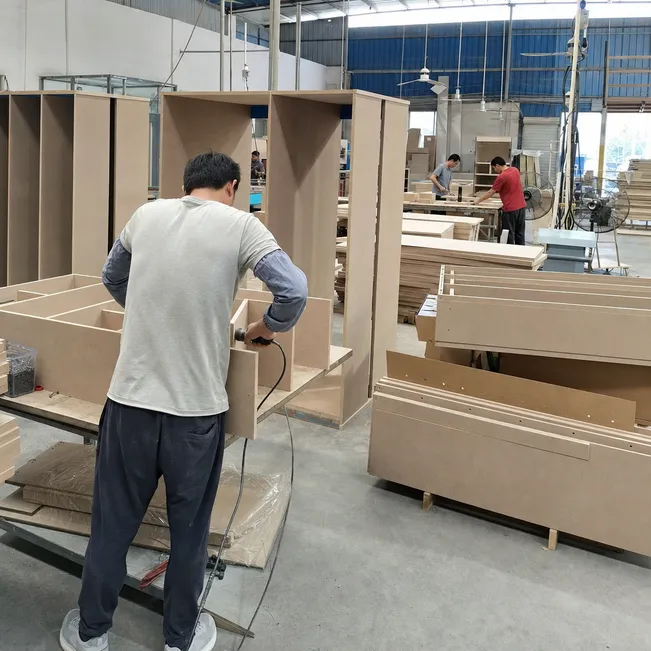
Core Volume SegmentWardrobe carcasses, bed frames, bookcase panels, and TV unit structures — furniture OEMs use blockboard where they need edge-fastening strength that MDF can't reliably provide and where solid timber would add too much weight and cost.
Furniture manufacturers in Southeast Asia, the Middle East, and Eastern Europe are consistent buyers. The segment runs on annual supply agreements with predictable reorder cycles.
Kitchen & Wardrobe Cabinet Production
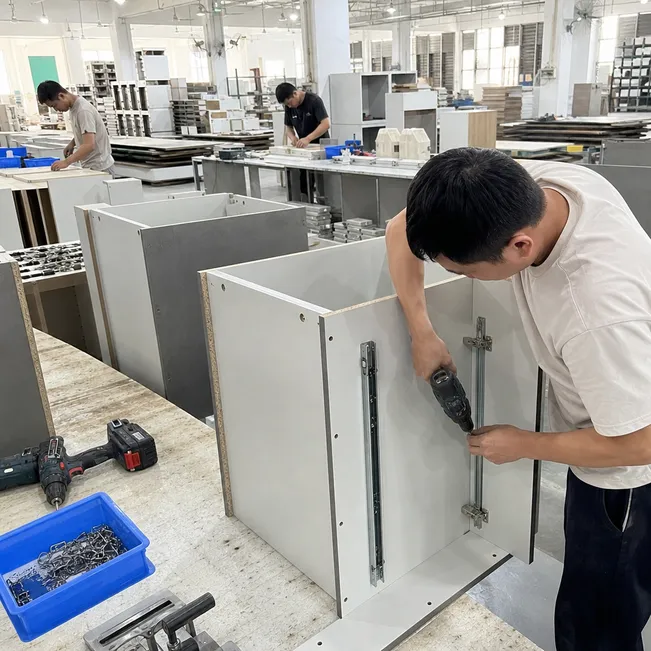
Margin Premium SegmentCabinet manufacturers need panels that hold hinge screws and drawer slide hardware without pull-out failure — blockboard's solid wood core delivers that where particle board and MDF struggle in high-cycle applications.
Distributors supplying kitchen cabinet manufacturers can position blockboard as the substrate that reduces warranty callbacks on hardware failure. This is where the cabinet-grade and melamine-faced variants earn their margin premium.
Commercial Fit-Out & Retail Fixtures
Laminate Blockboard SegmentShop counters, display shelving, reception desks, and retail fixture systems need a panel that arrives site-ready with a durable surface. HPL-faced blockboard on a solid core gives fit-out contractors a panel they can cut, edge-band, and install without additional surface work.
This segment tends to order in smaller quantities per project but at higher frequency — worth building into your stocking strategy if you're supplying fit-out contractors.
Joinery & Interior Construction
Structural Performance SegmentDoor frames, stair components, built-in shelving, and partition framing use blockboard where dimensional stability under load matters more than surface appearance. The solid core handles routing and profiling better than hollow-core alternatives.
The panel holds its shape in applications where it's fixed at one end and cantilevered — a performance characteristic hollow-core and composite alternatives can't match at equivalent weight.
Sourcing for a specific segment?
Each segment has different specification priorities. Tell us your end application and target market — we'll confirm the right variant, glue system, and surface finish for your order.
What Goes Wrong with Blockboard and How We Engineer Against It
Blockboard has a short list of failure modes that experienced buyers have seen before. They're worth naming directly because they're the reason sourcing decisions in this category come down to manufacturing process, not just price.
Core Strip Telegraphing
The most common complaint: the outline of individual core strips becomes visible through the face veneer, particularly after the panel has been in service for a year or more in a humid environment. The cause is almost always core strips pressed at too-high moisture content, or core strip widths that are too wide to maintain consistent bonding across the full strip face.
- 25–30mm strip width calibrated to maintain consistent bonding across the full strip face
- Pre-press moisture verification at 8–10% on every production run
- Accelerated humidity cycling tests: 72 hours at 85% RH — face veneer flatness measured before and after. Panels showing telegraphing at that stage do not ship.
Delamination at the Face Veneer
A glue line problem. Shows up most often at panel edges and corners, caused by insufficient glue spread, uneven press pressure, or face veneers that were too dry at layup — dry veneers absorb glue unevenly, leaving starved glue lines.
- Automated glue spreader applies resin at a controlled weight per square meter
- Spread weight checked at the start of each production run and after any line stoppage
- Post-press tap inspection on every panel — a delaminated area produces a hollow sound that's caught before the panel reaches the sanding line
Thickness Variation Across a Batch
Creates problems for buyers whose downstream customers run panels through automated cutting equipment. A batch with ±1.5mm thickness variation causes feed errors and requires manual adjustment — that's a cost your customer passes back to you.
- Calibrated wide-belt sanding holds thickness tolerance to ±0.5mm across the panel and batch-to-batch
- Thickness measured at five points per panel on outgoing inspection
Formaldehyde Emission Non-Compliance
The failure mode with the highest commercial consequence — a container rejected at customs or pulled from a retailer's shelves. This is not a testing problem; it's a glue system specification problem.
- CARB P2 formulated as the baseline for export production — the glue system is specified before the panel is pressed, not tested after
- Outgoing emission testing done per batch using a gas analysis method
- Results included in shipping documentation for all US-bound orders
Process controls, not post-production sorting.
Every failure mode above is addressed at the production stage — moisture verification, glue spread control, press calibration, and glue system specification. Outgoing inspection catches what process controls miss. The goal is that nothing reaches your container that shouldn't.
Matching Blockboard Specification to Your Market and Application
The five variants in our range cover most sourcing scenarios, but the right choice depends on what your downstream buyers are building and what market they're selling into.
Furniture OEMs & Cabinet Manufacturers
Who apply their own surface treatment
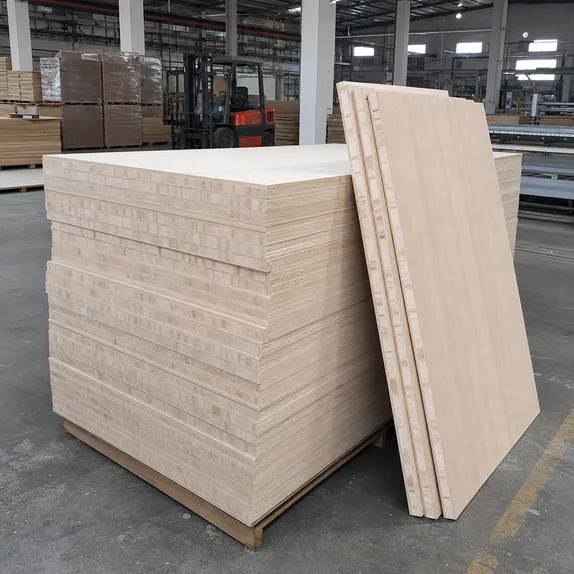
Recommended variants: Blockboard Furniture Board or 18mm Blockboard
Specify face veneer grade based on finish: Grade B for painted surfaces, Grade A for stained or clear-coated applications
Confirm core species — poplar for standard applications, pine if your buyers need higher screw-holding values
Kitchen & Wardrobe Cabinet Producers
Who need a ready-to-assemble substrate
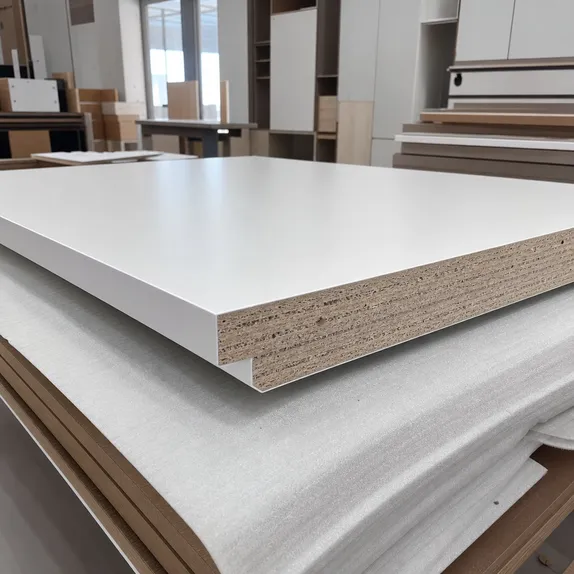
Recommended variant: Blockboard Cabinet Board with edge sealing
The edge seal adds a small cost but eliminates moisture ingress at cut edges — relevant for kitchen environments where panels are exposed to steam and humidity cycling over years of use
Commercial Fit-Out Contractors & Retail Fixture Manufacturers
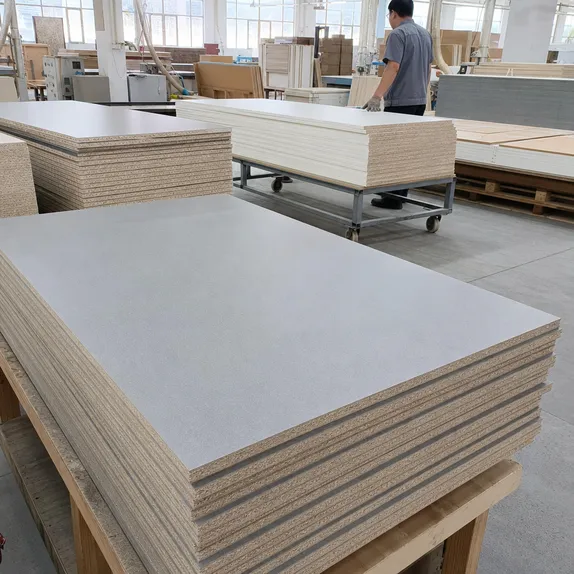
Recommended variant: Laminate Blockboard — arrives site-ready
HPL color and texture options available — we can match standard HPL ranges from major laminate suppliers, or work from buyer-specified samples
Flat-Pack Furniture Manufacturers & Kitchen Cabinet Distributors
Who need a finished panel at a competitive price
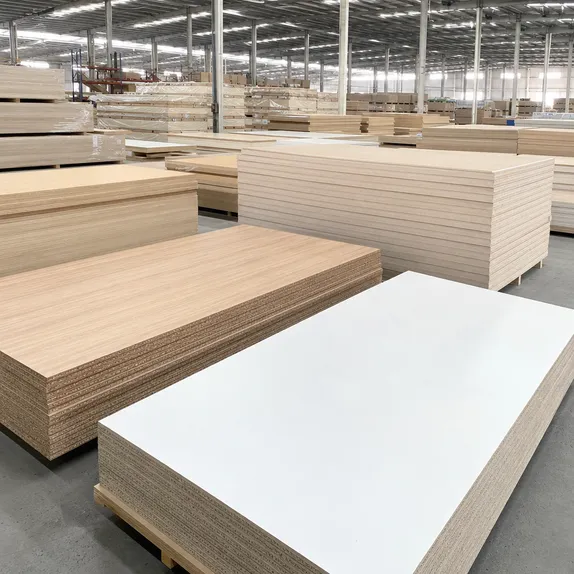
Recommended variant: Melamine Blockboard — the volume play
White and woodgrain are the fastest-moving finishes; solid colors available on runs over 200 sheets
CARB P2 Compliance — US Market
CARB P2Specify MUF glue system on any variant. This is a production-stage specification — it needs to be confirmed on the purchase order, not requested after the panels are pressed. Outgoing emission test results are included in shipping documentation for all US-bound orders.
Not sure which variant fits your buyer's application?
Send us the end-use description and target market — we'll recommend the specification and send back a quote with the relevant certification documentation.
Export Packaging, Container Loading, and Landed Cost Factors
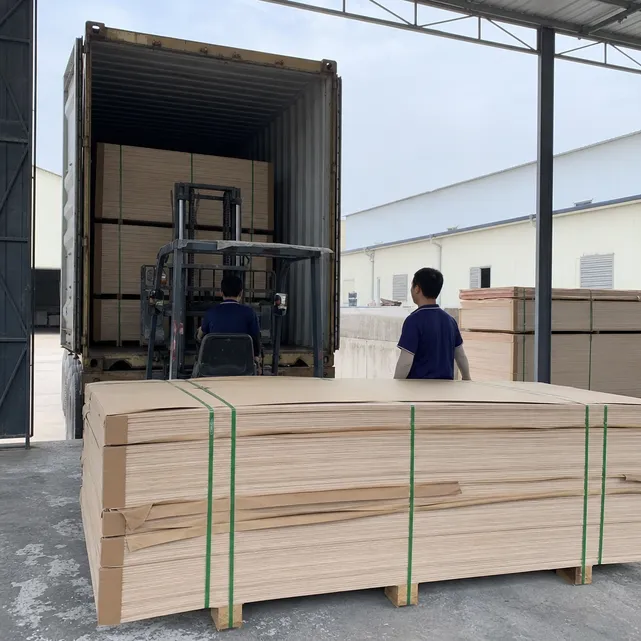
Blockboard ships well in containers — the panel format is efficient to stack and load. The main packaging challenge is protecting face veneers from surface damage during transit.
Standard Export Packaging
Panels are bundled in packs of 50–100 sheets depending on thickness, with kraft paper interleaving between panels to protect face surfaces. Bundles are edge-protected with corner boards, strapped, and wrapped in moisture-resistant polyethylene film.
For melamine-faced and laminate-faced variants, foam interleaving is added between panels — the finished surfaces are more sensitive to contact damage than sanded panels.
Mixed-thickness loads are possible. We provide a loading plan with each shipment so your receiving team knows the bundle configuration.
Export Documentation Package
- Commercial invoice & packing list
- Bill of lading & certificate of origin
- Phytosanitary certificate (where required)
- CARB P2 compliance documentation for US-bound shipments
- FSC chain-of-custody records for FSC-specified orders
- CE declaration for EU shipments
We prepare the documentation package to the standard required for your destination market. Buyers don't need to chase paperwork.
Container Loading Quantities
Standard panel size 1220×2440mm. Figures assume full container utilization.
| Thickness | 20GP Approx. Sheets | 40HQ Approx. Sheets |
|---|---|---|
| 12mm | 800–900 | 1,800–2,000 |
| 15mm | 650–750 | 1,450–1,600 |
| 18mm | 550–620 | 1,200–1,400 |
| 25mm | 380–430 | 850–950 |
Consolidated Load Advantage
For buyers ordering mixed product types, we coordinate consolidated loads. Blockboard and melamine plywood, for example, load efficiently together in a 40HQ — that consolidation reduces your per-unit freight cost compared to running separate containers for each product type.
Certifications Covering Your Key Import Markets
CARB P2 and FSC documentation are included as standard in the shipping package for applicable orders. Third-party pre-shipment inspection is available through SGS, Bureau Veritas, or your preferred agency — we coordinate access.
Quality Management System
Process consistency across production batches. Systematic quality controls from raw material intake through finished panel inspection.
US Market Formaldehyde Compliance
Required for California and increasingly enforced across all US states. Documentation included as standard in the shipping package for US-bound orders.
Verified Sustainable Wood Sourcing
Required by buyers with sustainability procurement policies or supplying into FSC-specified projects. Chain-of-custody records included for FSC-specified orders.
European Market Compliance
Construction product compliance for EU market entry. CE declaration included in the documentation package for EU-bound shipments.
Third-Party Pre-Shipment Inspection
Available through SGS, Bureau Veritas, or your preferred inspection agency. We coordinate access — buyers don't need to manage the logistics of arranging factory access separately.
Certification Summary by Market
All certification documents are prepared to the standard required for your destination market and included in the shipping package.
Frequently Asked Questions
Sourcing questions we hear from furniture manufacturers, cabinet makers, and importers — answered with the specifics that matter for procurement decisions.
Both are engineered wood panels with cross-grain construction, but the core is different. Plywood uses thin veneer layers throughout — typically 1.5–3mm per ply. Blockboard uses solid wood strips (25–30mm wide) as the core, faced with veneer plies on both sides.
The solid core gives blockboard better screw-holding at the edges and higher stiffness-to-weight ratio for furniture applications, but it's not suitable for applications requiring uniform bending strength in both directions the way structural plywood is.
Poplar is the standard choice for most furniture applications: it's lighter, more dimensionally stable, and bonds more consistently with standard UF and MUF resin systems.
Pine core is worth specifying if your buyers need higher screw-holding values — pine's denser grain structure gives better pull-out resistance for heavy hardware like full-extension drawer slides and European-style hinges on large cabinet doors. The weight difference is roughly 10–15% per panel, which adds up on a full container load.
CARB P2 compliance for blockboard requires MUF (melamine-urea-formaldehyde) resin in the core glue system, not just the face veneer adhesive. Specify "CARB P2 compliant, MUF core glue" on your purchase order — this triggers the correct resin formulation at the production stage.
We include the CARB compliance documentation package (TPC test reports, chain-of-custody records) in the shipping documents for all US-bound orders. Panels pressed with standard E1 UF resin will not meet CARB P2 limits, so this needs to be confirmed before production, not tested after.
Warping after delivery is almost always a moisture content problem — either the panels were pressed at too-high core moisture, or they were stored in a humid environment without adequate stacking support. Our panels ship at 8–12% moisture content with edge sealing on export-grade products.
On your end: store panels flat on a level surface with full-length support, in a covered space with controlled humidity. Don't stand panels vertically against a wall for extended periods — even well-made blockboard will take a set if it's unsupported and exposed to humidity differential between faces.
MOQ is one 20GP container per order. Mixed variants within a single container are possible — we regularly load furniture board, cabinet board, and melamine-faced variants together for buyers who want to trial multiple SKUs.
For new buyers, a mixed container is a practical way to test the range before committing to single-variant volume orders.
Yes. Custom dimensions are available on confirmed orders — blockboard is cut-to-size, so non-standard dimensions are a production scheduling question rather than a tooling cost.
Common custom requests include 1220×2800mm for wardrobe applications and 600×2440mm pre-ripped panels for cabinet manufacturers who want to reduce their own cutting step. Confirm custom dimensions on the purchase order; we'll advise on yield and any minimum quantity requirements for non-standard sizes.
Factory Background and Why It Matters
for This Category
We've been manufacturing blockboard at our Xuzhou facility since 2008 — it's one of the original product lines, not a category we added later to fill out a catalog. The process knowledge for blockboard is embedded in the team: the core strip drying parameters, the press cycle calibration for different thicknesses, the face veneer grading criteria that prevent telegraphing complaints downstream.
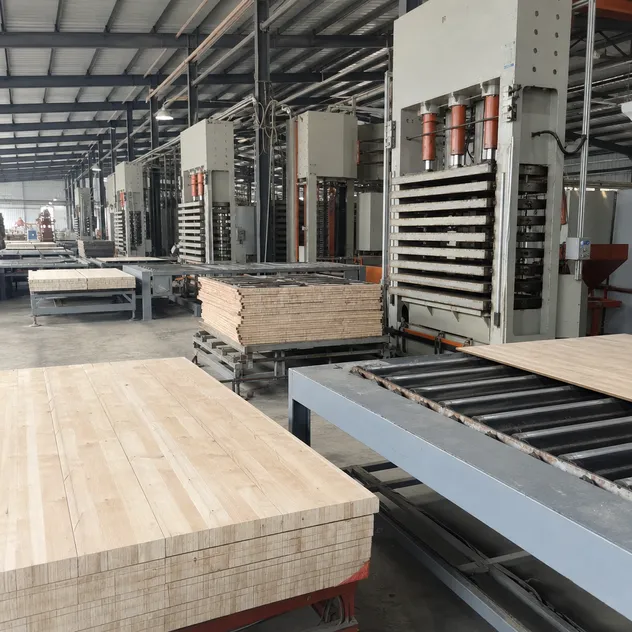
Blockboard runs on dedicated press capacity — it doesn't compete with film-faced plywood or MDF for press time, which means your order runs on schedule rather than getting pushed when another product category has a volume spike.
Across the full product range. Blockboard represents a consistent share of that output — not a specialty run scheduled around other categories.
Why dedicated press capacity matters
- Core strip drying parameters calibrated specifically for blockboard — not shared with veneer or MDF schedules
- Press cycle calibration maintained per thickness — 12mm, 15mm, 18mm, and 25mm each have their own validated parameters
- Face veneer grading criteria enforced to prevent telegraphing — the core strip joints don't show through on finished surfaces
- Your order doesn't get pushed when film-faced plywood or MDF has a volume spike — blockboard has its own press schedule
Explore the blockboard range
Ready to Source Blockboard?
Send your specification, target volume, and destination market to get a detailed quote and the certification documentation relevant to your import market.