

Melamine Plywood Manufacturer — Factory-Direct Supply
Five sub-product variants covering standard melamine board through high-gloss cabinet panels. Manufactured at our 18,000 m² facility in Xuzhou since 2008. Export-certified for North America, Europe, Middle East, Southeast Asia, and Australia.
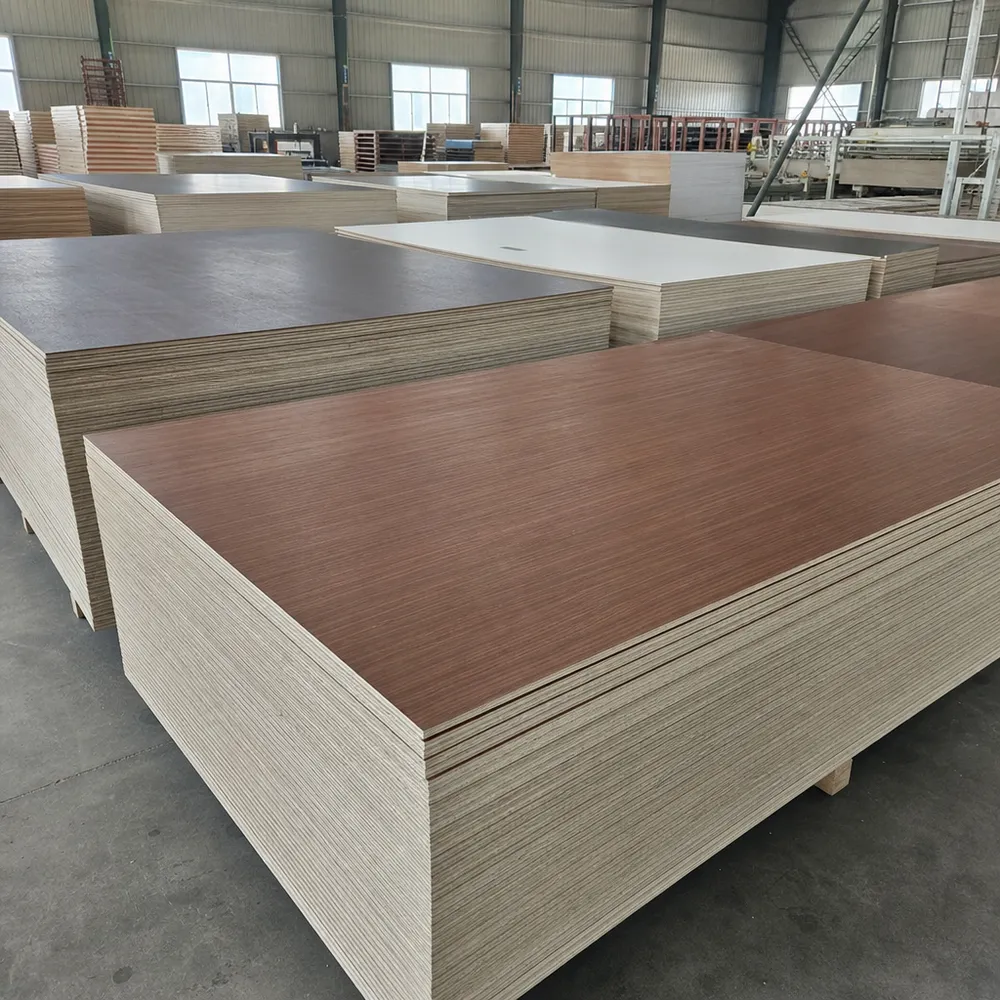
What Melamine Plywood Is — and Where It Sits in Your Product Line
Melamine plywood is a plywood substrate — typically poplar, eucalyptus, or hardwood core — with a melamine-impregnated paper overlay pressed directly onto the face and back under heat and pressure. The result is a panel with a hard, cleanable surface that's ready for furniture and cabinet fabrication without additional finishing. No painting, no laminating, no secondary processing cost.
We've been manufacturing melamine faced plywood since 2008 as part of our broader engineered wood panel range. For distributors and furniture manufacturers, this product sits at a specific point in the supply chain: it's a semi-finished panel that your downstream customers can cut, edge-band, and assemble directly. The surface is the finish. That's the commercial logic — you're selling a panel that reduces your buyer's fabrication cost, which is a margin argument you can make at the point of sale.
Why the Substrate Matters
The substrate matters more than most buyers initially realize. A melamine overlay on a low-density, inconsistent core will telegraph core voids through the surface under load — you'll see it as surface depression or edge crumbling at cut lines.
Our Core Construction Standard
We run our melamine plywood on the same core construction standards as our commercial plywood range: veneer grading before layup, moisture-controlled pressing, and calibrated sanding to ±0.2mm thickness tolerance. The melamine paper bonds to a flat, consistent substrate, which is what keeps the surface intact through cutting and edge-banding operations.
The Commercial Logic for Distributors
You're selling a panel that reduces your buyer's fabrication cost — no painting, no laminating, no secondary processing. That's a margin argument you can make at the point of sale. The surface is the finish.
Manufacturing Process — Core to Surface
Melamine Plywood Product Line
Five product variants cover the main commercial applications in furniture manufacturing, cabinet production, and interior fit-out. Each is linked to its full specification page.
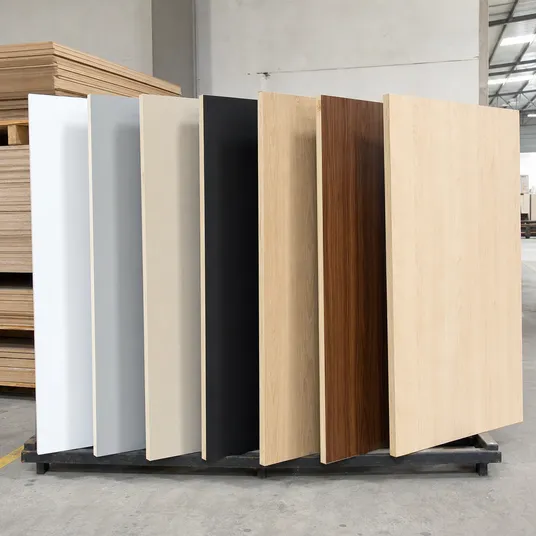
Melamine Board
The standard entry point — melamine paper pressed onto a poplar or eucalyptus core plywood substrate. Available in a range of solid colors and wood-grain decors. This is the volume SKU for furniture distributors supplying flat-pack and RTA furniture manufacturers.
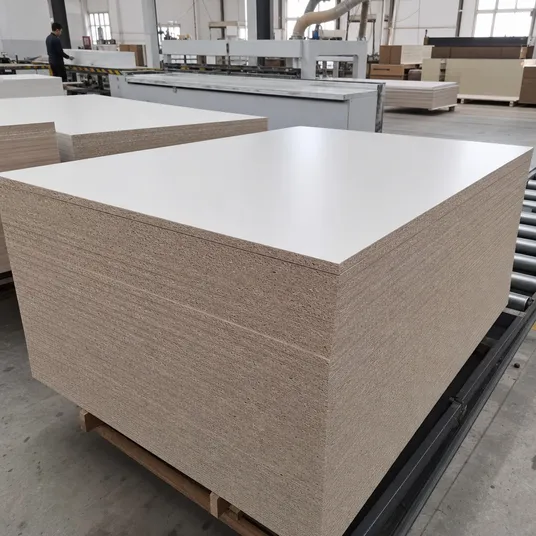
Melamine Cabinet Board
Cabinet GradeHeavier core construction optimized for cabinet carcass applications — side panels, shelves, and base units where the panel carries load and must hold fasteners cleanly. Denser core layup than standard melamine board, which matters when your downstream customer is using cam locks and dowels in high-cycle cabinet assembly. Edge crumbling at fastener points is the failure mode this construction is designed to prevent.
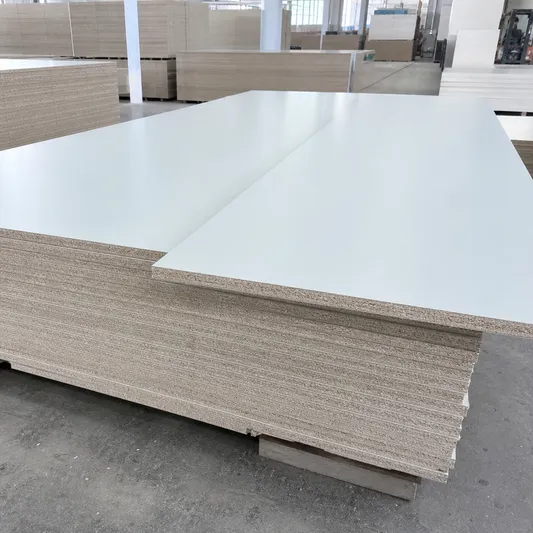
18mm Melamine Plywood
High VolumeThe most-ordered thickness in our melamine range — 18mm is the standard cabinet carcass dimension across most European and North American furniture systems. If you're supplying into markets where kitchen and wardrobe cabinet systems are specified at 18mm, this is the SKU your buyers will reorder. We stock this thickness in the highest volume and can commit to consistent batch availability for repeat orders.
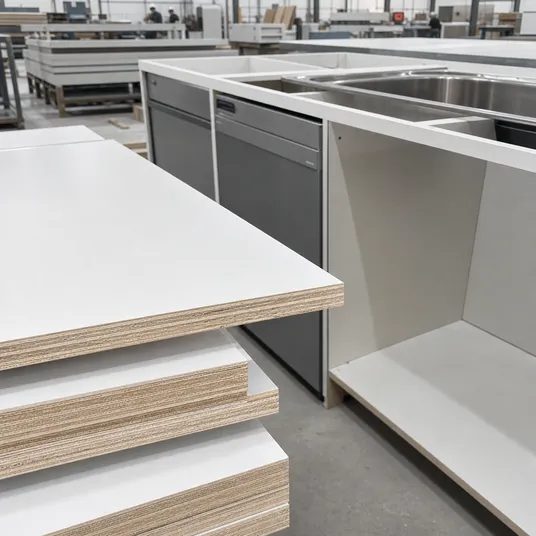
Kitchen Melamine Plywood
MR GradeFormulated for kitchen cabinet applications where moisture exposure is a regular condition — around sinks, dishwashers, and under-bench areas. We use a moisture-resistant (MR) glue system on the core construction and a melamine overlay with higher resin saturation for improved surface resistance. Standard melamine plywood will survive occasional moisture contact, but kitchen environments involve sustained humidity cycling — the MR core is the right specification for that application, and it's a spec your buyers can verify.
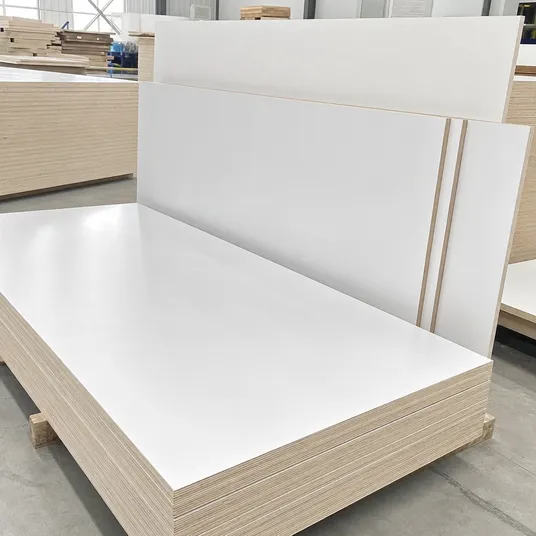
White Melamine Plywood
High DemandBright white melamine overlay on a plywood core — the most requested single decor in our range. White is the default specification for retail shelving, office furniture, and interior fit-out projects where a clean, neutral surface is required. We stock this in both standard and MR core variants. If your buyers are specifying white across multiple product lines, this is the SKU that consolidates that demand into a single, consistent supply source.
Need a Custom Specification?
If your buyers require a thickness, core species, or decor not listed here, we can discuss custom production runs. Minimum order quantities apply. Send us your specification sheet and we'll confirm feasibility and lead time.
Standard Specification Reference
The table below covers the standard parameters across our melamine plywood range. Dimensions, tolerances, and surface properties are the figures your technical buyers will check against their own procurement specs.
| Parameter | Standard Range | Tolerance / Note | Applicable Grade |
|---|---|---|---|
| Thickness | 9mm / 12mm / 15mm / 18mm / 25mm | ±0.2mm calibrated sanding | All grades |
| Panel Size | 1220×2440mm / 1525×2440mm | ±2mm length/width | All grades |
| Core Species | Poplar / Eucalyptus / Combi | Specified at order | All grades |
| Glue System | MR (Moisture Resistant) / E1 / E0 | E1 standard; E0 on request | All grades |
| Melamine Overlay Weight | 120–180 g/m² | Higher weight = better abrasion resistance | All grades |
| Surface Finish | Smooth / Embossed / Sync-pore | Sync-pore on selected decors | All grades |
| Formaldehyde Emission | E1 ≤ 1.5 mg/L / E0 ≤ 0.5 mg/L | Perforator method; CARB P2 available | All grades |
| Moisture Content | 8–12% | Kiln-dried core veneers | All grades |
| Bending Strength (MOR) | ≥ 30 N/mm² | EN 310 / GB/T 17657 | Cabinet / Kitchen grade |
| Internal Bond (IB) | ≥ 0.4 N/mm² | EN 319 / GB/T 17657 | Cabinet / Kitchen grade |
| Surface Abrasion (Taber) | ≥ 150 revolutions IP | EN 13329 method | All grades |
| Certifications Available | FSC® / CARB P2 / CE / ISO 9001 | Confirm at order; not all certs on all SKUs | Grade-dependent |
All figures are standard production parameters. Specific batch test reports available on request for orders above MOQ. Tolerances may vary for custom thickness or non-standard panel sizes.
Where Melamine Plywood Is Specified
Melamine plywood is a downstream material — it goes into finished products your buyers are manufacturing or installing. Understanding the end-use context helps you match the right grade to the right buyer.
Kitchen Cabinet Carcasses
The primary volume application. Side panels, base units, wall units, and drawer boxes in kitchen cabinet systems. MR grade is the correct specification for this application. 18mm is the standard carcass thickness in most European and North American kitchen systems.
Wardrobe & Storage Systems
Walk-in wardrobes, sliding door systems, and modular storage units. White and light wood-grain decors dominate this segment. Standard melamine board is typically sufficient — MR grade is not required unless the installation is in a high-humidity environment such as a bathroom-adjacent wardrobe.
Office Furniture
Desks, credenzas, filing pedestals, and open-plan storage. Office furniture buyers typically specify E1 or E0 emission grades for indoor air quality compliance. White, light grey, and walnut decors are the most common specifications in this segment.
Retail Shelving & Display
Shop fit-out, display shelving, and point-of-sale fixtures. Surface abrasion resistance is a key parameter here — retail shelving takes repeated contact from products and cleaning. Higher overlay weight (160–180 g/m²) is the right specification for this application.
Flat-Pack & RTA Furniture
Ready-to-assemble furniture for mass-market retail channels. Cost efficiency and consistent batch quality are the primary procurement criteria. Standard melamine board on a poplar core is the typical specification. Cam lock and dowel fastener compatibility is a non-negotiable requirement — edge crumbling at fastener points is the most common quality complaint in this segment.
Interior Fit-Out & Joinery
Commercial and residential interior fit-out — wall paneling, feature walls, built-in joinery, and partition systems. Sync-pore surface finish (texture registered to the decor pattern) is increasingly specified in this segment for a more premium visual result. E0 emission grade is often required for commercial projects with indoor air quality certification requirements.
How We Supply Melamine Plywood
Supply reliability is the variable that determines whether a distributor relationship works long-term. Here's how our supply chain is structured and what that means for your procurement planning.
Order & Shipping Reference
~280–320 sheets depending on thickness
Mixed SKU loading available
DDP available for select destinations
LC at sight available for established accounts
Courier cost covered by buyer
Questions Distributors Ask Before Their First Order
Answers to the specification, quality, and logistics questions that come up most often in distributor conversations.
What is the difference between melamine plywood and melamine board?
The core material. Melamine plywood uses a cross-laminated veneer core, which gives it higher structural strength, better screw-holding, and superior dimensional stability. Melamine board (MDF or particleboard core) is lower cost and better suited to flat-panel applications where structural load is not a factor. Both use the same melamine paper surface.
What does MR grade mean and when do I need to specify it?
MR stands for Moisture Resistant. It refers to the adhesive used in the core — MR grade uses a melamine-urea formaldehyde glue that resists short-term moisture exposure. Specify MR grade for kitchen carcasses, bathroom vanities, and any application where the panel may be exposed to steam or humidity. Standard grade is adequate for dry interior applications.
How do E1 and E0 formaldehyde emission grades differ?
E1 allows up to 0.1 ppm formaldehyde emission (EN 717-1) and is the standard for most European and international markets. E0 is a stricter grade at ≤0.05 ppm, required for projects with indoor air quality certification (LEED, BREEAM, WELL) or for markets with tighter regulations such as California CARB Phase 2. We supply both — specify at time of order.
Can you supply custom decors or non-standard sheet sizes?
Yes. Custom decors are available with a minimum order quantity per decor — contact us for the current MOQ threshold. Non-standard sheet sizes (e.g., 2440×1220mm, 2800×2070mm) can be produced with 7–14 days additional lead time. Standard sizes are 1220×2440mm and 1525×2440mm.
What certifications do your panels carry?
Our standard range carries CE marking, EN 13986 compliance, and E1 formaldehyde certification. FSC® chain-of-custody certification is available for orders requiring it. CARB Phase 2 compliant production is available on request. Test reports for MOR, MOE, internal bond, and surface soundness are available for any batch.
What is the minimum order and how is it shipped?
The minimum order is one 20ft container, which holds approximately 280–320 sheets depending on thickness and sheet size. Mixed SKU loading is available within a single container. We ship FOB, CIF, or CFR — DDP is available for select destinations. Standard payment terms are 30% deposit with the balance against bill of lading.
How do I evaluate panel quality before placing a full container order?
We provide free physical samples — you cover courier cost. Samples include the surface finish, edge profile, and a cross-section showing core construction. For buyers who need third-party verification, we can arrange pre-shipment inspection through SGS, Bureau Veritas, or your preferred inspection agency at your cost.
What surface finishes are available beyond standard melamine?
Standard melamine (smooth), sync-pore (texture registered to decor pattern), and soft-touch (low-gloss tactile finish) are available across most decors. High-gloss UV-coated surface is available on selected SKUs. Sync-pore is the most commonly specified premium finish in the current market — it significantly reduces the visual gap between melamine and real wood or stone surfaces.
Talk to Our Export Team
We work with distributors, importers, and large-volume buyers. If you're evaluating melamine plywood or melamine board for your product range, our export team can provide specifications, samples, and pricing within one business day.
Request Pricing or Samples
Technical Specifications: Category-Wide Parameter Ranges
These are the general parameter ranges across our melamine plywood product line. Individual product pages carry the exact specifications for each variant.
| Parameter | Range / Options |
|---|---|
| Thickness | 9mm, 12mm, 15mm, 18mm, 21mm, 25mm (custom available) |
| Sheet Size | 1220×2440mm standard; custom dimensions on confirmed orders |
| Core Material | Poplar, eucalyptus, hardwood (species by specification) |
| Core Construction | Cross-grain veneer layup, odd-number plies |
| Glue System | MR (moisture-resistant) / WBP (waterproof boil-proof) by application |
| Melamine Paper Weight | 80–120 g/m² (standard to heavy-duty overlay) |
| Surface Finish | Matte, satin, high-gloss |
| Decor Options | Solid colors, wood grain, stone pattern (subject to MOQ) |
| Formaldehyde Emission | E1 standard; CARB P2 available |
| Thickness Tolerance | ±0.2mm (calibrated sanding) |
| Moisture Content | 8–12% (export-grade target range) |
| Certifications |
ISO 9001:2015 CARB P2 FSC CE
|
Why 8–12% Moisture Content Is a Process Target, Not a Final Test
The 8–12% moisture content range is not a specification we test at the end — it's achieved through controlled veneer drying and pre-press moisture verification. Panels that arrive at your warehouse outside that range will move dimensionally in your buyer's environment. We built our drying process around that specific failure mode from the beginning.
Substrate and Surface: The Two Variables That Determine Downstream Performance
Most buyers evaluate melamine plywood by the surface — color, texture, gloss level. Those are the visible variables. But the substrate construction is what determines whether the panel performs through fabrication and end use.
Core Density and Void Control
Edge QualityCore density and void control directly affect edge quality at cut lines. A poplar core with voids will crumble at the cut edge, which means your buyer's edge-banding operation produces visible defects.
Our process: We grade incoming veneers before layup and reject core veneers with open defects above the specification limit. The result is a cut edge that holds cleanly through automated panel saws and CNC routing.
Glue System Selection
Moisture PerformanceGlue system selection determines moisture performance. Standard urea-formaldehyde (UF) glue is adequate for dry interior applications. For kitchen and bathroom cabinet applications, MR or WBP glue systems maintain bond integrity under humidity cycling.
Important: The glue system is specified at the order stage — it's not a post-production upgrade.
Melamine Paper Weight and Resin Saturation
Surface HardnessPaper weight and resin saturation determine surface hardness and scratch resistance. Heavier paper (100–120 g/m²) with higher resin content produces a harder surface that resists abrasion better in high-use applications.
Press Parameters
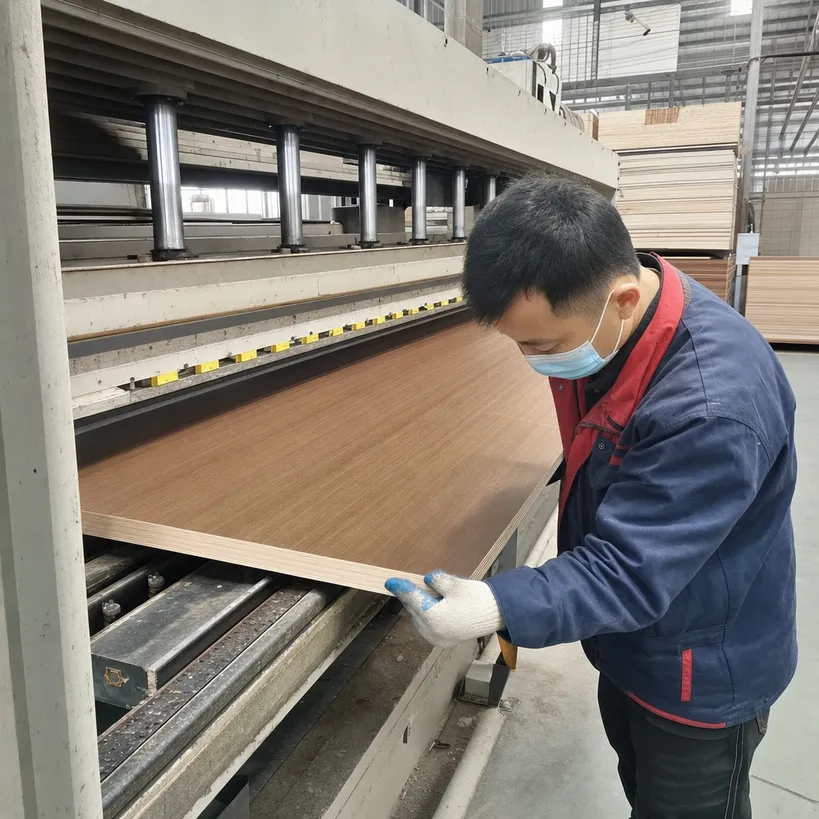
Bond IntegrityPress parameters are the variable that ties everything together. Melamine paper bonds to the substrate through heat and pressure — the press temperature, pressure, and cycle time determine whether the bond is complete and uniform.
Our verification: Press parameters are logged per batch, and we run a peel test on each production run to verify bond integrity before the panels reach the sanding line.
The Most Common Field Failure in Melamine Panels
Incomplete bonding produces surface lifting at edges and corners — the most common field failure in melamine panels. We've seen batches from other factories where the melamine surface looks perfect on delivery but starts lifting at corners within six months of installation.
That's a press parameter problem, not a paper quality problem. The fix is in the process, not the material spec.
Glue System Selection by Application
Adequate for dry interior applications where humidity cycling is not a factor.
Maintains bond integrity under moderate humidity cycling. Specified for kitchen and bathroom applications.
Full waterproof bond integrity. Specified for high-humidity commercial environments and demanding export markets.
Market Segments Where Melamine Plywood
Generates Repeat Orders
Melamine plywood moves in volume in specific market segments. These are the segments where our existing buyers have built repeatable order patterns.
Furniture Manufacturing Supply Chains
Highest Volume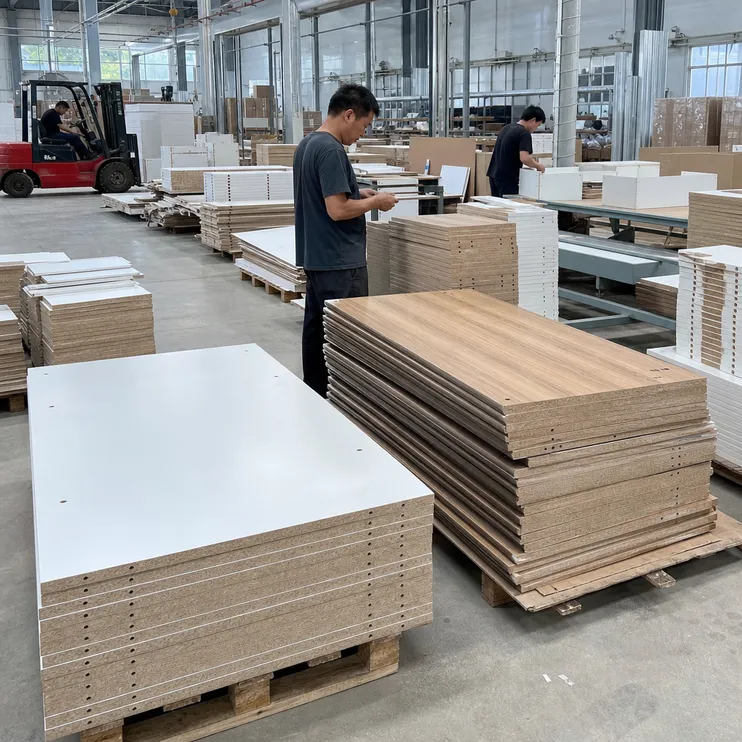
RTA (ready-to-assemble) and flat-pack furniture manufacturers are the largest volume buyers of melamine plywood. They consume it in high volume, on tight specifications, with consistent color and thickness requirements across production runs.
Critical specification: Batch-to-batch color consistency. A color shift between orders creates a production problem for your buyer. We maintain decor records and can match color across orders on confirmed programs.
Kitchen and Wardrobe Cabinet Fabricators
Stable Reorder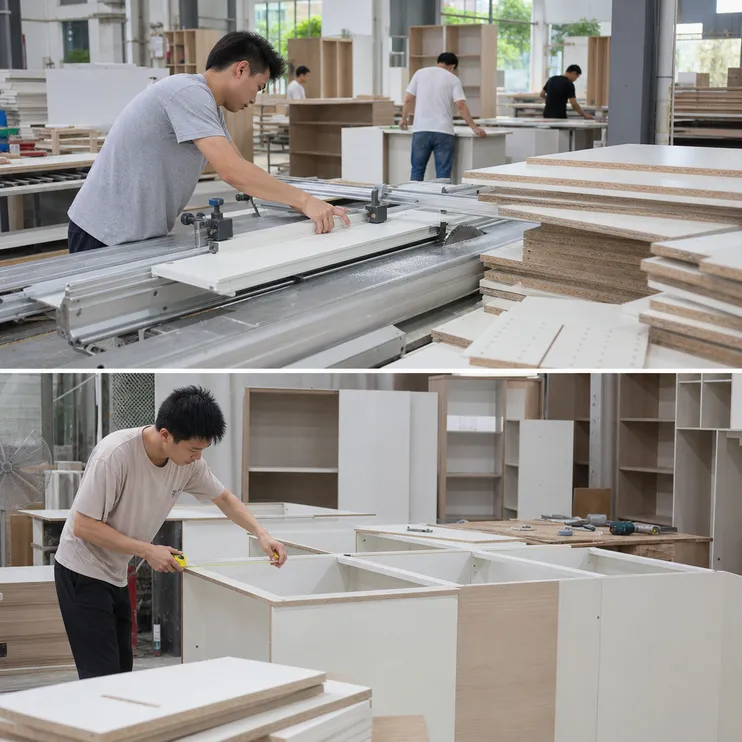
Cabinet shops and kitchen manufacturers use melamine plywood for carcass construction. The 18mm thickness in MR glue specification is the standard for this segment.
Order pattern: Volume is moderate per customer but highly repeatable — a cabinet fabricator running 50–100 kitchens per month has a predictable monthly panel consumption that makes them a stable reorder account.
Interior Fit-Out Contractors and Joinery Suppliers
Multi-SKU Orders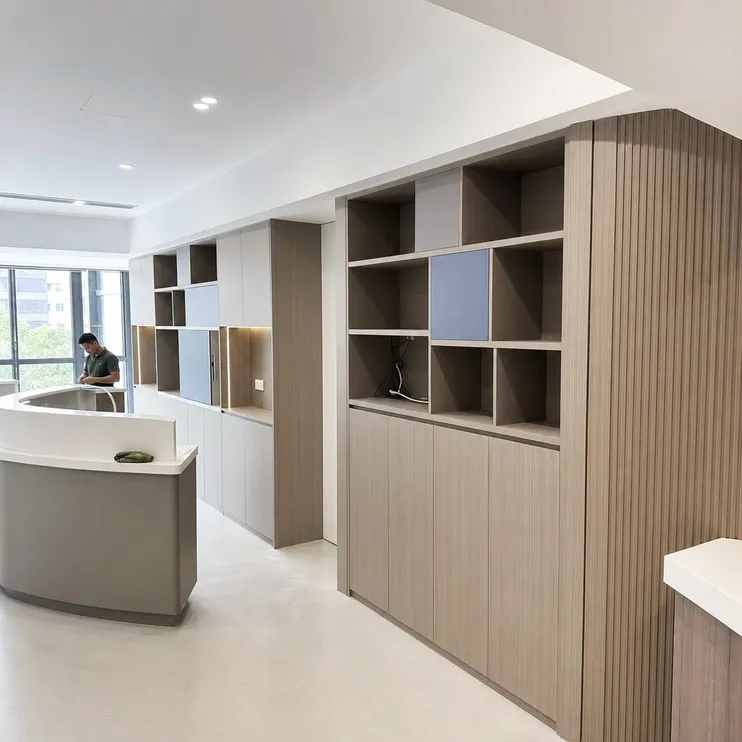
Commercial fit-out projects (offices, retail, hospitality) use melamine panels for built-in joinery, wall paneling, and furniture. These buyers often need a range of decors and thicknesses within a single project order.
Range coverage: Our product line covers the full thickness range from 9mm to 25mm, so a single order can cover multiple panel applications in one shipment.
Building Materials Distributors
Reorder Programs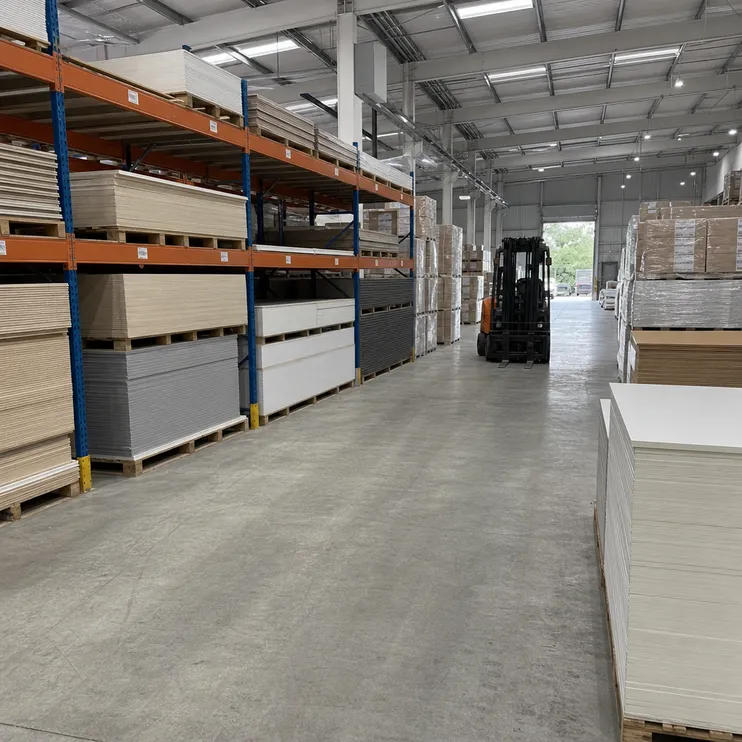
Distributors stocking a panel range for resale to trade customers (joiners, cabinet makers, builders) need a supplier who can maintain consistent stock availability and deliver on short lead times for reorders.
Supply reliability: Our 6 production lines and 450,000 m³ annual capacity mean we can support distributor reorder programs without the supply gaps that come from a factory running at full utilization with no buffer capacity.
Selecting the Right Melamine Plywood
Specification for Your Market
The product line covers five variants, but the selection logic is straightforward once you know what your downstream buyers are building.
Standard Furniture and Shelving
→ Melamine Board in 15mm or 18mm, standard UF glue, matte or satin surface
This is the volume specification for most furniture distribution businesses. Color range is the main variable — we can discuss decor options based on what's moving in your market.
Cabinet Carcass Construction
Kitchen Standard→ Melamine Cabinet Board or 18mm Melamine Plywood in MR glue specification
The denser core construction holds fasteners better, and the MR glue handles the humidity exposure in kitchen and bathroom environments. If your buyers are building kitchens, this is the right specification.
High-Visibility Furniture and Display
Margin Opportunity→ Glossy Melamine Plywood where the panel face is part of the design
The gloss surface commands a price premium in retail furniture markets — it's a margin opportunity if your buyers are selling into contemporary furniture segments.
Kitchen-Specific Applications
Moisture Exposure→ Kitchen Melamine Plywood with MR or WBP glue system
The surface resin saturation is higher than standard melamine board, which matters for sustained moisture exposure around sinks and appliances.
Mixed-Application Distribution
Recommended Starting Point→ 18mm Melamine Plywood in MR glue covers the majority of cabinet and furniture applications from a single SKU
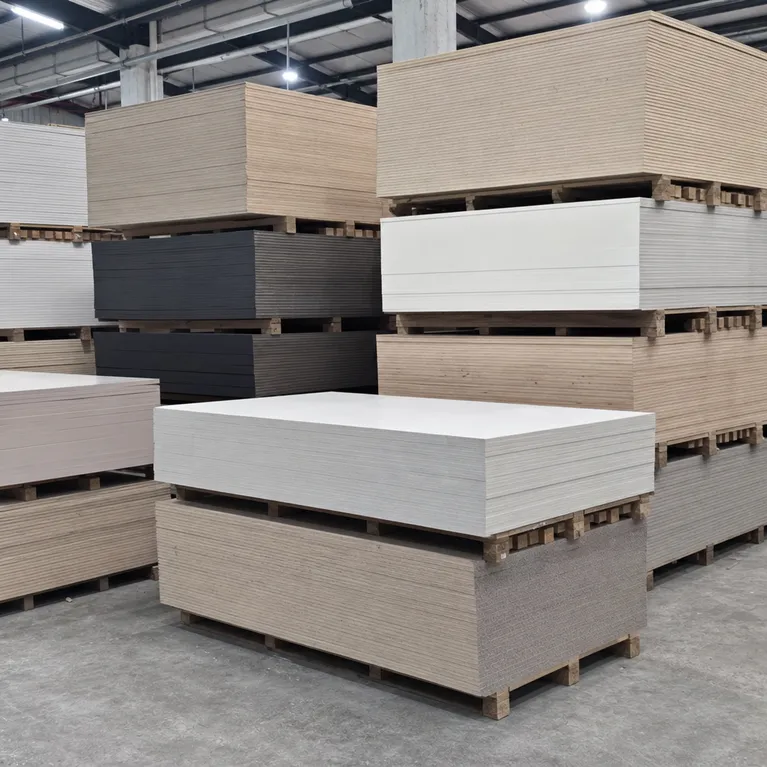
If you're stocking for a trade customer base with varied applications, the 18mm Melamine Plywood in MR glue covers the majority of cabinet and furniture applications from a single SKU. Most distributors new to this product category start with 18mm in two or three decors and expand the range once they understand their customers' preferences.
| Application | Recommended Product | Glue Spec | Key Reason |
|---|---|---|---|
| Standard furniture / shelving | Melamine Board 15mm / 18mm | UF | High-volume specification; color range is main variable |
| Cabinet carcass construction | Melamine Cabinet Board / 18mm Melamine Plywood | MR | Denser core; humidity resistance |
| High-visibility / display furniture | Glossy Melamine Plywood | MR / UF | Price premium; contemporary retail segment |
| Kitchen-specific (sinks / appliances) | Kitchen Melamine Plywood | MR / WBP | Higher resin saturation; sustained moisture |
| Mixed-application distribution | 18mm Melamine Plywood | MR | Single SKU covers majority of applications; start with 2–3 decors |
Quality Failures in Melamine Plywood — and How We Engineer Against Them
Melamine plywood has a short list of failure modes that experienced buyers have encountered. These are the ones worth understanding before you commit to a supplier.
Surface Lifting and Delamination at Edges
Happens when the melamine paper bond is incomplete — usually a press temperature or pressure problem, sometimes a substrate moisture issue.
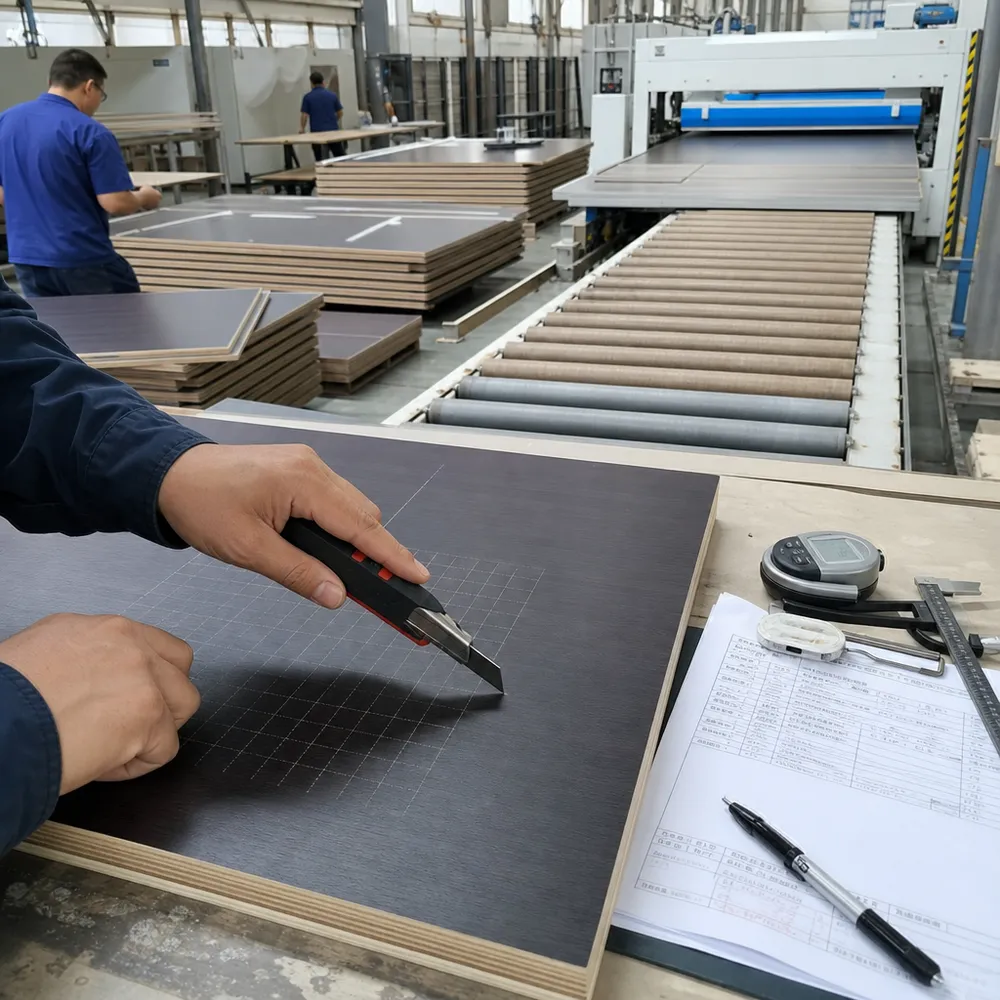
Our engineering response: Press parameters are logged per batch, and we run a cross-cut peel test on each production run. Any batch that shows incomplete bonding at the peel test is pulled before it reaches the sanding line. This is not a final inspection step — it's a production gate.
Color Variation Between Batches
Creates problems for furniture manufacturers running multi-batch production. Melamine paper is produced in rolls, and color can shift between paper production lots.
Our engineering response: We maintain decor records and source paper from consistent suppliers. For buyers with strict color-matching requirements across large programs, we recommend specifying paper lot numbers on confirmed orders and requesting a color sample from each new paper lot before production.
Edge Crumbling at Cut Lines
Indicates a core void problem. When a panel saw or CNC router cuts through a void in the core, the melamine surface loses its substrate support at the cut edge and crumbles.
Our engineering response: We grade core veneers before layup and reject veneers with open defects above the specification limit. The result is a cut edge that holds cleanly — relevant if your buyers are running automated panel processing equipment where edge quality affects downstream assembly.
Thickness Variation Across a Batch
Causes feed errors in automated cutting equipment and visible gaps in assembled furniture.
Our engineering response: Our calibrated wide-belt sanding holds thickness tolerance to ±0.2mm across the panel. For buyers supplying into furniture manufacturing operations with automated panel saws, this tolerance is the specification that determines whether your panels run cleanly through their equipment.
Formaldehyde Emission Non-Compliance
This is a market access risk, not just a quality issue. CARB P2 is the most stringent emission standard in our export markets, and we formulate to meet it as the baseline for export production.
If you're supplying into California or other CARB-regulated markets, we include the CARB documentation package as standard — you don't need to request it separately.
-
Press parameters logged per batch
-
Cross-cut peel test on every production run
-
Core veneer grading before layup
-
±0.2mm thickness tolerance, wide-belt sanding
-
CARB P2 documentation included as standard
OEM and Custom Specification Capability
Our OEM program covers the main customization dimensions that furniture manufacturers and distributors typically need.
To first production sample. Depends on paper sourcing requirements for custom decors. Standard catalog specifications ship on normal production schedule.
Custom Decors and Colors
Available on Confirmed OrdersWe can press melamine paper in custom decors on confirmed orders. The minimum order quantity for custom decor production depends on the paper sourcing requirement — standard catalog decors have lower MOQs than custom-sourced papers.
Private-label panel ranges: We can work from your decor specifications or help you select from our paper supplier's catalog.
Custom Dimensions
No Tooling Investment RequiredNon-standard sheet sizes are available on confirmed orders. Plywood is cut-to-size, not molded, so custom dimensions are a scheduling and yield question rather than a tooling investment.
Custom Core Construction
Application-SpecificCore species, ply count, and glue system can be specified by application.
Private Label and OEM Branding
North America & Europe ProgramsBundle marking, panel stamping, and documentation can be prepared under your brand for OEM programs. We've run OEM programs for distributors in North America and Europe who supply melamine panels under their own brand to trade customers.
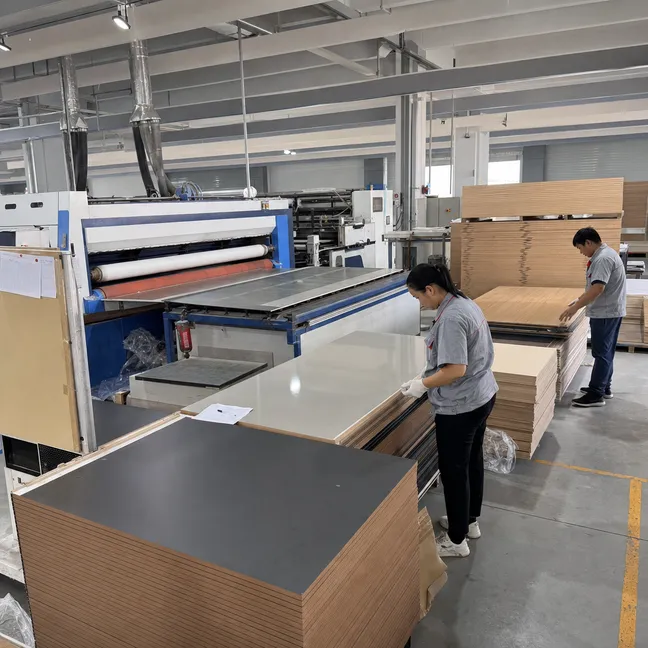
Building a private-label panel range for your distribution business?
We can work from your decor specifications or help you select from our paper supplier's catalog. Custom dimensions, core construction, and full OEM documentation are available on confirmed orders.
Applications by End Use
Melamine plywood is specified across furniture manufacturing, shopfitting, and interior construction. The right specification depends on the application's structural, aesthetic, and compliance requirements.
The surface finish grade and core construction should be matched to the application. A high-gloss kitchen door panel has different requirements than a structural cabinet carcass or a retail display unit.
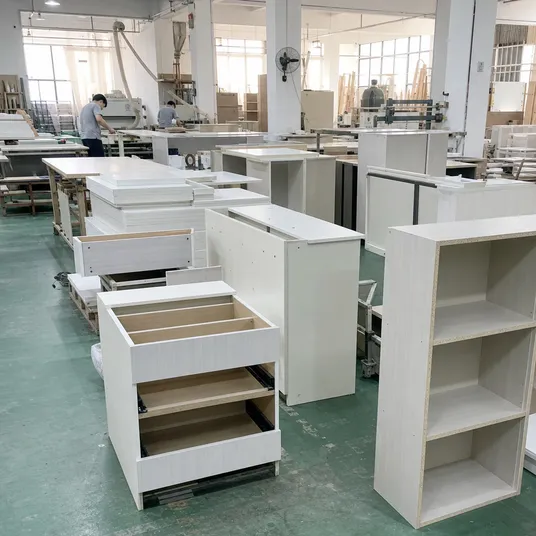
Furniture Manufacturing
Cabinet carcasses, drawer boxes, shelving, and panel furniture. The plywood core provides better screw-holding and edge stability than MDF or particleboard alternatives, which matters for flat-pack and RTA furniture.
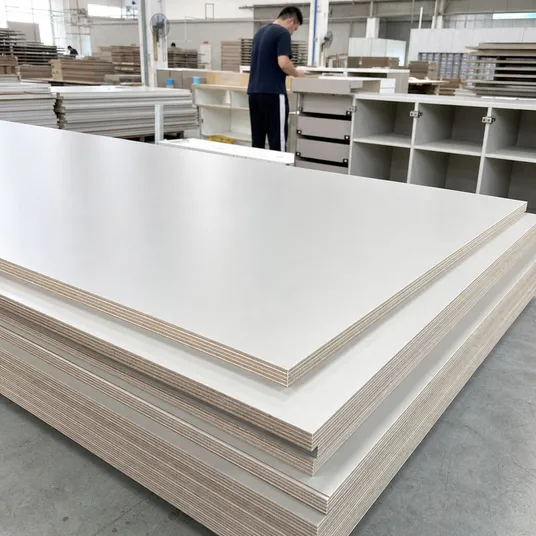
Kitchen & Bathroom Cabinetry
Moisture-resistant core construction is the key specification for kitchen and bathroom environments. MR glue systems prevent delamination in high-humidity conditions. The melamine surface is easy to clean and resistant to common household chemicals.
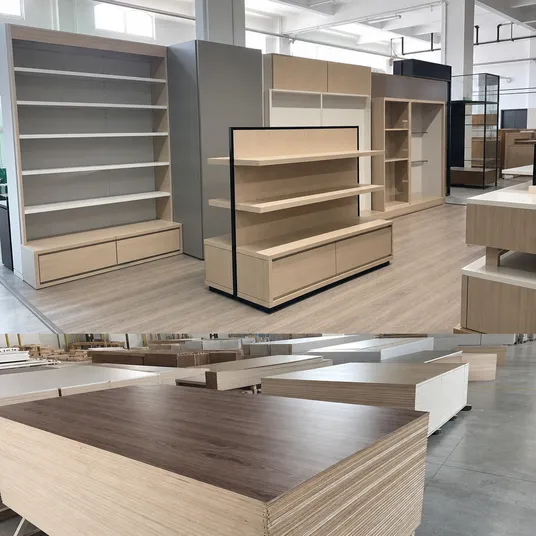
Retail Shopfitting
Display units, shelving, and wall paneling for retail environments. Consistent decor matching across large runs is important for branded retail fit-outs. Custom decor programs allow retailers to specify proprietary colors and textures.
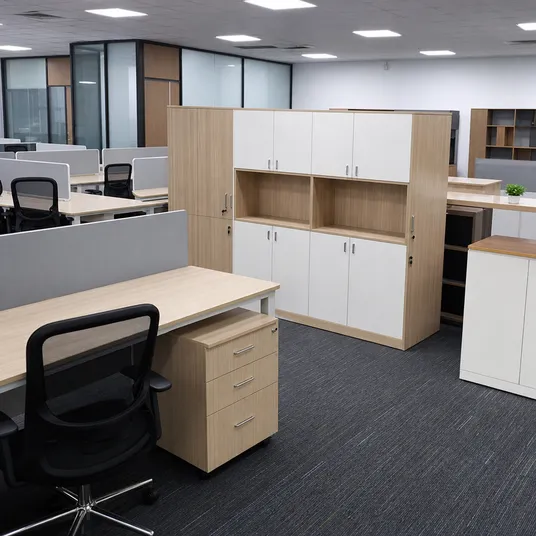
Office Furniture
Desks, storage units, partitions, and modular office systems. Low-emission glue systems (E0 or CARB P2) are increasingly specified for office environments, particularly in North American and European markets.
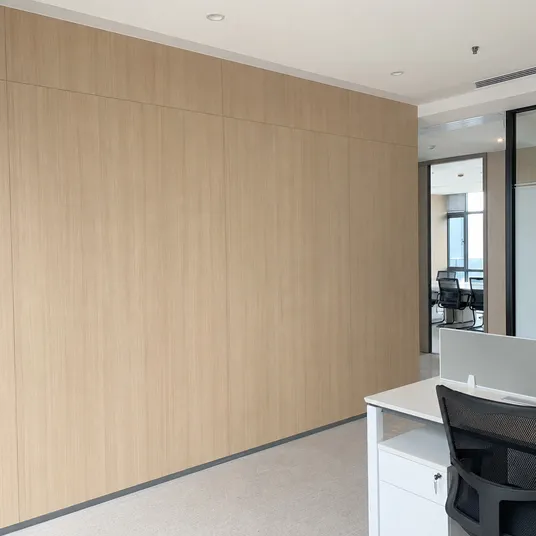
Interior Wall Paneling
Feature walls, wainscoting, and decorative paneling in commercial and residential fit-out. Larger sheet sizes reduce joint frequency and improve the finished appearance. Custom dimensions are available for specific panel module requirements.
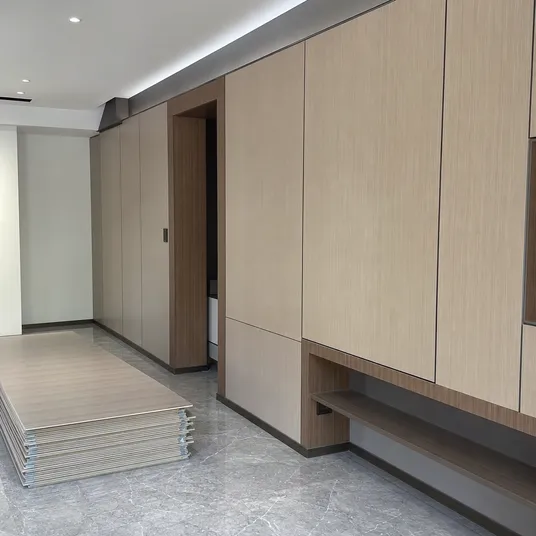
Hospitality & Contract Interiors
Hotel rooms, restaurant fit-outs, and contract furniture programs. High-volume, consistent supply is the primary requirement. OEM programs with private-label documentation are well-suited to contract interior distributors supplying multiple project sites.
Application Specification Quick Reference
Common thickness and core specifications by application type. Custom specifications available on confirmed orders.
| Application | Typical Thickness | Core / Glue | Surface Grade |
|---|---|---|---|
| Cabinet carcasses | 15mm – 18mm | E1 / E0 | B/BB |
| Kitchen / bathroom | 15mm – 18mm | MR / WBP | B/BB or better |
| Shelving (load-bearing) | 18mm – 25mm | E1 / E0 | BB/BB |
| Drawer boxes / backs | 9mm – 12mm | E1 | BB/CC |
| Wall paneling | 9mm – 12mm | E1 / E0 | B/BB |
| Office furniture | 15mm – 18mm | E0 / CARB P2 | B/BB |
Export Logistics: Container Loading and Documentation for Melamine Plywood
From container utilization to customs clearance — here's how melamine plywood ships from our Xuzhou facility to your warehouse.
Container Loading
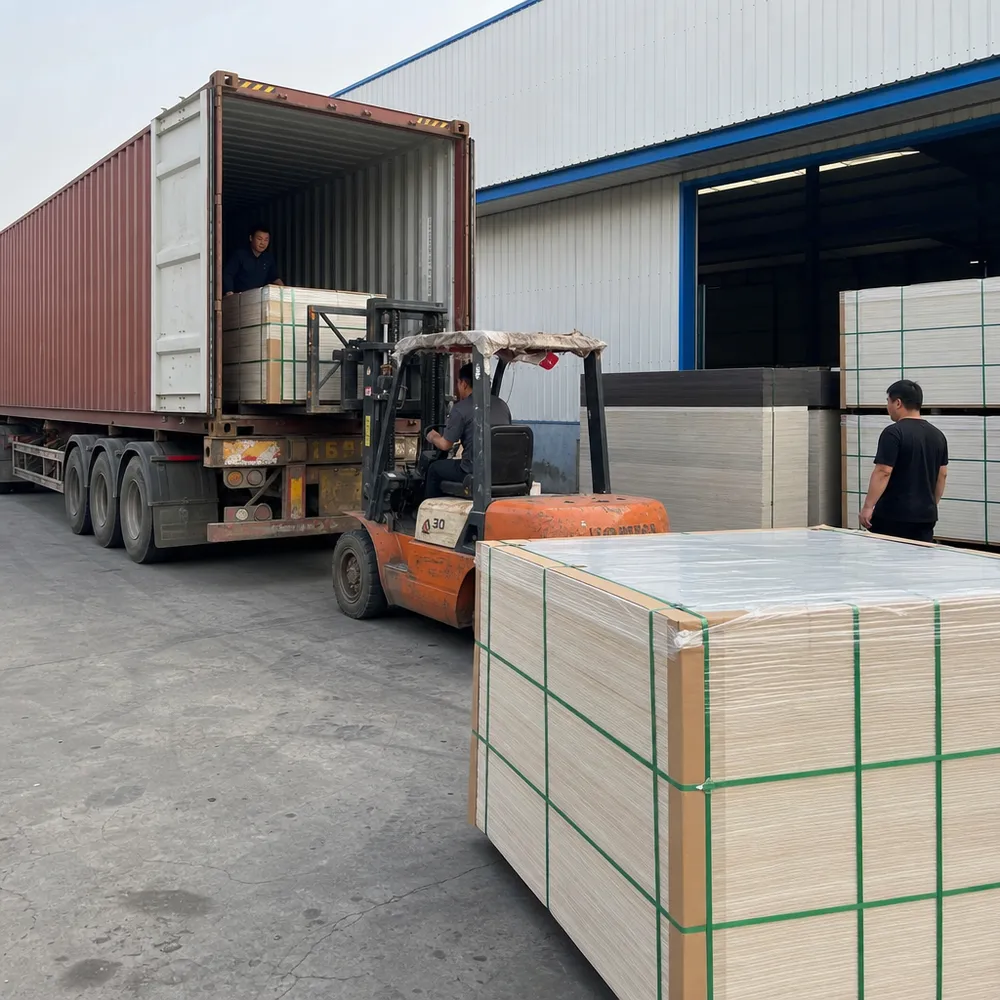
Standard 1220×2440mm panels ship efficiently in 20HQ and 40HQ containers. Panels stack flat for high utilization — a 40HQ container typically carries 18–22 m³ of melamine plywood depending on thickness and stacking configuration.
We provide a loading plan with each shipment so your receiving team knows the exact bundle count and stacking arrangement before the container arrives.
Panels are bundled in packs of 50–100 sheets depending on thickness, strapped and edge-protected with corner boards. The top sheet of each bundle is protected with a moisture-resistant film wrap. The melamine surface is the finish — surface protection during transit is part of our packaging specification, not an afterthought.
Xuzhou connects to Qingdao, Shanghai, and Lianyungang ports. Transit times to major destination ports run 18–35 days depending on routing and destination market.
Export Documentation
We've been through enough customs clearance cycles in North America, Europe, and the Middle East to know what documentation gaps cause delays. The paperwork is prepared to avoid them.
Full CARB documentation package included as standard on all US-bound shipments. No separate request needed.
Chain-of-custody documentation included on confirmed FSC orders for buyers with sustainability sourcing policies.
CE declaration of conformity included as standard for all European Union destination shipments.
Certifications Covering Your Key Import Markets
These four certifications cover the procurement gates in our main export markets. Audit reports and certification documents are available on request — we don't make buyers chase documentation.
Quality Management System
Process consistency and traceability across the full manufacturing operation.
Formaldehyde Emission Limit
Required for California market access. CARB documentation package included as standard on US-bound shipments.
Wood Fiber Traceability
Fiber traceability to certified forests. Chain-of-custody records available on confirmed FSC orders.
Construction Product Compliance
EU market compliance for construction products. CE declaration of conformity included on all EU-bound shipments.
| Certification | Market Coverage | What It Covers |
|---|---|---|
| ISO 9001:2015 | Global | Quality management system — process consistency and traceability |
| CARB P2 | USA (California + broader US market) | Formaldehyde emission limit — required for California market access |
| FSC Chain of Custody | Global (sustainability-audited buyers) | Wood fiber traceability to certified forests |
| CE | European Union | Construction product compliance for EU market |
Audit reports and certification documents are available on request. We don't make buyers chase documentation.
For US-bound shipments, the CARB documentation package is included as standard — no separate request required.
For EU shipments, CE declaration of conformity is included as standard. FSC chain-of-custody records available on confirmed FSC orders.
Frequently Asked Questions
Specification and sourcing questions we hear most often from furniture manufacturers, distributors, and importers.
The substrate is the difference. Melamine plywood uses a cross-grain veneer core — multiple layers of wood veneer pressed together — which gives it better screw-holding strength, impact resistance, and dimensional stability under load compared to MDF. Melamine MDF uses a medium-density fiberboard core, which machines more cleanly and holds a sharper routed edge, but is heavier and less resistant to moisture.
For cabinet carcass construction where the panel carries load and holds fasteners, melamine plywood is the stronger specification. For door fronts and decorative panels where machining quality matters more than structural performance, melamine MDF is often preferred.
Industry practice: Most furniture manufacturers use both — carcass in melamine plywood, doors in melamine MDF.
18mm is the standard carcass thickness across European and North American kitchen cabinet systems. It provides adequate load-bearing capacity for shelf spans up to 900mm and holds cam locks and dowels cleanly in standard cabinet assembly.
If you're supplying into a market with established cabinet system standards, 18mm in MR glue specification covers the majority of applications without needing to manage multiple thickness SKUs.
Adequate for dry interior applications — bedroom furniture, office furniture, shelving in climate-controlled environments.
Right specification for kitchen and bathroom cabinet applications where the panel will be exposed to humidity cycling.
Specified for applications with direct water contact or outdoor exposure.
Distribution recommendation: For most furniture distribution businesses, stocking 18mm melamine plywood in MR glue covers the majority of customer applications without needing to manage multiple glue system SKUs.
Surface lifting is almost always a press parameter problem — incomplete bonding between the melamine paper and the substrate due to insufficient temperature, pressure, or press cycle time. It can also result from pressing onto a substrate with elevated moisture content.
When evaluating a supplier, ask specifically about their press parameter logging and in-process bond testing protocol.
Supplier shows batch-level press records and peel test results — failures are caught in-process before they compound.
Supplier only tests finished panels at the end of the line — catching failures after they've already been produced.
MOQ for custom decor production depends on the paper sourcing requirement.
Solid colors and common wood grains that our paper suppliers stock. Lower MOQ, faster lead time.
Specific colors or patterns not in the standard catalog. Requires minimum paper order from the supplier.
Private-label recommendation: Start with catalog decors to establish the program and move to custom papers once volume justifies the sourcing commitment.
Yes — we produce melamine plywood to CARB P2 emission standards as the baseline for export production. CARB P2 is the most stringent formaldehyde emission limit in our export markets, and we formulate to meet it rather than treating it as a special option.
The CARB documentation package is included as standard. If you're supplying into California or other CARB-regulated markets, the compliance documentation is ready without additional lead time.
Start Your Melamine Plywood
Sourcing
Most buyers new to our melamine plywood range start with a sample order across two or three decors in 18mm — enough to run through your own quality check and show your customers before committing to a full container. We can ship samples within 7–10 working days.
If you already have a specification — thickness, decor, glue system, volume, destination market — send it to us directly and we'll come back with a detailed quote and the relevant certification documentation for your import requirements.
Sample shipment within 7–10 working days. Full container quotes returned with certification documentation.