

Kitchen Melamine MDF
Factory-Direct for Volume Buyers
Kitchen-grade melamine MDF engineered for cabinet production — flat, stable, and surface-ready out of the box. Consistent thickness tolerance, low-formaldehyde core, and a surface that holds edge banding without pre-treatment.
Built for buyers who run production lines, not one-off projects.
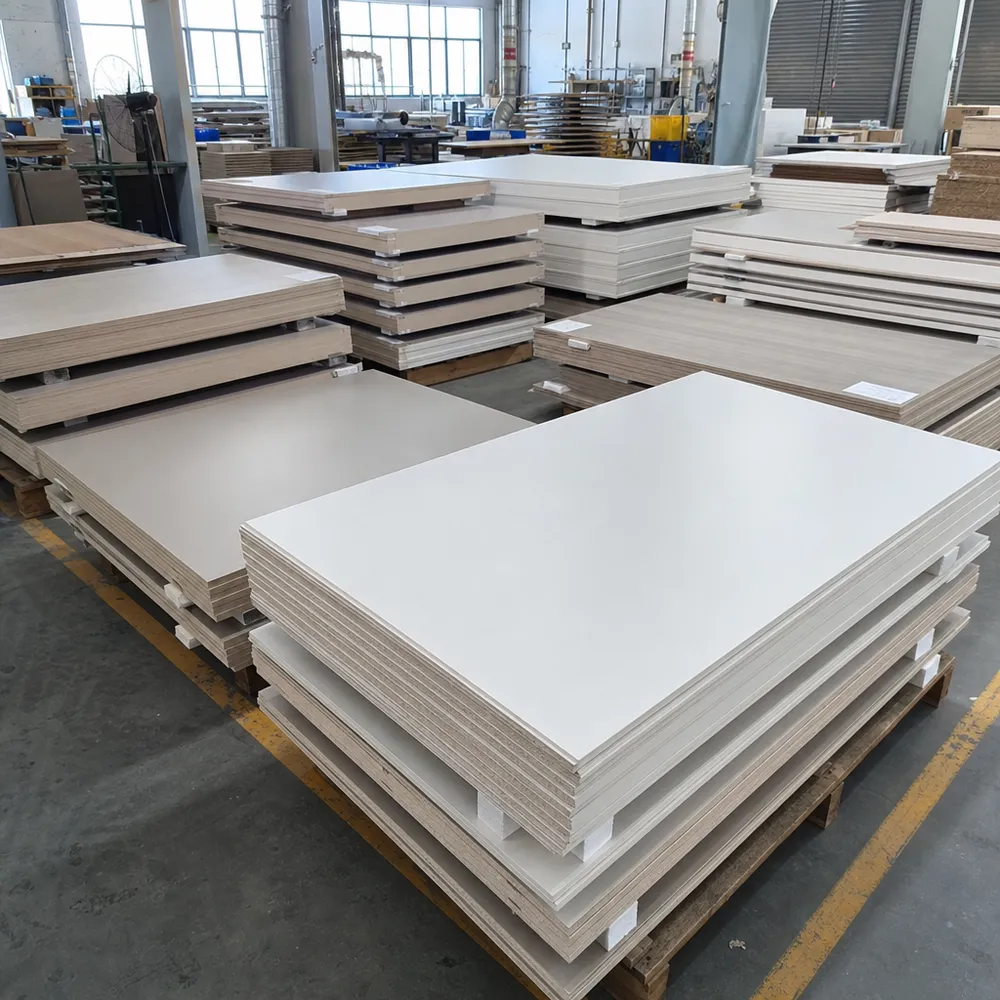
What Kitchen Melamine MDF Is — and Where It Sits in the Cabinet Supply Chain
Kitchen melamine MDF is medium-density fiberboard with a melamine-impregnated paper overlay pressed directly onto both faces under heat and pressure. The result is a panel that arrives at your customer's factory or workshop with a finished, cleanable surface — no painting, no laminating, no additional surface prep required before cutting and assembly.
The distinction from standard melamine MDF matters commercially. Kitchen-grade panels are specified for higher moisture exposure than general interior applications — cabinet interiors, door panels, and carcass sides in kitchens and bathrooms see steam, cleaning chemicals, and humidity cycling that would cause a standard decorative panel to swell at the edges or delaminate at the face.
The MDF core density and the resin system in the melamine paper both need to be calibrated for that environment. We run kitchen melamine MDF on a dedicated pressing schedule with a higher-resin melamine paper — typically 120–130 g/m² basis weight — than we use for standard furniture-grade panels. The extra resin content is what gives the surface its resistance to moisture penetration and chemical cleaning.
For your downstream customers — cabinet manufacturers, kitchen fitters, joinery shops — this means they're buying a panel that goes straight into production without an additional finishing step. That's a real cost saving on their end, and it's the reason kitchen melamine MDF commands a margin premium over raw MDF in most markets. Your buyers are paying for the surface, not just the substrate.
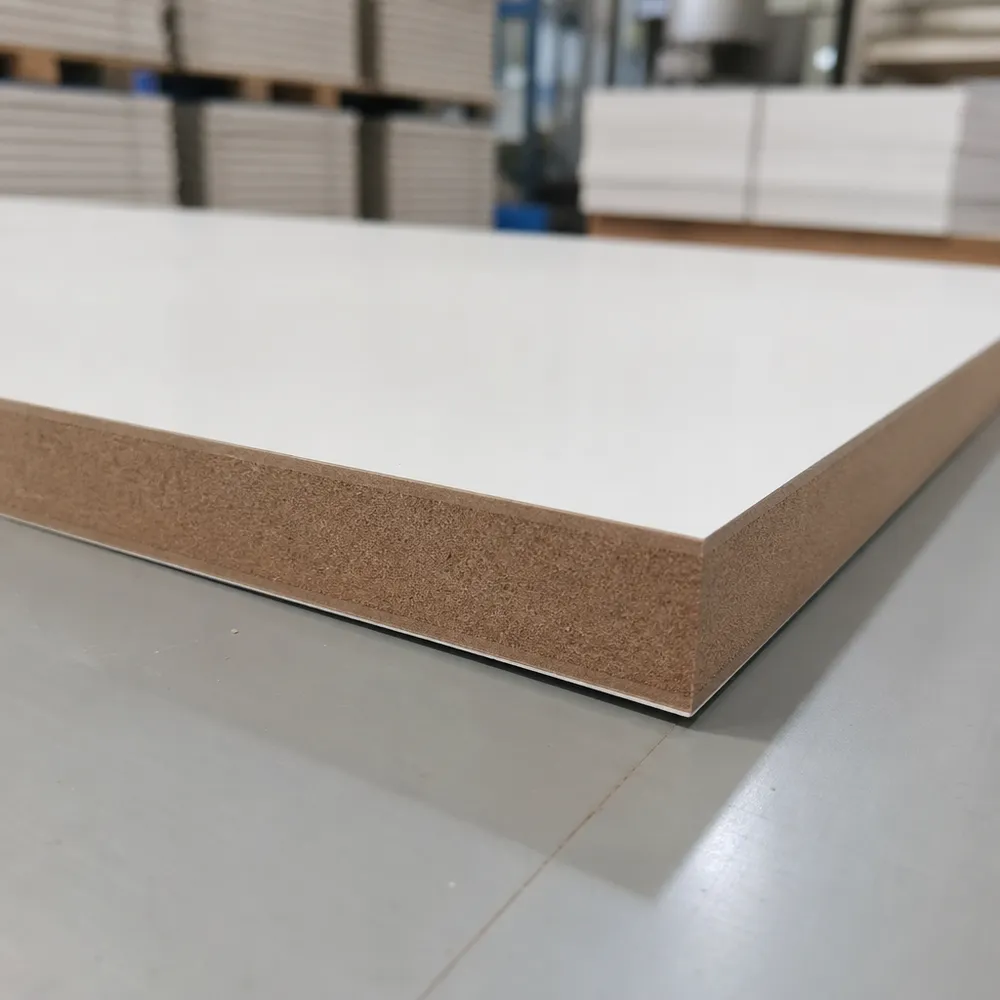
Moisture-Calibrated Core
Higher core density and resin system engineered for kitchen and bathroom humidity cycling.
Surface-Ready Panels
No painting, laminating, or surface prep needed. Straight into production on arrival.
Margin Premium
Commands a price premium over raw MDF. Buyers pay for the finished surface, not just substrate.
Edge Banding Ready
Surface holds edge banding without pre-treatment — no additional adhesion prep step required.
Technical Specifications
These are industry-standard parameters for kitchen melamine MDF. Actual specifications vary by order — contact us with your target application and we'll confirm exact values.
Kitchen Melamine MDF — Standard Parameters
| Parameter | Typical Specification |
|---|---|
| Core material | E1/E0 MDF (medium-density fiberboard) |
| Core density | 680–750 kg/m³ |
| Melamine paper weight | 120–130 g/m² (kitchen-grade) |
| Standard thickness | 15mm, 16mm, 18mm (most common for cabinet carcass) |
| Available thickness range | 9mm – 25mm |
| Standard panel size | 1220 × 2440mm |
| Custom sizes | Available on confirmed orders |
| Surface finish | Matte, satin, or textured (woodgrain, solid color) |
| Surface hardness | ≥ 3H pencil hardness (Taber abrasion resistant) |
| Moisture resistance | MR (moisture-resistant) grade core available |
| Formaldehyde emission | E1 standard (≤ 0.124 mg/m³); CARB P2 available |
| Thickness tolerance | ±0.2mm |
| Squareness tolerance | ≤ 2mm per 1000mm |
| Color options | White, off-white, woodgrain, solid colors — custom available |
Specifications shown are industry-standard values for this product type. Contact us for detailed product data sheets and confirmation of exact parameters for your order.
Ready to confirm specs for your order?
Include thickness, size, surface color, and destination market — we'll come back with pricing and lead time.
Key Parameters at a Glance
Compliance & Standards
Certification availability varies by mill. Confirm required certifications when placing your inquiry.
Moisture-Resistant (MR) Core
For sink cabinets, under-bench units, and humid environments, specify MR-grade core. Provides improved dimensional stability under intermittent moisture exposure — not a waterproof product.
Surface Finishes & Color Range
Kitchen melamine MDF ships with the decorative surface already bonded. No additional finishing required. Choose from standard stocked colors or specify custom decors for larger orders.
Matte Finish
Flat, non-reflective surface. Most popular for contemporary kitchen cabinetry. Hides minor surface marks and fingerprints well.
Satin Finish
Low-gloss sheen between matte and gloss. Balances cleanability with a refined appearance. Common in mid-range and premium kitchen lines.
Textured / Woodgrain
Embossed surface texture synchronized with the printed decor. Provides tactile depth and a more natural appearance for woodgrain patterns.
Standard Color Families
Whites & Neutrals
Pure white, off-white, cream, and warm neutral tones. The most-ordered color family for kitchen cabinetry globally.
Woodgrain Decors
Oak, walnut, teak, wenge, and pine patterns. Printed and embossed to replicate natural timber grain.
Greys & Anthracite
Light grey through to deep anthracite. Strong demand in European and Australian kitchen markets.
Solid & Custom Colors
Greens, blues, terracotta, and deep tones. Custom decors available for container-quantity orders.
Custom Decor & Color Matching
For orders of sufficient volume, we can source panels in custom decors matched to your brand palette or existing range. Minimum quantities apply and lead times are longer than standard stock. Send us your target color reference (RAL, NCS, or physical sample) and we'll advise on feasibility.
Where Kitchen Melamine MDF Is Used
The combination of a hard, cleanable surface and a stable MDF core makes this panel the default substrate across residential and commercial kitchen manufacturing.
Cabinet Carcass & Box Construction
The primary use case. Side panels, base panels, top panels, and internal shelving for base and wall cabinet units. 16mm and 18mm are the dominant thicknesses.
Cabinet Door Blanks
Flat-panel and slab door construction. Melamine surface provides a ready-to-use face without additional painting or laminating. Often used for budget and mid-range door production.
Drawer Boxes & Internal Components
Drawer sides, bottoms, and dividers. The smooth melamine interior surface is easy to clean and resists moisture from everyday kitchen use.
Shelving & Interior Fitout
Fixed and adjustable shelving within pantry units, tall cabinets, and larder units. Also used in retail display fitout and commercial kitchen storage.
Commercial & Hospitality Kitchens
Hotel room kitchenettes, apartment fit-outs, student accommodation, and commercial break-room cabinetry. High-volume projects benefit from consistent panel quality and surface uniformity.
Who Buys This Product
Not Sure Which Thickness or Grade?
Tell us your application — cabinet carcass, door blank, shelving, or drawer box — and your target market. We'll recommend the right thickness, core grade, and surface finish for your use case.
How We Press Kitchen Melamine MDF: The Process Details That Affect Your Margin
The surface quality of melamine MDF is determined almost entirely at the pressing stage — and pressing is where most quality variation in this product category originates. Here's what we do differently, and why it matters when your customer runs the panels through a CNC router or edge bander.
Short-Cycle Lamination Press
160–180°C calibrated to paper weight and core density
We use a short-cycle lamination press for melamine paper application, running at 160–180°C with press times calibrated to the paper weight and core density. The critical variable is temperature uniformity across the press platen — a 5°C differential across a 1220×2440mm panel produces visible gloss variation on the finished surface, which shows up as a reject when your customer cuts the panel and the face color doesn't match across pieces.
Platen Uniformity Verification
Quarterly checks + test panel at every batch start
Our press platens are checked for temperature uniformity quarterly, and we run a test panel at the start of each production batch to verify surface consistency before committing the full run. We added this step after a batch of woodgrain panels came out with a subtle banding pattern — not visible on the full sheet, but obvious once cut into 600mm cabinet doors. That's the kind of defect that generates returns, not just complaints.
E1 / CARB P2 Core Sourcing
No blending of kitchen-grade and standard-grade cores
The MDF core we use for kitchen-grade panels is sourced from mills running E1 or CARB P2 formaldehyde emission specifications. We don't blend kitchen-grade and standard-grade cores on the same pressing run — the core density affects press time, and mixing densities in a single batch produces inconsistent surface adhesion.
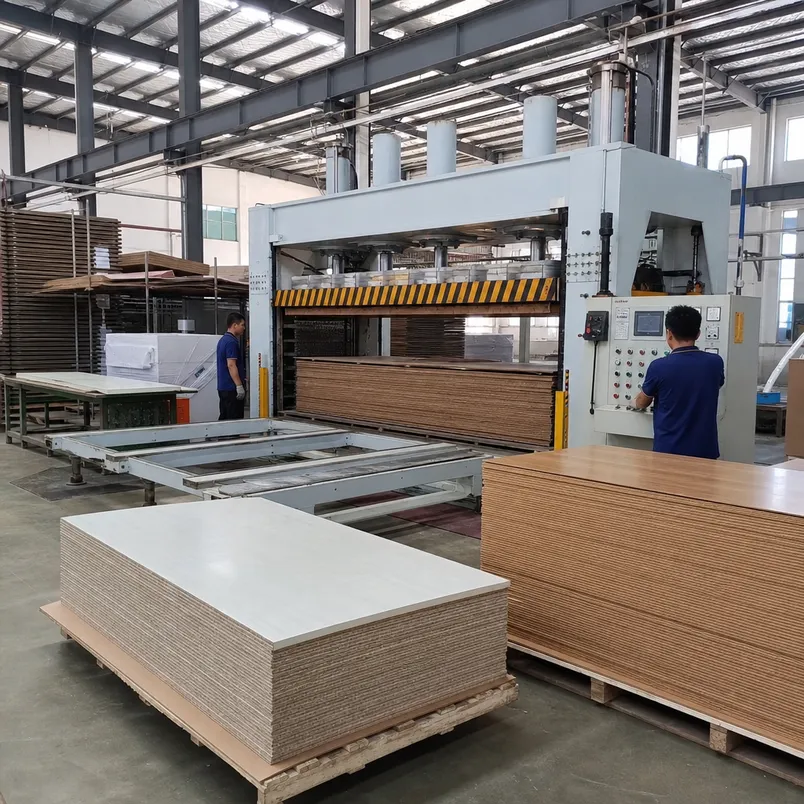
Full Batch Traceability
Each production batch is logged with core supplier, paper lot, press parameters, and QC results, so if a surface issue surfaces downstream, we can trace it to the specific run and identify whether it was a material or process issue.
Edge Quality for Direct Banding
Kitchen melamine MDF panels are trimmed on precision saws after pressing, and the edge condition determines whether edge banding adheres cleanly without pre-sanding. We trim to a 90° edge with a surface roughness that allows direct edge banding application — your customer's edge bander doesn't need to run a pre-sanding pass, which saves time on every linear meter of cabinet carcass they produce.
Why the 5°C Rule Matters for Your Customer's Production
A 5°C differential across a 1220×2440mm panel produces visible gloss variation on the finished surface. This shows up as a reject when your customer cuts the panel and the face color doesn't match across pieces — generating returns, not just complaints. Temperature uniformity across the full platen is the single most important variable in kitchen melamine MDF surface quality.
Market Segments Where Kitchen Melamine MDF Generates Repeatable Volume
Three buyer segments drive consistent, high-volume demand for kitchen melamine MDF. Each has distinct order patterns, specification requirements, and commercial logic for the distributor or importer supplying them.
Cabinet Manufacturers Supplying Kitchen Retailers and Developers
This is the highest-volume segment for kitchen melamine MDF globally. Cabinet manufacturers — from small joinery shops to large-scale flat-pack producers — consume melamine MDF in consistent, repeatable volumes tied to their production schedules.
A mid-size cabinet manufacturer running 50–100 kitchens per month will order 200–400 sheets of 18mm melamine MDF per order cycle, with reorders every 4–8 weeks. The product specification is fixed once the manufacturer has qualified a supplier, so the relationship is sticky — switching costs are real because re-qualifying a new panel supplier means re-running edge banding and CNC settings.
For distributors supplying this segment, the commercial logic is straightforward: once you're the qualified supplier for a cabinet manufacturer, you own that volume until something goes wrong. The margin on kitchen melamine MDF is typically higher than on raw MDF because the surface finish is a value-add that the manufacturer is paying for, not just a commodity substrate.
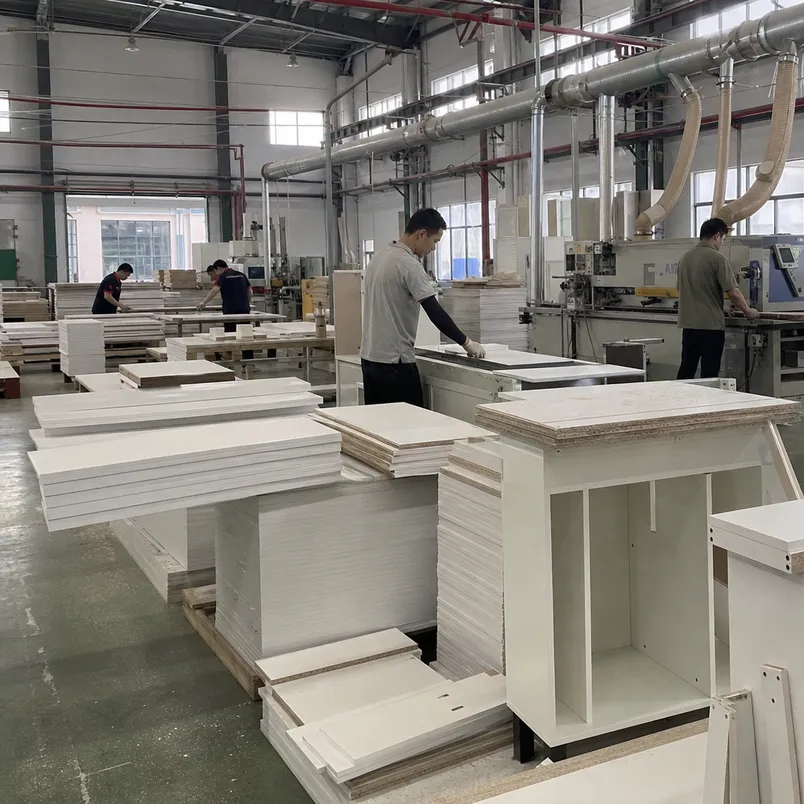
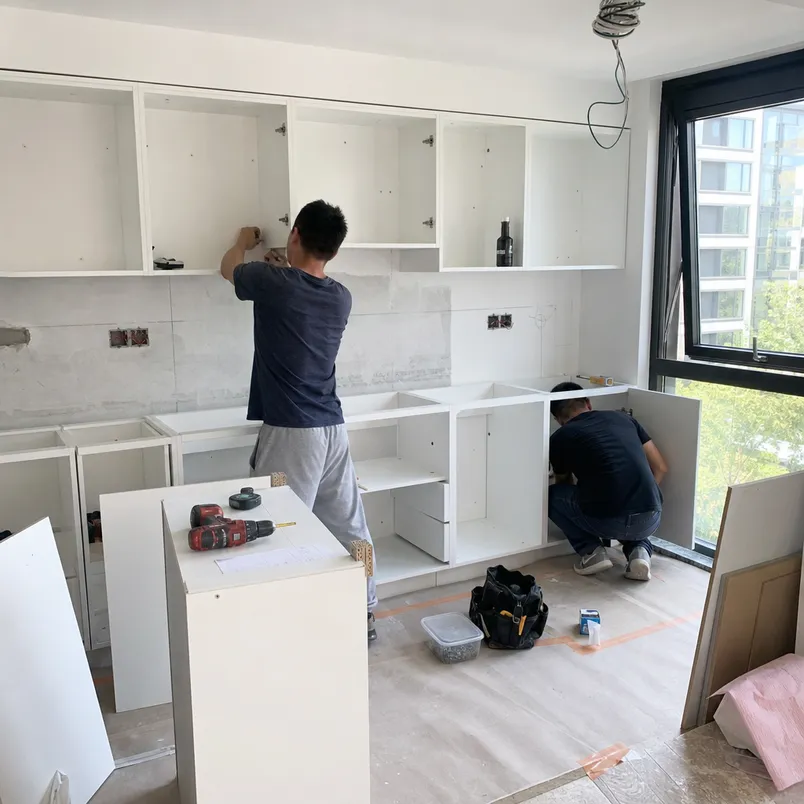
Kitchen Renovation Contractors and Fit-Out Companies
Contractors running kitchen renovation projects — residential developments, hotel refurbishments, commercial fit-outs — buy kitchen melamine MDF in project-specific volumes that are larger and less frequent than manufacturer orders. A 50-unit residential development might require 2,000–4,000 sheets across the project, ordered in 2–3 tranches as construction phases progress.
The specification is set by the project architect or interior designer, and the contractor needs a supplier who can hold the same color and finish across multiple deliveries. Color consistency across batches is a real issue in this segment — if the first delivery is slightly warmer white than the second, the contractor has a problem on site.
Lot-Locked Color Consistency
We address cross-batch color variation by logging the melamine paper lot number for each order and holding reserve stock of the same lot for follow-on deliveries on confirmed projects. It's not a standard practice in the industry, but it's the kind of thing that prevents a contractor from having to repaint cabinet doors to match.
Overseas Furniture Manufacturers Sourcing Finished Panel
Furniture manufacturers in markets where local MDF production is limited — parts of Southeast Asia, the Middle East, East Africa — import kitchen melamine MDF as a finished panel rather than sourcing raw MDF and laminating locally. The economics work when local lamination capacity is expensive or inconsistent: importing a finished panel at a slightly higher per-sheet cost is cheaper than running a lamination line with high reject rates.
For importers and distributors serving this segment, kitchen melamine MDF is a higher-margin SKU than raw MDF because the value-add is built in. Container utilization is the same — 1220×2440mm panels load identically regardless of surface finish — so the freight cost per sheet is the same, but the selling price is higher.
Key Import Markets for Finished Panel
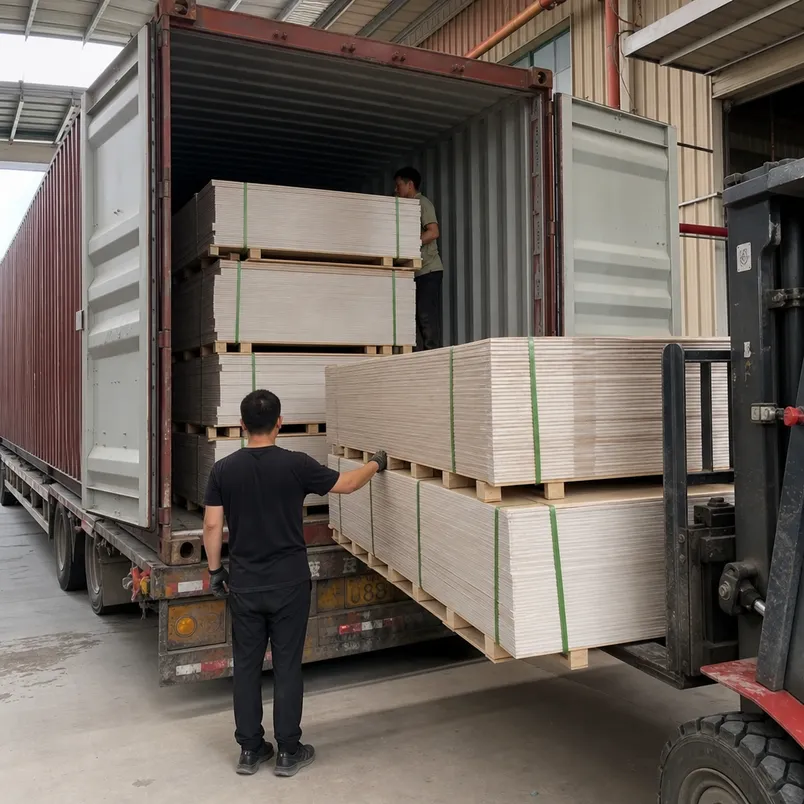
The Container Economics Argument
1220×2440mm panels load identically regardless of surface finish — freight cost per sheet is the same for raw or finished panel
Finished panel selling price is higher — the value-add is built in, margin is captured at source
Importing finished panel eliminates local lamination line costs and reject rate risk for the buyer
Sourcing for Any of These Segments?
Whether you're qualifying a panel supplier for a cabinet manufacturer, holding color across a multi-tranche project, or importing finished panel for a market with limited local lamination — we can discuss the specifics.
Customization: What We Can Specify, What Affects MOQ
Kitchen melamine MDF customization falls into three categories: surface, dimension, and core specification. Here's what's practical at different order volumes.
Surface Customization
Color and Pattern
Standard colors in stock: white, off-white, light grey, beige, and common woodgrain patterns (oak, walnut, maple). Custom colors and patterns are available with a minimum order of 500 sheets per color.
Melamine paper is sourced to your specified color reference (RAL, Pantone, or physical sample). We press a first-article sample for your approval before committing the production run.
Gloss Level
Matte and satin finishes are standard. High-gloss kitchen melamine MDF is a separate product with a different pressing process.
See High-Gloss Melamine MDFTexture
Woodgrain embossing (synchronized or non-synchronized) is available. Synchronized pore texture — where the emboss pattern aligns with the printed woodgrain — requires a matched paper and press plate combination.
Dimension Customization
Panel Size
Standard 1220×2440mm panels are available from stock. Custom sizes — 1220×2800mm, 1220×3050mm, or non-standard widths — are available on confirmed orders.
We cut to size on precision saws. There's no tooling cost for custom dimensions, just a yield consideration that affects pricing.
Thickness
Thickness customization within the 9–25mm range is available. 18mm is the most common for cabinet carcass; 15mm and 16mm are common for door panels and drawer fronts.
Core Specification
Moisture-Resistant (MR) Core
For applications with higher humidity exposure — under-sink cabinets, bathroom vanities — we can specify an MR-grade MDF core with a green-dyed cross-section (the standard visual indicator for MR grade).
CARB P2 Core
For US-bound shipments, we source CARB P2-compliant MDF core as standard for kitchen melamine MDF orders. The CARB documentation package is included with the shipment.
E0 Ultra-Low Formaldehyde
Available on request for markets with stricter emission requirements. Confirm via inquiry — pricing and lead time differ from standard E1.
MOQ Reference Summary
Minimum order quantities by customization type
| Customization Type | Specification | MOQ | Notes |
|---|---|---|---|
| Color / Pattern | Custom color (RAL, Pantone, sample) | 500 sheets/color | First-article sample approval before production run |
| Texture | Synchronized pore embossing | 1,000 sheets/pattern | Matched paper and press plate required |
| Panel Size | Non-standard dimensions | 200 sheets/size | No tooling cost; yield affects pricing |
| Thickness | Non-standard (e.g. 17mm, 20mm) | 300 sheets | 9–25mm range available |
| MR Core | Moisture-resistant MDF core | Same as standard | Green-dyed cross-section; material sourcing change only |
| CARB P2 Core | US-compliant formaldehyde emission | Standard for US orders | Documentation package ships with order |
| E0 Core | Ultra-low formaldehyde | Confirm via inquiry | Pricing and lead time differ from E1 |
Send Your Customization Requirements
Include target market, application, and volume and we'll confirm feasibility and pricing.
Certifications and Compliance for Your Import Market
The certifications we hold on kitchen melamine MDF are the ones that matter at customs and in downstream market compliance.
CARB P2
US MarketFormaldehyde emission compliance for the US market. The CARB documentation package — including the composite wood product (CWP) certification and chain-of-custody records — ships with every US-bound order. No additional documentation chase required on your end.
FSC Chain of Custody
SustainabilityWood fiber traceability for buyers with sustainability sourcing requirements or customers in markets where deforestation-linked supply chains are a regulatory or reputational risk.
ISO 9001:2015
Quality ManagementQuality management system certification covering our production and QC processes.
CE
EU MarketApplicable for European construction and building material applications.
EU Buyers
The melamine surface meets EN 14322 (melamine-faced boards for interior use) performance requirements — surface abrasion resistance, moisture resistance, and formaldehyde emission. Test reports available on request.
VOC & Indoor Air Quality Markets
For buyers supplying into markets with specific VOC or indoor air quality regulations, confirm your target standard when inquiring and we'll specify the appropriate core and resin system.
Documentation Package
Standard documentation shipped with every order includes test reports, certificate copies, and a material safety data sheet. Additional documents — third-party lab reports, country-of-origin declarations, or customs-specific formats — available on request.
Request the Full Certification Package
Tell us your target market and application and we'll send the relevant certificates and test reports.
Where Kitchen Melamine MDF Is Used
The surface and core properties of kitchen melamine MDF make it the default substrate for cabinet and furniture manufacturers across price tiers and markets.
Cabinet Carcasses
Base and wall cabinet boxes — the primary volume application. Consistent thickness and flatness are critical for assembly line efficiency and door alignment.
Cabinet Doors & Drawer Fronts
Flat-panel and routed door profiles. Surface quality and edge machinability determine finish quality and edge-banding adhesion.
Shelving & Interior Panels
Fixed and adjustable shelves, back panels, and dividers. Moisture resistance matters here — especially in base cabinets near sinks and dishwashers.
Wardrobe & Bedroom Furniture
The same substrate used in kitchen cabinetry translates directly to wardrobe systems, bedroom carcasses, and fitted furniture — same tooling, same process.
Commercial Fit-Out
Office joinery, retail display units, and hospitality millwork where a durable, cleanable surface is required at scale and budget.
Flat-Pack & RTA Furniture
Ready-to-assemble furniture for retail and e-commerce. Consistent panel dimensions and surface quality reduce returns and assembly complaints.
Not sure which spec fits your application? Share your end-use details — cabinet type, market, and any relevant standards — and we'll recommend the right thickness, core, and surface combination. Get a recommendation →
Container Loading and Export Packaging
Kitchen melamine MDF ships in standard 20GP and 40HQ containers. Loading quantities depend on thickness — use the figures below to plan your order volume and freight cost per sheet.
Loading Quantities by Thickness
| Thickness | Sheets / 20GP | Sheets / 40HQ |
|---|---|---|
| 15mm | ~900 sheets | ~1,900 sheets |
| 16mm | ~850 sheets | ~1,800 sheets |
| 18mm | ~750 sheets | ~1,600 sheets |
| 25mm | ~540 sheets | ~1,150 sheets |
Loading quantities are approximate for standard 1220×2440mm panels. Actual quantities depend on packing configuration and mixed-thickness loads.
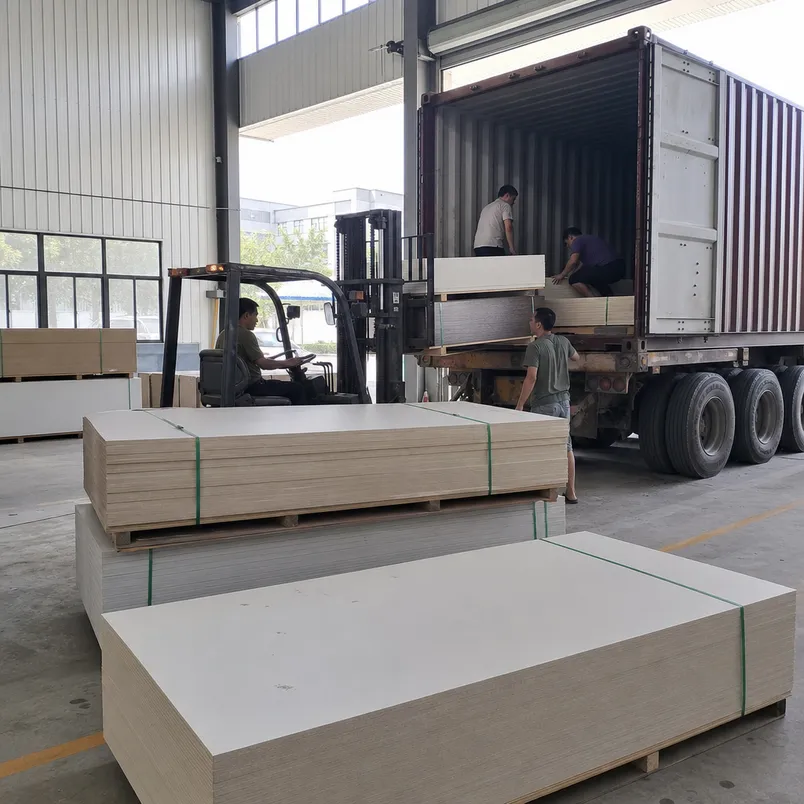
Container Type Guide
A 20GP suits smaller initial orders or mixed-product shipments. A 40HQ roughly doubles your sheet count per freight dollar — the preferred choice once you've confirmed your color and thickness mix. For mixed-thickness loads, we calculate actual quantities at order confirmation.
Bundle Packing
Panels are bundled in packs of 50–100 sheets, strapped, and wrapped in moisture-resistant film. Each bundle is clearly marked with product specification, color code, thickness, batch number, and destination port.
Corner Board Protection
Corner boards protect edges during transit. Edge damage on melamine panels is the most common transit defect — and it's entirely preventable with proper corner protection. We apply corner boards as standard on every bundle.
Custom & Blind Shipping
For e-commerce or retail distribution buyers, we apply custom labels and packaging per your brand requirements on orders over 500 sheets. Blind shipping — no QDPlywood.com markings on outer packaging — is available for distributors protecting their supply chain.
Sourcing Kitchen Melamine MDF vs. Kitchen Melamine Plywood: The Commercial Trade-Off
Buyers evaluating kitchen cabinet board often compare melamine MDF against melamine plywood. The choice affects your downstream customer's production cost and your own margin structure. Here's how to think through it.
The fiberboard core has no grain direction, so there's no risk of face veneer telegraphing through the melamine surface under humidity cycling.
The surface is smoother and color is more uniform across the panel — the dominant choice in most markets for these finish types.
If you're building a product line covering both segments, we supply both from the same factory with consistent certification documentation.
For applications requiring repeated drilling and re-drilling of hinge screws, plywood holds better over time.
Relevant for frameless cabinets with concealed hinges that will be adjusted repeatedly — plywood holds the hinge screw better over time.
Relevant for large cabinet carcasses where weight matters for installation, or for applications where the panel will be drilled and re-drilled multiple times.
Grain direction in the plywood core can cause face veneer to telegraph through the melamine surface under humidity cycling — a risk for solid-color finishes.
MDF is the standard choice in most markets for painted or solid-color finishes due to its smoother, more uniform surface.
How the Choice Affects Your Margin Structure
The choice between melamine MDF and melamine plywood affects your downstream customer's production cost and your own margin structure in two ways:
Surface finish requirements drive the decision in most markets
For painted or solid-color finishes, MDF is the standard choice because the surface is smoother and color is more uniform across the panel. If your customers are specifying these finishes, MDF is the lower-risk sourcing choice.
Application mechanics determine where plywood wins
If your customers are building frameless cabinets with concealed hinges that will be adjusted repeatedly, plywood holds the hinge screw better over time. Weight per sheet also matters for large carcasses where installation labor is a cost factor.
If your market or customer base has a preference, or if you're building a product line that covers both segments, we can supply from the same factory with consistent documentation.
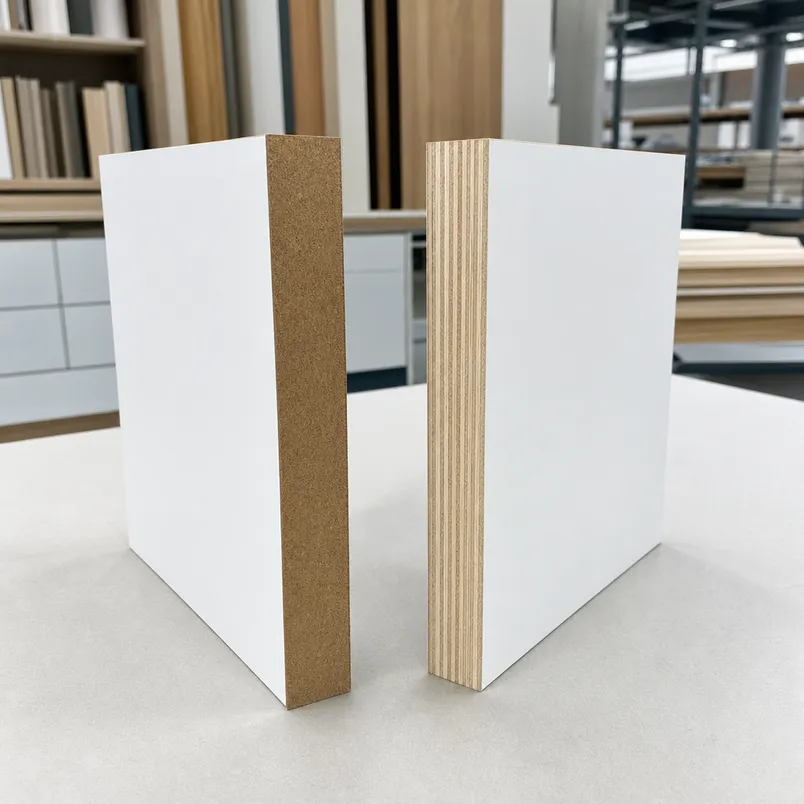
We Produce Both
If your market or customer base has a preference, or if you're building a product line that covers both segments, we can supply from the same factory with consistent documentation.
View Kitchen Melamine PlywoodQuick Reference: MDF vs. Plywood for Kitchen Cabinets
| Decision Factor | Melamine MDF | Melamine Plywood |
|---|---|---|
| Surface flatness & uniformity | Superior | Good |
| Painted / solid-color finishes | Standard choice | Less common |
| Screw-holding strength | Good | Superior |
| Weight per sheet (equiv. thickness) | Heavier | Lighter |
| Humidity cycling / veneer telegraphing risk | No risk | Possible |
| Frameless cabinets / repeated hinge adjustment | Adequate | Preferred |
Frequently Asked Questions
Common specification and sourcing questions from cabinet manufacturers, distributors, and importers.
18mm is the most common thickness for cabinet carcass sides, tops, and bottoms in most markets. 15mm and 16mm are used for door panels and drawer fronts where weight reduction matters. Some European cabinet manufacturers specify 19mm for carcass to match legacy tooling setups — we can produce 19mm on confirmed orders. If you're supplying a manufacturer who has an existing specification, confirm their current thickness before ordering.
Yes. The melamine surface covers both faces but not the edges — exposed MDF edges need edge banding or edge tape to prevent moisture ingress and to finish the appearance. This is standard practice in cabinet production. The edge condition of our panels is trimmed to allow direct edge banding application without pre-sanding, which saves your customer a step in their production process.
E1 is the European standard (≤ 0.124 mg/m³ air concentration). CARB P2 is the California Air Resources Board standard for composite wood products sold in the US — it's roughly equivalent to E1 in emission limits but requires a specific certification and documentation chain that E1 does not.
Important for US importers: If you're shipping to the US, you need CARB P2 documentation, not just E1 compliance. We supply CARB P2 documentation as standard for US-bound orders.
For trial orders from new buyers, we can discuss sample shipments — contact us with your target specification and we'll advise on the most practical way to qualify the product before committing to a full container.
We log the melamine paper lot number for each order. For confirmed projects requiring multiple deliveries, we hold reserve stock of the same paper lot to ensure color consistency across tranches. Specify this requirement when placing your first order and we'll confirm availability and reserve the lot.
Standard kitchen melamine MDF is suitable for bathroom vanity applications where the panel is not in direct water contact. For under-sink cabinets or areas with regular water exposure, specify MR-grade (moisture-resistant) core — the green-dyed cross-section is the standard visual confirmation.
Other Melamine MDF Products in This Range
If kitchen melamine MDF doesn't match your exact requirement, the other products in our melamine MDF range cover adjacent specifications.
Melamine MDF Board
Standard furniture-grade melamine MDF for general interior applications where kitchen-grade moisture resistance isn't required. Lower cost per sheet, same surface quality for dry environments.
White Melamine MDF
White-only specification with tighter color consistency tolerances, suited for buyers who need a single-color SKU with guaranteed batch-to-batch match.
High Gloss Melamine MDF
High-gloss surface for premium kitchen and bathroom cabinet fronts. Different pressing process, higher per-sheet cost, but commands a significant retail price premium in most markets.
18mm Melamine MDF
If your requirement is thickness-specific rather than application-specific, this page covers the 18mm specification across all surface options.
Browse the full melamine MDF range or contact us to discuss which specification fits your application.
Get a Quote for Kitchen Melamine MDF
Send us your specification and we'll come back with pricing, lead time, and the relevant certification documentation for your import requirements.
What to Include in Your Enquiry
The more detail you provide upfront, the faster we can return an accurate quote. Include the following in your message:
- Thickness and size — standard or custom dimensions
- Surface color or pattern — solid, woodgrain, or custom decor
- Core grade — E1, CARB P2, or MR (moisture-resistant)
- Destination market — determines which certification documentation applies
- Target volume — per order or annual estimate
New to this category? Most new buyers start with a sample order to test surface quality and edge condition with their own production equipment before committing to a full container. We can arrange samples — tell us what you need and we'll work out the most practical way to get product in your hands.
Xuzhou QD Wood Industry Co., Ltd.
Tongshan District, Xuzhou, Jiangsu Province, China
Xuzhou, Jiangsu Province, 221116, China
Certifications Available on Request