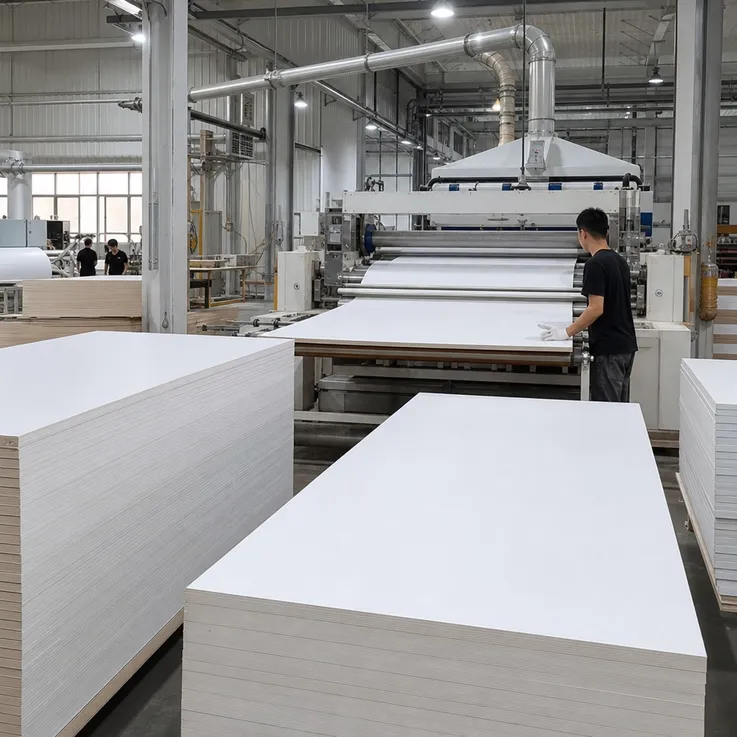
White Melamine MDF Manufacturer
Factory-direct white melamine MDF — clean, flat surface with CARB P2 and FSC certification built in.
We press white melamine paper directly onto MDF core under controlled heat and pressure, so the surface arrives ready for your downstream customer's cut-and-assemble process — no secondary finishing required.
What White Melamine MDF Is — and Where It Sits in the Product Range
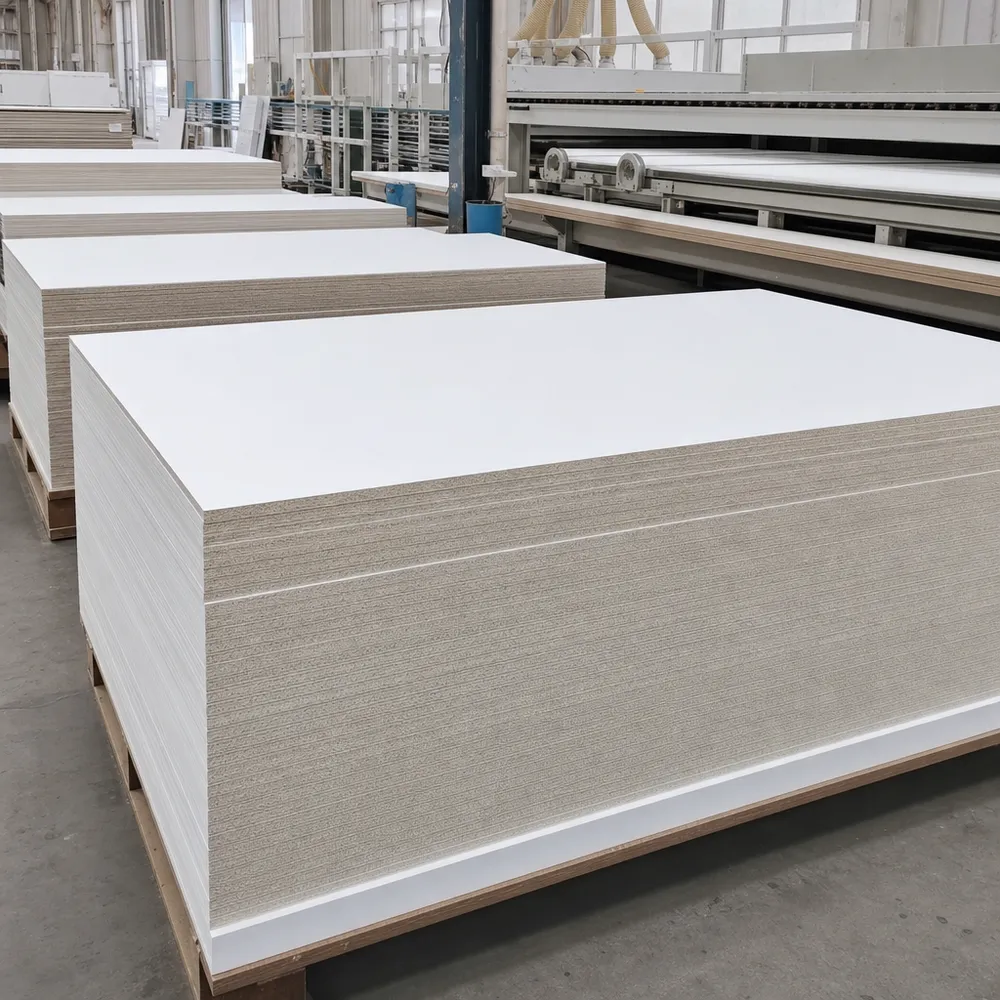
White melamine MDF is a medium-density fiberboard panel with a white melamine-impregnated paper surface fused to both faces under heat and pressure. The result is a panel with a smooth, hard, cleanable surface that arrives ready for cutting, edgebanding, and assembly — no painting, no laminating, no secondary surface prep required by your customer.
Within our melamine MDF range, white is the baseline specification. It's the highest-volume color we run, which means it's the most consistently available, the most competitively priced, and the one we've optimized our pressing parameters around. If you're building a furniture line, stocking a distribution warehouse, or supplying a cabinet shop, white is the SKU that moves.
Ready-to-use surface — no secondary finishing
The melamine paper is pressed directly onto the MDF core. Your downstream customer receives a panel they can cut, edgeband, and assemble immediately. No painting, no laminating, no additional surface prep in their workflow.
How White Compares in the Range
The distinction from our other melamine MDF variants matters for your sourcing decision.
White Melamine MDF
Workhorse SKU. Standard matte surface, full thickness range (3–25mm), broadest application fit, and the volume pricing that comes with being our most-produced product. Highest availability, most competitive price point.
High-Gloss Melamine MDF →
UV-lacquered or high-gloss paper overlay for a reflective finish. Higher cost, more fragile surface. Suited for premium cabinet fronts where the reflective finish is a selling point.
18mm Melamine MDF →
Thickness-specific product for buyers who need that exact dimension for cabinet carcass work. Optimized for the most common cabinet construction thickness.
Furniture Manufacturing
Building a furniture line? White melamine MDF is the panel your production line is already calibrated for — consistent surface, consistent thickness, consistent availability.
Distribution Warehousing
Stocking a distribution warehouse? White is the SKU that moves. Highest volume means fastest replenishment and the most competitive landed cost per panel.
Cabinet Shop Supply
Supplying a cabinet shop? The ready-to-use surface eliminates a finishing step from their workflow — a concrete cost and time advantage you can pass on to your buyer.
Technical Specifications
Industry-standard values for this product type. Actual specifications may vary by thickness and order specification. Contact us for detailed product data sheets and test reports.
White Melamine MDF — Full Specification Table
Specifications shown are industry-standard values for this product type. Actual specifications may vary by thickness and order specification. Contact us for detailed product data sheets and test reports.
±0.2mm Thickness Tolerance
The spec that matters most for CNC operations. Consistent thickness means your toolpaths stay accurate across every panel in a run — no mid-job recalibration, no surface blowout from depth variance.
E1 Standard — CARB P2 Available
Standard production meets E1 (≤0.124 mg/m³). For North American buyers or projects requiring CARB Phase 2 compliance, specify at order — we source from certified mills and can provide documentation.
FSC-Certified Supply Available
FSC chain-of-custody certification available for buyers with green building or procurement requirements. Specify at order. CoC documentation provided with shipment.
Approximate Panel Weight by Thickness
Per 1220×2440mm panel at 720 kg/m³ nominal density. Actual weight varies by batch.
Why White Melamine MDF
The case for white melamine MDF isn't complicated. It solves a specific set of problems better than the alternatives — and the market has voted with its purchasing volume.
No Finishing Required
The melamine surface is the finish. No priming, no painting, no sanding between coats. For production environments, that's a full process step eliminated — and the associated labor, materials, and drying time with it.
Moisture and Stain Resistance
Melamine resin is inherently resistant to moisture, common household chemicals, and staining. It outperforms raw MDF and painted surfaces in kitchen and bathroom environments where wipe-down durability matters.
Dimensional Consistency
MDF core is manufactured to tighter tolerances than particleboard or plywood. Combined with the melamine overlay, you get a panel that machines predictably — critical for CNC routing, edge banding, and dowel joinery.
White Works With Everything
White is the neutral that doesn't date. It pairs with any hardware finish, any countertop material, any door style. For manufacturers producing for a broad market, white eliminates the color-matching problem entirely.
Supply Chain Reliability
White melamine MDF is the highest-volume SKU in the category. That means more mills producing it, more stock held at distribution points, and faster replenishment cycles than any specialty color or finish.
White Melamine MDF vs. Alternatives
| Attribute | White Mel. MDF | Raw MDF | Mel. Particleboard |
|---|---|---|---|
| Ready-to-use surface | |||
| CNC edge quality | Moderate | ||
| Screw holding | Lower | ||
| Surface hardness | Lower | Similar | |
| Cost per panel | Mid | Lower | Lower |
| Moisture resistance | |||
| Supply availability |
Where White Melamine MDF Has Limits
- Exposed edges need treatment. The MDF core is visible on cut edges and must be edge-banded or filled before use in finished furniture.
- Not for structural or load-bearing use. MDF has lower bending strength than plywood. It's an interior panel product, not a structural one.
- Surface is not repairable. Deep scratches or chips in the melamine layer cannot be touched up invisibly. Damaged panels are typically replaced, not repaired.
- Weight is higher than particleboard. MDF is denser than particleboard alternatives — relevant for shipping cost calculations on large orders.
Applications
White melamine MDF is specified across a wide range of interior panel applications. These are the end uses that drive the majority of volume.
Kitchen Cabinet Carcasses
The interior box of kitchen cabinets — base units, wall units, tall units. White interior surfaces are the industry standard. 18mm is the dominant thickness for carcass sides, tops, and bottoms.
Cabinet Door Blanks
Flat-panel cabinet doors routed from melamine MDF sheet. The surface is ready for hardware — no additional finishing. Common in contemporary and handleless kitchen designs.
Wardrobe & Storage Systems
Fitted wardrobes, walk-in closet systems, and modular storage. White interior panels maximize perceived light in enclosed spaces. Shelving, dividers, and drawer boxes all use this product.
Office Furniture
Desks, pedestals, filing cabinets, and shelving units for commercial office fit-out. White and light grey melamine MDF are the two dominant panel choices in this segment.
Retail Shopfitting
Display shelving, gondola units, and wall paneling in retail environments. White provides a clean backdrop that doesn't compete with merchandise. Fast to fabricate and install.
Healthcare & Institutional
Nurse stations, built-in storage, and casework in healthcare and institutional settings. The wipe-clean surface and E1/CARB compliance make it suitable for environments with hygiene requirements.
Sourcing & Trade Information
Practical information for importers, distributors, and procurement teams. What to specify, how orders are structured, and what to expect from the supply chain.
MOQ & Order Structure
- Minimum order quantities typically start at 1 full container (20ft or 40ft) for direct mill orders.
- A standard 40ft container holds approximately 600–750 panels of 18mm 2440×1220mm, depending on packing density.
- Mixed-thickness containers are possible but may require higher total volume commitments.
- Panels are typically palletized in bundles of 50–100 sheets with interleaving paper to protect surfaces.
- Local distributors often offer smaller lot sizes — useful for sampling or project-specific top-up orders.
What to Specify When Ordering
- Thickness: 12mm, 15mm, 18mm, 25mm — confirm tolerance (typically ±0.2mm).
- Panel size: 2440×1220mm standard; 2800×2070mm or custom sizes available from some mills.
- Surface finish: Gloss level (matte, satin, gloss) and texture (smooth, woodgrain emboss, super-matte).
- Emission standard: E1 (EN 717-1) or CARB P2 — specify which is required for your market.
- Face configuration: Double-sided white (most common) or single-sided with backing paper.
- Certification documents: Request test reports, FSC/PEFC chain-of-custody certificates, and CARB TPC certificates at time of order.
Lead Times & Logistics
- Production lead time from Chinese mills is typically 15–25 days after order confirmation and deposit.
- Sea freight transit adds 18–35 days depending on destination port (shorter to Southeast Asia, longer to Europe or North America).
- Total door-to-port lead time: plan for 6–10 weeks from order to arrival under normal conditions.
- Panels ship flat in sealed containers. Moisture ingress during transit is the primary damage risk — inspect on arrival.
- FOB and CIF pricing are both common. Confirm Incoterms before comparing supplier quotes.
Quality Control on Arrival
Frequently Asked Questions
Common questions from buyers, fabricators, and specifiers about white melamine MDF.
What is the difference between E1 and CARB P2 emission standards?
Can white melamine MDF be used in bathrooms or wet areas?
What edge banding is compatible with white melamine MDF?
How does white melamine MDF compare to white-painted MDF?
What screw and fixing types work best in MDF?
Is FSC-certified white melamine MDF available?
How We Press White Melamine MDF: The Process Behind the Surface
Surface quality is determined almost entirely at the pressing stage — and this is where most quality variation in the market originates.
Resin Cure Chemistry
The melamine paper is pre-impregnated with melamine-formaldehyde resin. When it hits the press at the right temperature and pressure, the resin cures and bonds the paper to the MDF core as a single fused layer. Under-cure — from incorrect temperature — means the surface looks fine but the paper delaminates under heat or moisture cycling. Pressure distribution errors create micro-voids at the paper-core interface that show up as surface blistering after a few months in service.
Caul Plate Maintenance
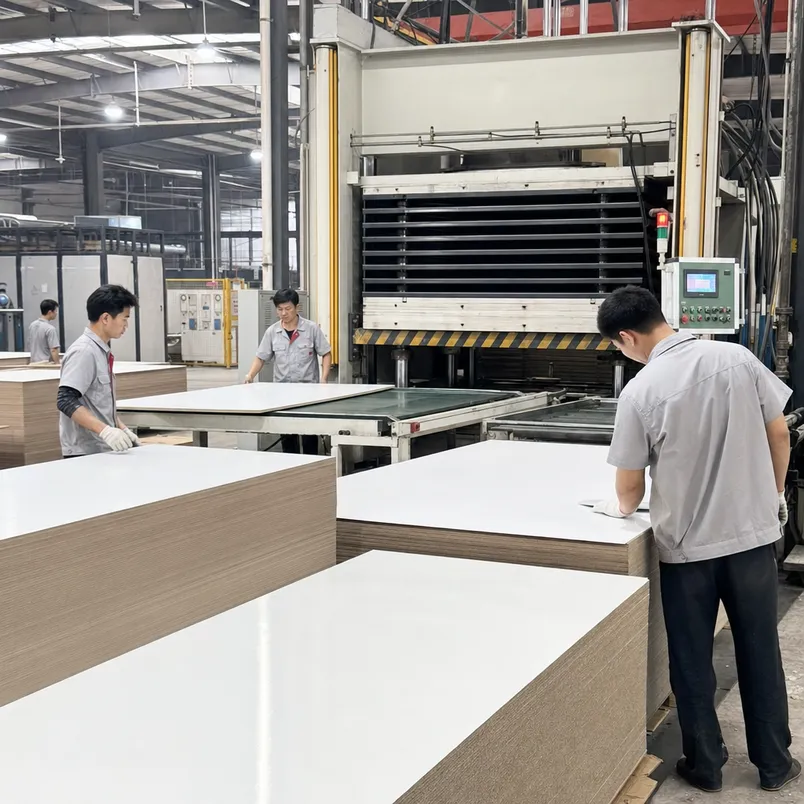
We run short-cycle hot presses with steel caul plates inspected and resurfaced on a scheduled maintenance cycle. The caul plate surface condition directly transfers to the panel surface — a scratched or pitted caul plate produces surface texture variation that your downstream customer will see under raking light. We track caul plate condition and replace them before they affect surface quality, not after a customer complaint.
MDF Core Qualification
The MDF core is sourced from qualified mills with consistent density and moisture content. We don't press melamine paper onto whatever MDF is cheapest that week — core density affects how the resin penetrates and bonds at the interface, and inconsistent core density produces inconsistent surface hardness across a batch. Our incoming inspection checks core density and moisture before panels go to the pressing line. We've rejected full truckloads of MDF core for moisture content out of spec — it's not a pleasant conversation with the supplier, but it's the right call.
Paper Color Consistency
The white melamine paper is sourced from suppliers who provide consistent basis weight and resin content batch-to-batch. Color consistency matters for your buyers: if they're ordering white melamine MDF across multiple shipments for a furniture line, the white needs to match. We specify the paper by colorimetric values, not just "white," and we check incoming paper against the reference standard before it goes to the press.
Quality Control Checkpoints
- Incoming MDF core: density and moisture content inspection before pressing line entry
- Incoming melamine paper: colorimetric check against reference standard, basis weight and resin content verification
- Caul plate condition: scheduled inspection and resurfacing cycle, replaced before surface quality is affected
- Press parameters: temperature and pressure distribution monitored to prevent under-cure and micro-void formation
- Post-press surface inspection: raking-light check for texture variation, blistering, or delamination indicators
Why this matters for your supply chain: Surface defects from pressing errors — blistering, delamination, texture variation — typically appear weeks or months after delivery, not at goods receipt. By the time your customer reports the issue, the panels are already cut and assembled. Upstream process control is the only reliable prevention.
Market Segments Where White Melamine MDF Generates Repeatable Volume
White melamine MDF serves several distinct buying patterns. Understanding which segment you're supplying determines what specifications, certifications, and logistics capabilities actually matter.
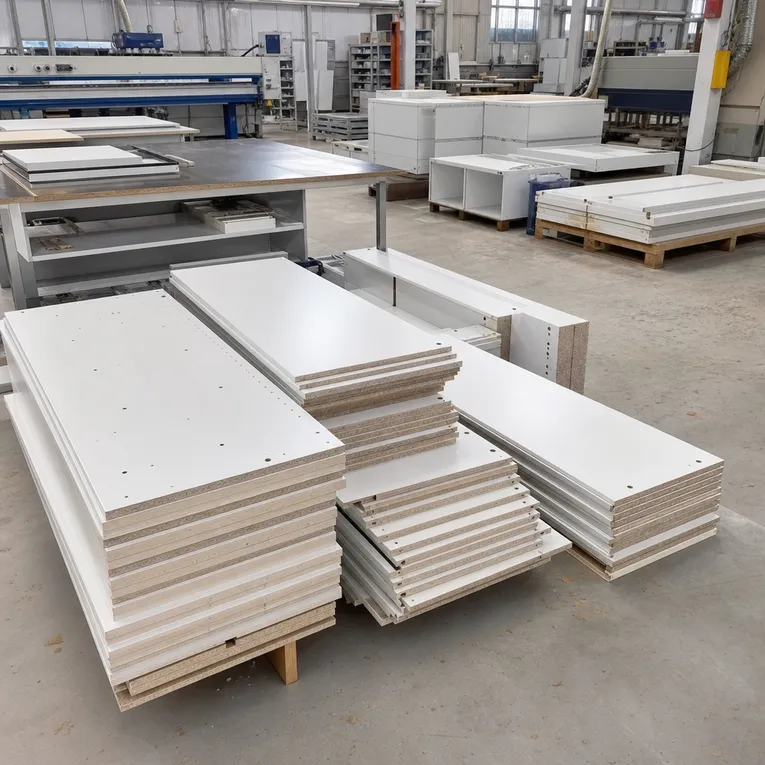
Flat-Pack and RTA Furniture Manufacturing
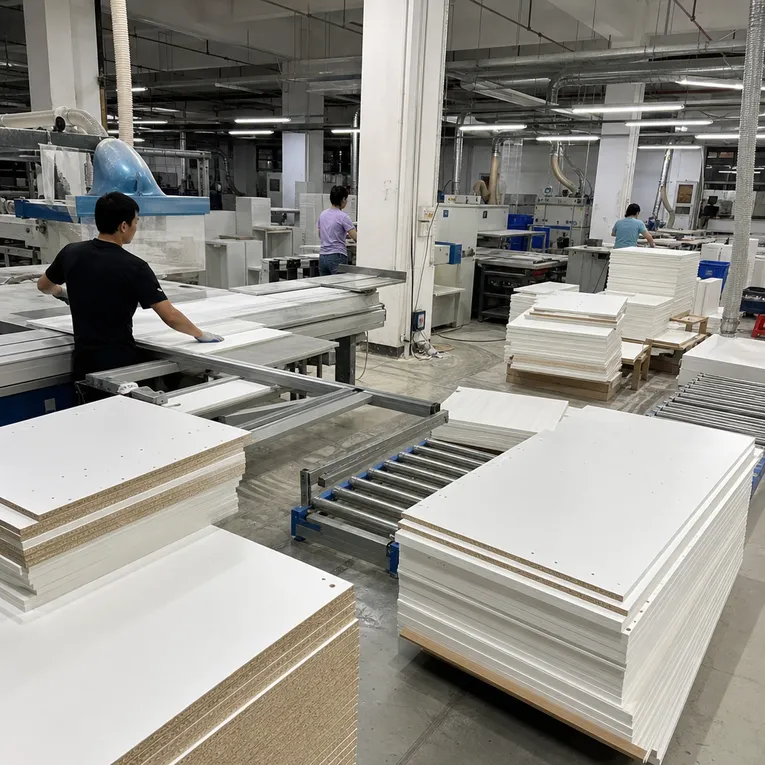
The largest volume segment for white melamine MDF globally. Cabinet carcasses, shelving units, wardrobe interiors, and desk surfaces are all cut from white melamine MDF panels. Manufacturers in this segment buy in full container loads, often on monthly or quarterly replenishment cycles.
They're highly sensitive to surface consistency and thickness tolerance because their CNC cutting and edgebanding lines are calibrated to specific panel parameters. If you're supplying furniture manufacturers, white melamine MDF is a foundational SKU — the one they reorder most frequently and the one where supply disruption causes the most production downtime.
Kitchen and Bathroom Cabinet Supply
Cabinet shops and kitchen manufacturers use white melamine MDF for interior carcass components — the parts that don't show but need to be dimensionally consistent for the assembly to work. Volume patterns are similar to furniture manufacturing.
The surface finish requirement here is functional rather than decorative: it needs to be cleanable and moisture-resistant enough for the application, not necessarily premium. Standard white melamine MDF at E1 or CARB P2 emission levels covers this segment well.
Retail Fixture and Display Manufacturing
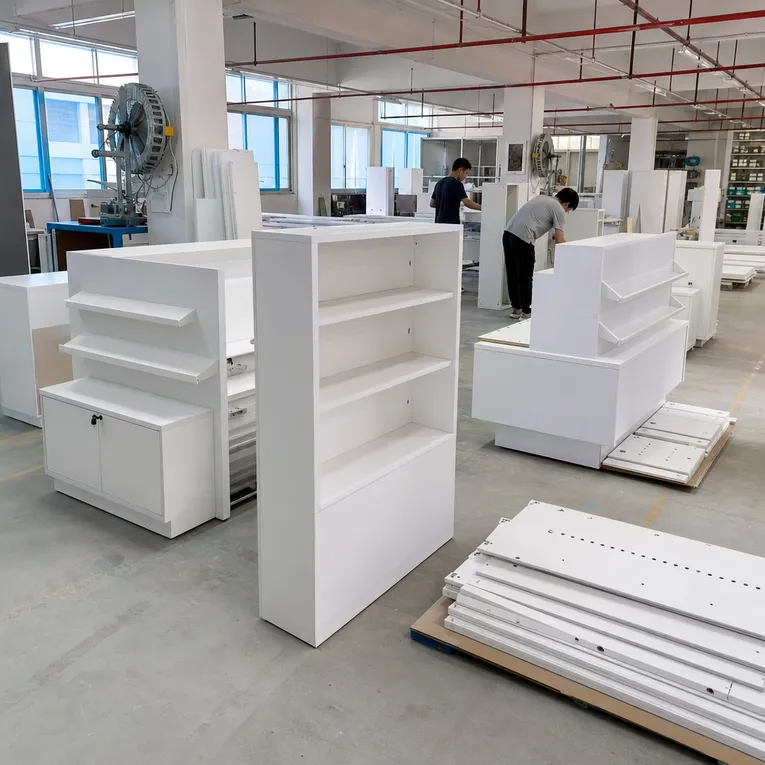
White melamine MDF is used for shelving, display cases, and point-of-sale units. This segment tends to order in smaller quantities than furniture manufacturing but at higher frequency, and they often need custom sizes cut to their fixture dimensions.
Our OEM sizing capability — custom panel dimensions on confirmed orders — is directly relevant here. This segment has grown for us in the Middle East and Southeast Asia over the last few years, driven by retail expansion in those markets.
Building Materials Distribution
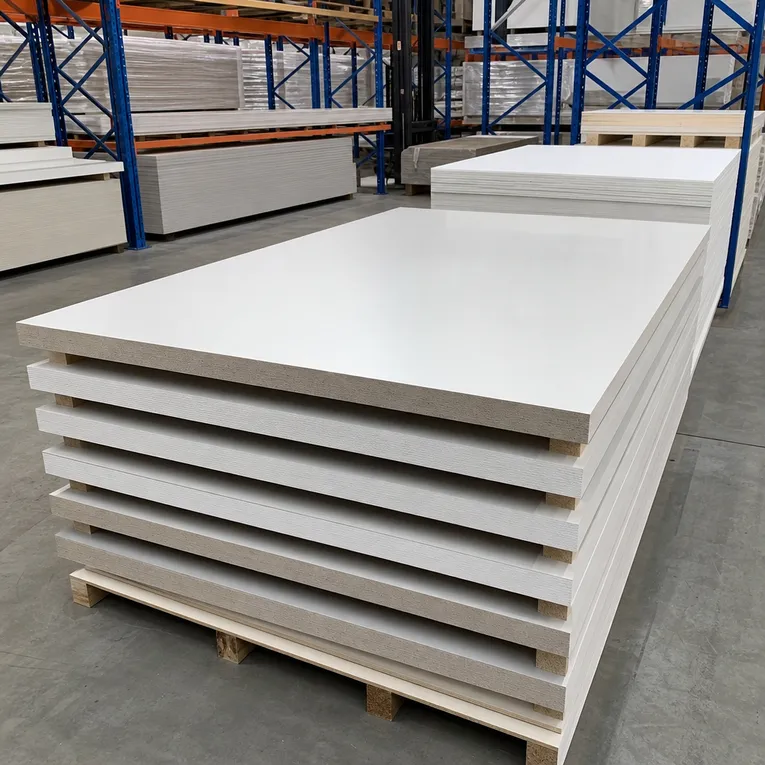
Distributors stock standard-size white melamine MDF panels and sell to local cabinet shops, joiners, and contractors. This is a different buying pattern from direct manufacturing supply: the key variables are consistent availability, competitive landed cost, and documentation that clears customs without delays.
Our CARB P2 and FSC certification stack covers the documentation requirements for North American and European distribution channels. CE covers EU construction product regulations. For distributors, the certification package is as important as the panel specification.
Related Products in the Melamine MDF Range
Customization: What You Can Specify, What You Can't
White melamine MDF customization runs across four dimensions. Here's what's adjustable, what's constrained, and what falls outside this product entirely.
Thickness
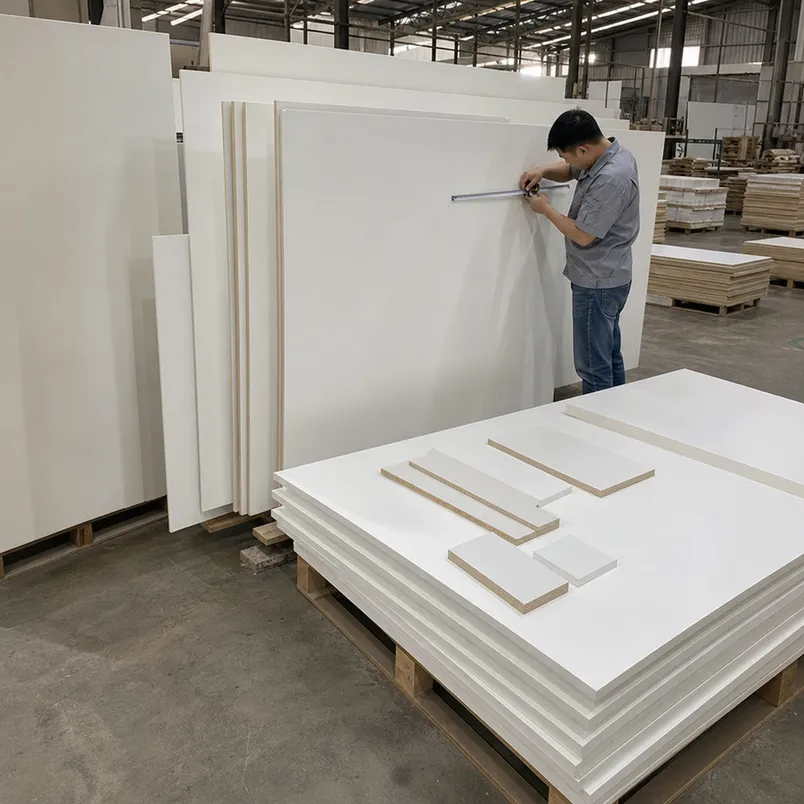
Standard increments from 3mm to 25mm. Non-standard thicknesses — such as 16mm or 20mm — are available on confirmed orders with minimum quantities. The constraint is press setup and yield optimization, not capability. Tell us your target volume and we'll confirm feasibility and MOQ.
Panel Dimensions
Standard is 1220×2440mm. We can produce 1220×2800mm, 1220×3050mm, and other non-standard lengths on confirmed orders. Width variation is more constrained by press width — confirm your required dimensions with us before committing to a specification.
Surface Finish
Standard is matte white. Satin finish — slightly higher sheen, same melamine paper process — is available. High-gloss white is a different product; see our high-gloss melamine MDF page.
Formaldehyde Emission Standard
Standard production runs to E1. CARB P2 is available and is our standard specification for North American shipments. E0 (ultra-low emission) is available on request for buyers supplying into markets with stricter indoor air quality requirements.
What Cannot Be Customized
Color is fixed. The white color is not adjustable on this SKU. If you need a different color, that's a different SKU in our melamine MDF range.
Standard core only. The MDF core construction is standard furniture-grade. If you need moisture-resistant (MR) core for high-humidity applications, specify this at inquiry — it affects both the core material and the resin system.
Need a non-standard thickness, extended panel length, or MR core? Tell us your specification and target volume — we'll confirm availability and lead time.
Tell us your specification| Dimension | Standard | Custom / On Request | Notes |
|---|---|---|---|
| Thickness | 3mm – 25mm (standard increments) | 16mm, 20mm, other non-standard | MOQ applies; confirm volume at inquiry |
| Panel Size | 1220×2440mm | 1220×2800mm, 1220×3050mm, other lengths | Width constrained by press; confirm before spec |
| Surface Finish | Matte white | Satin white | High-gloss is a separate product SKU |
| Emission Standard | E1 | CARB P2 (standard for NA), E0 on request | Specify at inquiry for correct resin system |
| Core Type | Standard furniture-grade MDF | Moisture-resistant (MR) core | MR affects core material and resin system |
Certification and Compliance: What's Covered for Your Market
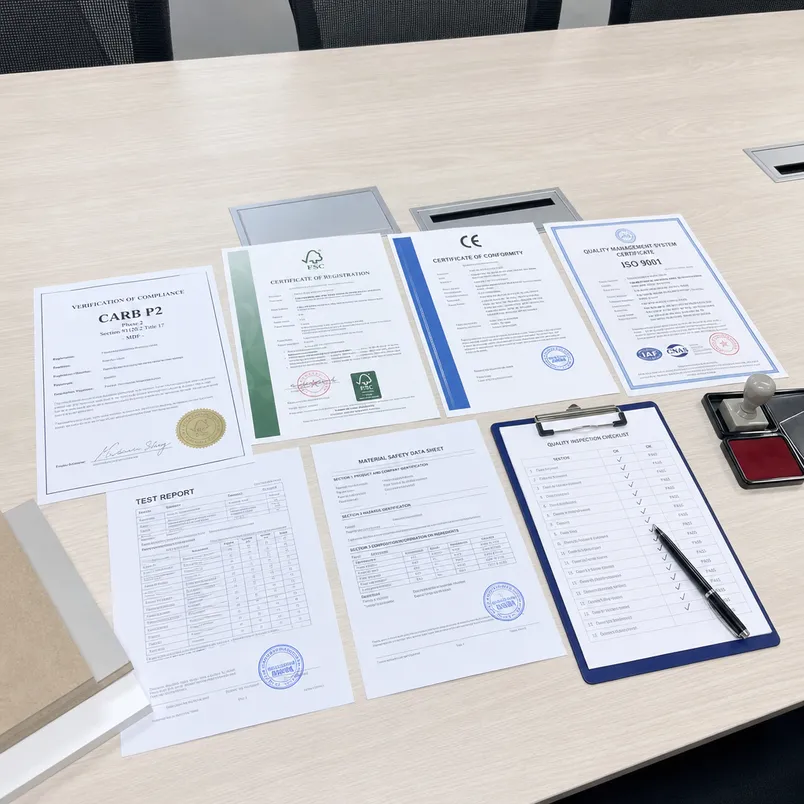
The certifications we hold on white melamine MDF are the same as our full melamine MDF range: ISO 9001:2015, CE, FSC chain-of-custody, and CARB P2.
North American Market
California Air Resources Board Phase 2 — the most stringent formaldehyde emission limits in North America (≤0.11 ppm for MDF). Standard for all US export orders. CARB documentation package included with US shipments.
Sustainability Sourcing
FSC chain-of-custody covers buyers with sustainability sourcing requirements — retailers with environmental procurement policies, or buyers supplying into markets where deforestation-linked supply chains are a regulatory or reputational risk. Available on request for FSC-certified orders.
European Market
CE marking covers European construction product regulations. CE documentation is included with EU shipments. E1 formaldehyde emission (≤0.124 mg/m³ air) is the European standard — our standard production meets E1, and CARB P2 is more stringent, covering E1 requirements as well.
Quality Management
ISO 9001:2015 quality management system covers our full production process. Third-party test reports from SGS and Bureau Veritas are available on request. If your buyers require specific test documentation, we can provide it or coordinate third-party inspection before shipment.
Certification Coverage by Market
CARB P2 documentation package included with all US shipments. This is the certification your US buyers will ask for — it's already in the box.
CE documentation included with EU shipments. E1 standard met as baseline; CARB P2 exceeds E1 requirements.
FSC chain-of-custody documentation available for FSC-certified orders. Covers retailers with environmental procurement policies and deforestation-risk markets.
E0 ultra-low emission available on request for buyers supplying into markets with stricter indoor air quality requirements.
Third-Party Testing
Test reports from third-party laboratories are available on request. We work with SGS and Bureau Veritas for independent testing. If your buyers require specific test documentation, we can provide it or coordinate third-party inspection before shipment.
Container Loading and Export Logistics
White melamine MDF ships in standard 20HQ and 40HQ containers. Loading quantities depend on thickness — use the table below to plan your order volume.
Loading Quantities per 40HQ Container
| Thickness | Panels per 40HQ (approx.) | Notes |
|---|---|---|
| 18mm | ~800–900 panels | Most common specification |
| 12mm | ~1,100–1,200 panels | — |
| 9mm | ~1,400–1,500 panels | — |
| 6mm | ~1,800–2,000 panels | — |
| 25mm | ~600–650 panels | — |
Loading quantities are approximate and depend on packaging configuration and mixed-thickness orders. We provide a loading plan with each shipment.
Packaging for Ocean Transit
Panels are bundled, edge-protected with corner boards, and wrapped in moisture-resistant film. The white melamine surface is face-protected with interleaving paper or PE film within the bundle — surface scratches during transit are the most common damage claim on melamine panels, and the packaging is designed to prevent them. The current spec came from analyzing damage patterns on returned containers, not from guessing.
Export Documentation
We prepare documentation to the standard required for your destination market. Buyers who've had customs clearance delays with other suppliers typically find the difference is in the documentation preparation, not the product itself.
Transit Times from Xuzhou
Sourcing White Melamine MDF: Common Questions
Answers to the questions buyers ask most often before placing a container order — MOQ, lead times, standards, and specification decisions.
Standard MOQ is one 20HQ container for stock specifications (18mm, 1220×2440mm, white matte, E1 or CARB P2). For custom dimensions or non-standard thicknesses, MOQ is higher — confirm with us at inquiry.
Sample orders (small quantities for testing with your customers) are available before committing to a container order.
We confirm lead time at the quotation stage — we don't quote lead times we can't meet.
- Flatter, more uniform surface
- Better screw-holding in the face
- Preferred for painted or melamine-faced furniture components
- Standard choice for cabinet carcasses and shelving
- Better screw-holding at edges
- Higher bending strength
- Preferred for structural components
- Better for edge-mounted applications
We produce both. If you're deciding between them, send us your application details and we'll give you a direct recommendation.
Yes, within the same paper specification. We specify white melamine paper by colorimetric values (L*, a*, b* coordinates) and check incoming paper against the reference standard.
If color matching across shipments is critical for your application, tell us at the order stage and we'll manage paper batch continuity.
The panel faces are finished; the cut edges expose raw MDF core and need edgebanding or edge sealing before use in furniture or cabinetry. This is standard practice in the industry — your downstream customers will know this.
We can supply panels with pre-applied edge sealing on request for export transit protection, but the final edgebanding is applied by the furniture manufacturer or cabinet shop.
Most European markets and general commercial applications. Standard specification where no specific regulation applies.
Required for California. De facto standard for US distribution. Available as stock specification.
JIS A 5905 standard for Japan. Available on request.
If you're unsure what your market requires, tell us your destination and we'll advise.
Get a Quote for White Melamine MDF
Send us your specification — thickness, panel size, emission standard, target volume, and destination market — and we'll come back with a detailed quote, lead time confirmation, and the relevant certification documentation for your import requirements.
Most buyers in this category start with a sample order to test surface quality and thickness consistency with their own customers before committing to a container. We can ship samples; tell us what you need.
What to include in your RFQ
- Thickness and panel size (or OEM dimensions if non-standard)
- Emission standard required — E0, E1, or CARB P2
- Target volume and order frequency
- Destination market and port of discharge
- Whether you need samples before committing to a container
Xuzhou QD Wood Industry Co., Ltd.