

Chipboard Particle Board Manufacturer
Factory-direct chipboard particle board — P2 and P5 grades, CARB P2 compliant, available raw, melamine-faced, or veneer-faced. 8mm to 25mm thickness range, density 600–720 kg/m³, formulated to meet CARB P2 and E1 emission standards as standard — not as a special option.
Produced under ISO 9001:2015 certification with full export documentation for North America, Europe, and beyond.
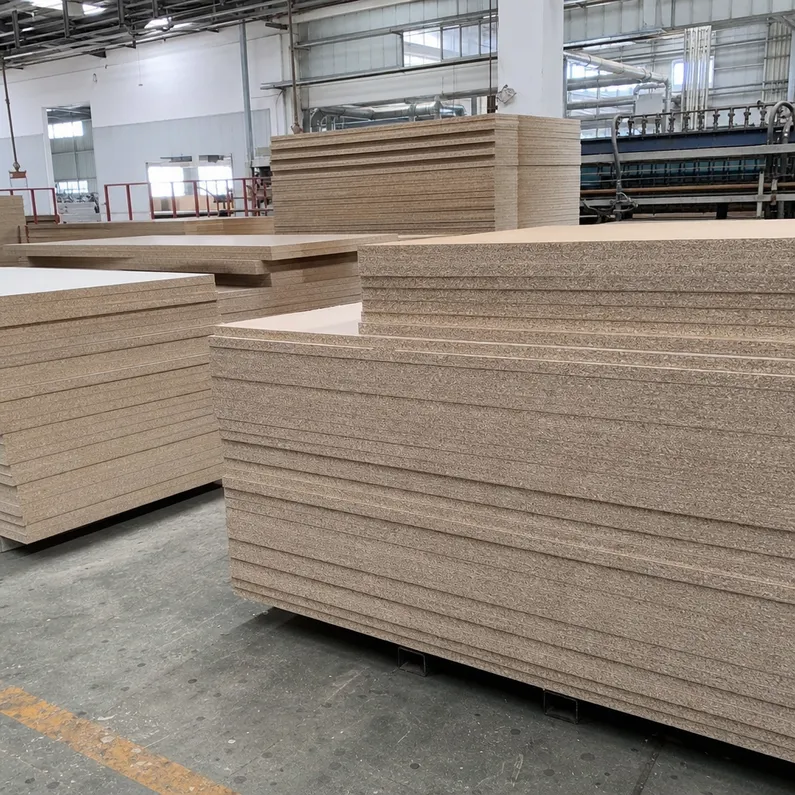
What This Product Is and Where It Sits in the Range
Chipboard particle board is the furniture and interior fit-out substrate in our particle board and OSB range — distinct from the structural OSB panels we produce for construction sheathing and subfloor applications. Where OSB is engineered for load-bearing performance, chipboard is engineered for dimensional stability, flat surface quality, and consistent screw retention — the properties that matter when you're manufacturing cabinet carcasses, shelving units, or interior joinery components.
We produce chip board particle board in two grades: standard P2 (dry interior conditions) and moisture-resistant P5 (humid environments, green-dyed core). The distinction matters commercially because P2 and P5 serve different downstream markets and carry different price points — stocking both gives your customers the right spec for their application rather than forcing them to over-specify or under-specify.
Surface configurations cover raw sanded board, melamine-faced (standard and custom colors), and veneer-faced — so the same substrate ships into furniture manufacturing, flat-pack retail supply chains, and bespoke joinery depending on how it's finished.
The category page covers the full particle board and OSB range including OSB structural panels, OSB general-purpose panels, and OSB flooring. See the full range at the Particle Board & OSB category page →
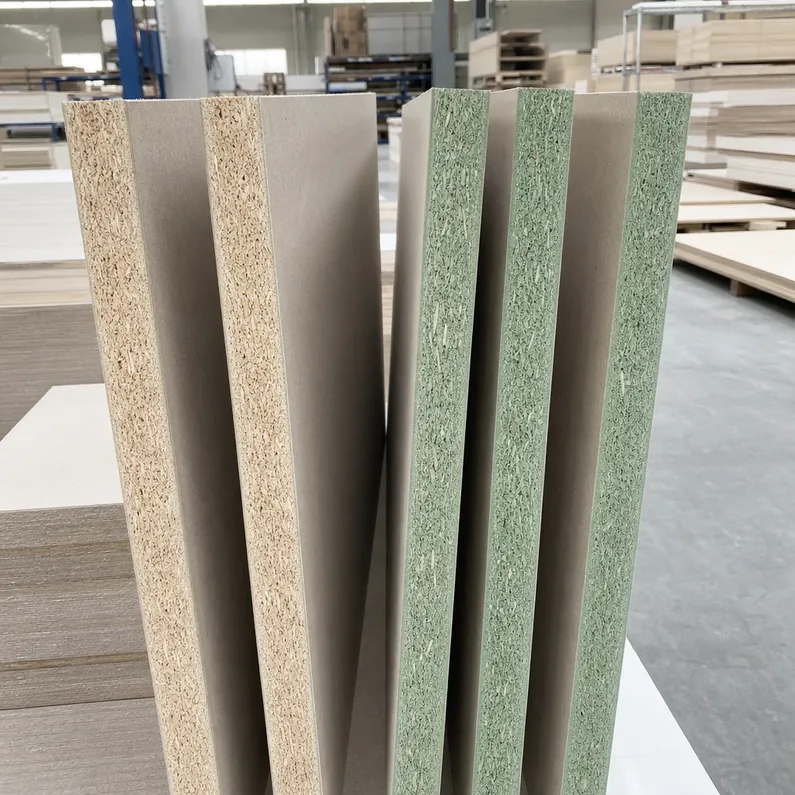
Standard P2
Dry interior conditions. UF resin binder. Natural/light-colored core. Furniture, shelving, cabinet carcasses.
Moisture-Resistant P5
Humid environments. MUF resin binder. Green-dyed core for visual grade verification. Kitchen, bathroom, humid interiors.
Surface Configurations
Raw Sanded
Both grades
Melamine-Faced
Standard & custom
Veneer-Faced
P2 only
Exact Specifications: What Goes Into Your Comparison Sheet
| Parameter | Standard P2 | Moisture-Resistant P5 |
|---|---|---|
| Classification | EN 312 P2 | EN 312 P5 |
| Thickness Range | 8, 10, 12, 15, 16, 18, 22, 25mm | 8, 12, 15, 16, 18, 22, 25mm |
| Standard Panel Size | 1220×2440mm | 1220×2440mm |
| Density | 600–680 kg/m³ | 650–720 kg/m³ |
| Binder System | UF resin | MUF resin |
| Formaldehyde Emission | E1 / CARB P2 | E1 / CARB P2 |
| Core Identification | Natural / light-colored | Green-dyed core |
| Internal Bond Strength | ≥0.35 N/mm² | ≥0.45 N/mm² |
| Modulus of Rupture (18mm) | ≥11 N/mm² | ≥13 N/mm² |
| Thickness Tolerance | ±0.3mm (sanded) | ±0.3mm (sanded) |
| Surface Options | Sanded / melamine / veneer | Sanded / melamine |
| Certifications | ISO 9001:2015, CE, CARB P2 | ISO 9001:2015, CE, CARB P2 |
Specifications shown are industry-standard values for this product type. Actual specifications may vary by order. Contact us for detailed product data sheets and test reports.
Request a Chipboard Particle Board Data Sheet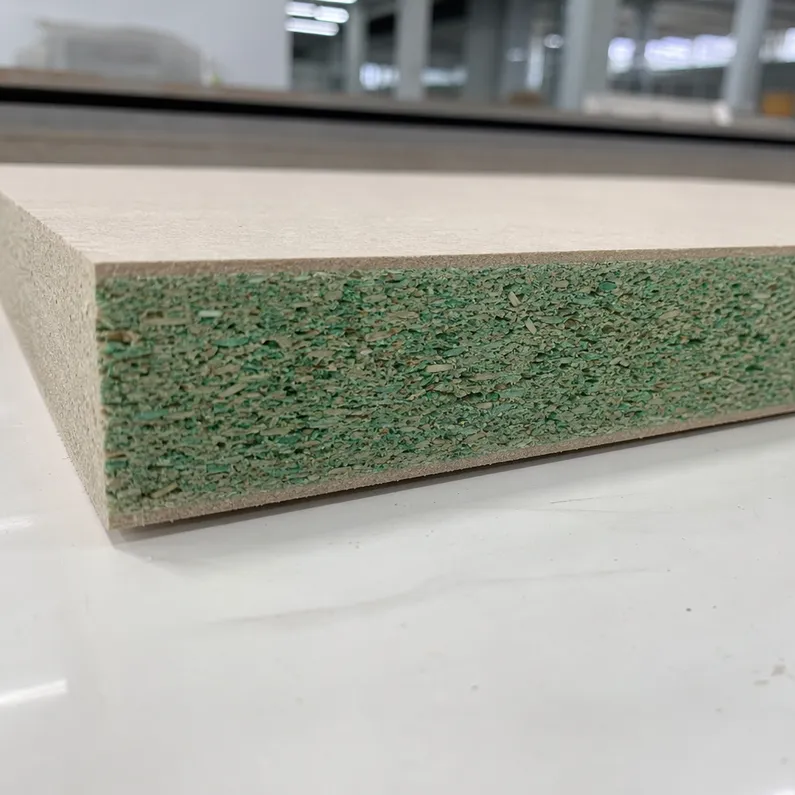
Why the Green Core Matters
The green dye in P5 is not cosmetic — it's a quality-control marker. It lets fabricators, inspectors, and end-users visually confirm they're working with moisture-resistant grade material before any surface finish is applied. No guesswork on site.
E1 & CARB P2 Compliance
Both grades meet E1 (≤0.1 ppm formaldehyde) under EN 717-1 and CARB Phase 2 (≤0.09 ppm) under ATCM. This covers EU interior air quality requirements and US import compliance in a single certification — relevant for buyers supplying both markets.
Common Thickness Applications
Applications: Furniture, Flooring, Construction & More
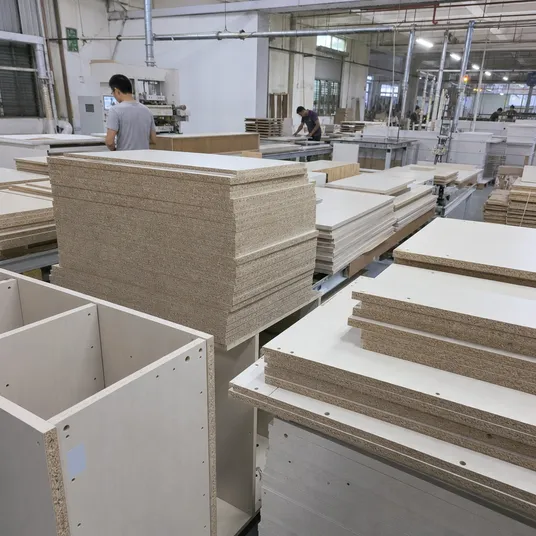
Furniture Manufacturing
The dominant substrate for flat-pack and RTA furniture. Consistent density and smooth sanded surface make it ideal for direct lamination, foiling, and edge-banding. Cabinet carcasses, shelving units, wardrobe interiors, and desk panels.
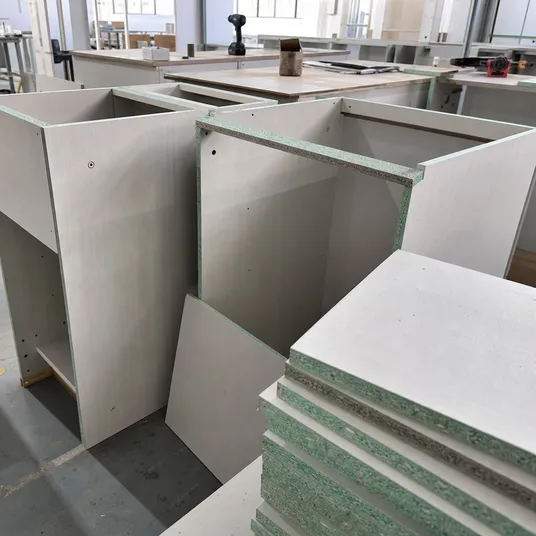
Kitchen & Bathroom Cabinets
P5 moisture-resistant grade is the specified choice for kitchen and bathroom cabinet carcasses. The MUF binder resists swelling from steam and splash exposure. Green core allows quick grade verification during installation and inspection.
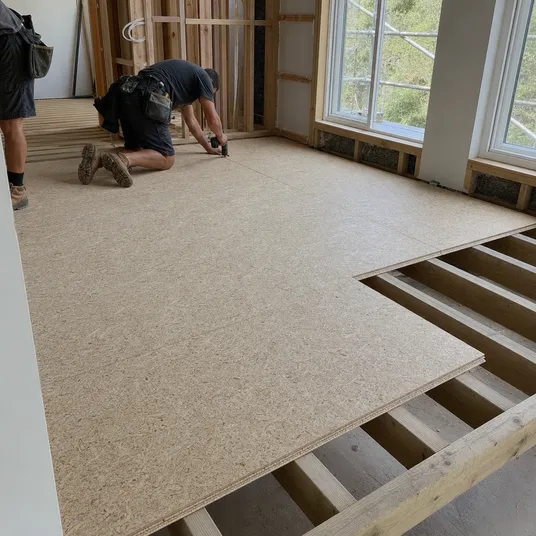
Flooring Substrate
P5 tongue-and-groove panels are widely used as floating floor decking in residential construction. Higher density and MUF binder provide the load-bearing capacity and moisture resistance required for ground-floor and intermediate-floor applications.
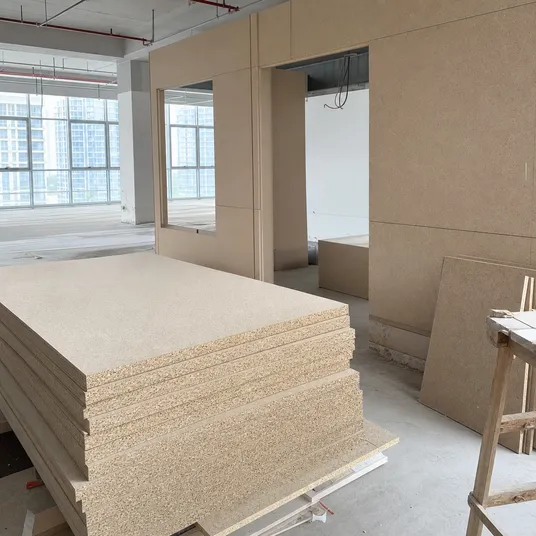
Interior Fit-Out & Partitioning
Cost-effective substrate for commercial interior partitions, wall linings, and display fixtures. Consistent thickness tolerance (±0.3mm) ensures clean joints and flush finishes. Compatible with direct paint, laminate, and veneer finishes.
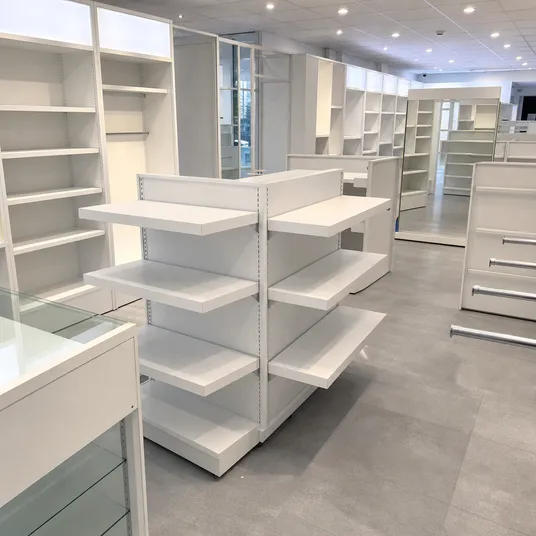
Retail & Display Fixtures
Melamine-faced chipboard is the standard substrate for shop shelving, gondola units, and point-of-sale displays. The smooth, hard surface accepts direct print and foil wrapping. High screw-holding strength supports repeated fixture assembly and reconfiguration.
Industrial Packaging & Pallet Decking
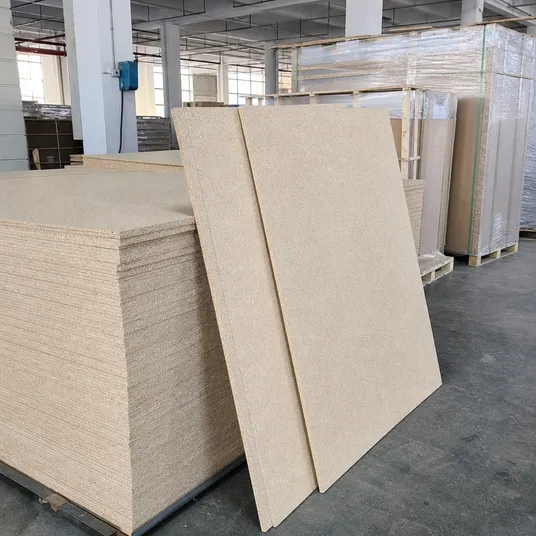
Raw sanded chipboard provides a cost-effective rigid panel for protective packaging inserts, pallet decking, and transit crating. Uniform density ensures predictable load distribution. Available in custom cut-to-size for high-volume packaging lines.
Not sure which grade fits your application?
Our technical team can confirm the right grade, thickness, and surface configuration for your specific use case — including compliance requirements for your target market.
Resin Formulation and CARB P2 Compliance: The Detail That Protects Your Market Access
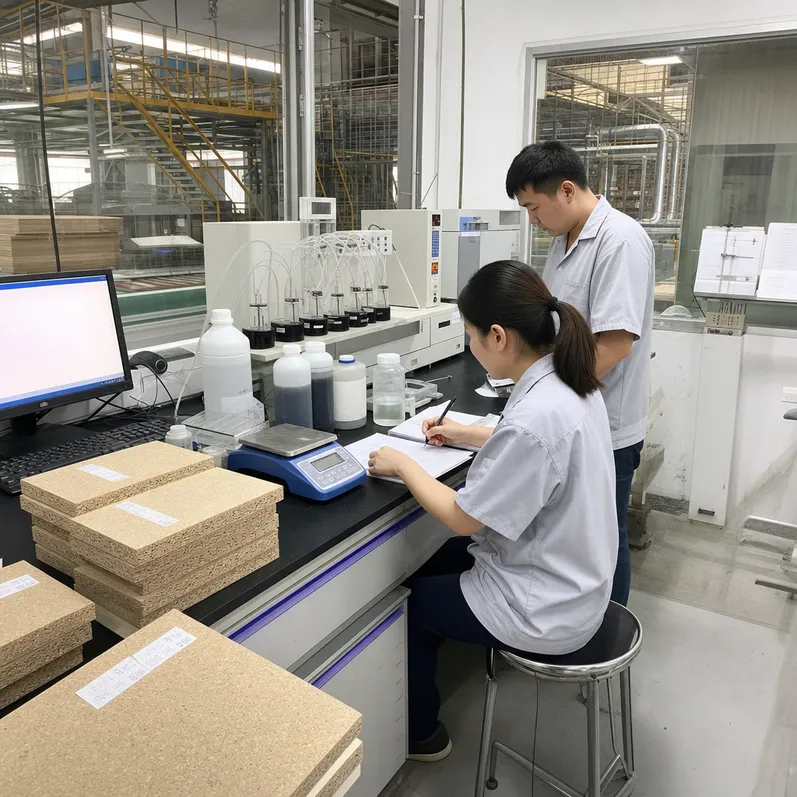
Chipboard particle board uses UF or MUF resin systems — and this is where a lot of buyers get caught out when sourcing from suppliers who haven't invested in low-emission formulation. Standard UF resin produces excellent bond strength at low cost, but the formaldehyde emission level depends entirely on the resin formulation and press parameters. A supplier who claims CARB P2 compliance but hasn't invested in the resin chemistry to back it up will pass a fresh-panel test and fail a field audit six months later.
We formulate our chipboard resin to meet CARB P2 as the baseline across the entire production run — not as a special order option, and not by testing a sample panel and hoping the rest of the batch follows. The P5 moisture-resistant grade uses MUF resin, where the melamine component both improves moisture resistance and reduces formaldehyde emission compared to standard UF.
We made the decision to standardize on CARB P2 formulation in 2015 when CARB enforcement started catching up with importers — it added cost to our resin purchasing, but it eliminated the compliance risk for our buyers entirely. Every container ships with ASTM E1333 test reports for US-bound orders and EN 717-1 reports for EU-bound orders.
For buyers sourcing into Japan, where the F★★★★ standard applies, we can produce to that specification on confirmed orders. The resin formulation adjusts, press parameters change, and emission testing is conducted before shipment. Ask about it when you send your inquiry.
Test Reports Shipped With Every Container
One SKU. Three Markets. One Documentation Package.
A single chipboard specification from us ships to California, the EU, and Australia without requiring you to manage separate compliance documentation for each market. That's one SKU, one supplier relationship, one documentation package — supply chain simplification that compounds over time as your volume grows.
Surface Configurations and What They Mean for Your Product Line
Raw sanded chipboard, melamine-faced board, and veneer-faced board are three different commercial products that happen to share the same substrate. Understanding which configuration fits which market segment determines how you build your SKU mix.
Raw Sanded Chipboard
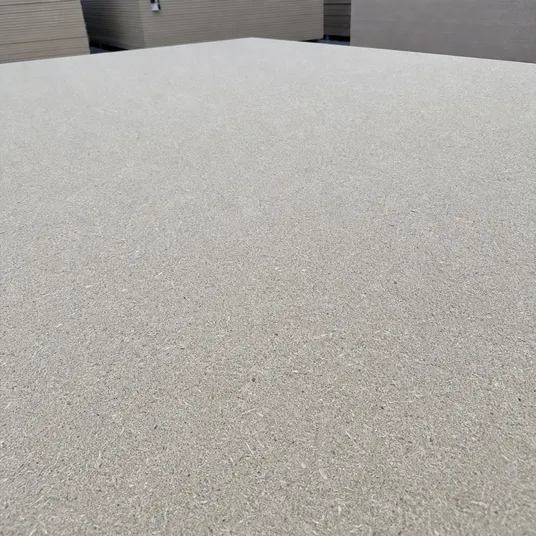
The substrate for buyers who apply their own surface treatment — furniture manufacturers who laminate their own melamine paper, joinery shops who apply veneer or lacquer in-house, and industrial buyers who use chipboard as a core material in composite panel systems.
Melamine-Faced Chipboard
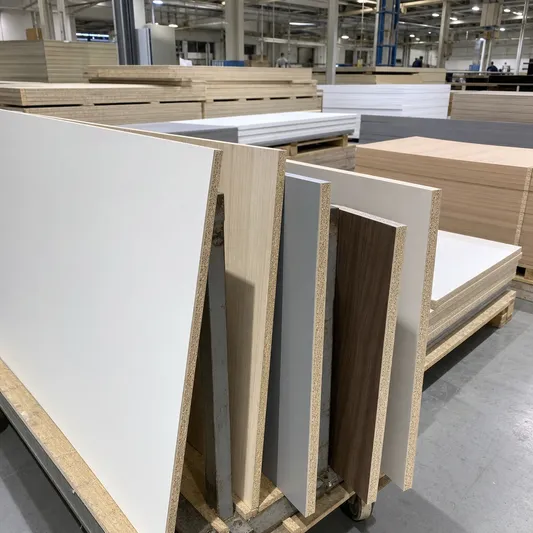
The ready-to-use configuration for flat-pack furniture manufacturers and distributors who supply to retail or direct-to-consumer channels. Melamine paper is pressed directly onto the chipboard substrate in our melamine pressing line — the same line used for melamine MDF and melamine plywood.
Custom color MOQ is 500 sheets per color. Below that threshold, paper changeover cost doesn't make commercial sense for either side.
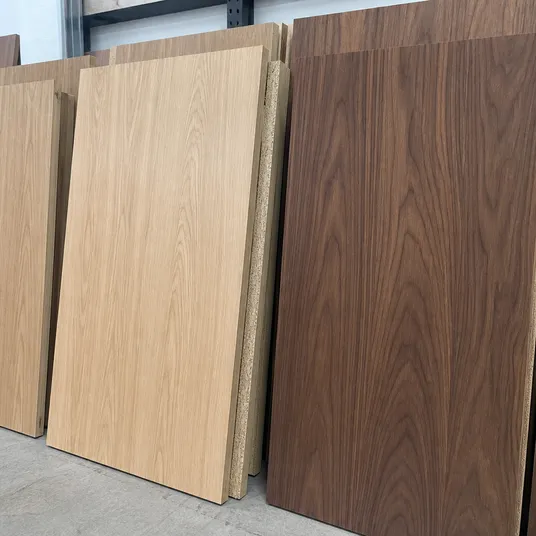
Veneer-Faced Chipboard
For furniture manufacturers who need a natural wood appearance on a cost-efficient substrate. Face veneers are sourced through the same grading process used for our plywood range — so veneer quality is consistent with what you'd expect from a plywood manufacturer, not a chipboard-only operation.
Sourcing both plywood and chipboard from us? We can manage veneer grain and color matching between products because we're grading from the same veneer stock.
Configuration Selection Guide
Match your downstream process to the right chipboard configuration
| Configuration | Best For | Surface Finish | Volume Profile |
|---|---|---|---|
| Raw Sanded | Manufacturers applying own laminate, veneer, or lacquer | ±0.3mm tolerance, direct-lamination ready | Highest Volume |
| Melamine-Faced | Flat-pack furniture, retail and D2C distribution | Pressed at 160–180°C, abrasion and scratch resistant | 500 sheets/color min |
| Veneer-Faced | Premium furniture requiring natural wood appearance | Oak, walnut, cherry, teak — plywood-grade veneer stock | Confirmed Order |
Market Segments Where Chipboard Particle Board
Generates Repeatable Volume
The commercial value of chipboard particle board comes from its position in high-frequency, predictable procurement cycles. These are the segments where your chipboard volume compounds.
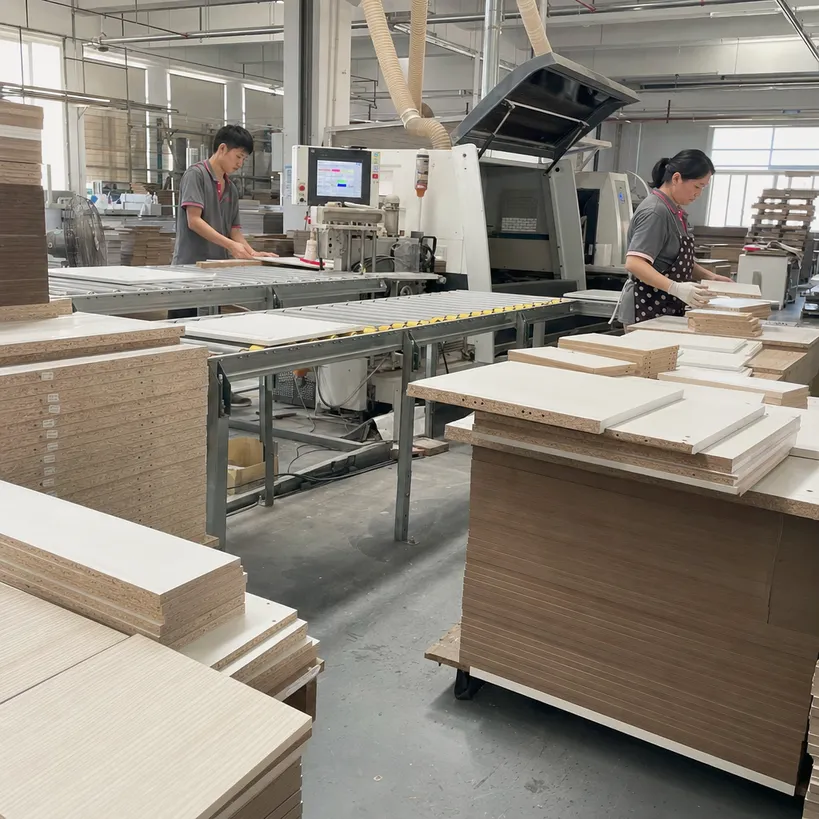
Flat-Pack Furniture Manufacturing
Highest Global VolumeFurniture manufacturers in Southeast Asia (Vietnam, Malaysia, Indonesia), Eastern Europe (Poland, Romania, Turkey), and the Middle East who supply to retail chains run chipboard through their production lines in multi-container volumes on monthly schedules. The spec is consistent — 18mm P2 melamine-faced in white or woodgrain is the workhorse SKU — and the reorder pattern is predictable.
If you're distributing into furniture manufacturing clusters, chipboard is the SKU that anchors the relationship and opens the door to other panel categories.
A single mid-size furniture manufacturer running 50,000 units per year of flat-pack cabinetry can consume 8–12 containers of chipboard annually.
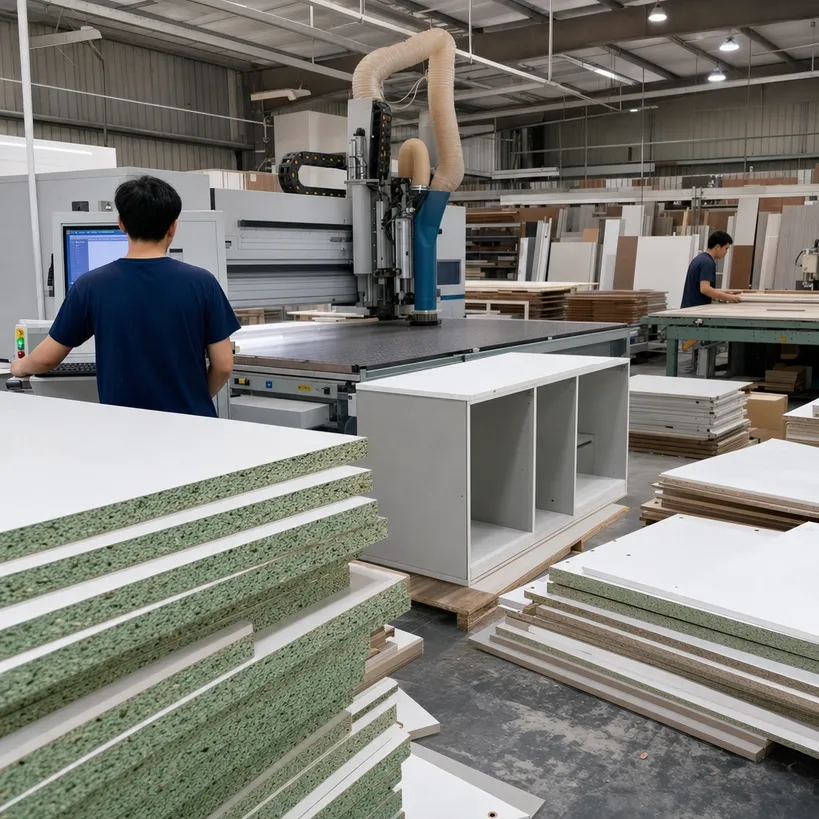
Kitchen & Bathroom Cabinet Manufacturing
P5 Moisture-Resistant GradeCabinet manufacturers who supply to residential construction projects, kitchen retailers, and hospitality fit-out contractors specify P5 as standard for carcass construction in wet areas. The green-dyed core is a specification verification tool that experienced buyers and their customers have come to rely on — it's a selling point you can communicate downstream.
Kitchen cabinet manufacturers in the Middle East and Southeast Asia, where humidity levels make P2 inadequate for wet area applications, are a particularly strong market for P5 chipboard.
A kitchen cabinet manufacturer supplying to a mid-size residential development project can order 3–5 containers of P5 chipboard per project cycle.
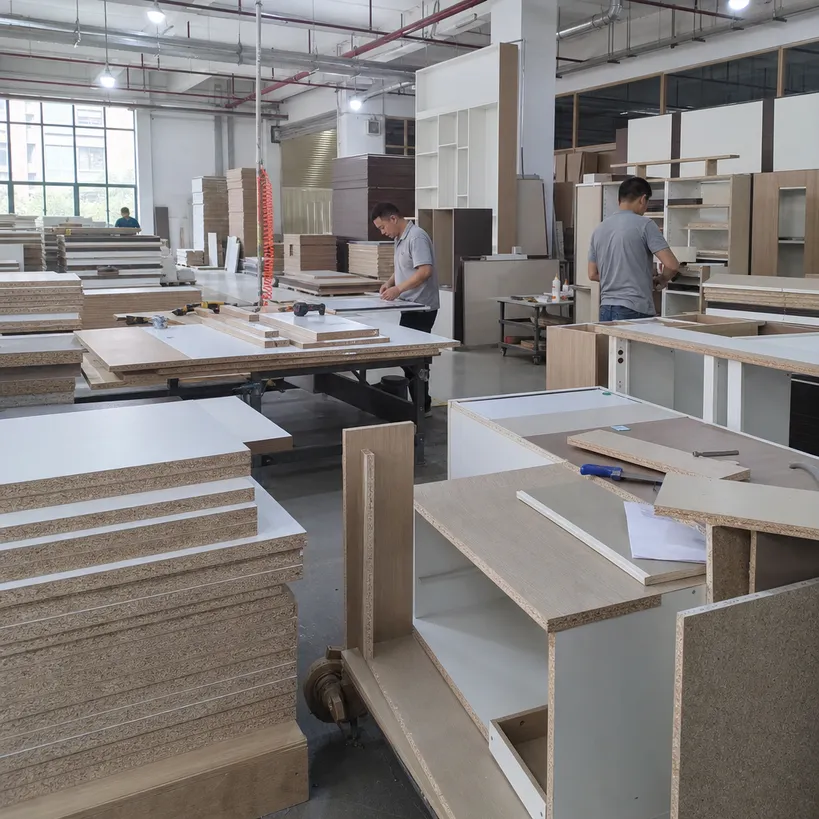
Commercial Fit-Out & Interior Joinery
Mixed-Load CapabilityOffice fit-out contractors, hospitality joinery manufacturers, and retail fixture suppliers use chipboard as the substrate for shelving, display units, reception counters, and built-in furniture. This segment tends to order in mixed loads — multiple thicknesses, some melamine-faced, some raw — which suits our OEM capability and our ability to consolidate mixed-specification containers.
The order frequency is project-driven rather than production-schedule-driven, but the volumes per project are substantial.
A commercial fit-out for a mid-size hotel or office building can consume 200–500 sheets of chipboard across multiple thicknesses.
Distributor & Wholesaler Stocking Programs
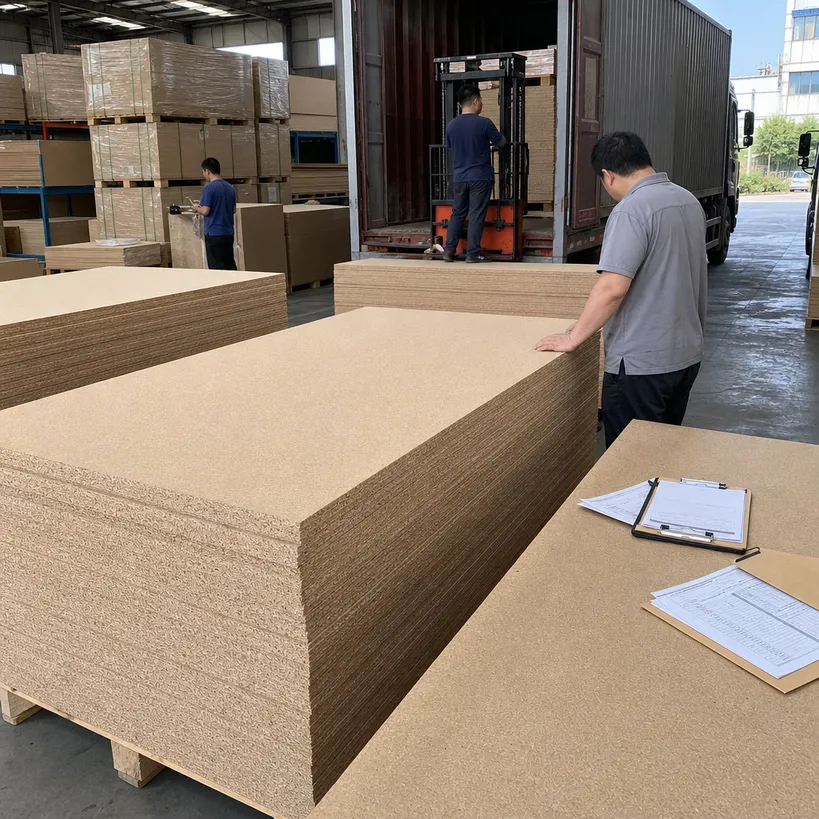
Documentation-ReadyChipboard is a commodity-adjacent panel that moves through distribution channels in most markets. Distributors who stock a range of panel products — MDF, plywood, chipboard — use chipboard as a volume anchor because it's the most price-competitive substrate for interior applications.
The key differentiator for distributors is documentation: CARB P2 compliance documentation, CE declaration, and FSC chain-of-custody records are the compliance gates that determine whether your chipboard can be sold into regulated markets.
We provide the full documentation package as standard, so your stock is pre-qualified for the markets you're selling into.
Density, Screw Retention, and the Failure Mode
That Costs Your Customers Money
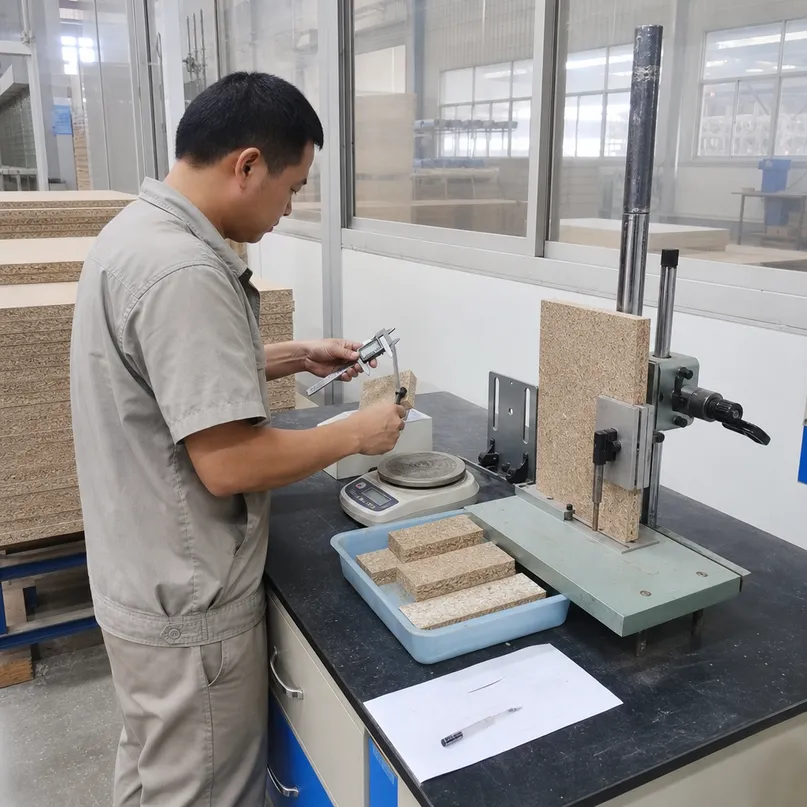
This is the technical detail that separates chipboard specifications that work from ones that generate warranty claims. Screw pull-out resistance is a direct function of chipboard density and resin distribution uniformity — it's the failure mode behind hinge failures, drawer runner failures, and cam lock failures in assembled furniture.
EN 312 Performance Parameters by Grade
We run density checks on every production batch with a tolerance of ±20 kg/m³ from the specified grade. The density check happens at the press output stage — panels that fall outside tolerance are pulled before they reach the sanding line. This is not a statistical sampling check; it's a batch-level verification.
The Field Failure Pattern to Avoid
The most common complaint we hear from buyers switching from lower-cost chipboard suppliers is inconsistent density across a batch — panels that test fine on the first container and show hinge failures on the third.
Consistent density requires consistent resin spread and consistent press parameters, which requires process discipline that not every chipboard manufacturer maintains.
If you're sourcing chipboard for furniture applications and your current supplier can't provide density test reports with shipment documentation, that's a gap worth closing before you have a field failure to explain to your customer.
Customization Parameters: What You Can Specify and What Affects MOQ
The standard range covers most sourcing requirements, but a meaningful portion of our chipboard volume ships to custom specifications. Here's what's adjustable and what the constraints are.
| Customization Parameter | Options | MOQ Impact |
|---|---|---|
| Thickness | 8–25mm (standard increments) | Standard MOQ (1×20HQ) |
| Non-standard thickness | Custom within 8–25mm range | 1×40HQ minimum |
| Panel size | 1220×2440mm standard; 1250×2500mm available | Standard MOQ |
| Custom panel dimensions | Confirm on inquiry | 1×40HQ minimum |
| Density grade | 600, 650, 680, 720 kg/m³ | Standard MOQ for listed grades |
| Custom density specification | Specific kg/m³ with test report | 1×40HQ minimum |
| Surface — raw sanded | Standard | Standard MOQ |
| Surface — melamine-faced | Standard colors (white, beige, grey, woodgrain) | Standard MOQ |
| Surface — melamine custom color/texture | Any color/texture | 500 sheets per color minimum |
| Surface — veneer-faced | Oak, walnut, cherry, teak (standard species) | 1×20HQ per species |
| Surface — custom veneer species | Confirm on inquiry | 1×40HQ minimum |
| Formaldehyde standard | E1 / CARB P2 (standard); F★★★★ (on order) | 1×40HQ for F★★★★ |
| Private label / OEM marking | Bundle marking, product codes, brand labels | No MOQ impact |
| FSC chain-of-custody | Available on confirmed FSC orders | Advance notice required |
Standard vs. Custom MOQ Logic
Standard MOQ for chipboard particle board is one 20HQ container for standard specifications. Custom specifications — non-standard dimensions, custom density grades, custom melamine colors — require one 40HQ container to justify the production setup.
Most buyers start with a single container of 18mm P2 raw sanded or melamine-faced to test with their customers, then expand to mixed-thickness loads once the supply relationship is established.
OEM / Repeat Production Programs
For OEM programs — custom specifications that repeat on a production schedule — the process runs from specification confirmation to first production sample in 15–20 working days.
The engineering team reviews the specification, confirms feasibility, and flags any compliance implications before production starts.
Learn about OEM capabilityContainer Loading and Landed Cost Calculation
Chipboard is a dense, flat product — container utilization directly affects your landed cost per sheet, and it's worth calculating before you finalize your order specification.
Approximate Loading Quantities — Standard 1220×2440mm in a 40HQ Container
| Thickness | Approx. Sheets per 40HQ |
|---|---|
| 8mm | 3,200–3,600 sheets |
| 12mm | 2,100–2,400 sheets |
| 15mm | 1,700–1,900 sheets |
| 18mm | 1,400–1,600 sheets |
| 22mm | 1,100–1,250 sheets |
| 25mm | 950–1,100 sheets |
Packing Method
Panels are stacked flat on timber bearers, banded in bundles of 50–100 sheets depending on thickness, and wrapped in moisture-resistant film for ocean transit. Corner boards protect panel edges during handling. Each bundle is marked with product specification, thickness, density grade, batch number, and destination port — the marking information your receiving team needs to verify the load against the purchase order without opening every bundle.
Mixed-Thickness & Consolidated Orders
For mixed-thickness orders, we coordinate the loading plan to maximize container utilization — heavier/thicker panels on the bottom, lighter panels on top, with separating layers between product types. We provide a loading plan with each shipment. For buyers ordering chipboard alongside OSB or other panel categories, we can consolidate into a single container to reduce your per-unit freight cost.
Transit Times from Xuzhou
Export Documentation Package
We prepare the full documentation package as standard. Every shipment includes:
- Commercial invoice
- Packing list
- Bill of lading
- Certificate of origin
- Phytosanitary certificate (where required)
Market-specific documentation included as applicable:
- US-bound shipments: CARB P2 documentation with ASTM E1333 test reports
- EU shipments: CE declaration of conformity
- FSC-certified orders: FSC chain-of-custody records
How Chipboard Particle Board Compares to Sibling Products in This Range
If you're evaluating chipboard particle board alongside other products in our particle board and OSB range, here's the positioning across application, key differentiator, and best fit.
| Product | Primary Use | Key Differentiator | Best Fit |
|---|---|---|---|
| Chipboard Particle Board | Furniture, cabinetry, interior fit-out | Flat surface, consistent density, P2/P5 grades, melamine/veneer facing options | Furniture manufacturers, cabinet makers, fit-out contractors |
| Oriented Strand Board | Structural sheathing, load-bearing applications | EN 300 OSB/3 and OSB/4 structural classification, MDI resin (zero-added formaldehyde) | Construction contractors, prefab housing manufacturers |
| OSB Panels | Site hoarding, packaging, general construction | High volume, cost-efficient, consistent dimensions | Building contractors, packaging manufacturers, site managers |
| OSB Flooring | Subfloor and floating floor applications | Tongue-and-groove profile, anti-slip surface, moisture-resistant resin | Residential builders, fit-out contractors |
Chipboard vs. OSB: The Specification Decision
Chipboard and OSB are both resin-bonded wood panel products, but they serve fundamentally different applications. If your customers are specifying for structural or semi-structural applications — floor decking, wall sheathing, roof boarding — OSB is the correct product. If they're specifying for furniture, cabinetry, shelving, or interior joinery where surface quality and screw retention matter more than structural performance, chipboard is the right substrate.
Frequently Asked Questions
Specification, compliance, and sourcing questions we answer regularly for importers, distributors, and furniture manufacturers.
P2 is standard chipboard rated for dry interior conditions — relative humidity consistently below 65%. P5 is moisture-resistant chipboard rated for humid conditions, using MUF resin and identifiable by its green-dyed core.
For furniture and shelving in climate-controlled environments (offices, bedrooms, living areas), P2 is the correct and cost-efficient specification. For kitchen cabinet carcasses, bathroom vanities, laundry furniture, or any application where the panel will be exposed to steam, splashing, or sustained humidity, specify P5.
Cost context: The price premium for P5 over P2 is typically 15–25% depending on thickness — significantly less than the cost of a warranty claim or a site remediation for a failed kitchen installation.
Yes. We formulate our chipboard resin to meet CARB P2 as the baseline for all production — both P2 and P5 grades. We provide ASTM E1333 test reports with every US-bound shipment.
The test reports are conducted on production samples from the actual batch being shipped, not on a reference sample from a previous production run.
If you're sourcing chipboard for the US market and your current supplier can't provide current ASTM E1333 test reports, that's a compliance gap that will eventually surface in a customs audit or a downstream customer's compliance review.
For kitchen base units and any carcass carrying sustained heavy loads — kitchen appliances, heavy cookware, filing loads — specify 680 kg/m³ or higher, and use P5 moisture-resistant grade.
The density determines screw pull-out resistance at hinge and drawer runner fixings. 600 kg/m³ P2 chipboard is adequate for light shelving but will show hinge failures under the load cycles of a working kitchen.
680–720 kg/m³ P5 — eliminates hinge failure as a warranty issue under full kitchen load cycles.
680–720 kg/m³ P5 — panel carries its own weight plus contents; density is the critical variable.
One 20HQ container
Standard thickness, standard panel size, standard density grades, standard surface configurations.
One 40HQ container
Non-standard dimensions, custom density grades, custom melamine colors, or F★★★★ formaldehyde specification.
Most new buyers start with a single 20HQ container of one or two specifications to test with their customers before expanding to mixed loads.
Yes — raw sanded chipboard at ±0.3mm thickness tolerance is a standard substrate for veneer lamination. The surface flatness and density consistency of our chipboard are sufficient for direct veneer application using standard cold-press or hot-press lamination processes.
For veneer lamination applications, specify the higher-density grade (680 kg/m³ or above) — the denser substrate provides better adhesion and reduces the risk of veneer telegraphing surface irregularities.
Factory-applied option: We also supply veneer-faced chipboard directly if you prefer a factory-applied veneer rather than laminating in-house.
We hold FSC chain-of-custody certification, so yes — FSC-certified chipboard is available on confirmed orders.
FSC certification requires advance notice so we can source FSC-certified raw material and maintain the chain-of-custody documentation through production. Not all chipboard orders are FSC-certified by default.
Confirm your FSC requirement when placing the order and we'll include it in the production specification and documentation package.
Start Your Chipboard Particle Board Inquiry
The fastest path to a quote is to send us your specification. We'll come back with pricing, lead time, and the relevant documentation for your market.
What to Include in Your Spec
The fastest path to a quote is to send us your specification. Include the following details and we'll respond with pricing, lead time, and documentation.
-
Grade — P2 or P5
-
Thickness — your required dimension
-
Surface configuration — raw, melamine-faced, or veneer-faced
-
Quantity — volume per order or per month
-
Destination port — for freight and landed cost calculation
-
Certification requirements — CARB P2, FSC, CE, or other market-specific standards
Evaluating Us as a New Supplier?
A single-container trial order is the standard starting point. We can ship samples of specific grades and thicknesses before you commit to a container — useful if you need to run the panel through your production line or test it with your own customers before placing volume.
Not Sure Whether Chipboard or OSB Fits Your Application?
Send us your project spec or a description of your downstream customer's use case — we'll recommend the right product and grade.
Xuzhou QD Wood Industry Co., Ltd.
No. 88 Sanbao Industrial Park, Tongshan District
Xuzhou, Jiangsu Province, 221116, China
Ready to place a trial container?
A single-container trial is the standard starting point. Samples of specific grades and thicknesses are available before you commit to volume.