

Melamine MDF Board — Factory-Direct Panels
Consistent core density, tight thickness tolerance, and a surface that holds up through downstream processing. We press the melamine paper directly onto MDF core in-house — no outsourced lamination, no adhesive layer variability. What you receive is what we pressed.
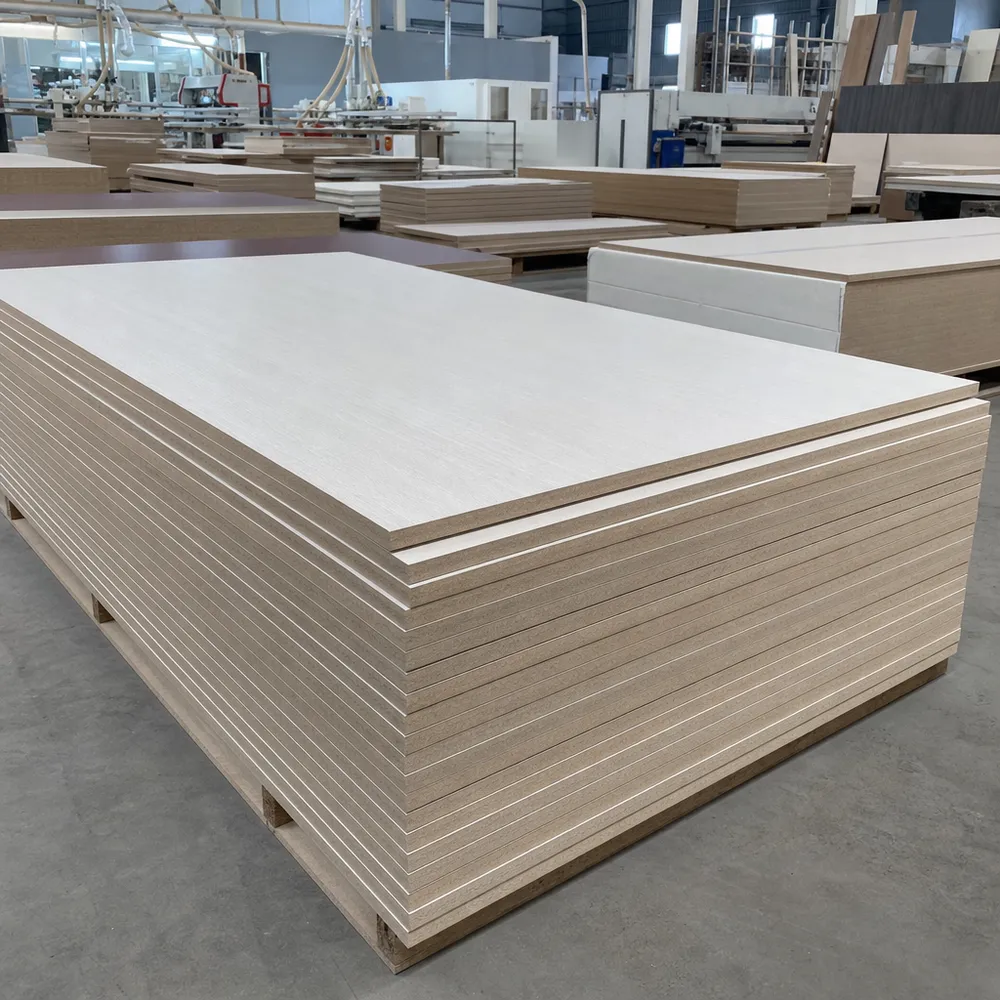
What Melamine MDF Board Is — and Where It Sits in Your Product Mix
Melamine MDF board is medium-density fiberboard with a melamine-impregnated paper surface fused directly to the core under heat and pressure. The result is a panel with a hard, smooth, cleanable surface and a dimensionally stable MDF substrate — no veneer, no adhesive film, no secondary lamination step required before it goes to your customer or into production.
MDF Core vs. Plywood Core: The Commercial Distinction
- Flatter, more uniform surface
- No grain telegraphing through face
- Ideal for painted or solid-color finishes
- Right substrate for CNC cabinet carcasses, drawer fronts, shelving
- Better screw-holding at edges
- Higher bending strength
- Useful for structural applications
- Edge-load-bearing or curved components
If your buyers are running CNC cutting lines for cabinet carcasses, drawer fronts, or shelving, melamine MDF is the right substrate. If they need edge-load-bearing panels or curved components, that's a different conversation.
Where This Page Fits in Our Melamine MDF Range
This page covers the standard melamine MDF board — the core SKU that covers the widest range of applications. For narrower application sourcing, the pages below go deeper on specific configurations:
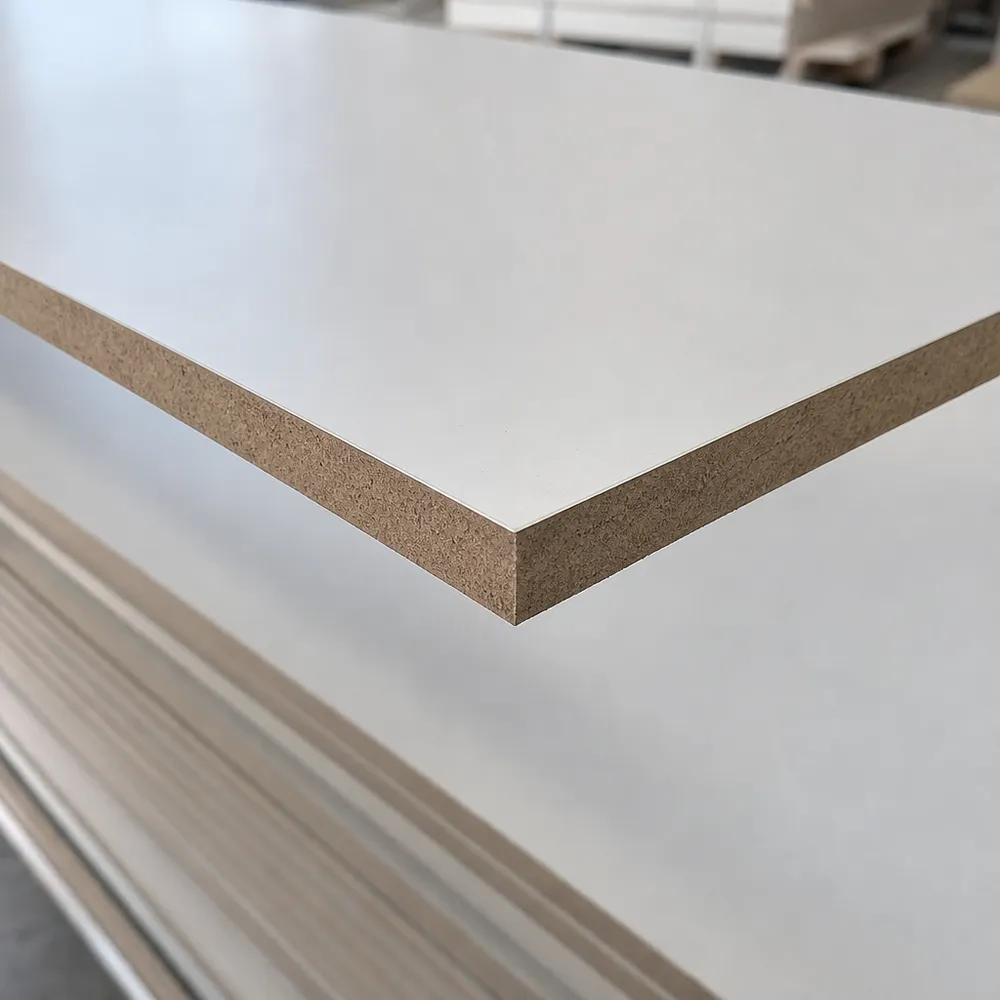
Primary Applications
Technical Specifications
We run melamine MDF board across a thickness range of 2.5mm to 25mm. The table below covers the standard parameters — actual specifications on your order are confirmed at inquiry stage, since core density and surface weight vary by application.
Standard Product Parameters
| Parameter | Standard Value |
|---|---|
| Thickness range | 2.5mm – 25mm |
| Standard panel size | 1220 × 2440mm |
| Custom sizes | Available on confirmed orders |
| Core material | MDF (medium-density fiberboard) |
| Core density | 680–750 kg/m³ (typical; varies by thickness) |
| Surface | Melamine-impregnated paper, single or double-sided |
| Surface finish options |
Matte Satin Woodgrain Solid Color
|
| Formaldehyde emission | E1 standard (≤0.124 mg/m³) E0 on request |
| CARB P2 compliance | Available — specify at order stage |
| Moisture resistance | Standard (interior use) MR grade available |
| Thickness tolerance | ±0.2mm |
| Squareness tolerance | ±1mm per 1000mm |
| Color options | 120+ standard colors Custom matching available |
| MOQ | Negotiable by thickness and color — contact us for details |
All specifications are indicative. Final parameters — including core density, surface weight, and emission grade — are confirmed at inquiry stage based on your application and destination market.
Thickness Range at a Glance
Compliance Options
- E1 — standard across all SKUs
- E0 — available on request, specify at inquiry
- CARB P2 — available for US-bound shipments
- FSC — chain-of-custody documentation available on select runs
Need a spec sheet? We can provide a full technical data sheet for your target thickness and emission grade. Send us your application details and we'll turn it around quickly.
Request a spec sheetManufacturing Process & Quality Controls
The surface performance of melamine MDF depends almost entirely on what happens during pressing. Here's how we control it — and what that means for your buyers' production lines.
MDF Core Selection
Core density is matched to application — higher density for thinner panels where screw-hold matters, standard density for thicker carcass stock. We don't run a single-density core across all thicknesses.
Melamine Paper Impregnation
Decorative paper is saturated with melamine resin under controlled conditions. Resin content and cure rate are monitored per batch — this is what determines surface hardness and scratch resistance in the finished panel.
Short-Cycle Pressing
Impregnated paper is fused to the MDF core under heat and pressure in a short-cycle press. Temperature, pressure, and dwell time are controlled to achieve full resin cure without surface blister or delamination risk. No adhesive film — the resin bonds directly to the fiber surface.
Dimensional Calibration
Panels are calibrated to thickness tolerance after pressing. Our standard is ±0.2mm across the panel face — critical for CNC nesting where stack height and toolpath depth are set to a fixed thickness.
Surface & Emission QC
Each production run is checked for surface defects (blister, delamination, color deviation) and emission levels. Batch test reports are available on request — we don't ship without them on compliance-sensitive orders.
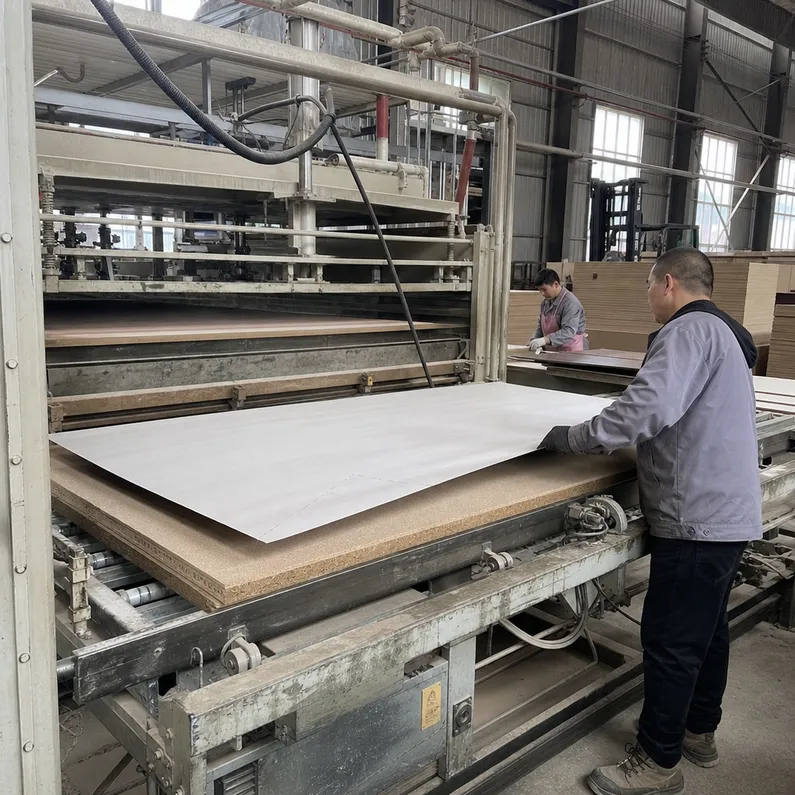
Quality Control Checkpoints
Batch test reports available. For compliance-sensitive markets — EU, US, Australia — we provide emission test reports and, where required, third-party certification documentation. Specify your destination market at inquiry stage.
Sourcing, Lead Times & Logistics
We supply melamine MDF board ex-factory China, with consolidation and container loading handled at our end. Here's what importers and distributors need to know before placing an order.
Lead Times
Standard production lead time is 15–25 days from order confirmation, depending on thickness, color, and volume. Custom colors or non-standard sizes add 5–10 days.
Packaging & Loading
Panels are palletized and stretch-wrapped for container loading. We handle FCL and LCL consolidation — most standard orders ship in 20ft or 40ft containers.
Documentation
Standard export documentation includes commercial invoice, packing list, bill of lading, and certificate of origin. Emission test reports, phytosanitary certificates, and fumigation certificates available on request.
Pricing Structure
We quote FOB, CFR, or CIF depending on your preference. Pricing varies by thickness, surface finish, emission grade, and volume. We don't publish price lists — all quotes are application-specific.
MOQ & Volume Flexibility
MOQ is negotiable and depends on thickness and color. Standard colors in common thicknesses (15mm, 18mm) can often be consolidated with other orders to reduce minimum requirements.
Markets We Supply
We regularly ship to Europe, North America, Australia, the Middle East, and Southeast Asia. Compliance documentation is matched to destination market requirements.
A note on incoterms and port selection
We work with freight forwarders at major Chinese export ports (Shanghai, Ningbo, Guangzhou). If you have a preferred forwarder or nominated carrier, we can coordinate with them directly. For buyers without an established freight relationship, we can recommend options — just flag it when you inquire.
Frequently Asked Questions
Questions we get from importers, distributors, and procurement teams sourcing melamine MDF board for the first time — or switching suppliers.
What's the difference between melamine MDF and laminated MDF?
Melamine MDF uses a resin-impregnated paper that's fused directly to the core under heat and pressure — no adhesive layer. Laminated MDF applies a separate film or foil using adhesive. The melamine process produces a harder, more durable surface that's better suited to CNC cutting and high-volume production. Laminated panels can delaminate at cut edges; melamine panels don't.
Can melamine MDF be used in kitchens or bathrooms?
Standard melamine MDF is rated for interior dry use. For kitchen carcasses in normal conditions, it performs well. For areas with sustained moisture exposure — behind sinks, in bathrooms — specify moisture-resistant (MR) grade core. The melamine surface itself is water-resistant; the risk is at the core and cut edges if they're not sealed.
What thickness should I specify for cabinet carcasses?
18mm is the most common specification for cabinet carcasses in European and Australian markets. 15mm is used where weight reduction matters or for smaller units. 25mm is specified for worktops or heavy-load shelving. If your buyers are running a standard kitchen cabinet line, 18mm melamine MDF is almost certainly what they need.
Do you supply samples before a full order?
Yes. We can provide physical samples of surface finish, color, and thickness for evaluation before order confirmation. Sample lead time is typically 5–7 days. For buyers evaluating multiple colors or finishes, we can send a sample board set — contact us with your shortlist.
How do I verify emission compliance for my market?
Specify your destination market and required standard at inquiry stage. For EU shipments, we provide E1 test reports as standard. For US shipments, CARB P2 documentation is available. For Australia, we can provide NATA-accredited test reports where required. All documentation is batch-specific — not generic certificates.
Can you match a specific color or decor from another supplier?
In most cases, yes. Send us a physical sample or the decor reference number from your current supplier. We'll confirm whether we have a direct match in our standard range or whether a custom run is needed. Custom color matching typically requires a minimum run — we'll confirm the MOQ when we assess the sample.
What's the typical container load for 18mm melamine MDF?
A standard 40ft container holds approximately 600–700 sheets of 18mm melamine MDF at 1220×2440mm, depending on pallet configuration and weight limits. We provide exact container utilization figures with the proforma invoice so your buyers can plan warehouse intake accurately.
Is melamine MDF suitable for CNC routing and edge banding?
Yes — it's the primary substrate for CNC cabinet production. The consistent core density gives clean tool paths and predictable cut quality. Cut edges are typically finished with PVC or ABS edge banding applied by hot-melt. The melamine surface bonds well with standard edge banding adhesives at the face-to-edge joint.
Ready to Source Melamine MDF Board?
Send us your specification — thickness, surface finish, emission grade, destination market, and target volume. We'll come back with a working price within 24 hours.
Send an Inquiry
Other Ways to Reach Us
What to include in your inquiry
- Thickness and sheet size (or confirm standard 1220×2440mm)
- Surface finish and color — or send a reference sample
- Emission standard required (E1, CARB P2, or other)
- Destination port and preferred incoterm
- Estimated volume per order or per year
We work directly with importers, distributors, and procurement teams. No intermediaries — you deal with the factory team from first inquiry through to shipment.
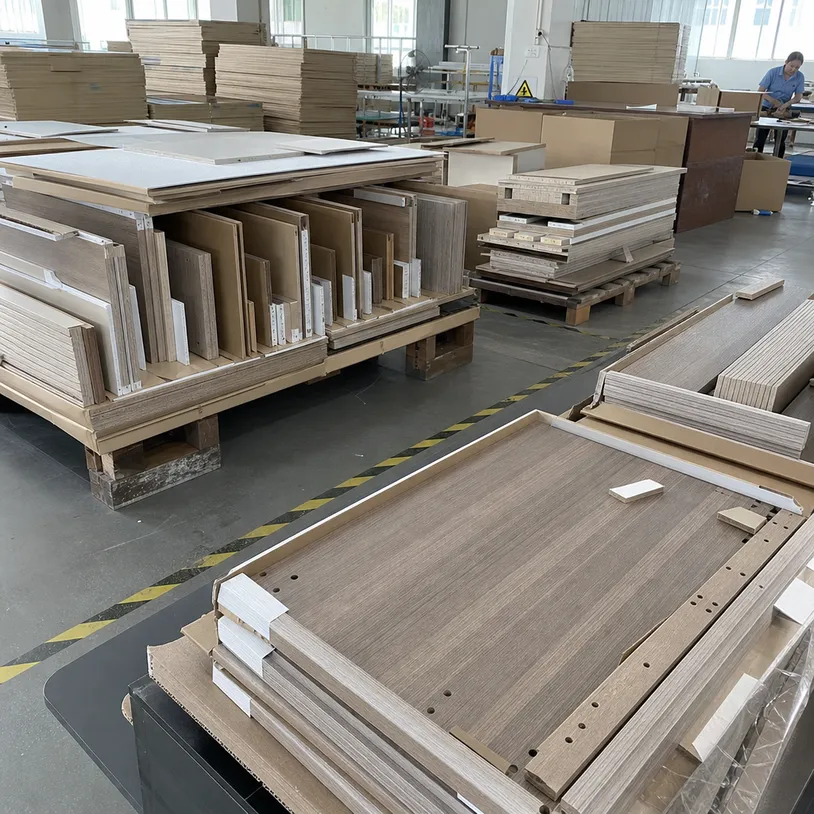
How We Press It: The Process Behind Surface Consistency
Surface quality is determined almost entirely at the press stage — and that's where most of the variation between suppliers shows up.
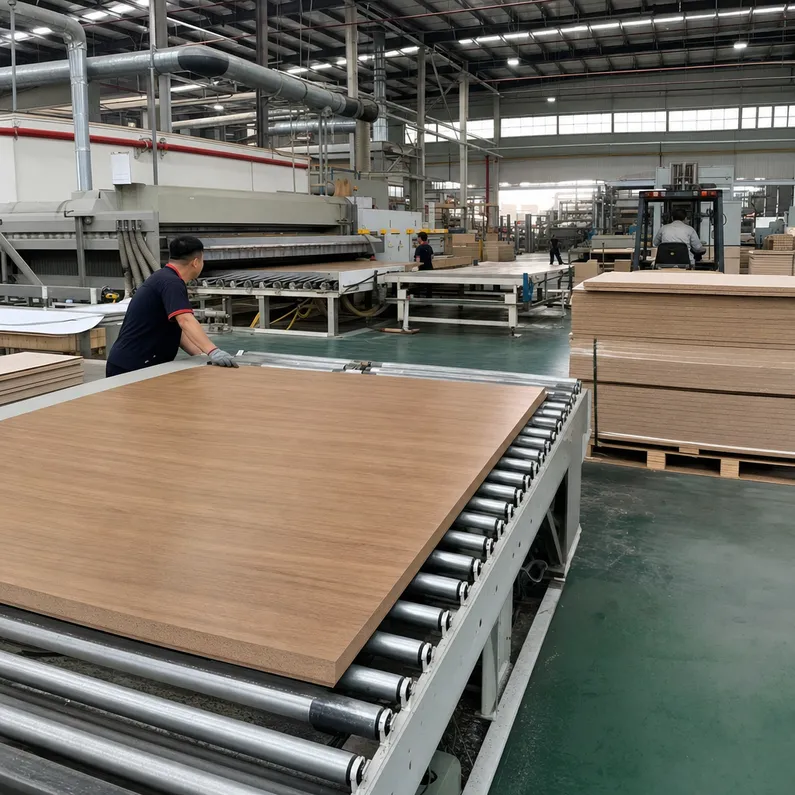
We press melamine paper onto MDF core using a short-cycle hot press line. The press parameters — temperature, pressure, and dwell time — are calibrated per paper weight and core density. A heavier melamine paper (typically 80–120 g/m²) requires a longer dwell time to fully cure the resin; under-pressing leaves the surface with micro-porosity that shows up as dull patches or uneven sheen across a batch.
The MDF core we use is sourced from mills running E1 or E0 resin systems. We specify core density at 680–750 kg/m³ for standard furniture-grade panels. Below 650 kg/m³ and you start seeing screw pull-out failures at edge joints — the most common warranty complaint in flat-pack furniture.
Buyer note: We've had buyers come to us after sourcing lower-density core from other suppliers and getting returns from their retail customers. The density spec is not a premium feature — it's the floor for reliable downstream performance.
After pressing, panels go through a calibrated sanding pass on the back face to bring thickness into tolerance, then trimming to final dimensions. Thickness tolerance of ±0.2mm is maintained across the panel — relevant if your buyers are running automated panel saws or CNC routers where thickness variation causes feed errors or depth inconsistency on routed profiles.
The melamine paper itself is sourced from established paper mills with consistent resin impregnation. We don't mix paper batches within a production run — color and surface texture consistency across a full container order is something we treat as a basic requirement, not a premium service.
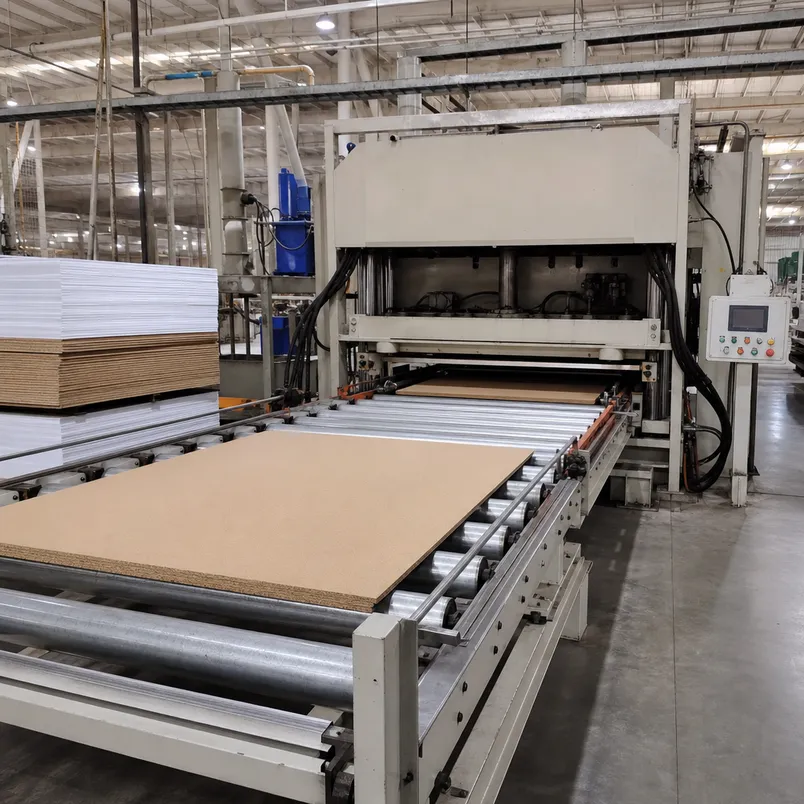
Production Sequence
Core Sourcing
E1/E0 resin MDF core from certified mills. Density specified at 680–750 kg/m³ — verified per batch before pressing.
Paper Preparation
Single-batch melamine paper per production run. No batch mixing — ensures color and texture consistency across a full container order.
Hot Press Cycle
Temperature, pressure, and dwell time calibrated per paper weight. Full resin cure eliminates micro-porosity and surface sheen variation.
Calibration & Trim
Back-face sanding pass brings thickness to ±0.2mm tolerance. Final trim to dimension. Critical for CNC router and automated panel saw compatibility.
Thickness Selection and What It Means for Your Buyers' Applications
Thickness is the first spec decision your buyers make. Getting it wrong costs them in either material waste or structural failure. Here's how the range maps to common applications.
Back panels for cabinets and wardrobes, drawer bottoms, decorative wall paneling. At this range, the panel is not load-bearing — it's a closure or aesthetic surface.
Buyers in the flat-pack furniture segment use 3mm and 4mm back panels at high volume. A single furniture manufacturer can move 50,000+ sheets per year in this range.
Shelf panels for lighter-duty applications, door inserts, decorative partitions.
The 12mm spec is common in retail display fixtures and office furniture components where the panel needs to span 600–800mm without visible sag under moderate load.
The core cabinet carcass range. 18mm is the industry standard for kitchen cabinet sides, shelves, and base units across most markets.
If you're supplying to kitchen cabinet manufacturers or distributors who serve the renovation market, 18mm melamine MDF is the volume SKU.
See the 18mm melamine MDF page for full detailCountertop substrates, heavy-duty shelving, worktops for commercial fit-out.
Less common in residential furniture but relevant for commercial interior contractors and hospitality fit-out projects.
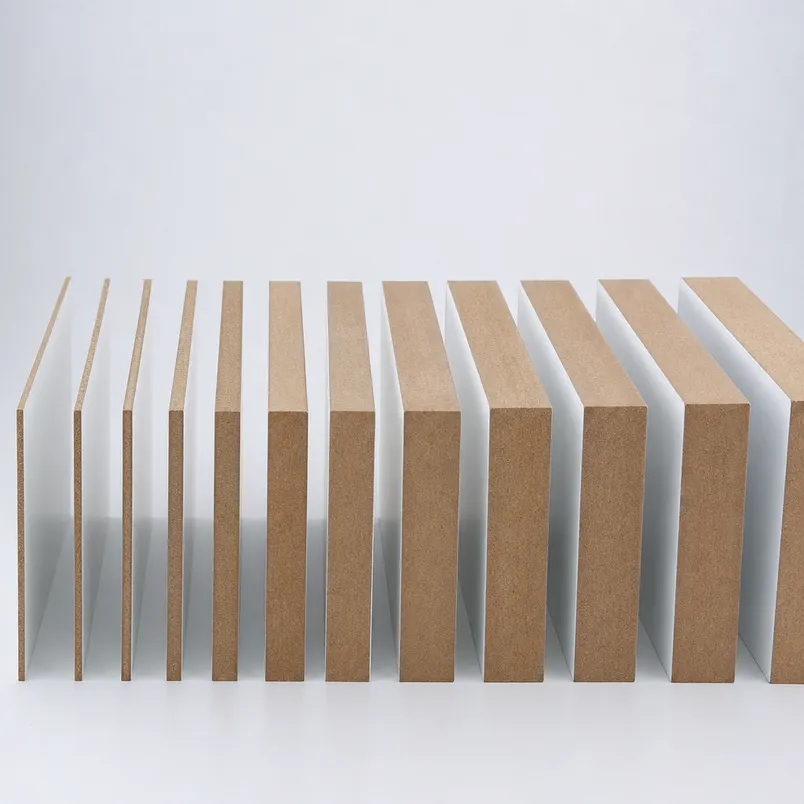
Thickness at a Glance
Spec note: Thickness tolerance of ±0.2mm is maintained across the panel. If your buyers run automated panel saws or CNC routers, this tolerance directly affects feed accuracy and routed profile depth consistency.
Market Segments Where This Product Generates Repeatable Volume
Melamine MDF board drives consistent reorder volume across four distinct buyer segments. Understanding which segment your buyers fall into determines which commercial variables matter most.
Furniture Manufacturers and OEM Suppliers
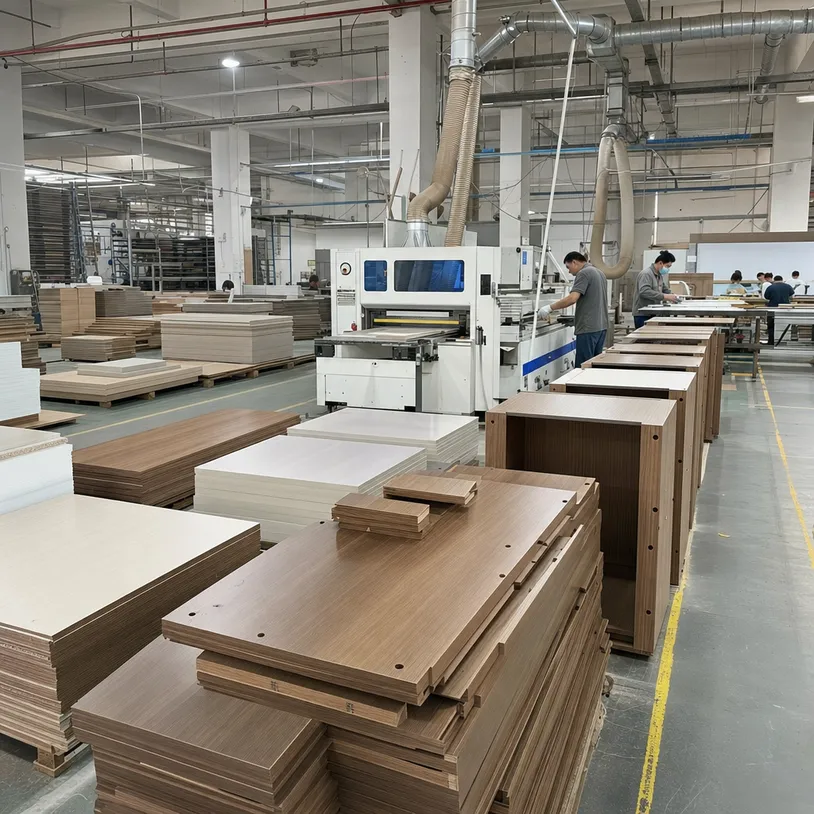
Highest VolumeCabinet carcasses, wardrobe components, bookcase shelving, and bed frames are the highest-volume applications. A mid-size furniture manufacturer running 500–2,000 containers per year will have melamine MDF board as one of their top three raw material SKUs by volume.
Key Commercial Variables
- Color consistency across reorders
- Thickness tolerance for automated production lines
- CARB P2 compliance for manufacturers exporting to North America
Kitchen and Bathroom Cabinet Distributors
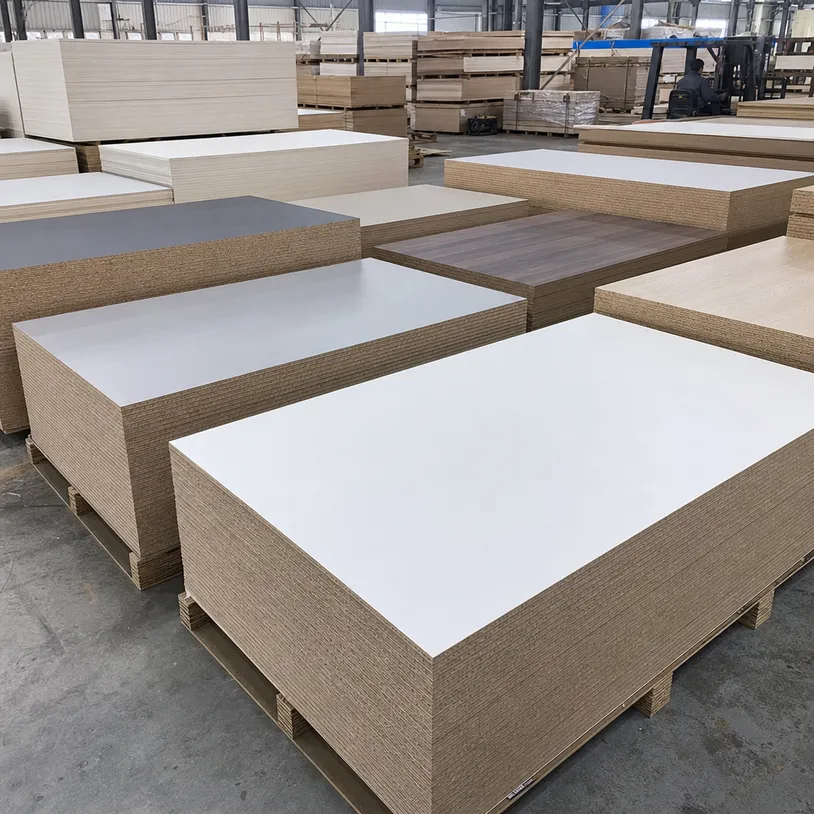
30–60 Day Reorder CyclesThe renovation market in North America, Europe, and Australia runs on 18mm melamine MDF for cabinet carcasses. Distributors in this segment typically stock 4–8 standard colors and reorder on 30–60 day cycles.
Margin risk: A color shift between reorders forces the distributor to either sell mismatched inventory at a discount or absorb a return. Color consistency across production runs is the primary commercial requirement in this segment.
Standard Stock Colors
Interior Fit-Out Contractors and Project Buyers
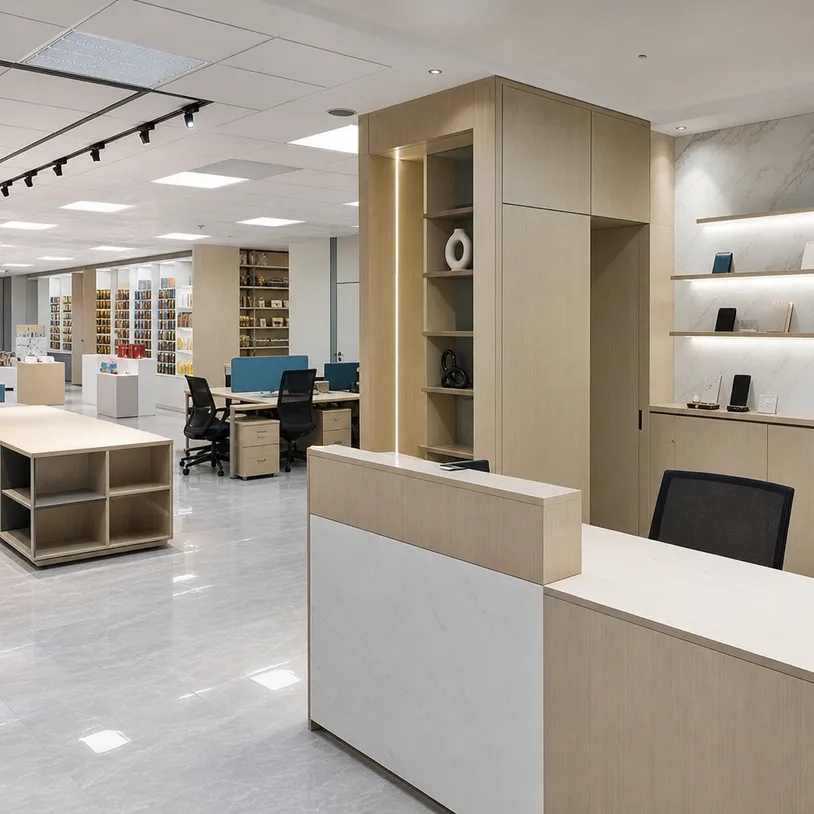
500–5,000 Sheets Per ProjectCommercial office fit-out, retail store fixtures, hospitality interiors, and healthcare furniture all use melamine MDF board for wall paneling, built-in cabinetry, and millwork components. Project orders tend to be larger but less frequent.
Documentation Requirements
CE Compliance
European projects
CARB P2
US projects
FSC CoC
Sustainability-audited
We carry all three — see our certifications.
E-Commerce and Independent Furniture Brands
Growing SegmentBrands selling flat-pack furniture through Amazon, Wayfair, or their own DTC channels need panels that survive parcel shipping without edge damage and arrive with consistent surface quality.
We can supply panels cut to component dimensions with edge banding applied, reducing your buyer's production step and enabling direct-to-warehouse fulfillment. This is a growing segment for us — worth considering if you're building a product line for online retail.
Color Range and Surface Options: What Drives Margin in Your Market
The surface finish is where melamine MDF board earns its margin premium over raw MDF. We offer 120+ standard colors across matte, satin, and woodgrain finishes. Here's the commercial logic for your buyers.
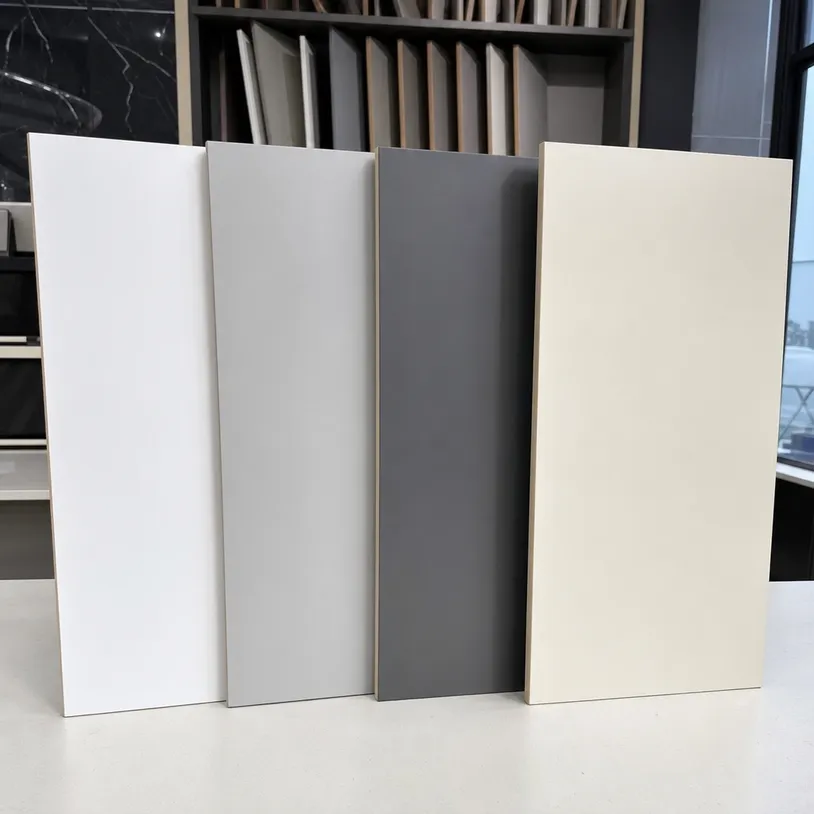
Solid Colors
White · Grey · Black · Cream
The highest-volume SKUs in most markets. White and light grey together typically account for 60–70% of volume in residential furniture. These are commodity specs — your margin comes from supply reliability and color consistency, not from the color itself.
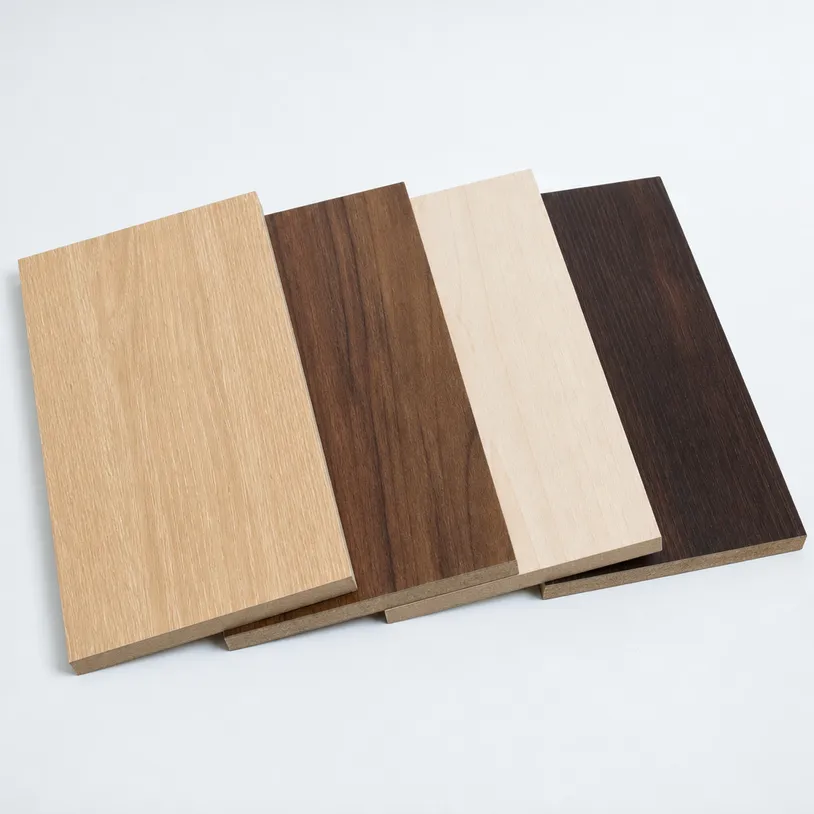
Woodgrain Finishes
Oak · Walnut · Maple · Wenge
Woodgrain melamine MDF competes with real veneer panels at a significant cost advantage — the surface is more durable (no grain raising, no finishing required) and the cost is 30–50% lower than comparable veneer panels.
For distributors supplying mid-market furniture manufacturers, woodgrain melamine MDF is often the product that drives the most margin per sheet.
Custom Color Matching
OEM Buyers · MOQ AppliesWe can match custom colors for OEM buyers with minimum run quantities. If your customer has a brand color or a specific RAL/NCS reference, we work with our paper supplier to source or produce the matching paper.
Lead time for custom color runs is longer than standard. Confirm at inquiry stage.
High-Gloss Surface
Separate Product LineAvailable as a separate product line. Standard melamine MDF is matte to satin; gloss requires a different press process and paper specification.
View High-Gloss Melamine MDFFull Color Range
120+ Standard Colors Available
Matte, satin, and woodgrain finishes across a full standard range. Solid colors and woodgrain patterns are available from stock. Custom RAL/NCS matching available for OEM runs with confirmed lead times.
Certification Stack: Pre-Qualified for Your Key Import Markets
Certifications are procurement gates, not marketing badges. Every certification below maps to a specific market requirement. We maintain these as standard — not as premium add-ons — so your documentation package is ready when your buyer asks for it.
US Market Compliance
Formaldehyde emission compliance for the US market. We formulate to CARB P2 as the baseline for export-grade panels — not as a special option.
If you're supplying furniture manufacturers or distributors who sell into California or the broader US market, CARB P2 documentation is a procurement gate. We prepare the documentation package as standard for US-bound shipments.
Chain of Custody
For buyers with sustainability sourcing policies or customers in markets where deforestation-linked supply chains carry reputational or regulatory risk.
FSC documentation is available on request for FSC-certified orders.
European Market Access
Covers European construction and building material applications.
Relevant for interior fit-out contractors and project buyers supplying into EU markets.
Process Quality Management
Process quality management certification covering our production and QC systems.
Audit reports available on request.
Formaldehyde Emission Standards
E1 is standard across our melamine MDF range — the baseline for most export markets.
E0 (ultra-low emission) is available for buyers supplying into markets with stricter indoor air quality requirements — Japan, South Korea, and premium residential segments in Europe and North America.
Specify E0 at order stage.
Full documentation packages are prepared as standard for US-bound shipments. For other markets, request the relevant certificate set at inquiry stage and we'll confirm availability for your order.
Customization Parameters: What You Can Specify, What Has Limits
Every parameter below is specifiable at order stage. Where there are practical limits — minimum run quantities, scheduling constraints — we've stated them plainly so you can plan accurately.
Thickness
Any thickness from 2.5mm to 25mm. Non-standard thicknesses (e.g., 16mm, 19mm) are available on confirmed orders.
MDF is cut-to-thickness, not molded — so custom thickness is a scheduling question, not a tooling question.
Panel Dimensions
Standard 1220×2440mm. Custom sizes available on confirmed orders.
Common custom requests include 1220×2800mm for tall wardrobe panels and 1830×2440mm for wider format applications.
Surface Finish
Matte, satin, woodgrain, or custom. Single-sided or double-sided melamine facing.
Back face options include plain MDF, balancing paper (to prevent warping), or melamine paper matching the face.
Core Specification
Default core for most applications.
Moisture-resistant MDF core for higher-humidity environments. Relevant for kitchen and bathroom applications where the panel may be exposed to steam or condensation.
Ultra-low emission core for Japan, South Korea, and premium residential segments.
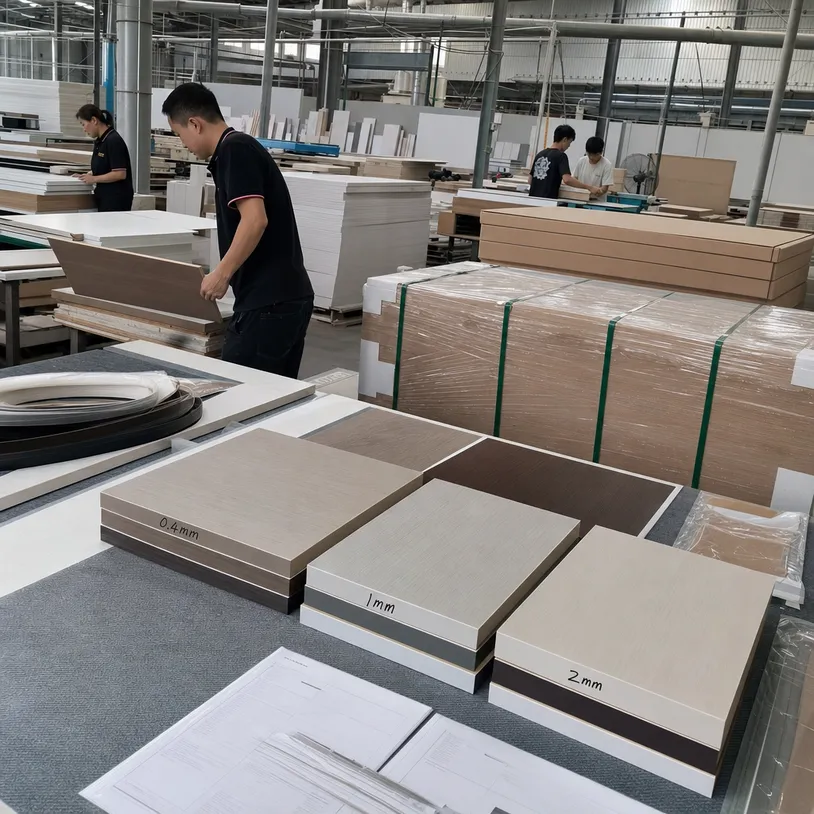
Edge Treatment
Panels can be supplied with PVC edge banding applied for buyers who want to reduce their own production steps.
Edge banding color matching to the face is standard.
Branding & OEM Marking
OEM packaging, custom bundle marking, and private-label documentation available.
We've run OEM programs for furniture brands in North America and Europe where the panels ship with the buyer's brand identity on the packaging.
What Has Limits
Custom colors below minimum run quantities are not economical — the paper sourcing and press setup cost doesn't amortize on small runs.
Below approximately 200–300 sheets per color, standard colors are the practical choice. Confirm minimum quantities for custom colors at inquiry stage.
Custom color MOQ: ~200–300 sheets per color — confirm at inquiry
Quick Reference: Specifiable Parameters
| Parameter | Range / Options | Notes |
|---|---|---|
| Thickness | 2.5mm – 25mm | Non-standard thicknesses on confirmed orders; scheduling, not tooling |
| Panel Size | 1220×2440mm standard; custom on order | 1220×2800mm and 1830×2440mm most common custom requests |
| Surface Finish | Matte, satin, woodgrain, custom | Single or double-sided; back face options available |
| Core Type | Standard E1, MR, E0 ultra-low | MR for humid environments; E0 for premium/regulated markets |
| Edge Banding | 0.4mm, 1mm, 2mm PVC | Color-matched to face as standard |
| OEM / Branding | Custom packaging, bundle marking, private-label docs | Available for confirmed programs; discuss at inquiry |
| Custom Color MOQ | ~200–300 sheets per color | Below this threshold, standard colors are the practical choice |
Need a specific configuration?
Send your thickness, size, finish, and core requirements — we'll confirm availability and lead time.
What the Paperwork Actually Covers
Certifications matter when your buyers or regulators ask for them. Here's what we hold, what each one covers, and what it means for your import process.
CARB Phase 2
California Air Resources Board
Required for composite wood products sold into California and effectively the US market standard. Covers formaldehyde emissions from the MDF core.
Relevant for: US importers, retailers, and furniture brands selling in North America.
FSC Chain of Custody
Forest Stewardship Council
Certifies that the wood fiber used in the MDF core is sourced from responsibly managed forests. Required by many European retailers and green building specifications.
Relevant for: EU buyers, LEED projects, and retailers with sustainability sourcing policies.
E1 / E0 Emission Class
EN 13986 / JIS A 5905
European E1 is the baseline for EU market access. E0 (ultra-low) meets Japanese JIS and South Korean standards, and is increasingly requested for premium residential projects.
Relevant for: EU market access (E1 minimum); Japan, South Korea, premium residential (E0).
ISO 9001
Quality Management System
Documents that production processes, inspection procedures, and supplier controls meet an internationally audited quality management standard.
Relevant for: Buyers who require documented QMS from suppliers as part of their own compliance programs.
CE Marking
EN 13986 Declaration of Performance
Required for wood-based panels sold into the European Economic Area. Confirms the product meets the harmonized standard for structural and non-structural panel applications.
Relevant for: All EU and EEA importers — this is a legal requirement, not optional.
Third-Party Testing
SGS, Intertek, Bureau Veritas
Pre-shipment inspection and independent lab testing available through SGS, Intertek, or Bureau Veritas. Test reports can be provided with shipment documentation.
Relevant for: Buyers who require independent verification before payment release or customs clearance.
A Note on Documentation
Certification documents — test reports, CoC certificates, declarations of performance — are provided with shipment. If your customs broker or buyer requires specific formats or additional declarations, flag this at the order stage so we can prepare the right paperwork.
For CARB compliance specifically: we can provide the third-party certifier name and certificate number for your records, which is what US Customs and your buyers will ask for.
Need specific certification documents?
Tell us which certificates your buyers or customs process requires — we'll confirm what we can provide.
Packaging, Container Loading, and Landed Cost Planning
Standard packaging protects panels through transit. Container loading plans ship with every order so your receiving team and freight forwarder know the exact configuration before the container arrives.
Standard Packaging Specification
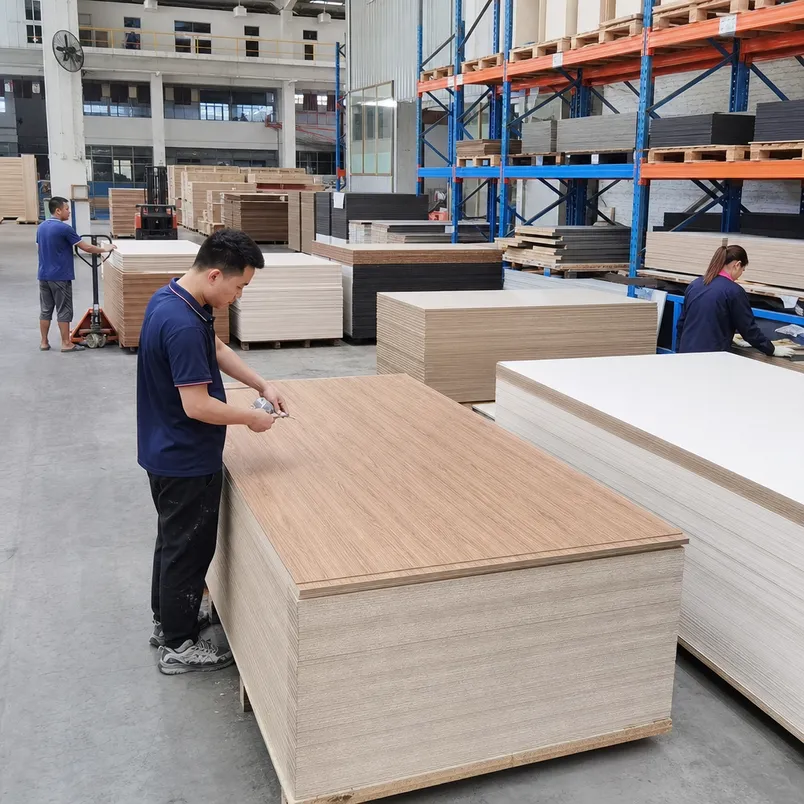
50–100 sheets per bundle depending on panel thickness
Strapped, corner-protected, and wrapped in moisture-resistant film
Product specification, color code, thickness, quantity, and batch number on every bundle
Consolidated containers for distributors building initial inventory across a color range — packed to prevent damage from differential settling
Transit Times from Xuzhou
Via Qingdao, Shanghai, or Lianyungang
Container Loading — Standard 1220×2440mm Panels
| Container Type | Approx. Loading (18mm) | Notes |
|---|---|---|
| 20GP | ~280–320 sheets | Depends on thickness and stacking configuration |
| 40HQ | ~600–680 sheets | Standard for most export orders |
Thinner panels (3mm, 6mm) load significantly more sheets per container. We provide a loading plan with each shipment so your receiving team and freight forwarder know the exact configuration before the container arrives.

Sourcing Melamine MDF Board vs. Sourcing from a Trading Company
We are a factory, not a trading company. The practical difference for your order is not a marketing claim — it's a specification and documentation guarantee that a trading company structurally cannot provide.
Specification integrity
The specification you confirm with us is the specification we produce. Not the lowest-cost factory available for that order.
Sample-to-production match
The sample you approve is from the same production process as your order — not a reference sample from a different run.
Batch-accurate documentation
CARB P2 documentation covers the actual production batch, not a reference batch from a different run submitted to satisfy a trading company's paperwork requirement.
Direct technical answers
When you have a question about press parameters, paper source, or core density — we can answer it because we made the decision, not because we're relaying it from a supplier.
What Buyers Report After Trading Company Failures
These are not hypothetical risks. They're the reason buyers who've been burned once start looking for factory-direct relationships:
Core density below spec — panels arrived lighter and weaker than the agreed specification
Color off from the approved sample — the trading company sourced from a different factory for that order
Formaldehyde documentation didn't match the actual production batch — a compliance risk in regulated import markets
Factory Direct vs. Trading Company
Sibling Products in the Melamine MDF Range
Each product in this range is optimized for a specific market segment, thickness standard, or surface specification. Use the table below to match your application to the right configuration.
| Product | Best Fit |
|---|---|
| White Melamine MDF | High-volume white and off-white SKUs; the most common color in residential furniture |
| High-Gloss Melamine MDF | Premium furniture and kitchen cabinet doors where gloss finish commands a retail price premium |
| 18mm Melamine MDF | Kitchen and bathroom cabinet carcasses; the standard thickness for the renovation market |
| Kitchen Melamine MDF | MR-core panels for kitchen and bathroom environments; moisture-resistant specification |
If you're not sure which configuration fits your market, send us your target application and volume — we'll recommend the right spec and surface combination.
Get a RecommendationFrequently Asked Questions
Decision-stage questions from importers, distributors, and furniture brands sourcing melamine MDF board for the first time or switching suppliers.
MDF core gives a flatter, more uniform surface with no grain telegraphing — the right choice for solid-color and woodgrain finishes on furniture components. Plywood core has better screw-holding at edges and higher bending strength, which matters for structural applications.
For flat-panel furniture (cabinet carcasses, shelving, drawer fronts), melamine MDF is the standard substrate. For applications requiring edge load-bearing or curved components, melamine plywood is the better fit.
E1 is standard across our range (≤0.124 mg/m³ per EN 717-1). E0 (ultra-low emission) is available on request for buyers supplying into Japan, South Korea, or premium residential segments in Europe and North America.
CARB P2 compliance is available for US-bound shipments — specify at order stage and we prepare the documentation package as standard.
Standard colors (white, grey, woodgrain, and other catalog colors) have no minimum beyond what makes sense for container loading.
Custom color matching — where we source or produce a specific paper to match your RAL/NCS reference — requires a minimum run to amortize the paper sourcing and press setup cost. The practical floor is approximately 200–300 sheets per color, but confirm at inquiry stage since it depends on the paper availability and your thickness specification.
Yes. We apply PVC edge banding in 0.4mm, 1mm, and 2mm thickness, color-matched to the face. This reduces your buyer's production step and is common for buyers supplying flat-pack furniture brands or e-commerce channels where the panels go directly to a warehouse rather than a production facility.
Specify edge banding requirements at order stage.
These are production lead times — add transit time for your destination port. Contact us with your target delivery date and we'll work back from there.
We retain batch records including paper lot, press parameters, and color measurement data for each production run. When you reorder, reference your original order number and we match against the retained batch record.
For high-volume buyers with strict color consistency requirements, we can hold a paper stock reservation to ensure the same paper lot is used across multiple production runs. This is worth discussing at the initial order stage if color consistency across reorders is a commercial requirement for your customers.
Paper stock reservations for color-critical programs should be discussed at initial order stage — not at reorder stage.
Get a Quote for Melamine MDF Board
Send us your requirements and we'll respond with a detailed quote, relevant certification documentation, and a sample if needed before you commit to a full order.
What to Include in Your RFQ
- Thickness — specify the thickness range you need (2.5mm–25mm)
- Panel size — standard 1220×2440mm or custom dimensions
- Surface finish — matte, gloss, woodgrain, solid color, or high-gloss
- Color requirements — RAL reference, sample, or description
- Target volume — container quantity or annual volume estimate
- Destination market — determines which certification documentation applies
Sample Orders Available
Most new buyers in this category start with a sample order to verify color and surface quality against their own production process before placing a container order. We can ship samples within 5–7 working days.
What You'll Receive
Detailed Quote
Unit price, MOQ, and lead time
Certification Docs
Relevant to your import market
Physical Sample
Ships in 5–7 working days
Explore More
Related Products in the Melamine MDF Range
White Melamine MDF
Clean white surface for furniture and cabinetry
View productHigh Gloss Melamine MDF
Mirror-finish surface for premium cabinet fronts
View product18mm Melamine MDF
Standard structural thickness for shelving and carcasses
View productKitchen Melamine MDF
Moisture-resistant grade for kitchen cabinet applications
View product