

CNC MDF Board Manufacturer
CNC MDF engineered for clean cuts, tight tolerances, and zero tearout — direct from factory.
Consistent internal density means your router bits and laser heads track true across the full sheet. No voids, no hard spots, no batch-to-batch surprises that force your downstream customers to recalibrate.
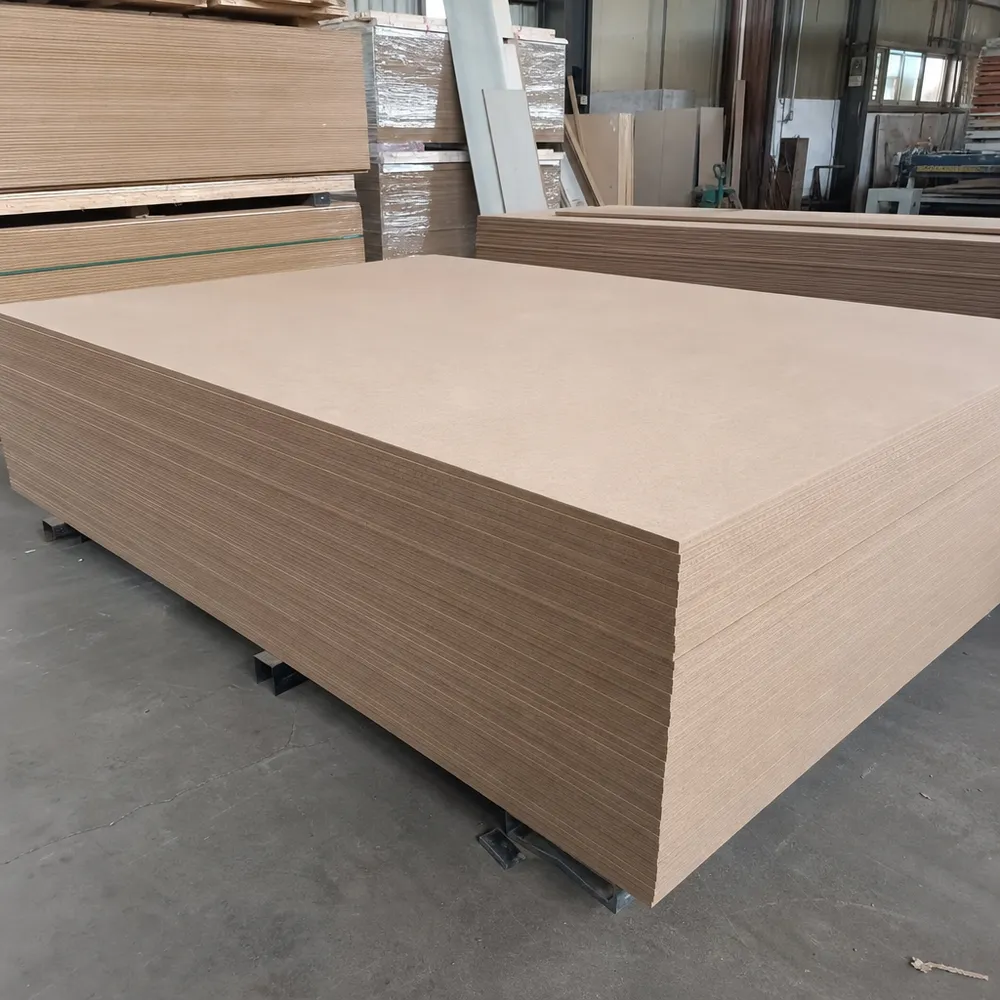
What Makes MDF Suitable for CNC — and Where Most Boards Fail
Not all MDF runs well on a CNC router or laser cutter. The failure mode we hear about most from buyers is inconsistent density across the panel — the board cuts cleanly in the center, then the router starts chattering near the edges, or the laser loses focus depth because the fiber density shifts. That's a fiber distribution problem, and it comes from the forming and pressing stage of production.
Our CNC MDF is produced on a continuous flat-press line where fiber mat formation is controlled by an air-laying system that distributes fiber uniformly before pressing. The result is a board with consistent density from edge to edge and face to core — typically 700–780 kg/m³ for standard grades, with tighter density variation than boards produced on older multi-daylight batch presses. (We still run batch presses for standard furniture MDF, but CNC-grade boards go through the continuous line specifically because the density uniformity is better.) That consistency is what lets your customers run a CNC program without stopping to adjust feed rates or laser power mid-sheet.
The surface hardness matters too. CNC routing and laser cutting both generate heat at the cut point. A surface that's too soft absorbs heat and chars; a surface that's too hard causes premature bit wear. Our CNC MDF targets a surface hardness of 35–45 N/mm² (Brinell), which sits in the range that most router bit manufacturers specify for MDF applications. The sanding finish is calibrated to 80–120 grit depending on thickness — smooth enough for direct painting or lamination, with enough tooth for adhesive bonding.
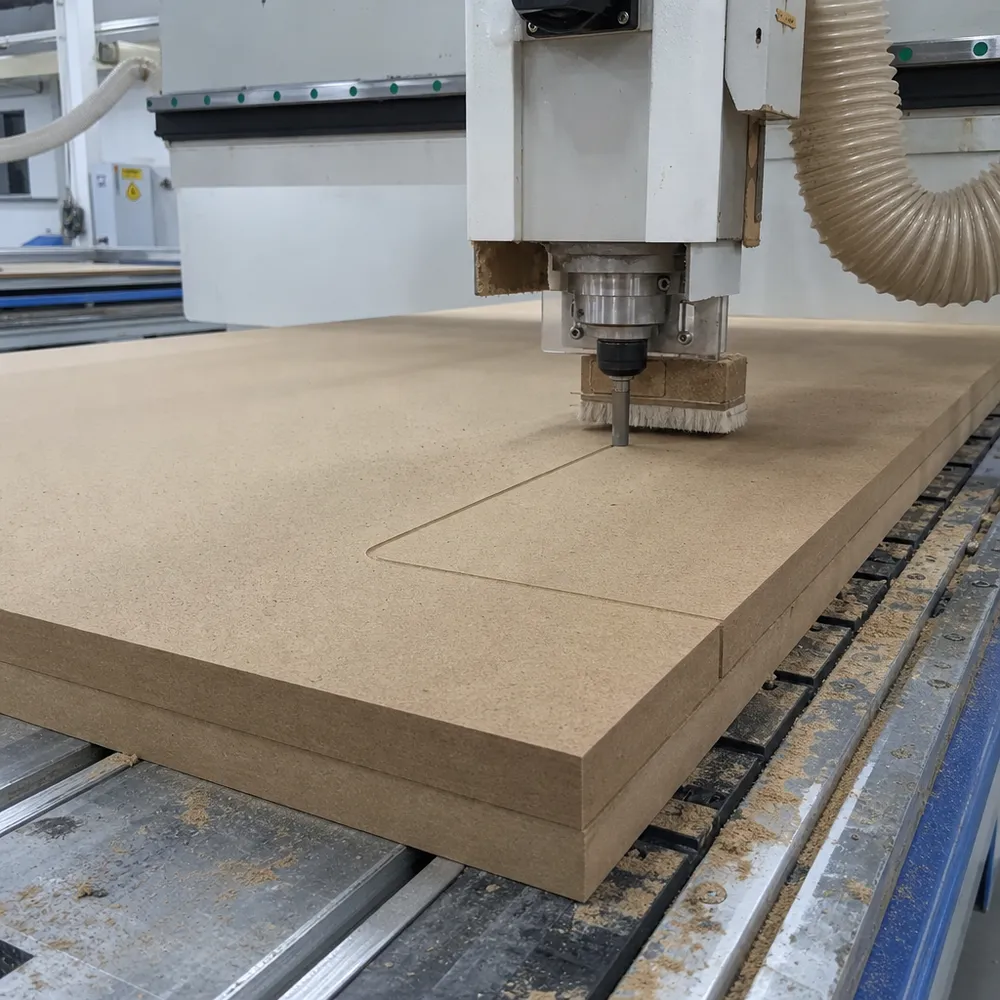
Uniform Density
Air-laying fiber mat on continuous flat-press line. Edge-to-edge consistency, no hard spots.
Surface Hardness
35–45 N/mm² Brinell. Balanced for heat dissipation — no charring, no premature bit wear.
Sanding Finish
80–120 grit both faces. Ready for direct painting, lamination, or adhesive bonding.
Why the press line matters
We run batch presses for standard furniture MDF. CNC-grade boards go through the continuous flat-press line specifically because density uniformity is measurably better — and that's what prevents mid-sheet feed-rate adjustments on your customers' machines.
Technical Specifications
Industry-standard values for CNC-grade MDF. Actual specifications may vary by order. Contact us for detailed product data sheets and test reports.
Dimensional & Physical
Mechanical Performance
Emissions & Certifications
Specifications shown are industry-standard values for this product grade. Actual specifications may vary by order. Contact us for detailed product data sheets and test reports.
Request a Spec Sheet for CNC MDFThickness Selection for CNC and Laser Applications
The thickness you need depends on what your downstream customers are cutting and how deep their toolpaths run. Here's how we see it break down across the orders we ship.
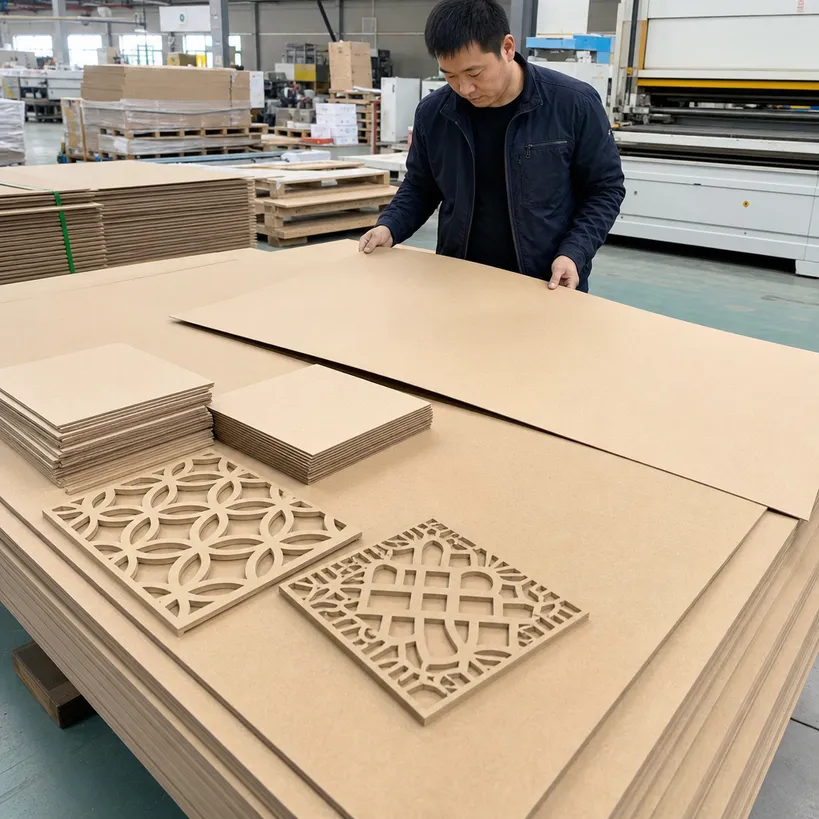
Laser-Cut Decorative & Fretwork
The range for laser-cut decorative panels, fretwork, and thin-profile signage. At these thicknesses, the board needs to be flat — any bow or twist causes the laser head to lose focus distance, which shows up as inconsistent kerf width.
Storage & transit control: We kiln-dry to 5–9% moisture and stack-store under weight before shipping to keep thin boards flat through transit. Thin MDF that arrives bowed is one of the most common complaints from buyers sourcing from factories that don't control storage conditions.
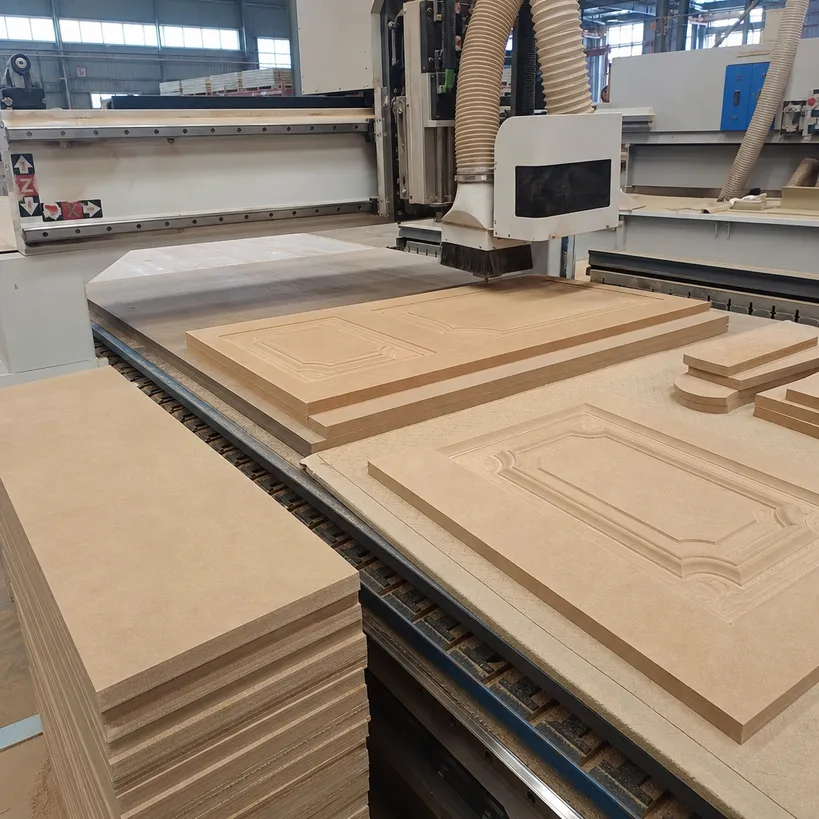
CNC Routing — Cabinet & Furniture
Covers the bulk of CNC routing applications: cabinet door profiles, decorative molding patterns, furniture components with routed edges. This is our highest-volume CNC MDF thickness range.
Default spec: The 12mm board is the default spec for most furniture manufacturers and kitchen cabinet suppliers we supply — it gives enough material for a full profile pass without the weight penalty of 18mm.
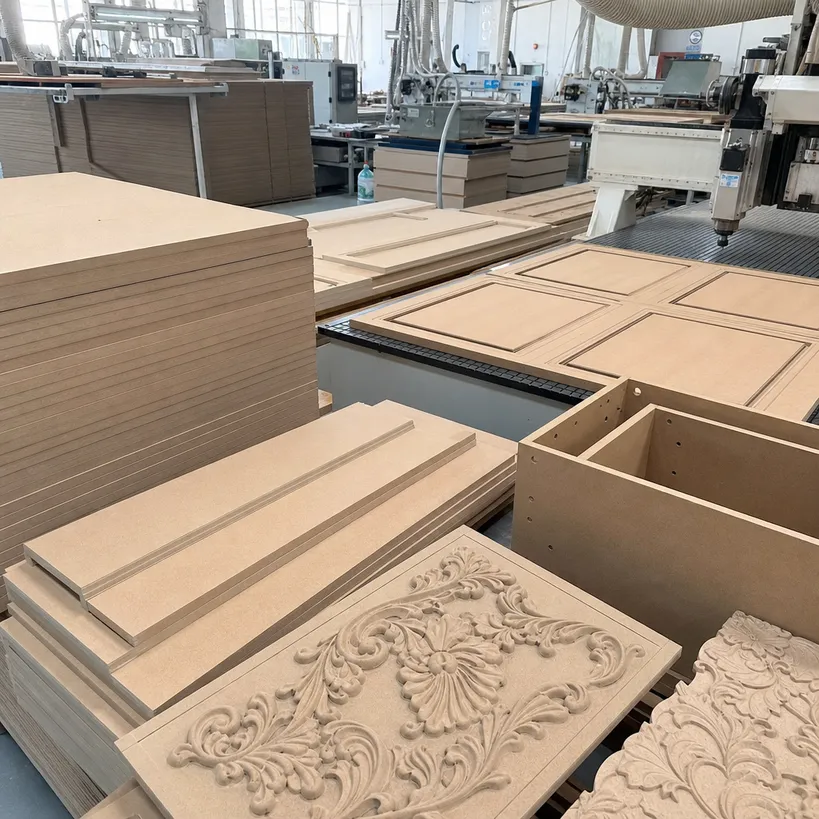
Structural CNC & Carved Panels
Where structural CNC applications start — routed shelf edges, thicker cabinet carcass components, display fixtures that need to hold their shape under load.
Decorative carving substrate: At 18mm, commonly used as a substrate for CNC-carved decorative panels that get painted or lacquered — the extra thickness gives carvers room to work without breaking through.
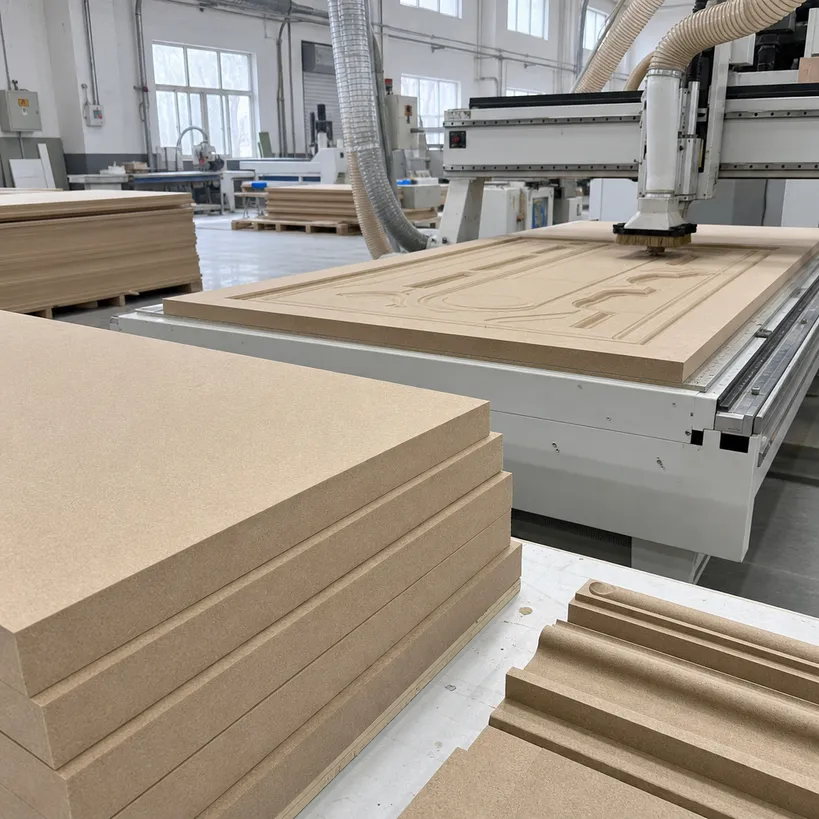
Architectural Millwork & Deep Carving
A specialty thickness, mostly for architectural millwork, thick-profile signage, and custom furniture pieces where the CNC carving depth exceeds what 18mm can accommodate.
Lead time note: Lead time on 25mm is slightly longer because we batch it separately — worth confirming availability when you place the order.
Thickness Quick Reference
| Thickness | Primary Application |
|---|---|
| 3–6mm | Laser cutting, fretwork, thin signage |
| 9–12mm | Cabinet doors, furniture routing, molding profiles |
| 15–18mm | Structural carcass, display fixtures, carved panels |
| 25mm | Architectural millwork, thick-profile signage, deep carving |
Market Segments Where CNC MDF Moves Volume
Understanding which segment your downstream customers fall into determines the grade, thickness, and compliance documentation that matters most for your orders.
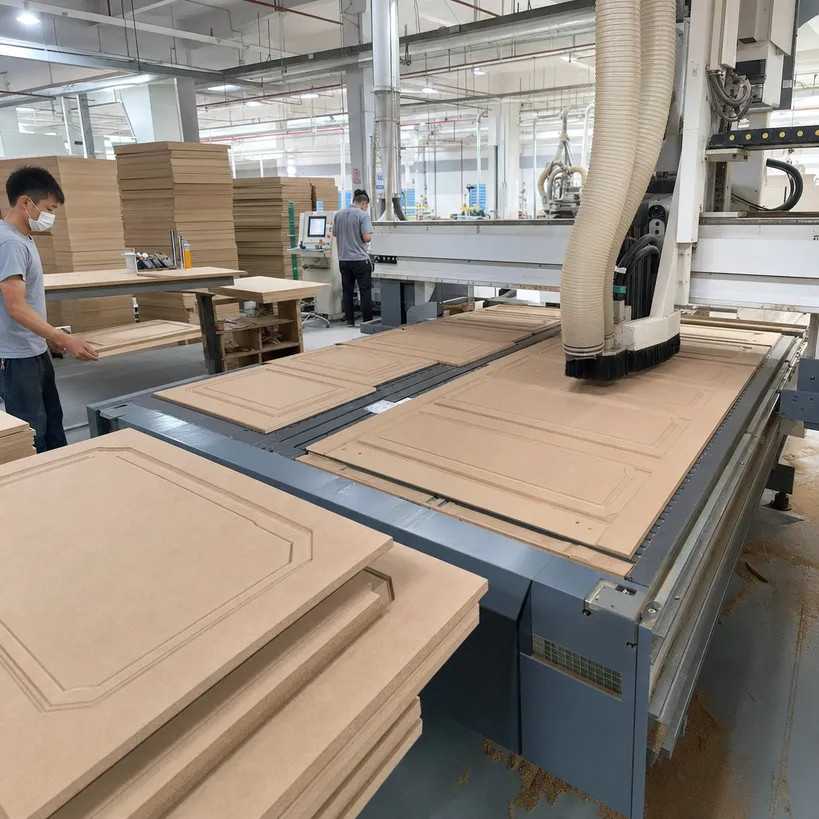
Furniture Manufacturing & Kitchen Cabinet Production
Core Segment — Highest VolumeCabinet door manufacturers running CNC routers to produce profiled door fronts go through MDF in volume — a mid-size cabinet shop running two CNC tables can consume 500–800 sheets per month. If you're supplying furniture manufacturers or kitchen cabinet factories, CNC MDF is a recurring, high-frequency SKU.
Key buying criterion: Consistency. Your customers need every sheet to run the same way, because they're running the same CNC program on every board. Batch-to-batch density variation is the fastest way to lose this account.
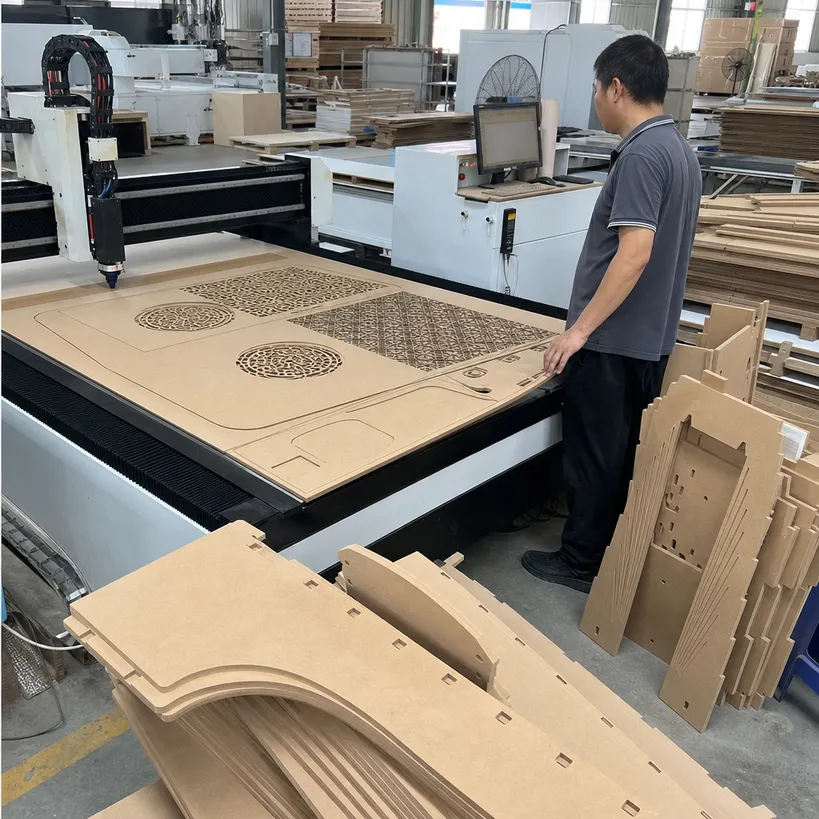
Signage & Display Manufacturing
Growing SegmentRetail display fixtures, trade show booths, and point-of-sale displays. These buyers typically order in smaller quantities but at higher frequency, and they often need custom sizes cut to their display dimensions. The laser cut MDF application is strong here — laser-cut logos, decorative grilles, and backlit panel cutouts are standard products for this segment.
Compliance note: CARB P2 compliance matters for US-based display manufacturers supplying into retail environments with indoor air quality requirements.
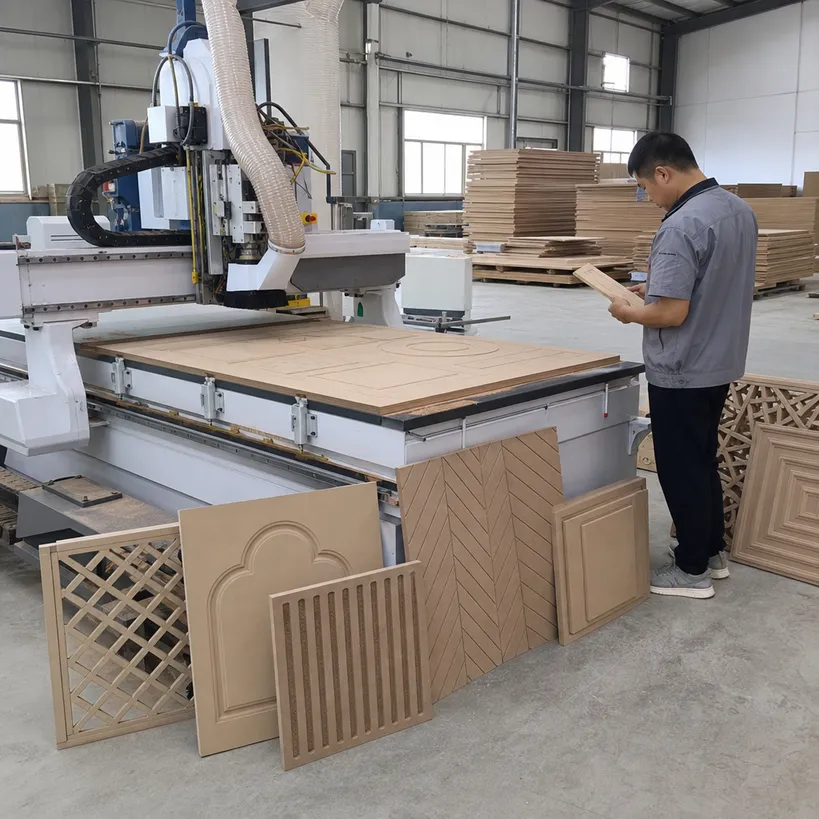
Architectural Millwork & Interior Fit-Out
Project-Based OrdersRouted wall panels, decorative ceiling tiles, wainscoting, and custom millwork components. This segment tends to order thicker boards (15–25mm) and often requires FSC certification for projects targeting LEED credits or sustainability-audited commercial interiors.
Order pattern: A single fit-out project might consume 200–500 sheets of a specific thickness, then nothing for months. The FSC documentation we provide covers the chain-of-custody requirement without you needing to source it separately.
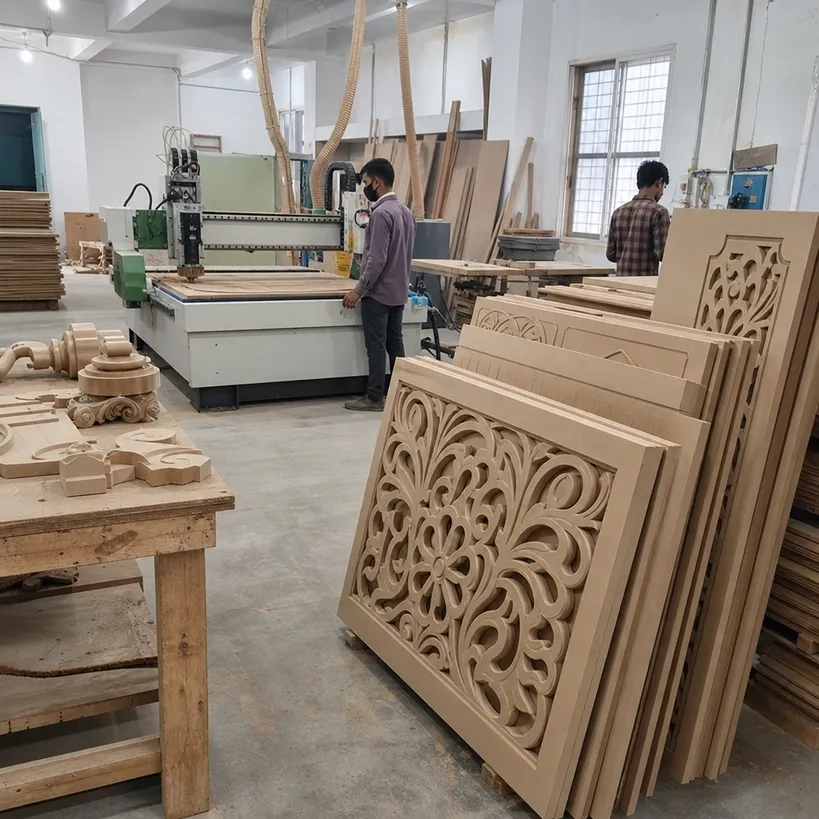
MDF Carving Board for Decorative Arts & Craft Manufacturing
Consistent NicheManufacturers producing decorative wall art, carved panel inserts, and ornamental components for furniture. A smaller but consistent segment. These buyers prioritize surface quality and edge definition on carved profiles.
Surface finish: The 80–120 grit sanded surface we supply takes paint and lacquer cleanly without grain raise, which matters when the finished product is a painted decorative piece.
Segment Buying Criteria at a Glance
| Segment | Order Pattern |
|---|---|
| Furniture / Cabinet | High-frequency, high-volume |
| Signage / Display | Smaller qty, higher frequency |
| Architectural Millwork | Project-based, variable |
| Decorative Arts / Craft | Consistent, moderate volume |
Related MDF Products
Technical Specifications
CNC MDF — Standard Product Data
The figures below reflect our standard CNC-grade MDF range. Custom thickness, density, and emission class options are available on request — contact us with your spec sheet and we'll confirm availability.
Physical & Dimensional Properties
Mechanical Properties
Emission Class & Certifications
Machining & Processing Guidance
Standard Thickness Availability
We stock the following thicknesses ex-warehouse for most markets: 3, 4, 6, 9, 12, 15, 18, 22, 25, 30 mm. Non-standard thicknesses (e.g. 7mm, 10mm, 16mm) are available on indent order with standard lead times. Contact us to confirm current stock levels for your target market.
Need the Full Technical Data Sheet?
Test reports, emission certificates, and product data sheets are available on request. We can also provide batch-specific documentation for quality audits.
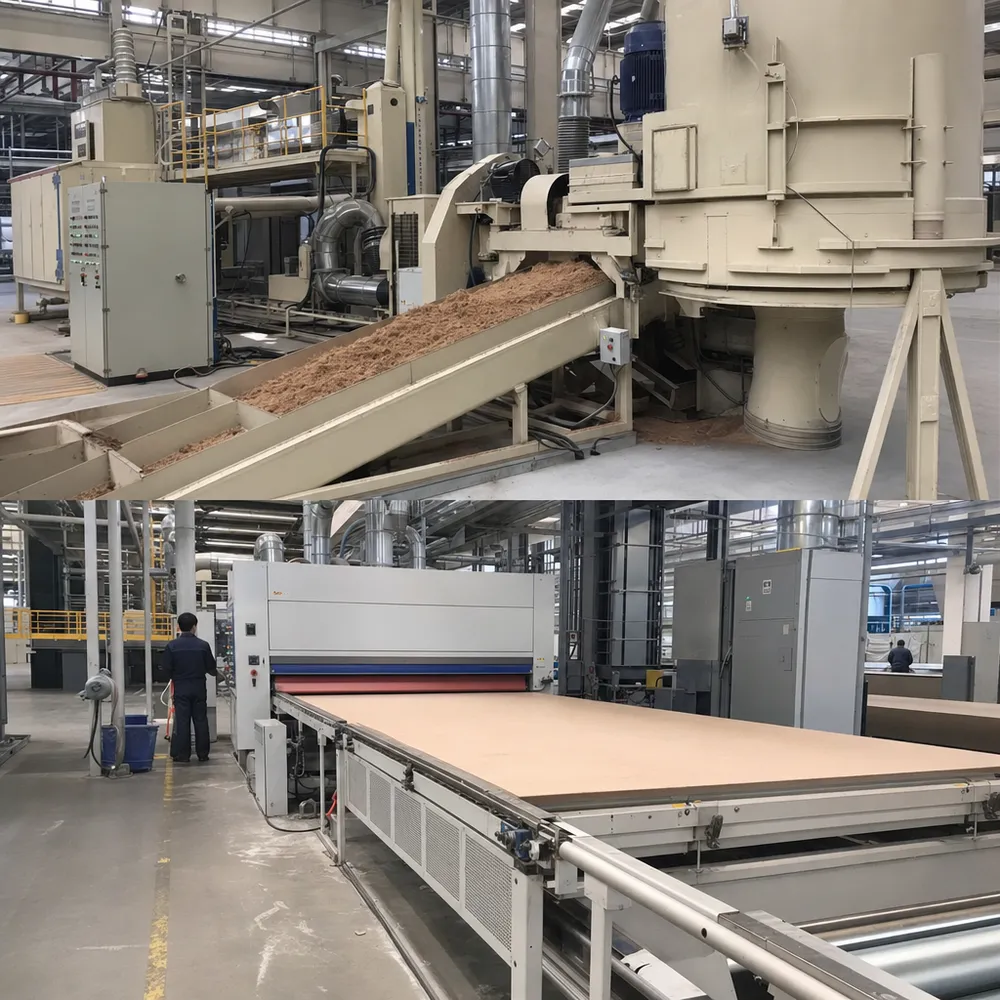
How We Produce CNC MDF: The Process Details That Affect Your Cut Quality
The fiber preparation stage is where CNC MDF quality is determined — not at the press. Here's what we do differently, and why it shows up on your CNC table.
Fiber Preparation & Refiner System
Stage 1 — Where quality is setWe use a refiner system that produces fiber at a consistent length and diameter. Coarser fiber produces a rougher internal structure that shows up as fuzzing on routed edges. Fiber that's too fine produces a board that's dense but brittle — it chips rather than cuts cleanly.
The target fiber geometry for our CNC grade is calibrated to produce a smooth, clean edge on both router and laser cuts without requiring secondary sanding of the cut face.
Blowline Resin Application
Stage 2 — Uniform bond strengthResin is injected into the fiber stream in the dryer — blowline blending — which gives more uniform resin distribution than surface-spray systems. Uniform resin distribution is what produces consistent internal bond strength across the panel.
A board with uneven resin distribution will have zones of lower bond strength that show up as edge crumbling on deep profile passes — something you won't see on a surface inspection but your customers will find immediately on the CNC table.
24–48 Hour Conditioning Stack
Stage 3 — Stress equalizationAfter pressing, boards go through a conditioning stack for 24–48 hours before sanding. This lets the internal stresses from pressing equalize. Boards that go straight from press to sander have residual stress that can cause slight warping after the surface is removed.
The conditioning step is one we added after seeing warping complaints on early production runs. It's not something every factory bothers with because it adds floor space and handling time.
Calibrated Wide-Belt Sanding
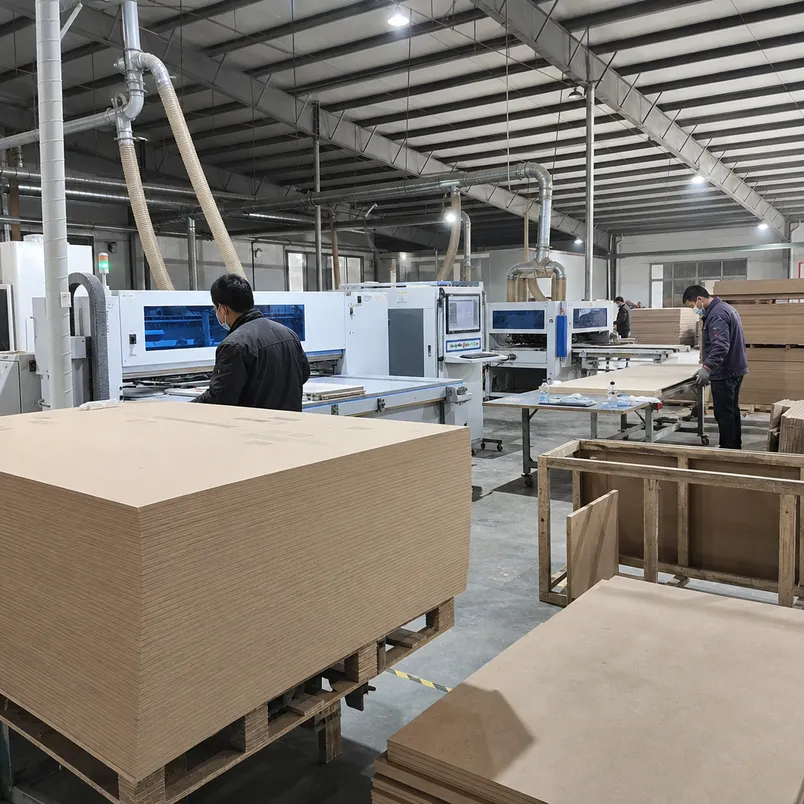
Stage 4 — Thickness toleranceThe sanding line runs calibrated wide-belt sanders that hold thickness tolerance to ±0.2mm across the full panel.
For CNC applications, thickness consistency matters because most CNC tables use vacuum hold-down. A board that's 0.5mm thicker at one end than the other will lift off the vacuum table during the cut, which causes the router to deflect and ruins the profile.
Customization Options for CNC MDF Orders
Standard production covers most routing and laser applications. Non-standard configurations are available on confirmed orders — contact us to confirm MOQ and lead time for your specific requirements.
Thickness
3mm to 25mm in standard increments. Non-standard thicknesses (e.g., 10mm, 14mm, 16mm) available on confirmed orders with a minimum quantity.
Sheet Size
Standard 1220 × 2440mm. Custom sizes available on confirmed orders.
Formaldehyde Grade
Standard production is E1. CARB P2 available for US-bound orders. E0 available for sensitive indoor environments.
FSC Certification
Available on orders where chain-of-custody documentation is required. Specify at order placement — FSC-certified production runs are scheduled separately.
Surface Options
Standard sanded both faces. Single-face sanded and factory-primed surface available.
Density Grade
Standard CNC grade covers most routing and laser applications. High-density grade available for structural and high-wear applications.
Minimum Order Quantities
MOQ for standard thickness and size: typically one full container load — approximately 800–1,200 sheets of 18mm depending on container type. Smaller quantities are available for sample orders.
Certifications and Compliance for Your Import Market
We prepare the relevant documentation package as standard for each destination market. You don't need to chase it separately — the paperwork ships with the boards.
California Air Resources Board Phase 2
The most stringent formaldehyde emission standard in the US market. CARB P2 compliance is required for composite wood products sold into California and is increasingly used as the baseline standard by US buyers regardless of destination state. Our CARB P2 certification covers MDF production — documentation is available with each shipment for US-bound orders.
Quality Management System
Quality management system certification covering our full production process, including MDF. Audit reports available on request.
Certified Sustainable Sourcing
Available for orders requiring certified sustainable sourcing documentation. Relevant for buyers supplying into LEED-certified projects, sustainability-audited retail chains, or markets with deforestation-linked supply chain regulations. Also satisfies EU Timber Regulation (EUTR) due diligence requirements.
European Market Documentation
Available for European market shipments where CE documentation is required for engineered wood panels.
Formaldehyde Emission Standard
Standard production meets E1 (≤0.124 mg/m³ per EN 717-1). CARB P2 and E0 available on request.
Market-Specific Documentation Packages
For buyers supplying into the EU, EUTR requires due diligence on timber product sourcing — our FSC chain-of-custody documentation satisfies this requirement. For buyers supplying into the US, TSCA Title VI (which mirrors CARB P2) applies to composite wood products — our CARB P2 certification covers this.
We prepare the relevant documentation package as standard for each destination market. You don't need to chase it separately — specify your destination market when requesting a quote and the correct compliance package is included automatically.
Packaging and Container Loading for CNC MDF
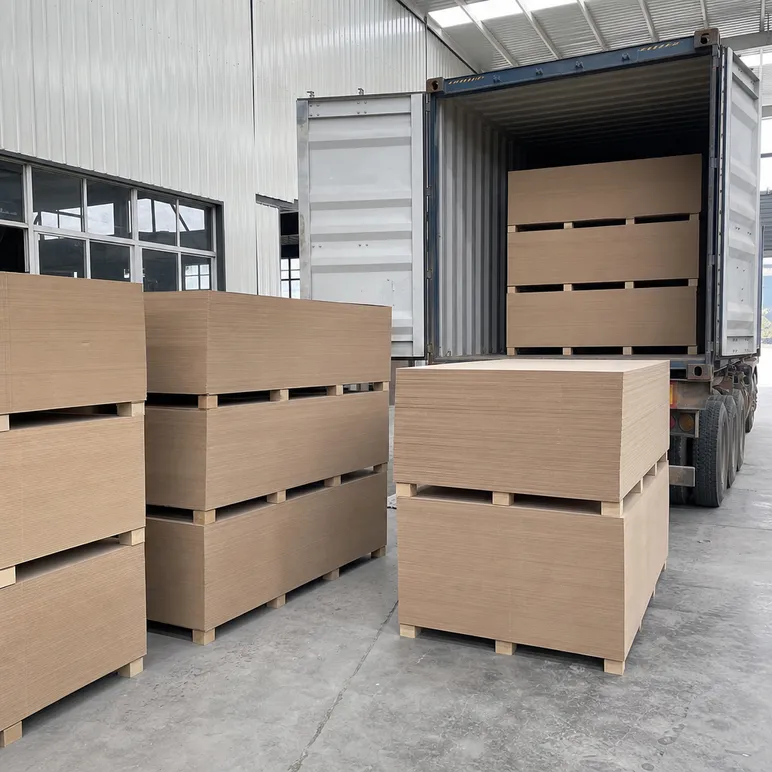
MDF is hygroscopic. Ocean transit through humid routing — Southeast Asia, Gulf — can raise moisture content if packaging isn't sealed properly. Here's how we handle it.
Packaging Specification
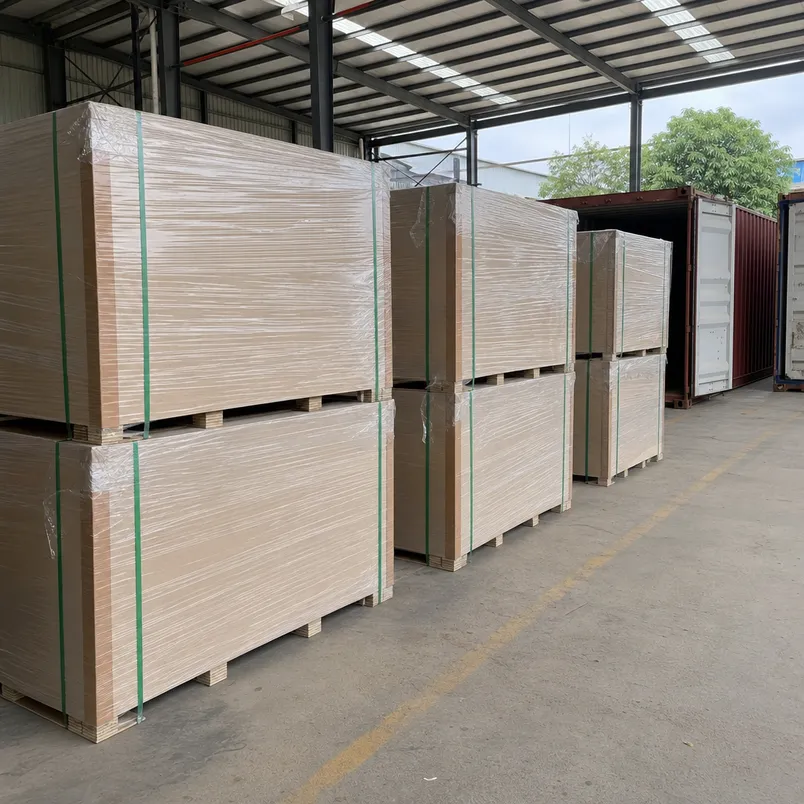
Bundles of 50–100 sheets depending on thickness, strapped and edge-protected with corner boards.
3–6mm boards are interleaved with kraft paper to prevent surface-to-surface abrasion during transit.
All bundles wrapped in moisture-resistant film. MDF is hygroscopic — ocean transit through humid routing (Southeast Asia, Gulf) can raise moisture content if packaging isn't sealed properly.
Each bundle marked with product specification, thickness, density grade, formaldehyde class, batch number, and destination port. CARB P2 orders receive the CARB composite panel label on each bundle as required by the regulation.
Transit Times from Xuzhou
Container Loading Quantities
Standard 1220 × 2440mm sheets. Loading quantities are approximate and depend on bundle configuration and container dimensions.
| Thickness | Sheets per 20HQ | Sheets per 40HQ |
|---|---|---|
| 6mm | ~1,800 | ~3,600 |
| 9mm | ~1,200 | ~2,400 |
| 12mm | ~900 | ~1,800 |
| 18mm | ~600 | ~1,200 |
| 25mm | ~420 | ~840 |
CNC MDF vs. Other MDF Products in Our Range
We produce several MDF grades under the QDPlywood.com MDF range. Here's how CNC MDF sits relative to the others — so you can match the right grade to each application without overpaying or under-specifying.
| Product | Best For | Key Difference from CNC MDF |
|---|---|---|
| Standard MDF Board | Furniture carcass, shelving, general interior use | Lower density uniformity requirement; not optimized for CNC edge quality |
| MDF Furniture Board | Cabinet boxes, drawer components, flat-pack furniture | Surface optimized for lamination and foil wrapping; density spec is furniture-grade, not CNC-grade |
| HDF MDF | Flooring underlayment, thin structural panels, high-wear surfaces | Higher density (≥800 kg/m³); harder surface; less suited for deep profile routing |
| 18mm MDF | Standard thickness for general MDF applications | Thickness-specific product; available in both standard and CNC grade |
| CNC MDF | CNC routing, laser cutting, carving, profiled components | Density uniformity optimized for machining; consistent edge quality across full sheet |
Best for
Furniture carcass, shelving, general interior use
vs. CNC MDF
Lower density uniformity requirement; not optimized for CNC edge quality
Best for
Cabinet boxes, drawer components, flat-pack furniture
vs. CNC MDF
Surface optimized for lamination and foil wrapping; density spec is furniture-grade, not CNC-grade
Best for
Flooring underlayment, thin structural panels, high-wear surfaces
vs. CNC MDF
Higher density (≥800 kg/m³); harder surface; less suited for deep profile routing
Best for
Standard thickness for general MDF applications
vs. CNC MDF
Thickness-specific product; available in both standard and CNC grade
Best for
CNC routing, laser cutting, carving, profiled components
Differentiator
Density uniformity optimized for machining; consistent edge quality across full sheet
Laser cutting thin panels
CNC MDF in 3–6mm is the right starting point for decorative laser-cut panels.
High-wear surfaces
Need a harder surface? Ask us about HDF — density ≥800 kg/m³ for demanding wear applications.
Flat furniture components
Components that won't be machined? Standard furniture MDF gives you a better price point.
Frequently Asked Questions
Technical and commercial questions we hear from importers, distributors, and CNC shop operators. If your question isn't here, contact us directly.
For CNC routing, 700–780 kg/m³ is the standard range — dense enough to hold a clean edge on profile passes, not so hard that it accelerates bit wear.
For laser cutting, the same density range works well. The key variable is moisture content: keep it at 5–9%, because higher moisture content causes charring and inconsistent kerf.
If your customers are doing both routing and laser on the same board, standard CNC grade covers both applications.
We can produce up to 1525 × 3660mm on confirmed orders. The practical limit is what fits in a standard container — oversized sheets require special loading and may increase your freight cost.
Most buyers running large-format CNC tables (2440 × 1220mm cutting area) find that standard 1220 × 2440mm sheets work fine with a 90-degree rotation.
If the boards have been in transit through significant temperature or humidity changes, 24–48 hours of acclimatization in the machining environment is good practice.
We ship at 5–9% moisture content, but if your facility is significantly drier or more humid than that, the boards will equilibrate to the ambient conditions.
Machining boards that haven't acclimatized can result in slight dimensional changes after cutting — relevant for tight-tolerance joinery applications.
E1 (European Standard)
≤0.124 mg/m³ per EN 717-1. Standard requirement for European market shipments.
CARB P2 (California Standard)
≤0.11 ppm per ASTM E1333 for MDF. Slightly more stringent. Required for US-bound shipments.
We produce to CARB P2 as the default for export orders where the destination market isn't specified — it covers both standards.
We can ship sample boards — typically 5–10 sheets of a specified thickness — for evaluation before a full container order.
Sample orders are available at cost. Contact us with your thickness and size requirements and we'll confirm availability and lead time.
Yes. Factory-applied primer is available as a surface option. It reduces your downstream customers' prep time before painting and gives a more consistent paint adhesion base than raw sanded MDF.
Specify at order placement — it adds lead time for the coating step. Minimum quantity applies. Confirm with our team.
Get a Quote for CNC MDF
Send us your thickness, sheet size, formaldehyde grade, and destination market — we'll come back with a detailed quote, the relevant certification documentation, and container loading quantities for your volume.
Xuzhou QD Wood Industry Co., Ltd.
No. 88 Sanbao Industrial Park, Tongshan District,
Xuzhou, Jiangsu Province, 221116, China
Most inquiries get a response within 24 hours.
Evaluating CNC MDF for the First Time?
If you want to test a sample before committing to a container, tell us — we handle sample orders regularly and can ship within a few days of specification confirmation.
What to Include in Your RFQ
- Thickness and sheet size (standard or custom)
- Formaldehyde emission grade (E0, E1, or CARB P2)
- Destination market and port of discharge
- Target volume (container quantity or annual estimate)
- Any surface finish, density, or certification requirements
Explore More MDF Products
View all MDF products in our range or browse related categories.
Standard MDF for general interior and furniture applications.
Optimized surface smoothness and density for furniture manufacturing.
High-density fiberboard for flooring underlays and thin-panel applications.
18mm thickness — the most common cabinet and shelving specification.