

OSB Flooring Manufacturer — Factory-Direct OSB Subfloor Panels
Structural OSB flooring panels built to export-grade density and emission standards — direct from our Xuzhou factory. Consistent strand orientation, controlled resin loading, and CARB P2-compliant formaldehyde levels. Every panel ships with the documentation your import market requires.
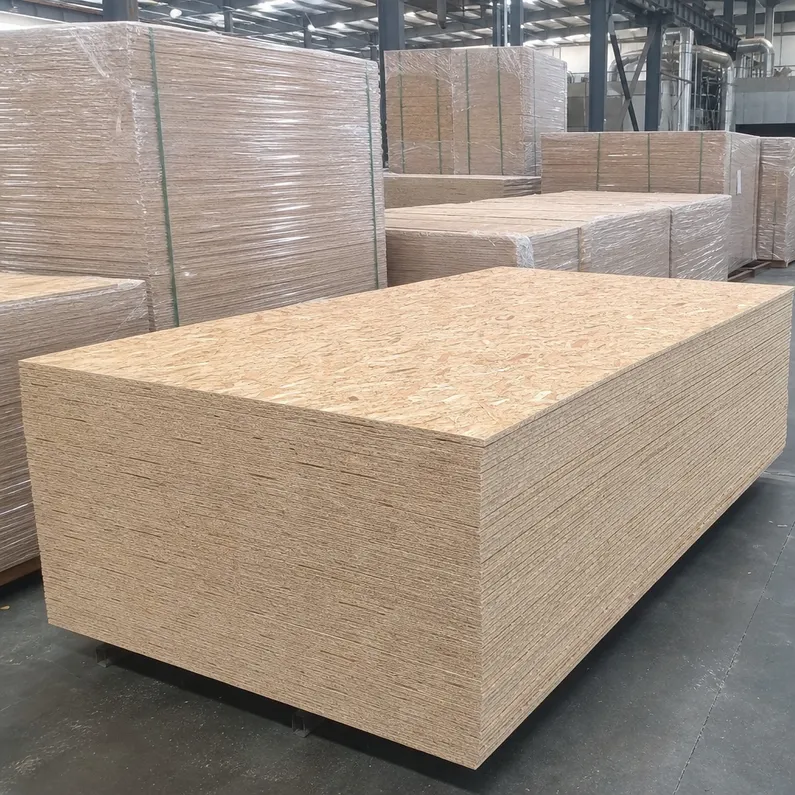
What OSB Flooring Is — and Where This Product Sits in the Range
OSB flooring is oriented strand board produced specifically for subfloor and structural floor decking applications — thicker, denser, and bonded with waterproof-grade resin compared to standard OSB sheathing. The distinction matters commercially: a buyer sourcing OSB for wall sheathing and a buyer sourcing OSB subfloor panels are looking at different density targets, different thickness ranges, and different surface treatments. We produce both, and this page covers the flooring-grade specification.
Three-Layer Strand Construction
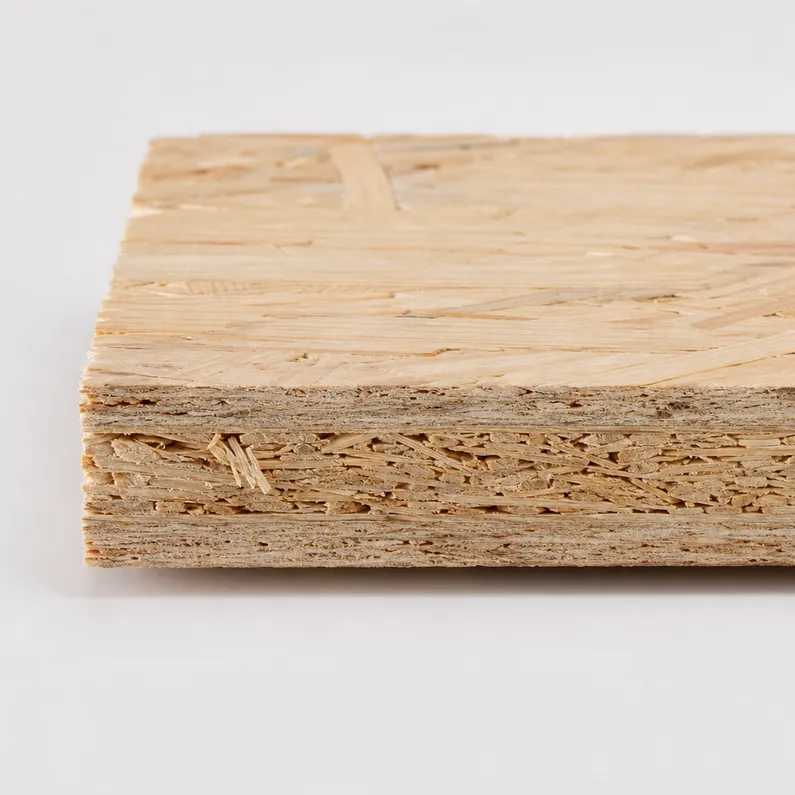
Our OSB flooring panels use a three-layer strand construction. The face layers run strands in the long-panel direction for bending stiffness; the core layer runs perpendicular for cross-panel stability.
Strand Geometry — Why It's Controlled at the Flaker
Strand geometry is controlled at the flaker — we target strand length of 75–100mm and thickness of 0.6–0.8mm, which is the range that gives you the right balance of surface smoothness and internal bond strength.
MDI-Based Resin System — Why It Matters for Your Market
Resin is MDI (methylene diphenyl diisocyanate) for the core and PMDI-blended phenolic for the face layers. MDI gives you the waterproof bond and low formaldehyde emissions that CARB P2 and E1 markets require — it's more expensive than UF resin, but it's the only way to hit those emission targets without compromising bond strength.
We switched the full OSB line to MDI-based systems in 2019. The cost went up, but we stopped having conversations with buyers about emission test failures at the border.
OSB Flooring Technical Specifications
Standard production runs on the following parameters. Custom thickness and panel dimensions are available on confirmed orders — see the customization section below.
Standard Production Parameters
| Parameter | Standard Specification |
|---|---|
| Panel thickness |
15mm 18mm 22mm
Most common for subfloor
|
| Panel dimensions |
1220 × 2440mm (standard)
1250 × 2500mm available
|
| Density |
620–680 kg/m³
Flooring grade
|
| Bending strength (parallel) |
≥ 22 N/mm²
EN 310
|
| Bending strength (perpendicular) |
≥ 11 N/mm²
EN 310
|
| Internal bond strength |
≥ 0.34 N/mm²
EN 319
|
| Moisture resistance |
V313 test cycle
EN 321 — suitable for humid conditions
|
| Formaldehyde emission | E1 ≤ 0.124 mg/m³ CARB P2 |
| Surface |
Sanded face (smooth side up for overlay)
Tongue-and-groove edge available
|
| Resin system | MDI core / PMDI-phenolic face |
| Moisture content at shipment | 5–9% |
Specifications shown are industry-standard values for flooring-grade OSB. Actual production parameters may vary by order specification. Contact us for a detailed data sheet on your target thickness and market.
Thickness Options at a Glance
Custom thicknesses (12mm, 25mm) available on confirmed orders with minimum volume requirements.
Compliance & Certifications
Panels ship at 5–9% MC. Allow acclimatization on site before installation, especially in high-humidity climates. Failure to acclimatize is the most common cause of post-installation swelling complaints.
Where OSB Flooring Panels Are Used
OSB flooring panels cover a wide range of structural and semi-structural applications. The common thread is load distribution over a framed or joisted substrate — anywhere you need a stiff, dimensionally stable deck that can take foot traffic, point loads, and overlay materials.
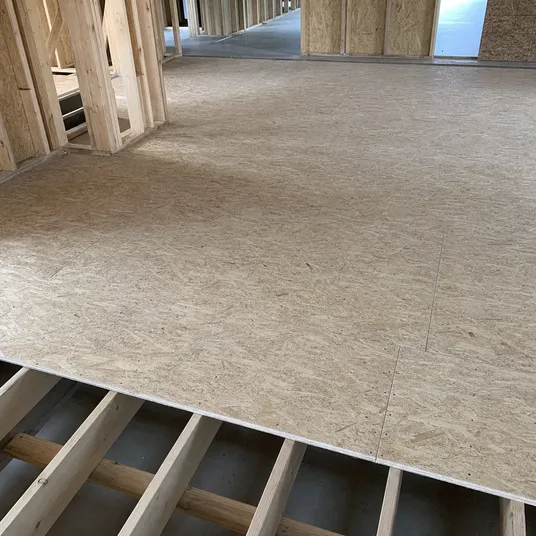
Residential Subfloor
The primary application. OSB panels span floor joists at 400–600mm centres, providing the structural deck that all finish flooring — hardwood, LVT, tile, carpet — is installed over. 18mm is the standard thickness for 400mm joist spacing; 22mm for 600mm centres.
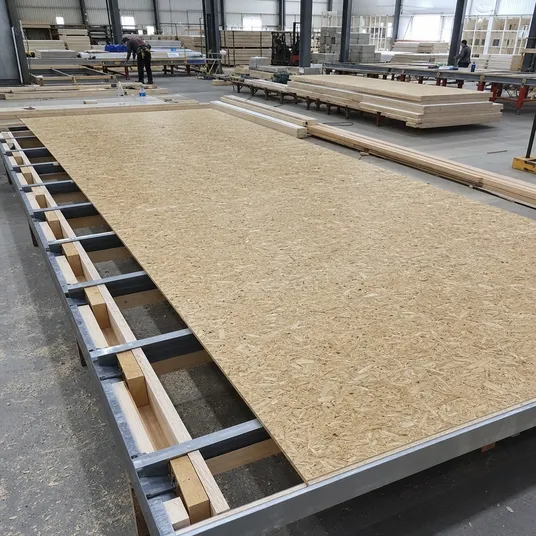
Modular & Prefab Construction
Floor cassettes and volumetric modules require panels that hold tight tolerances and don't move during transport. OSB's dimensional stability and consistent density make it the default choice for off-site manufacturers who need predictable performance at scale.
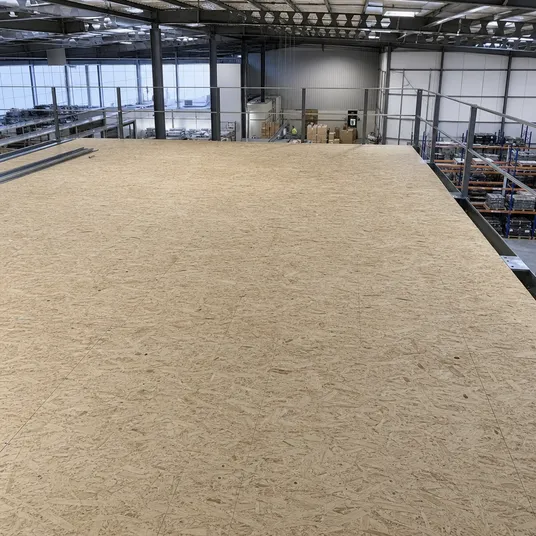
Commercial Mezzanine Decks
Warehouse and retail mezzanines use 22mm OSB/4 panels for the deck surface. The higher density and bending strength handle point loads from racking, pallet jacks, and foot traffic without the deflection issues you get with lighter panels.
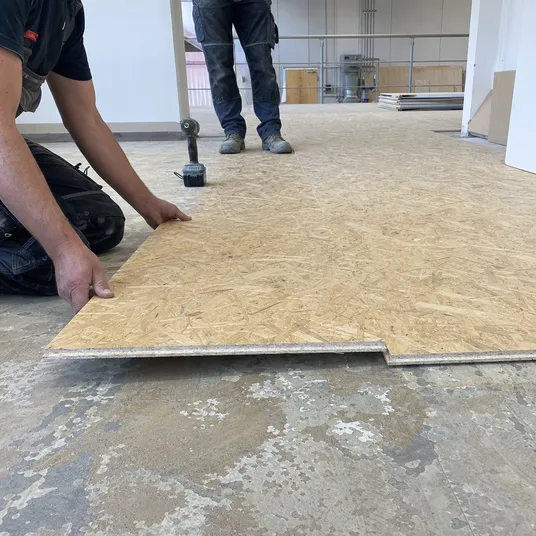
Renovation & Overlay
15mm panels are commonly used to overlay and level existing floors before new finish flooring is installed. The sanded face provides a flat, consistent surface for LVT or engineered wood adhesive bonds. Thinner profile keeps floor height changes manageable at door thresholds.
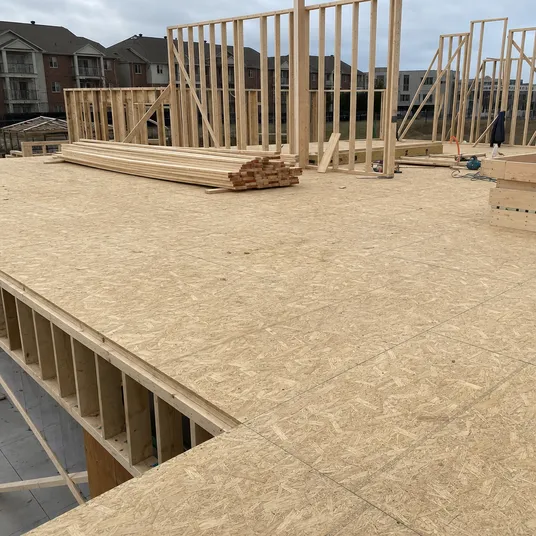
Timber Frame Platform Decks
In platform-frame timber construction, the floor deck is also the working platform for the next storey's wall panels. OSB handles the construction traffic and temporary loading during the build sequence, then remains as the permanent subfloor.
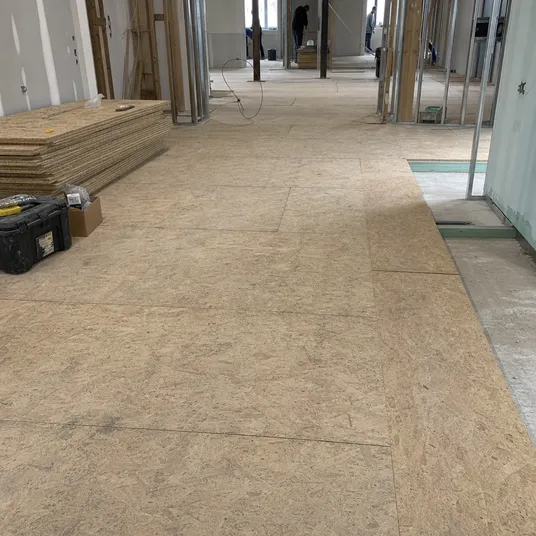
Temporary Site Protection
Contractors use OSB panels to protect finished floors during fit-out, create temporary walkways over uneven ground, and form hoarding bases. The cost-per-panel makes OSB the practical choice for protection applications where the panel won't remain in the final build.
Who Buys OSB Flooring Panels from Us
Most of our OSB flooring volume goes to importers and distributors who supply the construction trade, not to end contractors directly. Here's how the typical buyer profiles break down.
Subfloor Performance: What the Density and Bond Numbers Mean for Your Orders
Understanding the numbers behind OSB flooring grade helps you make better sourcing decisions — and gives you the technical language to defend your specification to downstream customers.
Density Range: 620–680 kg/m³
Commercial Structural GradeThe 620–680 kg/m³ range is the commercial dividing line between structural flooring-grade OSB and lighter sheathing-grade panels. Below 600 kg/m³, point-load deflection issues emerge under concentrated loads — furniture legs, appliance feet — generating warranty claims from your downstream customers.
Above 700 kg/m³, the panel gets heavy enough to affect container loading efficiency and handling on site without meaningful structural benefit for most floor applications. We land in the 620–680 range deliberately.
Container Loading Efficiency
A 40HQ container of 18mm OSB flooring at this density loads approximately 18–20 m³ of panels — roughly 580–620 sheets of 1220×2440mm. That's the loading configuration we've optimized for, and it's what we use when we calculate your landed cost per sheet.
Buyer tip: If you're comparing FOB prices between suppliers, ask them for the container loading quantity. A lighter panel at a lower FOB price can end up costing more per installed square meter once you account for the extra containers.
V313 Moisture Resistance Test
EN 300 OSB/3 RequirementThe V313 moisture resistance test is the one that matters for flooring applications. It cycles panels through wetting, freezing, and drying — simulating the conditions a subfloor panel sees during construction before the building is weathertight.
Panels that pass V313 hold their dimensions and bond integrity through that exposure. Panels that don't will swell at the edges and delaminate — the failure mode that generates the most expensive warranty claims in the residential construction supply chain.
Internal Bond Strength: ≥ 0.34 N/mm²
EN 319 — Every Production BatchOur internal bond strength target of ≥ 0.34 N/mm² (EN 319) is the minimum for structural floor applications under EN 300 OSB/3 classification. We run internal bond tests on every production batch — not just on certification samples.
The test involves cutting small specimens from the panel and pulling them apart in tension perpendicular to the face. If the bond fails in the wood fiber rather than at the glue line, the resin system is working correctly. If it fails at the glue line, something went wrong in the press — temperature, pressure, or resin spread — and we pull the batch.
Market Segments Where OSB Subfloor Panels Move at Volume
Four distinct buyer categories drive consistent OSB flooring volume. Understanding which segment you're serving shapes how you position the product, structure your inventory, and negotiate supply terms.
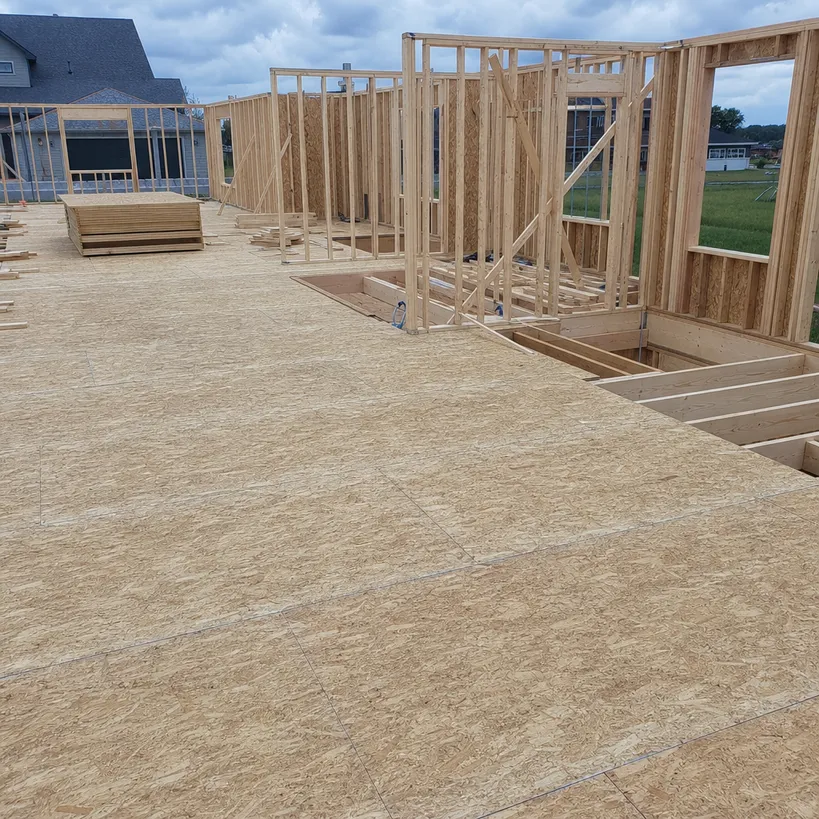
Residential Construction Supply Chains
The primary volume driver for OSB flooring. Framing contractors and building material distributors in North America and Australia specify 18mm or 22mm OSB subfloor as the standard floor decking for timber-frame residential construction.
A single housing development of 50–100 units can consume 800–1,500 sheets of 18mm OSB subfloor. Distributors supplying regional builders run this as a stocked SKU with predictable reorder cycles — typically quarterly for mid-size distributors, monthly for larger regional operations.
Distribution opportunity: OSB subfloor is a high-turn, low-complexity product that anchors the engineered wood panel category for distributors building a business in these markets.
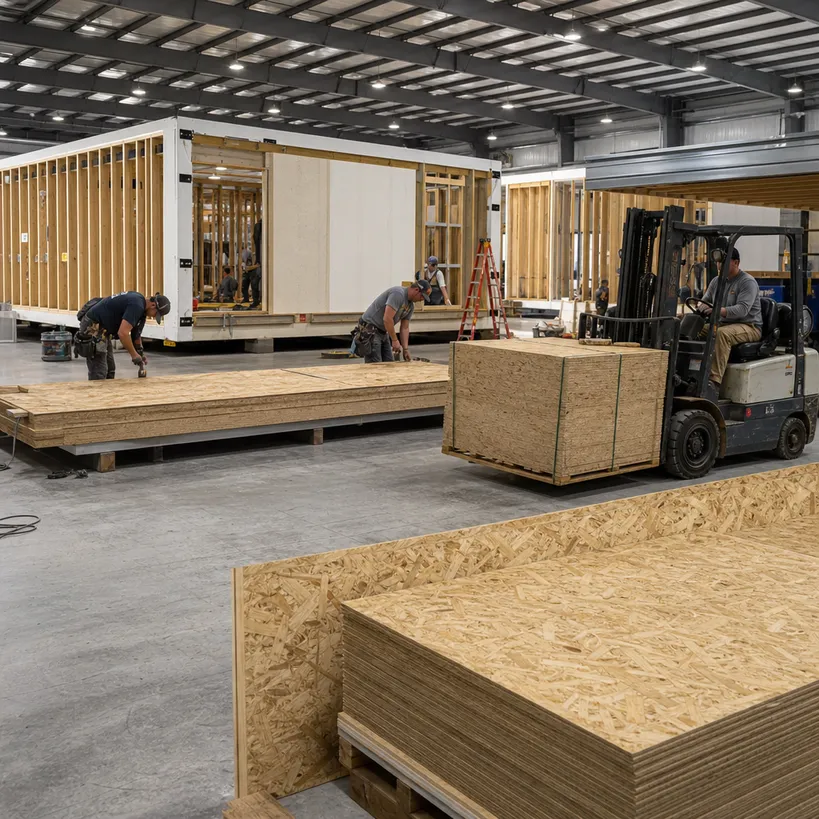
Modular and Prefabricated Building Manufacturers
A growing segment, particularly in Europe and Southeast Asia. Modular building factories consume OSB flooring in large, consistent volumes — they're essentially running a production line that requires the same panel specification every week.
Modular manufacturers buy on annual contracts with fixed specifications, which means predictable volume and simplified logistics. They also tend to be less price-sensitive than spot buyers because supply consistency matters more to their production schedule than marginal cost savings.
Regional note: German buyers want CE-marked panels with EN 300 OSB/3 documentation; Malaysian buyers focus on density and moisture resistance. We've shipped to both — the volume pattern is similar, the documentation differs.
Container Flooring and Industrial Applications
OSB flooring panels serve as a cost-effective alternative to hardwood or plywood in applications where structural performance matters but surface appearance doesn't. Shipping container refitters, temporary structure builders, and industrial mezzanine floor fabricators all use OSB flooring-grade panels.
These buyers typically order in smaller quantities than residential distributors, but they're less seasonal and often source year-round. The 22mm thickness is the most common specification for these applications.
Lower per-order volume, but consistent reorder cadence and minimal seasonality.
Building Material Importers Entering New Markets
OSB subfloor is a commodity-adjacent product with clear specifications, established demand, and straightforward import documentation — which makes it a lower-risk first order for an importer who wants to test a new supplier relationship before committing to more complex products.
We've had buyers start with a single 40HQ container of OSB flooring and expand to film-faced plywood, MDF, and melamine panels within 18 months once they've seen how we handle documentation and quality consistency.
OSB flooring is a proven entry point for building a broader panel supply relationship.
Ready to discuss your volume requirements?
Whether you're a regional distributor building a stocked SKU program, a modular manufacturer sourcing on annual contract, or an importer placing your first container — we can structure supply terms around your actual buying pattern.
Tongue-and-Groove Edge Profile: What It Adds to Your Product Offering
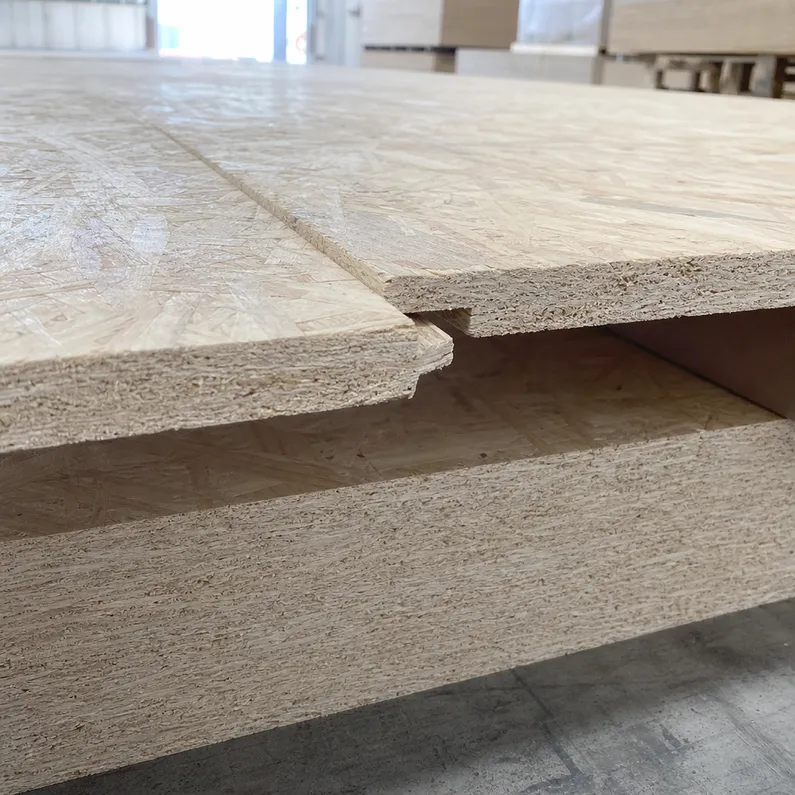
Standard OSB flooring ships with square-cut edges. Tongue-and-groove (T&G) edge profiling is available as a production option and changes the commercial positioning of the panel meaningfully.
T&G panels interlock at the joints, which eliminates the need for blocking under panel edges in floor framing — a labor cost saving that contractors can quantify. In North American residential construction, T&G OSB subfloor commands a price premium of 15–25% over square-edge panels at the distribution level, and it's the specification that most production builders prefer because it reduces installation time. If you're supplying into the North American market, T&G is worth specifying — the margin differential more than covers the additional production cost.
Profile Geometry
Profile geometry follows standard North American and European conventions, so panels are compatible with standard installation practice without requiring any site adjustment.
Minimum order quantity for T&G panels is higher than for square-edge. We run T&G profiling on a dedicated edge-milling line after panels are sanded and trimmed to final dimension — a full production run is needed to justify the line changeover. Confirm your volume before specifying T&G on a trial order.
Square-Edge vs. T&G: Key Differences
Certification Coverage for Your Import Market
OSB flooring sold into regulated construction markets requires documentation that goes beyond a factory quality certificate. Here's what we hold and what it covers.
CE Marking
Certified under EN 300 — the European standard for oriented strand board. Mandatory for structural building products in EU member states and many associated markets.
CARB P2
California Air Resources Board Phase 2 compliance for formaldehyde emissions. The most stringent formaldehyde emission standard in the US — effectively the national standard for composite wood.
ISO 9001:2015
Covers our quality management system across all product lines, including OSB. Third-party audited.
FSC Chain of Custody
Available for buyers with sustainability sourcing requirements or who supply into markets where deforestation-linked supply chains create regulatory or reputational risk.
Market-Specific Requirements
For markets with specific structural performance requirements beyond CE — Australian H2 treatment requirements, specific US building code references, or other jurisdiction-specific documentation — contact us with your target market and application. We'll confirm what documentation we can provide and what additional testing may be needed.
Documentation Included as Standard
CE declaration of conformity ships with every EU-bound order. Full CARB P2 documentation package is prepared as standard for US-bound OSB flooring shipments. ISO 9001 audit reports and FSC documentation are available on request.
OSB Flooring Customization: What We Can and Can't Do
Production flexibility matters when you're building a branded product line or sourcing for a specific market. Here's an honest breakdown of what's adjustable, what requires minimum volume, and what we don't produce.
Available Customization Options
Thickness
Standard production runs at 15mm, 18mm, and 22mm. Non-standard thicknesses (12mm, 25mm) are available on confirmed orders with sufficient volume.
Minimum run quantity applies — OSB production involves press setup and resin calibration that doesn't make sense for small batches.
Panel Dimensions
Standard is 1220×2440mm. We produce 1250×2500mm for European markets and custom dimensions on confirmed orders.
Non-standard dimensions affect container loading efficiency — we'll calculate the impact on your landed cost before confirming.
Edge Profile
Square-cut is standard. Tongue-and-groove is a production option available at higher MOQ.
Surface Treatment
Standard sanded face. A light resin-impregnated paper overlay on the face is available for applications requiring a smoother surface.
Less common for subfloor applications, but relevant for some industrial flooring uses.
Emission Specification
Standard production meets E1 and CARB P2. E0 specification (≤ 0.05 mg/m³) is available on request.
E0 requires a different resin loading and has a longer production lead time.
Branding and Marking
Custom bundle marking, private label stenciling, and OEM documentation are all available.
Most buyers building a branded product line in their market use this option.
What We Don't Produce
OSB/4 (heavy-duty load-bearing) is not in standard production runs. OSB/3 is the highest structural grade we produce as standard. If you need OSB/4 specification, contact us to discuss feasibility.
Fire-retardant treated OSB is not a standard product in our range.
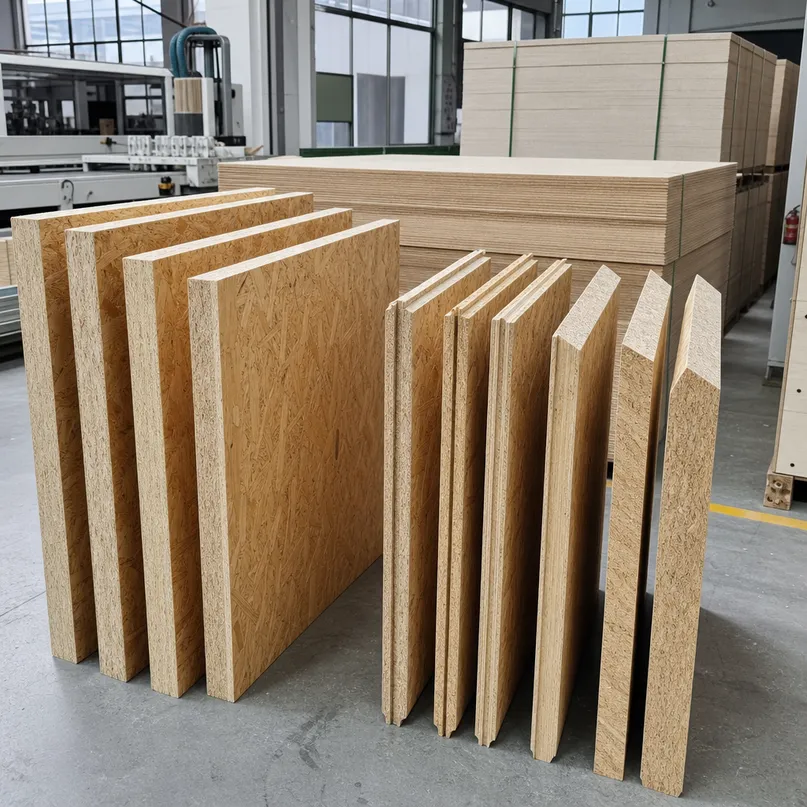
Have a Non-Standard Specification?
Send us your thickness, dimension, emission, and branding requirements. We'll confirm feasibility, minimum run quantity, and lead time before you commit to anything.
Send Us Your SpecificationContainer Loading and Export Logistics
OSB flooring ships efficiently in 40HQ containers. Here's the practical loading data, packaging approach, documentation set, and transit times from Xuzhou to major destination ports.
40HQ Container Loading Data
Standard Panel Size: 1220×2440mm
| Thickness | Sheets per 40HQ | Approx. m³ per 40HQ |
|---|---|---|
| 15mm | 680–720 sheets | ~19 m³ |
| 18mm | 580–620 sheets | ~18.5 m³ |
| 22mm | 480–510 sheets | ~18 m³ |
Packaging for Ocean Transit
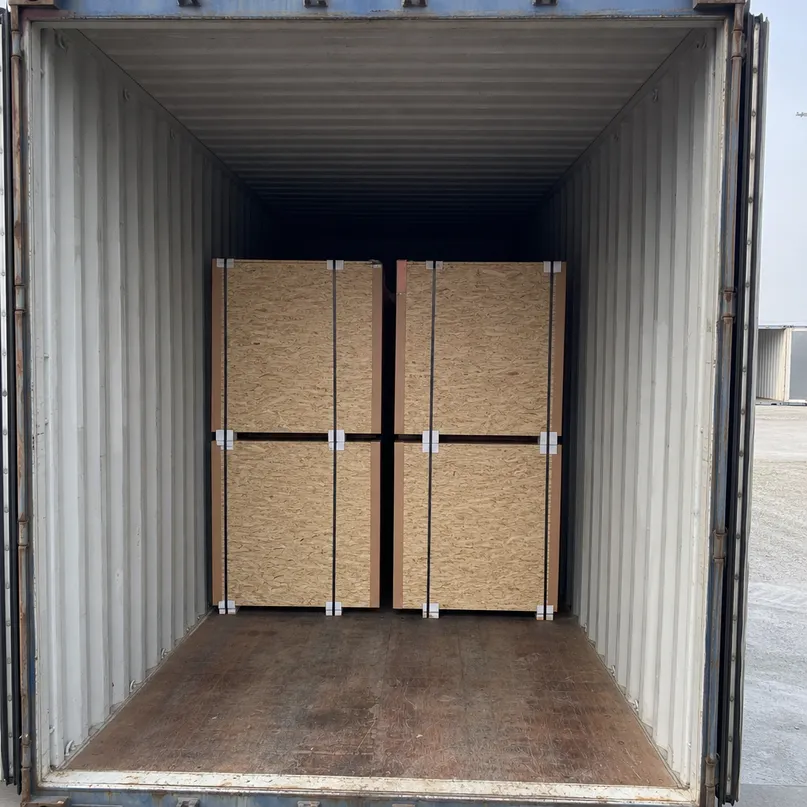
Panels bundled in packs of 50–100 sheets depending on thickness, strapped and wrapped in moisture-resistant film.
Corner boards protect panel edges during container loading and port handling — OSB panel edges are more vulnerable to impact damage than plywood, and corner protection reduces edge damage claims significantly on long-haul routes.
Each bundle marked with thickness, grade, batch number, and destination port.
Transit Times from Xuzhou
Loading via Qingdao or Shanghai
Export Documentation Set
We prepare the full documentation set before the container is loaded — not after it's on the water. Standard export documentation for OSB flooring includes:
Commercial Invoice
Standard for all shipments
Packing List & Bill of Lading
Standard for all shipments
Certificate of Origin
Standard for all shipments
Phytosanitary Certificate
Where required by destination country
CE Declaration of Conformity
EU shipments
CARB Documentation Package
US shipments
Documentation Ready Before Loading
We prepare the full documentation set before the container is loaded — not after it's on the water. This avoids delays at destination ports and gives your customs broker everything needed in advance.
Sibling Products in the OSB & Particle Board Range
OSB flooring is one of four products in our particle board and OSB range. Depending on your application and market, one of the others may be a better fit.
Oriented Strand Board (general)
Wall & Roof SheathingStandard OSB panels for wall sheathing, roof decking, and general construction applications. Lower density than flooring grade, wider thickness range, more economical for non-structural applications.
View Oriented Strand BoardOSB Panels
Furniture & IndustrialOSB in panel format optimized for furniture, packaging, and industrial applications where structural floor performance isn't required.
View OSB PanelsChipboard / Particle Board
Furniture & Interior Fit-OutFor furniture, shelving, and interior fit-out applications where OSB's strand texture isn't appropriate. Different density profile and surface finish.
View Chipboard / Particle BoardNot sure which product fits your application? Send us the end-use specification and we'll recommend the right panel.
View Full RangeFrequently Asked Questions
Specification, compliance, and ordering questions answered for importers and distributors.
For timber-frame residential construction with joists spaced at 400mm centers, 15mm OSB subfloor is the minimum — but most production builders specify 18mm as standard because it gives more tolerance for joist spacing variation and reduces springiness underfoot.
At 600mm joist spacing (common in some European timber frame systems), 22mm is the standard specification.
If your buyers are supplying into markets with specific building code requirements, confirm the local span table before specifying thickness — the numbers above are typical but not universal.
Not suitable for flooring in most construction applications.
Load-bearing in humid conditions. Standard classification for subfloor and floor decking.
Heavy-duty load-bearing in humid conditions. Used for industrial floors and high point load applications.
Our standard OSB flooring production is OSB/3. If you need OSB/4, contact us to discuss.
Yes. Our MDI resin system produces panels that meet CARB P2 formaldehyde emission limits. We test every production batch and maintain the documentation chain required for CARB compliance.
For US-bound shipments, the full CARB documentation package is included as standard — you don't need to request it separately.
- Dimensionally more consistent — strand orientation is controlled in production
- No grain variation causing thickness differences across the panel
- More cost-effective at equivalent structural performance
Edge swelling when exposed to moisture before the building is weathertight. This is why V313 moisture resistance matters. For buyers supplying into markets where construction timelines are tight and weather exposure is a risk, specify V313-rated OSB or recommend plywood for moisture-sensitive applications.
We produce both OSB and plywood. View our plywood range if your application requires it.
From order confirmation. Applies to new specifications.
For repeat orders with the same specification, lead time is typically shorter because the production parameters are already set. Add transit time based on your destination port.
Get a Quote for OSB Flooring
Send us your requirements and we'll return a detailed FOB quote with certification documentation and container loading data so you can calculate your landed cost accurately.
What to Include in Your Enquiry
To return an accurate FOB quote, certification documentation, and container loading data, we need the following from you:
- Target thickness — e.g. 9mm, 12mm, 15mm, 18mm
- Panel dimensions — standard 1220×2440mm or custom size
- Edge profile preference — square edge or tongue-and-groove
- Destination market — determines which certification documentation applies
- Estimated volume — container count or m³ per order
Most new buyers in this category start with a single 40HQ container to test the product with their own customers. We can ship samples before that if you need to verify the specification against your requirements.
Xuzhou QD Wood Industry Co., Ltd.
Xuzhou, Jiangsu, China
Related Products in This Range
Oriented Strand Board
Standard OSB structural panels for construction and industrial applications.
OSB Panels
Versatile OSB panels for wall sheathing, roofing, and packaging end-uses.
Chipboard Particle Board
Furniture-grade and flooring-grade particle board with E0/E1 emission options.