

Laminate Blockboard
Factory-Direct from Xuzhou
Solid wood strip core. High-pressure laminate surface. Built for furniture and interior fit-out applications where surface durability and dimensional stability both matter.
Custom laminate colors, core species, and panel dimensions available on confirmed orders. 18+ years export manufacturing. 6 production lines.
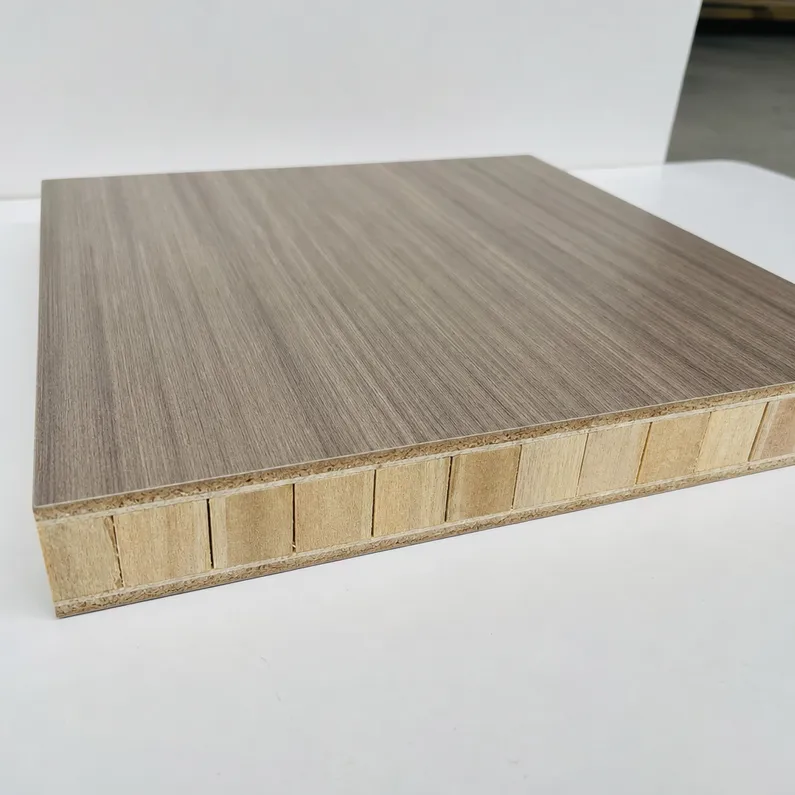
What Laminate Blockboard Is — and Where It Sits in the Blockboard Range
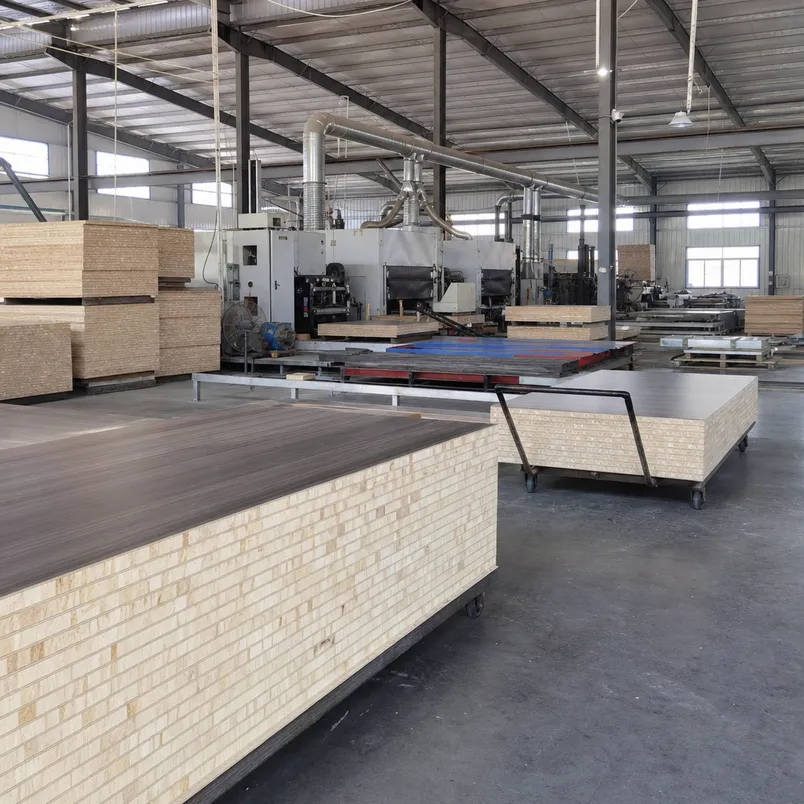
Laminate blockboard is a composite panel built around a solid wood strip core — typically poplar, pine, or eucalyptus strips edge-glued and sandwiched between cross-banded veneer layers — with a high-pressure laminate (HPL) sheet bonded to one or both faces under heat and pressure. The result is a panel that combines the screw-holding strength and dimensional stability of a solid-core board with a hard, wear-resistant decorative surface that arrives ready for use without additional finishing.
The distinction from plain blockboard matters commercially. Standard blockboard ships as a substrate — your downstream customer or fabricator still needs to apply a surface treatment before the panel is usable in a finished product. Laminate blockboard eliminates that step. The HPL face is already bonded, already finished, and already durable. For furniture manufacturers, kitchen cabinet producers, and interior fit-out contractors, that means one fewer processing step and a panel that can go directly into production.
Ready-to-use surface — no additional finishing required
The HPL face is bonded, finished, and durable at point of delivery. Furniture manufacturers and fit-out contractors can move directly into production without a separate surface treatment step.
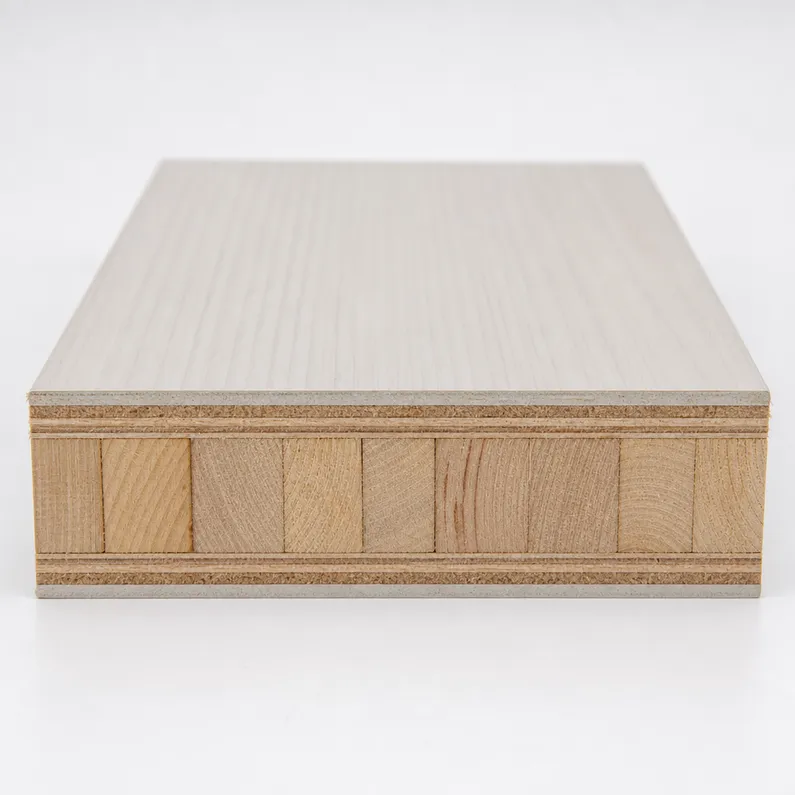
Where It Sits in the Blockboard Range
Within our blockboard range, laminate blockboard sits alongside melamine blockboard — the key difference being the surface system.
Melamine paper face. Adequate for standard interior furniture and cabinetry where surface contact is limited.
HPL sheet (0.6–1.0mm). Significantly higher abrasion resistance, impact resistance, and surface hardness. Right for high-traffic commercial interiors, worktops, and applications with regular mechanical contact.
If your buyers need a cost-effective decorative panel for standard cabinetry, melamine blockboard covers that segment. If they're specifying panels for demanding commercial applications, laminate blockboard is the right call.
Solid Wood Strip Core
Poplar, pine, or eucalyptus strips edge-glued for superior screw-holding strength and dimensional stability versus MDF or particle board.
HPL Surface (0.6–1.0mm)
High-pressure laminate bonded under heat and pressure. Hard, wear-resistant, and decorative — arrives ready for use without additional finishing.
CARB P2 & FSC Certified
Formaldehyde emissions compliant with CARB P2 and E1 standards. FSC chain-of-custody available for sustainability-conscious buyers.
Factory-Direct Export
18+ years manufacturing from Xuzhou, China. Custom laminate colors, core species, and panel dimensions confirmed at order stage.
Technical Specifications
The specifications below reflect industry-standard values for export-grade laminate blockboard. Actual parameters are confirmed at order stage based on your specification requirements.
Export-Grade Laminate Blockboard — Parameter Table
| Parameter | Specification |
|---|---|
| Panel Size (standard) | 1220 × 2440 mm |
| Panel Size (custom) | Available on confirmed orders |
| Thickness Range | 16mm, 18mm, 25mm (standard); other thicknesses on request |
| Core Material |
Poplar Pine Eucalyptus
Species confirmed at order
|
| Core Strip Width | Typically 25–40mm, edge-glued |
| Cross-Band Veneers | 1–2 layers each side, rotary-cut hardwood veneer |
| Face Laminate | High-pressure laminate (HPL), 0.6–1.0mm thickness |
| Laminate Bond Method | Hot press bonding, full-surface adhesive application |
| Surface Finish |
Matte Satin Gloss
Subject to laminate selection
|
| Moisture Content | 8–12% (export standard) |
| Formaldehyde Emission |
CARB P2 E1
|
| Glue Type | MUF / PF (moisture-resistant options available) |
| Density | Approx. 550–650 kg/m³ (core species dependent) |
| Tolerance (thickness) | ±0.5mm |
| Squareness | ≤1.5mm per 1000mm |
| Certification |
CARB P2 FSC E1 ISO 9001
|
| MOQ | 1 × 20ft container (approx. 600–800 sheets depending on thickness) |
| Lead Time | 15–25 days after order confirmation |
| Packing | Palletized, corner-protected, stretch-wrapped for export |
All specifications are indicative. Final parameters confirmed in pro-forma invoice. Request a spec sheet for your specific application.
Standard Thickness Guide
Suitable for cabinet doors, drawer fronts, and wall paneling where load-bearing is minimal. Lighter weight reduces shipping cost per unit.
The industry default for commercial furniture, shelving, and worktops. Balances structural rigidity with manageable weight. Covers the widest range of applications.
Specified for structural shelving, countertops under sustained load, and high-traffic commercial installations. Maximum rigidity and screw-holding performance.
Performance Ratings vs. Alternatives
Relative performance comparison. Ratings are indicative for typical export-grade product.
HPL surface rated at 400+ Taber cycles. Melamine typically 150–200.
Solid wood strip core absorbs impact better than hollow-core or particle board alternatives.
Solid wood strips hold screws and hardware significantly better than MDF or particle board cores.
Standard grade for dry interior use. MR/WBP glue options available for higher humidity environments.
Lighter than solid wood or MDF at equivalent thickness while maintaining structural integrity.
Applications & Use Cases
Laminate blockboard is specified across commercial interiors, retail fit-outs, and residential projects where a durable, decorative, ready-to-use panel is required. Below are the primary application segments our buyers source for.
Commercial Furniture
Office, hospitality & retail
Office desks, reception counters, hotel room furniture, and restaurant seating benefit from HPL's scratch and stain resistance under daily use.
- Office desks and workstations
- Reception and service counters
- Hotel room casegoods and wardrobes
- Restaurant and café furniture
Kitchen & Worktops
Residential & light commercial
Kitchen cabinet carcasses, worktop substrates, and pantry shelving where heat and moisture resistance of the HPL surface is a practical advantage.
- Kitchen cabinet doors and carcasses
- Worktop and countertop substrates
- Pantry and utility shelving
- Breakfast bar panels
Retail Fit-Out
Display, shelving & fixtures
Retail shelving, display fixtures, and point-of-sale units require panels that look good, resist daily handling, and can be installed quickly without additional finishing.
- Retail shelving and gondola units
- Display plinths and risers
- Point-of-sale and checkout counters
- Fitting room panels and partitions
Interior Wall Paneling
Feature walls & cladding
Feature walls, wainscoting, and corridor cladding in commercial and hospitality interiors. HPL surface provides a consistent, cleanable finish across large panel runs.
- Hotel corridor and lobby cladding
- Office feature walls
- Healthcare and education wall panels
- Wainscoting and dado panels
Educational & Institutional
Schools, libraries & labs
School furniture, library shelving, and laboratory benching demand panels that withstand heavy daily use, are easy to clean, and meet formaldehyde emission standards.
- Classroom desks and storage units
- Library shelving and study carrels
- Laboratory benchtops
- Canteen and cafeteria furniture
Residential Cabinetry
Wardrobes, bathrooms & living
Wardrobe carcasses, bathroom vanity units, and living room storage where a pre-finished panel eliminates on-site painting and speeds up installation for joiners and fit-out contractors.
- Built-in wardrobe carcasses and shelving
- Bathroom vanity and under-sink units
- Living room TV and media units
- Bedroom storage and bedside cabinets
Specifications & Standards
Standard product parameters for our laminate blockboard range. Custom thicknesses, panel sizes, and laminate specifications are available on request for volume orders.
Standard Product Specifications
| Parameter | Value / Range | Notes |
|---|---|---|
| Panel Thickness | 12mm, 16mm, 18mm, 25mm | Custom on request |
| Standard Panel Size | 2440 × 1220 mm (8′ × 4′) | Also 2440 × 610 mm available |
| Core Material | Softwood / hardwood blockboard | Poplar or pine core standard |
| Face Laminate | HPL (High Pressure Laminate) | 0.7mm – 1.0mm thickness |
| Back Laminate | Balancing HPL or kraft paper | Prevents warping |
| Surface Finish | Matte, satin, gloss, textured | Wood grain, solid, stone decors |
| Glue / Adhesive | MR (Moisture Resistant) / BWP | Phenol or urea formaldehyde |
| Formaldehyde Emission | E1 / CARB P2 | ≤ 0.1 ppm (E1 standard) |
| Screw-Holding Strength | Face: ≥ 900 N / Edge: ≥ 700 N | Per IS 1659 / EN 312 |
| Moisture Content | 8% – 12% | At time of manufacture |
| Density | 550 – 650 kg/m³ | Varies by core species |
| Applicable Standards | IS 1659, EN 312, CARB, E1 | Test reports available on request |
Thickness vs. Typical Application
Certifications & Compliance
IS 1659
Bureau of Indian Standards — blockboard specification
E1 Emission Standard
Formaldehyde ≤ 0.1 ppm, suitable for interior use
CARB Phase 2
California Air Resources Board compliant for export
EN 312
European standard for particleboard and panel products
FSC / PEFC (on request)
Chain-of-custody certified timber sourcing available
Available Laminate Finishes
Over 80 decor options available. Custom laminate matching available for orders above 500 sheets.
Need Test Reports?
Third-party lab reports for IS 1659, E1, and CARB P2 are available on request for qualified buyers and importers.
Request documentationThe Surface System: HPL vs. Melamine —
What the Difference Means for Your Buyers
The laminate face is where this product earns its price premium. Understanding the mechanism lets you communicate it clearly to your downstream customers.
Standard Melamine Paper
Melamine blockboard surface
Resin-impregnated decorative paper pressed directly onto the substrate
Thin profile: typically 0.1–0.2mm
Cost-effective and adequate for light-duty interior applications
Limited surface hardness and impact resistance — scratches and chips under sustained mechanical contact
Failure pattern: Edge chipping on melamine-faced cabinet doors in high-use environments after a few years of service.
HPL — High-Pressure Laminate
Laminate blockboard surface
Manufactured separately as a multi-layer sheet: decorative paper over multiple kraft paper layers, all saturated with thermosetting resins
Pressed at high pressure and temperature — typically 70–100 bar, 130–160°C — until layers fuse into a single dense sheet
Sheet is then bonded to the blockboard substrate in a secondary pressing operation
Brinell hardness typically 3–5× higher than melamine, with substantially better resistance to abrasion, impact, and moisture penetration
Result: A surface that holds up in applications where melamine would fail within a product warranty period.
How We Bond HPL at Our Factory
We run the HPL bonding on our hot press line using a full-surface adhesive spread. The failure mode we've seen with laminate blockboard from other factories is edge lifting and delamination at corners — this almost always traces back to insufficient adhesive coverage at the panel perimeter.
Commercial Applications
HPL-faced panels hold up where melamine would fail — enabling confident specification for commercial rather than just residential applications.
Fewer Warranty Claims
Surface durability that outlasts product warranty periods means fewer replacement orders and lower after-sale cost for your buyers.
Stronger Downstream Position
A product your customers can confidently specify for demanding environments strengthens your position as a reliable supply partner.
Application Segments and the Commercial Logic Behind Each
Laminate blockboard serves four distinct end-use segments. Each has its own procurement logic, specification requirements, and commercial opportunity for distributors.
Commercial Furniture Manufacturing
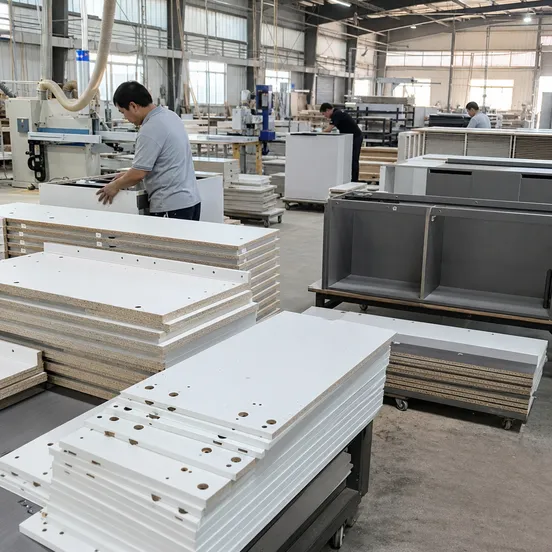
Kitchen cabinet carcasses, wardrobe panels, office furniture components, and retail display fixtures are the core volume segments for laminate blockboard. Furniture manufacturers sourcing this product are typically looking to eliminate a secondary lamination step from their production process — they want a panel that arrives ready to cut, edge-band, and assemble without additional surface treatment.
HPL handles surface function
Decorative and protective — no additional surface treatment required at the factory
Solid wood core handles structure
Structural integrity and fastening function — consistent density for predictable CNC tool wear
CNC-ready substrate
Consistent solid wood strip core density means more predictable tool wear and cleaner cut edges vs. particle board
Reduced processing overhead
Pre-laminated substrate eliminates secondary lamination step from the manufacturer's production line
Distribution note: Furniture manufacturers in Southeast Asia and the Middle East have been moving toward pre-laminated substrates to reduce their own processing overhead — a growing opportunity for distributors building supply lines for those regions.
Interior Fit-Out and Commercial Construction
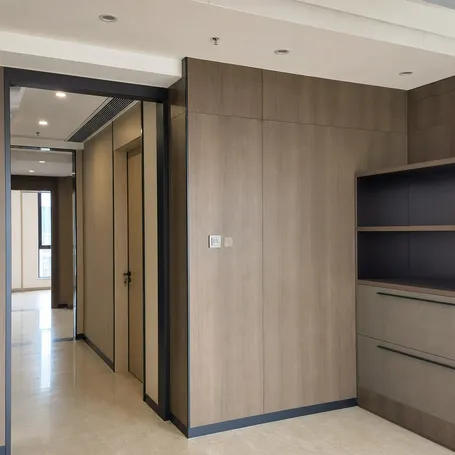
Laminate blockboard is a standard substrate for wall paneling, partition systems, door skins, and built-in joinery in commercial interior projects — hotels, offices, retail spaces, and hospitality fit-outs. The HPL surface is specified in these applications because it meets the durability requirements of commercial use without requiring site-applied finishing.
For contractors and fit-out companies: The panel arrives on site ready to install — no additional finishing required.
For distributors: Commercial fit-out projects run on defined specifications — once your product is written into a project spec, you have a repeatable order pattern for the duration of the project.
Worktops and Horizontal Surfaces
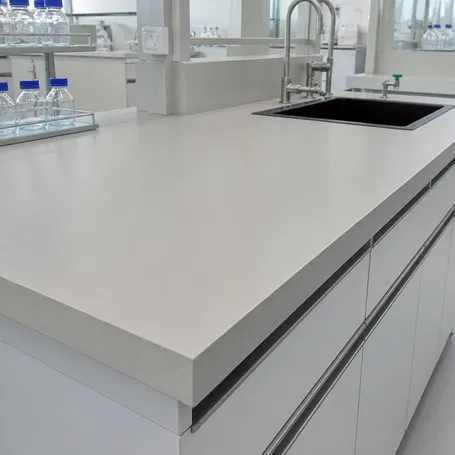
Laminate blockboard with a thicker HPL face (0.8–1.0mm) is used for worktops, countertops, and horizontal surfaces in kitchens, laboratories, and commercial food service environments. The solid wood core provides the rigidity and screw-holding strength needed for worktop applications; the HPL face provides the surface hardness and moisture resistance.
Commercial logic: Worktop panels command a price premium over standard panel products, and the specification requirements — surface hardness, moisture resistance, edge treatment — create a natural barrier to commodity competition.
Educational and Institutional Furniture
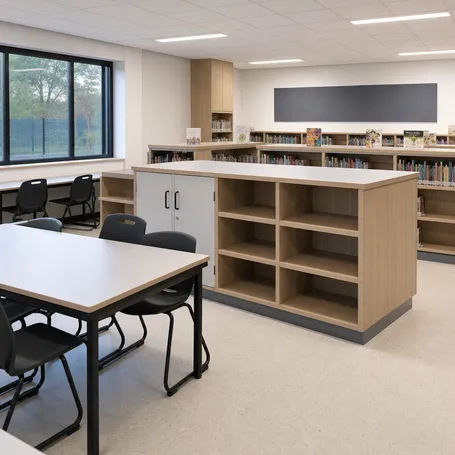
School furniture, library shelving, and institutional storage systems are a consistent volume segment for laminate blockboard. The durability requirements in these applications are high — surfaces need to withstand years of daily contact without visible degradation.
Pre-qualified at specification stage: Institutional buyers — school districts, government procurement agencies — typically specify HPL-faced panels explicitly in their procurement documents.
For distributors with institutional supply relationships: Predictable annual volume and low price sensitivity relative to commercial furniture — a stable, defensible segment.
Four Segments, One Product Line
Laminate blockboard serves commercial furniture manufacturing, interior fit-out, worktops, and institutional supply — each with distinct specification requirements and order patterns. Distributors who understand these segments can position stock and pricing accordingly rather than competing on commodity terms.
Standard Dimensions and Surface Options
Specifications below reflect standard production parameters. Custom dimensions, core species, and HPL surface selections are available for container-volume orders. Contact us to discuss project-specific requirements.
Panel Dimensions
| Parameter | Standard | Custom |
|---|---|---|
| Sheet Size | 1220 × 2440mm | On request |
| Thickness Range | 12mm – 25mm | Up to 30mm |
| Common Thicknesses | 12, 15, 18, 25mm | — |
| Tolerance (thickness) | ±0.5mm | ±0.3mm available |
| Squareness | ≤1.5mm/m | — |
Core Construction
| Parameter | Detail |
|---|---|
| Core Species | Poplar (standard); Eucalyptus, Pine available |
| Strip Width | 25–30mm (standard blockboard) |
| Core Veneer Faces | 1–2 layers each side |
| Glue Type | MR (E1) standard; WBP (E0) available |
| Formaldehyde Emission | E1 ≤0.1 ppm; E0 ≤0.05 ppm |
| Moisture Content | 8–12% |
HPL Surface Options
| Parameter | Options |
|---|---|
| HPL Thickness | 0.5mm, 0.8mm, 1.0mm |
| Surface Finish | Matte, Gloss, Woodgrain, Solid Colour, Textured |
| Face Application | Single face or double face |
| Back Balance Sheet | Kraft paper or thin HPL (0.5mm) |
| Colour Range | Standard palette; custom colour on volume |
| Abrasion Resistance | EN 438 Class 2 (standard); Class 4 (worktop) |
Mechanical Properties
| Property | Value | Standard |
|---|---|---|
| Bending Strength | ≥30 N/mm² | EN 310 |
| Modulus of Elasticity | ≥4,000 N/mm² | EN 310 |
| Screw Holding (face) | ≥900 N | EN 13446 |
| Screw Holding (edge) | ≥700 N | EN 13446 |
| Surface Hardness (HPL) | ≥1.0 N/mm² (Brinell) | EN 438-2 |
| Density (panel) | 480–560 kg/m³ | EN 323 |
Certifications and Compliance
Standard production meets E1 formaldehyde emission requirements. CARB Phase 2, FSC, and PEFC documentation available for qualifying orders. Contact us to confirm certification requirements for your market before placing an order.
Customization: What We Can Confirm at Order Stage
Laminate blockboard customization runs across four dimensions. The parameters below reflect what we can confirm on production orders — no ambiguity, no post-order surprises.
Laminate Surface
Color, finish, thickness, and face configuration
Standard solid colors, wood grain patterns, stone patterns, and abstract designs. Custom colors matched to RAL or Pantone references on orders meeting minimum run requirements.
Textured finishes available depending on laminate selection.
Single-face or double-face lamination available. Double-face lamination (HPL on both sides) is recommended for panels used in humid environments — prevents differential moisture absorption and warping.
Core Material
Species selection and strip width configuration
Panel Dimensions
Standard and custom size options
Custom lengths and widths available on confirmed orders. Plywood is cut-to-size, not molded — custom dimensions are a scheduling question, not a tooling cost question.
12mm and 20mm available on request with lead time confirmation.
Branding & Packaging
OEM labeling and export packaging options
Custom brand marks, grade stamps, and packaging for buyers running private-label programs.
Production Process: Where Laminate Blockboard Quality Is Actually Determined
The quality of a laminate blockboard panel is set at three points in production: core assembly, substrate pressing, and laminate bonding. Each stage has a specific failure mode — and the way we run each stage directly affects what you receive.
Core Assembly
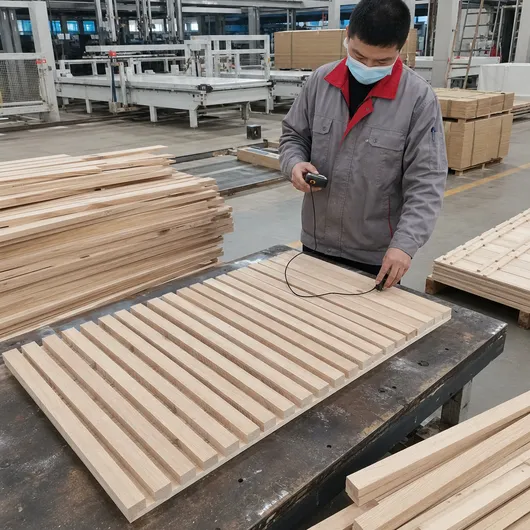
Solid wood strips are dried to 8–10% moisture content before assembly. This is the step most factories rush — if strips go into the core at higher moisture, the panel will continue to dry after pressing and the dimensional change will stress the laminate bond.
Common failure mode: Gaps in the core create soft spots that telegraph through the laminate face under load — a defect that shows up in the field rather than at inspection.
Our practice: Strip moisture is checked before layup, not after pressing. Core strips are edge-glued and assembled with consistent gap control.
Substrate Pressing
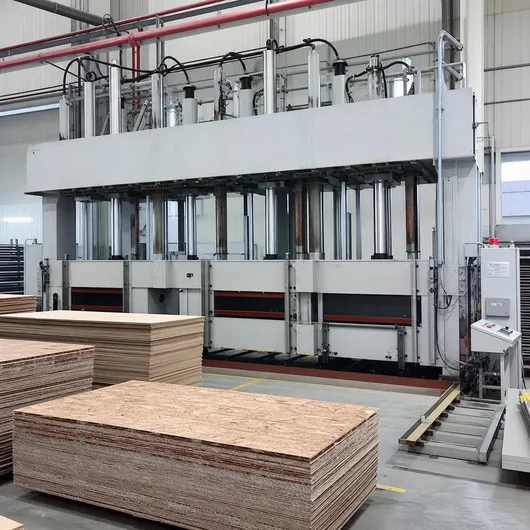
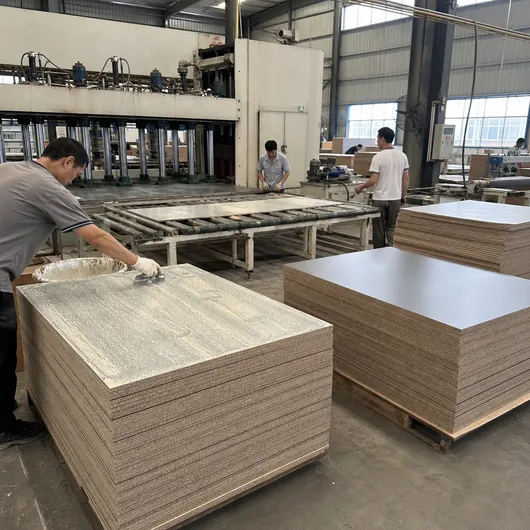
Core assembly, cross-band veneers, and face veneers are pressed in our multi-daylight hydraulic hot press system. Press parameters — temperature, pressure, and dwell time — are logged per batch.
Critical variable: Uneven pressure produces panels with localized bonding weakness that pass a surface check but delaminate under humidity cycling.
Our practice: Press calibration is checked on a scheduled basis. Any batch showing thickness variation outside ±0.2mm tolerance is pulled for review.
Laminate Bonding
The HPL sheet is bonded to the pressed substrate in a secondary hot press operation using a UF or PVA-based adhesive system — adhesive selection depends on the application specification and moisture exposure requirements.
Common shortcut: Skipping the post-press conditioning step causes the laminate to lift at edges as residual stress releases.
Our practice: Adhesive spread weight is checked before each press cycle. Panels are conditioned at ambient temperature before trimming — we trim after conditioning, not before.
Post-Lamination Quality Release
After pressing, panels go through a cross-cut peel test on sample panels from each batch to verify laminate adhesion before the batch is released to the sanding and trimming line.
This is the final gate before panels move to finishing. A batch that fails the peel test does not proceed — it is reviewed and either reworked or rejected. The peel test is not a documentation exercise; it is the mechanism that catches bonding failures before they reach your container.
Certifications and Market Compliance
The certification stack on our laminate blockboard covers the key procurement gates in our export markets. These are standard inclusions, not special options — documentation ships with the order.
California Air Resources Board Phase 2 formaldehyde emission standard — the most stringent formaldehyde limit in the US market and the effective baseline for any panel product entering North American distribution. Produced to CARB P2 compliance as standard. Documentation included with US-bound shipments.
Wood fiber in our panels can be traced to FSC-certified forest sources. Relevant if your buyers have sustainability sourcing policies or if you're supplying into markets where deforestation-linked supply chains carry reputational or regulatory risk.
Covers European construction and building material applications. Included with EU-bound shipments as standard.
Quality management system certification covering our full production process. Audit reports available on request.
Beyond CARB P2: Market-Specific Emission Standards
For buyers supplying into markets with specific formaldehyde emission requirements beyond CARB P2 — Japan's F★★★★ standard, Europe's E1/E0 — we can produce to those specifications on confirmed orders.
The resin system and press parameters are adjusted at the production stage. This is not a post-production treatment — the compliance is built into the panel during manufacture.
Specify your target market's emission standard at order stage. Resin system and press parameters are set during production — not applied as a post-production treatment.
Packaging, Container Loading, and Export Logistics
Standard export packaging, documented loading plans, and consolidated freight options for mixed-product orders. Here's what to expect from order to port.
Standard Export Packaging
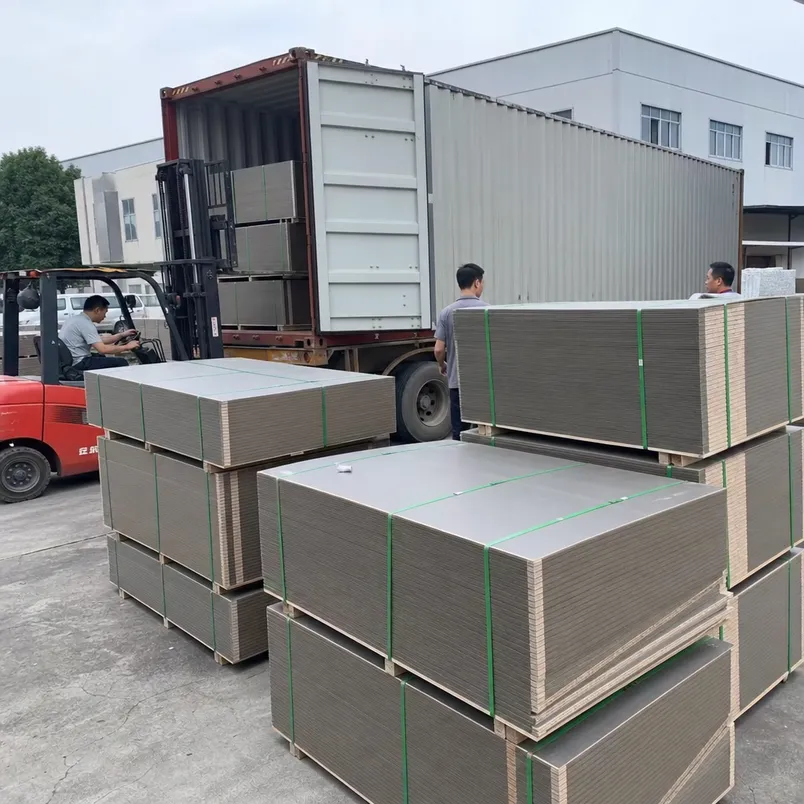
- Panels bundled and strapped with edge-protection corner boards
- Wrapped in moisture-resistant film for transit protection
- HPL face protected with peel-off protective film — worth requesting if your receiving facility has a long dwell time between container arrival and panel processing
Container Loading Capacity
Standard 1220 × 2440mm panels at 18mm thickness load into a 40HQ container at approximately 600–650 sheets depending on stacking configuration.
A loading plan is provided with each shipment so your receiving team knows the exact bundle count and configuration before the container arrives.
Freight and Port Connections
Export Documentation Package
Third-party pre-shipment inspection through SGS, Bureau Veritas, or your preferred agency can be arranged on request. Specify your inspection requirements at order stage.
Laminate Blockboard vs. Sibling Products: Choosing the Right Panel
| Laminate Blockboard | Melamine Blockboard | Blockboard (Plain) | |
|---|---|---|---|
| Surface | HPL sheet (0.6–1.0mm) | Melamine paper (0.1–0.2mm) | Veneer or unfinished |
| Surface Hardness | High — commercial grade | Medium — standard interior | Substrate only |
| Best For | Commercial furniture, worktops, high-traffic interiors | Standard residential furniture, cabinetry | Substrate for secondary processing |
| Price Position | Premium | Mid-range | Base |
| Downstream Processing | Minimal — cut, edge-band, assemble | Minimal — cut, edge-band, assemble | Requires surface treatment |
Standard Residential Cabinetry
If your buyers need a cost-effective decorative panel for standard residential cabinetry, melamine blockboard is the right product.
Own Lamination or Veneer
If they need a plain substrate for their own lamination or veneer application, plain blockboard covers that.
Hard, Durable Surface Required
Laminate blockboard is the right call when the application demands a hard, durable surface and the buyer wants to eliminate secondary finishing from their process.
Frequently Asked Questions
Formica is a brand name for high-pressure laminate — one of the original and most recognized HPL brands globally. "Formica blockboard" refers to blockboard with an HPL face, which is the same product as laminate blockboard. The surface performance characteristics are the same; the distinction is brand versus generic terminology. When buyers specify "Formica blockboard," they are typically specifying HPL-faced blockboard to a recognized quality benchmark. Our laminate blockboard uses HPL sheet meeting the same performance standards.
For horizontal surfaces subject to regular mechanical contact — kitchen worktops, laboratory benches, commercial countertops — specify 0.8–1.0mm HPL. The thicker laminate provides meaningfully better impact resistance and edge durability compared to 0.6mm.
For vertical surfaces (cabinet doors, wall panels, partition faces) where impact loading is lower, 0.6mm HPL is standard and cost-effective. If you're unsure, tell us the application and we'll recommend the right specification.
With the right specification, yes. The key variables are the glue type in the substrate (specify WBP/waterproof boil-proof adhesive rather than standard MR) and double-face lamination (HPL on both faces rather than one).
Single-face lamination in a humid environment creates differential moisture absorption between the laminated and unlaminated faces, which causes warping over time. Double-face lamination with WBP glue is the correct specification for bathrooms, commercial kitchens, and other high-humidity applications.
Correct specification for humid environments: WBP/waterproof boil-proof adhesive in the substrate + HPL on both faces (double-face lamination).
Standard laminate colors and wood grain patterns are available at our standard MOQ. Custom color matching (RAL or Pantone reference) requires a minimum run — contact us with your color specification and target volume and we'll confirm the MOQ and lead time.
Most custom color programs run on a 15–20 working day lead time from specification confirmation to first production sample.
The core difference is the substrate. Laminate blockboard uses a solid wood strip core, which gives it higher screw-holding strength and better resistance to sagging over long unsupported spans — relevant for shelving and worktop applications. HPL plywood uses a cross-laminated veneer core, which gives it better dimensional stability in both directions and is lighter per unit area at the same thickness.
- Higher screw-holding strength
- Better resistance to sagging over long spans
- Heavier than plywood at same thickness
- Better dimensional stability (both directions)
- Lighter per unit area at same thickness
- Lower screw-holding in edge grain
For furniture carcasses, shelving, and worktops where screw-holding and span rigidity matter, laminate blockboard is typically the better choice. For wall paneling and applications requiring consistent stability across both panel dimensions, HPL plywood is often preferred.
The most important certifications depend on your destination market and end use:
-
Formaldehyde emission — E1 or CARB P2Required for most residential and commercial interior applications. E1 is the European standard; CARB Phase 2 is required for California and increasingly adopted across North America.
-
FSC or PEFC chain of custodyRequired for projects with sustainability specifications or green building ratings (LEED, BREEAM). Confirms the timber core originates from responsibly managed forests.
-
Fire rating — EN 13501 or BS 476Required for commercial interiors, hospitality, and public buildings. Specify the required class (e.g., Class B-s1,d0 under EN 13501) at the time of order — fire-rated panels use a different substrate and cannot be substituted post-production.
-
IS 1659 (BIS) — for India marketThe Bureau of Indian Standards specification for blockboard. Relevant if you are supplying into the Indian domestic market or government projects requiring BIS-marked materials.
Our documentation: We supply test reports and certificates of conformity with each shipment. Share your destination market and project type when enquiring and we'll confirm which certifications apply to your order.
Standard sheet sizes are 8×4 ft (2440×1220mm) and 7×4 ft (2135×1220mm). Larger format panels (2800×2070mm and similar) are available on request for specific applications.
Cut-to-size supply is available for container-volume orders. Provide your cut list and we'll optimize the panel yield and quote accordingly. Cut-to-size reduces your on-site waste and handling costs, particularly relevant for high-volume joinery and fit-out projects.
Ready to Source Laminate Blockboard?
Share your specification — thickness, HPL color, sheet size, volume, and destination — and we'll respond with pricing, lead time, and available certifications within one business day.
Get a Quote for Laminate Blockboard
Send us your specification and we'll come back with a detailed quote, the relevant certification documentation for your import requirements, and a production schedule.
What to Include in Your Specification
-
Panel size — standard or custom dimensions
-
Thickness — nominal thickness required
-
Laminate color / finish — HPL or melamine, color reference or decor code
-
Core species preference — poplar, eucalyptus, or mixed hardwood
-
Target volume — CBM or container count per order cycle
-
Destination market — determines which certification documentation applies
Start with a Sample Order
Most buyers in this category start with a sample order to verify the laminate quality and core construction against their own production requirements before committing to a full container. We can arrange samples — contact us to discuss.
What We Send Back
Xuzhou QD Wood Industry Co., Ltd.
Sanbao Industrial Park, Tongshan District, Xuzhou, Jiangsu Province, China
Xuzhou, Jiangsu Province, 221116, China
Explore Related Products