

About QDPlywood | Leading Plywood Manufacturer
Xuzhou QD Wood Industry Co., Ltd. — manufacturing commercial-grade plywood and engineered wood panels since 2008. Factory-direct supply to distributors, importers, and project buyers across North America, Europe, the Middle East, Southeast Asia, and Australia.
Who We Are: A Dedicated Plywood Factory in Xuzhou, China
We are Xuzhou QD Wood Industry Co., Ltd., operating under the brand QDPlywood.com. Since 2008, we have manufactured commercial-grade plywood and engineered wood panels for distributors, importers, and project buyers across North America, Europe, the Middle East, Southeast Asia, and Australia. This is a factory-direct operation — no trading company layer, no middlemen marking up your landed cost.
Our facility sits in Sanbao Industrial Park, Tongshan District, Xuzhou, Jiangsu Province — a well-established wood processing cluster with direct rail and road access to major eastern seaports. That geography matters when you're calculating transit time and freight cost to your market.
The product range covers commercial plywood, film-faced plywood, MDF, melamine-faced boards, blockboard, OSB, HPL plywood, hardboard, and paper-overlaid panels. Most buyers come to us for one product category and expand their sourcing across the range once they see how we run. The thickness range runs from 2.5mm to 25mm, with custom sizing available on confirmed orders.
Location advantage: Sanbao Industrial Park, Tongshan District, Xuzhou, Jiangsu Province — direct rail and road access to major eastern seaports, reducing transit time and freight cost to your market.
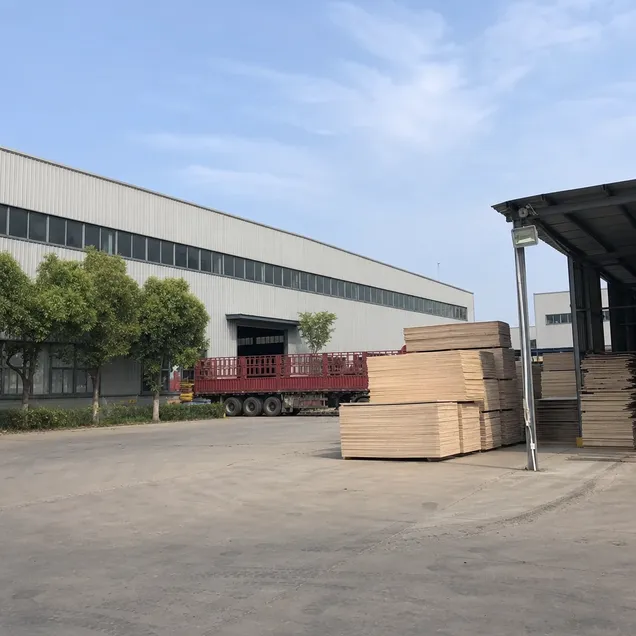
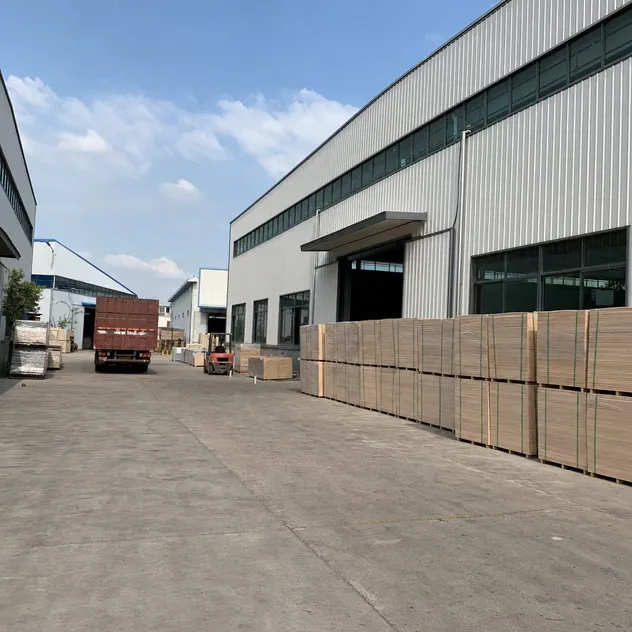
QDPlywood facility — Sanbao Industrial Park, Tongshan District, Xuzhou
Full Product Range
Commercial Plywood
Structural and general-purpose panels for construction and furniture
Film-Faced Plywood
Phenolic film overlay for concrete formwork and heavy-use applications
MDF & Melamine Boards
Medium-density fibreboard and melamine-faced panels for cabinetry
Blockboard & OSB
Solid core blockboard and oriented strand board for structural use
HPL Plywood
High-pressure laminate panels for decorative and wear-resistant surfaces
Hardboard
Dense, smooth-surface panels for backing, flooring underlays, and packaging
Paper-Overlaid Panels
Kraft or resin-impregnated paper overlay for paintable and printable surfaces
Thickness Range
2.5mm to 25mm standard. Custom sizing available on confirmed orders.
How We Got Here: 17 Years of Solving Export-Grade Problems
We started in 2008 focused on a single problem: Chinese plywood had a reputation for inconsistent moisture content that caused warping and delamination after it cleared customs. Buyers in humid climates — Southeast Asia, the Gulf, coastal Australia — were getting burned.
We built our drying and moisture control process around that specific failure mode from day one, targeting 8–12% moisture content for export-grade panels. That range is tighter than what most domestic-market factories bother with, and it's the reason our panels arrive flat and stay flat.
By the early 2010s, as European and North American buyers started requiring CARB P2 and FSC chain-of-custody documentation, we invested in the certification infrastructure rather than waiting for customers to force the issue. That decision cost us two years of compliance work and a significant audit overhead — but it opened markets that are now our largest revenue channels.
The hot press technology we run today was upgraded specifically to achieve the bonding consistency that CARB P2 formaldehyde limits demand. You can't hit those emission targets with inconsistent glue spread and press temperature — the process has to be engineered for it, not just tested for it at the end.
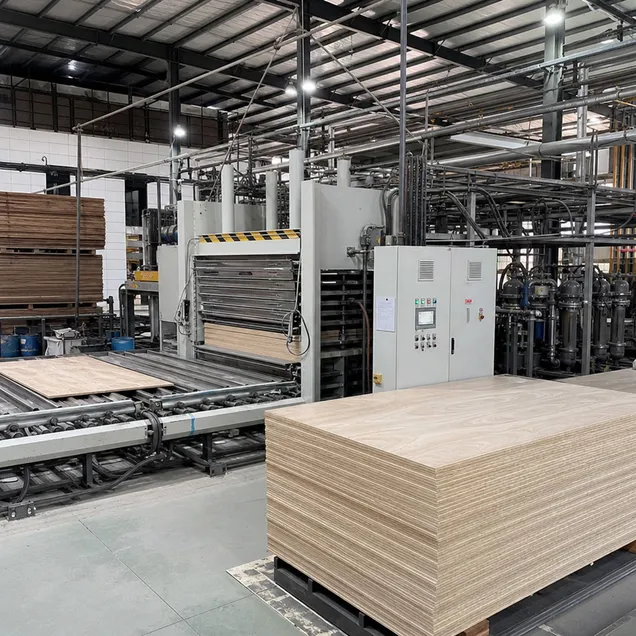
Why CARB P2 compliance required a process rebuild
Formaldehyde emission limits under CARB P2 can't be met by end-of-line testing alone. Consistent glue spread and press temperature have to be engineered into the production process. That's the infrastructure investment we made in the early 2010s.
Key Milestones
Launched with a focus on moisture-controlled export-grade plywood. Target: 8–12% MC for humid-climate markets.
Invested in CARB P2 and FSC chain-of-custody compliance infrastructure — two years of audit overhead that opened North American and European markets.
Hot press technology upgraded specifically to achieve the bonding consistency CARB P2 formaldehyde limits demand — engineered in, not tested in.
Supplying distributors, importers, and project buyers across North America, Europe, the Middle East, Southeast Asia, and Australia.
The Moisture Problem We Were Built to Solve
Inconsistent moisture content is the root cause of warping and delamination after panels clear customs — the failure mode that burned buyers in Southeast Asia, the Gulf, and coastal Australia. Our drying and moisture control process targets 8–12% MC for all export-grade panels. That's a tighter range than most domestic-market factories maintain, and it's why our panels arrive flat and stay flat in humid destination climates.
Inside the Factory: 18,000 m² Built Around Batch Consistency
The facility covers 18,000 square meters across production, drying, storage, and quality control areas. We run 6 production lines with an annual output capacity of 450,000 cubic meters. 220 employees work across production, QC, logistics, and technical support.
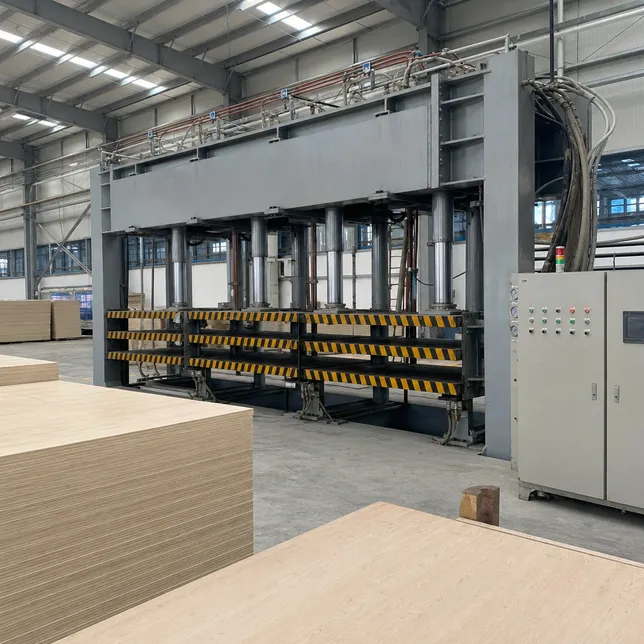
The Hot Press System: Where Bonding Consistency Is Made
The core of the operation is the hot press system. We run multi-daylight hydraulic hot presses calibrated to maintain uniform pressure and temperature across the full panel surface — the critical variable in plywood bonding is not just the glue formulation, it's the consistency of heat and pressure distribution across a 1220×2440mm sheet.
Uneven press conditions produce panels that pass a surface check but delaminate under load or humidity cycling. Our press parameters are logged per batch, so if a bonding issue surfaces downstream, we can trace it back to the specific production run.
Press parameters are logged per batch. If a bonding issue surfaces downstream, it can be traced back to the specific production run — not just the shipment date.
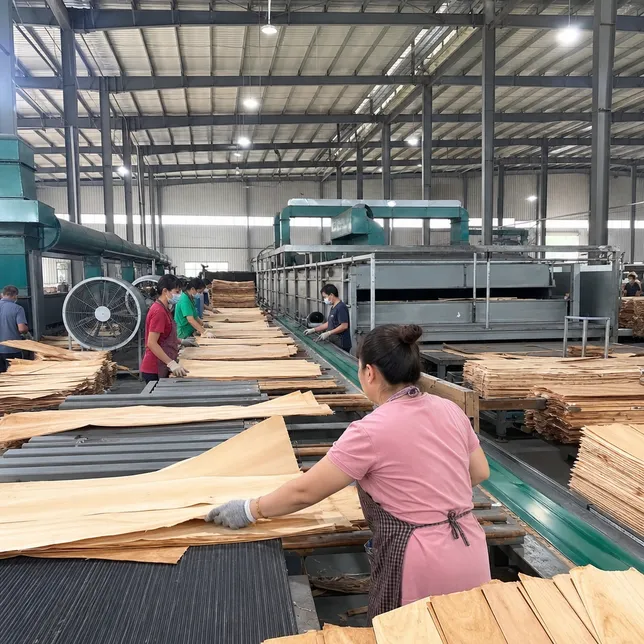
Veneer Preparation: Moisture-Controlled Layup Before the Press
Veneer preparation runs through a dedicated grading and drying line before it ever reaches the press. Incoming veneers are sorted by species, moisture content, and surface grade — we don't mix veneer grades within a panel unless the specification calls for it.
Core veneers are dried to target moisture before layup; face veneers are graded separately for surface quality.
A surprising number of factories skip the pre-press moisture check and rely on the hot press to drive out residual moisture — which it does, unevenly, and that's where you get thickness variation across a batch.
Surface Finishing: Tolerance That Matters for Downstream Processing
The surface finishing line handles sanding, trimming, and edge treatment. Calibrated sanding ensures thickness tolerance within ±0.2mm across the panel — relevant when your downstream customer is running the panels through automated cutting equipment where thickness variation causes feed errors.
Panels are trimmed to size on precision saws, and edge sealing is applied on export-grade products to prevent moisture ingress during ocean transit.
Core Equipment and Process Capabilities
Multi-Daylight Hydraulic Hot Press
Uniform bonding across full panel surface. Parameters logged per batch for traceability.
Veneer Grading & Pre-Press Drying
Moisture-controlled layup before pressing. Species and grade sorted before panel assembly.
Calibrated Wide-Belt Sanding
Thickness tolerance ±0.2mm. Prevents feed errors in downstream automated cutting equipment.
Precision Panel Trimming Saws
Consistent cut dimensions for downstream processing. Edge sealing applied on export-grade products.
Film Overlay Lamination Line
Phenolic and melamine film application for film-faced products.
Melamine Paper Pressing Line
For melamine-faced MDF and plywood production.
Automated Glue Spreading
Consistent resin application across veneer layers. Spread weight checked against specification at layup — too light causes bond failure, too heavy causes bleed-through on face veneers.
Certifications and the QC Process Behind Them
These certifications cover the markets where documentation is a procurement gate. Audit reports are available on request — we don't make buyers chase documentation.
The QC Process: Three Stages, Each Targeting a Specific Failure Mode
The quality control process runs in three stages, and each stage has a specific failure mode it's designed to catch.
Incoming Inspection
Covers veneer species verification, moisture content measurement, and surface defect grading.
- Veneers outside the moisture range for the target product specification are rejected — a veneer that's too wet going into the press will produce a panel that's dimensionally unstable after pressing, regardless of how well everything else is done.
- Species verification matters for FSC-certified orders where chain-of-custody documentation requires confirmed species identity.
In-Process Inspection
Runs at the layup stage and post-press.
- At layup, glue spread weight is checked against specification — too light and you get bond failure, too heavy and you get bleed-through on face veneers.
- Post-press, panels are checked for delamination, blister, and thickness. Any panel that shows a bonding defect at this stage is pulled before it reaches the sanding line.
Outgoing Inspection
Covers the full panel before packing.
- Thickness measurement at multiple points, surface grade assessment, formaldehyde emission testing (for CARB P2 and E1/E0 specifications), and moisture content verification.
- For film-faced products, film adhesion is tested by cross-cut and peel.
- Export batches are inspected against the purchase order specification before packing — dimensions, grade, quantity, and marking are all verified before the container is loaded.
Third-Party Inspection Available
On request, at buyer's preferred agency
We work with SGS, Bureau Veritas, and similar agencies. Buyers who require independent pre-shipment inspection can arrange it through their preferred agency and we'll coordinate access.
Audit Reports on Request
Documentation ready — no chasing required
Certification documentation for ISO 9001:2015, CE, FSC Chain of Custody, and CARB P2 is available on request. We don't make buyers chase documentation.
View CertificationsResponsible Sourcing and Environmental Compliance
Traceability, low-emission resin systems, and production waste management — the compliance baseline we hold across our full product range.
FSC Chain-of-Custody Certification
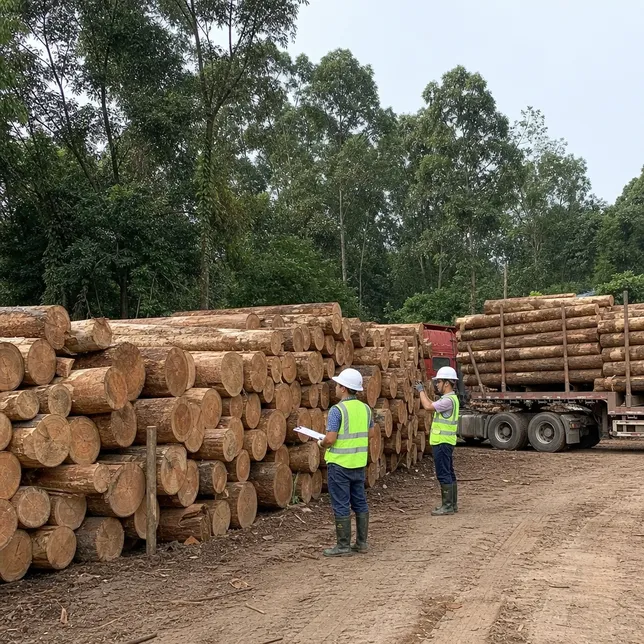
FSC chain-of-custody certification means the wood fiber in our panels can be traced back to certified forests. This is relevant if your buyers or end customers have sustainability sourcing requirements, or if you're supplying into markets where deforestation-linked supply chains are a reputational or regulatory risk.
Low-Formaldehyde Resin Systems
We use low-formaldehyde resin systems across our product range. The CARB P2 standard is the most stringent formaldehyde emission limit in our export markets, and we formulate to meet it as the baseline — not as a special option. This means every panel we ship is built to the tightest standard by default, regardless of destination market.
Production Waste Management
Waste veneer and trim offcuts from the production process are collected and processed — either recycled into core material for lower-grade applications or directed to biomass energy recovery. We don't landfill production wood waste.
Worker Safety Standards
Worker safety standards follow Chinese national occupational health regulations, with dust extraction systems on all sanding and cutting equipment and PPE requirements enforced on the production floor.
Compliance at a Glance
Wood fiber traceable to certified forests
Most stringent formaldehyde limit — standard across all products, not a premium option
Offcuts recycled into core material or directed to biomass energy recovery
Dust extraction on all sanding and cutting equipment; PPE enforced on production floor
Custom Development and OEM/ODM Capability
Our technical team handles OEM and ODM projects — custom veneer species, core material combinations, surface treatments, panel dimensions, and branding. The thickness range from 2.5mm to 25mm covers most commercial applications.
Custom Dimensions Without Tooling Costs
We can produce non-standard dimensions on confirmed orders without the tooling costs that would apply in other manufacturing categories. Plywood is cut-to-size, not molded — custom dimensions are a scheduling and yield question, not a capital investment question.
Working from Your Specifications
For OEM projects, we work from buyer-provided specifications or develop specifications jointly based on the target application and market requirements.
For furniture manufacturers who need consistent grain matching across a product line
For structural applications with defined load requirements
For film-faced products going into branded construction systems
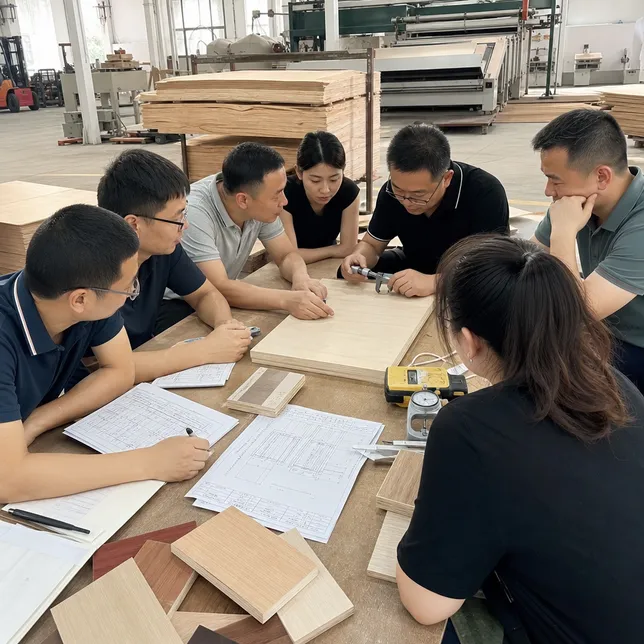
Engineering Team
The engineering team — roughly 20 people covering product development, process engineering, and quality systems — manages the specification development and first-article approval process for new OEM programs.
Lead time from specification confirmation to first production sample is typically 15–20 working days depending on material sourcing requirements.
Veneer Species
Custom face veneer species for grain consistency across product lines
Core Constructions
Custom core material combinations for structural load requirements
Surface Treatments
Custom film colors, textures, and surface finishes for branded systems
Panel Dimensions
Non-standard dimensions on confirmed orders — no tooling cost premium
The People Running the Operation
Chief Engineer
Production Leadership
Over 18 years in engineered wood panel manufacturing, covering both plywood and MDF production processes. The production team is led by someone who has spent nearly two decades solving the specific problems that arise at scale — batch consistency, press cycle calibration, veneer grading — not someone who learned the job from a manual.
QC Department Manager
Quality Control
Spent the earlier part of his career at a third-party testing laboratory — which means our internal QC process was built by someone who has seen what happens when factories cut corners, not by someone who learned QC from the factory's own procedures. That background shapes how incoming materials are checked, how in-process panels are sampled, and how final batches are released.
Export Team
Documentation, Customs & Buyer Communication
Handles documentation, customs coordination, and buyer communication. Most have been with us for more than eight years — which means they know the specific import requirements for your market without needing to look them up. That institutional knowledge reduces the back-and-forth that slows down first shipments and eliminates the documentation errors that cause customs delays.
The combination matters: a production lead who understands process variables, a QC manager whose instincts were shaped outside the factory, and an export team with deep market-specific documentation experience. These are not interchangeable roles filled by whoever was available — they represent the operational depth that makes consistent export execution possible.
Shipping to Your Market: What Export Execution Actually Looks Like
We export to North America, Europe, the Middle East, Southeast Asia, and Australia. Here is how each stage of the export process is handled.
Port Access from Xuzhou
Three major port options for routing flexibility
Transit times: 18–35 days to major destination ports, depending on routing and destination market.
Container Loading
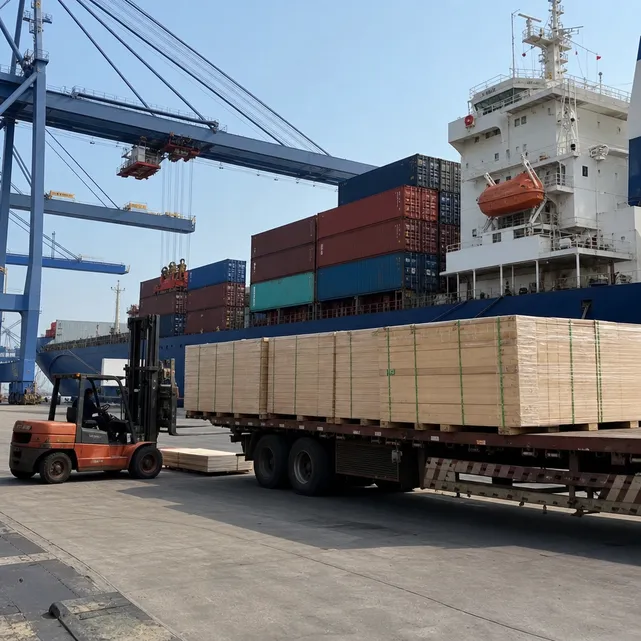
Loading is planned around panel dimensions and stacking configuration to maximize cubic utilization. Standard 1220×2440mm panels load efficiently into 20HQ and 40HQ containers.
We provide loading plans with each shipment so your receiving team knows exactly what to expect. For buyers ordering mixed product types, we coordinate consolidated loads to reduce per-unit freight cost.
Export Documentation
Standard documentation package covers all required documents. Market-specific additions are prepared as standard — not as extras that need to be requested.
Ocean Transit Packaging
Packaging is designed specifically for ocean transit conditions — not warehouse storage. Each bundle is built to arrive in the same condition it left the factory.
Documentation Gaps Are the Most Common Cause of Customs Delays
We've been through enough customs clearance cycles in North America, Europe, the Middle East, Southeast Asia, and Australia to know what documentation gaps cause delays — and we prepare the paperwork to avoid them. That experience is built into the standard documentation package, not offered as a premium service.
Six Reasons Your Sourcing Decision
Comes Down to Execution
Every plywood supplier claims quality. Here is what separates a factory that delivers on export requirements from one that does not.
18 Years of Export-Grade Production
Since 2008, every process decision has been made with export market requirements in mind — not retrofitted onto a domestic-market operation. That institutional depth shows in how we handle documentation, tolerances, and buyer-specific requirements.
Moisture Control Built Into the Process
8–12% moisture content for export panels is achieved through controlled drying and pre-press moisture verification — not tested at the end. Your panels arrive dimensionally stable because the process is designed that way from the start.
CARB P2, FSC, CE, ISO 9001:2015
The certification stack covers your key import markets without requiring you to qualify a separate supplier for each region. One factory, one audit trail, one point of contact — regardless of whether you are importing into the US, EU, or sustainability-audited supply chains.
6 Production Lines, 450,000 m³ Annual Capacity
Your volume order runs on a dedicated line without competing with other buyers' schedules. At 450,000 m³ annual capacity across six lines, we can absorb large orders and seasonal surges without compromising lead times or batch consistency.
OEM/ODM in 15–20 Working Days
From specification to production sample in 15–20 working days. Custom veneer species, core constructions, dimensions, and surface treatments — without the tooling cost overhead that makes short-run customization impractical at most factories.
Export Documentation Prepared to Market Standard
CARB packages for US shipments, CE declarations for EU, FSC chain-of-custody records for sustainability-audited buyers — all included as standard. You receive the documentation your customs broker and compliance team need without chasing it after the fact.
The difference between a supplier that quotes and a supplier that delivers is process discipline at every stage.
Send us your specification and destination market. We will return a detailed quote with the relevant certification documentation for your import requirements.
Contact QDPlywood
Send us your product specification, target volume, and destination market. We will come back with a detailed quote and the relevant certification documentation for your import requirements.
Xuzhou, Jiangsu Province, 221116, China
Ready to Request a Quote?
Include your product specification, target volume, and destination market. We will respond with a detailed quote and the certification documentation relevant to your import requirements — typically within one business day.