

OSB Panels Manufacturer — Factory-Direct
Factory-direct OSB panels built to structural sheathing standards — wall, roof, subfloor, and packaging applications from a single certified source. 6 production lines, 450,000 m³ annual capacity. Custom dimensions and OEM programs supported on confirmed orders.
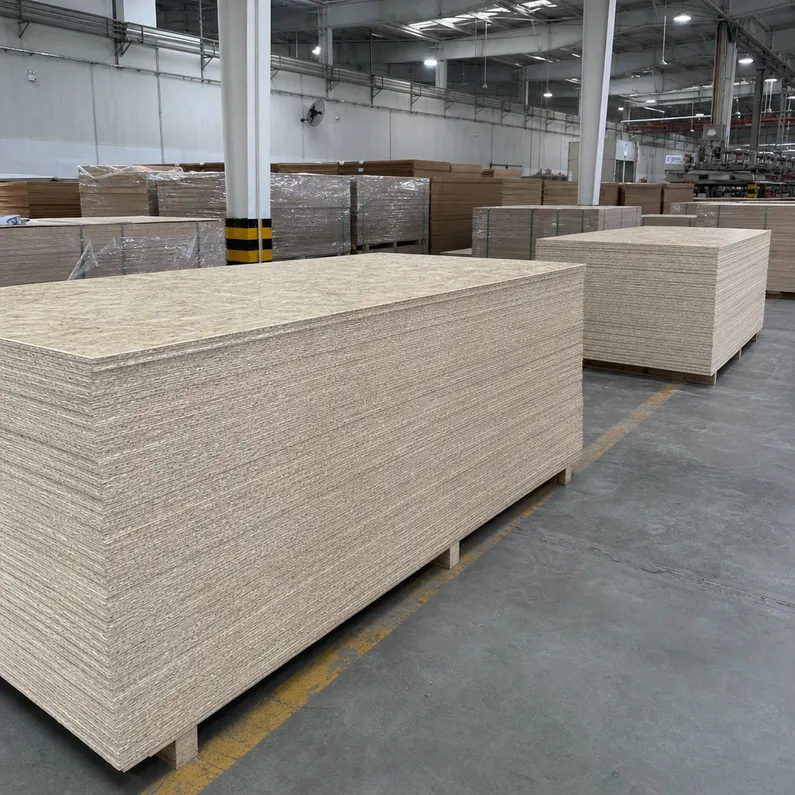
What OSB Panels Are — and Where This Product Sits in Our Range
OSB (oriented strand board) is a structural engineered wood panel made by compressing and bonding wood strands in oriented layers under heat and pressure. The strand orientation — cross-directional between layers, similar in principle to plywood's cross-grain construction — is what gives OSB its structural performance: consistent load distribution, resistance to racking, and dimensional stability under load.
We produce OSB panels as part of our broader particle board and OSB range. Within that range, this page covers our standard structural OSB panel product — the flat-pressed, resin-bonded sheathing panel used in wall, roof, and floor applications, as well as industrial packaging and pallet decking.
The panels we produce here are the workhorse format: flat-pressed, square-edge, available in standard and custom dimensions, and certified for the markets where structural sheathing documentation is a procurement requirement.
Related Products in This Range
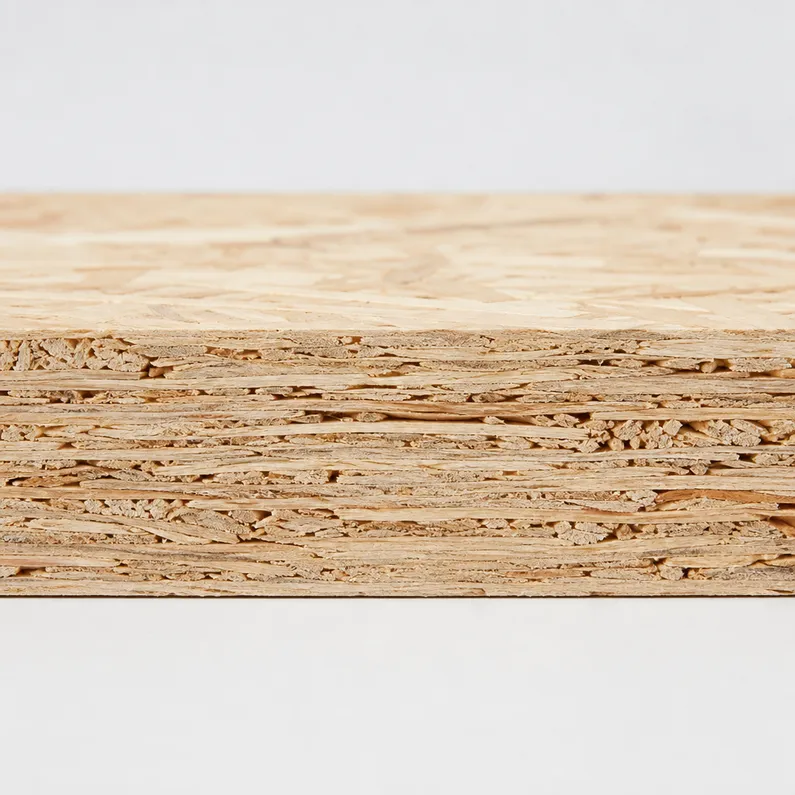
The Workhorse Format: What This Product Is
- Flat-pressed, square-edge — standard sheathing format for wall, roof, and subfloor applications
- Resin-bonded oriented strands — cross-directional layering for consistent load distribution and racking resistance
- Standard and custom dimensions — 1220×2440mm standard; custom sizes on confirmed orders
- Certified for documentation-required markets — CE, CARB P2, FSC, ISO 9001:2015
- Also used in industrial packaging and pallet decking — not just construction sheathing
Technical Specifications
OSB panel performance is defined by density, thickness, resin system, and strand orientation ratio. The table below reflects industry-standard values for structural-grade OSB panels of the type we produce. Contact us for the exact data sheet for your target application and market.
| Parameter | Typical Value |
|---|---|
| Panel thickness | 9mm, 11mm, 12mm, 15mm, 18mm, 22mm custom available |
| Standard panel size | 1220 × 2440mm (4′ × 8′); 1250 × 2500mm available |
| Board density | 600–680 kg/m³ |
| Moisture content (production) | 5–9% |
| Formaldehyde emission | E1 (≤0.124 mg/m³) CARB P2 available |
| Bending strength (parallel) | ≥22 N/mm² OSB/3 grade |
| Bending strength (perpendicular) | ≥11 N/mm² OSB/3 grade |
| Internal bond strength | ≥0.34 N/mm² |
| Thickness swelling (24h) | ≤15% |
| Surface | Sanded or unsanded; one side or two sides |
| Edge profile | Square edge standard T&G on OSB Flooring |
| Resin system | MDI (methylene diphenyl diisocyanate) or PMDI binder |
| Applicable standard | EN 300 (OSB/2, OSB/3, OSB/4) PS2 on request |
Specifications shown are industry-standard values for structural OSB panels. Actual production values may vary by order specification. Contact us for detailed product data sheets and test reports.
Standard Export Grade: EN 300 OSB/3
We produce to EN 300 OSB/3 as our standard export grade — that's the load-bearing, humid-conditions classification that covers most construction sheathing applications in European and Australian markets.
For North American buyers, we can produce to APA PS2 performance standards on confirmed orders.
OSB/3 vs PS2: These are not identical standards, but they overlap significantly in structural performance requirements. If you're bridging both markets, ask us about the specification that satisfies both.
EN 300 Grade Reference
OSB/4 available on request for heavy structural applications.
Need the full data sheet?
We can provide test reports, CE declaration of performance, and CARB compliance documentation for your import requirements.
Request DocumentationOSB Grades & Variants
We supply OSB in several configurations to match different end-use requirements. The right variant depends on your application, moisture exposure class, and any surface or edge treatment needed downstream.
Our core export product. Load-bearing, humid-condition rated, square-edge panels for wall, roof, and floor sheathing in timber-frame and light-gauge steel construction.
- Thicknesses: 9–22mm
- EN 300 OSB/3 certified
- CE marked, E1 emission class
- 1220×2440mm standard size
Tongue-and-groove profiled panels for subfloor and platform deck applications. The T&G edge eliminates the need for blocking at panel joints and provides a tighter, more stable floor assembly.
- Thicknesses: 15mm, 18mm, 22mm
- 4-sided T&G profile
- OSB/3 base grade
- Sanded top face available
Heavy-duty load-bearing panels for demanding structural applications — industrial flooring, mezzanine decks, and high-load wall diaphragms where OSB/3 bending strength is insufficient.
- Higher bending strength vs OSB/3
- Thicknesses: 18mm, 22mm+
- EN 300 OSB/4 certified
- Confirmed orders only
Load-bearing panels for dry service conditions. Suitable for interior structural applications where moisture exposure is controlled — furniture framing, interior partitions, and dry-storage shelving.
- Dry service class only
- Thicknesses: 9–18mm
- EN 300 OSB/2 certified
- Cost-effective vs OSB/3
Thinner, high-density panels for pallet decking, crating, and industrial packaging. Optimised for stiffness-to-weight ratio rather than structural bending — a cost-effective alternative to solid timber in packaging applications.
- Thicknesses: 9mm, 11mm, 12mm
- High surface density
- ISPM 15 exempt (processed wood)
- Custom cut sizes available
Panels produced to CARB Phase 2 formaldehyde emission limits for import into California and other US states that reference TSCA Title VI. Required for any composite wood product entering the US residential market.
- CARB P2 / TSCA Title VI compliant
- Third-party TPC certified
- Documentation provided
- Confirmed orders, MOQ applies
Not sure which grade fits your application?
Most construction sheathing buyers default to OSB/3 — it covers the widest range of applications and is the most widely accepted grade in CE-marked markets. If you're specifying for a particular building code or structural engineer's requirement, send us the spec sheet and we'll confirm the right grade and documentation package.
Structural Sheathing Applications: Market Segments Worth Targeting
OSB panels are a volume product in construction supply chains. The segments below represent the commercial patterns we see from our existing distributor and contractor buyers — each one has a different order profile and margin structure.
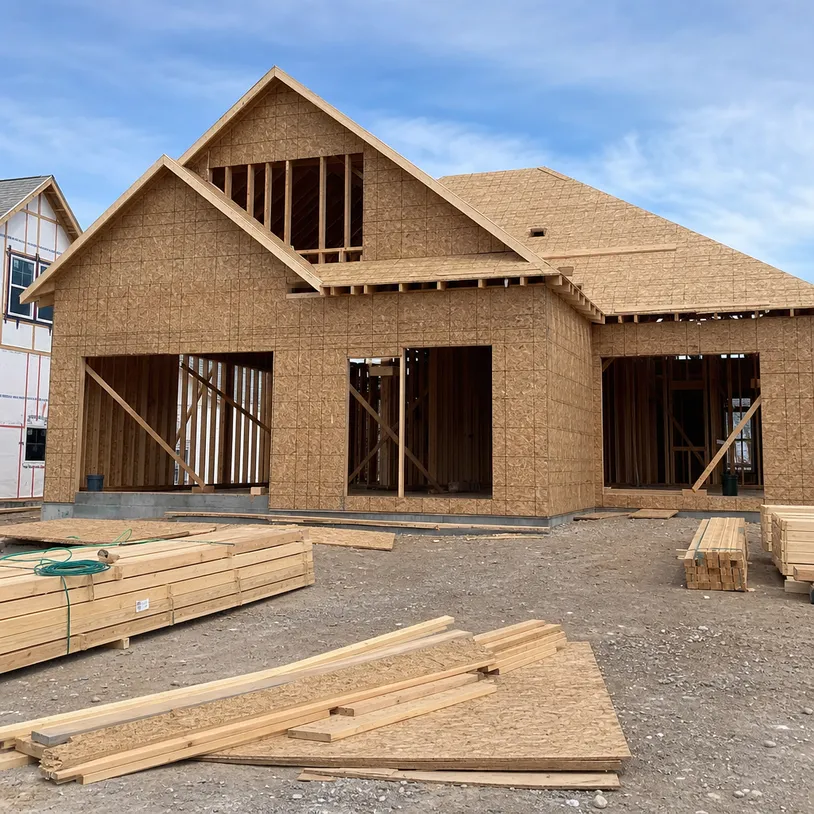
Residential and Light Commercial Framing Supply
Largest Volume SegmentFraming contractors and building material distributors supplying residential construction are the largest volume segment for structural OSB sheathing. Wall sheathing, roof decking, and subfloor applications each consume significant panel quantities per project — a standard single-family home in North America uses 80–120 sheets of OSB sheathing across all three applications.
Distributors supplying regional builders or lumber yards in this segment typically order in 40HQ container quantities and reorder on 6–8 week cycles during active building seasons. The margin play here is landed cost efficiency: your ability to offer consistent specification at a reliable price point is the competitive lever, not product differentiation.
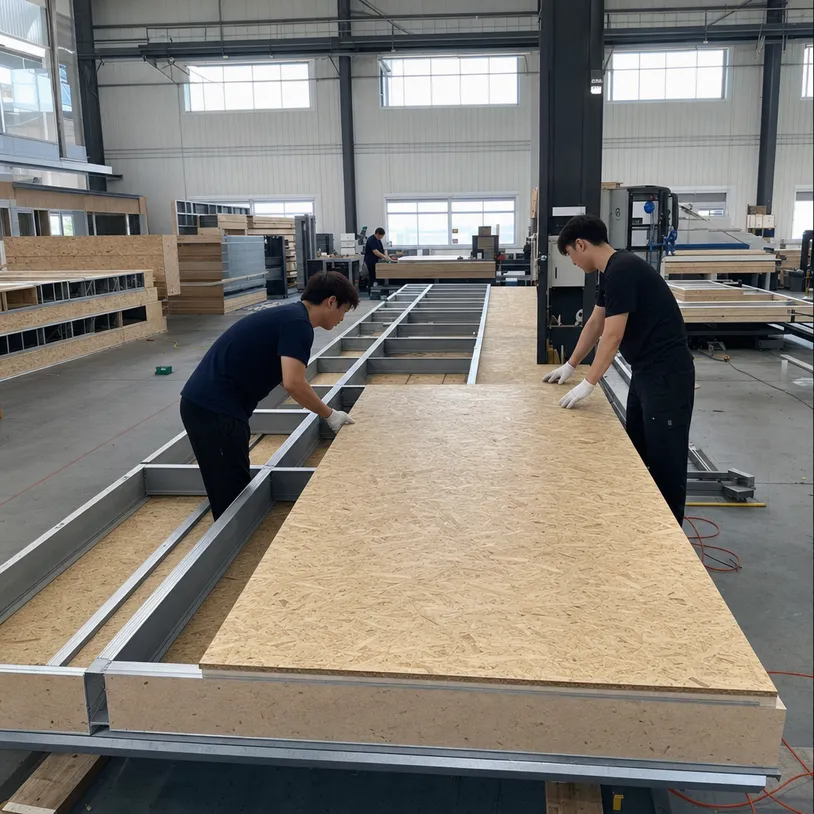
Prefabricated and Modular Construction
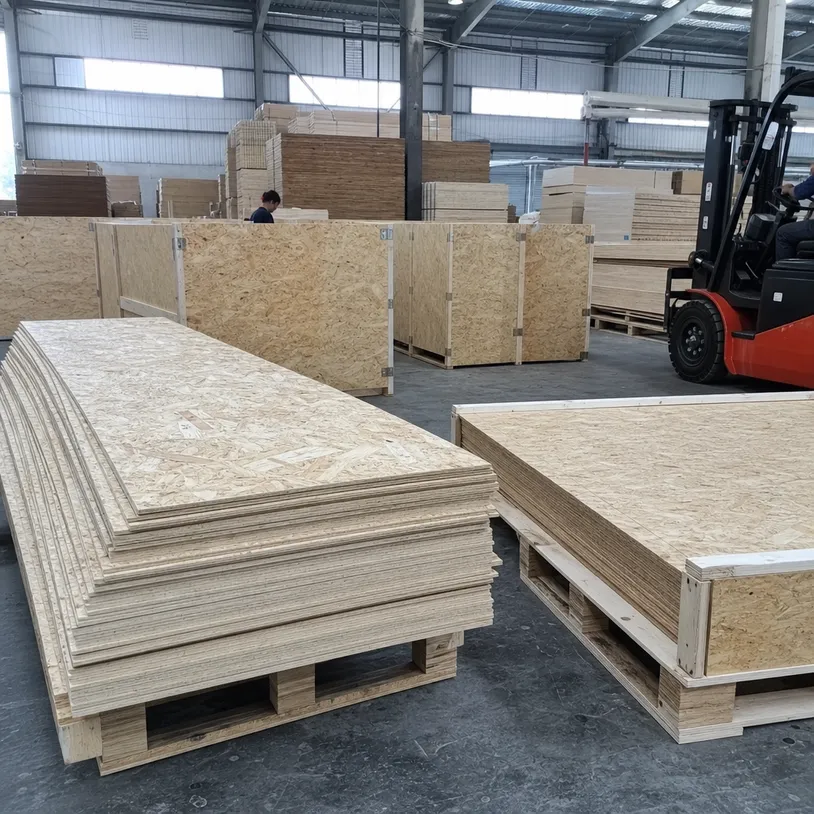
Growing Segment · Specification-LoyalPrefab panel manufacturers and modular building system producers purchase OSB in larger, more consistent volumes with tighter dimensional tolerances — their automated assembly lines don't tolerate the thickness variation that a framing crew can work around. We produce to ±0.3mm thickness tolerance on sanded panels, which is the spec most prefab buyers need for automated cutting and assembly.
This segment has grown noticeably over the past three years — modular construction is expanding in Europe and Australia, and the buyers in this space tend to be long-term, specification-loyal accounts once you're qualified in.
Sanded panel tolerance: ±0.3mm — meets automated cutting and assembly requirements for prefab production lines.
Industrial Packaging and Pallet Decking
Year-Round Demand · Price-SensitiveOSB panels are widely used in heavy-duty packaging crates, export pallet decking, and industrial dunnage applications. This segment uses lower-grade OSB (OSB/2 or equivalent) and is more price-sensitive than construction sheathing, but it offers year-round demand that isn't tied to construction seasonality.
Packaging manufacturers and pallet producers typically order in mixed-thickness lots and value consistent density and surface flatness over structural certification. If you're building a product line that spans construction and industrial applications, OSB is one of the few panel products that serves both segments from a single SKU range.
Furniture and Display Manufacturing
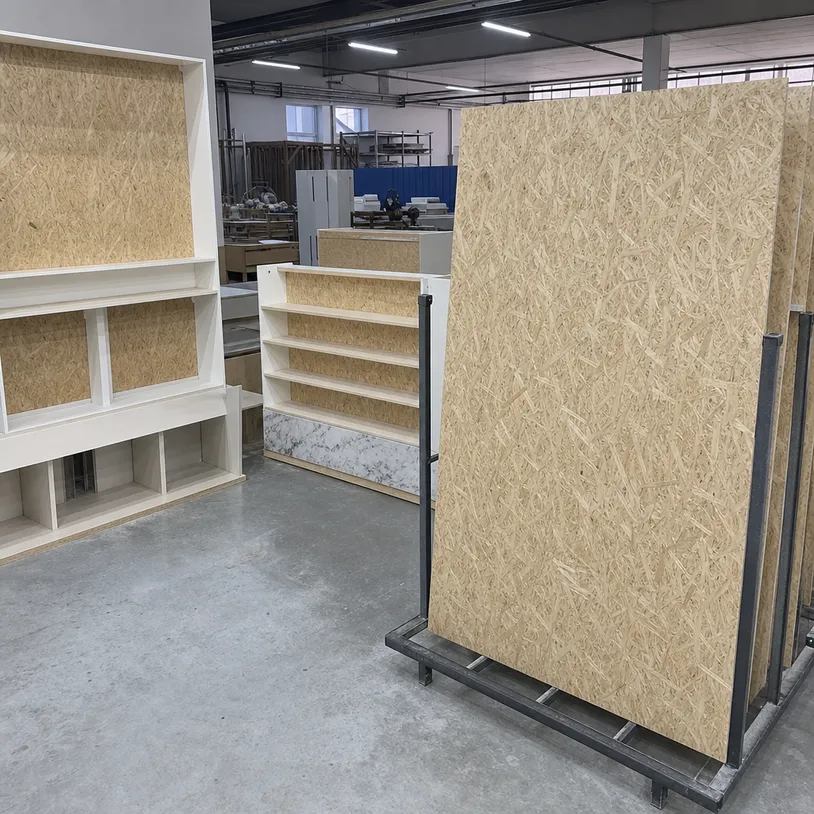
Better Margin · Appearance-DrivenThinner OSB panels (9–12mm) are used in furniture backs, display fixtures, and retail shelving where the visible strand texture is a design feature rather than a defect. This is a smaller segment but carries better margin than commodity sheathing — buyers in this space are paying for consistent surface appearance and controlled strand pattern, not just structural performance.
Surface consistency requirements for this application are available on inquiry.
Typical thickness range for this segment: 9–12mm. Strand pattern consistency is the primary specification criterion.
Discuss Your Target Market and Volume Requirements
Different segments have different order profiles, tolerance requirements, and margin structures. Tell us which segment you're supplying and we'll match you to the right product grade and container configuration.
How We Make OSB: The Process Decisions That Affect Your Order
OSB manufacturing involves more process variables than most buyers realize, and the choices made at each stage show up in the panel's performance consistency — which is what determines your downstream return rate.
Strand Preparation
Where density and structural performance are set
Wood logs are debarked and sliced into strands of controlled length (typically 75–150mm) and thickness (0.6–0.8mm). Strand geometry matters: longer, thinner strands produce better bending strength because they carry load more efficiently along their length.
We dry strands to 2–4% moisture before blending — this is lower than the target moisture content of the finished panel because the resin and pressing process adds moisture back.
Why this matters for your order: Getting pre-press moisture wrong is one of the most common sources of thickness swelling problems in OSB. Panels that swell excessively in service almost always trace back to strands that were too wet going into the blender.
Resin Blending
MDI binder — waterproof bond, near-zero formaldehyde
Resin blending uses MDI (methylene diphenyl diisocyanate) binder for the core layers and PMDI for face layers in our standard production. MDI binder is the reason modern OSB has better moisture resistance than older urea-formaldehyde bonded panels — it forms a waterproof bond that doesn't hydrolyze under humidity cycling.
It's also why our panels meet CARB P2 formaldehyde emission limits without special treatment: MDI-bonded OSB has near-zero formaldehyde emissions by chemistry, not by post-production treatment.
Mat Forming and Pressing
Strand orientation and continuous press lines
Face layers are oriented parallel to the panel's long axis; core layers are oriented perpendicular. The orientation ratio — typically 75–80% of strands aligned in the target direction — determines the bending strength differential between parallel and perpendicular directions.
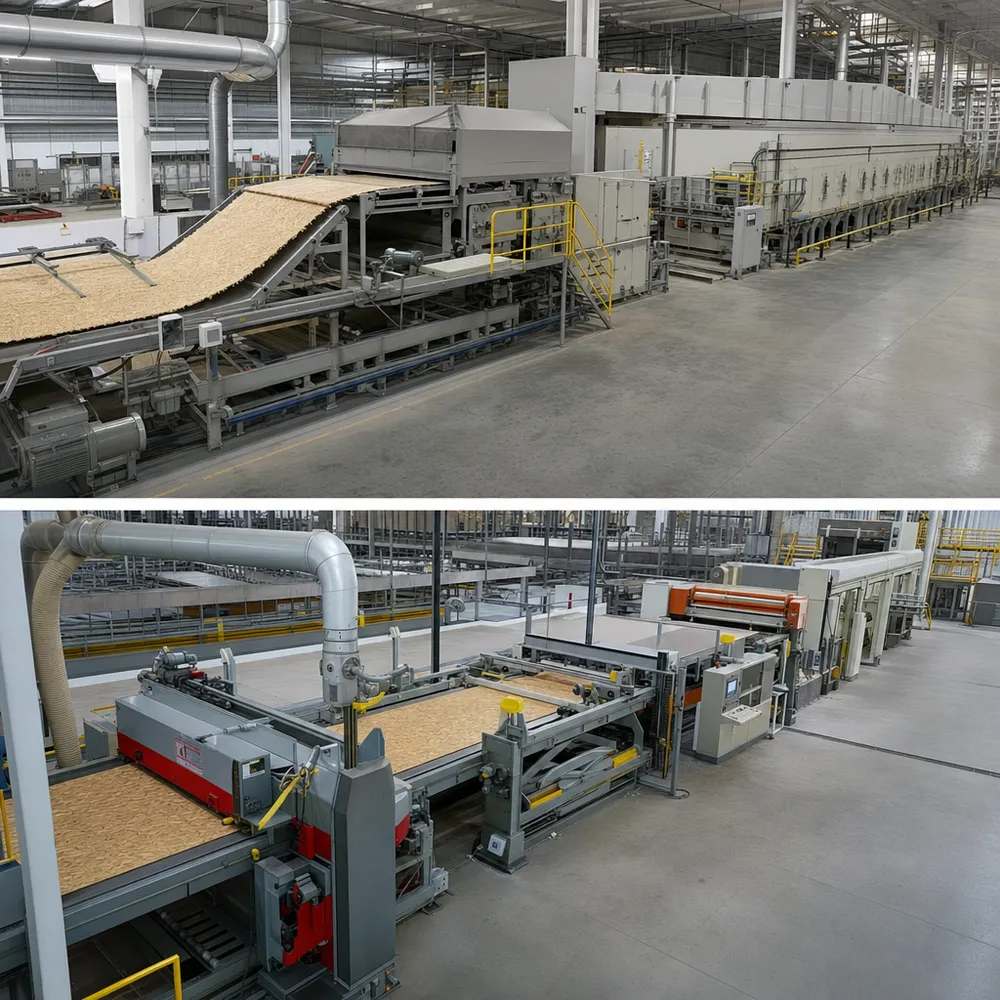
We run continuous press lines for OSB production, which gives more consistent density distribution across the panel than batch pressing. The press temperature and pressure profile is logged per production run, so if a structural performance question comes up on a specific batch, we can pull the production record.
Production records are logged per run. Structural performance queries on specific batches can be traced back to press temperature and pressure profiles.
Conditioning, Trimming and Sanding
Residual stress elimination and final tolerance
Post-press, panels go through a cooling and conditioning period before trimming and sanding. Skipping or shortening this step is a common shortcut that produces panels with residual internal stress — they'll be flat when they leave the factory and develop bow or twist during transit or storage.
We condition panels to ambient temperature before trimming. Sanded panels go through calibrated wide-belt sanding to ±0.3mm thickness tolerance.
Pre-Press Moisture Control
Strands dried to 2–4% before blending. Excess moisture at this stage is the primary cause of in-service thickness swelling — a defect that generates return claims and damages distributor relationships.
Continuous Press Lines
More consistent density distribution across the panel face than batch pressing. Every production run is logged — press temperature and pressure profiles are retrievable by batch if a structural performance question arises.
Full Conditioning Before Trim
Panels reach ambient temperature before trimming. Residual internal stress from rushed conditioning shows up as bow or twist in transit — not at the factory gate. We don't shortcut this step.
Certifications That Clear Your Import Documentation
The certification stack we hold covers the primary documentation requirements for OSB panels in our main export markets.
CE Marking
EN 300 · OSB/2, OSB/3, OSB/4Our OSB panels carry CE marking under EN 300, covering structural OSB grades OSB/2, OSB/3, and OSB/4. CE marking is a mandatory requirement for construction products sold into EU member states and is increasingly required in other markets that reference European standards. The Declaration of Performance (DoP) is included with EU-bound shipments as standard.
CARB P2
Formaldehyde Emissions · US MarketCalifornia Air Resources Board Phase 2 compliance covers formaldehyde emissions. MDI-bonded OSB panels inherently produce very low formaldehyde emissions, but CARB P2 certification requires documented testing and third-party verification, not just chemistry claims. Our CARB P2 documentation is available for US-bound shipments — this covers not just California but any US buyer whose downstream customers or retailers require CARB compliance.
FSC Chain of Custody
Certified Forest Sources · On Confirmed OrdersFSC certification means the wood fiber in our panels can be traced to certified forest sources. If your buyers have sustainability sourcing policies, or if you're supplying into retail channels that require FSC documentation, we can provide FSC-certified OSB on confirmed orders. Not every order needs FSC — if your market doesn't require it, there's no reason to pay the premium. But if it does, we have the chain-of-custody infrastructure in place.
ISO 9001:2015
Quality Management SystemOur quality management system is ISO 9001:2015 certified, covering the full production process from incoming material inspection through outgoing shipment. Audit reports are available on request.
Third-Party Pre-Shipment Inspection
Third-party pre-shipment inspection is available through SGS, Bureau Veritas, or your preferred agency. We coordinate access — buyers who require independent inspection before container loading can arrange it without friction.
Customization: What We Can and Can't Do
OSB is a cut-to-size product, not a molded one — custom dimensions are a scheduling and yield question, not a capital investment question. That means we can accommodate non-standard sizes on confirmed orders without tooling charges.
What We Can Customize
Panel Dimensions
Non-standard lengths and widths on confirmed orders. Common custom requests include 1250×2500mm for European markets and 1220×2440mm (4′×8′) for North American markets. Oversized panels up to approximately 1250×3050mm are possible depending on press configuration.
Thickness
We produce in the 9–22mm range as standard. Thicknesses outside this range require discussion — below 9mm, OSB strand geometry makes consistent production difficult; above 22mm, we can discuss on inquiry.
Surface Finish
Sanded (one or two sides) or unsanded. Sanded panels are specified for applications where thickness tolerance matters — prefab assembly, furniture, display. Unsanded is standard for construction sheathing where surface appearance is irrelevant.
Formaldehyde Emission Grade
E1 standard; CARB P2 on confirmed orders. E0 is available on inquiry for markets with stricter emission requirements.
Certification Documentation
CE, CARB P2, FSC as required by your market. Specify at order placement — documentation requirements affect production scheduling and material sourcing.
What We Can't Do
Tongue-and-Groove Edge Profiles
That's our OSB Flooring product.
Custom Strand Patterns or Decorative Surface Treatments
OSB strand appearance is a function of the manufacturing process, not a controllable design variable.
Structural Grades Above OSB/4
If your application requires performance beyond OSB/4 (EN 300), structural plywood is likely the right product. See our Structural Plywood page.
MOQ & Lead Time
Container quantities (20HQ or 40HQ) are the standard order unit for export. We can discuss smaller trial orders for new buyers.
Ready to confirm your specification?
Tell us your dimensions, grade, certification requirements, and destination market — we'll come back with a concrete quote.
Container Loading and Export Logistics
OSB panels are dense and heavy — container loading efficiency directly affects your landed cost per panel. Here's what to understand before you finalize your order specification.
40HQ Container Capacity
Standard 1220×2440mm panels
Thinner panels (12mm) load proportionally more sheets but similar cubic volume. We provide a loading plan with each shipment so your receiving team knows the exact count and configuration.
Ocean Transit Packaging
Protection and identification standards
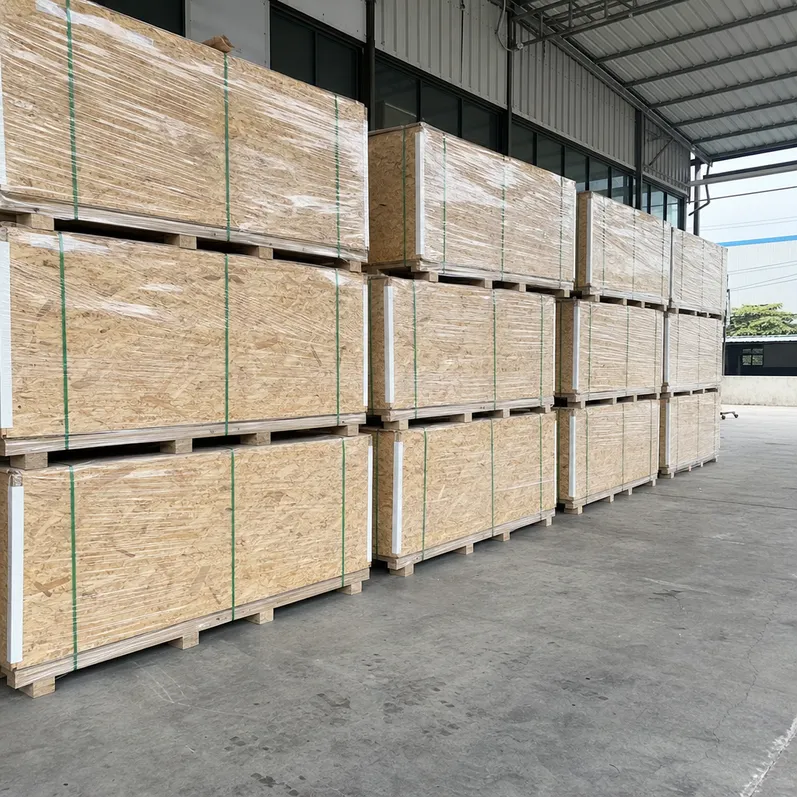
- Steel banding with corner protection and moisture-resistant film wrap
- Each bundle marked with product specification, thickness, grade, batch number, and destination port
- Private label, retailer barcodes, and market-specific marking available on confirmed orders

Port Connections from Xuzhou
Xuzhou connects to Qingdao, Shanghai, and Lianyungang ports.
Export Documentation Package
We prepare the full documentation package to the standard required for your destination market. We've cleared enough containers into North America, Europe, the Middle East, and Australia to know what each market's customs process requires.
- Commercial invoice
- Packing list
- Bill of lading
- Certificate of origin
- Phytosanitary certificate
- Where required by destination country
- CE Declaration of Performance
- EU shipments
- CARB P2 documentation
- US shipments
- FSC chain-of-custody records
- Where applicable
OSB Panels vs. Sibling Products: Choosing the Right Format
We produce several OSB and particle board formats under the same category. Here's how to navigate them so you order the right product for your application.
| Product | Best For | Key Difference from OSB Panels |
|---|---|---|
|
OSB Panels This page
|
Structural sheathing, wall/roof/floor, industrial packaging |
Square-edge, standard structural format |
|
Subfloor and floor decking with T&G edge |
Tongue-and-groove edge profile for tight-fitting floor installation |
|
|
General OSB board applications, broader format overview |
Category-level overview; links to specific OSB products |
|
|
Furniture substrate, interior shelving, non-structural applications |
Random particle orientation; lower structural performance, better surface for lamination |
When OSB Panels Are the Right Choice
If your application requires structural performance — wall sheathing, roof decking, subfloor — OSB panels are the right product. The oriented strand construction delivers the load-bearing and racking resistance these applications demand.
OSB's strand texture telegraphs through thin laminates, so if you need a smooth, consistent surface for lamination or furniture facing, particle board is the better substrate.
Not Sure Which Format Fits Your Project?
Send us the application details and we'll recommend the right product. We work across structural, furniture, and industrial packaging applications and can match the format to your end-use requirements.
View All Particle Board & OSB ProductsOSB Panels — Frequently Asked Questions
Answers to the questions we hear most often from builders, contractors, and procurement teams.
OSB — Oriented Strand Board — is an engineered wood panel made by compressing and bonding wood strands with resin under heat and pressure. The strands are deliberately oriented: outer layers run parallel to the panel's length for bending strength, while inner layers are cross-oriented for dimensional stability. This controlled orientation is what gives OSB its structural performance and distinguishes it from particle board, where particles are randomly distributed.
Standard OSB panels are produced in 1220 × 2440 mm (4 × 8 ft) sheets, with larger formats available on request. Common thicknesses range from 9 mm through to 22 mm, with 11 mm, 15 mm, and 18 mm being the most frequently specified for structural sheathing and subfloor applications.
Thickness selection depends on span, load, and application — wall sheathing typically uses thinner panels, while floor decking and industrial packaging often calls for 18 mm or 22 mm. Contact us with your span tables or load requirements and we can confirm the right specification.
OSB panels are manufactured with moisture-resistant resin binders and are suitable for use in humid or temporarily exposed conditions — roof sheathing and wall sheathing are typical examples where the panel may be exposed to weather during construction before cladding or roofing is applied.
OSB is not intended for permanent exterior exposure or prolonged immersion. For applications with sustained moisture contact, specify a panel with an appropriate durability class and ensure adequate ventilation and drainage in the assembly. If you're unsure whether standard OSB meets your exposure requirements, share the application details and we'll advise.
For most structural sheathing applications — wall, roof, and floor — OSB and plywood are interchangeable under current building codes and perform comparably in load-bearing and racking tests. OSB is typically more cost-effective and offers more consistent panel-to-panel uniformity because it doesn't carry the knot, void, or delamination risks associated with veneer-based products.
Plywood has an edge in applications requiring repeated fastening and removal, or where edge swelling from moisture is a concern. For standard new-build sheathing, OSB is the dominant choice in most markets due to its price-to-performance ratio.
Yes. OSB's uniform density and consistent structural properties make it well-suited to industrial packaging applications including pallet decking, crate bases, and heavy-duty transit packaging. The panel holds fasteners reliably and resists splitting under load, which matters in high-cycle pallet and packaging environments.
For packaging applications, 15 mm and 18 mm panels are most commonly specified. If you're sourcing for a specific load rating or ISPM 15 compliance requirement, contact us with the details and we'll confirm the right product and documentation.
We supply OSB panels in full packs and part-packs, from single-project quantities through to full container and bulk orders for merchants, contractors, and industrial buyers. Standard full-sheet supply is available ex-stock for common thicknesses.
Cut-to-size availability depends on specification and volume — contact us with your dimensions and quantities and we'll confirm lead time and pricing. For large or repeat orders, we can discuss scheduled supply arrangements to support your project programme.
Frequently Asked Questions
Common specification and sourcing questions from importers and distributors. If your question isn't covered here, send us the application details and we'll respond with a direct answer.
These are structural performance grades defined in EN 300. OSB/2 is for load-bearing use in dry conditions — interior applications where the panel won't see humidity cycling. OSB/3 is load-bearing in humid conditions, which covers most construction sheathing applications including exterior wall sheathing under cladding, roof decking under roofing membrane, and subfloor in areas with potential moisture exposure. OSB/4 is heavy-duty load-bearing in humid conditions — used in applications with higher structural demands, such as industrial flooring or heavily loaded wall systems.
For most residential and light commercial construction sheathing, OSB/3 is the correct specification. If you're unsure which grade your project or market requires, specify the application and we'll confirm the right grade.
MDI-bonded OSB panels produce very low formaldehyde emissions by chemistry — MDI resin doesn't release formaldehyde as a byproduct the way urea-formaldehyde resins do. Our OSB panels are produced with MDI/PMDI binder and are CARB P2 compliant on confirmed orders with documentation.
If your buyers or downstream retailers require CARB P2 certification documentation (not just compliance), specify this at order placement so we include the testing records and third-party verification in your shipment documentation.
For residential construction in North American and European markets:
These are general guidelines — your local building code or project specification will define the exact requirement. If you're supplying into a specific market and need to confirm the standard specification, send us the market and application details.
OSB/3 is rated for humid conditions, but it is not a weathering surface — it needs to be protected from direct weather exposure. In wall sheathing applications, OSB is installed behind cladding or weather-resistant barrier (WRB) membrane, not exposed to rain. In roof applications, it's covered by roofing membrane or tiles.
Prolonged direct exposure to rain will cause surface degradation and thickness swelling even in OSB/3 grade panels.
If your application involves direct weather exposure, film-faced plywood or pressure-treated structural panels are the appropriate product.
For standard dimensions and grades, we can supply from short-run production. New buyers typically start with a single container trial order — we can accommodate that without requiring a long-term volume commitment upfront.
Get a Quote for OSB Panels
Send us your specification and we'll come back with a detailed quote, the relevant certification documentation list, and a loading plan for your container configuration.
What to include in your RFQ
- Thickness and dimensions (standard or custom)
- Grade: OSB/2, OSB/3, or OSB/4
- Surface finish: sanded or unsanded
- Certification requirements: CE, CARB P2, FSC
- Target volume and destination market
New to sourcing OSB from China? Tell us your target market and the application your buyers are using the panels for — we'll recommend the specification that fits your market's building code requirements and send back a quote with the documentation package your import process needs.
Xuzhou QD Wood Industry Co., Ltd.
Sanbao Industrial Park, Tongshan District, Xuzhou, Jiangsu Province, 221116, China
Related Products in This Category
Other structural panel formats from the same product range.
EN 300 compliant OSB for structural sheathing, wall, roof, and floor applications. MDI-bonded, CE marked.
View productTongue-and-groove OSB flooring panels for subfloor and platform applications. Available in P5 and P7 load-bearing grades.
View productStandard and moisture-resistant particle board for furniture manufacturing, shelving, and interior fit-out. E1 and E0 emission grades available.
View productView the full range: Particle Board & OSB Manufacturer
About QDPlywood