

Melamine Cabinet Board — Factory-Direct Supply
Engineered for carcass construction — denser core, cleaner fastener retention, CARB P2 certified. Built specifically for cabinet side panels, shelves, and base units where the board carries load and holds cam locks through thousands of assembly cycles.
Manufactured at our 18,000 m² facility in Xuzhou since 2008.
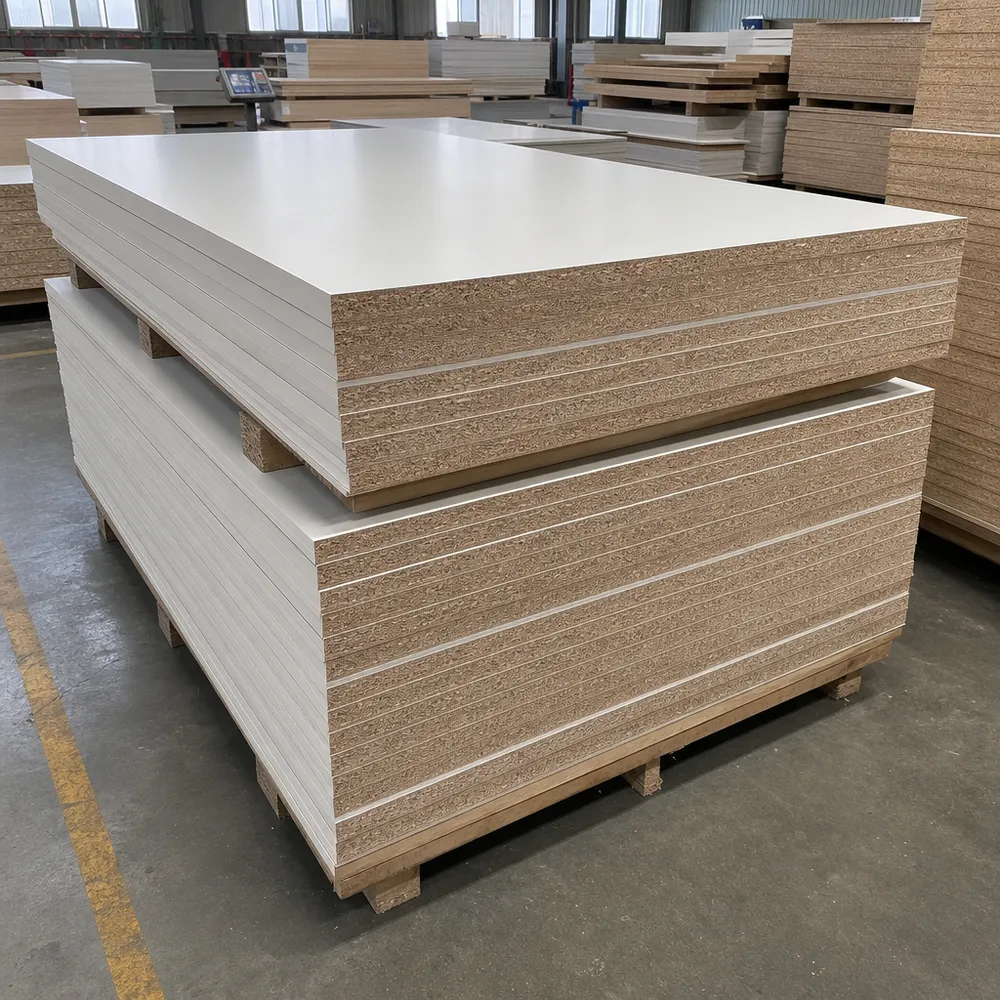
What Separates Cabinet-Grade Melamine Board from Standard Melamine Plywood
Most melamine plywood is built for furniture — shelving, flat-pack carcasses, decorative panels where the surface is the main specification. Melamine cabinet board is a different construction.
The core is denser, the ply count is higher for the given thickness, and the veneer grading is tighter because cabinet carcass applications put specific mechanical demands on the panel that standard furniture-grade melamine doesn't need to meet.
The Commercial Distinction That Matters
Cabinet manufacturers running cam lock and dowel assembly systems put the fastener directly into the panel edge and face. If the core has voids or low-density zones, the fastener pulls out under load — and that failure shows up as a warranty claim on your buyer's assembled cabinet, not as a defect you can catch at incoming inspection. The failure mode is invisible in the panel and only appears after assembly and loading.
We run our melamine cabinet board on a denser core layup than our standard melamine board. Incoming core veneers are graded to a tighter void specification — we reject core veneers with open defects above 3mm diameter for cabinet-grade production, versus a more permissive standard for furniture-grade panels. The result is a panel that holds cam locks and dowels cleanly at the edge and face, and that doesn't crumble at cut lines when your buyer's panel saw runs through it.
Why We Tightened the Core Grading Standard
We switched to this tighter core grading standard after seeing edge crumbling complaints from a cabinet manufacturer in Southeast Asia — the panels looked fine on delivery but failed at the cut edge in their automated panel processing line. The fix was in the core grading, not the surface specification.
The melamine surface on cabinet board is pressed at the same parameters as our standard melamine range — 100–120 g/m² paper weight with higher resin saturation for surface hardness. Cabinet interiors take more contact than furniture panels: dishes, pots, cleaning products. The heavier overlay is the right specification for that use environment, and it's a spec your buyers can verify by comparing surface hardness and scratch resistance against lighter-weight alternatives.
View All Melamine Plywood Products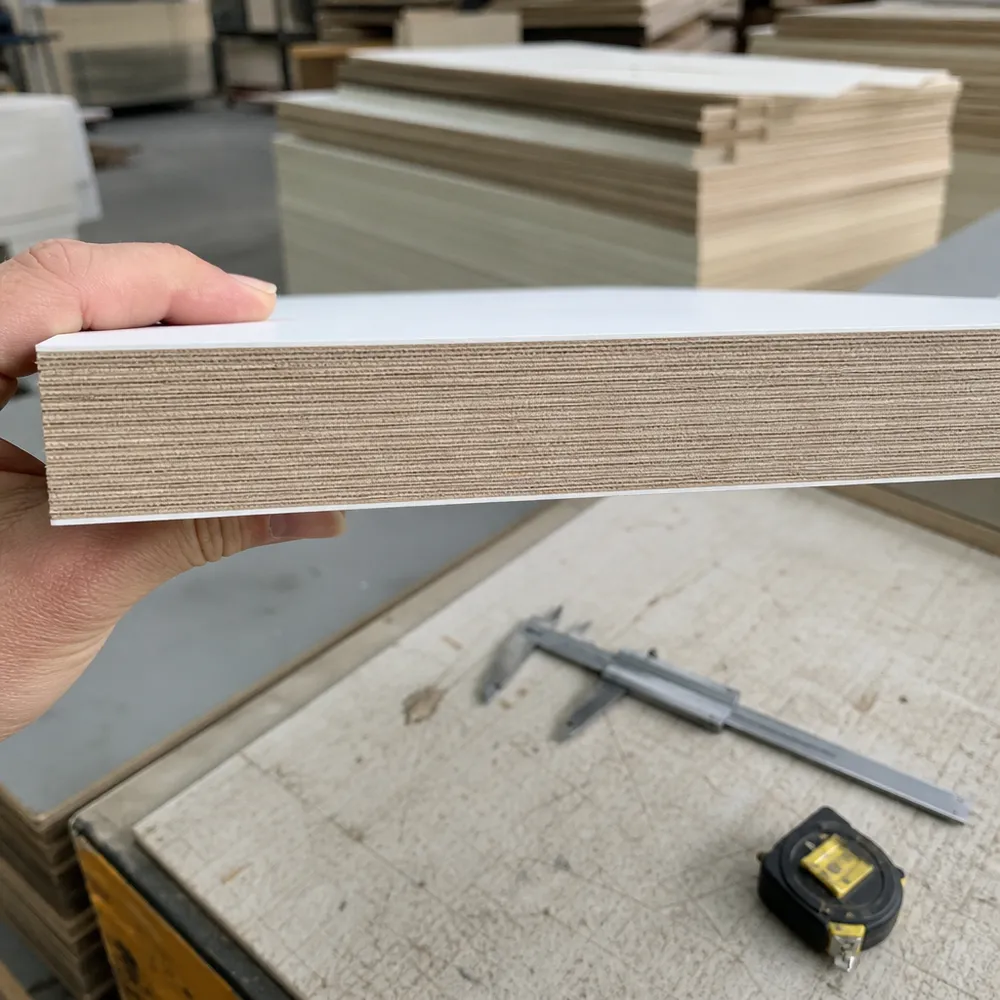
Cabinet-Grade vs. Standard Melamine: Key Differences
Fastener Retention
Dense-layup core holds cam locks and dowels cleanly at edge and face. No pull-out under load — the failure mode that only appears after assembly and loading in the field.
Clean Cut-Edge Performance
Tighter core void specification (≤3mm) prevents edge crumbling in automated panel processing lines — a failure mode that looks fine at incoming inspection but shows up in production.
Heavy-Duty Surface Overlay
100–120 g/m² melamine paper with higher resin saturation. Cabinet interiors face dishes, pots, and cleaning products — the heavier overlay is the right spec for that contact environment.
Technical Specifications
Standard values for melamine cabinet board. Actual specifications may vary by order. Contact us for detailed product data sheets and custom specification options.
Melamine Cabinet Board — Standard Specification
Thickness Selection Guide
Cabinet backs, drawer bottoms, light shelving
Adequate stiffness for non-structural panels. Reduces weight and material cost where load is not a factor. Common in back panels and drawer floors.
Carcass sides, shelves, doors — primary cabinet thickness
Industry standard for cabinet carcass construction. Balances stiffness, fastener retention, and weight. The default specification for most kitchen and wardrobe programs.
Countertop substrates, heavy-load shelving, worktops
Specified where deflection under sustained load is a concern. Used for countertop underlayment, heavy-duty shelving, and structural base panels in commercial cabinetry.
Formaldehyde Compliance — Export Standard
Standard production targets CARB Phase 2 (≤0.05 ppm for hardwood plywood), which satisfies US, Canadian, and most EU import requirements. E1 certification (≤0.1 mg/m³ per EN 717-1) is available on confirmed orders for EU-specific documentation requirements.
Third-party test reports available on request. Specify compliance requirement at order stage.
Dimensional Tolerances for CNC Processing
Thickness tolerance of ±0.2mm is achieved through calibrated wide-belt sanding after pressing. This is the tolerance that matters for CNC nesting — panels outside this range cause step-downs in edge-banding and misalignment in cam-lock assembly.
Thickness
±0.2mm
Length / Width
±1.5mm
Squareness
≤1.5mm/m
Bow / Warp
≤1.5mm/m
Applications
Melamine cabinet board is specified wherever a clean, durable interior surface is needed with the structural performance to hold fasteners under load. These are the primary end-use categories.
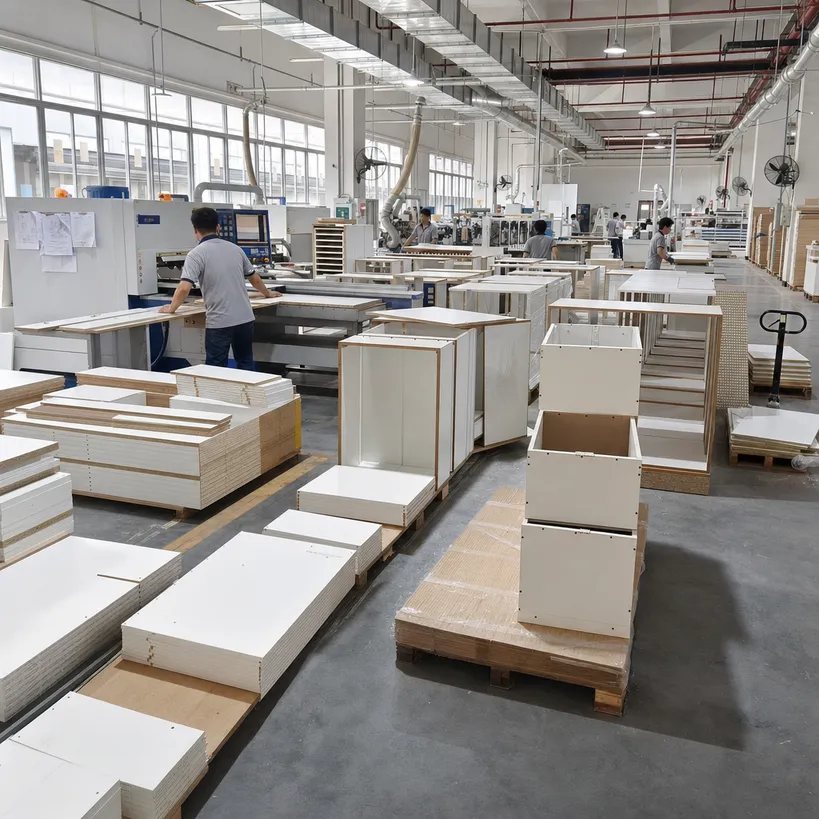
Kitchen Cabinetry
The primary application. Carcass sides, shelves, and base panels in kitchen cabinets require a surface that resists moisture, cleaning products, and food contact — and a core that holds cam locks and dowels under repeated loading.
- Base and wall cabinet carcasses
- Interior shelving and dividers
- Drawer boxes and cabinet backs
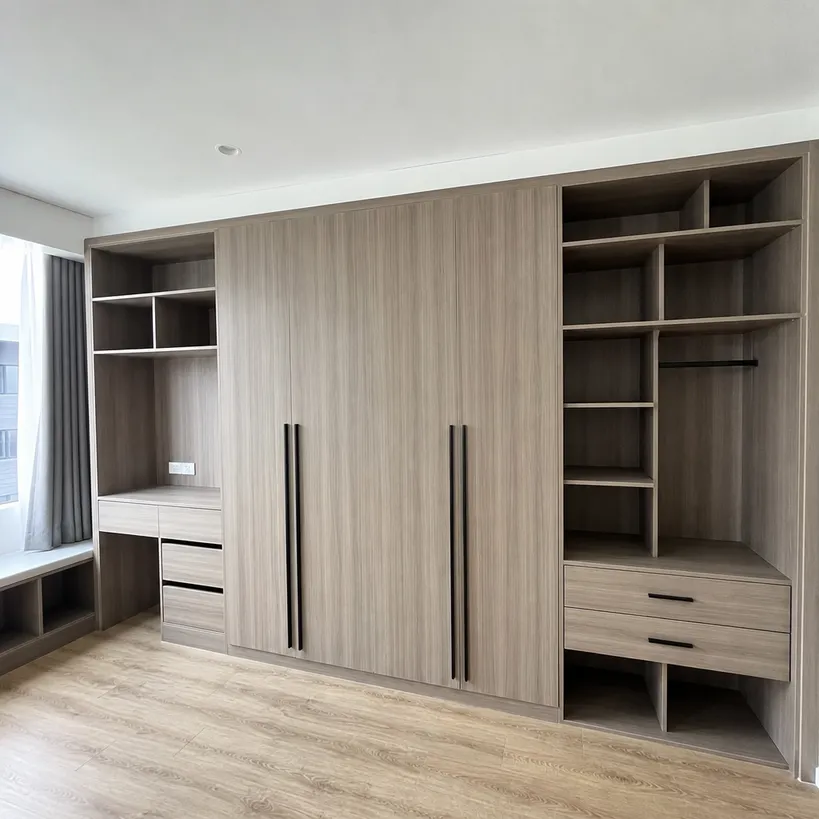
Wardrobe & Bedroom Furniture
Walk-in wardrobes and fitted bedroom furniture use melamine board for carcass construction where a consistent, cleanable interior finish is required across large panel runs. Wood-grain decors are common in this segment.
- Wardrobe carcass sides and tops
- Internal shelving and hanging rails
- Drawer fronts and panel doors
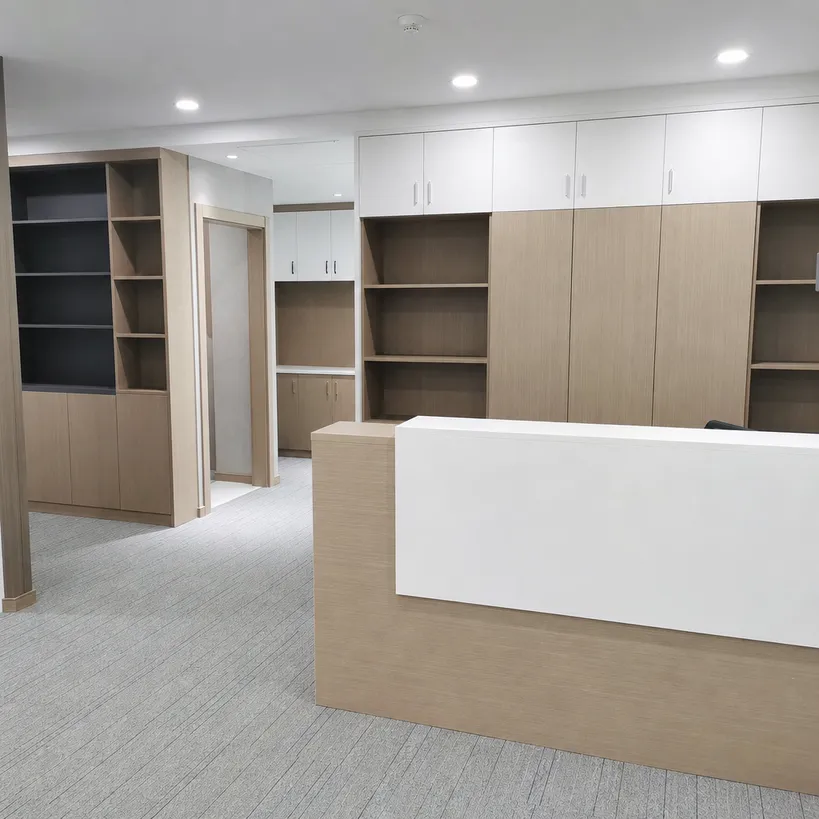
Office & Commercial Furniture
Office furniture programs — desks, storage units, reception counters — specify melamine board for its consistent surface quality and dimensional stability across high-volume production runs.
- Desk and workstation carcasses
- Filing and storage unit panels
- Reception and retail display counters
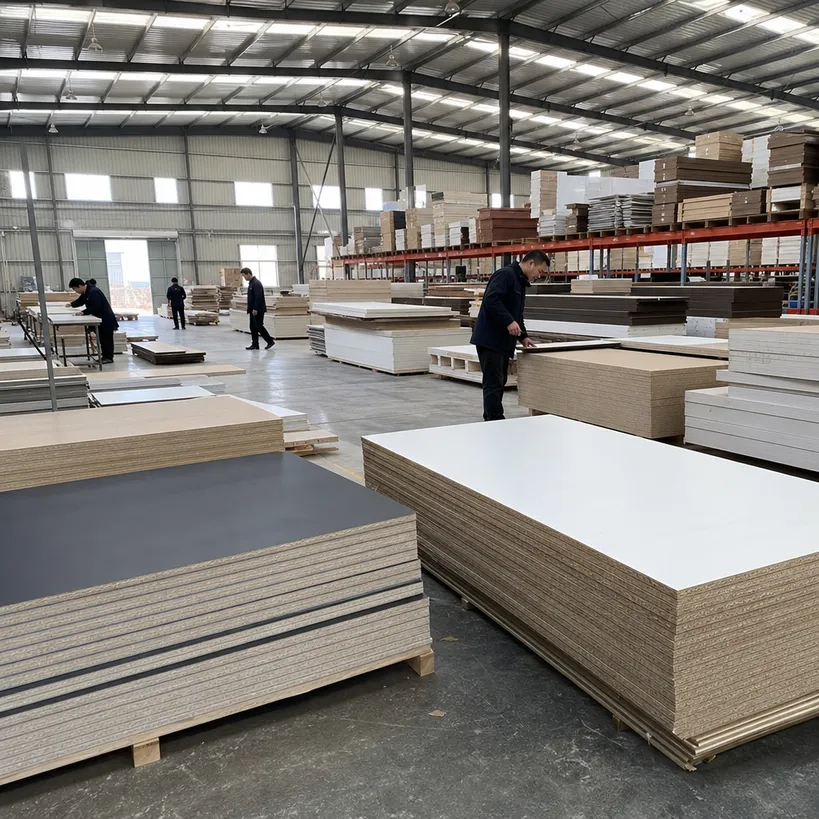
Retail & Display Fixtures
Shop-fitting and retail display programs use melamine board where a durable, cleanable surface is needed at scale. Solid-color and high-gloss options are common in this segment for brand-consistent finishes.
- Shelving and display unit carcasses
- Point-of-sale and counter units
- Gondola and wall-bay systems
Hospitality & Contract
Hotel room furniture, restaurant seating areas, and contract fit-outs specify melamine board for durability under high-use conditions. CARB P2 compliance is typically required for US hospitality projects.
- Hotel room case goods and wardrobes
- Restaurant and café millwork
- Healthcare and institutional cabinetry
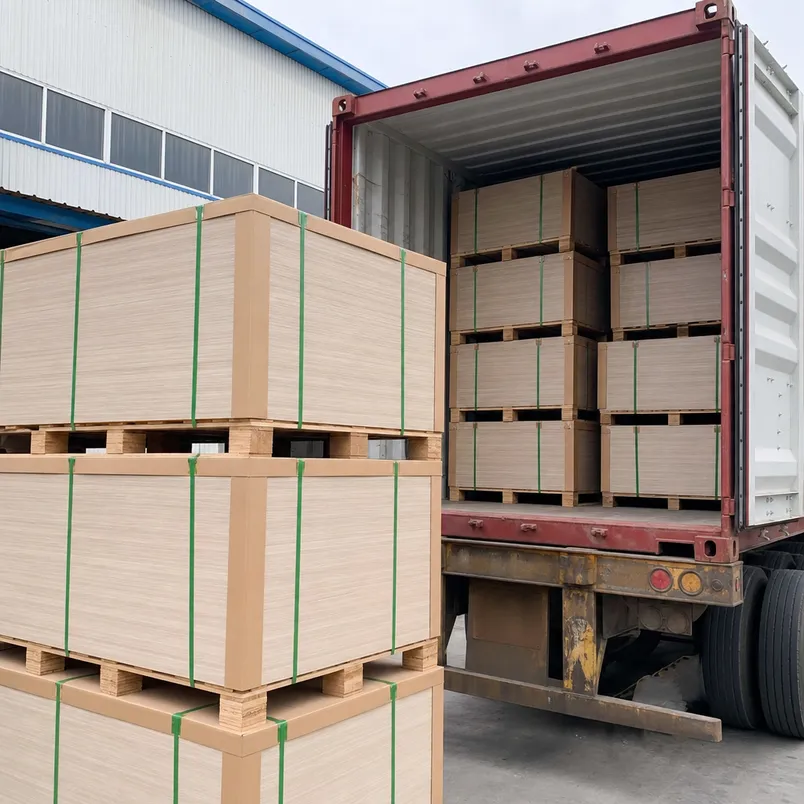
Flat-Pack & RTA Furniture
Ready-to-assemble furniture programs depend on consistent panel dimensions and reliable fastener retention across high-volume production. Tight thickness tolerance (±0.2mm) is the specification that makes automated assembly lines work.
- Flat-pack cabinet and shelving systems
- RTA furniture panel components
- High-volume OEM panel supply
Sourcing & Supply Considerations
What importers and furniture manufacturers need to know before placing a container order — specification, compliance, lead time, and what to verify before goods ship.
Specify Before You Order
Melamine board is not a commodity — the same nominal thickness from two suppliers can differ significantly in core void limit, overlay weight, and glue system. Specify core species, void limit, overlay g/m², glue type, and emission standard in writing before confirming. Verbal agreements on grade do not hold at inspection.
Pre-Shipment Inspection
Third-party pre-shipment inspection (PSI) is standard practice for container orders. Key inspection points: thickness measurement across the panel (not just center), surface defect count, edge condition after cross-cut, and formaldehyde test report date. Reports older than 6 months should be treated as unverified for the current production run.
Lead Times & Production Scheduling
Standard catalog decors: 25–35 days production lead time from order confirmation. Custom decors or non-standard sizes: 35–50 days. Container loading and port clearance adds 5–10 days. Plan for 60–70 days total from order to port of destination for standard orders — longer for first-time orders requiring sample approval.
Packaging & Container Loading
Panels are palletized with corner protection and stretch-wrapped. A standard 40' HQ container holds approximately 18–22 m³ of panel product depending on thickness mix. Panels should be stored flat on arrival — edge-stacking causes bow that is difficult to reverse once set.
Compliance Documentation
For US imports, request CARB P2 certification with the mill certificate number traceable to the California Air Resources Board database. For EU imports, EN 717-1 test reports and CE marking documentation should accompany the shipment. Keep originals — customs and end-customer audits both require them.
Order Specification Checklist
Confirm each item in writing before order confirmation to avoid disputes at inspection.
-
Core substrate MDF, PB, or plywood; density grade; void limit
-
Overlay weight Minimum g/m² for face and back paper
-
Thickness & tolerance Nominal thickness ±0.2mm or tighter for CNC lines
-
Panel dimensions 1220×2440mm or 1830×2440mm; squareness tolerance
-
Emission standard CARB P2, E1, E0, or F★★★★ — specify the market
-
Surface texture Smooth, fine-pore, or embossed; gloss level if applicable
-
Decor reference Supplier decor code + approved physical sample on file
-
Packaging & labeling Pallet configuration, bundle size, carton marking requirements
Typical MOQ & Volume Guidance
| Order Type | Typical MOQ | Notes |
|---|---|---|
| Catalog decor, std size | 1 container (~18 m³) | Mix of decors allowed within container |
| Custom decor | 300–500 sheets per decor | Paper tooling cost applies; sample approval required |
| Non-standard size | 200+ sheets per size | Press cycle efficiency affects minimum run |
| High-gloss finish | 500+ sheets per color | Dedicated press setup; longer lead time |
| Sample order | 5–10 sheets per decor | For approval only; not for production use |
Frequently Asked Questions
Common questions from importers, furniture manufacturers, and procurement teams sourcing melamine cabinet board for the first time or switching suppliers.
Q What is the difference between melamine board and MDF?
MDF is the core substrate — a dense, smooth panel made from wood fiber and resin. Melamine board is MDF (or particleboard, or plywood) with a melamine-impregnated paper overlay pressed onto the surface. The overlay provides the decorative finish and surface hardness. You can buy raw MDF and apply your own finish, or buy melamine board with the finish already applied at the mill.
Q Is CARB P2 certification required for all US imports?
CARB Phase 2 (ATCM) applies to composite wood products sold or used in California, but the Formaldehyde Standards for Composite Wood Products Act extended equivalent requirements to all US states. In practice, any panel product entering the US market should be CARB P2 compliant. Importers are responsible for ensuring compliance — not just the manufacturer. Request the CARB TPC (Third Party Certifier) certificate number and verify it in the CARB database before shipment.
Q What thickness should I specify for cabinet carcasses?
16mm is the standard for most residential cabinet carcasses — it balances weight, fastener retention, and material cost. 18mm is used where additional rigidity is needed, such as tall pantry units or heavy-load shelving. 12mm is common for back panels and drawer bottoms. For commercial or contract work, 18mm is often the baseline specification. Always confirm the actual finished thickness, not just the nominal — a 16mm panel with ±0.5mm tolerance can cause fit issues on CNC-cut components.
Q Can melamine board be used in wet areas like bathrooms?
Standard melamine board is not suitable for direct water exposure. The melamine surface itself is moisture-resistant, but the MDF or particleboard core will swell if edges are exposed to standing water or high humidity over time. For wet-area applications, specify moisture-resistant (MR) core board — identifiable by a green-tinted core — and ensure all edges are sealed with PVC or ABS edgebanding. Even MR-core panels should not be used in direct-contact wet zones like shower enclosures.
Q How do I verify the overlay weight of panels I receive?
Overlay weight (g/m²) is not easily verified in the field without lab equipment. The practical approach is to request the mill's production record for your specific order batch, which should state the paper weight used. During PSI, an inspector can check surface hardness and abrasion resistance as a proxy — a thin overlay will show wear quickly under a standardized scratch test. For high-volume programs, periodic third-party lab testing of incoming panels is worth the cost.
Q What causes color variation between orders and how do I manage it?
Decor paper is printed in batches, and color can shift slightly between paper production runs. The melamine pressing process also introduces minor variation depending on press temperature and cycle time. To manage this: always keep a physical approved sample from your first order; request the paper batch number on the mill certificate; and for color-critical projects, request a pre-production sample from the same paper batch before full production runs. Mixing panels from different production batches in the same visible installation is the most common source of color complaints.
Q What is the difference between E1, E0, and CARB P2 emission standards?
These are formaldehyde emission limits from different regulatory frameworks. E1 (European EN 717-1) allows up to 0.1 ppm formaldehyde; E0 is a stricter voluntary standard at ≤0.05 ppm. CARB P2 (California) limits are roughly equivalent to E1 for MDF and particleboard. F★★★★ (Japan JIS) is the strictest at ≤0.02 ppm. For US market entry, CARB P2 is the baseline. For EU, E1 is the minimum; E0 is increasingly specified for residential and children's furniture. These standards are not directly interchangeable — a CARB P2 certificate does not automatically satisfy EU CE marking requirements.
Q How should melamine panels be stored after delivery?
Store panels flat on a level surface, fully supported across the full panel length — not just at the ends. Keep them in a climate-controlled environment between 15–25°C and 45–65% relative humidity. Avoid storing near exterior walls, loading docks, or HVAC vents where temperature and humidity fluctuate. Panels stored on edge or in high-humidity environments will bow, and once set, the bow is difficult to reverse. Acclimate panels to the production environment for 48 hours before cutting if they have been in transit or cold storage.
Ready to Source Melamine Cabinet Board?
Send us your specification — thickness, core type, decor, emission standard, and target volume — and we'll come back with pricing, lead time, and a sample offer within one business day.
- CARB P2, E1, E0, and F★★★★ certified supply available
- Container and LCL options for all order sizes
- Physical samples dispatched within 5 business days
- Pre-shipment inspection coordinated on request
Quick Specification Request
Fill in what you know — we'll follow up on the rest.
Core Construction: The Variable Your Incoming Inspection Won't Catch
The core construction of cabinet melamine plywood is where the commercial risk lives — and it's the variable that's hardest to evaluate from a surface inspection or even a standard incoming quality check.
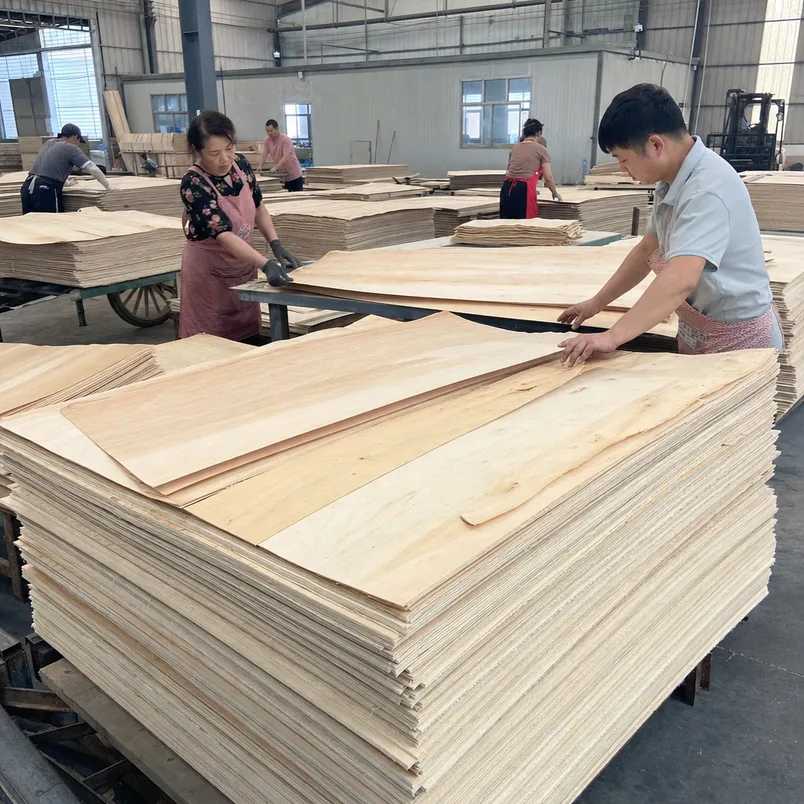
Cabinet-grade core grading produces more reject material per cubic meter of output than furniture-grade grading — a yield cost absorbed to ensure void-free core performance under cam lock fastener loads.
Veneer Sorting and Cabinet-Grade Grading Pass
Incoming veneers are sorted by species and moisture content before reaching the layup station. For cabinet-grade production, a separate grading pass checks each veneer sheet for open knots, splits, and voids. Veneers that pass the furniture-grade standard but fail the cabinet-grade void limit are redirected to standard melamine board production.
Multi-Daylight Hydraulic Hot Press — Core Bond QC
After layup, panels go through a multi-daylight hydraulic hot press. Press temperature, pressure, and cycle time are logged per batch. The critical variable for cabinet board is not just the melamine surface bond — it's the inter-veneer bond strength throughout the core. A panel with a well-bonded surface but weak core bonds will delaminate under the lateral load that cam lock fasteners apply. We run a shear test on core bond strength as part of in-process QC for cabinet-grade production, not just a surface peel test.
Calibrated Wide-Belt Sanding: ±0.2mm Thickness Tolerance
Post-press, panels go through calibrated wide-belt sanding to ±0.2mm thickness tolerance. For cabinet manufacturers running automated panel saws and CNC routers, this tolerance determines whether panels feed cleanly through their equipment. Thickness variation above ±0.3mm causes feed errors in most automated cutting systems — a production stoppage problem for your buyer, not just a quality complaint.
MR Glue System — Standard for Cabinet Carcass
The MR glue system (melamine-urea-formaldehyde) is standard on our melamine cabinet board. Kitchen and bathroom cabinet environments involve sustained humidity cycling — around sinks, dishwashers, and under-bench areas. Standard UF glue maintains bond integrity in dry interior conditions but degrades under repeated moisture exposure. MR glue maintains bond integrity through humidity cycling, which is the right specification for cabinet carcass applications regardless of whether the end use is kitchen, bathroom, or general storage.
Why We Recommend MR as the Cabinet Board Standard
Buyers sometimes ask whether they can save cost by specifying UF glue for non-kitchen cabinet applications. Technically yes — but we recommend MR as the standard for cabinet board because the cost difference is small and the risk reduction is significant if any of those cabinets end up in a humid environment.
- Degrades under repeated moisture exposure
- Risk of delamination in humid environments
- Suitable for dry interior conditions only
- Maintains bond integrity through humidity cycling
- Correct spec for kitchen, bathroom, and general storage
- Small cost premium, significant risk reduction
Market Segments That Drive Repeat Cabinet Board Orders
Cabinet melamine plywood generates repeatable order patterns in specific segments. These are the markets where our existing buyers have built stable reorder programs.
Kitchen Cabinet Manufacturers
Primary Volume SegmentA kitchen cabinet manufacturer running 50–100 kitchens per month consumes 18mm melamine cabinet board in consistent volume — side panels, base units, upper carcasses, and pantry units all use the same specification. The reorder pattern is predictable, the specification is stable, and the volume per customer is meaningful.
MR glue is non-negotiable for this segment. Any cabinet manufacturer who has had a warranty claim from a kitchen installation will specify MR as a minimum. This is the SKU that drives your panel business with that customer.
Wardrobe & Storage System Manufacturers
Higher Volume Per CustomerThese manufacturers typically run higher volumes than kitchen cabinet shops — a wardrobe system manufacturer supplying to residential developers or retail furniture chains can consume several containers per month. Built-in wardrobe systems, walk-in closet components, and modular storage units all use the same carcass specification.
Batch-to-batch color consistency is the quality variable that matters most for this segment. We maintain decor records and can match color across orders on confirmed programs.
Commercial Fit-Out Joinery Suppliers
Large Project OrdersCommercial fit-out projects often require a range of thicknesses and decors within a single order — a hotel room fit-out might specify 18mm for wardrobe carcasses, 15mm for desk units, and 25mm for reception counters. Our product line covers the full thickness range, so a single order can cover multiple panel applications.
500–2,000 sheets per project is typical for a mid-size commercial fit-out. Commercial fit-out is project-based with variable order timing, but individual project orders are often large.
Panel Distributors Supplying Trade Customers
Growing SegmentJoiners, cabinet makers, and builders need a cabinet-grade melamine board they can stock with confidence. The key requirement for distributors is supply consistency: your trade customers will specify your brand of cabinet board into their production process, and a supply gap or specification change creates a production problem for them.
Our 6 production lines and 450,000 m³ annual capacity mean we can support distributor reorder programs without the supply gaps that come from a factory running at full utilization. This segment has grown significantly in the last three years — worth paying attention to if you're building a panel distribution business in North America or Europe.
Ready to discuss your cabinet board supply program?
Whether you're a kitchen cabinet manufacturer, wardrobe system supplier, commercial fit-out joinery supplier, or panel distributor, we can structure a supply program around your volume and specification requirements.
Related Melamine Plywood Products
Customization Options for Your Cabinet Supply Chain
Cabinet board customization is a scheduling and specification question, not a tooling investment. Here's what we can configure on confirmed orders.
Thickness
Standard & non-standard
Standard cabinet board runs at 15mm, 18mm, and 25mm. Non-standard thicknesses are available on confirmed orders.
European cabinet systems specifying a slightly thinner carcass panel
North American cabinet systems where ¾″ (19.05mm) is the standard dimension
Sheet Dimensions
Standard & custom cut
Standard 1220×2440mm covers most markets. 1220×2800mm is available for tall wardrobe panel applications where a single sheet covers the full height without a horizontal joint.
Custom dimensions are available on confirmed orders — plywood is cut-to-size, so custom dimensions are a yield and scheduling question, not a capital cost.
Decor and Color
Catalog & custom papers
Catalog decors (solid colors and standard wood grains) are available at standard MOQs. Custom decors require a minimum paper order from our supplier.
For private-label cabinet board ranges, start with catalog decors and move to custom papers once volume justifies the sourcing commitment.
Glue System
MR standard · WBP available
MR glue is standard. WBP (waterproof boil-proof) is available for applications with direct water contact or outdoor exposure.
Core Species
Poplar · Eucalyptus · Hardwood
Poplar core is standard. Core species affects panel weight and fastener performance — we can advise on the right specification for your application.
Higher density and screw-holding strength
Premium applications requiring maximum performance
OEM Branding
Private-label programs
Bundle marking, panel stamping, and documentation can be prepared under your brand for OEM programs. We run OEM programs for distributors in North America and Europe who supply cabinet board under their own brand to trade customers.
Lead Time from Specification Confirmation
Lead time from specification confirmation to first production sample is 15–20 working days for standard specifications. Custom decors requiring paper sourcing add 10–15 working days depending on paper supplier lead time.
Compliance and Certification for Your Import Market
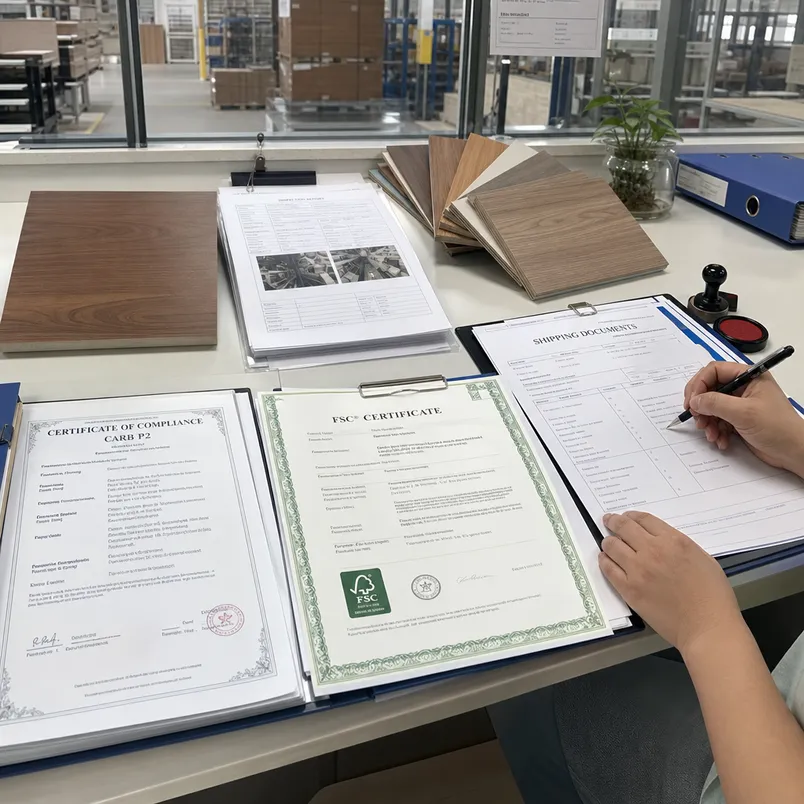
Audit reports and certification documents are available on request. We don't make buyers chase documentation — if you need a specific certificate for your import clearance or customer audit, tell us at the order stage and we'll include it in the shipment package.
| Certification | Market | What It Covers |
|---|---|---|
| CARB P2 | USA (California + broader US market) | Formaldehyde emission — required for California market access |
| FSC CoC | Global (sustainability-audited buyers) | Wood fiber traceability to certified forests |
| CE | European Union | Construction product compliance for EU market |
| ISO 9001:2015 | Global | Quality management system — process consistency and traceability |
CARB P2
USA — California Air Resources Board
CARB P2 is the most stringent formaldehyde emission standard in our export markets. We formulate to meet it as the baseline for export production — it's not a special option or an upcharge.
For US-bound shipments, the CARB documentation package is included as standard. If you're supplying into California or other CARB-regulated markets, the compliance documentation is ready without additional lead time.
FSC Chain of Custody
Global — sustainability-audited buyers
FSC chain-of-custody certification covers buyers with sustainability sourcing requirements or buyers supplying into markets where deforestation-linked supply chains are a regulatory or reputational risk.
For EU buyers subject to the EU Deforestation Regulation (EUDR), FSC documentation supports your due diligence requirements.
CE Declaration of Conformity
European Union
CE declaration of conformity is included for EU-bound shipments. For buyers supplying into construction and fit-out applications in the EU, CE marking is a procurement gate.
We prepare the declaration as standard for EU orders — no additional request required.
ISO 9001:2015
Global — quality management
ISO 9001:2015 covers quality management system — process consistency and traceability across production. Applicable to buyers globally who require documented QMS compliance from their supply chain.
Audit reports and certification documents available on request at the order stage.
Documentation Ready at Shipment
Audit reports and certification documents are available on request. We don't make buyers chase documentation — if you need a specific certificate for your import clearance or customer audit, tell us at the order stage and we'll include it in the shipment package.
CARB documentation package included standard for US-bound shipments
CE declaration prepared as standard for EU orders
FSC documentation supports EUDR due diligence requirements
Specific certificates included in shipment package on request at order stage
Packaging and Container Loading for Cabinet Board Shipments
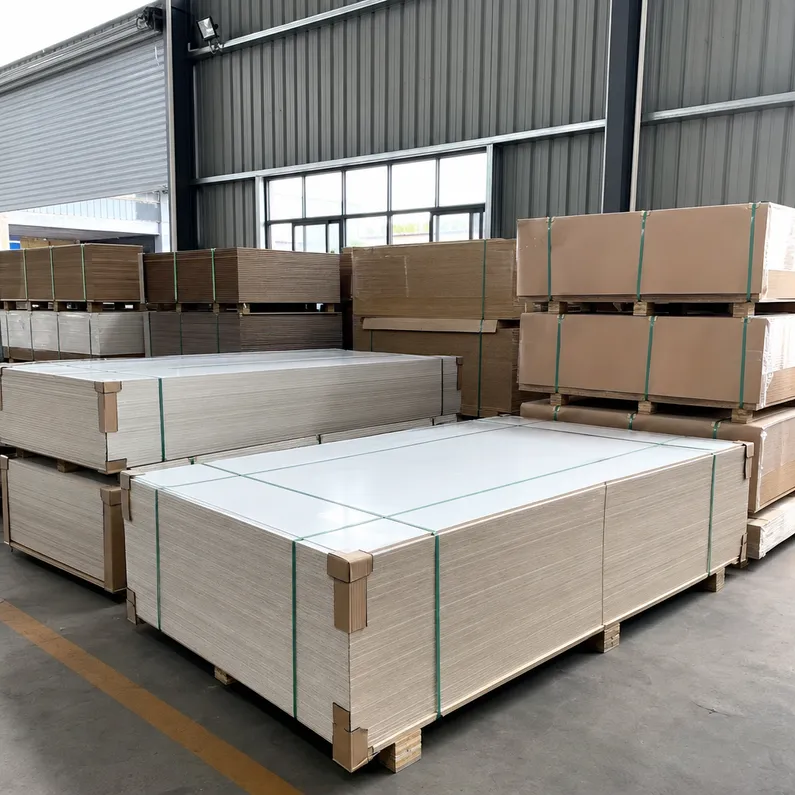
Standard 20HQ and 40HQ containers. Loading plans delivered before the container arrives. Packaging built around protecting the melamine surface — because surface damage is a landed cost problem, not just a quality complaint.
Container Capacity
Standard 1220×2440mm panels in 18mm thickness load to approximately 18–20 m³ per 40HQ container depending on stacking configuration. We provide a loading plan with each shipment — your receiving team knows the exact bundle count, stacking arrangement, and panel count before the container arrives.
Bundle Specification
Panels are bundled in packs of 50–100 sheets depending on thickness, strapped and edge-protected with corner boards. The top sheet of each bundle is protected with a moisture-resistant film wrap. The melamine surface is the finish — it arrives at your warehouse ready for resale or direct delivery to your customer's production line.
Custom Pallet Configuration
For buyers supplying directly to cabinet manufacturers, we can discuss pallet configuration and bundle sizing to match your customer's receiving and storage setup. A cabinet manufacturer running an automated panel processing line has specific requirements for how panels are bundled and labeled — we can accommodate those requirements on confirmed programs.
Export Documentation Package
We've been through enough customs clearance cycles in North America, Europe, and the Middle East to know what documentation gaps cause delays. The paperwork is prepared to avoid them.
- Commercial invoice & packing list
- Bill of lading
- Certificate of origin
- Phytosanitary certificate (where required)
- Certification package: CARB P2, FSC, CE as applicable
Surface Protection Is a Landed Cost Issue
The melamine surface is the finish — it arrives at your warehouse ready for resale or direct delivery to your customer's production line. Surface damage during transit is a landed cost problem, not just a quality complaint, so the packaging specification is built around protecting the surface. Moisture-resistant film wrap on the top sheet of every bundle, corner boards on every pack, and a loading plan that accounts for stacking load across the full container voyage.
Melamine Cabinet Board vs. Sibling Products: Choosing the Right Specification
The melamine plywood range covers five variants. Here's where melamine cabinet board sits relative to the others, and when to choose a different specification.
Standard melamine board uses a furniture-grade core construction with a more permissive void specification. It's the right choice for shelving, flat-pack furniture, and decorative panels where the panel doesn't carry fastener load.
Your buyers are building cabinet carcasses with cam lock assembly — cabinet board's denser core is the right specification.
Your buyers are building flat-pack furniture with surface-mounted hardware — standard melamine board is adequate and typically lower cost.
The 18mm melamine plywood page covers the standard 18mm thickness specification across the melamine range. Melamine cabinet board in 18mm is the same thickness but with the denser core construction and tighter void grading.
Your buyers specifically need cabinet-grade fastener performance — specify cabinet board.
Your buyers need 18mm melamine plywood for general furniture applications — the standard 18mm specification is the right choice.
Kitchen melamine plywood is optimized for moisture resistance — higher resin saturation in the melamine overlay and MR or WBP glue system as standard. Melamine cabinet board also uses MR glue as standard, so for kitchen cabinet carcass applications, either specification is appropriate.
For kitchen cabinet manufacturers, cabinet board in MR glue specification covers both core density and moisture resistance requirements in one specification.
Surface moisture resistance is the primary priority — kitchen melamine plywood prioritizes the overlay specification for high-humidity environments.
Glossy melamine plywood uses a high-polish surface for visible furniture and display applications. The core construction on glossy melamine is furniture-grade rather than cabinet-grade.
Fastener performance is required. For applications where both gloss surface and fastener performance are needed, contact us to discuss a custom specification.
Your buyers need a cabinet carcass with a high-gloss interior finish — display cabinets, retail fixtures, contemporary kitchen interiors.
Not sure which specification fits your buyer's application?
The right specification depends on the end application — carcass load, fastener type, surface finish requirement, and moisture exposure. Send us the application details and we'll confirm the correct specification before you quote your customer.
Frequently Asked Questions
Specification and sourcing questions we hear from cabinet manufacturers, importers, and distributors evaluating melamine cabinet board.
The core construction. Standard melamine plywood uses a furniture-grade core with a permissive void specification — adequate for shelving and flat-pack furniture where the panel doesn't carry fastener load. Melamine cabinet board uses a denser core layup with a tighter void limit (≤3mm diameter for core veneers), which is what gives it clean fastener retention for cam lock and dowel assembly systems. The surface specification is also heavier — 100–120 g/m² melamine paper versus 80 g/m² on standard furniture-grade panels. If your buyers are building cabinet carcasses with mechanical fasteners, cabinet board is the right specification.
18mm is the standard carcass thickness across European and North American kitchen cabinet systems. It provides adequate load-bearing capacity for shelf spans up to 900mm and holds cam locks and dowels cleanly in standard cabinet assembly. Some manufacturers use 15mm for upper cabinet carcasses where load is lower, and 25mm for base cabinets and pantry units where additional rigidity is specified. If you're supplying into a market with established cabinet system standards, 18mm in MR glue specification covers the majority of applications from a single SKU.
Yes. We produce melamine cabinet board to CARB P2 emission standards as the baseline for export production. CARB P2 is the most stringent formaldehyde emission limit in our export markets, and we formulate to meet it rather than treating it as a special option. For US-bound shipments, the CARB documentation package is included as standard — you don't need to request it separately.
Fastener pull-out in melamine cabinet board is almost always a core void problem. When a cam lock or dowel is installed into a zone with a core void, the fastener has no substrate to grip and pulls out under load. The failure is invisible in the panel before assembly. When evaluating a supplier, ask specifically about their core veneer grading standard — what is the maximum void size they accept in core veneers for cabinet-grade production? A supplier who can give you a specific number (we use ≤3mm diameter) is running a controlled grading process. A supplier who describes their core quality in general terms is not grading to a defined standard.
Ask your supplier: "What is your maximum core void diameter for cabinet-grade production?" A specific number indicates a controlled grading process.
MOQ depends on the specification. Standard catalog decors in 18mm are available at lower MOQs — typically from 200–300 sheets per decor for standard specifications. Custom dimensions, non-catalog decors, or custom core specifications require higher MOQs. Contact us with your target specification and volume — we'll confirm the MOQ and lead time for your specific requirements.
Yes, with the right glue system specification. Our standard melamine cabinet board uses MR (moisture-resistant) glue, which maintains bond integrity under the humidity cycling typical of bathroom environments. For applications with direct water contact — under-sink cabinets, wet area storage — we recommend specifying WBP (waterproof boil-proof) glue system. The melamine surface itself is moisture-resistant; the glue system is the variable that determines long-term performance in humid conditions.
Humidity cycling in bathroom environments. General bathroom cabinet carcasses.
Direct water contact. Under-sink cabinets, wet area storage applications.
Start Your Cabinet Board Sourcing
If you're evaluating melamine cabinet board for your supply chain, the fastest way to assess fit is a sample order. We can ship samples in your target thickness and decor within 7–10 working days — enough to run through your own quality check, test fastener retention in your assembly setup, and show your customers before committing to a full container.
If you already have a specification — thickness, decor, glue system, volume, destination market — send it directly to us and we'll come back with a detailed quote and the relevant certification documentation for your import requirements.
No. 88 Sanbao Industrial Park, Tongshan District,
Xuzhou, Jiangsu Province, 221116, China
Target thickness and decor. Enough to run your quality check, test fastener retention, and present to your customers before committing to a container.
Request a Quote or Sample
Send us your specification — thickness, decor, glue system, volume, and destination market — and we'll respond with a detailed quote and the certification documentation your import market requires.
Explore Related Products
Other melamine plywood specifications from our factory.
General-purpose melamine board for furniture and interior panel applications.
Standard 18mm thickness — the dominant carcass specification for kitchen and storage systems.
Melamine plywood specified for kitchen environments — moisture resistance and surface durability.
High-gloss melamine surface for visible door and panel applications requiring a premium finish.