

Factory-Direct Hardboard Paneling
Smooth face, consistent density, export-certified. Produced at our 18,000 m² Xuzhou facility with the same moisture-controlled process we apply across our full engineered wood range. CARB P2 and FSC certified as standard, not as an upgrade.
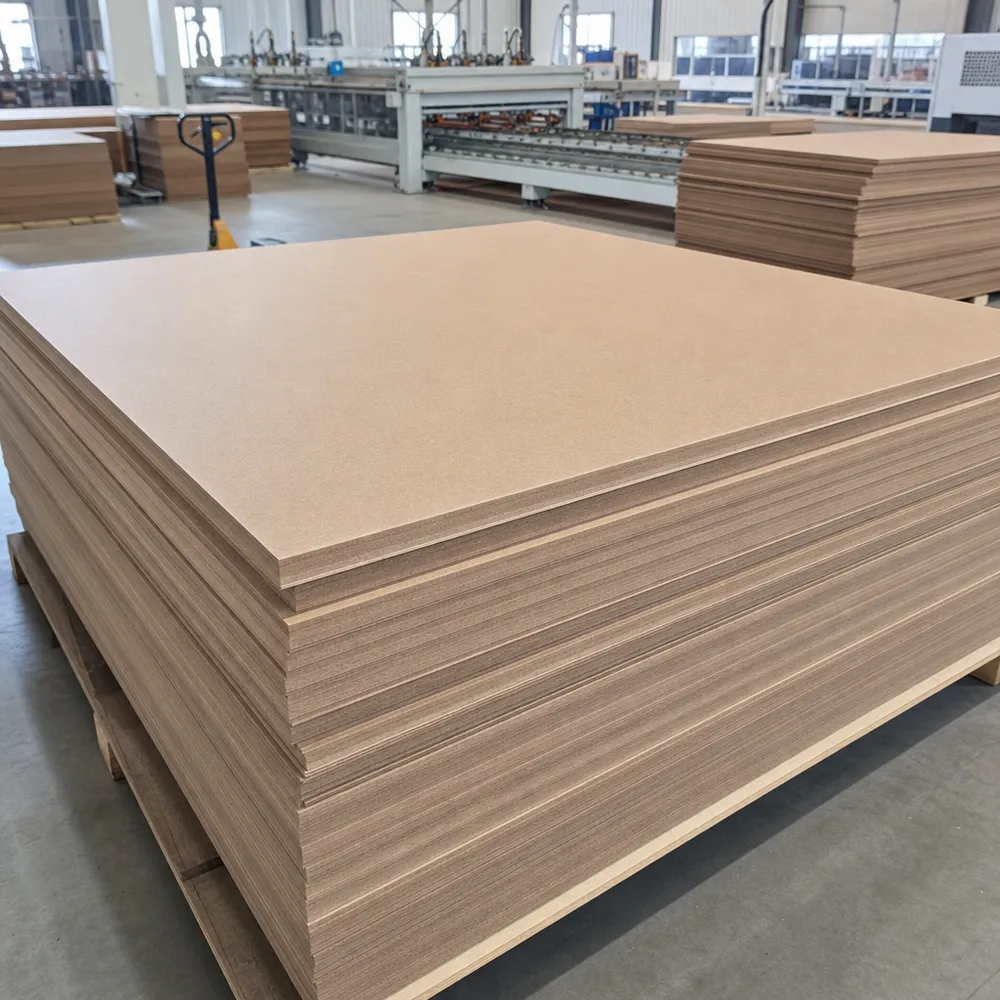
What Hardboard Paneling Is — and Where It Sits in Your Product Mix
Understanding the density difference, the surface finish, and how paneling differs from general-purpose sheet — so you can position it correctly for your buyers.
Hardboard paneling is a high-density fiberboard panel pressed to a smooth face on one or both sides, typically running 2.5mm to 6mm thick. The density is what separates it from standard MDF: hardboard is pressed harder and denser — typically 800–1000 kg/m³ — which gives it a harder surface, better screw-holding at the edge, and a face that takes paint, laminate, or print without the absorption issues you get with lower-density boards.
Within our hardboard range, paneling occupies a specific position. Hardboard sheets are the general-purpose substrate — flat, dense, cut to size. Hardboard paneling is the same substrate configured for wall and surface cladding applications: standard panel dimensions, smooth face optimized for finishing, and the dimensional consistency that installation workflows require. If your buyers are fitting panels to stud walls, lining van interiors, or cladding display fixtures, they need panels that are flat, square, and consistent in thickness — not just a sheet that's been cut down.
We've been producing hardboard as part of our engineered wood range since the early years of the factory. It's one of those products that doesn't get much attention until a buyer gets burned by a batch with thickness variation or surface porosity — then it becomes a sourcing priority. The process discipline we apply to plywood — moisture control, press calibration, outgoing inspection — carries directly into hardboard production.
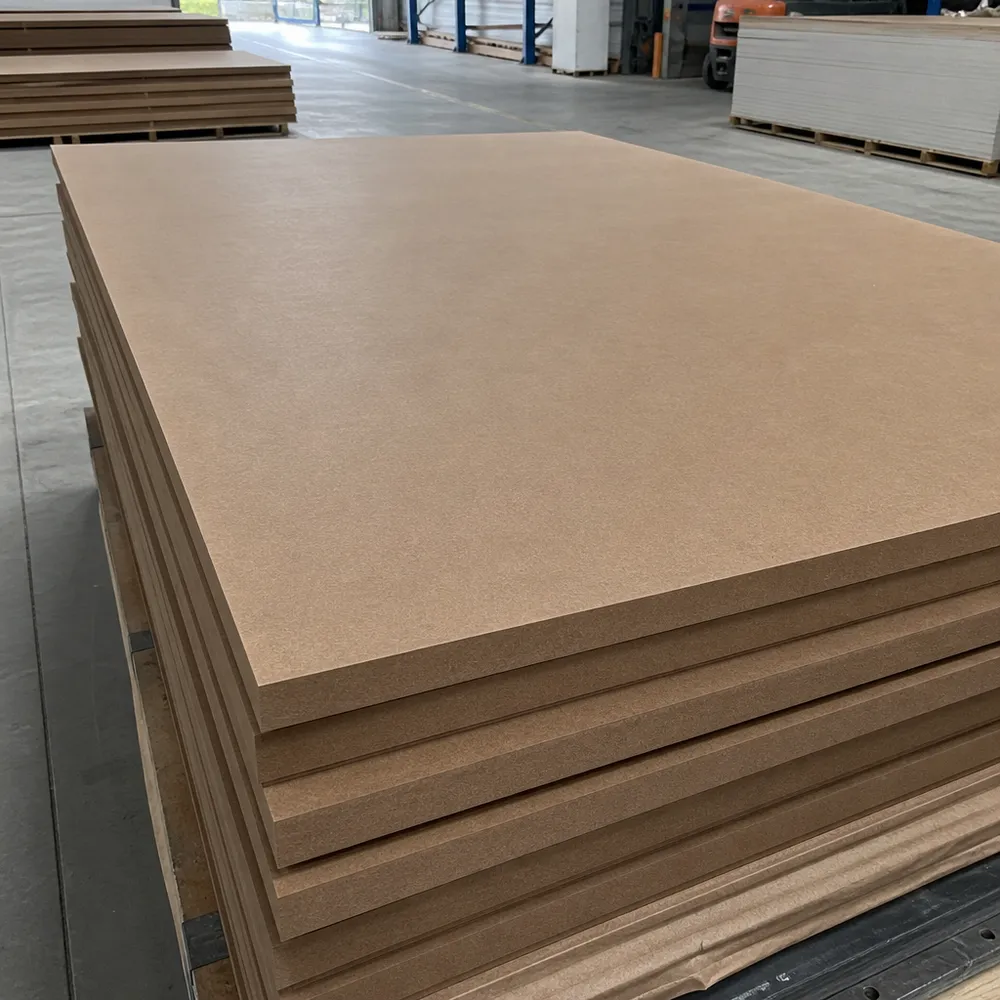
800–1000 kg/m³
Pressed harder and denser than standard MDF — harder surface, better edge screw-holding.
Smooth Face (S1S / S2S)
Takes paint, laminate, or print without the absorption issues of lower-density boards.
Cladding-Ready Dimensions
Standard panel dimensions and dimensional consistency for stud walls, van linings, and display fixtures.
Process Discipline
Moisture control, press calibration, and outgoing inspection — the same standards applied to our plywood range.
Other products in this hardboard range:
Hardboard Paneling Specifications
Standard parameters for our hardboard paneling. For custom dimensions, surface treatments, or specific density requirements, contact us with your target spec.
Standard Specification Table
| Parameter | Standard Value | Notes |
|---|---|---|
| Thickness | 2.5mm 3mm 4mm 5mm 6mm | Custom thickness on confirmed orders |
| Panel Size | 1220 × 2440mm | Custom sizes available |
| Density | 800–1000 kg/m³ | Typical for standard hardboard paneling |
| Face | Smooth (S1S or S2S) | S1S standard; S2S on request |
| Moisture Content | 8–12% | Export-grade target range |
| Formaldehyde Emission | E1 CARB P2 | CARB P2 as standard for export |
| Bending Strength | ≥ 30 MPa (typical) | Per GB/T 12626 or equivalent |
| Internal Bond | ≥ 0.5 MPa (typical) | Delamination resistance |
| Surface Finish | Sanded, calibrated | Thickness tolerance ±0.2mm |
| Certifications |
ISO 9001:2015 CE FSC CARB P2
|
Audit reports available on request |
Specifications shown are industry-standard values for this product type. Actual specifications may vary by order. Contact us for detailed product data sheets and confirmation of parameters for your specific application.
Why the ±0.2mm Tolerance Matters
For paneling applications — van linings, wall cladding, display fixtures — thickness consistency directly affects how panels sit against framing and how joints close. A ±0.2mm calibrated tolerance means less shimming, less filler, and faster installation across large runs.
Density in Context
At 800–1000 kg/m³, hardboard paneling is significantly denser than MDF (650–750 kg/m³) and standard particleboard (600–700 kg/m³). That density translates directly to surface hardness and screw-holding at edges.
Emission Standards
CARB Phase 2 is the benchmark for North American import compliance. E1 covers EU and most other markets. Both are available as standard — specify at order stage.
Need a Custom Spec?
Non-standard thicknesses, groove patterns, pre-primed surfaces, or specific density targets — send us your requirements and we'll confirm feasibility and MOQ.
Send Your SpecWhere Hardboard Paneling Is Used
The combination of smooth face, consistent thickness, and high density makes hardboard paneling a practical choice across a wide range of commercial and industrial end uses.
Van & Vehicle Lining
Hardboard paneling is a standard choice for van conversion linings — lightweight relative to plywood, easy to cut to shape, and smooth enough to accept carpet, vinyl, or direct paint.
- Lightweight — reduces payload impact
- Smooth face bonds well to adhesive-backed liners
- Consistent thickness for flush panel fitting
Wall Cladding & Partitions
Used as a substrate or finish layer on stud-framed walls in commercial fit-outs, retail interiors, and light industrial spaces where a hard, paintable surface is needed.
- Hard surface resists dents and scuffs
- Accepts paint, laminate, or wallpaper directly
- Standard sheet size covers stud bays efficiently
Display & Exhibition Fixtures
Retail display units, exhibition stands, and point-of-sale fixtures benefit from hardboard's smooth printable face and the ability to cut clean edges without chipping.
- Clean-cut edges with standard tooling
- Smooth face suitable for direct digital print
- Lightweight for temporary or modular builds
Furniture Backing & Drawer Bottoms
Cabinet backs, drawer bottoms, and wardrobe panels where a thin, rigid, smooth-faced sheet is needed to complete the structure without adding unnecessary weight.
- Thin profiles (2.5–4mm) for rebated grooves
- Rigid enough to resist racking in cabinet backs
- Consistent thickness for clean groove fits
Flooring Underlay & Substrate
Laid over existing subfloors to create a smooth, level surface before vinyl, carpet, or laminate installation — particularly in renovation projects where the existing floor is uneven.
- Smooth face eliminates print-through on vinyl
- Dense enough to bridge minor subfloor irregularities
- Consistent thickness for level finish across sheets
Packaging & Industrial Use
Pallet dividers, protective inserts, and industrial packaging components where a rigid, flat, low-cost sheet material is needed in volume.
- Cost-effective at volume for disposable applications
- Rigid and flat — no warping under load
- Available in bulk container quantities
Moisture-Sensitive Environments
Standard hardboard paneling is not rated for wet or high-humidity environments. For bathrooms, external cladding, or applications with direct moisture exposure, specify our moisture-resistant hardboard variant or consider our marine-grade plywood range. Contact us to discuss the right product for your conditions.
Sourcing, Supply Chain & Export
We supply hardboard paneling direct from verified manufacturing partners in China, with full container and LCL options for importers, distributors, and large-volume buyers.
Manufacturing & Quality Control
Mill Selection
We work with ISO 9001-certified mills with demonstrated export track records. New suppliers go through a qualification process before we place commercial orders.
Pre-Shipment Inspection
Thickness, density, moisture content, and surface quality are checked before loading. Third-party inspection is available on request.
Documentation Package
Full export documentation including packing list, commercial invoice, bill of lading, phytosanitary certificate, and test reports where required.
Packaging for Transit
Panels are bundled, edge-protected, and palletised or packed in cartons depending on destination and buyer preference. Corner and edge damage is a common issue with hardboard — we address it at packing stage.
Lead Times & MOQ
1×20'
Minimum order for standard spec (FCL)
25–35
Days production + loading (typical)
LCL
Available for smaller trial orders
FOB
Standard terms; CIF available on request
Shipping Origins
Key Export Markets
Compliance & Certifications
Ready to discuss a shipment?
Send us your target spec, destination port, and volume. We'll come back with pricing, lead time, and a sample offer within one business day.
Request a QuoteFrequently Asked Questions
Common questions from buyers, importers, and specifiers about hardboard paneling — product, supply, and compliance.
What is the difference between hardboard and MDF?
Both are wood fibre panel products, but hardboard is denser, thinner, and manufactured without added binders — the fibres are bonded under high heat and pressure using the wood's own lignin. MDF uses urea-formaldehyde resin and is produced in thicker sheets suited to routing and profiling. Hardboard is harder, smoother on one face, and better suited to thin-panel applications like backing boards and underlays.
Can hardboard paneling be used outdoors?
Standard hardboard is not suitable for outdoor or wet environments. It will absorb moisture, swell, and delaminate over time. For applications with any moisture exposure, specify our moisture-resistant (MR) hardboard grade, or consider an alternative panel product. If you're unsure which grade fits your application, contact us before ordering.
What thicknesses are available and what is the standard sheet size?
We supply hardboard paneling in 2mm, 2.5mm, 3mm, 3.5mm, 4mm, 5mm, and 6mm thicknesses. The most common sheet size is 1220×2440mm (4×8 ft), with 1220×1830mm also available. Custom sizes can be cut to order for container-quantity purchases. Tolerances are ±0.2mm on thickness and ±2mm on sheet dimensions.
What is the minimum order quantity?
For FCL (full container load) orders, the minimum is one 20-foot container. LCL (less than container load) is available for trial or smaller repeat orders, though unit pricing will be higher. We can advise on how many sheets fit a 20' or 40' container for your chosen thickness and sheet size.
Is formaldehyde-free hardboard available?
Standard hardboard produced via the wet process contains no added formaldehyde — the bonding is achieved through lignin activation under heat and pressure. Emission levels are typically well below E1 thresholds. For markets requiring CARB Phase 2 or E0 certification, we can source from mills with the relevant test documentation. Specify your compliance requirement at enquiry stage.
Do you offer samples before a full order?
Yes. We can arrange physical samples of our standard hardboard grades — typically A4 or A3 cut pieces — shipped via courier to your location. Sample lead time is 5–10 business days depending on destination. For buyers placing a confirmed order, sample costs are credited against the first shipment.
What surface finishes are available?
Standard hardboard has one smooth (S1S) face and one textured mesh face. We also supply S2S (smooth both sides) for applications where both faces are visible. Pre-primed and pre-painted white finishes are available for display and furniture applications. Tempered hardboard — oil-treated for improved hardness and moisture resistance — is available as a separate grade.
How is hardboard paneling typically priced?
Pricing is quoted per sheet or per cubic metre depending on buyer preference, on an FOB China basis. Key variables are thickness, sheet size, surface finish, grade (standard vs. tempered vs. MR), and volume. We provide firm pricing valid for 30 days. Contact us with your spec and target volume for a formal quotation.
How We Press Hardboard Paneling: The Process Details That Affect Your Batch
Hardboard is a hot-press product. The variables that determine panel quality are press temperature, pressure, and time — plus the moisture content of the fiber mat going in.
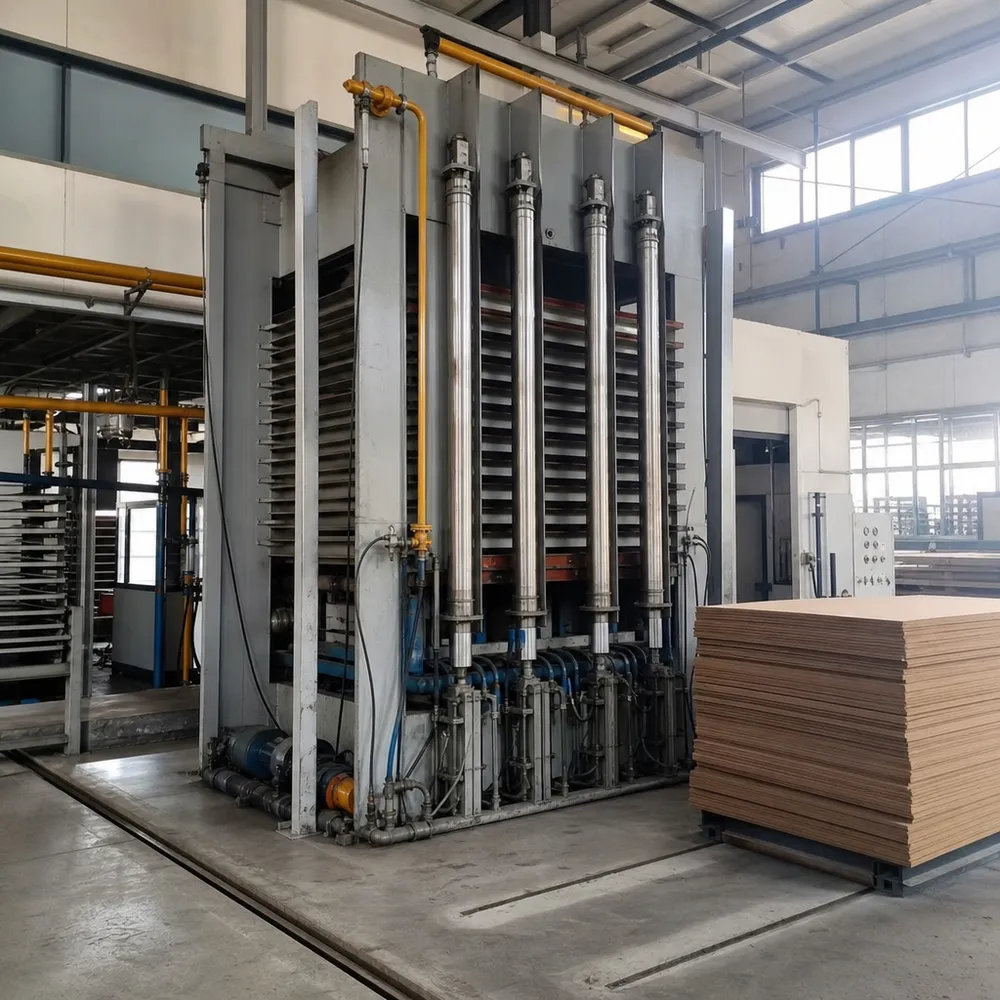
Multi-Daylight Hydraulic Hot Press
We run multi-daylight hydraulic hot presses calibrated for uniform pressure distribution across the full panel surface. The failure mode we're controlling for is density variation: if pressure is uneven, you get a panel that's harder in the center than at the edges, which shows up as surface porosity differences when your buyer applies paint or laminate.
Pre-Press Moisture Control
The fiber mat is prepared from wood fiber that's been refined and dried to a controlled moisture range before pressing. We don't press wet fiber and rely on the press to drive out moisture — that approach produces panels with residual stress that causes warping after the panel cools and acclimates.
Our pre-press moisture target is set to produce a finished panel at 8–12% moisture content, which is the range that keeps panels dimensionally stable through ocean transit and warehouse storage in your market.
Post-Press Sanding and Surface QC
Post-press, panels go through the sanding line for surface calibration and thickness control. The smooth face on S1S panels is the result of the press surface itself — a polished press plate produces the characteristic hardboard gloss. We check surface quality for porosity, pitting, and delamination blisters before panels reach the trimming saws. Any panel that shows a surface defect at this stage is pulled.
Most common defect we see: small blisters from localized steam release during pressing. It's a fiber moisture issue, and it's why the pre-press moisture check is non-negotiable in our process.
Batch traceability: Press parameters are logged per batch. If a quality issue surfaces after delivery, we can trace it back to the specific production run and identify whether it was a process deviation or a material issue.
Market Segments Where Hardboard Paneling Moves Volume
Four segments account for the majority of hardboard paneling volume. Each has distinct order patterns, thickness preferences, and buyer decision criteria.
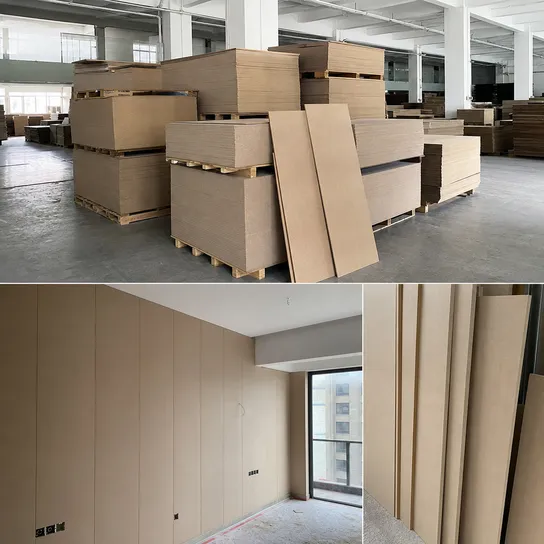
Interior Wall Cladding and Renovation Supply
Building material distributors supplying renovation contractors are a consistent volume segment. The typical order pattern is mixed-thickness: 3mm for lightweight wall lining applications, 4–5mm where a more rigid panel is needed. Contractors buy in pallet quantities per project, and distributors who stock a 2–3 thickness range capture the full project demand rather than losing part of the order to a competitor.
The smooth face means panels can be painted, wallpapered, or laminated on-site without additional surface prep — which reduces installation labor cost and is a selling point your distributor customers can use downstream.
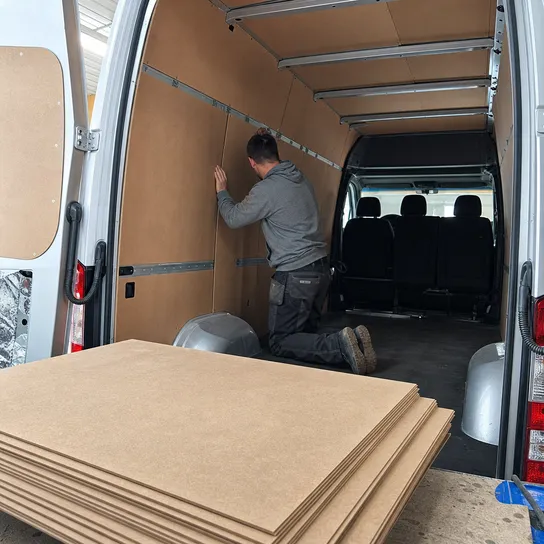
Van and Vehicle Interior Lining
This is a segment that's grown steadily over the past several years. Van conversion businesses — both commercial fleet outfitters and the growing aftermarket van-life conversion market — use 3mm and 4mm hardboard paneling as the primary interior lining material. The density and smooth face make it easy to cut, fit, and finish.
Orders typically run 500–2,000 panels per batch for commercial outfitters, with repeat cycles tied to fleet conversion schedules. If you're supplying into the automotive aftermarket or commercial vehicle fitting trade, hardboard paneling is a high-reorder product with predictable demand patterns.
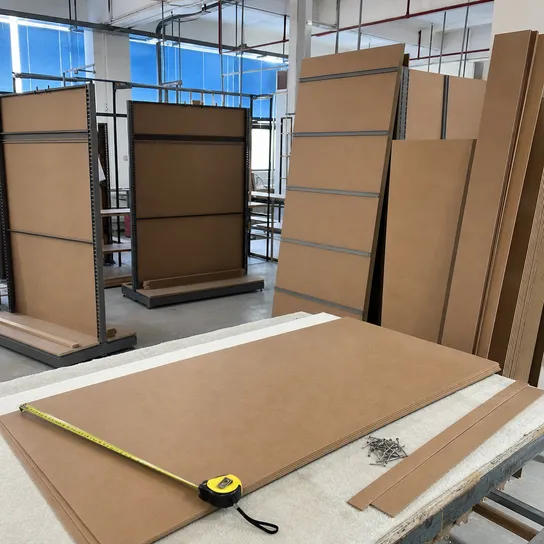
Display Fixture and Retail Fit-Out
Retail fixture manufacturers and shop-fitting contractors use hardboard paneling for back panels, shelf liners, and display surfaces. The smooth face takes print and laminate cleanly, and the density means the panel holds fasteners at the edge without splitting — relevant when fixtures are assembled with staples or small screws.
Order volumes in this segment tend to be project-driven: a retail chain rollout might require 5,000–20,000 panels across multiple locations, with tight dimensional tolerances because panels are cut to fit pre-engineered fixture frames. Custom sizing is worth discussing if your buyers are in this segment — we can cut to non-standard dimensions on confirmed orders, which eliminates the waste and labor cost of on-site cutting.
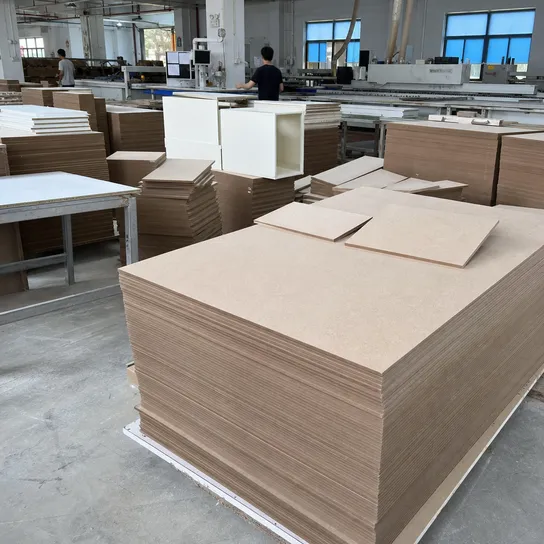
Furniture Back Panels and Drawer Bottoms
Furniture manufacturers — particularly flat-pack and RTA furniture producers — use 2.5mm and 3mm hardboard as back panels for wardrobes, cabinets, and drawer bottoms. The application is cost-sensitive and volume-driven: a mid-size furniture factory might consume 50,000–100,000 panels per year across their product range.
The key spec for this segment is consistent thickness and flat panels — warped back panels cause assembly problems on automated furniture lines. Our moisture control process is specifically designed to produce panels that stay flat through transit and storage, which is the failure mode that creates warranty claims and returns in this segment.
Discuss Volume Pricing for Your Target Segment
Order patterns, thickness mix, and annual volume all affect landed cost. Share your segment and target market — we'll put together pricing that reflects your actual buying pattern.
Customization Parameters and What They Mean for Your Order
Hardboard paneling customization is straightforward compared to more complex engineered wood products — there's no veneer species selection or core construction to specify. The variables that matter for your order are covered below.
Thickness
Standard range is 2.5mm to 6mm. Non-standard thicknesses — such as 3.5mm or 4.5mm — are available on confirmed orders. The constraint is press plate configuration, not tooling cost, so this is a scheduling question, not a capital question.
Panel Dimensions
Standard is 1220 × 2440mm. Custom sizes are available on confirmed orders — we cut on precision saws, so custom dimensions don't require new tooling, just a confirmed order quantity that justifies the yield calculation. Minimum order for custom dimensions is typically one full production run.
Surface Finish
S1S (smooth one side) is standard. S2S (smooth both sides) is available on request — the press process is the same, but S2S requires more careful handling through the sanding line to protect both faces. If your application requires a primed surface, see our primed hardboard product, which ships ready for paint application.
Formaldehyde Emission Grade
CARB P2 is our standard for export. E1 is available for markets where CARB P2 is not required. E0 is available on request for applications with stricter emission requirements — confirm with us on lead time and MOQ for E0 specification.
Certification Documentation
FSC chain-of-custody documentation is available for buyers with sustainability sourcing requirements. CARB P2 documentation is included as standard for US-bound shipments. CE declaration of conformity is included for EU shipments.
Sourcing note: If you're sourcing hardboard paneling for a market with specific formaldehyde regulations — California, EU, Australia — confirm the emission grade in your purchase order. We default to CARB P2 for export, but it's better to have it in writing than to sort it out at customs.
Compliance Coverage Across Your Export Markets
The certification stack we hold covers the primary import markets where hardboard paneling faces regulatory scrutiny.
US Market
The California Air Resources Board Phase 2 standard is the most stringent formaldehyde emission limit in the US market. Our hardboard paneling meets CARB P2 as standard for export production. For US-bound shipments, we prepare the full CARB documentation package — composite wood product declaration, TPC certification reference, and chain-of-custody records — as part of the standard export documentation set.
Sustainability Sourcing
FSC chain-of-custody documentation confirms the wood fiber in our panels traces back to certified forests. This is increasingly a procurement gate for European retail and construction buyers, and for US buyers supplying into LEED-certified projects.
European Market
CE declaration of conformity is included with EU-bound shipments. Relevant for buyers supplying into construction and building material channels where CE marking is a market access requirement.
Quality Management
Our quality management system is certified to ISO 9001:2015, which covers the process controls, inspection procedures, and documentation practices that underpin the product quality claims on this page.

Other Export Markets
For buyers supplying into Australia, the Middle East, or Southeast Asia, contact us about the specific documentation requirements for your market — we've shipped to all of these regions and know what customs and import authorities typically require.
Australia: We know the import documentation requirements and have shipped to Australian buyers. Contact us to confirm the current documentation set for your shipment.
Middle East: Regional import authority requirements vary by country. We can advise on documentation based on your destination port.
Southeast Asia: Active shipping lanes from our Xuzhou factory. Contact us for market-specific documentation guidance.
Certifications Held
Documentation is prepared as part of the standard export set for each destination market. If your market has specific requirements not listed here, contact us before placing your order.
Container Loading and Landed Cost Efficiency
Flat, uniform, and stackable — hardboard paneling is one of the more container-efficient products in the panel category. Here's what to expect per container and how we handle packaging for ocean transit.
Units Per 40HQ Container
Loading Plan Included
We provide a loading plan with each shipment so your receiving team knows the exact stack configuration and can plan unloading accordingly. For mixed-thickness orders, we coordinate the load to maximize cubic utilization — mixing 3mm and 6mm panels in the same container is straightforward when panel dimensions are consistent.
Packaging for Ocean Transit
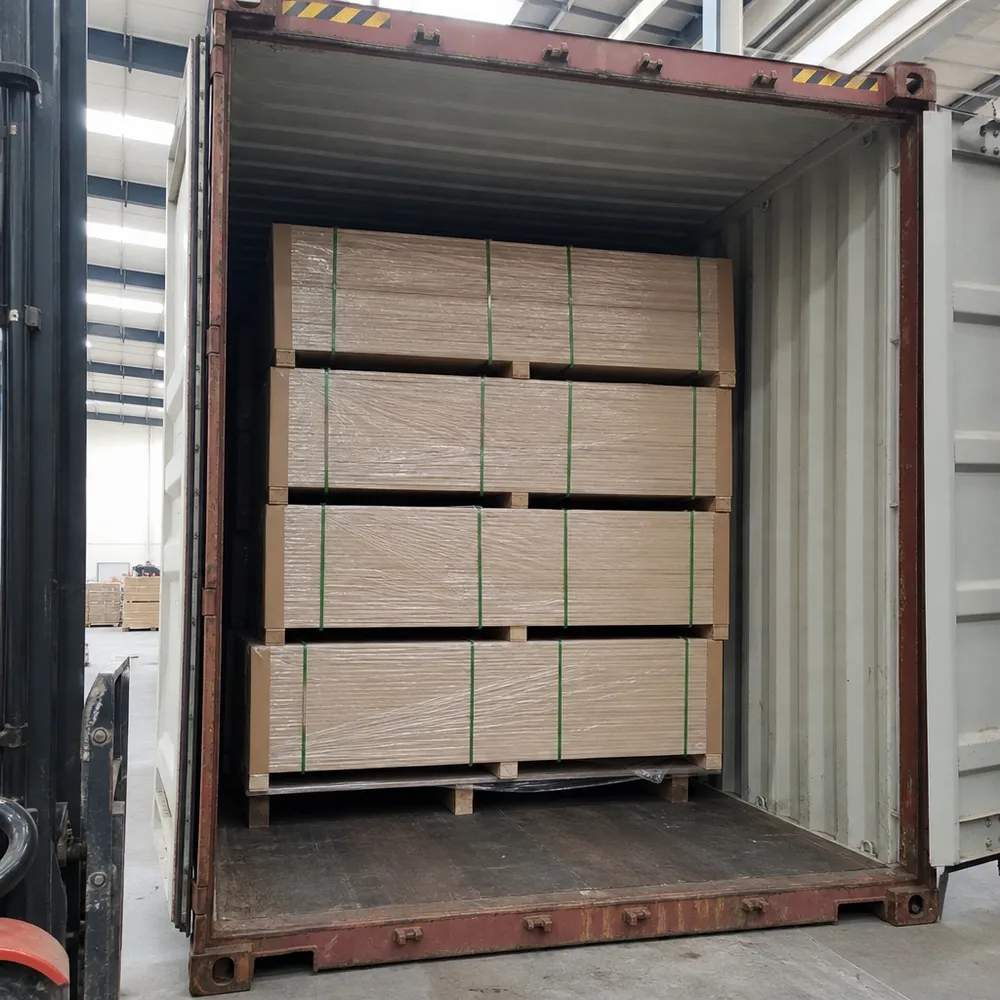
Transit Times from Xuzhou
We ship from Qingdao, Shanghai, or Lianyungang depending on routing and schedule.
Frequently Asked Questions
Common questions from importers, distributors, and OEM buyers evaluating hardboard paneling for their product mix.
For standard interior wall cladding over a stud frame, 3mm is the most common specification — it's rigid enough to span standard stud spacing without flex, light enough to handle easily, and cost-efficient for large-area applications.
If the wall surface is uneven or the panel needs to bridge gaps, 4mm or 5mm provides more rigidity and reduces the risk of visible flex lines after installation.
For van interior lining where the panel is bonded directly to a curved surface, 3mm is typically preferred because it conforms more easily to compound curves.
The higher density gives hardboard a harder surface that resists denting and takes paint without the raised grain you sometimes see on MDF after the first coat. The trade-off is that hardboard is less machinable. For flat panel wall cladding where the panel is cut to size and finished in place, hardboard is the better choice.
We include the CARB documentation package — composite wood product declaration and TPC certification reference — with US-bound shipments as standard. If you need to confirm compliance for a specific order or provide documentation to your downstream customers, we can supply the relevant test reports and certification records.
Contact us with your target size and we'll confirm the minimum quantity and lead time. Custom dimensions don't require tooling investment on our end, so the MOQ is driven by production scheduling efficiency rather than capital cost.
For exterior cladding applications, the panel needs to be fully sealed on all edges and faces before installation, and even then it's a marginal application.
If your buyers need a cladding panel for exterior or semi-exterior use, we'd recommend discussing a film-faced or HPL-surfaced option from our range rather than standard hardboard. Contact us with the specific application and we'll recommend the right product.
Other Hardboard Products in This Range
If hardboard paneling doesn't match your exact requirement, the other products in our hardboard range cover adjacent applications.
Hardboard Sheet
General-purpose substrate in standard and custom dimensions, for buyers who need the raw board without the paneling-specific configuration.
View product3mm Hardboard
If your application is specifically 3mm and you're sourcing at volume, this page covers the 3mm specification in detail.
View productPrimed Hardboard
Smooth face with a factory-applied primer coat, ships ready for paint application. Eliminates the priming step for your buyers and reduces installation labor cost.
View productMasonite Hardboard
The Masonite-type specification, for buyers whose downstream customers specify by that trade name.
View productHardboard Furniture Board
Configured for furniture back panel and drawer bottom applications, with the dimensional tolerances that furniture production lines require.
View productView the Full Hardboard Range
Browse all hardboard products, specifications, and configurations available from our Xuzhou factory.
View all hardboardGet a Quote for Hardboard Paneling
Send us your target specification — thickness, panel size, emission grade, volume, and destination market — and we'll come back with a detailed quote and the relevant certification documentation for your import requirements. Most inquiries get a response within 24 hours.
Thickness, panel size, emission grade
Specify your exact technical requirements
Volume and destination market
We'll size the quote to your order and logistics context
Certification documentation included
CARB P2, FSC, and market-specific compliance docs provided with quote
Response within 24 hours
Most inquiries receive a detailed response the same business day
Xuzhou QD Wood Industry Co., Ltd.
Send Your Inquiry
Factory-direct pricing. No intermediaries. Certification docs included with every quote.