

Melamine Board Manufacturer — Factory Direct
Standard melamine board in 9mm–25mm thickness, full decor range, CARB P2 and FSC certified. Manufactured at our 18,000 m² facility in Xuzhou since 2008. No trading company layer.
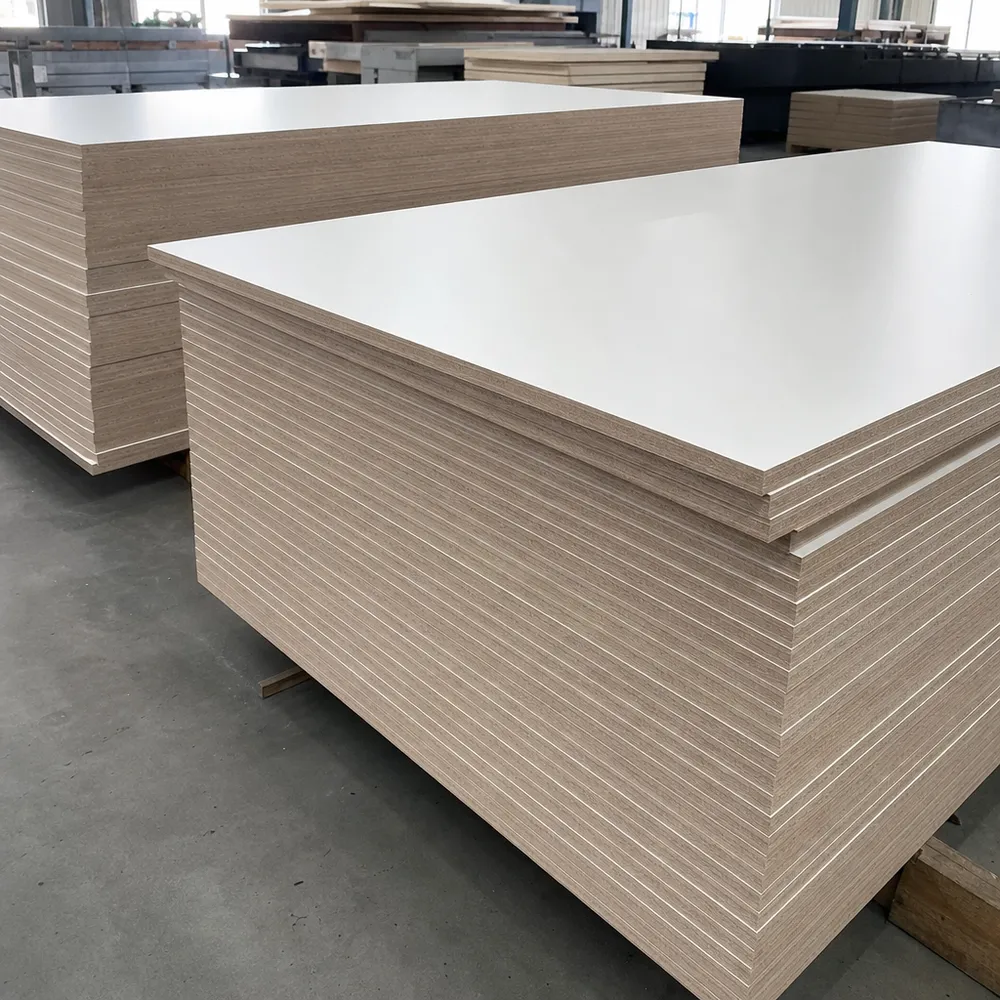
What Melamine Board Is — and Where It Fits in Your Supply Chain
Melamine board is a plywood substrate — typically poplar or eucalyptus core — with a melamine-impregnated paper overlay pressed onto both faces under heat and pressure. The surface is the finish. Your downstream buyers cut it, edge-band it, and assemble directly — no painting, no secondary laminating, no additional finishing cost in their workflow.
That's the commercial logic for stocking it. You're selling a panel that reduces your buyer's fabrication cost and eliminates a processing step. In furniture manufacturing and cabinet fabrication supply chains, that's a margin argument you can make at the point of sale — and it's why melamine board generates repeat orders at predictable intervals rather than one-off project buys.
The distinction between melamine board and other melamine-faced panels in our range comes down to the substrate and the application. Melamine board uses a standard plywood core construction — cross-grain veneer layup, odd-number plies — which gives it better screw-holding strength and impact resistance than an MDF-core equivalent. It's the right specification for furniture carcasses, shelving, and flat-pack components where the panel carries load and holds fasteners.
For door fronts and decorative panels where machining precision matters more than structural performance, melamine MDF is often the better choice. Most furniture manufacturers use both — carcass in melamine board, doors in melamine MDF.
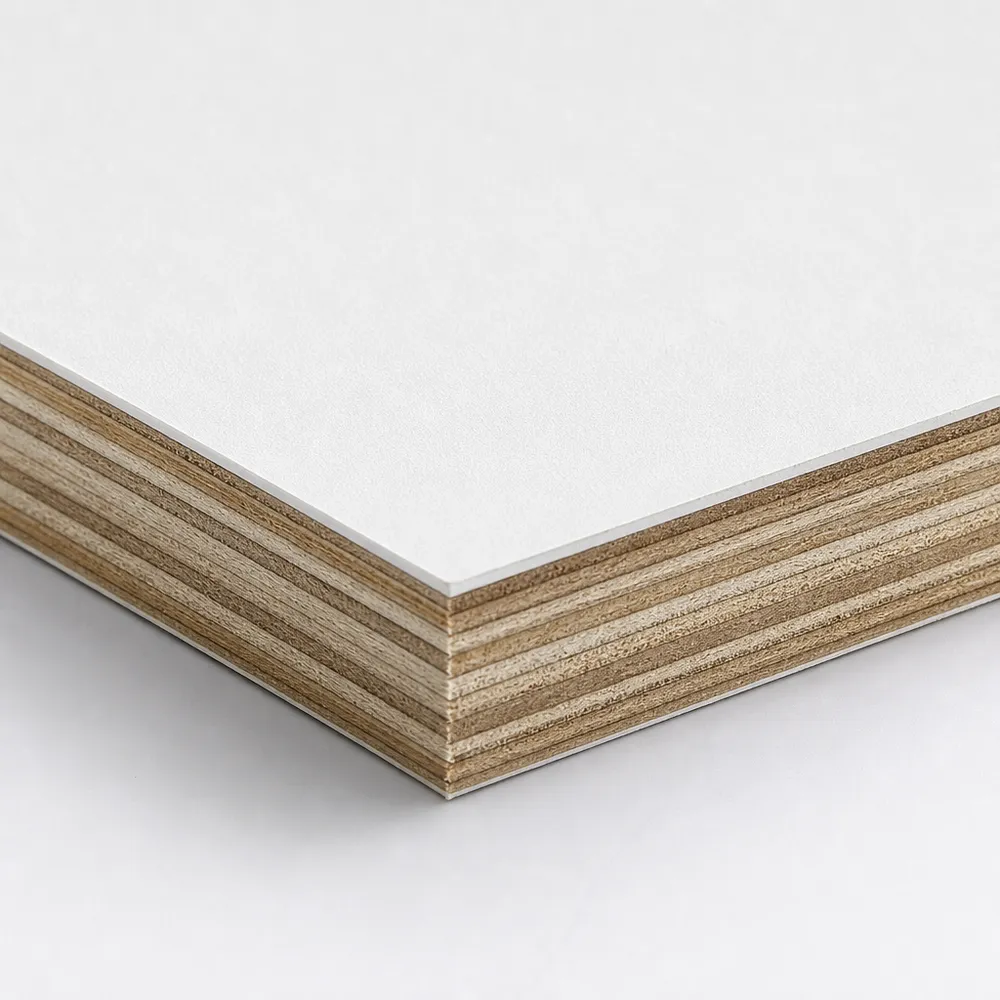
Melamine Board vs. Melamine MDF — Quick Reference
Melamine Board Specifications
These are the standard parameters for our melamine board product. Contact us to confirm exact specifications for your order.
Specifications shown are standard values for this product. Actual specifications may vary by order. Contact us for a detailed product data sheet and confirmation of exact parameters.
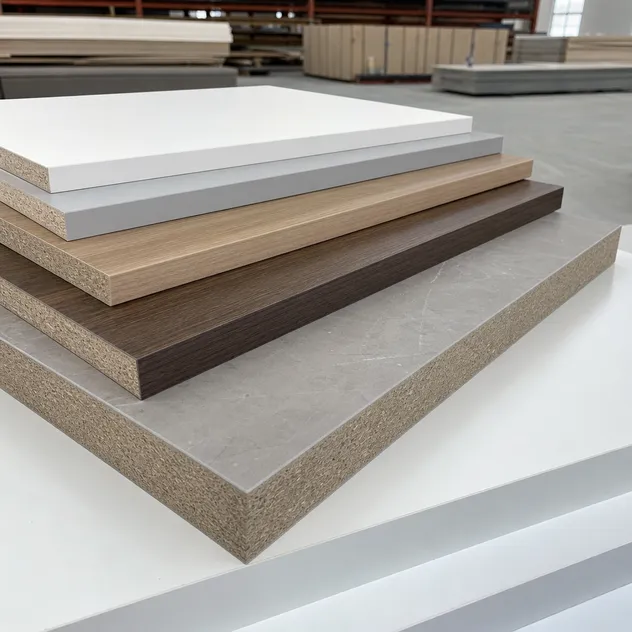
Surface Finish & Decor Options
The melamine surface is where the product earns its margin. Here's how the finish options break down and what drives buyer decisions.
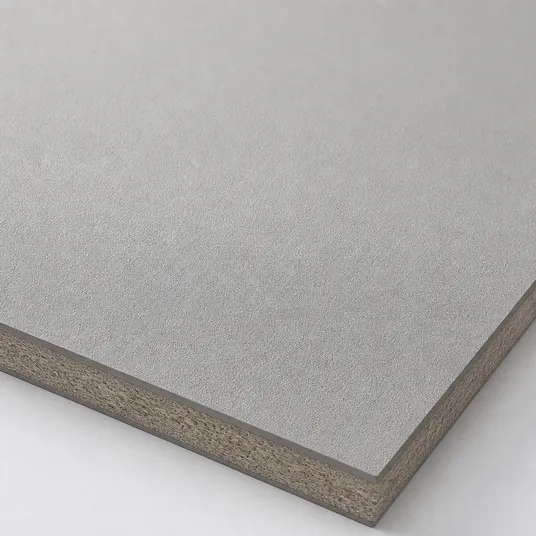
Low sheen, diffuse surface. Hides minor scratches and fingerprints well. Preferred for kitchen carcasses, office furniture, and retail shelving where durability matters more than visual drama.
- Scratch and fingerprint tolerant
- Consistent appearance across large runs
- No special handling during fabrication
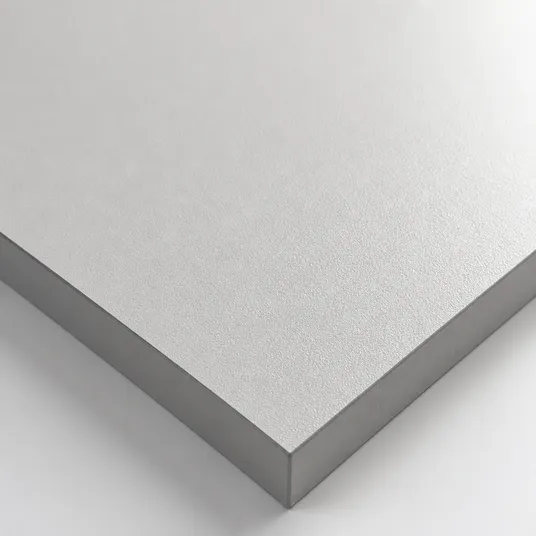
Mid-sheen finish that sits between matte and gloss. Offers a cleaner, more refined look without the maintenance demands of high gloss. Popular for residential cabinet door fronts and display furniture.
- Elevated appearance vs. matte
- More forgiving than gloss in use
- Works with most edge-banding profiles
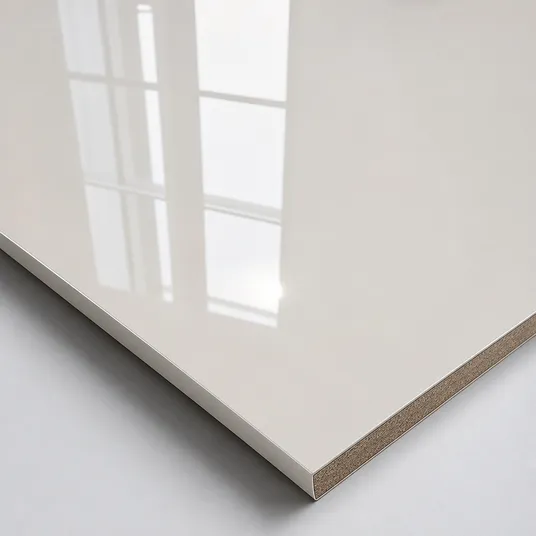
High-reflectance surface for premium cabinet fronts and display applications. Requires careful handling and packaging to avoid surface marring. Covered in detail on our dedicated product page.
- High visual impact
- Requires protective film during transit
- Higher MOQ for custom colors
Decor Pattern Categories
Standard decors ship from stock. Non-standard patterns are available subject to MOQ — typically one container minimum for custom decors. Confirm availability at inquiry stage.
White and off-white dominate volume orders. Grey tones and black are growing in commercial furniture. Custom RAL-matched colors available at MOQ.
Printed wood-grain decors replicate oak, walnut, beech, and teak appearances. Used extensively in flat-pack furniture and retail display units where real veneer cost is prohibitive.
Marble, concrete, and terrazzo-look decors for worktops, display surfaces, and accent panels. Growing segment in hospitality and retail fit-out. Subject to MOQ confirmation.
Applications & End Markets
Melamine board moves through a concentrated set of downstream industries. Understanding where it goes helps you position it with the right buyers.
Kitchen & Bath Cabinetry
The single largest end use. Carcass boxes, shelf panels, and interior components are almost universally melamine board in mid-range and value-tier kitchens. Door fronts use higher-grade or gloss variants.
Office & Commercial Furniture
Desks, storage units, partitions, and workstation panels. Commercial buyers specify melamine board for its consistent appearance across large quantities and ease of replacement.
Flat-Pack & RTA Furniture
Ready-to-assemble furniture manufacturers are among the highest-volume melamine board consumers globally. Consistent thickness and surface quality are non-negotiable for automated assembly lines.
Retail Display & Shopfitting
Shelving, display cases, and fixture panels for retail environments. Stone and wood-grain decors are common here. Buyers prioritize appearance consistency across multiple store rollouts.
Interior Construction
Wall paneling, ceiling liners, and partition systems in commercial interiors. MR-grade melamine board is specified where humidity exposure is a factor, such as bathrooms and kitchens.
Education & Hospitality
School furniture, dormitory fittings, hotel room casework, and restaurant seating. Durability and cleanability drive specification. Solid-color and wood-grain decors both feature heavily.
Who Actually Buys Melamine Board
Direct factory buyers. Highest volume, most price-sensitive. Require consistent spec across containers.
Stock and resell to fabricators and joiners. Value range breadth and reliable replenishment over lowest unit price.
OEM buyers sourcing carcass material. Often specify by thickness and emission standard. Repeat orders tied to production schedules.
Project-based buyers for retail and commercial interiors. Decor matching across batches is a key requirement.
Certifications & Compliance
Compliance documentation is a procurement requirement in most target markets. Here's what we hold and what it means for your import process.
Third-party audited quality management system covering production, inspection, and traceability. Required by most institutional and OEM buyers as a baseline supplier qualification.
California Air Resources Board Phase 2 formaldehyde emission standard. Mandatory for composite wood products sold into the US market under TSCA Title VI. Standard on all US-bound orders — no surcharge.
European formaldehyde emission classes per EN 13986. E1 is standard across the range. E0 (ultra-low) is available on select substrates for markets requiring stricter limits, including Japan and South Korea.
Forest Stewardship Council and Programme for the Endorsement of Forest Certification chain-of-custody certification. Available on request for buyers whose end customers require certified wood fiber sourcing documentation.
Declaration of Performance under EN 13986 for wood-based panels used in construction. Required for melamine board specified in EU building and interior construction applications.
What We Provide With Every Order
- Mill test report with formaldehyde emission test results per shipment lot
- Certificate of conformity referencing applicable standards (CARB, E1/E0, ISO)
- Full commercial documentation: commercial invoice, packing list, bill of lading, certificate of origin
- Phytosanitary certificate where required by destination country regulations
- Third-party inspection reports available on request (SGS, Bureau Veritas, Intertek)
Market-Specific Notes
TSCA Title VI / CARB Phase 2 compliance is mandatory. We supply the required CARB TPC (Third Party Certifier) documentation with all US-bound shipments.
E1 emission class and CE marking under EN 13986 cover most applications. EUDR timber regulation documentation available for applicable product lines.
ASNZS 4266 compliance documentation available. Biosecurity import permits and heat treatment certificates provided as standard for timber-based products.
F★★★★ (Japan) and E0-equivalent (Korea) emission grades available. Confirm requirement at inquiry stage — substrate selection affects lead time.
Need a specific certification not listed here? Contact us before placing an order. Most documentation requirements can be accommodated with advance notice — some require mill-level coordination and add lead time.
Sourcing & Supply Chain
Where the product comes from, how it moves, and what that means for your lead times and landed cost.
Origin & Mill Partners
Primary sourcing from established mills in China, with secondary supply from Vietnam and Malaysia for specific grades. All mill partners are audited annually against quality and compliance benchmarks.
Typical Lead Times
Lead times vary by order type, destination, and whether the spec is from stock or requires mill production. These are working estimates — confirm at inquiry.
MOQ & Order Structure
Minimum order quantities are set at the container level for most standard products. Mixed-container orders are available for buyers consolidating multiple SKUs.
Shipping & Incoterms
Most common term. Risk transfers at origin port. Buyer arranges freight and insurance from loading.
We arrange freight and insurance to destination port. Simplifies logistics for buyers new to direct import.
We cover freight to destination port; buyer arranges marine insurance. Common for experienced importers.
Available for buyers with established freight forwarders. Full logistics control from factory gate.
All shipments are palletized and stretch-wrapped. Corner protection and edge banding are applied to prevent transit damage. Container loading photos and pre-shipment inspection reports are provided as standard on orders above 2 containers.
Pricing Factors & How to Get a Quote
Melamine board pricing isn't a single number — it's a function of several variables. Understanding them helps you ask the right questions and compare quotes accurately.
What Drives the Price
MDF costs more than particleboard at equivalent thickness. HMR and moisture-resistant grades carry a further premium. Thicker panels cost more per sheet but often less per cubic meter.
High-gloss and super-matte finishes command a premium over standard satin. Custom or exclusive decors require minimum run quantities and add cost. Standard catalog decors are most price-competitive.
Container-level pricing is significantly better than LCL. Buyers committing to quarterly or annual volume programs receive preferential pricing tiers. First orders are typically priced at spot rates.
FOB pricing is the cleanest basis for comparison. CIF pricing includes freight and insurance, which varies by destination. Always compare on the same Incoterm basis when evaluating suppliers.
CARB Phase 2 and E1 are included as standard. F★★★★, E0, and FSC certification may add a small premium depending on the mill and product line. Confirm at inquiry stage.
How to Get an Accurate Quote
To generate a firm quote, we need the following information. The more detail you provide, the faster and more accurate the response.
Frequently Asked Questions
Questions we get from buyers regularly. If yours isn't here, contact us directly.
What's the difference between melamine board and MDF?
MDF is a substrate — a dense, smooth panel made from wood fiber and resin. Melamine board is MDF (or particleboard) with a melamine resin paper surface applied. The term "melamine board" refers to the finished, surfaced product.
Can I order samples before committing to a container?
Yes. Sample panels (typically A4 or A3 size) are available for most catalog decors and grades. Sample packs are dispatched by courier. Lead time is 5–10 business days depending on destination.
Is CARB Phase 2 compliance included as standard?
Yes, for all US-bound orders. CARB Phase 2 documentation is provided at no additional charge. If you're importing into the US, confirm this requirement at inquiry stage so we route through the correct certified mill.
What sheet sizes are available?
Standard sizes are 2440×1220mm and 2800×2070mm. Other sizes including 2440×1830mm and 3050×1220mm are available on production runs. Cut-to-size is available from warehouse stock for smaller quantities.
How do I know the decor will match between orders?
We retain reference samples from each production batch. For repeat orders, we match against the original batch reference. For critical color-matching applications, request a pre-production sample from the new batch before confirming the order.
What's the minimum order quantity?
MOQ is typically one full container (20ft or 40ft depending on product mix). For buyers needing smaller quantities, LCL consolidation is available at slightly higher per-unit cost. Contact us to discuss your volume requirements.
What payment terms do you offer?
Standard terms are 30% deposit with order confirmation, 70% balance against copy of Bill of Lading. Established buyers with order history may qualify for open account or letter of credit terms. T/T bank transfer is the primary payment method.
Can you supply edgebanding to match the decors?
Yes. Matching PVC and ABS edgebanding is available for most catalog decors. Edgebanding can be included in the same shipment as the panels. Specify widths (19mm, 22mm, 42mm) and quantity at inquiry stage.
How long does production and shipping take?
Production lead time is typically 15–25 days after order confirmation and deposit receipt. Ocean freight transit varies by destination: 18–25 days to US West Coast, 25–35 days to US East Coast and Europe, 10–18 days to Southeast Asia and Australia.
Do you offer private label or custom branding?
Yes. Custom pallet labels, packaging inserts, and branded documentation are available. Some buyers also source exclusive decors not available to other customers. Minimum volume thresholds apply — discuss at inquiry stage.
Ready to Source Melamine Board?
Send us your specifications and we'll respond with pricing, lead times, and available decors within one business day.
No commitment required. Sample requests welcome.
The Substrate Construction That Determines Downstream Performance
Most buyers evaluate melamine board by the surface — color, texture, decor. Those are the visible variables. The substrate construction is what determines whether the panel performs through fabrication and end use, and it's where the difference between a reliable supplier and a problem supplier actually shows up.
Core Void Control
A poplar core with voids will crumble at the cut edge when a panel saw or CNC router passes through — the melamine surface loses its substrate support and the edge breaks down. We grade incoming veneers before layup and reject core veneers with open defects above the specification limit.
For buyers whose downstream customers run automated panel processing equipment, this is the specification that determines whether your panels run cleanly through their saws and whether the edge-banding operation produces clean results.
Moisture Content at Pressing
We target 8–12% moisture content in the veneer before it goes into the press. Pressing onto veneer that's outside that range produces panels that move dimensionally after pressing — you get thickness variation across the batch and, in some cases, surface waviness that shows up when panels are installed side by side.
Our veneer drying line runs a pre-press moisture check on every batch. This sounds like a basic step, but a surprising number of factories skip it and rely on the hot press to drive out residual moisture — which it does, unevenly, and that's where thickness variation comes from.
Press Parameters
Melamine paper bonds through heat and pressure — the press temperature, pressure, and cycle time determine whether the bond is complete and uniform across the full panel surface. Incomplete bonding produces surface lifting at edges and corners, which is the most common field failure in melamine panels and the one that generates warranty claims from your downstream customers.
We log press parameters per batch and run a cross-cut peel test on each production run. Any batch that fails the peel test is pulled before it reaches the sanding line — it's a production gate, not a final inspection step.
Calibrated Sanding
Our wide-belt sanding line holds ±0.2mm tolerance across the panel. For buyers supplying into furniture manufacturing operations with automated panel saws, this tolerance is the specification that determines whether your panels feed cleanly through their equipment without adjustment.
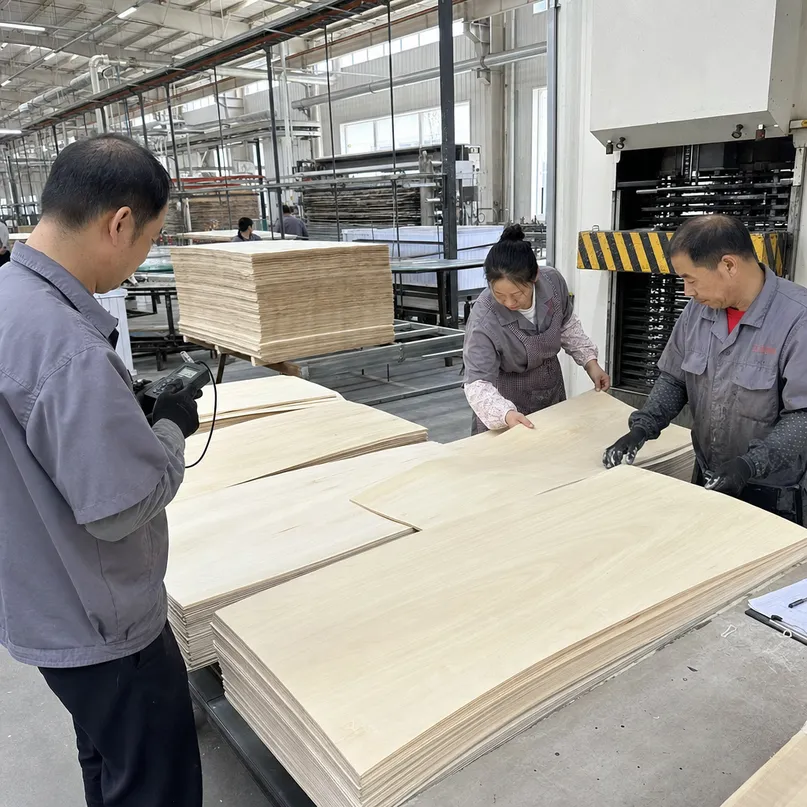
Production Gate Summary
- Incoming veneer graded before layup — open defects above spec limit rejected
- Pre-press moisture check on every batch — target 8–12% veneer moisture content
- Press parameters logged per batch — temperature, pressure, and cycle time recorded
- Cross-cut peel test on each production run — failed batches pulled before sanding line
- Wide-belt sanding to ±0.2mm thickness tolerance across the full panel
Why This Matters for Your Buyers
Surface lifting at edges and corners is the most common field failure in melamine panels. When it happens, the warranty claim lands with your customer — not the factory. Our peel-test gate is the step that keeps that failure mode out of your supply chain before it ships.
Market Segments That Drive Repeat Orders for Melamine Board
Melamine board moves in volume in specific segments. These are the ones where our existing buyers have built predictable reorder patterns.
Flat-Pack & RTA Furniture Manufacturing
Largest volume segmentManufacturers consuming melamine board for carcass panels, shelving, and back panels need consistent color and thickness across production runs — a color shift between orders creates a production problem for their assembly line. We maintain decor records and can match color across orders on confirmed programs.
Melamine board is a SKU that builds a recurring revenue base in this segment, not a one-time transaction.
Kitchen & Wardrobe Cabinet Fabricators
Stable reorder accountsCabinet shops use melamine board for carcass construction — side panels, shelves, base units, and internal dividers. The 18mm thickness in MR glue specification is the standard for this segment. A cabinet shop running 50–100 kitchens per month has a predictable monthly panel consumption.
Demand in this segment doesn't track with general construction activity — renovation cycles create sustained baseline volume.
Interior Fit-Out Contractors & Joinery Suppliers
Multi-thickness ordersThese buyers use melamine panels for built-in joinery, wall paneling, and furniture in commercial fit-out projects — offices, retail, hospitality. They often need a range of decors and thicknesses within a single project order.
Full thickness range in one shipment reduces the number of suppliers they need to manage per project.
Building Materials Distributors
Reorder programsDistributors stocking a panel range for trade customers — joiners, cabinet makers, builders — need a supplier who can maintain consistent stock availability and deliver on short lead times for reorders.
Buffer capacity means we can support distributor reorder programs without the supply gaps that come from a factory running at full utilization.
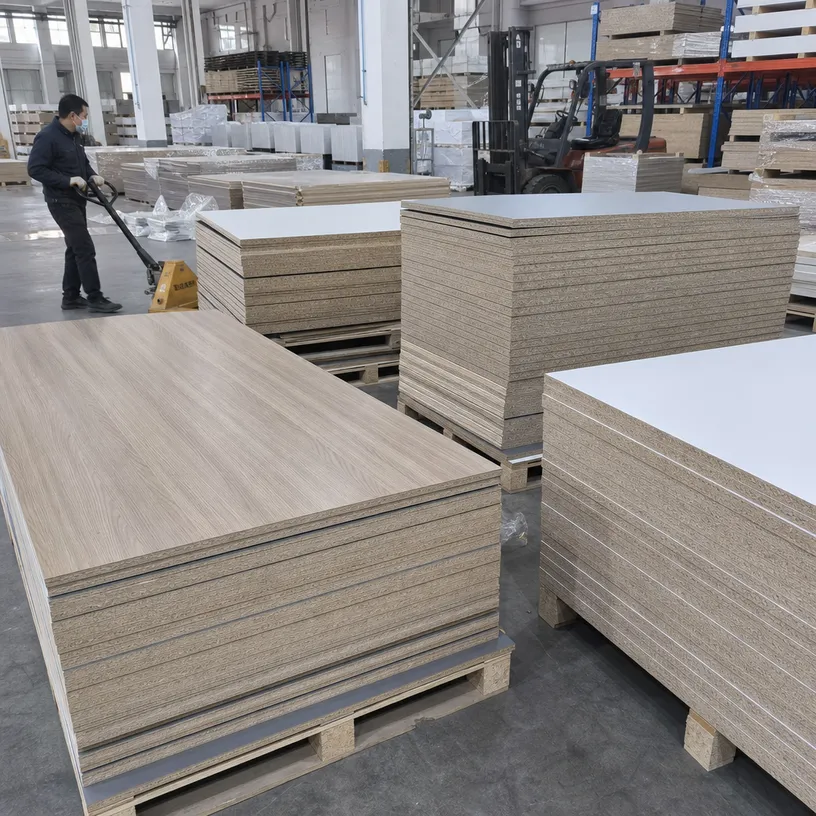
Why Segment Fit Matters for Your Margin
Each of these segments has a different reorder cycle and a different sensitivity to specification consistency. Matching your stock program to the right segment — and sourcing from a factory that can hold color and thickness across orders — is what converts a one-time container into a recurring account.
How the Melamine Pressing Process Protects Your Margin
The pressing process is where surface quality is determined. Understanding what a controlled process looks like versus a cost-cut process matters — because the difference shows up in your returns rate, not in the initial inspection.
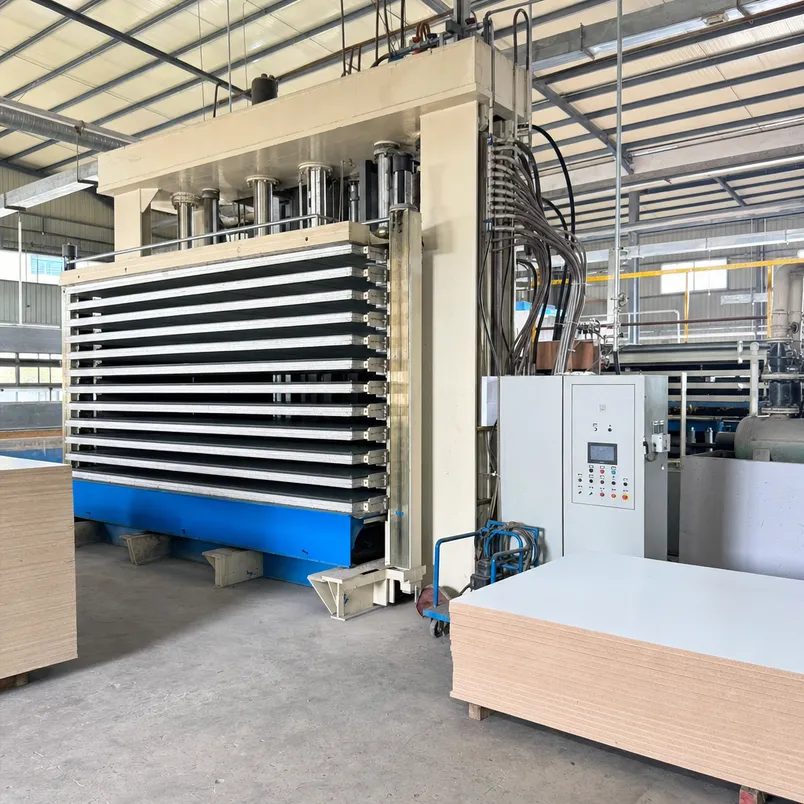
Multi-Daylight Hydraulic Hot Press
Calibrated to 1220×2440mm full panel surface
We press melamine board on multi-daylight hydraulic hot presses calibrated to maintain uniform temperature and pressure across the full 1220×2440mm panel surface. The critical variable is not just the press temperature — it's the consistency of heat distribution across the panel.
The failure mode to know: A press that runs hotter at the center than at the edges produces panels where the center bond is complete but the corners are under-bonded. Those corners lift within months of installation — and the failure looks like a surface quality problem to your customer, not a press parameter problem.
Paper Weight Specified by Application
80–120 g/m² range, not a post-production upgrade
The melamine paper we use runs 80–120 g/m² depending on the application. Heavier paper with higher resin saturation produces a harder surface that resists abrasion better in high-use applications.
Kitchen cabinets, commercial furniture, retail fixtures — high-contact surfaces requiring abrasion resistance
Bedroom furniture and shelving where the surface isn't subject to heavy contact
Paper weight is specified by application at the order stage — not as a post-production upgrade.
Cross-Cut Peel Test — Every Production Run
The checkpoint that stops surface-lifting failures at source
After pressing, every production run goes through a cross-cut peel test before it reaches the sanding line. We cut a 25mm strip from the panel edge and peel the melamine surface back.
Pass: Significant force required to peel; fiber remains on the paper — bond is complete.
Fail: Clean separation — bond is incomplete. Batch is pulled; press parameters reviewed before next run.
Calibrated Wide-Belt Sanding: ±0.2mm Thickness Tolerance
Consistent thickness across the batch — what automated cutting equipment requires
The sanding line follows pressing — calibrated wide-belt sanding to ±0.2mm thickness tolerance. The melamine surface is not sanded (that would damage it); the sanding is done on the back face and edges to bring the panel to final thickness.
Consistent thickness across the batch is what allows your downstream customers to run panels through automated cutting equipment without feed adjustments. Thickness variation is a hidden cost that shows up on your buyer's production floor, not on your inspection report.
Decor Range and Color Consistency Across Orders
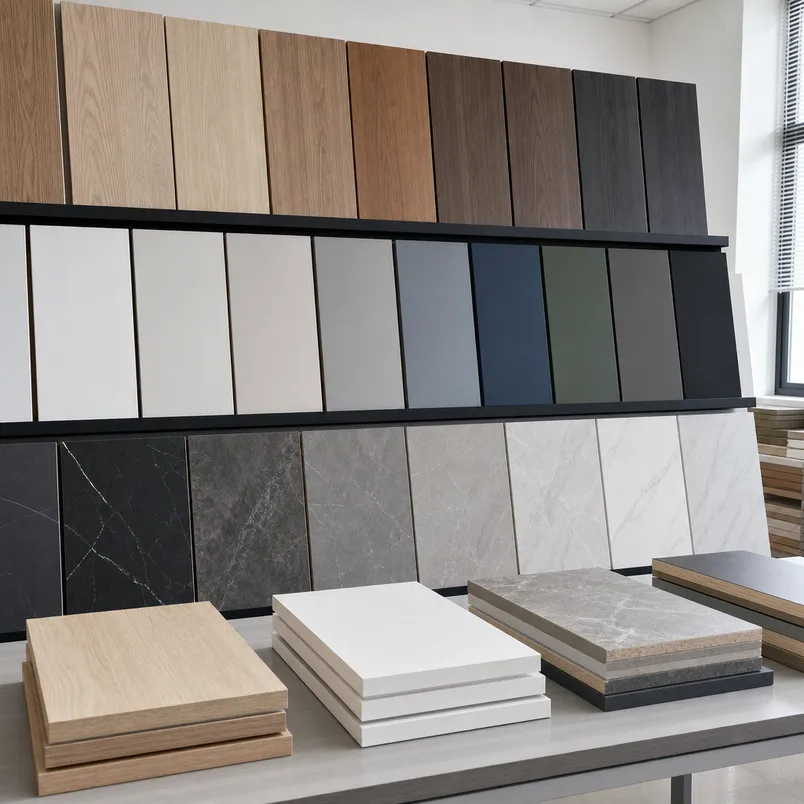
Color consistency across orders is the specification that matters most for buyers supplying into furniture manufacturing. A color shift between two orders of the same decor creates a production problem for your buyer — panels from different batches installed side by side in the same piece of furniture will show the variation.
Standard Catalog Decors
Wood Grain
Oak, walnut, maple, beech, and contemporary gray-tone wood grains — moving well in European and North American markets
Solid Colors
Standard white and off-white range plus a selection of grays and neutrals — available at lower MOQs from stock paper
Stone Patterns
Available on request — higher MOQs apply due to paper sourcing requirements outside the standard catalog
Standard catalog decors — the solid whites, grays, and common wood grains — are available at lower MOQs because we source the paper from stock. Custom decors sourced outside the standard catalog require a minimum paper order, which typically translates to higher per-decor MOQs.
Color Matching Across Orders
We maintain decor records by paper lot and can match color across orders on confirmed programs. For buyers with strict color-matching requirements, we recommend:
-
Specify paper lot numbers on confirmed orders to lock the color reference
-
Request a color sample from each new paper lot before production begins — this is the practical checkpoint for batch-to-batch consistency
Building a Private-Label Panel Range?
If you're building a private-label panel range for your distribution business, we can work from your decor specifications or help you select from our paper supplier's catalog.
Most buyers start with catalog decors to establish the program and move to custom papers once volume justifies the sourcing commitment. This keeps your initial MOQ manageable while you validate the range with your customers.
Standard Wood Grain Catalog — Key Patterns
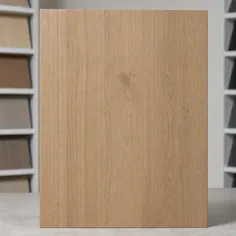
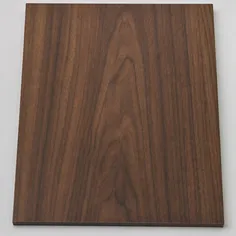
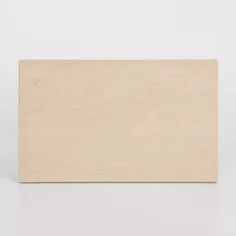
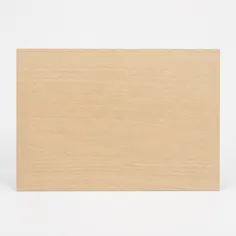
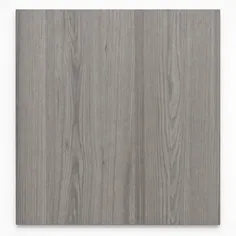
Swatch images are representative. Request physical samples for color-critical programs.
Customization Options for Melamine Board
Every dimension below is confirmed at order stage. Standard catalog specifications ship on normal production schedule — non-standard and custom specifications require confirmation before production begins.
| Customization Dimension | Options | MOQ / Lead Time Notes |
|---|---|---|
| Thickness | 9mm, 12mm, 15mm, 18mm, 21mm, 25mm; non-standard on request | Standard thicknesses: normal production schedule. Non-standard: confirm at order |
| Sheet Size | 1220×2440mm standard; 1220×2800mm, 1525×3050mm common custom | Custom dimensions: confirm at order, no tooling cost |
| Core Species | Poplar (standard), eucalyptus, hardwood | Hardwood core: higher MOQ, confirm availability |
| Glue System | UF (standard), MR (moisture-resistant), WBP (waterproof) | Specify at order stage — not a post-production change |
| Melamine Paper Weight | 80 g/m² (standard), 100 g/m², 120 g/m² (heavy-duty) | Specify at order stage |
| Surface Finish | Matte, satin | Gloss: see Glossy Melamine Plywood |
| Decor | Standard catalog decors (lower MOQ); custom-sourced decors (higher MOQ) | Custom decors: 500–1,000 sheets per decor minimum |
| Formaldehyde Standard | E1 (standard), CARB P2, E0 | CARB P2 standard for US-bound orders |
| OEM Branding | Bundle marking, panel stamping, documentation under your brand | Available on confirmed OEM programs |
Lead Time for Custom Specifications
From specification confirmation to first production sample: 15–20 working days for custom specifications. Standard catalog specifications ship on normal production schedule.
Glue System and Paper Weight Are Fixed at Order
Glue system (UF / MR / WBP) and melamine paper weight cannot be changed after production begins. Confirm these at order stage — not after panels are pressed.
Certifications and Compliance for Your Import Market
Documentation is prepared as part of the shipment package — not something buyers need to chase. If your import market requires it, it ships with the order.
Quality Management System
Global. Process consistency and batch traceability — covers the full production chain from raw material intake to finished panel.
Global
Formaldehyde Emission Limit
Required for California market access — and the most stringent formaldehyde emission standard in our export markets. Formulated to meet CARB P2 as the baseline for all export production. Not a special option or an upcharge.
USA (California + broader US market)
Chain of Custody
Wood fiber traceability to certified forests. Available on confirmed FSC orders for buyers with sustainability sourcing policies or audit requirements.
Global (sustainability-audited buyers)
Construction Product Compliance
EU market compliance for construction products. CE declaration of conformity is included as standard for EU-bound shipments.
European Union
What Ships With Your Order
-
US-bound shipments
CARB P2 documentation package included as standard
-
EU-bound shipments
CE declaration of conformity included as standard
-
FSC orders
Chain-of-custody records available on confirmed FSC orders
-
Audit reports and certificates
Available on request — prepared proactively, not chased by buyers
CARB P2 as Export Baseline
CARB P2 is the most stringent formaldehyde emission standard in our export markets. We formulate to meet it as the baseline for export production — it is not a special option or an upcharge.
We don't make buyers chase documentation. If your import market requires it, we prepare it as part of the shipment package.
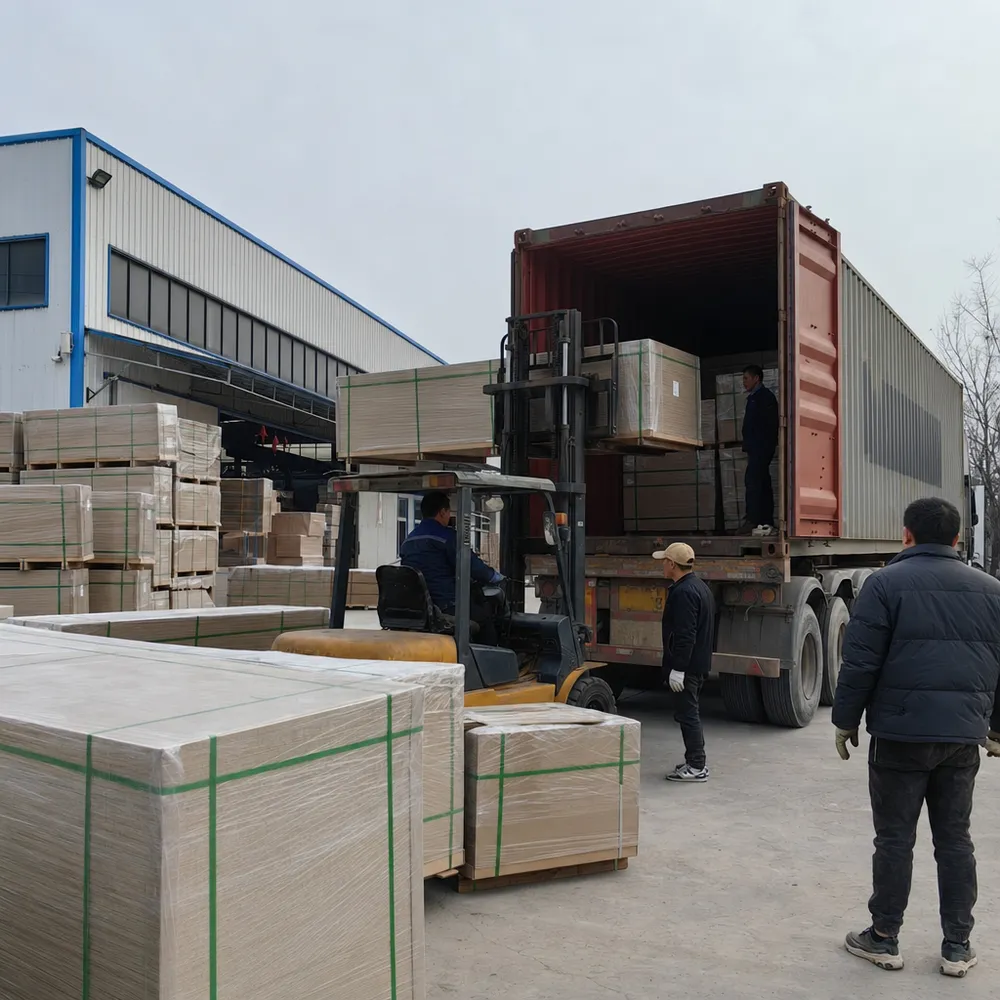
Learn more about our manufacturing capabilities and quality systemsContainer Loading and Export Logistics
Melamine board ships efficiently in standard 20HQ and 40HQ containers. Here's what to expect from our packaging, documentation, and transit process.
Container Utilization
Standard panel dimensions, optimized stacking
Standard 1220×2440mm panels stack flat and load to high container utilization. A 40HQ container typically carries 18–22 m³ of melamine board depending on thickness and stacking configuration.
Packaging Specification
Designed for ocean transit, surface-ready on arrival
The melamine surface is the finish — it arrives at your warehouse ready for resale, so surface protection during transit is part of our packaging specification.
- Panels bundled in packs of 50–100 sheets depending on thickness
- Strapped and edge-protected with corner boards
- Top sheet of each bundle protected with moisture-resistant film wrap
- Each bundle marked: product spec, decor code, thickness, quantity, batch number, destination port
Export Documentation
Prepared to avoid customs clearance delays
We've been through enough customs clearance cycles in North America, Europe, and the Middle East to know what documentation gaps cause delays — the paperwork is prepared to avoid them.
Port Access and Transit Times
Xuzhou factory — multiple port options
Xuzhou connects to Qingdao, Shanghai, and Lianyungang ports. Transit times to major destination ports run 18–35 days depending on routing and destination market.
Transit times to major destination ports depending on routing and destination market — North America, Europe, Middle East.
Other Melamine Plywood Products in This Range
Melamine board is the standard entry point in our melamine plywood range. Depending on your application and market, one of the sibling products may be a better fit.
Melamine Cabinet Board
Heavier core construction for cabinet carcass applications where the panel carries load and must hold fasteners cleanly. The right specification if your buyers are building kitchen and wardrobe cabinets with cam lock and dowel assembly.
18mm Melamine Plywood
The most-ordered thickness in our melamine range. If you're supplying into markets where 18mm is the standard cabinet carcass dimension, this is the SKU your buyers will reorder. We stock this thickness in the highest volume.
Kitchen Melamine Plywood
MR glue system and higher resin saturation melamine overlay for kitchen cabinet applications with sustained moisture exposure. The right specification for around-sink and under-bench applications.
Glossy Melamine Plywood
High-gloss surface for contemporary furniture and display cabinet applications where the panel face is visible and the finish is part of the design. Commands a price premium in retail furniture markets.
Not sure which product fits your market?
Our team can help you match the right substrate, glue system, and surface specification to your buyers' end-use requirements. Send us your application details and we'll recommend the right SKU.
Frequently Asked Questions
Technical and sourcing questions answered for furniture manufacturers, cabinet distributors, and import buyers.
What is the difference between melamine board and melamine MDF?
The substrate is the difference, and it determines the application. Melamine board uses a cross-grain plywood core — multiple veneer layers — which gives it better screw-holding strength, impact resistance, and load-bearing capacity than MDF. Melamine MDF uses a medium-density fiberboard core, which machines more cleanly and holds a sharper routed edge, but is heavier and less resistant to moisture.
For cabinet carcasses and furniture components where the panel carries load and holds fasteners, melamine board is the stronger specification. For door fronts and decorative panels where machining precision matters more than structural performance, melamine MDF is often preferred.
Application Split — Most Furniture Manufacturers
Melamine Board
Carcass panels — load-bearing, fastener-holding
Melamine MDF
Door fronts — machining precision, sharp routed edges
What thickness of melamine board is standard for furniture and cabinet applications?
18mm is the standard carcass thickness across European and North American kitchen and wardrobe cabinet systems. It provides adequate load-bearing capacity for shelf spans up to 900mm and holds cam locks and dowels cleanly in standard cabinet assembly.
Upper cabinet carcasses and lighter furniture components where load is lower.
Standard — covers the majority of applications
Shelf spans up to 900mm, cam locks, dowels. European and North American kitchen and wardrobe systems.
Base cabinets, pantry units, and furniture components with higher structural requirements.
For most furniture distribution businesses, stocking 18mm covers the majority of customer applications from a single SKU.
When should I specify MR glue instead of standard UF glue?
Standard UF (urea-formaldehyde) glue is adequate for dry interior applications — bedroom furniture, office furniture, shelving in climate-controlled environments. MR (moisture-resistant) glue is the right specification for kitchen and bathroom cabinet applications where the panel will be exposed to humidity cycling.
The glue system is specified at the order stage — it's not a post-production change.
For buyers stocking for a trade customer base with varied applications, 18mm melamine board in MR glue covers the majority of cabinet and furniture applications without needing to manage multiple glue system SKUs.
Dry interior use — bedroom furniture, office furniture, climate-controlled shelving. Standard specification for most interior furniture applications.
Kitchen and bathroom cabinet applications with humidity cycling exposure. Recommended default for trade buyers supplying mixed-application customers.
What causes melamine board surfaces to lift or peel, and how do I evaluate a supplier's process?
Surface lifting is almost always a press parameter problem — incomplete bonding between the melamine paper and the substrate due to insufficient temperature, pressure, or press cycle time. It can also result from pressing onto veneer with elevated moisture content.
Root cause: Insufficient temperature, pressure, or press cycle time during the melamine pressing stage. Elevated substrate moisture content is a secondary cause.
When evaluating a supplier, ask specifically about their press parameter logging and in-process bond testing protocol.
A supplier who can show you batch-level press records and peel test results is running a controlled process.
A supplier who only tests finished panels at the end of the line is catching failures after they've already been produced.
Questions to ask any supplier:
What is the minimum order quantity for melamine board?
MOQ depends on the specification. Standard catalog decors in standard thicknesses have lower MOQs — typically from one container load, which covers 18–22 m³ depending on thickness.
Custom decors sourced outside the standard catalog require a minimum paper order from the supplier, which typically translates to 500–1,000 sheets per decor.
For buyers new to our melamine board range, most start with a sample order across two or three decors in 18mm to run through their own quality check before committing to a full container. We can ship samples within 7–10 working days.
Does melamine board meet CARB P2 formaldehyde emission requirements?
Yes — we produce melamine board to CARB P2 emission standards as the baseline for export production. CARB P2 is the most stringent formaldehyde emission limit in our export markets, and we formulate to meet it rather than treating it as a special option.
For US-bound shipments, the CARB documentation package is included as standard. If you're supplying into California or other CARB-regulated markets, the compliance documentation is ready without additional lead time or upcharge.
Start Your Melamine Board Sourcing
Most buyers new to our melamine board range start with a sample order in 18mm across two or three decors — enough to run through your own quality check and show your customers before committing to a full container.
Start with a Sample Order
Recommended for first-time buyers
We can ship samples within 7–10 working days. A sample order in 18mm across two or three decors gives you everything you need to run your own quality check and present options to your customers before committing to a full container.
- 18mm thickness — the most common starting point for furniture and cabinet buyers
- Two or three decors to compare surface finish and color consistency
- Dispatched within 7–10 working days of order confirmation
- Relevant certification documentation included on request
Send Your Specification Directly
For buyers with defined requirements
If you already have a specification, send it to us directly and we'll come back with a detailed quote and the relevant certification documentation for your import requirements.
What to include in your spec
Xuzhou QD Wood Industry Co., Ltd.
No. 88 Sanbao Industrial Park, Tongshan District, Xuzhou, Jiangsu Province, 221116, China
[email protected]
Phone / WhatsApp
+8615852005272
Address
No. 88 Sanbao Industrial Park, Tongshan District,
Xuzhou, Jiangsu Province, 221116, China
Ready to move forward? Use any of the links below to get a quote, browse the full melamine plywood range, or learn more about our factory and production capabilities.