

Paper Overlaid Plywood Panel Manufacturer
Factory-direct paper overlaid plywood panels — smooth, stable, ready for paint or print.
Decoration paper overlaid plywood with consistent surface quality across full production runs. Thickness 2.5mm–25mm, custom sizing available, CARB P2 and FSC certified for North American and European markets.
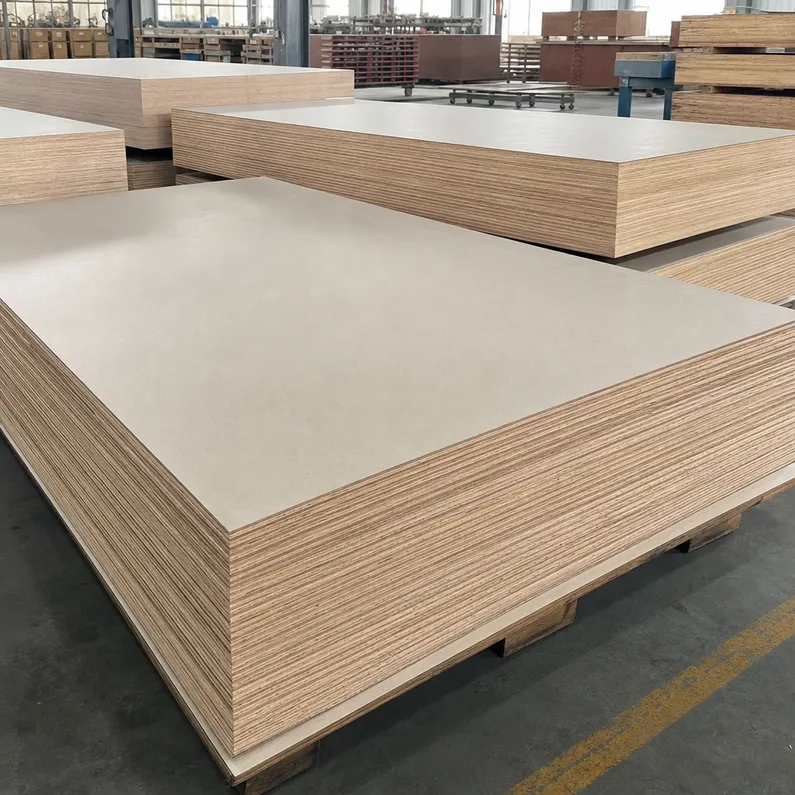
What Paper Overlaid Plywood Panels Are — and Where They Fit in Your Product Line
A paper overlaid plywood panel is a standard plywood substrate with one or two faces bonded under heat and pressure to a resin-impregnated paper overlay. The overlay fills the open grain of the face veneer, producing a surface that is dimensionally stable, uniformly smooth, and ready to accept paint, primer, or decorative print without the grain telegraphing through the finish coat.
The distinction from other surface-treated panels matters for sourcing decisions. Melamine-faced plywood arrives with a finished decorative surface — the surface treatment is the end product. A paper overlaid plywood panel is an intermediate product: the overlay creates a controlled substrate that your downstream customer or fabricator finishes themselves. That makes it the right choice for applications where the final color, texture, or print is specified by the end user — signage, painted cabinetry, display fixtures, and architectural millwork where the painter or printer controls the final appearance.
Within our paper overlaid plywood range, this panel product sits alongside MDO plywood and paper overlaid plywood sheets. The panel format is optimized for buyers who need a versatile, full-sheet product across a range of thicknesses — not a single-thickness commodity item.
If your order requires a specific overlay weight or a non-standard panel dimension, that's a customization conversation, not a product limitation.
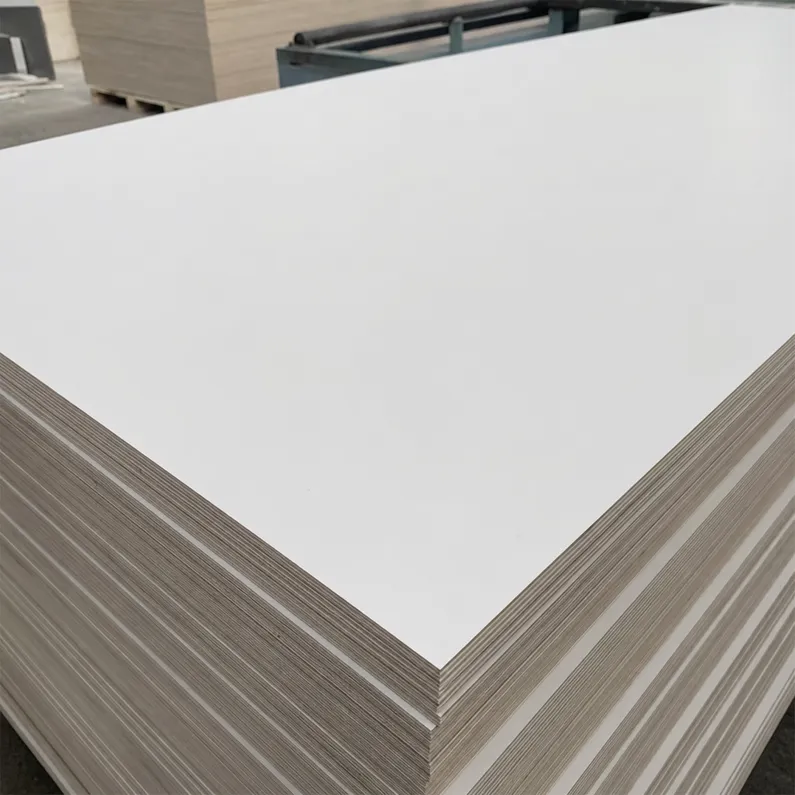
How It Compares to Adjacent Products
Paper Overlaid Plywood Panel
Intermediate substrate. Overlay controls surface uniformity; end user specifies final color, texture, or print. Versatile thickness range for multiple applications.
Melamine-Faced Plywood
Finished decorative surface — the surface treatment is the end product. Color and texture are fixed at manufacture. Not suitable where the end user controls final appearance.
MDO Plywood
Medium Density Overlay — heavier overlay weight, optimized for exterior signage and concrete forming. Shares the same intermediate-substrate logic but with a more specialized overlay spec.
Technical Specifications
The specifications below reflect industry-standard values for commercial paper overlaid plywood panels. Actual parameters are confirmed at order stage — contact us with your target application and we'll provide the exact spec sheet.
Standard Product Parameters
Overlay Weight — What It Means
Overlay weight (g/m²) is the single most important variable in paper overlaid plywood. It determines surface smoothness, paint holdout, and how many finishing cycles the panel can support.
MDO (Medium Density Overlay) uses a heavier, resin-rich overlay in the 220–400 g/m² range and is a distinct product category — see MDO Plywood.
Available Certifications
Custom Specifications Available
Non-standard panel sizes, custom overlay weights, specific glue lines, and proprietary face grades are available for container-quantity orders. Share your application brief and we'll confirm feasibility and lead time.
Manufacturing Process
Paper overlaid plywood is produced in a controlled multi-stage process. Each stage directly affects the surface quality and dimensional stability of the finished panel.
Log Selection & Veneer Peeling
Hardwood logs — typically poplar, eucalyptus, or mixed tropical hardwood — are selected for consistent density and low defect rate. Rotary peeling produces continuous veneer sheets at target thickness (typically 1.5–2.0mm per ply). Veneer is clipped, dried to 6–10% moisture content, and graded before lay-up.
Core Assembly & Glue Application
Veneer plies are assembled in cross-laminated orientation — each ply perpendicular to the adjacent one. Phenolic (WBP) or urea-formaldehyde (MR) resin is applied by roller spreader or curtain coater. Ply count is determined by target thickness: thinner panels use 3 plies; structural thicknesses use 5, 7, or more odd-numbered plies to maintain symmetry and prevent warping.
Hot Press — Core Panel
The assembled core is pressed under heat (130–150°C) and pressure (1.0–1.4 MPa) to cure the adhesive and consolidate the panel. Press time varies by thickness and glue type. After pressing, panels are cooled, trimmed to rough size, and inspected for delamination or core voids before proceeding to overlay application.
Overlay Paper Preparation
Kraft paper at the specified overlay weight is pre-impregnated with thermosetting resin (typically phenolic or melamine-urea blend). The resin content and cure state are controlled to ensure the paper bonds firmly to the face veneer without bleed-through or surface irregularity. Resin content typically runs 30–50% by weight of the dry paper.
Overlay Bonding — Second Hot Press
The pre-impregnated paper is laid onto the face (and back, for double-face panels) of the core panel and returned to the hot press. The second press cycle fuses the overlay to the veneer surface under controlled temperature and pressure, creating a continuous, grain-suppressed surface. Caul plates ensure flatness and uniform surface texture across the full panel.
Sanding, Sizing & Quality Inspection
Panels are sanded to final thickness tolerance (±0.5mm standard; ±0.3mm on request), trimmed to finished panel size, and inspected for surface uniformity, edge quality, and overlay adhesion. Panels are bundled, edge-sealed where specified, and palletized for export. Each production batch is accompanied by a mill test report confirming thickness, moisture content, and glue bond class.
The Overlay Bonding Process — Where Surface Quality Is Actually Decided
Surface quality is determined at the press stage, not at the sanding stage. Understanding how we engineer against the two primary failure modes explains why our panels perform consistently across production runs.
Press System and Calibration
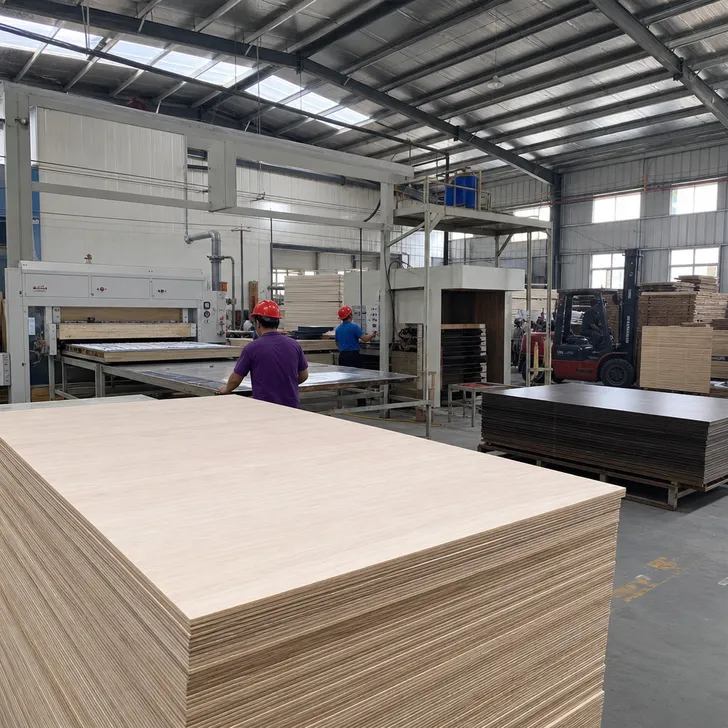
We run the overlay bonding on the same multi-daylight hydraulic hot press system used across our production lines — calibrated to maintain uniform pressure and temperature across the full 1220×2440mm panel surface. Consistent heat and pressure distribution across the entire sheet is the foundation of a defect-free overlay bond.
The Failure Mode We Engineer Against
Telegraphing happens when press temperature or pressure is uneven: the paper bonds well in the center of the panel but lifts slightly at the edges, or the face veneer grain pushes through the overlay because the resin didn't fully cure under consistent heat.
Either defect shows up immediately when the panel is painted — grain lines appear through the finish coat, or the overlay peels at the edge when the panel is cut. Both are visible failures your downstream fabricator will catch before committing to a production run.
Two-Point Quality Control
-
Face veneer graded before layup. The face veneer going under the overlay is graded and sanded before layup — we're not relying on the overlay to hide a rough face veneer, because it won't. The overlay fills grain; it doesn't bridge surface defects.
-
Press parameters logged per batch. Temperature, pressure, and dwell time are recorded for every production run. If a surface quality issue surfaces in outgoing inspection, we can trace it back to the specific press run and identify whether it was a material issue or a process deviation.
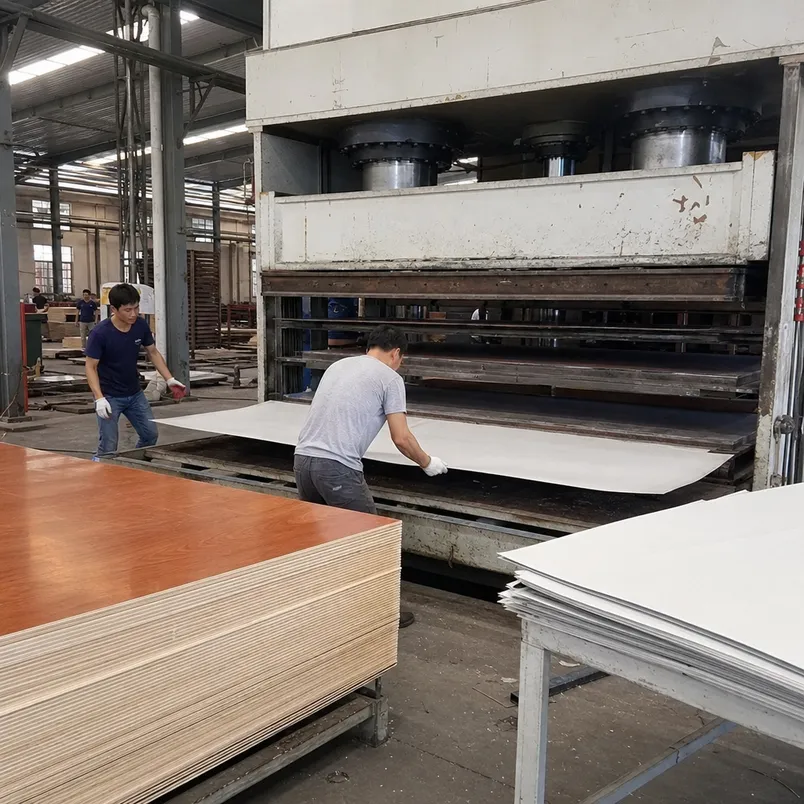
Overlay Weight Selection Guide
The overlay weight matters more than most buyers realize.
Adequate for interior painted applications. Provides a smooth, grain-free surface for single-cycle paint finishes in cabinetry, millwork, and interior wall paneling.
Recommended for exterior signage or applications where the panel will be painted and repainted multiple times. The heavier overlay holds up to repeated paint cycles without lifting at cut edges.
The practical result: a panel surface that passes a straight-edge check across the full sheet and accepts primer without grain show-through — which is the practical test your downstream fabricator will apply before they commit to a production run.
Market Segments Where This Panel Generates Repeatable Orders
For distributors building a product line, understanding which end-use segments drive consistent reorder volume — and why — is the difference between a one-time sale and a reliable revenue stream.
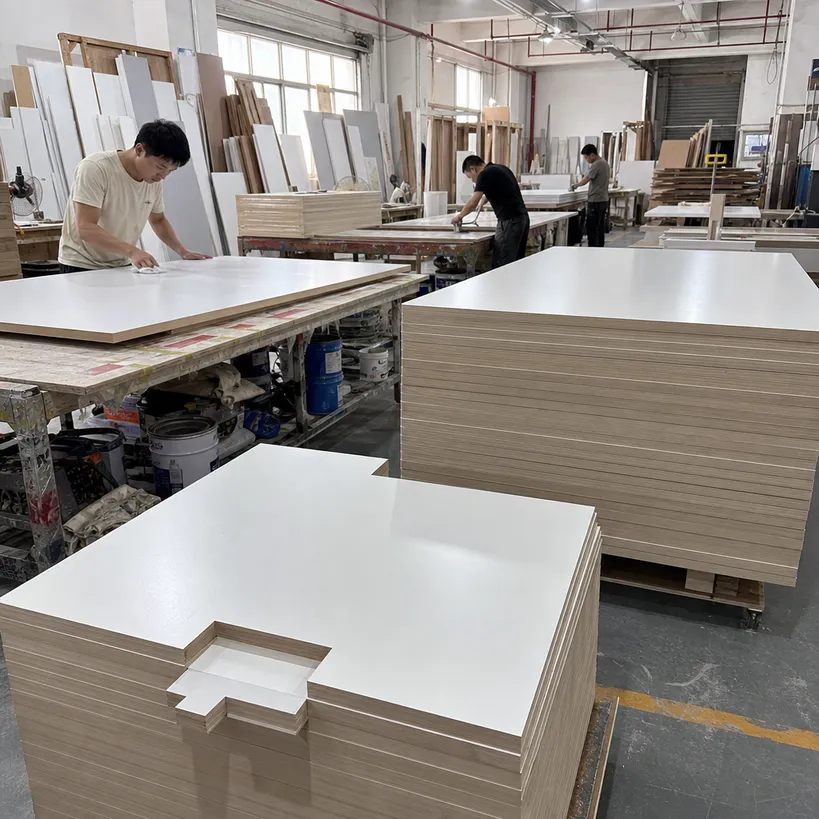
Signage and Display Fabrication
Highest VolumePallet quantities · 4–8 week reorder cycles
The highest-volume segment for paper overlaid plywood panels in most distribution markets. Sign shops and display fabricators need a substrate that paints flat, cuts clean, and holds routed edges without tearout. The paper overlay provides the smooth, grain-free surface that makes painted signage look professional rather than textured.
Reorder pattern: Fabricators in this segment typically order in pallet quantities on 4–8 week cycles. Once you're their substrate supplier, reorder frequency is predictable.
Painted Cabinetry and Millwork
Growing SegmentResidential and commercial interiors
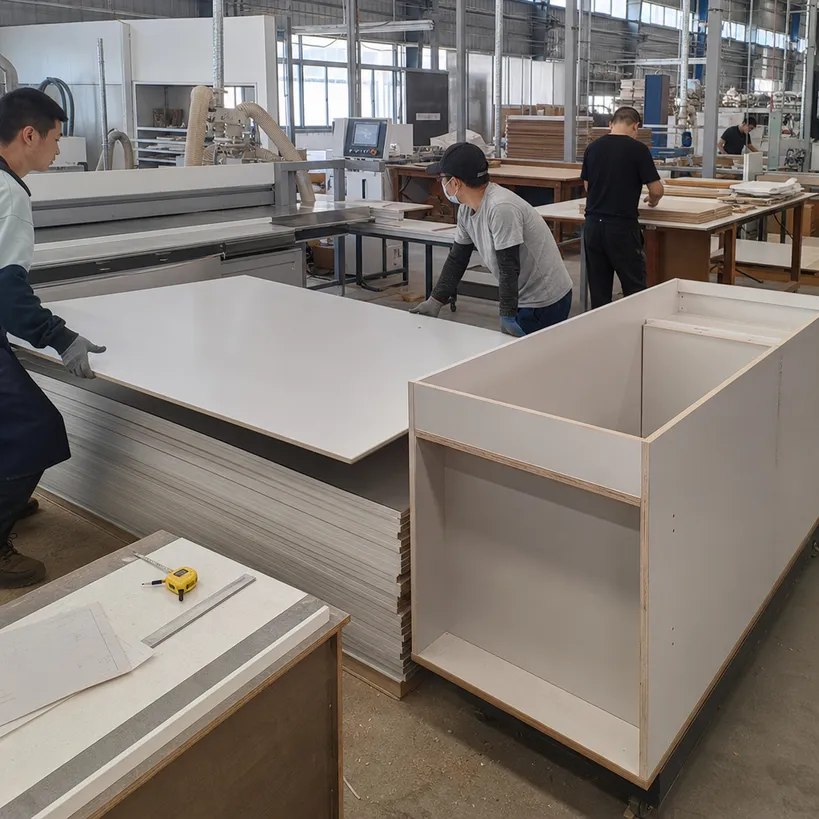
A growing segment as painted finishes continue to take share from stained wood in residential and commercial interiors. Cabinet shops and millwork fabricators who specify painted finishes need a substrate that won't telegraph grain through the paint. Paper overlaid plywood panels deliver that at a lower cost than MDF for applications where structural properties matter — door panels, face frames, and cabinet sides that need to hold screws and resist racking.
vs. MDF: MDF is heavier and doesn't hold fasteners as well at edges. Fabricators who've switched to paper overlaid plywood for painted work generally don't go back.
Architectural Wall Paneling and Interior Fit-Out
Retail · Hospitality · Office
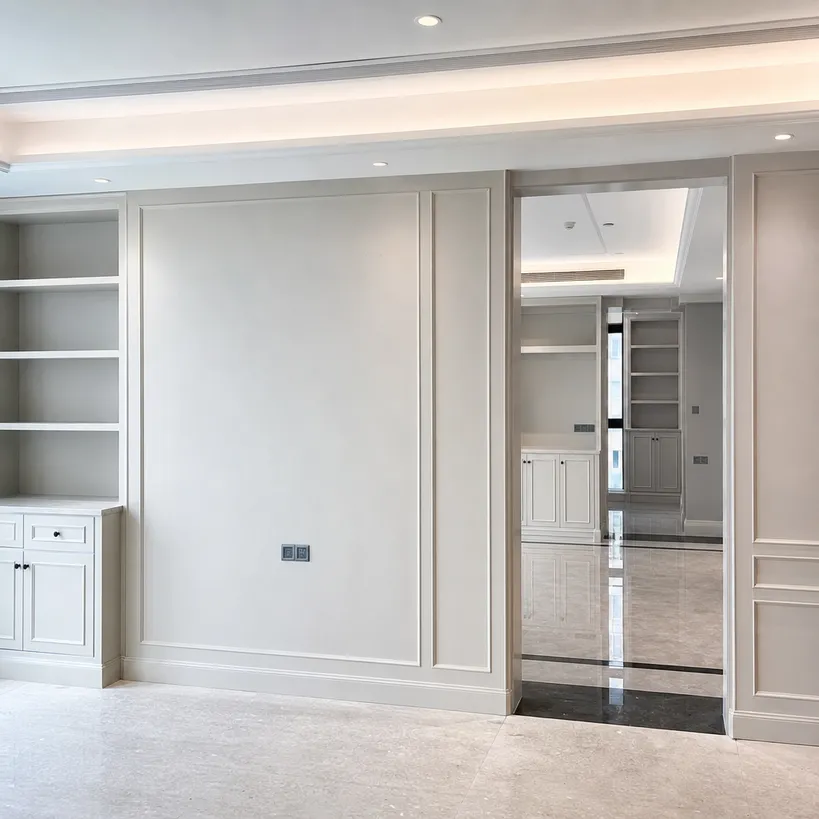
Contractors and fit-out companies in commercial interiors — retail, hospitality, office — specify painted panel systems where the surface needs to be consistent across large areas. A paper overlaid plywood panel delivers that consistency in a way that raw plywood cannot, because the overlay eliminates the grain variation that causes uneven paint absorption across a sheet.
Application: Substrate for site-painted or factory-painted wall systems in commercial interiors where surface consistency across large areas is a specification requirement.
Temporary and Reusable Formwork Overlays
Niche · ConsistentConstruction contractors · Larger single orders
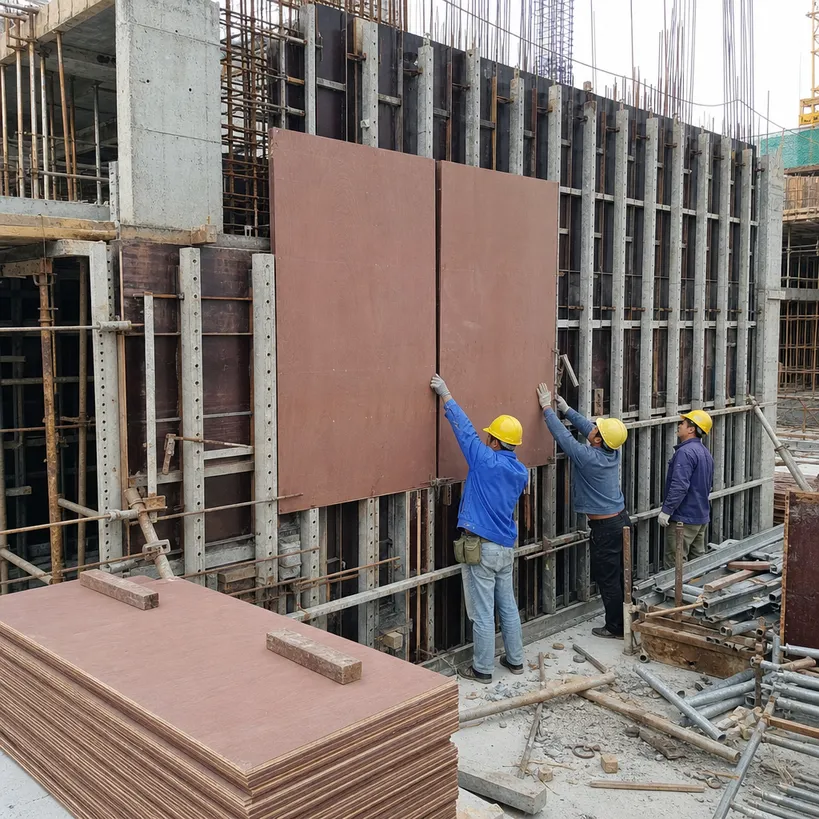
A niche but consistent segment in some markets — the paper overlay protects the plywood face during concrete pours and extends the reuse life of the panel. This is a smaller volume application but tends to generate larger single orders from construction contractors.
Order profile: Smaller total volume than signage or cabinetry, but individual orders from construction contractors are typically larger in unit quantity per purchase.
Distributor Volume Recommendation
Which segments to prioritize when building your product line
For distributors building a product line, the signage and painted cabinetry segments are the most reliable volume drivers. Both have consistent reorder patterns and relatively low price sensitivity compared to commodity plywood — the surface quality premium is visible and justifiable to the end customer.
Architectural fit-out and formwork are worth carrying for completeness, but they require longer sales cycles and project-based purchasing patterns that are harder to forecast.
Highest volume · Predictable reorder
Growing segment · Low price sensitivity
Project-based · Longer sales cycle
Smaller volume · Larger single orders
Customization Parameters for OEM and Private-Label Orders
Paper overlaid plywood panels are one of the more customizable products in our range because the key variables — overlay weight, core species, glue type, and panel dimensions — can all be adjusted without tooling changes.
Overlay Weight & Type
Standard production runs 120–180 g/m² kraft paper overlay. For buyers targeting exterior applications or high-durability painted surfaces, we can run 200–220 g/m² overlay on confirmed orders.
Core Species & Construction
Default core is poplar or eucalyptus cross-laminated veneer. Buyers who need higher bending stiffness or screw-holding performance can specify hardwood core — mixed tropical hardwood or birch — relevant for structural panel applications where the overlay is secondary to substrate performance.
Glue Bond Type
WBP phenolic resin is standard for export-grade panels. MR (urea-formaldehyde) glue is available for interior-only applications where cost is the primary driver. For CARB P2 compliance, we use low-formaldehyde resin systems across both glue types.
Panel Dimensions
Standard 1220×2440mm. Custom dimensions are available on confirmed orders — we cut to size on precision saws, so custom dimensions are a scheduling question, not a tooling question. Minimum order quantities for custom dimensions are higher than standard sizes; confirm with us at inquiry stage.
Private Label & OEM Marking
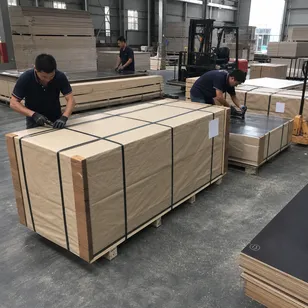
Bundle marking, panel stamping, and custom packaging are available for buyers who distribute under their own brand. We've run private-label programs for distributors in North America and Europe — the process is straightforward once the specification is confirmed.
MOQ & Lead Time
MOQ for standard configurations starts at one container load (approximately 20–25 m³ for a 20GP) depending on thickness mix. Custom specifications typically require a higher MOQ to justify the production run setup. Send us your target specification and volume — we'll confirm MOQ and lead time in the quote.
Compliance Coverage for Your Import Market
Every major import market has its own documentation requirements. Here's what we cover as standard — and what we prepare for each destination.
CARB P2
US Market StandardCARB P2 is the formaldehyde emission standard that governs wood panel imports into California and, practically, the entire US market — most major US distributors require CARB P2 compliance across their panel inventory regardless of end destination. Our paper overlaid plywood panels are produced to CARB P2 as the baseline, not as a premium option. The resin systems we use are formulated to meet the ≤0.05 ppm emission limit, and outgoing inspection includes formaldehyde emission testing on each production batch.
FSC Chain-of-Custody
SustainabilityFSC chain-of-custody certification covers the wood fiber sourcing for buyers with sustainability procurement requirements. If your downstream customers — retailers, architects, or project owners — require FSC documentation, we can supply it as part of the standard export package. Sustainability sourcing requirements have moved from a niche specification to a standard procurement question in European and North American commercial interiors markets.
CE Marking
EU MarketCE marking covers European construction product requirements. For buyers supplying into EU construction and building material channels, CE declaration of conformity is included in the export package.
ISO 9001:2015
QMS CertifiedISO 9001:2015 certification covers the quality management system — relevant for buyers whose own supplier qualification process requires documented QMS. Audit reports are available on request; we don't make you chase documentation.
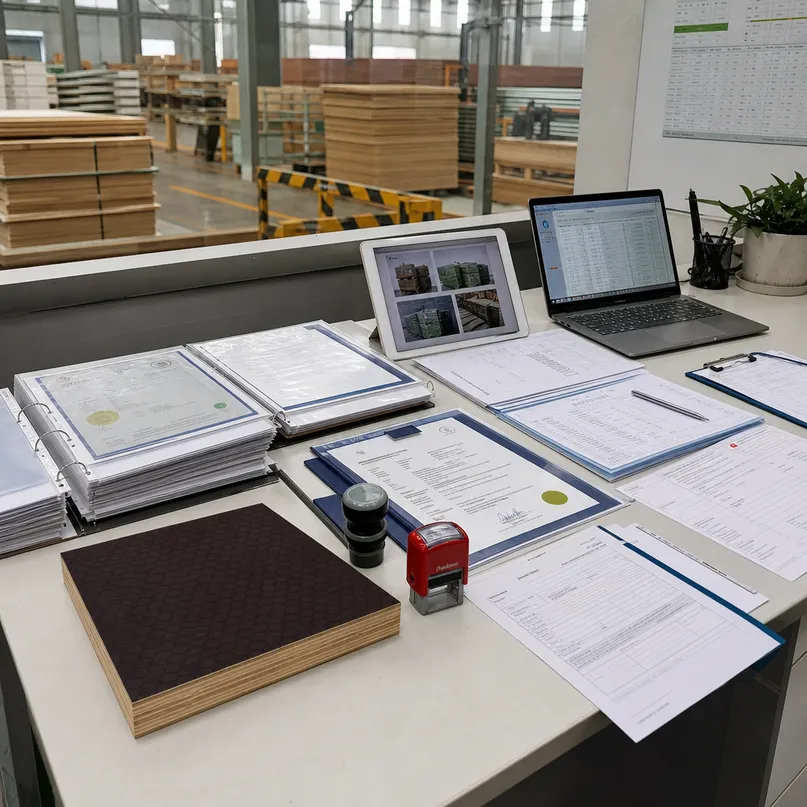
Documentation by Destination
Packaging, Container Loading, and Transit Protection
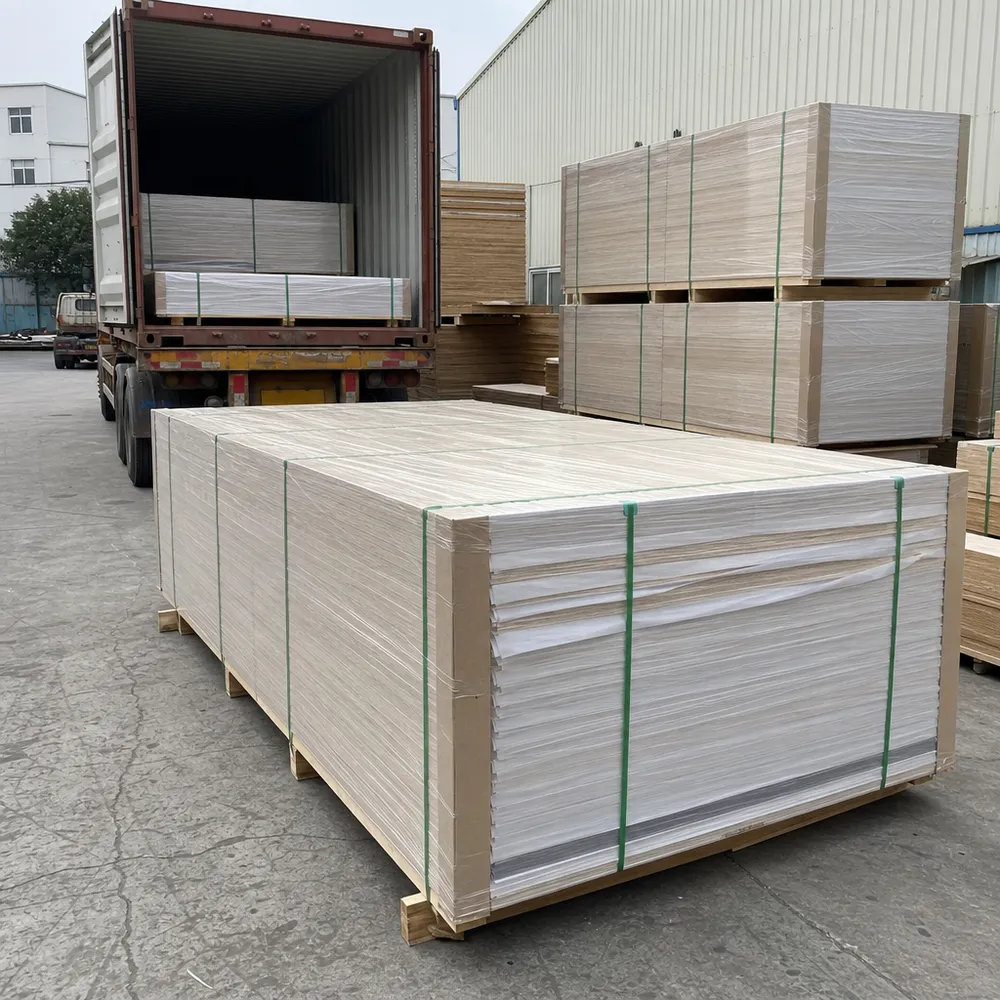
Paper overlaid plywood panels are surface-sensitive products — the overlay can be scratched or marked during handling, and any surface damage shows up immediately when the panel is painted. We package accordingly.
Bundle & Protection Standards
Panels are interleaved with protective paper between sheets to prevent surface contact and overlay scratching during transit and handling.
Bundles are strapped and fitted with corner boards to protect edges from impact during container loading and port handling.
Export bundles are wrapped in moisture-resistant film. The overlay is paper-based and will absorb moisture if the bundle is exposed during ocean transit or port storage.
Each bundle is marked with product specification, thickness, quantity, batch number, and destination port for traceability from factory to warehouse.
Container Loading — Standard 1220×2440mm Panels
| Container | Approx. Loading (18mm) | Notes |
|---|---|---|
| 20GP | ~280–320 sheets | Varies by thickness and bundle configuration |
| 40HQ | ~600–680 sheets | Preferred for mixed-thickness orders |
We provide loading plans with each shipment so your receiving team knows the bundle configuration and stacking order before the container is opened. For mixed-thickness orders, we coordinate the loading sequence to minimize handling at your warehouse.
Transit Times from Xuzhou
We ship through Qingdao, Shanghai, and Lianyungang depending on routing and schedule.
Sourcing Paper Overlaid Plywood Panels from QDPlywood.com
We've been manufacturing paper overlaid wood panels since the early years of the operation — it's not a product we added to fill out a catalog. The overlay bonding process runs on the same press infrastructure as our core plywood production, which means the process discipline we apply to bonding consistency carries over directly to overlay adhesion quality.
Our export team has been handling North American, European, and Middle Eastern shipments long enough to know the documentation requirements for each market without looking them up. CARB packages for US shipments, CE declarations for EU, FSC records for sustainability-audited buyers — all prepared as standard, not as add-ons.
Direct rail and road access to Qingdao and Shanghai ports. Mixed-thickness container orders accommodated without lead time penalty.
Mixed-thickness container orders are accommodated without the lead time penalty you'd get from a factory that treats non-standard configurations as special runs.
Related Products in the Paper Overlaid Plywood Range
If the paper overlaid plywood panel doesn't match your exact specification, two sibling products may be a better fit.
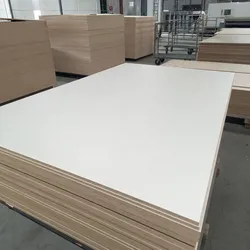
MDO Plywood
Medium Density Overlay plywood with a heavier resin-fiber overlay (typically 180–220 g/m²), designed specifically for exterior signage and painted applications requiring maximum surface durability and weather resistance. If your buyers are sign fabricators working with exterior-grade painted signs, MDO is the specification to quote.
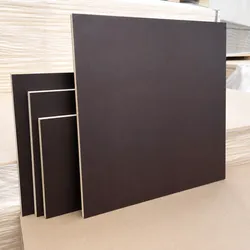
Paper Overlaid Plywood Sheet
Optimized for buyers who need a specific sheet format, custom overlay specification, or private-label packaging. If your order has non-standard dimensions or a specific overlay weight requirement as the primary driver, the sheet product page covers those customization parameters in more detail.
For the full paper overlaid plywood range, see Paper Overlaid Plywood.
Frequently Asked Questions
Specification and sourcing questions answered for procurement and product managers.
For interior painted signage, 120–150 g/m² is standard and cost-effective. For exterior painted signage — roadside signs, site hoardings, outdoor display — specify 180–220 g/m² and WBP glue bond.
The heavier overlay resists moisture absorption at cut edges, which is where exterior painted panels typically fail first. If your sign fabricator customers are reporting edge delamination on painted panels, overlay weight and glue type are the first two variables to check.
MDO (Medium Density Overlay) is a specific grade of paper overlaid plywood defined by a heavier, resin-fiber overlay (typically 180 g/m² and above) that meets the PS 1 standard for exterior use. Standard paper overlaid plywood panels use a lighter kraft paper overlay and are typically specified for interior applications.
The practical difference for your buyers: MDO is the specification for exterior painted signage and concrete formwork; standard paper overlaid panels are the specification for interior painted cabinetry, millwork, and display fixtures.
We produce both — see MDO Plywood for the exterior-grade specification.
Standard configurations (1220×2440mm, stock thicknesses, single or double face) start at one container load — approximately 20–25 m³ for a 20GP depending on thickness. Mixed-thickness orders within a single container are accommodated.
Custom dimensions or non-standard overlay weights require a higher MOQ; confirm at inquiry stage.
The overlay adds negligible weight and does not meaningfully change the panel's bending stiffness or screw-holding performance — those properties are determined by the core construction and thickness. The overlay's function is surface quality, not structural contribution.
If your application requires specific structural performance (load ratings, span tables), specify the core construction and thickness, and we'll confirm the structural parameters.
Standard paper overlaid panels with WBP glue bond can be used for light-duty concrete formwork applications. For high-cycle formwork where the panel will be reused 10+ times, we recommend specifying a heavier overlay weight (180–220 g/m²) and a hardwood core for improved rigidity and surface durability.
For dedicated formwork applications, our film-faced plywood range is typically the more cost-effective choice over multiple reuse cycles — the phenolic film surface releases from concrete more cleanly than a paper overlay.
15–25 working days from order confirmation to container loading. Applies to stock thicknesses, 1220×2440mm, single or double face.
20–30 working days. Applies to non-standard dimensions, overlay weight, or core species.
These are production lead times — add transit time for your destination port. Contact us with your target delivery date and we'll confirm feasibility at quote stage.
Get a Quote for Paper Overlaid Plywood Panels
Send us your target specification and we'll come back with a detailed quote, relevant certification documentation, and a loading plan for your container.
What to Include in Your Quote Request
-
Thickness
Your target panel thickness in mm or inches
-
Overlay Type
Single face or double face overlay
-
Glue Bond
Interior, exterior (WBP), or marine-grade requirement
-
Volume
Estimated order quantity — sheets, CBM, or containers
-
Destination Market
Country or region — determines which certification documentation applies
Evaluating Paper Overlaid Plywood for the First Time?
Tell us your target application and the market you're supplying into. We'll recommend the overlay weight and core construction that fits, based on what's working for our existing buyers in that segment.
What We Send Back
Detailed Quote
Unit price, MOQ, and lead time
Certification Docs
Relevant to your import requirements
Loading Plan
Container utilization breakdown
Xuzhou QD Wood Industry Co., Ltd.
Factory-direct paper overlaid plywood manufacturer — Jiangsu Province, China
[email protected]
Phone / WhatsApp
+8615852005272
Address
No. 88 Sanbao Industrial Park, Tongshan District,
Xuzhou, Jiangsu Province, 221116, China
Certifications Available