

Oriented Strand Board Manufacturer — Factory-Direct OSB Supply
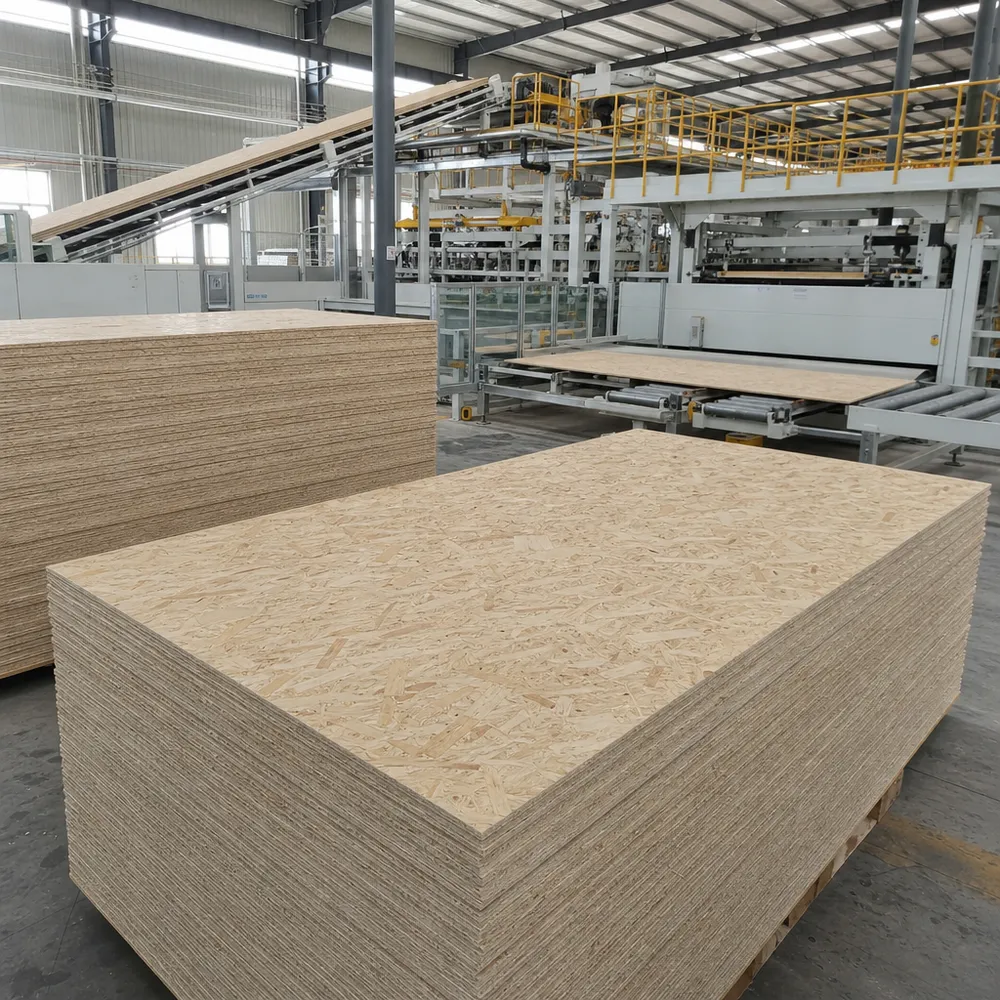
Structural-grade oriented strand board, manufactured and exported direct from Xuzhou, China — no trading company markup.
CE and CARB P2 compliant panels in standard and custom dimensions, with FSC chain-of-custody documentation available for sustainability-audited buyers.
What Sets This OSB Apart from Generic Commodity Supply
Oriented strand board sits in a category where most buyers assume the product is interchangeable — same strands, same resin, same panel. That assumption costs money downstream.
The difference between a well-made OSB panel and a commodity one shows up in three places: dimensional stability under humidity cycling, internal bond strength under load, and formaldehyde emission compliance when the panels land in a regulated market.
We manufacture oriented strand board at our 18,000 m² facility in Xuzhou, Jiangsu Province, running the same quality infrastructure we apply across our full engineered wood panel range. The OSB production process uses oriented wood strands — typically poplar or pine, depending on the order specification — pressed with waterproof resin under high heat and pressure.
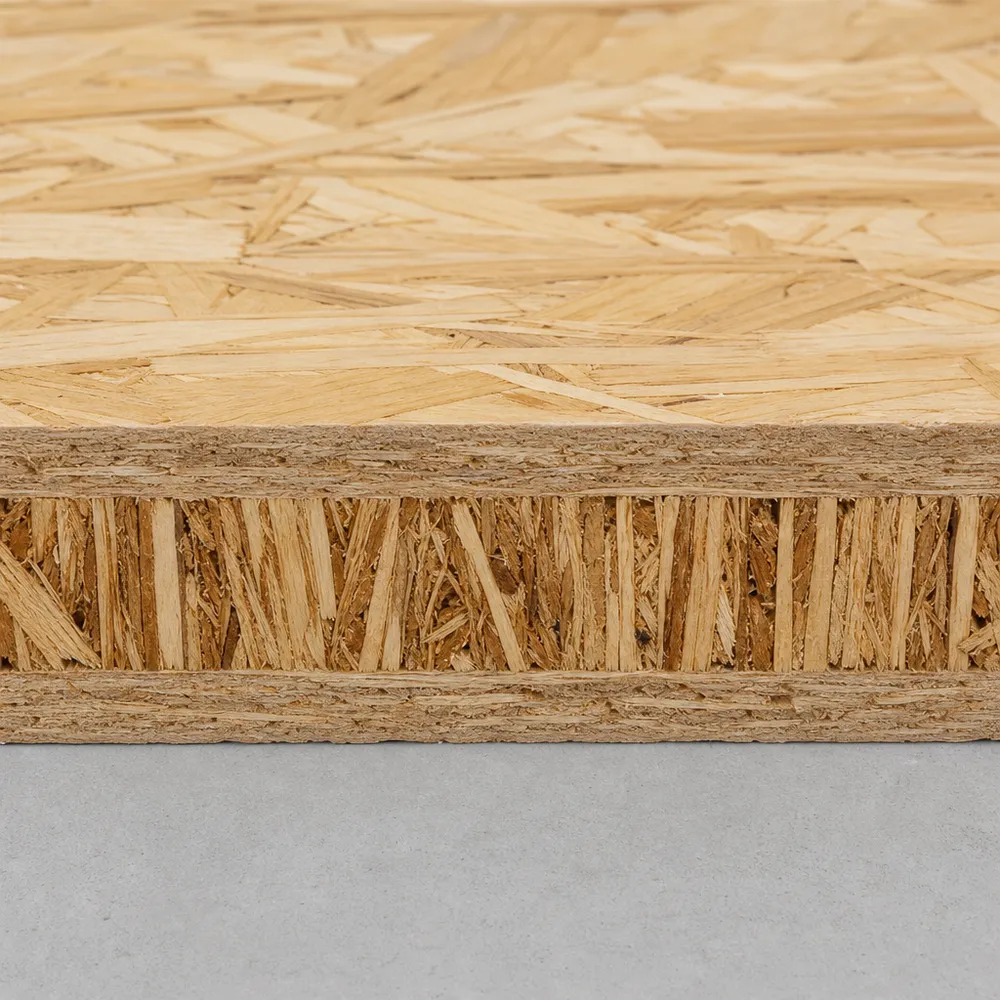
The strand orientation runs perpendicular between face and core layers, which is what gives OSB its cross-directional strength profile. We run the press parameters to achieve internal bond strength consistent with structural-grade applications, not just the minimum needed to hold the panel together for transit.
Dimensional Stability
Consistent performance under humidity cycling — not just on the data sheet.
Internal Bond Strength
Structural-grade press parameters, not minimum transit-hold spec.
Emission Compliance
CARB P2 and E1 documentation ready for regulated import markets.
What This Means for Your Sourcing
Panels that perform to spec in the field, not just on the data sheet. Fewer warranty claims from your downstream customers, fewer customs holds from emission compliance issues, and documentation that satisfies your buyers' procurement requirements without you having to chase it.
We run MDI resin as standard on export-grade panels — it's more expensive than UF-based systems, but it's what gets you to CARB P2 emission levels and genuine moisture resistance. Buyers who've had delamination problems with cheaper OSB from other sources usually trace it back to the resin system.
OSB Technical Specifications
Standard production parameters for our oriented strand board. Contact us for exact values on your specific order — these represent typical production ranges.
| Parameter | Typical Value / Range |
|---|---|
| Panel thickness | 6mm, 9mm, 11mm, 12mm, 15mm, 18mm, 22mm, 25mm |
| Standard panel size | 1220 × 2440mm (4' × 8') |
| Custom panel size | Available on confirmed orders |
| Density | 580–650 kg/m³ (typical) |
| Moisture content (production) | 5–9% |
| Internal bond strength | ≥ 0.34 MPa (OSB/2 equivalent) |
| Bending strength (parallel) | ≥ 20 N/mm² (typical, 18mm panel) |
| Bending strength (perpendicular) | ≥ 10 N/mm² (typical, 18mm panel) |
| Formaldehyde emission | E1 standard (≤ 0.124 mg/m³); CARB P2 available |
| Surface | Unsanded (standard), sanded (on request) |
| Edge treatment | Square edge (standard); tongue-and-groove available |
| Strand species | Poplar, pine (specify at order) |
| Resin system | MDI or pMDI (waterproof binder) |
| Certifications |
ISO 9001:2015 CE FSC CARB P2
|
Specifications shown are industry-standard values for this product type. Actual specifications may vary by order. Contact us for detailed product data sheets and confirmation of exact parameters for your application.
Available Thicknesses
Certifications
ISO 9001:2015
Quality management system
CE Marking
EU market conformity
FSC Chain of Custody
Responsible forest sourcing
CARB Phase 2
California emission standard
Need a Full Data Sheet?
We can provide complete product data sheets, third-party test reports, and emission certificates for your procurement or compliance review.
Request Data SheetWhere OSB Gets Used
OSB's combination of structural performance, dimensional consistency, and cost efficiency makes it the dominant panel product in residential and light commercial construction. Here's where buyers typically deploy it.
Roof Sheathing
Structural decking
The largest single application for OSB globally. Panels are nailed directly to roof trusses or rafters, providing the structural diaphragm that ties the roof system together and carries wind and snow loads.
Wall Sheathing
Lateral bracing & envelope
Applied to exterior stud walls to provide racking resistance and a substrate for cladding systems. OSB's consistent thickness and nail-holding strength make it well-suited for shear wall applications in seismic and high-wind zones.
Floor Decking
Subfloor & underlayment
Tongue-and-groove OSB is the standard subfloor panel in platform-frame construction. The T&G edge eliminates differential deflection between panels and provides a flat, stiff substrate for finish flooring.
Packaging & Crating
Industrial & export packaging
OSB's uniform density and consistent nail-holding make it a reliable choice for heavy-duty crates, pallet decks, and export packaging where plywood would be over-specified and MDF would be too heavy or moisture-sensitive.
Site Hoarding & Formwork
Temporary works & site enclosure
Temporary site hoardings, concrete formwork backing, and site protection panels. OSB's cost per square metre and structural stiffness make it the default choice for contractors who need panels that perform but won't be reused indefinitely.
Furniture & Interior Fitout
Decorative & structural interior use
Sanded OSB has found a niche in exposed interior applications — retail fitouts, feature walls, shelving, and furniture where the strand texture is a deliberate aesthetic choice rather than something to be hidden.
Who Buys OSB from Us
Most of our OSB volume moves through distributors and trading companies who supply regional builders' merchants, construction material importers, and large-format DIY chains. Direct sales to construction contractors happen on larger projects where the volume justifies a direct mill relationship.
If you're a distributor looking to add a reliable OSB source with consistent quality and documentation, or a contractor with a project requiring a significant panel volume, we're set up to handle both.
Distributors
Regional and national panel distributors supplying builders' merchants and trade counters.
Importers
Construction material importers managing container-level procurement for domestic resale.
Contractors
Large residential and commercial contractors with project-level panel requirements.
Retail Chains
Large-format DIY and home improvement retailers sourcing direct from mill.
OSB vs Plywood: Choosing the Right Panel
Both products have legitimate structural applications. The right choice depends on your end-use, budget, and market. Here's an honest comparison.
| Factor |
OSB
|
Plywood
|
|---|---|---|
| Cost per m² | Lower | 15–30% higher typical |
| Structural strength (parallel) | Good — oriented strands add directional strength | Good — cross-ply construction balances strength |
| Moisture resistance | Good with MDI resin; swells at edges if exposed long-term | Better edge resistance; marine grade available |
| Thickness consistency | More consistent | Veneer variation can affect tolerance |
| Surface quality | Textured strand surface; sanded available | Smoother standard |
| Nail / screw holding | Excellent face; edge holding lower than plywood | Good face and edge holding |
| Weight | Slightly heavier at same thickness | Slightly lighter |
| Raw material efficiency | Higher yield | Requires peeler-grade logs; more waste |
| Best for | Roof/wall/floor sheathing, packaging, site hoarding | Marine, high-moisture, curved forms, fine joinery |
Choose OSB when…
Cost-efficiency is a priority and the application is structural sheathing
- Roof, wall, or floor sheathing in residential construction
- Packaging and crating where moisture exposure is controlled
- Site hoarding and temporary works where cost per panel matters
- Markets where OSB is the established structural panel standard
- Projects requiring consistent thickness tolerance across large volumes
Choose Plywood when…
Surface quality, edge moisture resistance, or curved applications are required
- Marine or high-humidity environments with prolonged exposure
- Concrete formwork requiring smooth release surfaces
- Fine joinery, furniture, and visible interior applications
- Curved or bent panel applications requiring veneer flexibility
- Applications where edge screw-holding is structurally critical
OSB Specifications & Standards
Standard dimensions, thickness ranges, mechanical properties, and certification references for the OSB grades we supply.
Standard Dimensions
Mechanical Properties
Standards & Certifications
Moisture Exposure Note
OSB/3 and OSB/4 are rated for humid conditions but are not waterproof. Prolonged direct water exposure — particularly at cut edges — will cause swelling. Panels should be stored under cover, installed promptly, and edges sealed or protected in applications with ongoing moisture risk. Thickness swell values are specified per EN 317 and should be reviewed for your application.
How We Source and Ship OSB
We work with established OSB mills in Central and Eastern Europe. Most shipments move by container or breakbulk depending on destination and volume.
Mill Relationships
Our OSB supply comes from mills with established CE marking, consistent production capacity, and documented quality management systems. We don't broker spot cargo from unknown origins — the mills we work with are audited, and we can provide mill certificates, test reports, and third-party inspection on request.
For buyers who require specific mill disclosure as part of their procurement process, we can discuss this during the inquiry stage. We understand that for regulated markets or large retail chains, knowing the production origin matters.
Mill certificates available
Production batch documentation, test reports, and CE declaration of performance on request.
Third-party inspection
SGS, Bureau Veritas, or buyer-nominated inspector arrangements supported at loading port.
FSC® / PEFC chain of custody
Certified supply available for buyers requiring sustainable sourcing documentation.
Shipping & MOQ
Minimum order quantity
One full container (20' or 40') is the standard MOQ. Partial loads considered for established buyers or repeat programs.
Container vs breakbulk
Containerised shipments for most destinations. Breakbulk available for high-volume orders where port infrastructure supports it.
Incoterms
FOB, CFR, and CIF available. DAP to named destination for select markets. Terms confirmed at quotation stage.
Lead times
Typically 3–6 weeks from order confirmation to loading, depending on mill schedule and destination port transit time.
Documentation
Full export documentation including phytosanitary certificate, packing list, commercial invoice, and B/L as standard.
Packing & Container Loading
Panels are palletised and stretch-wrapped for container loading. Pallet dimensions and stack heights are optimised per thickness to maximise container utilisation. We provide a packing list with exact panel count, pallet count, and gross/net weights per shipment. If you have specific pallet or labelling requirements for your receiving warehouse, let us know at the order stage.
Structural Performance: Where OSB Grade Selection Matters
OSB is graded by structural performance, not just by thickness. The grade determines whether a panel is suitable for dry interior use only, load-bearing applications in humid conditions, or exterior exposure. Getting this wrong means your downstream customer installs panels that fail — and that failure comes back to you.
We produce panels aligned with the following grade classifications. Specify your target grade at inquiry and we'll confirm the production parameters and available certifications.
Load-bearing, dry conditions
EN 300 OSB/2Internal bond ≥ 0.34 MPa, bending strength to EN 300 OSB/2 requirements.
Suitable for structural floor, wall, and roof sheathing in dry interior environments.
Standard choice for residential construction framing packages in markets where humidity is controlled post-installation.
Load-bearing, humid conditions
EN 300 OSB/3Upgraded resin system and tighter press parameters to achieve moisture resistance.
Internal bond ≥ 0.34 MPa with cyclic humidity test performance.
The grade most European construction buyers specify — covers both structural and humid-environment requirements in a single panel, simplifying your SKU management for mixed residential and light commercial projects.
Heavy-duty load-bearing, humid conditions
EN 300 OSB/4Higher density target (typically 640–680 kg/m³), increased bending strength, and full moisture resistance.
Specified for industrial flooring, heavy-load platforms, and structural applications where OSB/3 is marginal.
Most common from buyers supplying into industrial construction and prefab building component manufacturers — volume per order tends to be larger and specification is tighter. Confirm your requirements early.
The grade distinction matters commercially
OSB/3 and OSB/4 carry a price premium over OSB/2 — and that premium is justifiable to your downstream customers when the application genuinely requires it. Selling OSB/2 into a humid-environment application to save cost is a warranty claim waiting to happen.
Market Segments Where This OSB Generates Repeatable Volume
Four buyer categories account for the majority of our OSB export volume. Each has distinct specification requirements, order patterns, and commercial dynamics worth understanding before you position your supply offer.
Residential Construction Supply Chains
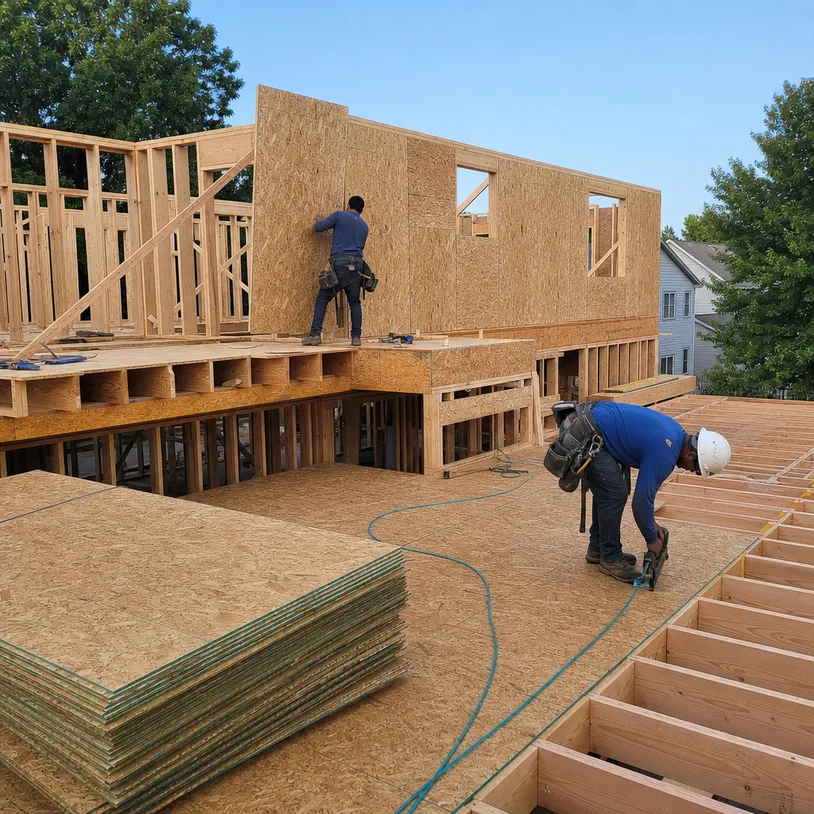
Highest-volume segmentFraming contractors and building material distributors supplying residential construction are the highest-volume OSB buyers. Standard 18mm OSB/3 in 1220×2440mm panels is the workhorse SKU: floor decking, wall sheathing, roof sarking.
A single residential development project can consume 500–2,000 sheets depending on scale. If you're supplying into a regional homebuilder network or a national building materials chain, OSB is a high-frequency reorder product — the kind that builds a distribution relationship rather than a one-time transaction.
Prefabricated Building Component Manufacturers
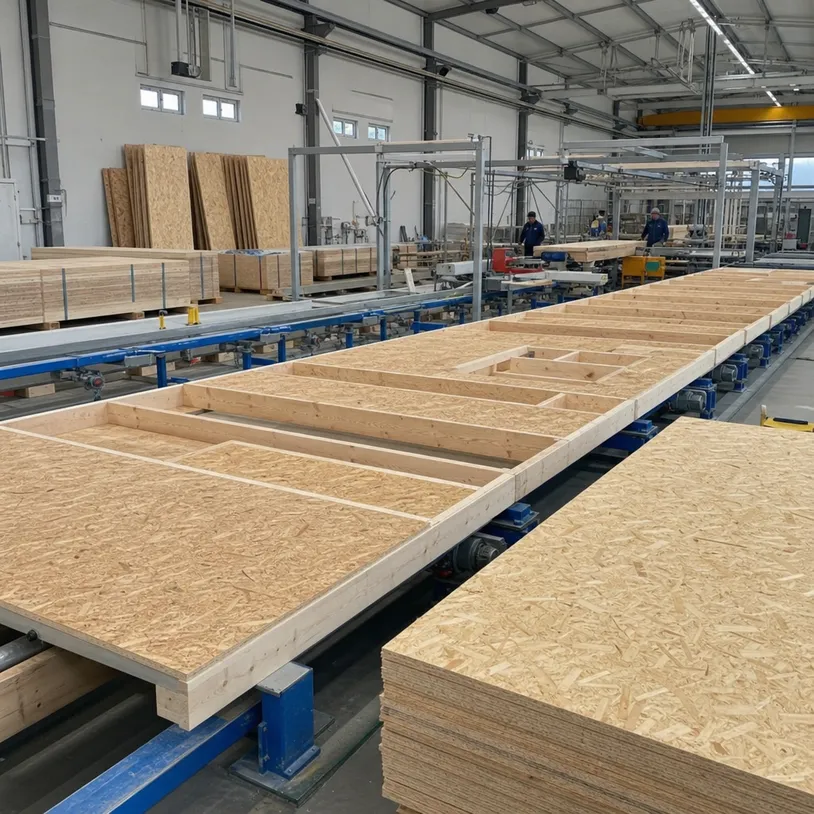
Predictable order patternPrefab wall panel, floor cassette, and roof truss manufacturers buy OSB in consistent, high-volume runs. Their production schedules are predictable, which means your order pattern is predictable.
They typically specify OSB/3 or OSB/4 with tight thickness tolerance (±0.3mm or better) because their automated assembly lines can't accommodate panel-to-panel variation. We hold ±0.2mm thickness tolerance on calibrated panels — that's the spec that keeps your prefab buyer's line running without manual adjustment.
Packaging and Industrial Applications
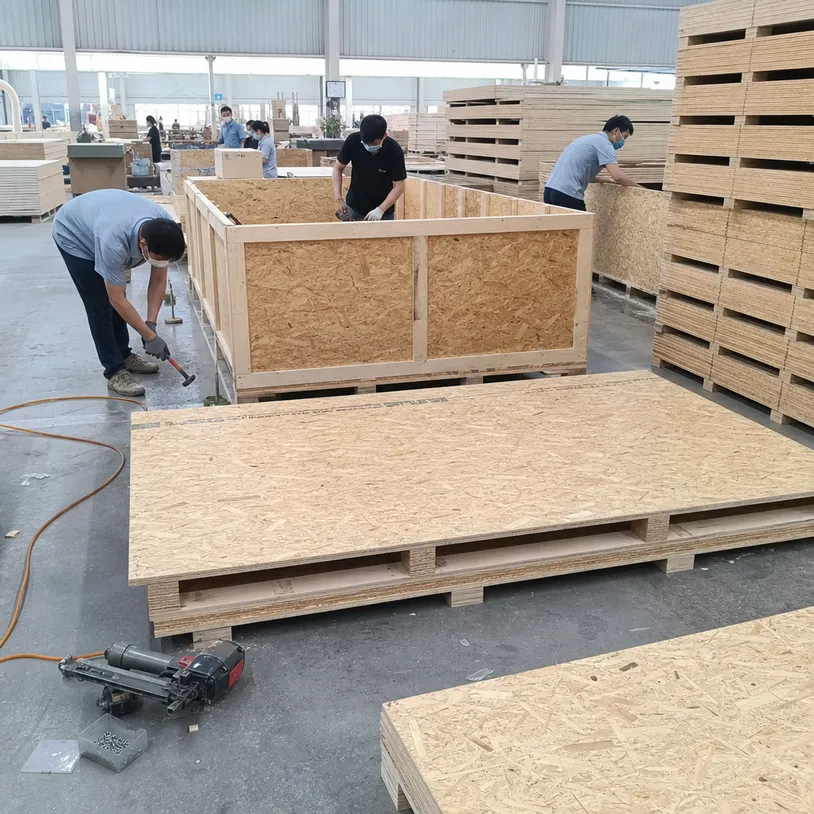
Price-sensitive, high volumeHeavy-duty crating, pallet decking, and industrial packaging use OSB for its strength-to-weight ratio and consistent panel dimensions. These buyers are less specification-sensitive than construction buyers but more price-sensitive, and they order in volume.
OSB/2 grade covers most packaging applications. This segment has grown over the last few years as buyers look for alternatives to solid wood crating — worth building into your product mix if you're serving industrial distributors.

Export-Market Building Material Distributors
Compliance-driven procurementDistributors in the Middle East, Southeast Asia, and Australia who supply into construction markets where OSB adoption is growing. These buyers often need CE documentation for project specifications and FSC certification for government or institutional projects.
Having both certifications on a single OSB supply source simplifies their procurement and compliance documentation — which is a real commercial advantage when they're pitching to project developers.
Tell us your target market and volume
We'll recommend the right OSB grade and configuration for your supply chain.
How We Make OSB: Process Decisions That Affect Your Order
Every production decision below has a direct consequence for the panel you receive. This is how we run the line — and why it matters for structural-grade supply.
Strand Preparation & Geometry
Incoming logs are debarked and flaked into strands — typically 75–150mm long and 0.6–0.8mm thick for structural-grade panels. Strand geometry is critical: too short and you lose directional strength; too thick and you get density variation in the mat. We run flaker settings to structural-grade strand geometry and check strand dimensions as part of incoming material QC.
Drying & Moisture Control
After flaking, strands go through a rotary drum dryer to reach target moisture content before blending. We target 2–4% strand moisture at the blending stage — tighter than what some commodity producers run. Wet strands don't accept resin evenly, and uneven resin distribution is the root cause of internal bond variation across a panel.
Resin Blending: MDI + Wax
The resin blending drum applies MDI resin and wax simultaneously. Wax provides moisture resistance; MDI provides bond strength. The ratio is controlled by weight, not by time — so each batch gets the same resin loading regardless of strand bulk density variation. This is the control point that separates consistent structural-grade output from commodity production.
Mat Forming & Cross-Orientation
Mat forming orients the strands mechanically — face layers run parallel to the panel length, core layer runs perpendicular. This cross-orientation is what gives OSB its structural performance in both directions. The mat goes through a continuous press or multi-opening press depending on the production run; we log press temperature, pressure, and dwell time per batch.
Post-Press Finishing
Post-press, panels are cooled, trimmed to dimension, and inspected before moving to the finishing and packing line. Every panel that ships has passed dimensional and visual inspection at this stage.
Internal Bond Test: The QC Gate That Matters
The QC checkpoint that catches the most problems is the post-press internal bond test. We pull samples from each production batch and test internal bond strength by tensile perpendicular-to-plane. If a batch falls below the grade threshold, it doesn't ship as structural grade.
We've had batches that looked fine visually but failed the IB test — usually traceable to a resin blending issue or a press temperature deviation. The test catches it before it becomes your problem.
Production Batch Logging: What We Record Per Run
Compliance Documentation for Your Import Market
OSB moves into regulated markets — North America, Europe, Australia — where documentation gaps cause customs delays and project disqualification. We prepare the documentation package as standard, not as an add-on.
CARB P2 compliance documentation covers formaldehyde emission requirements under California's Airborne Toxic Control Measure. This is the standard US distributors and retailers require for engineered wood panels.
- CARB TPC (Third Party Certifier) certificate
- Emission test reports
We produce to CARB P2 as a production baseline on export-grade OSB — not as a special run.
CE marking under EN 300 (OSB for use in construction) covers structural performance and emission requirements for the EU market. CE documentation includes the Declaration of Performance (DoP) referencing the applicable harmonized standard.
- Declaration of Performance (DoP)
- EN 300 harmonized standard reference
- FSC chain-of-custody documentation (green building projects)
FSC certification covers the full production chain from certified fiber sourcing through to the finished panel.
CE documentation is widely accepted as a quality reference in these markets even where it's not a mandatory import requirement. We include it as standard on export shipments.
- Test reports aligned with AS/NZS 4357 (Australian buyers)
- Confirm specific compliance requirement at inquiry
Third-Party Pre-Shipment Inspection
Third-party pre-shipment inspection is available through SGS, Bureau Veritas, or your preferred agency. We coordinate access and provide the inspection lot documentation.
Learn more about our certifications and quality processAgency
Custom OSB: Dimensions, Grade, and Surface Options
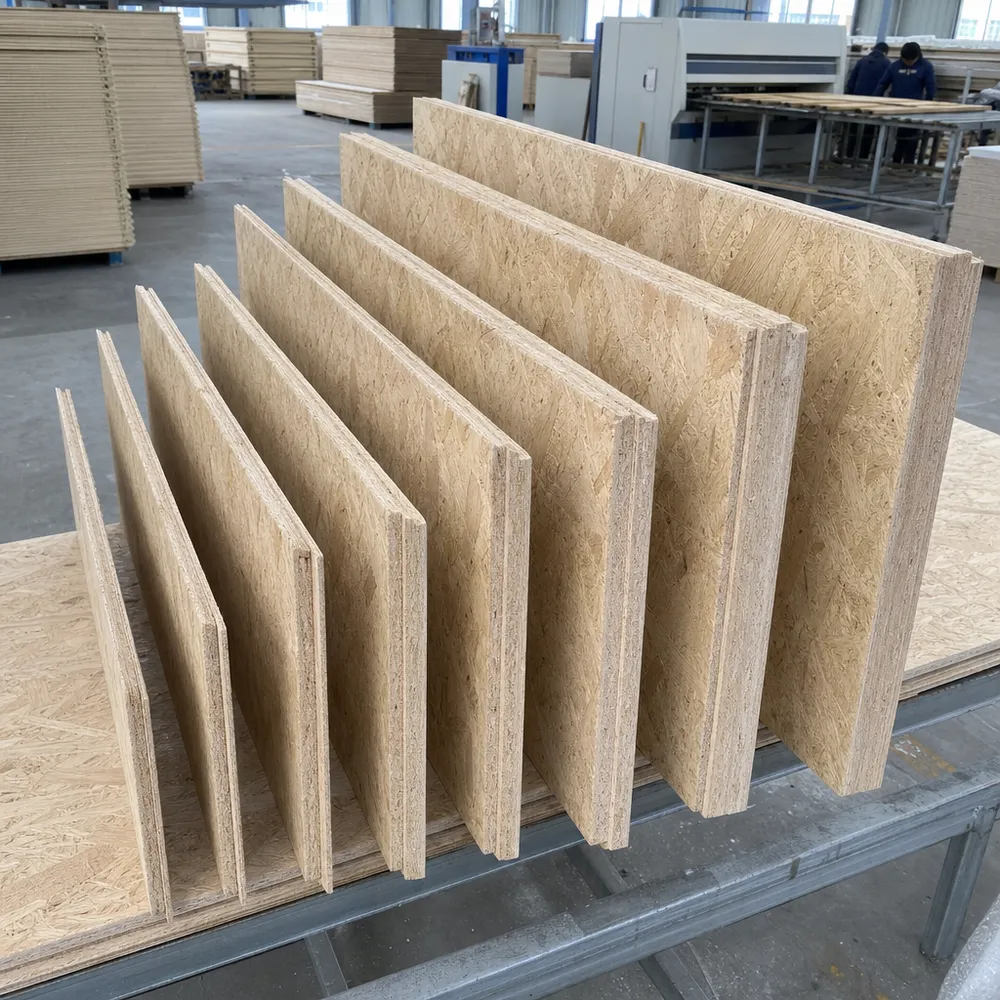
Standard 1220×2440mm panels cover most applications, but we handle custom orders without the tooling cost overhead that applies in other manufacturing categories. OSB is cut-to-size from the production mat — custom dimensions are a scheduling and yield question, not a capital investment.
Thickness Range
6mm through 25mm in standard increments. Non-standard thicknesses available on confirmed orders with minimum volume.
Panel Dimensions
Custom lengths and widths available. Common non-standard requests include:
Grade Specification
OSB/2, OSB/3, or OSB/4 — specify at inquiry. Grade affects resin system, press parameters, and density target, so it needs to be confirmed before production scheduling.
Surface Options
Natural strand texture, suitable for structural applications where surface appearance is not a factor.
Calibrated to ±0.2mm thickness tolerance. Required for applications where panel-to-panel consistency matters — prefab assembly lines, flooring underlayment.
Available on flooring-grade panels. Eliminates the need for blocking at panel joints and speeds installation for your downstream customers.
Branding and Marking
Custom bundle marking, private label stenciling, and OEM documentation available for buyers who supply under their own brand. Minimum order quantities apply for custom marking — confirm at inquiry.
Note on custom dimensions: Non-standard panel sizes affect container loading efficiency. We'll run a loading plan for your specific dimensions before you confirm the order so you know the landed cost impact before committing.
Container Loading and Logistics
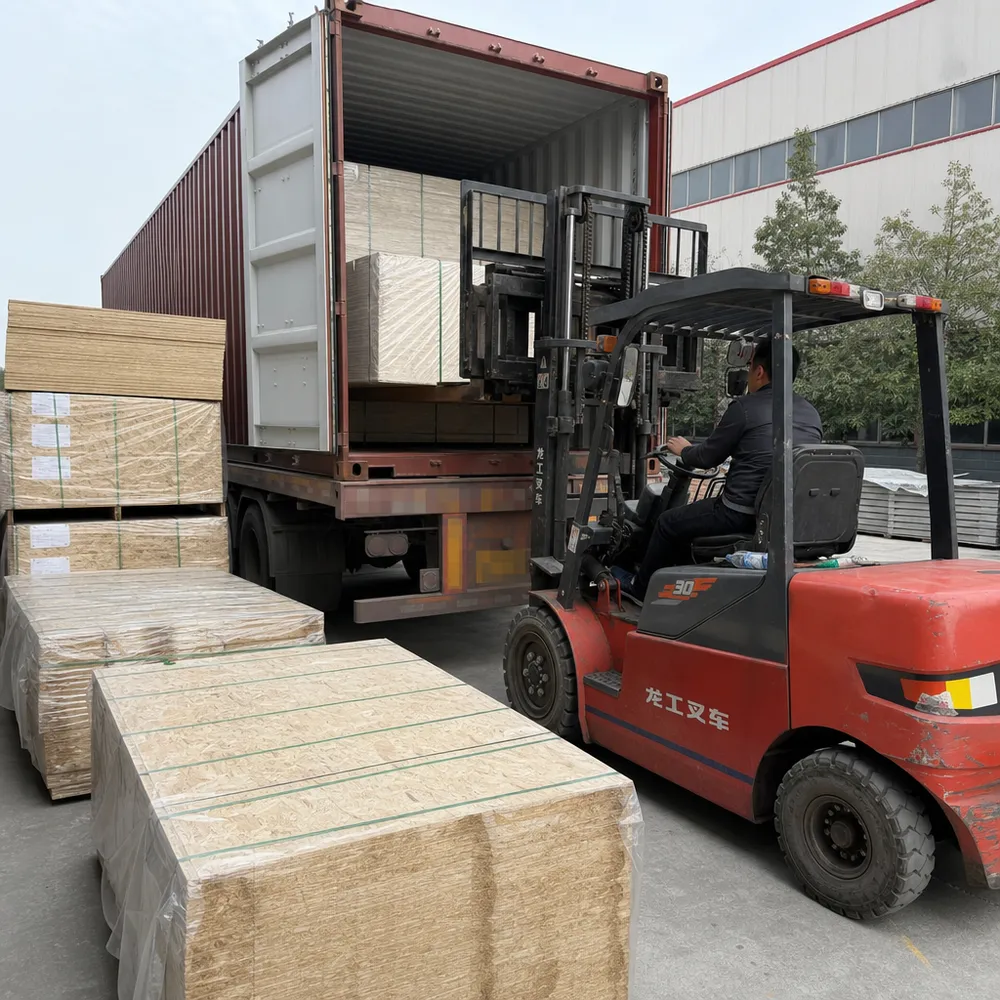
OSB ships efficiently in 20HQ and 40HQ containers. Standard 1220×2440mm panels stack flat and load to near-maximum container cubic utilization. We provide a loading plan with each shipment.
Container Loading Capacity
Loading quantities vary by thickness and panel dimensions. We provide exact loading plans per order.
Transit Times from Xuzhou
Qingdao, Shanghai, and Lianyungang are all accessible from our facility.
Packing and Bundle Specification
Bundled in packs of 50–100 sheets depending on thickness
Strapped and wrapped in moisture-resistant film for ocean transit
Corner boards protect panel edges during handling
Each bundle marked with product specification, grade, thickness, quantity, batch number, and destination port
Export Documentation
We've shipped enough containers to North America, Europe, the Middle East, and Australia to know what documentation gaps cause clearance delays — the paperwork goes out complete.
OSB vs. Sibling Products: Choosing the Right Panel for Your Market
Under our Particle Board & OSB range, OSB is one of four products. Here's how to position them for your buyers.
| Product | Best Fit | Key Differentiator |
|---|---|---|
| Oriented Strand Board | Structural sheathing, load-bearing floors, prefab components | Cross-directional strength, structural grade certification (OSB/2–4), moisture-resistant resin |
| OSB Panels | General-purpose panel applications, non-structural uses | Broader format and thickness range, value-optimized for non-structural specs |
| OSB Flooring | Subfloor and flooring underlayment | T&G edge profile, calibrated surface, flooring-specific load rating |
| Chipboard / Particle Board | Furniture substrate, interior fit-out, shelving | Smooth surface for laminate/veneer facing, lower cost than OSB for non-structural applications |
When to Specify OSB
If your buyer needs structural performance — floor decking that carries live loads, wall sheathing that contributes to racking resistance, roof sarking under tile — oriented strand board is the right product.
When Chipboard Is the Better Fit
If they need a smooth substrate for furniture or cabinetry, chipboard particle board is the better fit and the lower cost option. View Chipboard / Particle Board →
Explore the full range
Frequently Asked Questions
Technical and commercial questions we hear from importers, distributors, and procurement teams. If your question isn't here, contact us directly.
The grade classification under EN 300 defines the structural performance and moisture resistance level.
Load-bearing in dry conditions only. Suitable for interior structural applications where humidity is controlled.
Adds moisture resistance. Suitable for humid conditions including exterior sheathing under cladding and subfloor applications with potential moisture exposure.
Heavy-duty grade: higher density, higher bending strength, and full moisture resistance for demanding structural applications.
For most residential construction supply, OSB/3 is the standard specification. If your buyers are asking for OSB without specifying a grade, they almost certainly need OSB/3.
Yes. We use MDI (methylene diphenyl diisocyanate) resin as the standard binder on export-grade OSB. MDI-bonded panels produce formaldehyde emissions well below the CARB P2 threshold of 0.05 ppm for composite wood products.
The CARB TPC certificate and emission test reports are included in the documentation package for US-bound shipments. No special order or premium is required — it's the production standard for our export OSB.
Edge swelling is the most common OSB failure mode in the field. It happens when panel edges absorb moisture — either during construction before the building is weathertight, or from subfloor moisture vapor in flooring applications.
Root causes:
Insufficient moisture resistance in the resin system — an OSB/2 panel used in a humid-condition application
Inadequate edge sealing during or after installation
Installation without expansion gaps between panels
How our OSB/3 and OSB/4 address this:
Our OSB/3 and OSB/4 panels use MDI resin with wax addition for moisture resistance, which significantly reduces edge swell compared to UF-bonded panels. For flooring applications, we recommend the T&G edge profile — it controls the joint and reduces the exposed edge area.
If your buyers are seeing edge swell problems with their current OSB source, the first question is whether they're using the right grade for the application.
Practical minimum is typically one full container load (20HQ) to justify the production scheduling and yield adjustment.
Minimums are lower — confirm at inquiry with your target thickness and volume.
Custom marking and private label require a minimum of one production batch, which we'll specify when you send us the requirements.
To container loading
From order confirmation, depending on material sourcing and production scheduling
We'll confirm lead time at the quotation stage based on current production load.
For buyers with regular reorder patterns, we can discuss forward scheduling to hold production slots.
Get a Factory-Direct OSB Quote
Send us your target specification and we'll come back with a detailed quote, the relevant certification documentation for your import requirements, and a container loading plan.
What to Include in Your Enquiry
To generate an accurate quote, include the following in your message:
-
Grade — OSB/2, OSB/3, or OSB/4
-
Thickness — your required panel thickness in mm
-
Panel Dimensions — standard or custom sheet size
-
Volume — estimated order quantity (m³ or container count)
-
Destination Market — country and any import certification requirements
New to Sourcing OSB from China?
Most buyers start with a sample order to verify the panel against their own quality standards before committing to a full container. We can ship samples for your evaluation — contact us to arrange it.
What You'll Receive
Detailed Price Quote
Certification Documentation
Container Loading Plan
Xuzhou QD Wood Industry Co., Ltd.
Factory-direct OSB manufacturer, Xuzhou, Jiangsu, China
[email protected]
Phone / WhatsApp
+8615852005272
Address
No. 88 Sanbao Industrial Park, Tongshan District,
Xuzhou, Jiangsu Province, 221116, China