

Factory-Direct Particle Board & OSB — 17 Years of Export-Grade Production
Four product lines covering structural OSB panels, OSB flooring underlayment, and chipboard particle board — produced under ISO 9001:2015, CARB P2, and FSC certification, ready for North America, Europe, and beyond.
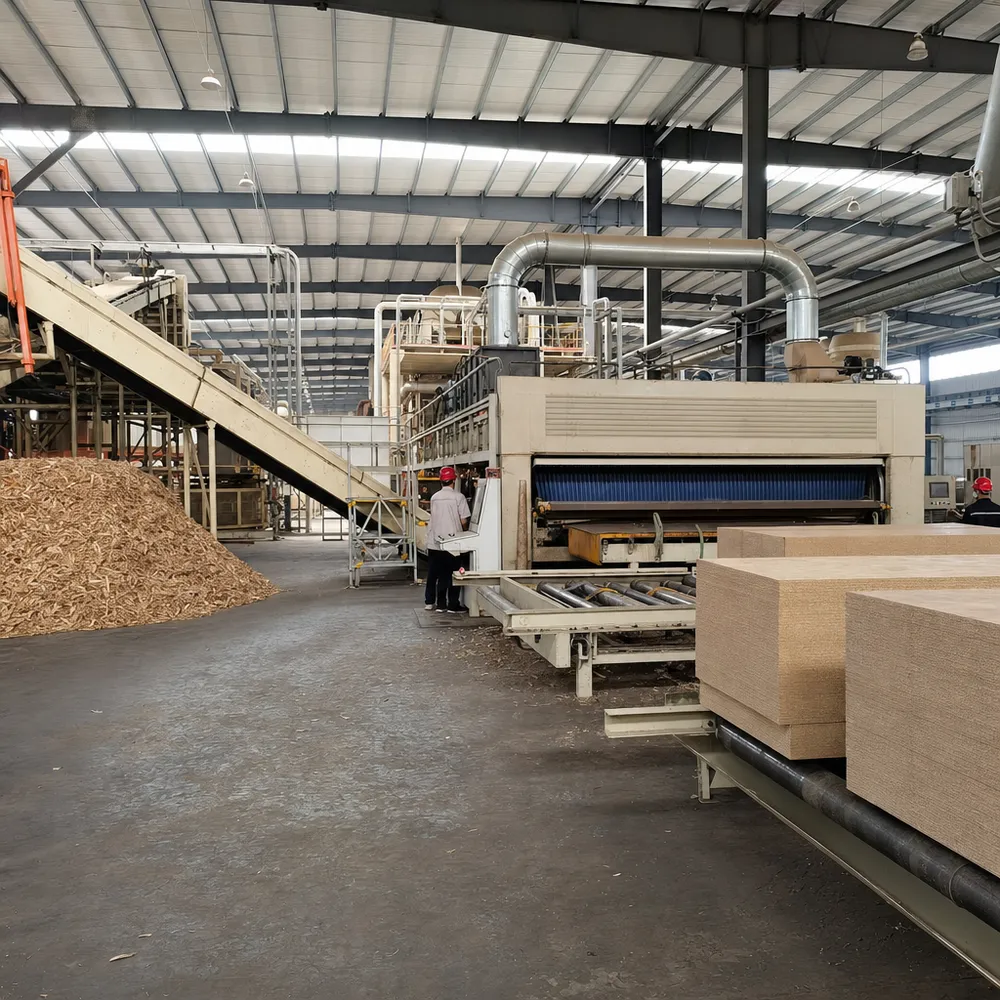
What We Make and Why It Matters to Your Supply Chain
We are Xuzhou QD Wood Industry Co., Ltd., operating as QDPlywood.com — a factory-direct engineered wood panel manufacturer based in Xuzhou, Jiangsu Province, China. Particle board and OSB sit alongside plywood, MDF, and blockboard in our production range, which means when you source this category from us, you're working with a manufacturer who understands how these panels interact with the rest of a project's material spec — not a trader who handles one SKU at a time.
The particle board and OSB category covers two distinct manufacturing processes and two distinct buyer use cases. OSB (oriented strand board) is a structural panel — strands of wood compressed and bonded under heat and pressure in cross-oriented layers, producing a panel with predictable load-bearing and shear performance. Chipboard particle board is a furniture and interior fit-out substrate — wood particles bonded with resin under pressure, producing a flat, stable, cost-efficient panel for cabinetry, shelving, and interior applications. We produce both, and the distinction matters when you're specifying for a project or building a product line for your distribution customers.
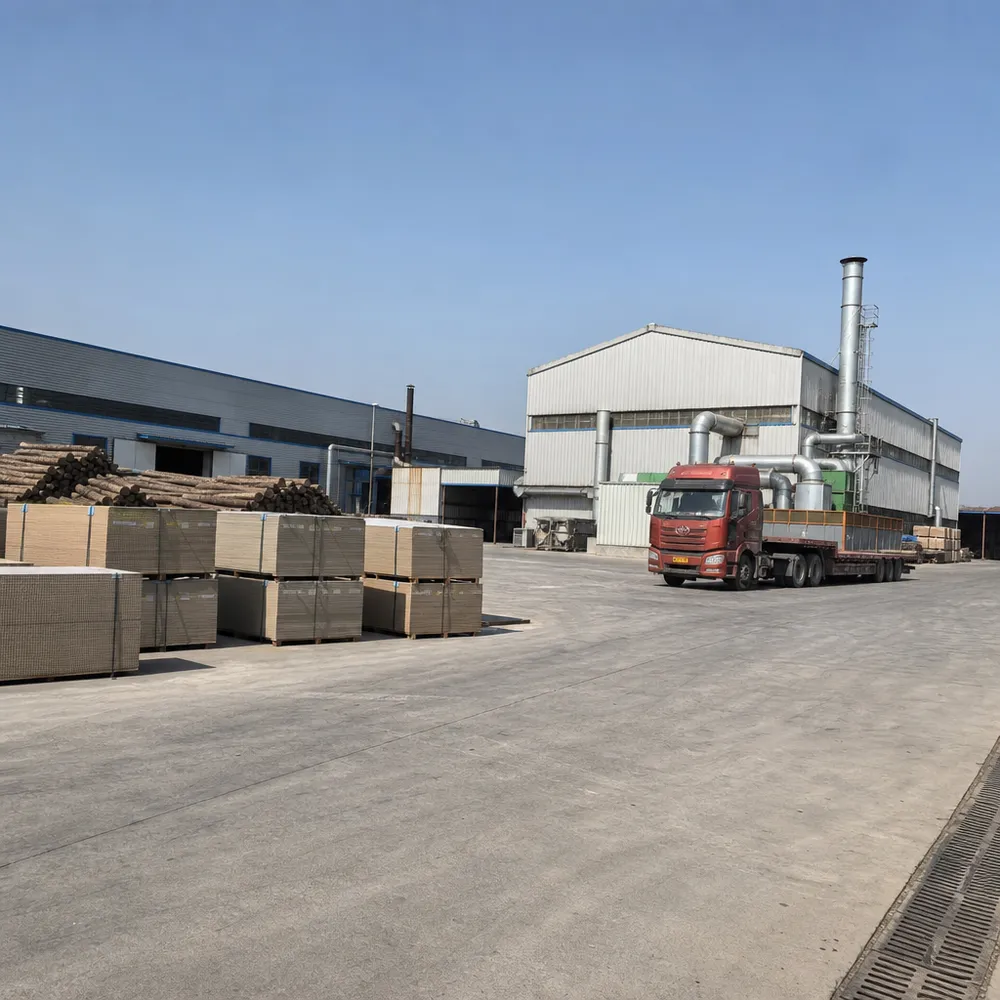
OSB — Structural Panel Technology
Strands of wood compressed and bonded under heat and pressure in cross-oriented layers. The cross-orientation is what delivers predictable load-bearing and shear performance — each layer runs perpendicular to the adjacent one, distributing load across the panel rather than along a single grain direction. Used in wall sheathing, roof decking, and floor underlayment.
Chipboard Particle Board — Interior Substrate Technology
Wood particles bonded with resin under pressure, producing a flat, stable, cost-efficient panel. The manufacturing process optimises for surface smoothness and dimensional consistency — the properties that matter for furniture manufacturing, cabinet carcasses, shelving, and interior fit-out. Not a structural panel, but the right tool for its application.
Four Products, Two Technologies: The Full Product Line
The particle board and OSB range at QDPlywood.com covers four product lines. Here's how they map to buyer use cases.
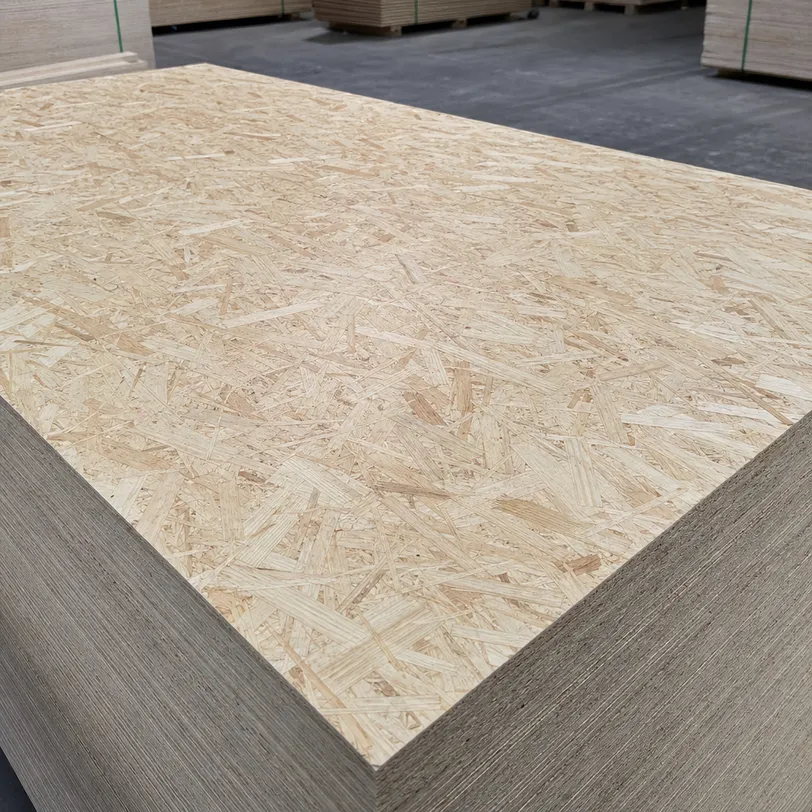
Oriented Strand Board
Structural OSB produced in cross-oriented strand layers for wall sheathing, roof decking, and floor underlayment in timber-frame and light-gauge steel construction. The cross-orientation of strands distributes load across the panel rather than along a single grain direction. Produced to EN 300 OSB/3 and OSB/4 classifications, covering load-bearing applications in humid conditions.
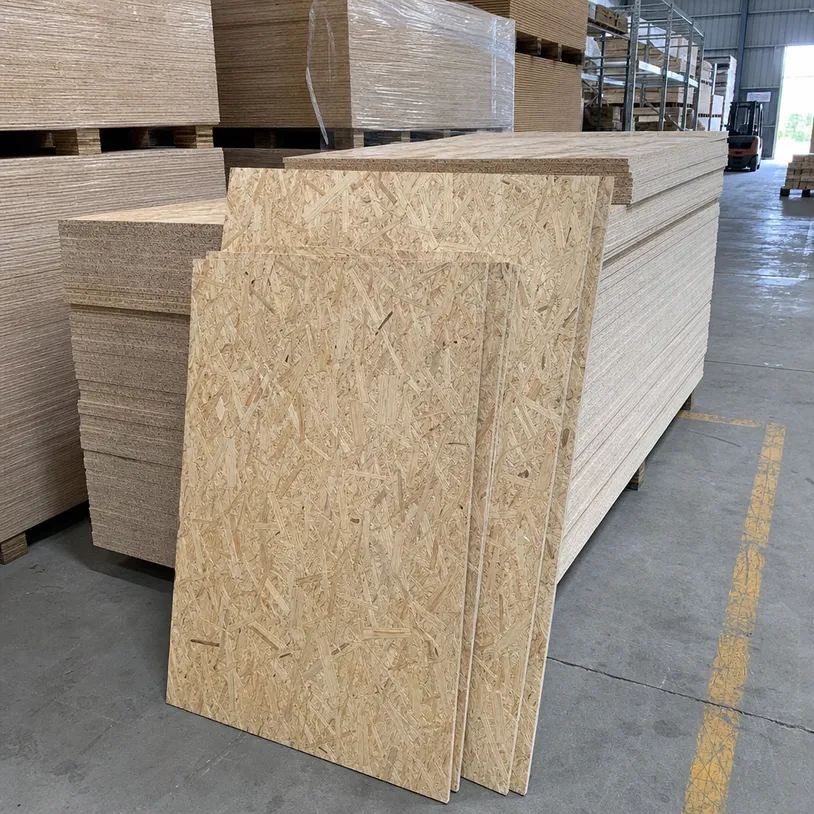
OSB Panels
General-purpose OSB panels for construction hoarding, site boarding, packaging, and industrial applications where structural performance is secondary to cost efficiency and dimensional stability. These panels are the workhorse of the range — high volume, consistent spec, container-ready. If your customers are building contractors, site managers, or packaging manufacturers, this is the SKU that moves in volume.
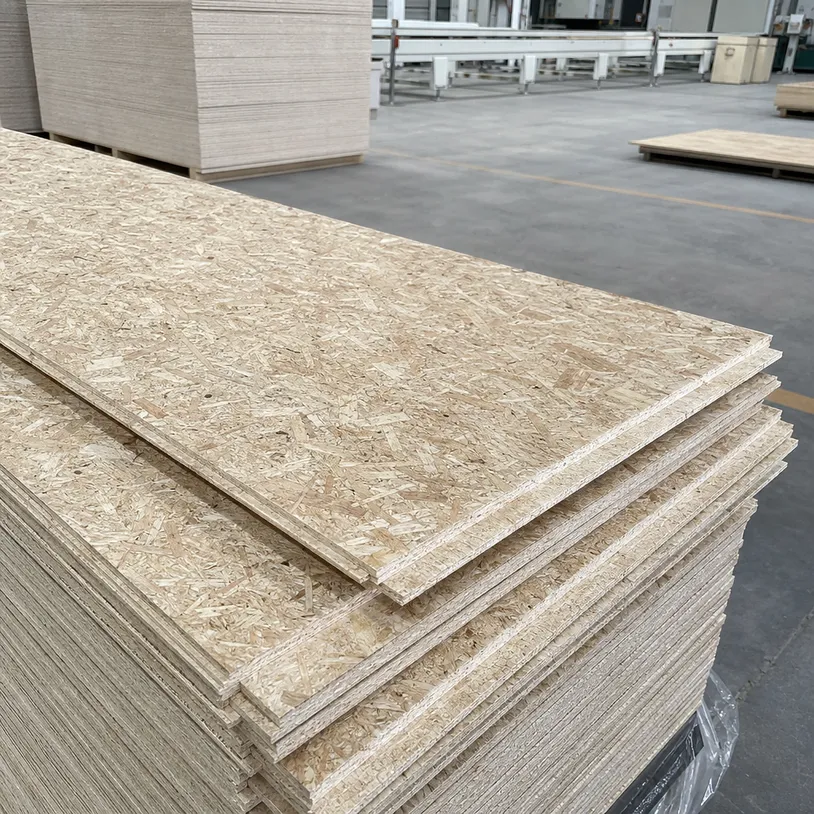
OSB Flooring
Tongue-and-groove OSB flooring panels engineered for subfloor and floating floor applications. The T&G profile eliminates panel-to-panel gaps and distributes point loads across joints — relevant for customers installing over joists or battens where unsupported edges would deflect under foot traffic. Produced with a moisture-resistant resin system and a textured anti-slip surface on the top face, so they're usable as a working platform during construction before the finish floor goes down.
Dual-use: working platform during construction and permanent subfloor substrate.
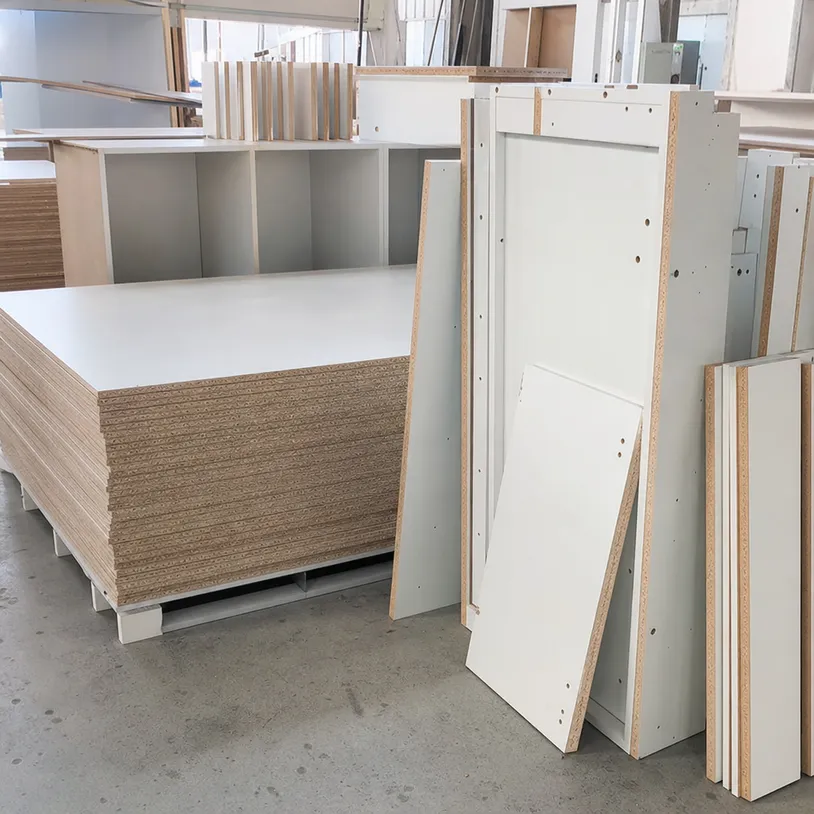
Chipboard Particle Board
Standard chipboard particle board for furniture manufacturing, cabinet carcasses, shelving, and interior fit-out. The manufacturing process optimises for surface smoothness and dimensional consistency — the properties that matter when panels are being laminated, veneered, or edge-banded downstream. Density range of 600–720 kg/m³ gives the panel enough screw-holding strength for furniture joinery without the weight penalty of MDF.
Specification Tables — OSB and Chipboard Side by Side
Key technical parameters for procurement and specification. For full datasheets, contact the trading desk.
OSB — Oriented Strand Board Specifications
| Parameter | OSB/3 (Load-bearing, humid) | OSB/4 (Heavy-duty, humid) |
|---|---|---|
| Standard | EN 300 | EN 300 |
| Thickness range | 9mm – 22mm | 15mm – 25mm |
| Panel size (standard) | 1220 × 2440mm | 1220 × 2440mm |
| Panel size (alt.) | 1250 × 2500mm (on order) | 1250 × 2500mm (on order) |
| Bending strength (parallel) | ≥ 20 N/mm² | ≥ 28 N/mm² |
| Bending strength (perpendicular) | ≥ 10 N/mm² | ≥ 15 N/mm² |
| Internal bond strength | ≥ 0.32 N/mm² | ≥ 0.45 N/mm² |
| Moisture resistance | Humid conditions (Service class 2) | Humid conditions (Service class 2) |
| Formaldehyde emission | E1 (≤ 0.124 mg/m³) | E1 (≤ 0.124 mg/m³) |
| CE marking | Yes — EN 300 / EN 13986 | Yes — EN 300 / EN 13986 |
| Typical applications | Wall sheathing, roof decking, floor underlayment | Heavy structural, industrial flooring, high-load panels |
Chipboard Particle Board — Specifications
| Parameter | Standard Chipboard (P2) | Moisture-Resistant (P3/P5) |
|---|---|---|
| Standard | EN 312 P2 | EN 312 P3 / P5 |
| Thickness range | 8mm – 38mm | 12mm – 25mm |
| Panel size (standard) | 1220 × 2440mm | 1220 × 2440mm |
| Density | 600–680 kg/m³ | 660–720 kg/m³ |
| Modulus of rupture | ≥ 13 N/mm² | ≥ 13 N/mm² |
| Internal bond | ≥ 0.35 N/mm² | ≥ 0.35 N/mm² |
| Surface | Sanded, laminate-ready | Sanded, laminate-ready |
| Moisture resistance | Dry interior conditions only | Humid conditions (P5: load-bearing) |
| Formaldehyde emission | E1 (≤ 0.124 mg/m³) | E1 (≤ 0.124 mg/m³) |
| CE marking | Yes — EN 312 / EN 13986 | Yes — EN 312 / EN 13986 |
| Typical applications | Furniture, shelving, cabinet carcasses, interior fit-out | Kitchen units, bathroom furniture, flooring substrate |
All values are minimum requirements per EN standard. Actual mill certificates available on request from the trading desk.
Technical Specifications Across the Range
Full parameter comparison across all four product lines. Thickness tolerance: ±0.3mm on sanded panels, ±0.8mm on unsanded. Panel squareness: ≤2mm per 2m length — tolerances that matter when your customers run panels through automated cutting equipment or install with mechanical fasteners at fixed centers.
| Parameter | OSB (Structural) | OSB Panels (General) | OSB Flooring (T&G) | Chipboard Particle Board |
|---|---|---|---|---|
| Thickness Range | 9mm–25mm | 9mm–18mm | 18mm–22mm | 8mm–25mm |
| Standard Panel Size | 1220×2440mm | 1220×2440mm | 1220×2440mm | 1220×2440mm |
| Density | 580–650 kg/m³ | 550–620 kg/m³ | 600–650 kg/m³ | 600–720 kg/m³ |
| Binder System | MDI / pMDI resin | MDI resin | MDI resin (MR grade) | UF / MUF resin |
| Classification | EN 300 OSB/3 OSB/4 | EN 300 OSB/2 | EN 300 OSB/3 | EN 312 P2 P5 |
| Formaldehyde Emission | E1 CARB P2 | E1 | E1 CARB P2 | E1 CARB P2 |
| Surface | Sanded / unsanded | Unsanded | Textured anti-slip | Sanded / faced |
| Moisture Resistance | Humid conditions (OSB/3) | Dry conditions (OSB/2) | Humid conditions | Standard / MR grade |
| Certifications |
ISO 9001 CE FSC CARB P2
|
ISO 9001 CE
|
ISO 9001 CE FSC
|
ISO 9001 CE CARB P2
|
±0.3mm on sanded panels · ±0.8mm on unsanded panels
≤2mm per 2m length — critical for automated cutting lines and fixed-center mechanical fastening
Resin Systems & Formaldehyde Compliance
The binder chemistry determines both performance and regulatory status. We source panels across the full resin spectrum — from standard UF grades through low-emission MUF and PMDI systems — so you can match the right chemistry to your end-use requirements without over-specifying.
Standard binder for interior dry-use panels. Cost-effective, widely available. Compliant to E1 (<8mg/100g) and CARB P2 (<0.09 ppm) when properly formulated. Not suitable for humid or exterior exposure.
Enhanced moisture resistance over standard UF. Used in P5 chipboard and OSB/3 flooring grades. Lower formaldehyde release than UF. Suitable for humid interior conditions (service class 2).
No formaldehyde in the binder chemistry. Standard for structural OSB/3 and OSB/4. Meets the most stringent emission standards including CARB P2, NAF, and California 93120. Preferred for green building certifications (LEED, BREEAM).
Ultra-low emission UF or MUF formulations achieving <3mg/100g (E0) or <1.5mg/100g (Super-E0). Required for Japanese JIS A 5908 F★★★★ compliance and increasingly specified in healthcare and education projects.
Global Formaldehyde Emission Limits
| Standard | Region | Limit | Method |
|---|---|---|---|
| E2 | EU | <30 mg/100g | EN 120 |
| E1 | EU | <8 mg/100g | EN 120 |
| E0 | EU / Asia | <3 mg/100g | EN 120 |
| CARB P2 | USA | <0.09 ppm | ASTM E1333 |
| NAF | USA | No added formaldehyde | ASTM E1333 |
| F★★★★ | Japan | <0.3 mg/L | JIS A 1460 |
| GB 18580 | China | <0.124 mg/m³ | GB/T 17657 |
All panels supplied by Timber Trade International are tested to the emission standard required by the destination market. Third-party test reports are available on request. For LEED v4 / BREEAM projects, specify MDI-bonded OSB or E0-grade chipboard and we will provide the relevant documentation package.
Where Particle Board & OSB Are Specified
From structural sheathing to furniture substrate, these panels cover a wide range of end uses. The right grade depends on load requirements, moisture exposure, and surface finish needs.
Construction & Structural
- Wall sheathing and racking panels (OSB/3, OSB/4)
- Roof decking and sarking boards
- Floor decking — T&G OSB flooring panels
- I-joist and engineered timber web material
- Structural insulated panels (SIPs) facing
- Timber frame and SIPS construction
Furniture & Interiors
- Cabinet carcass and shelving substrate (P2 chipboard)
- Flat-pack and RTA furniture components
- Laminate flooring underlay and substrate
- Worktop and countertop core material
- Stair treads and risers (high-density chipboard)
- Decorative wall panelling and feature boards
Packaging & Industrial
- Pallet decking and heavy-duty crating
- Transit packaging for machinery and equipment
- Vehicle load floors and van lining panels
- Hoarding and site boarding (OSB/3)
- Concrete formwork and shuttering
- Exhibition stands and display structures
Sourcing & Supply Chain
We work with a vetted network of mills across Europe, North America, and Asia. Each supply partner is audited against our quality and compliance framework before onboarding, and reviewed annually. This gives you consistent panel quality regardless of which mill fulfils a given order.
CE-marked panels from established producers in Poland, Germany, Austria, and the Baltic states. Short lead times to UK and EU buyers. FSC and PEFC chain-of-custody standard.
CARB P2-certified OSB and chipboard from Canadian and US producers. APA-rated structural panels available for projects requiring North American building code compliance.
Competitively priced chipboard and OSB from audited mills in China and Southeast Asia. GB 18580 and E1 compliant. Suitable for cost-sensitive furniture and packaging applications.
Typical Lead Times & Minimum Orders
| Product | MOQ | Lead Time |
|---|---|---|
| OSB/3 Structural | 1 pallet | 3–5 working days (EU stock) |
| OSB/3 T&G Flooring | 1 pallet | 3–7 working days |
| OSB/4 Heavy Structural | 1 truck load | 2–4 weeks (mill order) |
| P2 Chipboard | 1 pallet | 3–5 working days (EU stock) |
| P5 Moisture-Resistant | 1 pallet | 5–10 working days |
| Custom Dimensions | 1 truck load | 3–6 weeks (mill cut) |
FCL and LCL options available for intercontinental shipments. We handle export documentation and phytosanitary certificates.
Key OSB and chipboard grades held in EU and UK warehouses for rapid dispatch. Call-off contracts available for high-volume buyers.
Where These Panels Fit: Market Segments Worth Building
The commercial value of particle board and OSB comes from their position in high-volume, repeatable procurement cycles. These aren't one-off specialty products — they're commodity-adjacent panels that move in container quantities on regular schedules.
Residential Construction & Prefab Housing
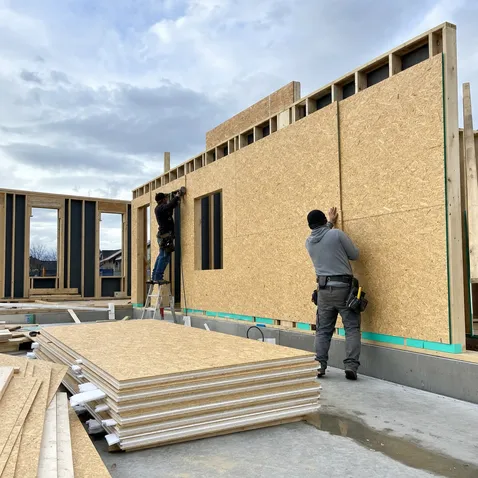
OSB/3 structural panels are the standard sheathing material in North American timber-frame construction and increasingly in European prefab housing systems. A single residential development project can consume 500–2,000 sheets of OSB sheathing.
Prefab panel manufacturers building wall and floor cassettes order on a production schedule, not project-by-project — supply relationship is predictable.
Volume per project: 500–2,000 sheets of OSB sheathing.
Furniture Manufacturing & Flat-Pack
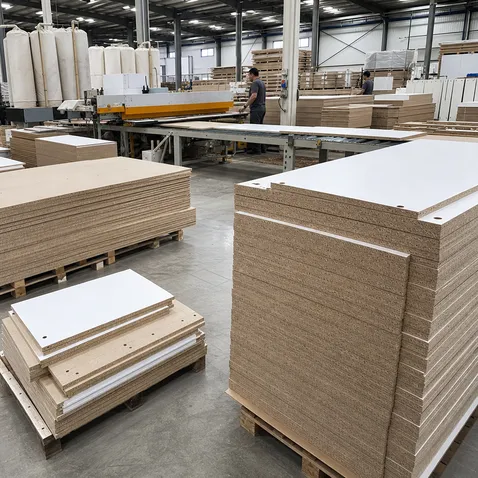
Chipboard particle board is the substrate behind most flat-pack furniture globally. Furniture manufacturers in Southeast Asia, Eastern Europe, and the Middle East who supply to retail chains run chipboard through their lines in multi-container volumes.
Key clusters: Vietnam, Poland, Turkey — chipboard is a high-velocity SKU with consistent reorder patterns.
Orders move in multi-container volumes on regular schedules.
Commercial Fit-Out & Interior Construction
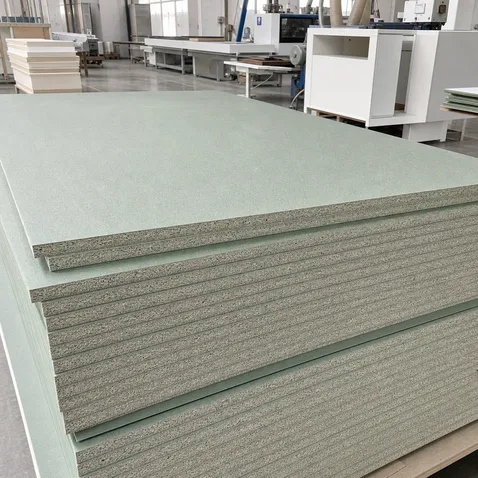
Moisture-resistant chipboard (P5 grade) is the standard substrate for kitchen cabinet carcasses, bathroom vanities, and commercial joinery in humid environments. Fit-out contractors and joinery manufacturers specify MR chipboard as a baseline.
Hospitality, healthcare, and residential projects specify MR chipboard as baseline.
Segment orders in mixed loads — multiple thicknesses, faced and raw — suits our OEM capability.
Site Hoarding & Temporary Construction
General-purpose OSB panels are the standard material for construction site hoarding, temporary flooring, and concrete formwork backing. This is a high-turnover segment: panels get used for one project cycle and replaced.
Volume driven by construction activity in your market. Spec is simple: consistent dimensions, no surface defects, predictable delivery.
Panels used for one project cycle and replaced — repeat procurement is built into the model.
Packaging & Industrial Logistics
OSB panels are used as pallet decking, crate lining, and heavy-duty packaging substrate in industrial logistics. This is a lower-margin segment but a high-volume one.
Gateway account logic: A packaging manufacturer who starts buying OSB panels from you may expand into other panel categories as the relationship develops.
Applications: pallet decking, crate lining, heavy-duty packaging substrate.
Find the right panel for your segment
Each product page carries full technical specs, grade options, and export documentation details.
Matching Panel Grade to Application
The most common sourcing mistake we see is buyers specifying OSB/2 (dry conditions) for applications that will see humidity cycling — and then dealing with edge swelling and delamination complaints from their customers. Here's the decision logic we walk buyers through.
Any Moisture Exposure
Subfloor, roof sheathing, wall sheathing in climates with seasonal humidity variation, bathroom or kitchen substrate.
The price difference between OSB/2 and OSB/3 is modest; the cost of a warranty claim or a site remediation is not.
Purely Dry Interior
Wall lining, ceiling substrate, furniture carcass in a climate-controlled environment.
Paying for OSB/3 in a dry interior application is unnecessary cost that your customers will eventually push back on.
Structural with Defined Load Requirements
Floor joists, roof rafters, shear walls — applications where a structural engineer has defined load requirements.
Confirm the panel's characteristic bending strength (fm,k) and modulus of elasticity (E0,mean) against the structural engineer's spec. We can provide test reports for these values on request.
Furniture & Cabinetry
Chipboard density matters more than most buyers realize. The right density depends on the load the cabinet will carry.
Low-density chipboard in a kitchen base unit will fail at the hinge and drawer-runner fixings within 2–3 years under normal use.
Acoustic & Fire-Rated Assemblies
Party walls, floor/ceiling assemblies, and any application where a building regulation or insurer requires a tested fire or acoustic rating.
Panel selection alone does not deliver a fire or acoustic rating — the entire tested assembly (framing, insulation, fixings, finishes) must match the tested configuration. Substituting one panel for another voids the test certificate.
Matching Thickness to Span and Load
Thickness is not a preference — it is a structural variable. The tables below reflect common UK practice and EN 12871 test data. Where a structural engineer has specified otherwise, follow their specification.
Based on EN 12871 and common UK housebuilding practice. Always verify against project-specific structural calculations.
Based on EN 12871 and common UK housebuilding practice. Always verify against project-specific structural calculations.
Based on EN 12871 and common UK housebuilding practice. Always verify against project-specific structural calculations.
Deflection limits based on L/300 for shelving. Verify against actual load and material modulus of elasticity.
What Goes Wrong with OSB and Chipboard — and How We Prevent It
These are the failure modes that experienced buyers have learned to ask about. We'd rather address them directly than have you discover them after a container arrives.
Edge Swelling in OSB
OSB/2 panels used in moisture-exposure applications, or OSB/3 panels stored on-site without edge sealing and exposed to standing water. The panel core absorbs moisture at cut edges faster than the face, causing edges to swell and the surface to telegraph through finish flooring.
Our OSB/3 panels use a wax-emulsion edge treatment on factory-cut edges to slow moisture ingress during site storage. For buyers in high-humidity markets — Southeast Asia, the Gulf, coastal regions — we recommend specifying edge-sealed panels and including storage instructions in your product documentation.
Chipboard Screw Pull-Out Failure
A density and resin quality issue. Low-density chipboard (below 580 kg/m³) and chipboard with inconsistent resin distribution both show poor screw retention — the fastener pulls through the panel face under load.
We run density checks on every production batch. Our chipboard density tolerance is ±20 kg/m³ from the specified grade. If you're sourcing chipboard for furniture applications where hinge and drawer runner performance matters, ask for the density test report with your shipment documentation.
Formaldehyde Emission Non-Compliance
A documentation problem as often as it is a manufacturing problem. Panels produced to E1 or CARB P2 spec can fail compliance testing if the test is conducted on aged panels that have off-gassed, or if the test method doesn't match the certification standard.
We provide emission test reports conducted to the applicable standard — ASTM E1333 for CARB, EN 717-1 for E1 — with each shipment. Keep these on file. If your customer or their customer faces a compliance audit, you need the original test documentation, not just a certificate number.
Delamination in OSB Under Cyclic Loading
Occurs when the strand-to-resin bond is compromised by moisture cycling before the resin has fully cured. This is a manufacturing process issue — specifically, insufficient press time or press temperature for the panel thickness.
We log press parameters per batch, and our press cycle times are set with a safety margin above the minimum cure time for each thickness. For buyers who have had delamination issues with other suppliers, we can provide press parameter records for your quality audit.
Ask for the Test Documentation, Not Just the Certificate
Every shipment includes density test reports, emission test reports (ASTM E1333 / EN 717-1), and press parameter records on request. These are the documents that matter when your customer faces a compliance audit — a certificate number alone is not sufficient.
Container Loading and Export Logistics
OSB and chipboard are high-density, high-volume products — container utilization directly affects your landed cost per sheet. Here's how we load.
40HQ Container Capacity
Standard 1220×2440mm panels
Standard Loading Method
-
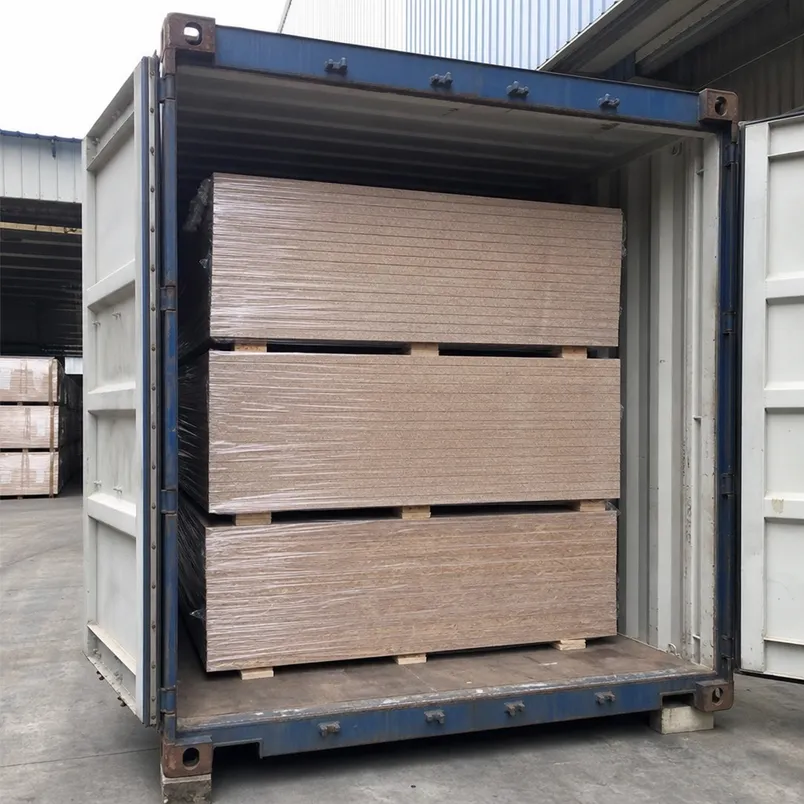
Panels stacked flat on timber bearers, banded in bundles of 50–100 sheets depending on thickness
-
Wrapped in moisture-resistant film for ocean transit; corner boards protect panel edges during handling
-
Each bundle marked with product specification, thickness, density grade, batch number, and destination port
-
Mixed-thickness orders: heavier/thicker panels on bottom, lighter panels on top, with separating layers between product types
-
Loading plan provided with each shipment so your receiving team can verify the load configuration before unloading
Transit Times from Xuzhou
Export Documentation Package
We prepare the full documentation package as standard. Buyers who have dealt with customs delays caused by missing documentation will recognize why this matters.
OEM and Custom Specification Capability
The standard range covers most sourcing requirements, but a significant portion of our particle board and OSB volume ships to OEM specifications. Here's what custom orders look like in practice.
Custom Panel Dimensions
Non-standard sizes for prefab housing manufacturers who cut panels to module dimensions in their factory. We can produce panels up to 1250×2500mm as a standard alternative, and larger sizes on confirmed orders with sufficient volume to justify the press configuration change.
Custom Surface Treatments
OSB panels with primer coat for direct painting, chipboard with custom melamine paper colors or textures for furniture manufacturers who need a specific finish outside our standard range.
Minimum order for custom melamine colors: typically 500 sheets per color. Below that, the paper changeover cost doesn't make sense for either side.
Custom Density Specifications
Furniture manufacturers who have engineered their products around a specific chipboard density and screw pull-out value can specify the density grade directly. We produce to the specified density with test report confirmation.
Private Label and OEM Marking
Panels marked with your brand, your product codes, or your customer's specification markings. We handle this at the bundling and labeling stage without affecting production scheduling.
OEM Project Timeline
From specification confirmation to first production sample.
Minimum order for custom specifications is typically one 40HQ container to justify the production setup. Standard specs start at one 20HQ container.
Ready to discuss a custom specification?
Explore our full OEM/ODM capability or contact us directly with your specification. The engineering team will review feasibility and confirm before any production commitment.
Frequently Asked Questions
Sourcing decisions for structural panels involve real technical tradeoffs. These are the questions buyers ask most often — answered with the specificity that actually helps you specify correctly.
OSB/2 is rated for dry conditions only — interior applications where relative humidity stays below 65%. OSB/3 is rated for use in humid conditions, meaning it can handle moisture exposure without significant loss of structural performance. OSB/4 is a high-load structural grade for applications with defined engineering requirements.
For most construction sheathing applications in North America and Europe, OSB/3 is the correct specification — it covers both dry and humid conditions and is the grade that building codes typically reference. OSB/2 is appropriate for dry interior applications like furniture backing and site hoarding where moisture exposure is not a factor.
Practical guidance: If you're unsure, specify OSB/3. The cost premium over OSB/2 is small, and the risk of specifying OSB/2 in a humid application is significant.
Our structural OSB uses MDI (methylene diphenyl diisocyanate) resin, which is a no-added-formaldehyde binder system. MDI-bonded OSB is exempt from CARB P2 emission limits because the resin chemistry does not produce formaldehyde. We provide documentation confirming the resin system with each shipment.
For chipboard particle board, we formulate to CARB P2 using low-emission UF/MUF resin and provide ASTM E1333 test reports.
Both product types ship with the full CARB documentation package for US-bound orders.
Most buyers in this category start with a single container of one or two product types to test with their customers, then expand to mixed loads across the range once the supply relationship is established.
Specify OSB/3 rather than OSB/2 for any application in a humid climate. Beyond the panel grade, site storage practice matters:
- Store panels off the ground on bearers
- Cover with a breathable tarp — not sealed plastic, which traps condensation
- Install promptly after delivery to minimize exposure time
For extreme humidity markets — Southeast Asia, the Gulf, coastal Australia — we recommend specifying panels with factory-applied edge sealing, which slows moisture ingress at cut edges during the period between delivery and installation. Ask us about edge-sealed OSB when you send your inquiry.
Standard chipboard (P2 grade) is not suitable for kitchen applications where the panels will be exposed to steam, splashing, or sustained humidity.
Specify moisture-resistant chipboard (P5 grade, green-dyed core) for kitchen and bathroom cabinet carcasses. P5 chipboard uses a melamine-modified resin system that significantly reduces moisture absorption and maintains dimensional stability in humid conditions.
For kitchen base units specifically: also specify a density of 680 kg/m³ or higher. Base units carry heavy loads and the hinge and drawer runner fixings need adequate screw pull-out resistance.
We hold FSC chain-of-custody certification, which means we can supply FSC-certified panels with the full chain-of-custody documentation required for buyers with sustainability sourcing policies or FSC project certification requirements.
FSC-certified orders require advance notice so we can source FSC-certified raw material and maintain the chain-of-custody documentation through production.
Important: Not all orders are FSC-certified by default. Confirm your FSC requirement when placing the order and we'll include it in the production specification.
Have a question not covered here?
Our technical team handles specification queries directly. Send your question with your application context and we'll give you a straight answer — not a sales pitch.
Start Your Sourcing Inquiry
The fastest way to get a quote is to send us your target specification. We'll come back with pricing, lead time, and the relevant certification documentation for your market.
What to Include in Your RFQ
Include these details in your first message and we can turn around a quote without a back-and-forth:
-
Product type — OSB structural, OSB panels, OSB flooring, or chipboard
-
Thickness and panel size — standard or custom dimensions
-
Quantity — number of panels or container count
-
Destination port — for accurate freight and lead time estimates
-
Certification requirements — CARB P2, FSC, CE, or other market-specific standards
New to This Product Category?
If you're evaluating us as a new supplier, a single-container trial order is the standard starting point. We can ship samples of specific grades before you commit to a container order — useful if you need to test the panel with your own customers or run it through your production line before placing volume.
Explore Individual Product Lines
Contact Us Directly
Send your spec sheet and target quantity. We respond within one business day.
Submit a structured request with your full specification. Useful for multi-SKU or complex orders.
Submit an RFQXuzhou QD Wood Industry Co., Ltd.
Ready to move forward?
Send your specification to [email protected] or message us on WhatsApp. We'll respond with pricing, lead time, and certification documentation within one business day.