

Commercial Plywood Factory-Direct
Export-grade commercial plywood, manufactured direct from our 18,000 m² facility in Xuzhou, China — no trading company markup on your landed cost.
2.5mm to 25mm thickness range, CARB P2 and FSC certified, moisture-controlled to 8–12% for dimensional stability after customs clearance. Custom dimensions and OEM specifications available on confirmed orders.
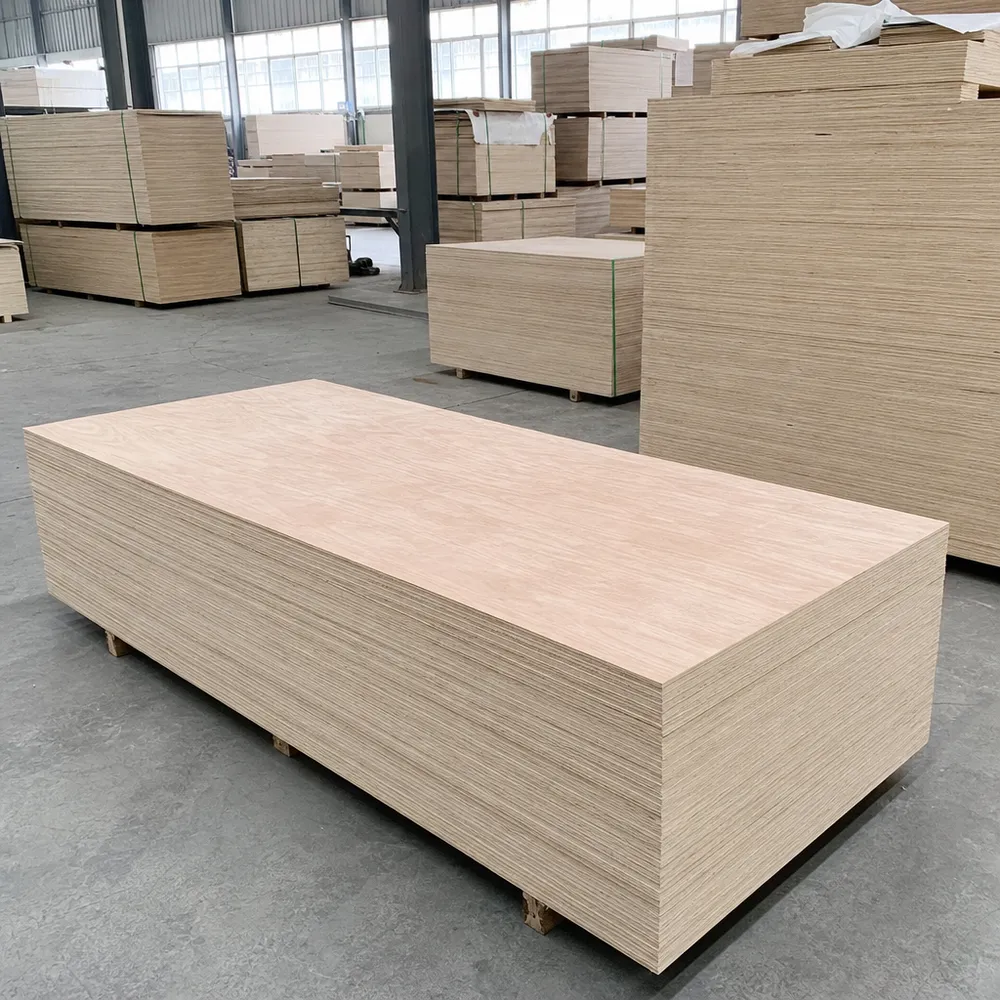
What "Commercial Grade" Actually Means for Your Orders
Commercial plywood is the workhorse of the engineered wood panel market — cross-laminated veneer construction, balanced layer count, and a face/back grade combination that suits downstream processing rather than decorative display. The term covers a wide range of specifications, and that's where most sourcing problems start: two suppliers quoting "commercial plywood" may be describing panels with meaningfully different core constructions, glue systems, and moisture performance.
Our commercial plywood is built around a consistent set of production decisions we've held since 2008. The core uses rotary-cut hardwood veneers — typically poplar or eucalyptus depending on the specification — dried to target moisture before layup. Face and back veneers are graded separately from core material; we don't mix face-grade and core-grade veneers within a panel unless the spec calls for it.
The glue system is urea-formaldehyde for interior-grade panels and melamine-fortified UF or phenolic resin for moisture-resistant and exterior-grade variants. Every batch is pressed on multi-daylight hydraulic hot presses calibrated for uniform pressure and temperature distribution across the full 1220×2440mm panel surface.
The result is a plywood board that arrives flat, stays flat, and cuts cleanly on automated equipment — which matters when your downstream customer is running panels through a CNC router or panel saw and thickness variation causes feed errors or stepped cuts.
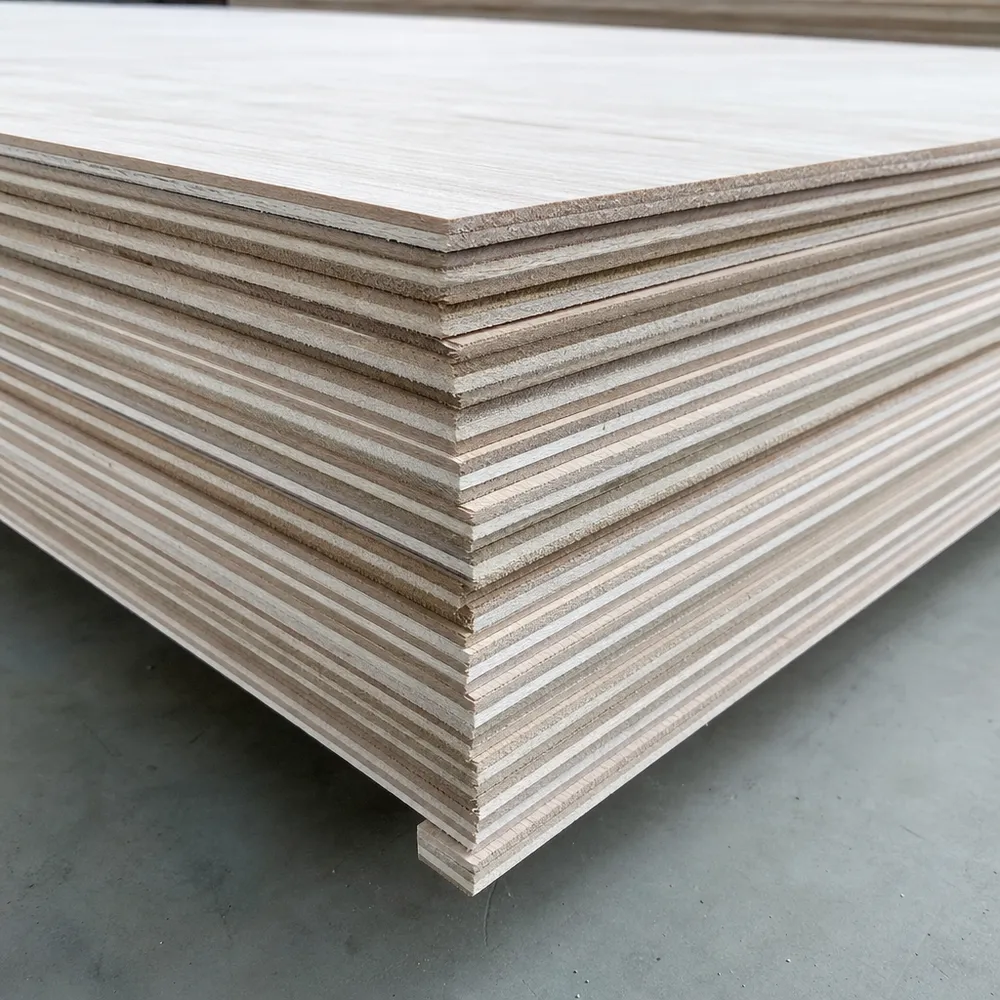
Core Construction
Rotary-cut hardwood veneers (poplar or eucalyptus), dried to target moisture before layup. No mixed face/core grading within a panel.
Glue System
UF resin for interior grade. MUF resin for moisture-resistant. Phenolic resin for exterior grade. Matched to end-use environment.
Press Calibration
Multi-daylight hydraulic hot presses with uniform pressure and temperature distribution across the full 1220×2440mm panel surface.
Downstream Performance
Arrives flat, stays flat, cuts cleanly on CNC routers and panel saws. Thickness variation controlled to ±0.2mm to prevent feed errors.
Technical Specifications
Standard commercial plywood specifications from our production lines. Exact parameters for your order depend on the specification you confirm — contact us for a detailed data sheet.
Standard Production Parameters
| Parameter | Standard Values |
|---|---|
| Face/Back Veneer Species | Poplar, eucalyptus, birch (on request) |
| Core Construction | Cross-laminated rotary-cut hardwood veneer |
| Standard Thickness |
2.5mm 3mm 4mm 5mm 6mm 8mm 9mm 12mm 15mm 18mm 21mm 25mm
|
| Standard Panel Size | 1220×2440mm (4'×8') |
| Alternative Sizes | 1220×2135mm, 1525×3050mm, custom on confirmed orders |
| Number of Plies |
3-ply 2.5–5mm
5-ply 6–12mm
7-ply 15–18mm
9-ply 21–25mm
|
| Glue System | Interior: UF resin · Moisture-resistant: MUF resin · Exterior: Phenolic resin |
| Surface Grade | BB/BB, BB/CC, CC/CC (face/back) |
| Thickness Tolerance | ±0.2mm (calibrated sanding) |
| Moisture Content | 8–12% (export standard) |
| Formaldehyde Emission |
E0 ≤0.5 mg/L
E1 ≤1.5 mg/L
CARB P2 ≤0.05 ppm (on request)
|
| Density | 550–650 kg/m³ (species and grade dependent) |
| Bending Strength (MOR) | ≥24 MPa (parallel) · ≥18 MPa (perpendicular) |
| Modulus of Elasticity (MOE) | ≥6,000 MPa (parallel) |
| Glue Bond Shear Strength | ≥0.7 MPa (dry) · ≥0.7 MPa (wet, MR/WBP grade) |
| Surface Finish | Sanded both sides (S2S) standard; unsanded available on request |
| Applicable Standards | GB/T 9846, EN 636, AS/NZS 2269 (on request) |
Thickness Tolerance Matters
CNC routers and automated panel saws are calibrated to a fixed feed height. Panels outside ±0.2mm cause chatter, tool deflection, and rejected cuts. Our calibrated sanding holds this across the full panel surface — not just the centre.
Moisture Content at Export
Panels shipped at 8–12% MC are stable for most destination climates. If your facility runs at a significantly different equilibrium MC, specify this at order stage so we can adjust conditioning before packing.
Emission Class Selection
E1 covers most commercial and industrial applications. E0 and CARB P2 are available for markets with stricter indoor air quality requirements — specify at order stage as they require a different resin formulation and cannot be upgraded post-production.
Need a full data sheet? We can provide a production-specific technical data sheet with test reports for your confirmed specification. Contact us with your thickness, grade, and glue line requirements.
Request a Data SheetGrades & Surface Quality
Commercial plywood is graded by face and back veneer quality. The grade you choose affects cost, appearance, and how much secondary processing you need to do before the panel goes into service.
Veneer Grade Reference — Face / Back
| Grade | Surface Characteristics | Typical Use |
|---|---|---|
| BB | Sound, smooth veneer. Small knots and minor repairs permitted. Suitable for paint or light stain finish. | Furniture carcasses, cabinet interiors, display fixtures, painted joinery |
| CC | Open knots, splits, and patches permitted. Structurally sound but surface is not finish-ready without additional work. | Structural sheathing, hoarding, concrete formwork, packing crates |
| BB/CC | BB face for the visible side; CC back for the concealed side. Cost-efficient where only one face is seen. | Shelving, wall panelling, shop fitting where back face is against a wall or frame |
| CC/CC | Both faces CC. Lowest cost option. Structural performance is identical to higher grades. | Packaging, temporary works, industrial flooring substrate, hidden structural panels |
Painted or Laminated Finish
BB/BB or BB/CC is the right starting point. The surface is smooth enough for direct paint application or laminate bonding without a skim coat. CC face will telegraph defects through thin laminates.
Structural or Hidden Applications
CC/CC delivers the same structural performance as BB/BB at lower cost. If the panel is behind a wall, under a floor, or inside a crate, paying for a BB face adds no functional value.
Mixed-Grade Orders
Many buyers order BB/CC for the majority of their panels and BB/BB only for exposed components. We can pack and label by grade within the same container to keep your receiving process clean.
Grade Labelling and Verification
Grade designations (BB, CC) follow GB/T 9846 definitions. If your project requires compliance with EN 636 or another standard, specify this at order stage — grading criteria differ between standards and panels are not interchangeable without confirmation. We provide mill test reports on request.
Glue Lines & Moisture Resistance
The adhesive system determines how a panel performs when it encounters moisture. Choosing the wrong glue line for the environment is one of the most common specification errors — and one of the easiest to avoid.
UF Resin
InteriorUrea Formaldehyde · Dry conditions only
Standard adhesive for interior-grade commercial plywood. Cost-effective and widely available. Not suitable for any application where the panel will be exposed to sustained humidity, condensation, or direct moisture.
MUF Resin
Moisture-ResistantMelamine Urea Formaldehyde · Humid conditions
Upgraded adhesive for environments with elevated humidity or intermittent moisture exposure. Significantly better wet-bond retention than UF. The practical choice for most commercial and light industrial applications where moisture is a factor.
Phenolic Resin
Exterior / WBPPhenol Formaldehyde · Full weather exposure
Weather and boil-proof (WBP) adhesive for panels exposed to direct weather, repeated wetting and drying cycles, or high-humidity industrial environments. Required for concrete formwork, marine applications, and exterior cladding substrates.
Quick Selection Guide
Dry interior — no moisture risk
→ UF resin (most cost-effective)
Humid interior or covered exterior
→ MUF resin (moisture-resistant)
Direct weather or water exposure
→ Phenolic / WBP resin
If you are unsure which glue line your application requires, contact us with the end-use environment details. Specifying the wrong adhesive system is not correctable after production.
The Moisture Control Process That Protects Your Landed Inventory
This is the part of our operation we've spent the most time engineering — and it's where most quality failures in Chinese plywood originate.
The Failure Mode Most Pre-Shipment Inspections Miss
When we started in 2008, the consistent complaint from buyers in Southeast Asia, the Gulf, and coastal Australia was panels that arrived dimensionally correct but warped or delaminated within weeks of clearing customs. The failure mode was almost always the same: moisture content that was acceptable at the factory gate but outside the stable range for the destination climate. A panel pressed at 14–16% moisture content will release that moisture in a dry warehouse and cup. A panel pressed at 6–7% will absorb moisture in a humid environment and swell. Neither failure shows up on a pre-shipment inspection — the panel looks fine when it's packed.
How We Engineered Around This Failure
Dedicated Drying Line — Before Layup
Incoming veneers are dried in our dedicated drying line to a target moisture range before they reach the layup station. We don't rely on the hot press to drive out residual moisture — that produces uneven results across the panel.
Pre-Press Moisture Verification at Layup
Moisture is checked at the layup stage. Veneers outside the target range are pulled back to the drying line rather than pressed. No exceptions.
Post-Press Conditioning Before Sanding
Panels are conditioned after pressing to allow residual stress to equalize before sanding. This step is skipped by many factories to save time — we don't skip it.
Edge Seal + Moisture-Resistant Film for Export
For export shipments, panels are edge-sealed and wrapped in moisture-resistant film before container loading. The edge seal prevents moisture ingress at the cut edges during ocean transit — the most vulnerable point on a panel during a 25-day sea voyage.
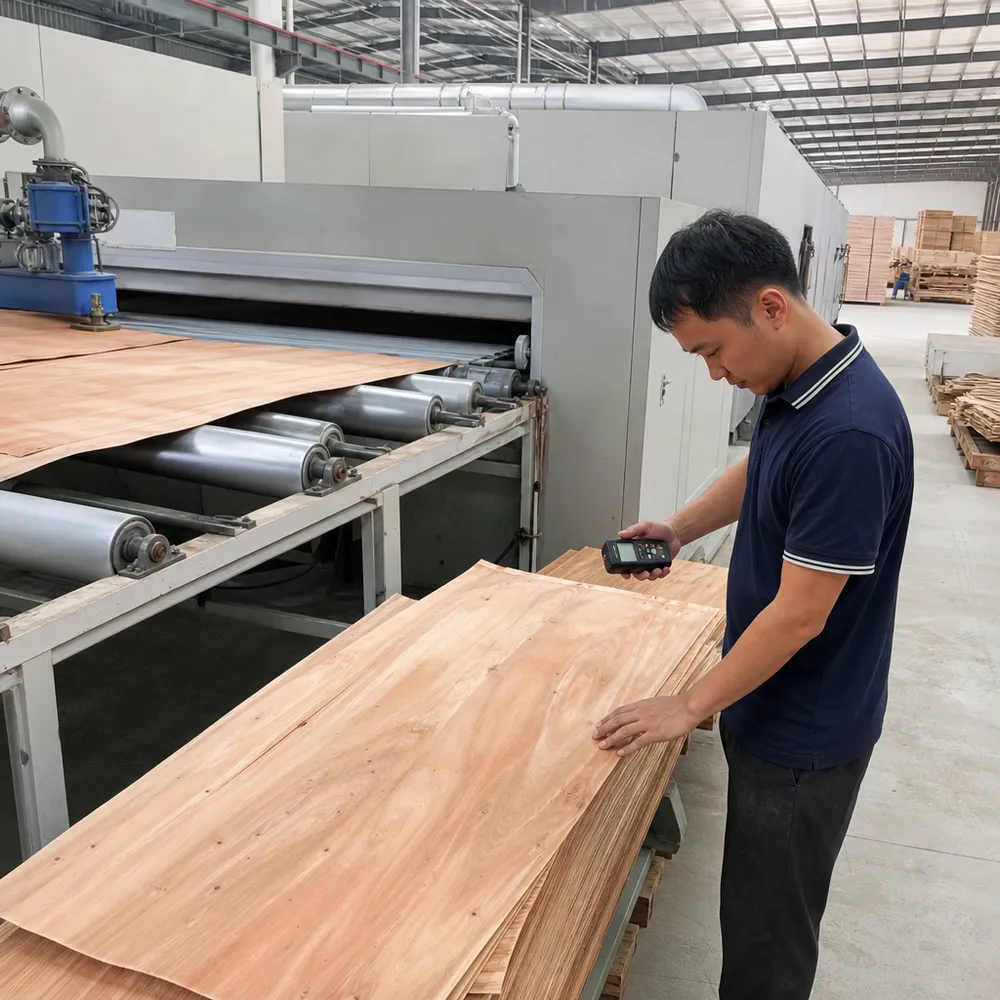
The 8–12% Target Range
The result is a finished panel at 8–12% moisture content — a range that's stable across the humidity conditions your panels will encounter in transit and in your customer's warehouse.
We've shipped to buyers in Jeddah, Singapore, Melbourne, and Houston — four very different humidity environments. The 8–12% range holds across all of them without adjustment. That range isn't arbitrary.
Verified Stable Across Export Destinations
Certifications That Clear Your Import Documentation
Every certification below is held and maintained on our commercial plywood range. Audit reports and test certificates are available on request — we don't make buyers chase documentation.
CARB Phase 2
Formaldehyde emission ≤0.05 ppm. The most demanding formaldehyde standard in our export markets — formulated to meet it as the baseline across our commercial plywood range, not as a premium option.
Relevant Markets
USA — California and all TSCA Title VI states
FSC Chain of Custody
Verified sustainable wood fiber sourcing. Wood fiber in your panels can be traced back to certified forests. FSC documentation is included as standard on FSC-specified orders — relevant under EUDR for EU market supply chains.
Relevant Markets
EU, North America, Australia — buyers with sustainability procurement policies
CE Mark
Construction product compliance for the European Union. Required for panels entering EU construction supply chains and for buyers operating under EU product regulation frameworks.
Relevant Markets
European Union
ISO 9001:2015
Quality management system certification. A standard procurement qualification requirement for institutional and commercial buyers globally. Confirms documented process control across production.
Relevant Markets
Global — procurement qualification requirement
Why CARB P2 Is Our Baseline, Not a Premium Option
CARB P2 is the most demanding formaldehyde emission standard in our export markets. We formulate to meet it as the baseline across our commercial plywood range — not as a premium option. The hot press parameters and resin system we run are engineered to achieve consistent emission performance, not just to pass a spot test.
Hitting CARB P2 consistently requires tight control of glue spread weight and press temperature. If either variable drifts, emission levels drift with them. Our press parameters are logged per batch — so if a question arises about a specific shipment, we have the production record to answer it.
For FSC-specified orders, chain-of-custody documentation is included as standard. If your buyers or end customers have sustainability sourcing requirements — or if you're supplying into EU markets where deforestation-linked supply chains carry regulatory risk under EUDR — FSC documentation is ready without a separate request process.
Certification Quick Reference
Audit Reports & Test Certificates
Available on request. We don't make buyers chase documentation — if you need a certificate for a specific certification or batch, ask and we'll provide it.
Learn About Our Quality ProcessWhere Commercial Plywood Moves: Market Segments Worth Targeting
Four distinct buyer segments drive commercial plywood volume. Each has different spec priorities — here's how our panels fit each one.
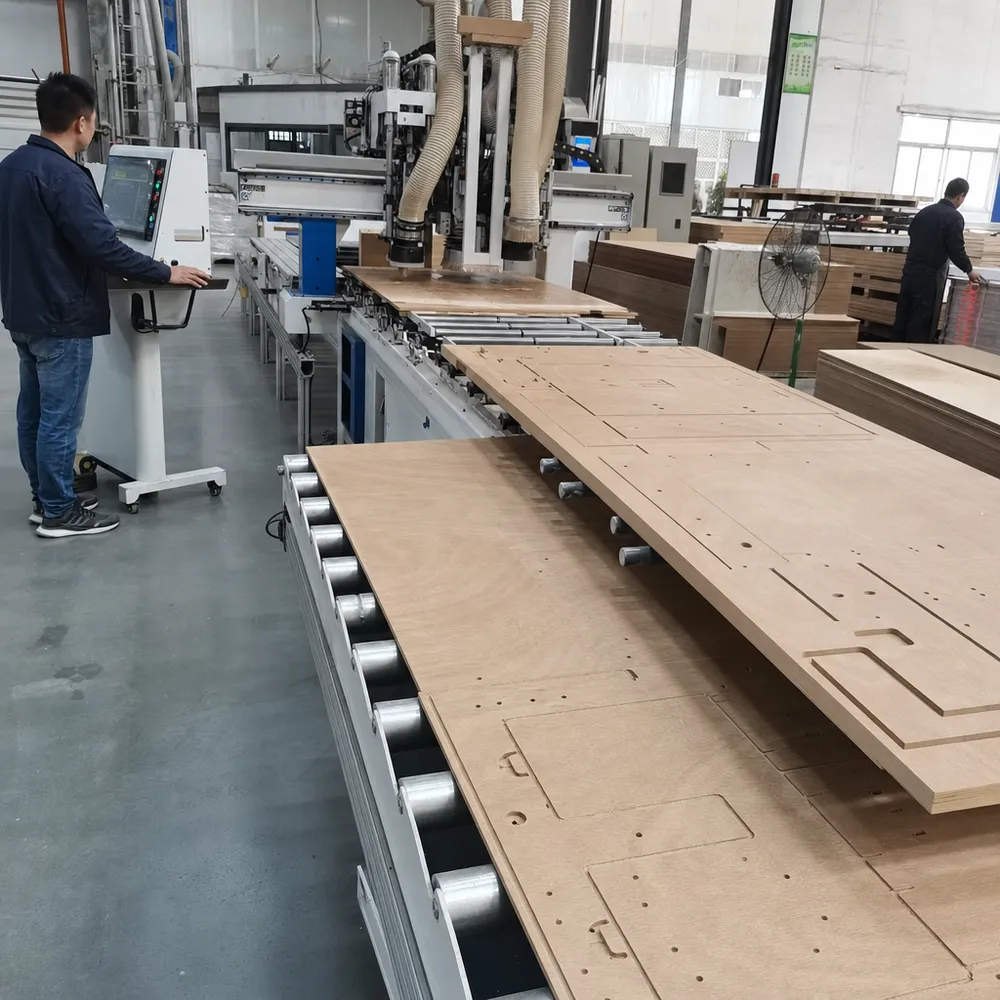
Furniture Manufacturing & Cabinet Production
Furniture manufacturers in Southeast Asia, Eastern Europe, and the Middle East use our panels as substrate for melamine-faced and veneer-faced furniture components. The critical spec here is consistent thickness tolerance — our panels hold ±0.2mm.
Automated edge-banding and CNC routing equipment requires panels within tight thickness tolerances to run without manual adjustment between batches. A furniture manufacturer running 500 panels per day through a CNC line cannot absorb thickness variation — it stops the line. Our calibrated sanding ensures your downstream customer's equipment runs without interruption, which means fewer complaints and repeat orders for you.
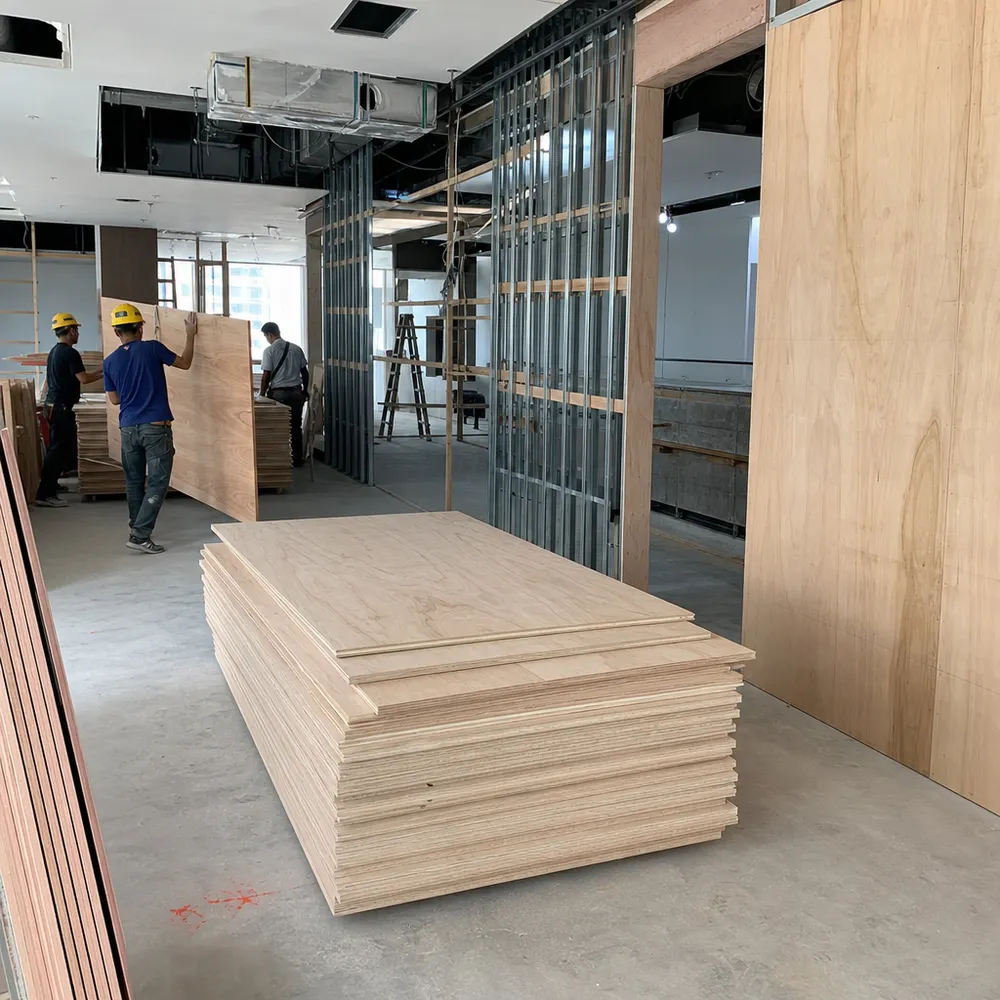
Construction & Fit-Out Contractors
Contractors use commercial plywood sheets for wall sheathing, flooring underlayment, concrete formwork backing, and interior partition framing. For commercial fit-out projects — retail, hospitality, office — CARB P2 certification is increasingly a specification requirement, particularly on projects with indoor air quality standards.
Supplying CARB P2-certified plywood boards lets your contractor customers meet those specs without sourcing from a separate supplier — one SKU covers the indoor air quality requirement.
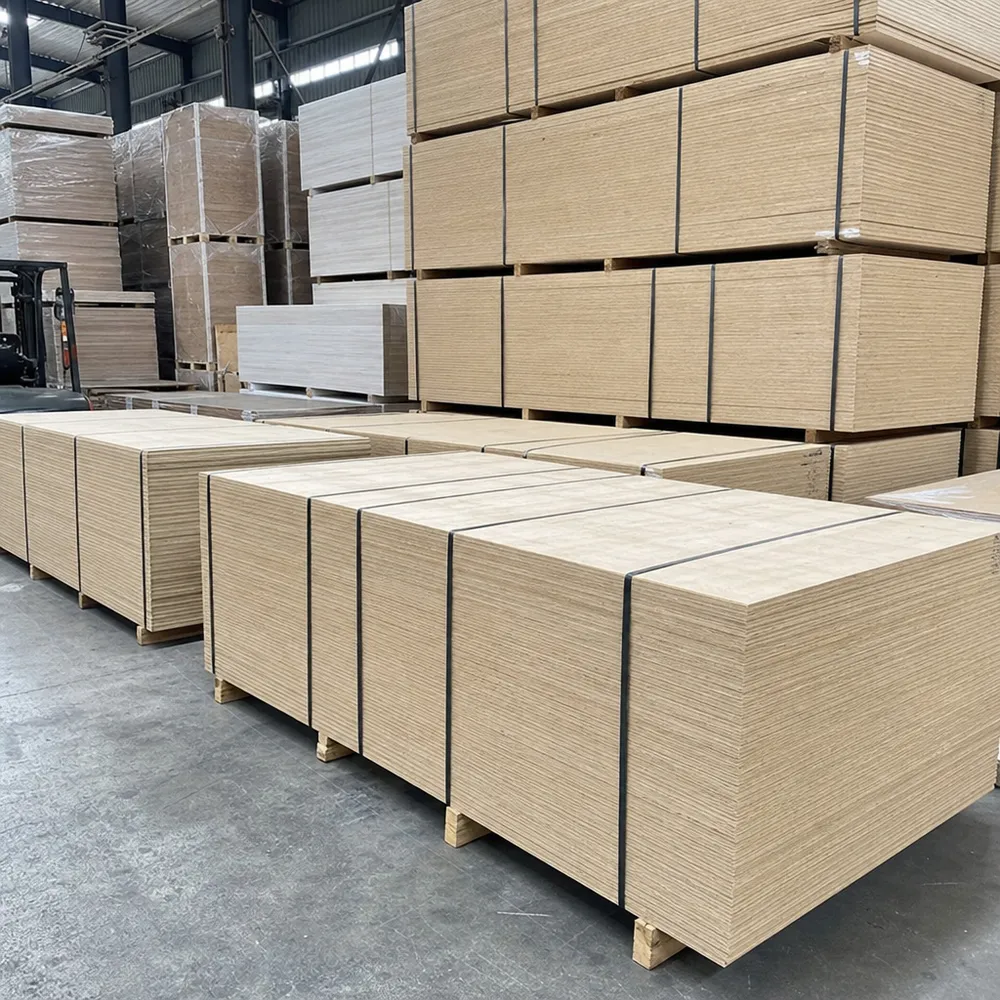
Wholesale Distribution & Import/Export
The combination of our capacity and certification stack creates the most commercial leverage here. A distributor stocking our commercial plywood can serve furniture manufacturers, construction contractors, and retail lumber yards from a single SKU range — the same panel, certified for multiple end-use requirements.
The 450,000 m³ annual capacity means your volume orders run without competing with other buyers' schedules, and the 6 production lines give us the flexibility to run your specification without disrupting standard production.
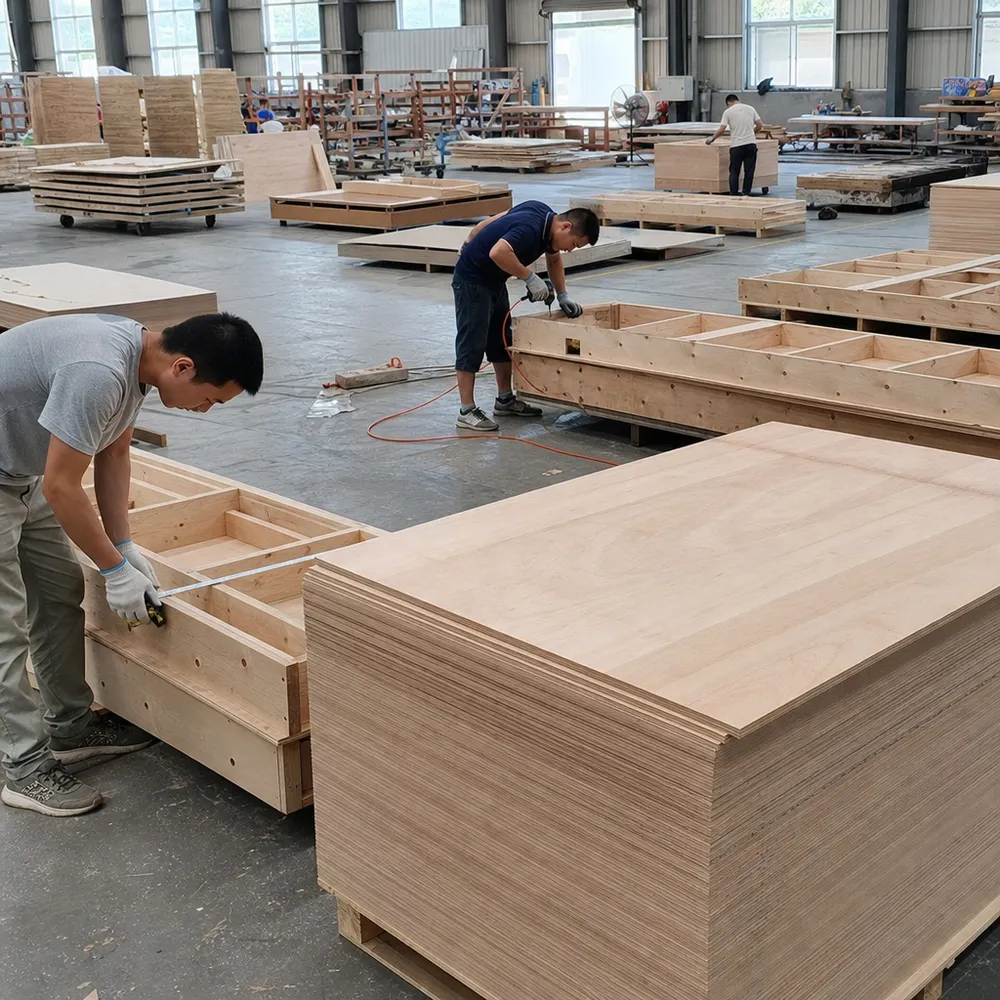
Overseas Manufacturers Using Plywood as a Component
Packaging manufacturers, door and window frame producers, RV and modular building manufacturers typically need consistent panel dimensions and stable moisture content more than decorative surface quality. Our CC/CC grade panels serve this segment well.
The surface isn't premium, but the structural consistency and dimensional stability are production-line reliable — which is what matters when plywood is a hidden component, not a finished face.
Customization: What We Can Specify, What We Can't
Commercial plywood customization at our factory is a specification question, not a tooling question. Plywood is cut-to-size, not molded — custom dimensions are a scheduling and yield decision, not a capital investment.
Available on Confirmed Orders
Any value from 2.5mm to 25mm. Non-standard thicknesses (e.g., 11mm, 14mm, 17mm) are available; minimum order quantities apply for non-standard specs.
Standard 1220×2440mm is our default. We also produce 1220×2135mm and 1525×3050mm. Custom dimensions outside these ranges are available on confirmed orders — we'll advise on yield efficiency and minimum quantities.
Standard production uses poplar and eucalyptus core with poplar face. Birch face veneer is available for a harder, finer-grained surface. Custom face veneer species (oak, teak, walnut) are available for OEM furniture programs — lead time depends on veneer sourcing.
Interior (UF), moisture-resistant (MUF), and exterior/WBP (phenolic) glue systems are all in standard production. Specify the end-use environment and we'll recommend the appropriate glue system.
Select the grade that matches your application's visibility requirements.
CARB P2, E1, and E0 are all available. E0 requires a specific resin formulation and carries a small premium — worth specifying if your buyers are in markets with strict indoor air quality requirements.
Custom grade stamps, brand marks, and bundle labeling are available on confirmed OEM programs.
What We Can't Do
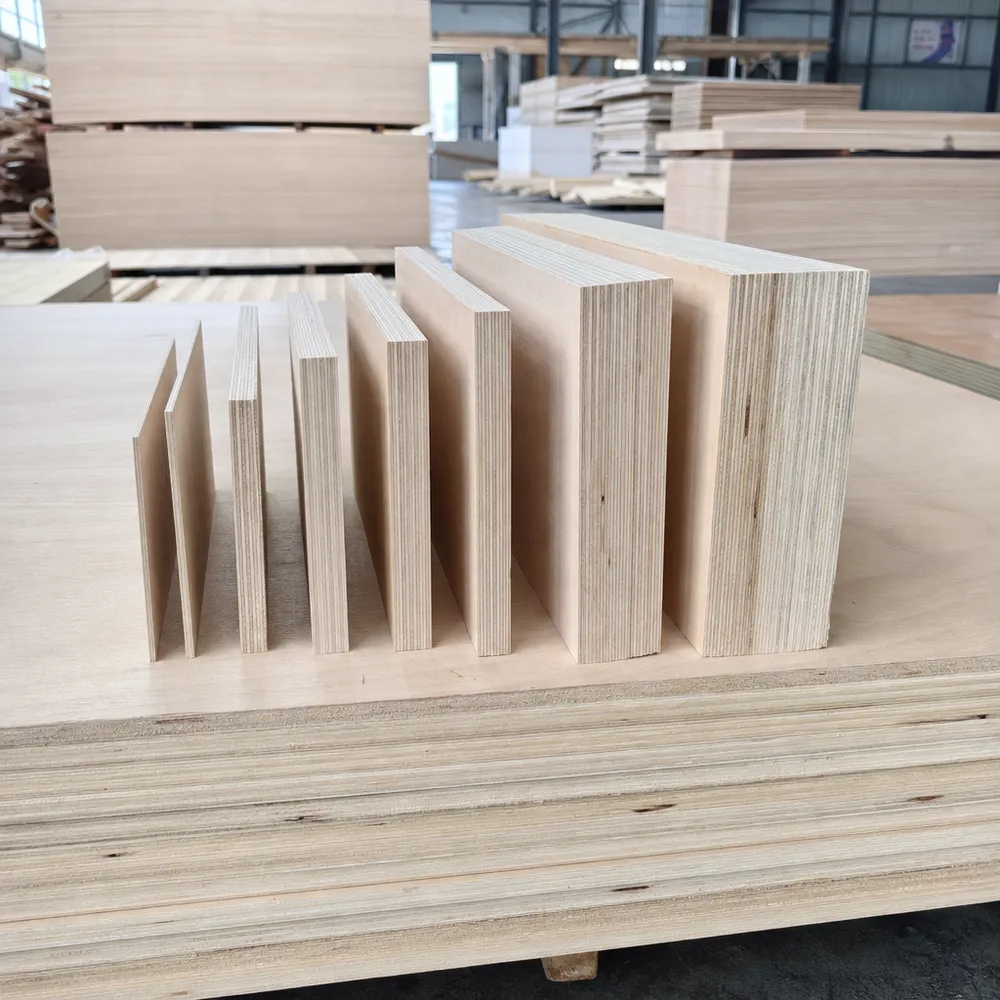
We don't produce panels below 2.5mm or above 25mm in standard commercial plywood construction.
Under 2.5mm: The veneer count and pressing parameters change significantly — that's a different product category.
Above 25mm: Blockboard or LVL construction is typically more appropriate for structural requirements at that thickness.
| Thickness Range | 2.5mm – 25mm |
| Standard Size | 1220×2440mm |
| Core Species | Poplar / Eucalyptus |
| Face Veneer | Poplar (std), Birch (opt) |
| Glue Systems | UF / MUF / WBP |
| Surface Grades | BB/BB · BB/CC · CC/CC |
| Emission Standards | CARB P2 / E1 / E0 |
| OEM Branding | Available on confirmed orders |
Documented for the Markets You Sell Into
Every certification we hold is third-party verified and kept current. If your buyer or destination market requires documentation, we can provide it with your shipment.
Mandatory for plywood sold into the US market. Our CARB P2 certification covers formaldehyde emissions and is maintained through ongoing third-party testing. TPC number available on request.
FSC-certified material is available for buyers who need to demonstrate responsible sourcing to their end customers or meet green building specifications such as LEED. Minimum order quantities apply.
Required for plywood entering the EU construction market. Our panels are tested and documented to EN 636 and EN 13986, covering mechanical performance, dimensional tolerances, and formaldehyde class.
E1 is standard across our range. E0 is available with a specific low-emission resin formulation — relevant for Japan, South Korea, and buyers with strict indoor air quality requirements. Test reports issued per batch.
Our production facility operates under ISO 9001:2015 certification, covering incoming material inspection, pressing parameters, moisture content control, and outgoing quality checks before loading.
All export packaging uses ISPM 15-compliant heat-treated timber. Phytosanitary certificates are issued per shipment by the relevant Chinese authority and included in the shipping document set.
We can provide test reports, certificates of conformity, mill certificates, and third-party lab results. Tell us which market you're selling into and we'll confirm which documents apply.
Production Capacity and Order Execution
Six production lines. 18,000 m² facility in Xuzhou. 450,000 m³ annual output. Here's what those numbers mean for your supply chain.
What 450,000 m³ Means for Your Schedule
A 40HQ container of 18mm commercial plywood holds roughly 20–22 m³ of panels. Our monthly output capacity is sufficient to run multiple container orders simultaneously — one buyer's schedule does not affect another's.
This matters most when you're planning a seasonal push or coordinating multiple destination ports. We can stage and load concurrent orders without compressing your delivery window.
Lead Time Breakdown
Batch Traceability Through Production
We log press parameters, veneer lot, glue batch, and QC inspection results per production run. If a quality issue surfaces after delivery, we can trace it back to the specific batch and identify the root cause.
This has happened twice in the past three years. Both times we identified the issue, replaced the affected panels, and adjusted the process. Batch logging turns a quality complaint into a process improvement rather than a dispute.
Export Documentation — Standard Package
We've been through enough customs clearance cycles in North America, Europe, the Middle East, and Australia to know what documentation gaps cause delays. Every shipment includes:
Mixed-Specification Consolidated Loads
Container loading is planned around panel dimensions and stacking configuration to maximize cubic utilization. We provide loading plans with each shipment. For buyers ordering mixed specifications, we coordinate consolidated loads to reduce per-unit freight cost.
Packaging and Container Loading for Ocean Transit
Export-grade packaging engineered for the full ocean transit cycle — from press to receiving dock, including tropical water routes.
Bundle Construction
What's Marked on Every Bundle
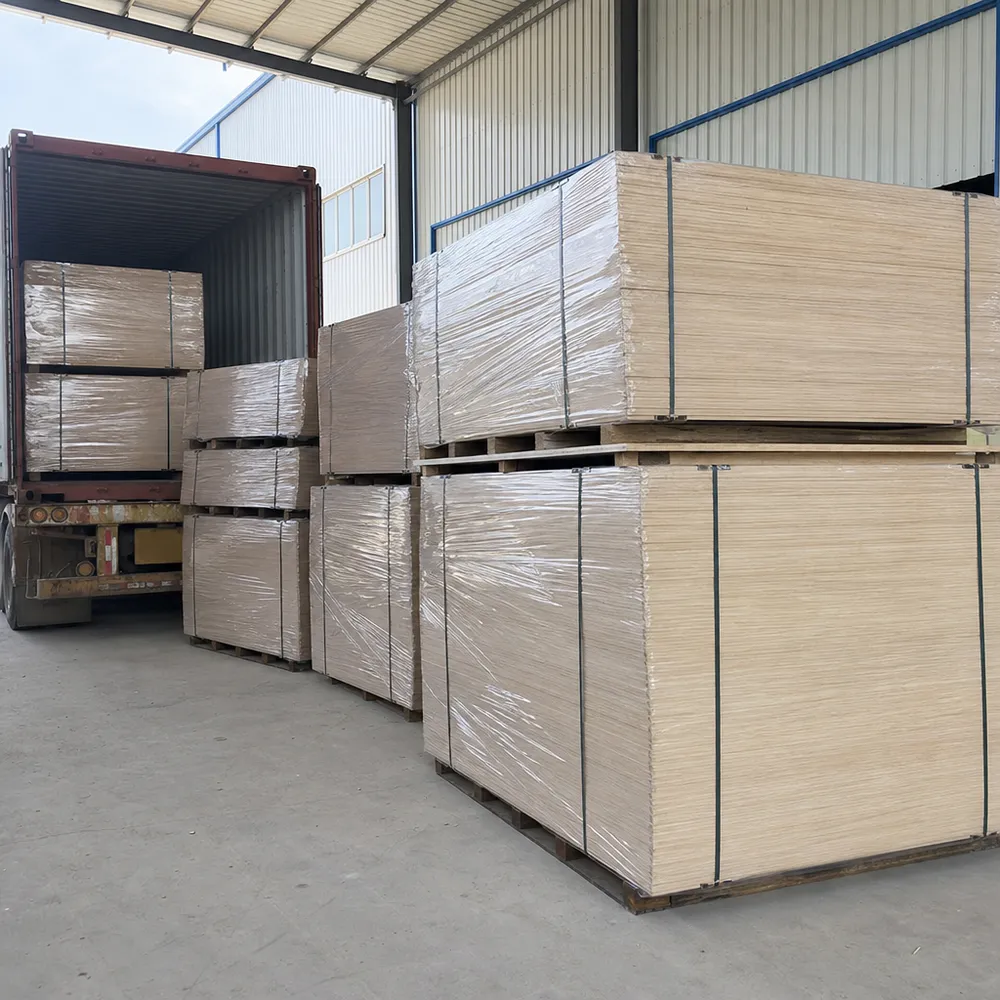
Container Loading Plans
Loading is planned around panel dimensions and stacking configuration to maximize cubic utilization. We provide a loading plan document with every shipment. For mixed-specification orders, we coordinate consolidated loads to reduce per-unit freight cost.
Loading quantities below are approximate for 1220×2440mm panels. Actual quantities depend on bundle configuration and container type. We provide exact loading plans with each order.
Standard Container Loading Quantities
Approximate quantities for 1220×2440mm panels — 20HQ and 40HQ containers
| Thickness | Panels per 20HQ | Panels per 40HQ |
|---|---|---|
| 6mm | ~2,400 sheets | ~4,800 sheets |
| 9mm | ~1,600 sheets | ~3,200 sheets |
| 12mm | ~1,200 sheets | ~2,400 sheets |
| 15mm | ~960 sheets | ~1,920 sheets |
| 18mm | ~800 sheets | ~1,600 sheets |
| 25mm | ~560 sheets | ~1,120 sheets |
Freight Cost Planning
Use the loading quantities above to estimate container utilization before requesting a quote. Mixed-spec consolidated loads reduce per-unit freight cost.
Customs Clearance Ready
Full documentation package prepared as standard. North America, Europe, Middle East, and Australia clearance cycles covered without documentation gaps.
Batch Traceability
Every production run is logged. If a quality issue surfaces post-delivery, we trace it to the specific batch, replace affected panels, and adjust the process.
Selecting the Right Plywood Board for Your Application
Commercial plywood is the general-purpose panel in our range. If your application has specific performance requirements, one of the sibling products in our commercial plywood series may be a better fit.
Marine Plywood
Direct water exposureWBP phenolic glue throughout, BS 1088 construction. For applications with direct water exposure or high-humidity environments where delamination risk is unacceptable.
Exterior Plywood
Weather exposureExterior-grade glue system, suitable for outdoor construction applications where the panel will be exposed to weather.
Interior Plywood
Dry indoor useUF glue system optimized for dry interior applications. Lower cost than moisture-resistant grades where the application doesn't require it.
Furniture Plywood
Manufacturing linesTighter face veneer grading (BB/BB minimum), calibrated sanding to ±0.15mm. Optimized for furniture manufacturing lines.
Structural Plywood
Load-bearingEngineered for load-bearing applications. Specific ply construction and glue system to meet structural performance standards.
Moisture Resistant Plywood
Humid interiorsMUF glue system for applications in humid environments that don't require full exterior or marine grade.
Hardwood Plywood
Finished face surfaceHardwood face veneer (oak, birch, teak) for applications where the plywood surface is the finished face.
Not sure which specification fits your application?
Send us the end-use environment and performance requirements — we'll recommend the right product and glue system.
Frequently Asked Questions
Common questions from importers, distributors, and OEM buyers on specifications, certifications, and order logistics.
Standard MOQ is one 20HQ container for standard specifications (1220×2440mm, standard thickness, standard grade). For mixed specifications within a single container, we can combine different thicknesses and grades to reach container volume. Sample orders (5–10 sheets per specification) are available for new buyers before committing to a container order.
CARB P2 (≤0.05 ppm) is the most stringent and is required for panels sold into the US market under TSCA Title VI. E1 (≤0.124 mg/m³ by chamber test) is the European standard and is less restrictive than CARB P2. E0 (≤0.05 mg/m³) is a Japanese standard roughly equivalent to CARB P2 in stringency.
If you're supplying into the US, specify CARB P2. For Europe, E1 meets CE requirements; E0 is available for buyers with stricter indoor air quality requirements. We produce to all three standards — specify which you need when requesting a quote.
Using interior-grade glue in a humid application is the most common cause of delamination complaints — it's worth getting right at the specification stage. If you're unsure, tell us the end-use environment and we'll specify the appropriate glue system.
For standard commercial plywood applications where the face will be painted, laminated, or covered, poplar face is the most cost-effective choice.
Yes. Custom dimensions are available on confirmed orders. Common non-standard requests include:
We'll advise on minimum order quantities and yield efficiency for non-standard dimensions — some sizes cut more efficiently from our standard press format than others, which affects cost.
For plywood imported into the US, the primary regulatory requirements are:
We supply a full documentation package with every shipment — TPC certificate, test reports, species declarations, and phytosanitary certificates — so your customs clearance process is straightforward.
Our standard minimum is one 20ft container, which typically holds 18–22 m³ of plywood depending on thickness and panel size. For mixed-specification orders, we can combine compatible specs within a single container to help you reach the minimum efficiently.
If you're evaluating us for the first time and need a smaller trial quantity, contact us — we can sometimes accommodate sample orders or consolidate with other shipments depending on timing.
Total door-to-port lead time is typically 45–65 days from PO confirmation. We provide vessel booking details and a bill of lading as soon as the container is loaded so you can track the shipment in real time.
Ready to Source?
Get a quote for your next plywood order
Tell us your specification — thickness, grade, glue system, certification, and volume — and we'll come back with pricing, lead time, and a sample offer within one business day.
Get a Quote for Your Commercial Plywood Order
Send us your specification and we'll come back with a detailed FOB quote and the relevant certification documentation for your import requirements.
What to Include in Your Enquiry
A complete specification lets us return an accurate FOB quote without back-and-forth. Include the following in your first message:
-
Thickness — e.g. 12mm, 18mm, 25mm
-
Grade — face/back veneer grade (e.g. BB/CC, B/BB)
-
Glue System — MR, WBP, or E0/CARB P2 compliant
-
Panel Size — standard 1220×2440mm or custom dimensions
-
Target Volume — sheets per order or m³ per container
-
Destination Market — country/region for certification matching
New Buyer? Start with a Sample Order
Most new buyers start with a sample order to verify specification before committing to a container. We can ship samples within 5–7 working days of specification confirmation.
What You'll Receive
Explore More Commercial Plywood Products
Browse related product pages for application-specific specifications and certifications.