

Interior Plywood Manufacturer — Factory-Direct, CARB P2 & FSC Certified
Interior grade plywood built for dry-environment performance — consistent bonding, controlled emissions, and surface quality that holds up through downstream processing.
We manufacture interior plywood for distributors, furniture OEMs, and building material importers who need panels that arrive flat, cut clean, and pass formaldehyde compliance in their target market.
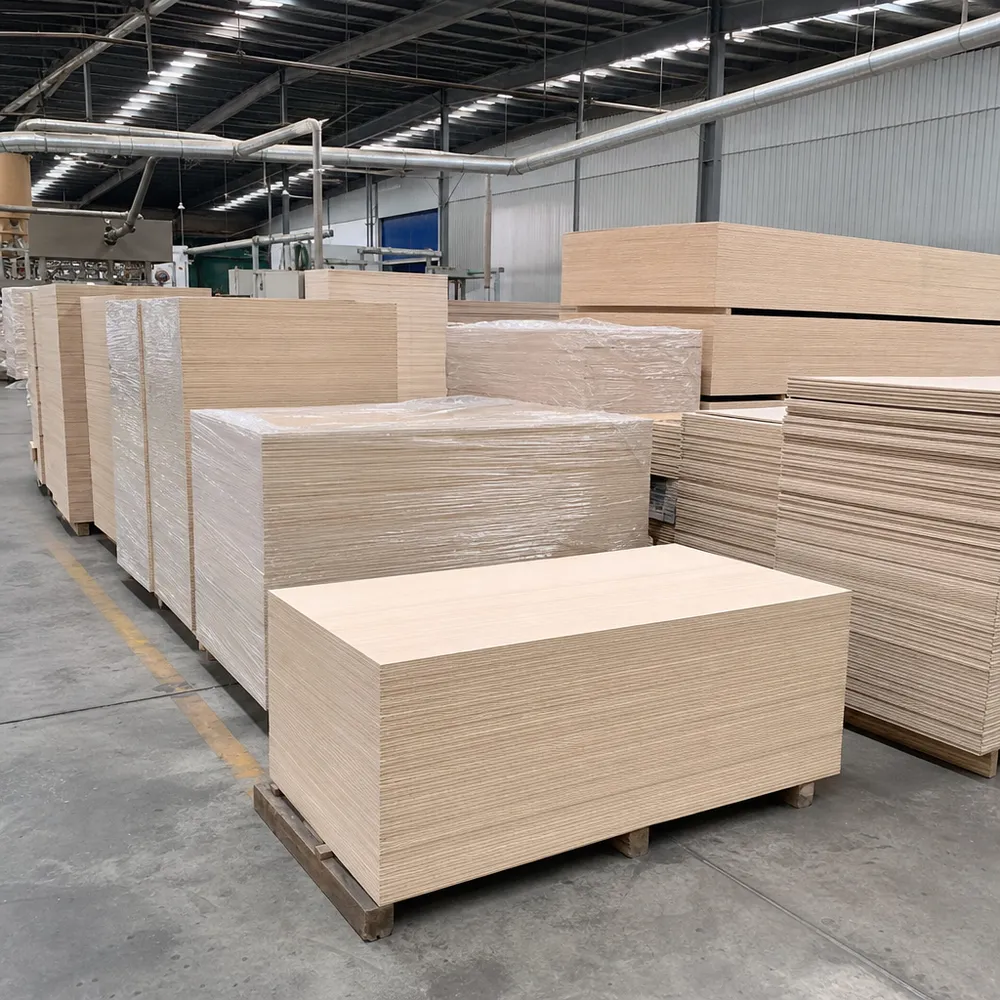
What Interior Grade Plywood Actually Means — and Where the Spec Decisions Are
Interior plywood is manufactured with urea-formaldehyde (UF) resin systems rather than the phenolic or melamine-based adhesives used in exterior and marine grades. That adhesive choice is the defining characteristic — UF bonds perform well in stable, dry indoor environments, and they allow manufacturers to hit the low formaldehyde emission thresholds that markets like California (CARB P2), the EU (E1/E0), and Japan (F★★★★) require.
The trade-off is moisture sensitivity: interior grade panels are not designed for prolonged humidity exposure or direct water contact. If your downstream application involves kitchens, bathrooms, or any environment with regular moisture cycling, that's a different product conversation.
What this means commercially: interior plywood is the workhorse panel for furniture manufacturing, cabinetry, interior wall paneling, flooring underlayment, and general joinery. These are high-volume, repeatable segments.
A furniture manufacturer running a production line doesn't want to pay for marine-grade adhesive on panels that will never see water — they want consistent UF bonding, tight thickness tolerance, and emission compliance documentation that clears customs without delays.
We produce interior plywood across the full commercial thickness range — 2.5mm through 25mm — with standard panel dimensions of 1220×2440mm and custom sizing available on confirmed orders. Face veneer species, core construction, and surface grade are all configurable depending on your downstream application and target market.
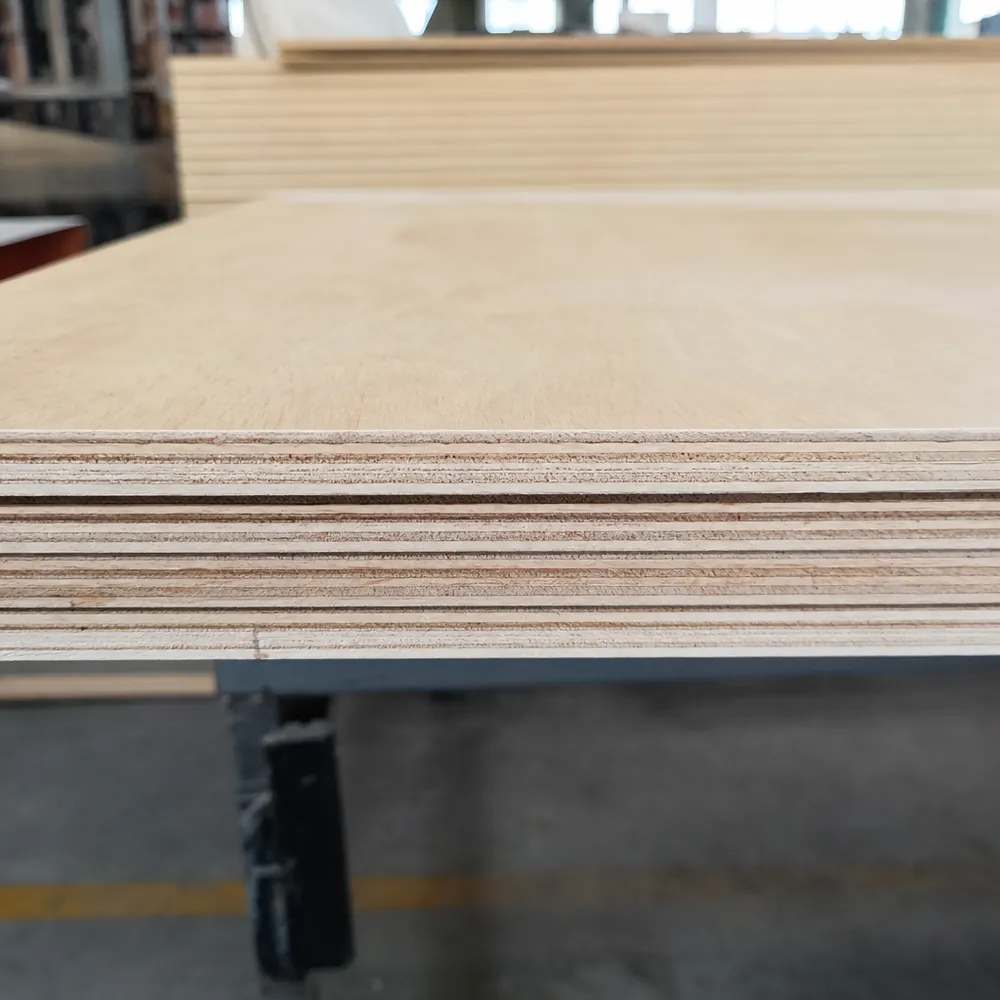
UF Resin System
Optimized for dry indoor environments. Enables CARB P2, E1/E0, and F★★★★ emission compliance.
Configurable Construction
Core species, face veneer, surface grade, and thickness all buyer-specified per order.
Compliance Documentation
Emission test reports and certification paperwork that clear customs without delays.
Production-Line Ready
Consistent bonding and tight tolerance for furniture OEMs and high-volume downstream processors.
Primary Applications
Technical Specifications
Standard parameters for our interior grade plywood range. Core construction, face veneer, surface grade, and thickness are all buyer-specified on confirmed orders.
Interior Plywood — Standard Specification Table
| Parameter | Specification |
|---|---|
| Panel dimensions (standard) | 1220 × 2440mm |
| Thickness range |
2.5mm 3mm 4mm 5mm 6mm 9mm 12mm 15mm 18mm 21mm 25mm
|
| Thickness tolerance | ±0.2mm (calibrated sanding) |
| Core construction |
Poplar Eucalyptus Mixed Hardwood (buyer-specified)
|
| Face veneer options |
Poplar Birch Okoume Pine Hardwood on request
|
| Adhesive system | Urea-formaldehyde (UF) — interior grade |
| Formaldehyde emission |
CARB P2 ≤0.05 ppm E1 ≤0.1 mg/m³ available
|
| Moisture content | 8–12% (export standard, controlled drying) |
| Surface grade |
BB/BB BB/CC CC/CC (buyer-specified)
|
| Sanding | Both faces sanded to 80–120 grit (unsanded available on request) |
| Flatness / warp tolerance | ≤1mm per 1000mm panel length |
| Glue bond strength | ≥0.7 MPa dry shear (per GB/T 9846) |
| Standard packing | Palletized, corner-protected, stretch-wrapped; fumigation certificate available |
| MOQ | 1 × 20ft container (mixed thickness negotiable) |
| Lead time | 15–25 days from order confirmation (subject to spec and volume) |
Custom panel sizes (e.g. 1250×2500mm, 915×1830mm) available on request. Tolerances may vary for non-standard dimensions.
Compliance Standards
CARB Phase 2
≤0.05 ppm HCHO — California Air Resources Board compliant for US market entry
E1 / E0
European EN 13986 emission classes — E1 ≤0.1 mg/m³, E0 ≤0.05 mg/m³ available
F★★★★ (JIS A 5908)
Japan's highest formaldehyde emission class — ≤0.3 mg/L average
GB/T 9846
Chinese national standard for plywood — base manufacturing and test reference
Buyer Notes
- Emission grade must be specified at order confirmation — cannot be changed post-production.
- Third-party inspection (SGS, BV, Intertek) accommodated at buyer's cost before shipment.
- Test reports issued per batch — available in English, with lab accreditation details.
- UF adhesive is not suitable for exterior, high-humidity, or wet-area applications.
- Sample panels available prior to bulk order — lead time 5–7 business days.
Thickness & Construction Guide
Matching panel thickness and core species to your application avoids over-engineering costs and under-spec failures. Use this guide as a starting point — our team can advise on edge cases.
Thickness Selection by Application
| Thickness | Plies | Typical Applications | Notes |
|---|---|---|---|
| 2.5 – 3mm | 3-ply | Drawer bottoms, cabinet backs, light backing panels | Low load-bearing; poplar core standard |
| 4 – 6mm | 3-ply / 5-ply | Door skins, decorative panels, light wall cladding | Good flatness; suitable for lamination |
| 9mm | 5-ply | Furniture frames, shelving, partition infill | Versatile mid-range; eucalyptus core for added stiffness |
| 12mm | 7-ply | Cabinet carcasses, wardrobe bodies, stair risers | Most common furniture grade; balanced stiffness/weight |
| 15 – 18mm | 9-ply / 11-ply | Worktops, table tops, heavy shelving, flooring substrate | High demand range — confirm lead time early |
| 21 – 25mm | 13-ply+ | Structural furniture components, stage flooring, heavy-duty shelving | Eucalyptus or mixed hardwood core recommended |
Core Species Comparison
Poplar Core
- Lightweight — lower freight cost per panel
- Smooth, consistent surface — ideal for lamination
- Cost-effective for high-volume furniture runs
- Lower screw-holding vs. hardwood cores
Best for
Furniture panels, cabinet backs, door skins, decorative applications
Eucalyptus Core
- Higher density — superior stiffness and load capacity
- Better screw-holding and edge strength
- Good dimensional stability under load
- Heavier — higher freight cost per panel
Best for
Worktops, heavy shelving, structural furniture, flooring substrate
Mixed Hardwood Core
- Cost-balanced between poplar and eucalyptus
- Adequate strength for most general joinery
- Widely available — shorter lead times
- Species mix varies — less predictable grain consistency
Best for
General joinery, interior construction, mid-range furniture
Interior Use Only — UF Adhesive Limitation
All panels in this range use urea-formaldehyde (UF) adhesive, which is not waterproof. Prolonged exposure to moisture, humidity above 85%, or direct water contact will cause delamination. For wet areas, bathrooms, exterior cladding, or marine applications, please enquire about our WBP/MR plywood range instead.
Formaldehyde Emission Compliance
Emission compliance is the most common customs and regulatory barrier for plywood importers. Here's how our interior grade panels meet the major market standards — and what documentation you receive.
CARB Phase 2 — United States
California Air Resources Board / TSCA Title VI
≤0.05
ppm HCHO limit
TSCA VI
Federal equivalent
Required for all hardwood plywood sold into the US market. Our CARB P2 panels ship with third-party lab test reports from accredited Chinese testing bodies, accepted by US Customs.
E1 / E0 — European Union
EN 13986 / EN 717-1
≤0.1
mg/m³ — E1 class
≤0.05
mg/m³ — E0 class
E1 is the standard EU requirement for interior wood-based panels. E0 is available for buyers targeting premium or eco-labelled product lines. Specify at order stage.
F★★★★ — Japan
JIS A 5908 / JAS standard
≤0.3
mg/L average
4★
Highest JIS class
Japan's most stringent formaldehyde class. Required by major Japanese furniture and construction importers. Test method differs from EN/CARB — confirm requirement at enquiry stage.
Documentation Provided Per Shipment
Emission Test Report
Batch-specific, from accredited lab — English version available
Certificate of Conformity
Declares compliance with specified standard (CARB P2 / E1 / F★★★★)
Phytosanitary Certificate
Issued by Chinese quarantine authority — required for most markets
Bill of Lading & Packing List
Full shipping documentation for customs clearance
Commercial Invoice & Certificate of Origin
Form E (ASEAN-China FTA) available where applicable
How Emission Testing Works
-
1
Production batch sampling
Panels are sampled from each production run before shipment
-
2
Accredited lab analysis
Samples tested by CNAS-accredited laboratory using EN 717-1, ASTM E1333, or JIS A 1460 method as required
-
3
Report issued & archived
Test report references batch number and production date — traceable to your shipment
-
4
Forwarded with shipping docs
Sent digitally before vessel departure; originals included in document package
If your market requires third-party inspection (SGS, Bureau Veritas, Intertek), we can coordinate pre-shipment inspection at your cost. Notify us at order confirmation stage to allow scheduling time.
Standard Thickness & Sheet Sizes
All dimensions are nominal. Actual thickness tolerance is ±0.5 mm for sanded panels. Custom sizes and thicknesses are available on full-container orders — enquire for lead time.
Available Thicknesses
| Thickness (mm) | Plies | Typical Use |
|---|---|---|
| 3 mm | 3-ply | Door skins, drawer bottoms, backing panels |
| 4 mm | 3-ply | Cabinet backs, light decorative panels |
| 6 mm | 5-ply | Drawer sides, light shelving, partitions |
| 9 mm | 7-ply | Shelving, cabinet sides, wall panelling |
| 12 mm | 9-ply | Cabinet carcasses, furniture panels — most popular |
| 15 mm | 11-ply | Worktops, heavy shelving, stair treads |
| 18 mm | 13-ply | Structural furniture, flooring substrate, benchtops |
| 25 mm | 17-ply | Heavy-duty shelving, industrial furniture |
★ 12 mm is the highest-volume thickness in this range — best container utilisation and pricing.
Standard Sheet Sizes
1220 × 2440 mm
Standard international — highest availability, best pricing
1220 × 2745 mm
Extended length — popular for wardrobe and tall cabinet runs
1525 × 2440 mm
Wider sheet — reduces joins in large panel applications
1525 × 3050 mm
Large format — kitchen and commercial joinery applications
Container Loading Reference
~600–650
sheets per 20ft FCL
(18 mm, 1220×2440)
~1,300+
sheets per 40ft FCL
(18 mm, 1220×2440)
Thinner panels yield proportionally more sheets per container. Exact quantities confirmed at booking stage based on final specification.
Face Veneer Species & Finish Options
The face veneer determines the panel's visual character and finishing behaviour. All species below are available in this interior grade range — minimum quantities and lead times vary by species.
Birch
Pale / CreamFine, even grain with minimal figure. Accepts stain and paint uniformly — the benchmark face veneer for painted furniture and Scandinavian-style joinery.
Okoume
Pink / Light RedAfrican hardwood with a silky, interlocked grain. Lightweight and easy to work. Popular in European markets for furniture and interior panelling.
Bintangor
Red / Orange-BrownSoutheast Asian species with a warm reddish tone. Cost-effective face veneer widely used in general furniture and construction-grade panels.
Pencil Cedar
Red / AromaticDistinctive reddish-brown with natural aromatic properties. Preferred for wardrobe interiors, drawer linings, and premium storage applications.
Meranti
Yellow / Light BrownVersatile SE Asian hardwood with a moderately coarse grain. Good strength-to-weight ratio. Widely used across Asia-Pacific markets for general joinery.
Walnut / Teak Face
Dark / PremiumDecorative face veneers for premium furniture and fit-out. Typically sliced veneer over a poplar or eucalyptus core. MOQ and lead time apply — enquire separately.
Surface Finish Options
Sanded (S2S)
Both faces sanded to 80–120 grit. Ready for painting, staining, or laminating. Standard finish for this range.
Unsanded
Rough-pressed surface. Lower cost — suitable where face will be covered, laminated, or further processed.
Melamine Faced
White or woodgrain melamine paper bonded to face. Ready-to-use for cabinet interiors and shelving. MOQ applies.
UV Coated
UV-cured lacquer applied to face veneer. Enhances grain appearance and provides surface protection. Enquire for availability.
Emission Compliance as a Market Access Tool
The formaldehyde emission spec is where interior plywood either opens or closes doors in your target market. Here's how we've engineered compliance into the baseline — not as a premium add-on.
CARB P2 — The Tightest Standard in Our Export Markets
≤0.05 ppm Hardwood PlywoodCalifornia's Air Resources Board sets the limit at ≤0.05 ppm for hardwood plywood. It applies to any panel sold or used in California regardless of where it was manufactured. If you're distributing into the US, CARB P2 documentation is not optional — it's a customs and retail compliance requirement.
We formulate to CARB P2 as the baseline across our interior plywood production, not as a premium option. Our hot press parameters and UF resin system are calibrated to hit that emission target consistently. Running a separate lower-spec line for non-CARB orders creates more process complexity than it saves in resin cost — we made that calculation in 2012 when we upgraded the press system, and it was cleaner to engineer the whole line to the tighter standard.
What this means for your sourcing: You get CARB P2 documentation as standard, not as an add-on that requires a separate production run or a premium price.
EU Market — E1 & E0
CE Declaration of Conformity Included
E1 emission compliance (≤0.1 mg/m³ formaldehyde) is included in the CE declaration of conformity we provide for EU-bound shipments. E0 is available on request for buyers targeting markets or applications with stricter requirements.
FSC Chain-of-Custody
Wood Fiber Traceability
FSC chain-of-custody certification covers the wood fiber traceability requirement for buyers with sustainability sourcing policies or who supply into markets where deforestation-linked supply chains carry regulatory or reputational risk.
Compliance Summary by Market
Need to confirm compliance documentation for your specific market?
We can provide test reports, CE declarations, and FSC certificates before order confirmation.
How We Control Moisture — and Why It Matters for Your Landed Cost
Moisture content is the variable that causes the most post-shipment problems with plywood — warping, delamination, and dimensional instability after the panels clear customs and acclimatize to the destination environment.
The 8–12% range we target for export panels is tighter than what most domestic-market factories bother with, and it's achieved through process control, not just end-of-line testing.
Why 8–12% — Not Just a Number
Too High
Dimensional instability after the panel reaches the destination. Furniture manufacturers running panels through automated cutting equipment see feed errors and dimension variation when moisture content is inconsistent across a batch.
Too Low
The panel can absorb ambient moisture unevenly after installation, causing surface telegraphing in finished furniture.
8–12% Target Range
Calibrated for the humidity conditions typical of climate-controlled indoor environments in our main export markets.
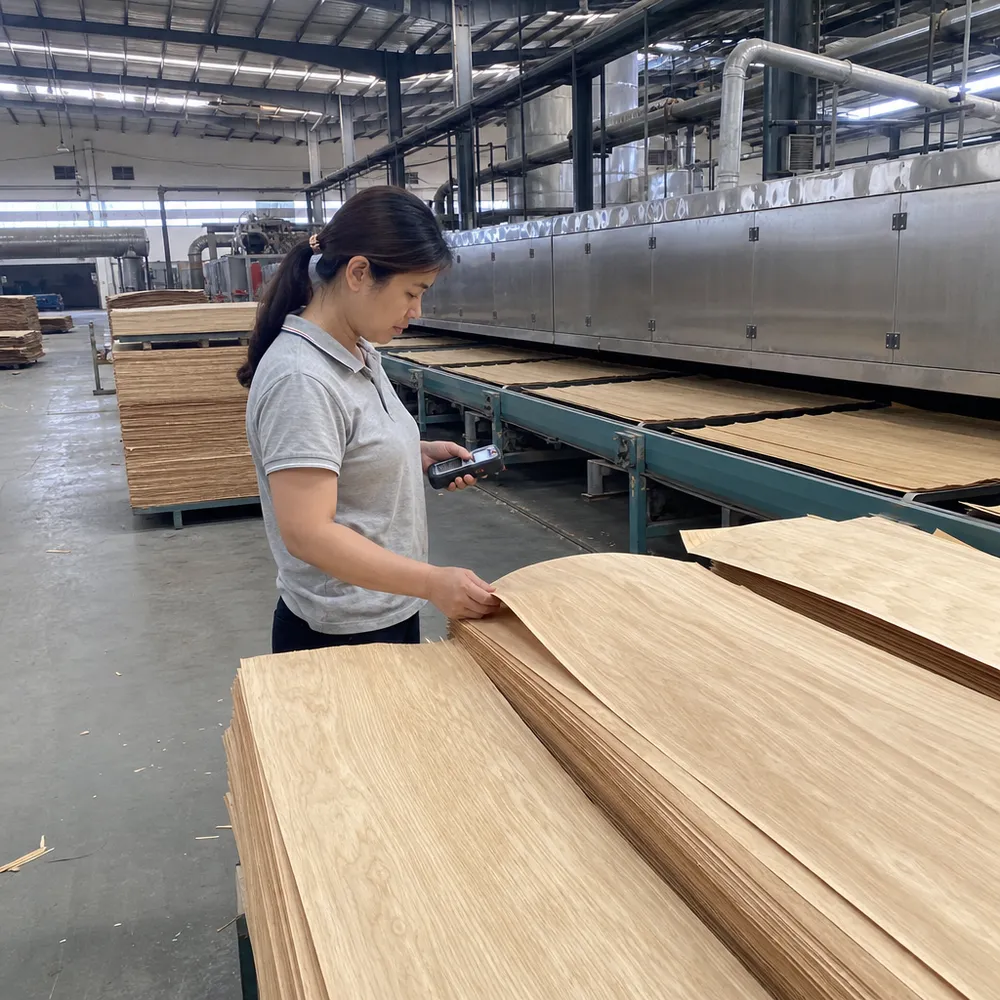
The Process — Step by Step
Incoming Veneer Sorting
Veneers are sorted by species and initial moisture content before they enter the drying line.
Core Veneer Drying to Target
Core veneers are dried to target moisture before layup. We don't rely on the hot press to drive out residual moisture — that approach produces uneven results across the panel surface.
Face Veneer Grading & Separate Drying
Face veneers are graded and dried separately to maintain surface quality and consistent moisture profile independent of core processing.
Pre-Layup Moisture Verification
At layup, moisture content is verified before the panel goes into the press — not assumed from the drying schedule.
Post-Press Conditioning
Panels are conditioned before sanding to allow the moisture profile to stabilize across the full panel cross-section.
Outgoing Inspection — Final Moisture Check
The final moisture check happens at outgoing inspection. Panels outside the 8–12% range are pulled before packing — not shipped and flagged later.
Relevant for Automated Processing Lines
Furniture manufacturers running panels through automated cutting equipment see feed errors and dimension variation when moisture content is inconsistent across a batch. Consistent 8–12% MC across a shipment eliminates that variable from your production floor.
Surface Quality and Thickness Tolerance —
What Your Downstream Processor Needs
Interior plywood goes through more secondary processing than most panel products. Each downstream operation — edge banding, laminating, CNC routing, nailing — has a tolerance requirement that traces back to the panel's surface quality and thickness consistency.
Our calibrated wide-belt sanding line holds thickness tolerance to ±0.2mm across the full panel surface. That spec matters when your customer is running panels through an automated edge bander — thickness variation above ±0.3mm causes the banding to lift at the edges, which generates warranty claims and rework.
The ±0.2mm tolerance is not a marketing number. It's the parameter our QC team checks at multiple points across each panel during outgoing inspection. Furniture OEM customers have switched suppliers specifically because of thickness variation causing edge banding failures on their production line.
Why Thickness Consistency Matters at the Machine Level
Furniture manufacturers run interior plywood through panel saws, edge banders, and CNC routers. Cabinet shops laminate it, veneer it, or paint it. Flooring underlayment gets nailed or glued. Each of these operations has a tolerance requirement that traces back to the panel's dimensional consistency.
When thickness variation exceeds the machine's calibration window, the result isn't just cosmetic — it's production downtime, rework labor, and warranty exposure. The ±0.2mm spec is the parameter that keeps automated lines running without recalibration between batches.
QC checks are performed at multiple points across each panel during outgoing inspection — not just at panel edges. Batch-to-batch consistency is verified so your production line doesn't need to recalibrate between orders.
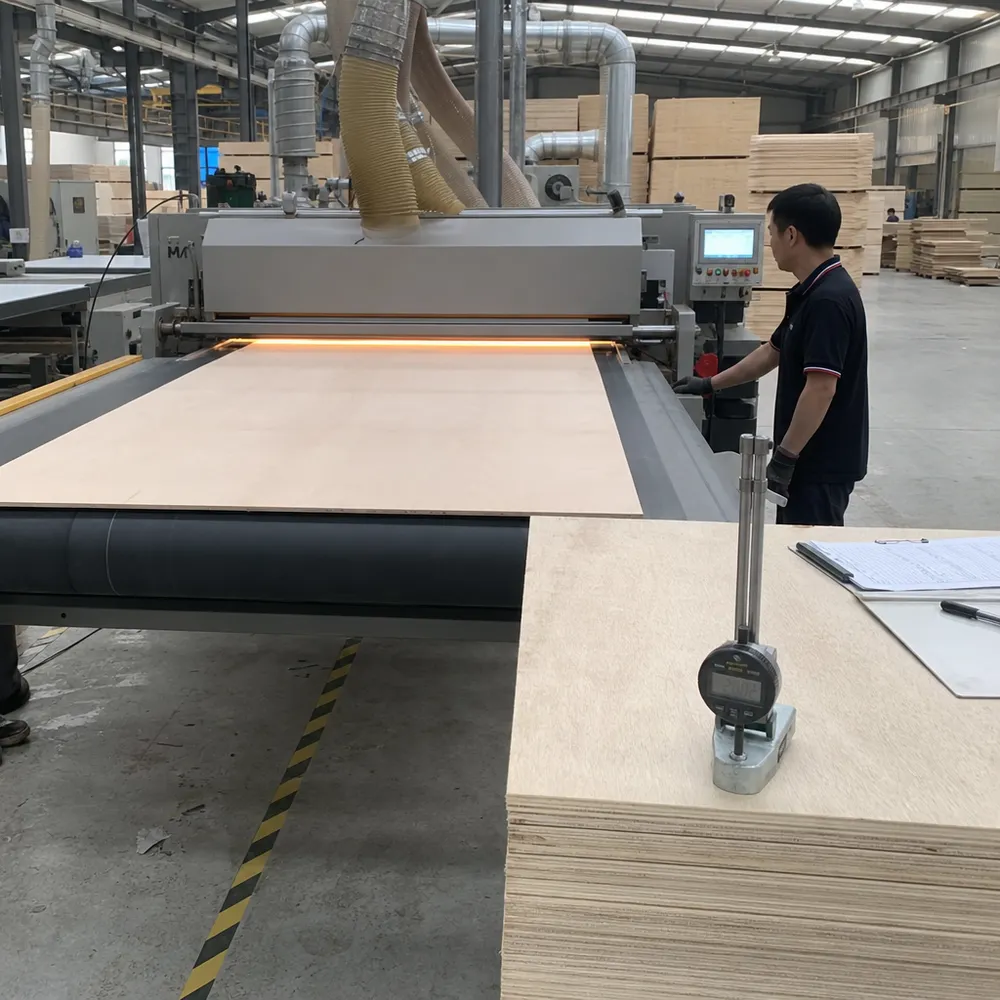
Surface Grade Options — Specified at Order Time
Both faces suitable for furniture-grade applications where both sides will be visible or laminated. The default spec for furniture OEM supply chains.
Works for applications where one face is concealed. Reduces cost without compromising the visible face quality.
The economy option for underlayment and structural applications where surface appearance is irrelevant. Lowest cost per panel.
Sanded-One-Side (SOS) panels are also available for applications where only the face grade matters and you want to save on the back face. Worth asking about if you're cost-optimizing a high-volume SKU.
Market Segments Where Interior Plywood Moves at Volume
Four distinct buyer segments drive the majority of interior plywood volume. Each has different spec priorities, order patterns, and compliance requirements. Understanding which segment you're supplying into determines which parameters to lead with.
Furniture Manufacturing Supply Chains
Flat-pack, RTA, cabinet carcass OEMs
A mid-size furniture factory running 500 units/day of cabinet carcasses consumes 200–400 sheets of 18mm interior plywood daily.
Furniture OEMs — particularly those producing flat-pack and ready-to-assemble furniture for retail — are the largest volume buyers of interior plywood. The key requirements for this segment are thickness consistency (for automated processing), CARB P2 or E1 compliance (for retail market access), and reliable batch-to-batch consistency so the production line doesn't need to recalibrate between orders.
Buyers Ask About First
Building Materials Distribution
Residential & commercial construction supply
Fastest-Moving Thickness SKUs
Interior plywood is a standard SKU for building materials distributors serving residential and commercial construction. Distributors in this segment typically carry 3–5 thickness SKUs and reorder on 30–60 day cycles.
Margin Opportunity
Distributors who can provide CARB P2 or FSC documentation to their contractor customers command a price premium over commodity suppliers who can't. The compliance documentation is the differentiator.
Joinery and Millwork Contractors
Commercial fit-out: office, retail, hospitality
Smaller quantities per project but higher order frequency. Often need custom dimensions to minimize waste on specific project layouts.
Commercial fit-out contractors use interior plywood for wall paneling substrates, built-in joinery, and decorative panel backing. This segment orders in smaller quantities per project but at higher frequency.
Key Differentiator
The ability to supply non-standard panel sizes on confirmed orders is a meaningful differentiator here — most distributors can't offer it, but a direct factory relationship can.
Overseas Furniture Manufacturers Sourcing for Export
Southeast Asia, Middle East, Eastern Europe → North America / EU
Compliance Chain
Furniture manufacturers in Southeast Asia, the Middle East, and Eastern Europe who produce for export to North American or European markets need panels that are pre-qualified for their destination market's formaldehyde standards. Sourcing CARB P2-compliant interior plywood means their finished furniture clears US customs without additional testing requirements.
Growing Segment
Manufacturers who previously sourced locally are switching to factory-direct import when they realize the compliance documentation is already built into the supply chain — eliminating a separate testing and certification step.
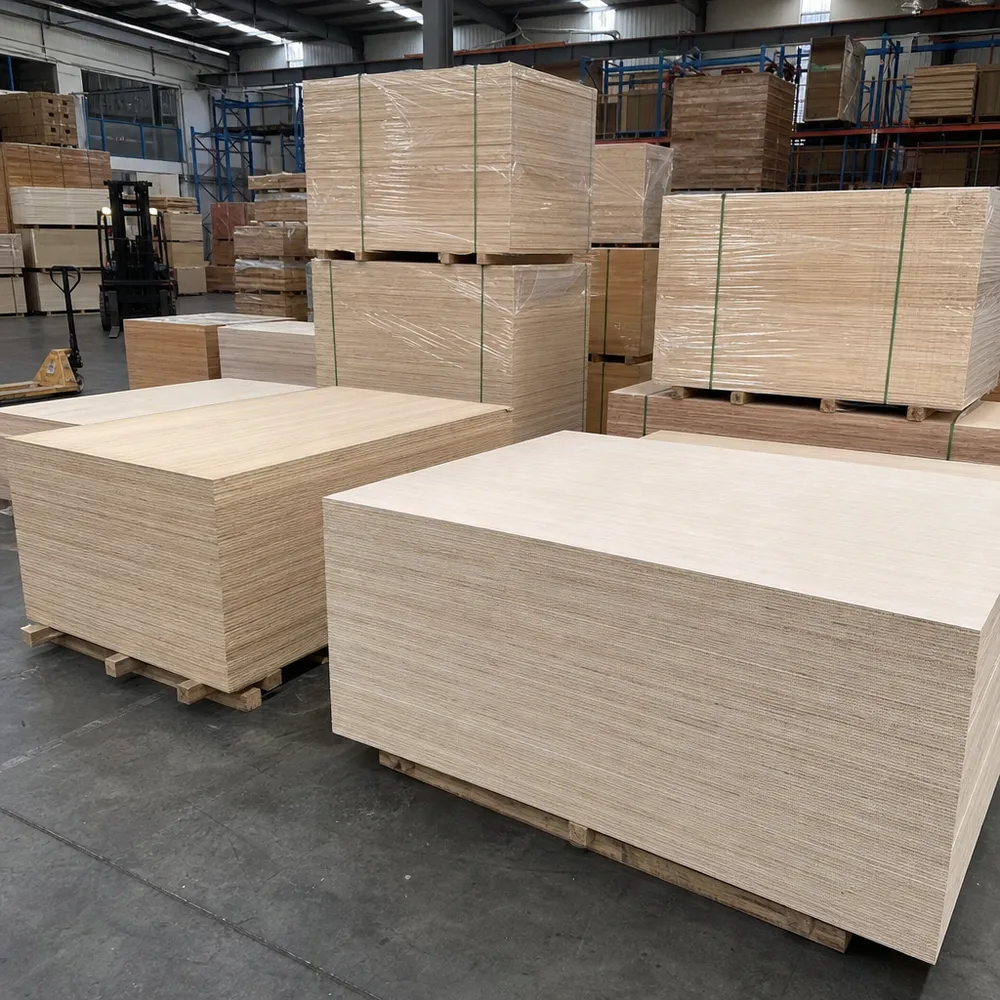
Which Segment Are You Supplying Into?
Each segment has different spec priorities. Furniture OEMs lead with thickness tolerance and CARB compliance. Distributors lead with SKU range and documentation. Joinery contractors lead with custom sizing. Export manufacturers lead with pre-qualified compliance documentation.
Tell us your segment and order volume and we'll confirm which specs and documentation packages apply to your supply chain.
Customization Parameters for Interior Plywood Orders
Interior plywood is one of the more configurable products in our range. Core construction, face veneer species, surface grade, thickness, and panel dimensions are all specifiable at order time. Here's what's actually adjustable and what the practical limits are.
Thickness
2.5mm – 25mmStandard thicknesses from 2.5mm to 25mm. Non-standard thicknesses (e.g., 11mm, 14mm, 17mm) are available on confirmed orders.
MOQ for non-standard thickness: Typically one full container load (approximately 20–25 m³ depending on thickness). Below that, the yield loss from cutting standard-thickness panels doesn't make commercial sense for either party.
Panel Dimensions
Standard 1220×2440mmStandard 1220×2440mm. Oversized panels up to 1525×3050mm are available depending on core construction.
Custom cut-to-size is available for confirmed orders — useful for joinery contractors who want to minimize on-site waste. Minimum order for custom dimensions is negotiable based on total volume.
Core Species
3 OptionsPoplar Core (Standard)
Lightweight, machines cleanly, holds fasteners well. Standard for most interior plywood applications.
Eucalyptus Core
Higher density and screw-holding strength. Suited for cabinet carcasses and structural joinery.
Hardwood Core (Mixed Tropical)
Premium furniture applications. Core species affects panel weight, machinability, and price — worth specifying if your downstream application has specific requirements.
Face Veneer
Multiple SpeciesPoplar Face (Standard)
For panels that will be laminated, painted, or overlaid.
Birch Face
Where the natural veneer will be visible or where a finer grain is required.
Okoume, Pine & Others
Available on request for OEM programs with specific aesthetic requirements.
Surface Treatment
3 FinishesEdge sealing is applied as standard on export-grade panels to prevent moisture ingress during ocean transit.
Branding & Marking
OEM AvailableOEM labeling, custom bundle marking, and private-label packaging are available for buyers who want to present the product under their own brand.
MOQ for OEM programs is discussed at the inquiry stage — contact us with your volume and labeling requirements.
Have a specific configuration in mind?
Send your full specification — thickness, core, face, dimensions, surface treatment, and target volume — and we'll return a detailed quote.
Packaging, Container Loading, and What Arrives at Your Warehouse
Interior plywood ships in bundles of 50–100 sheets depending on thickness, strapped and edge-protected with corner boards. Here's what the full logistics picture looks like from our factory to your receiving dock.
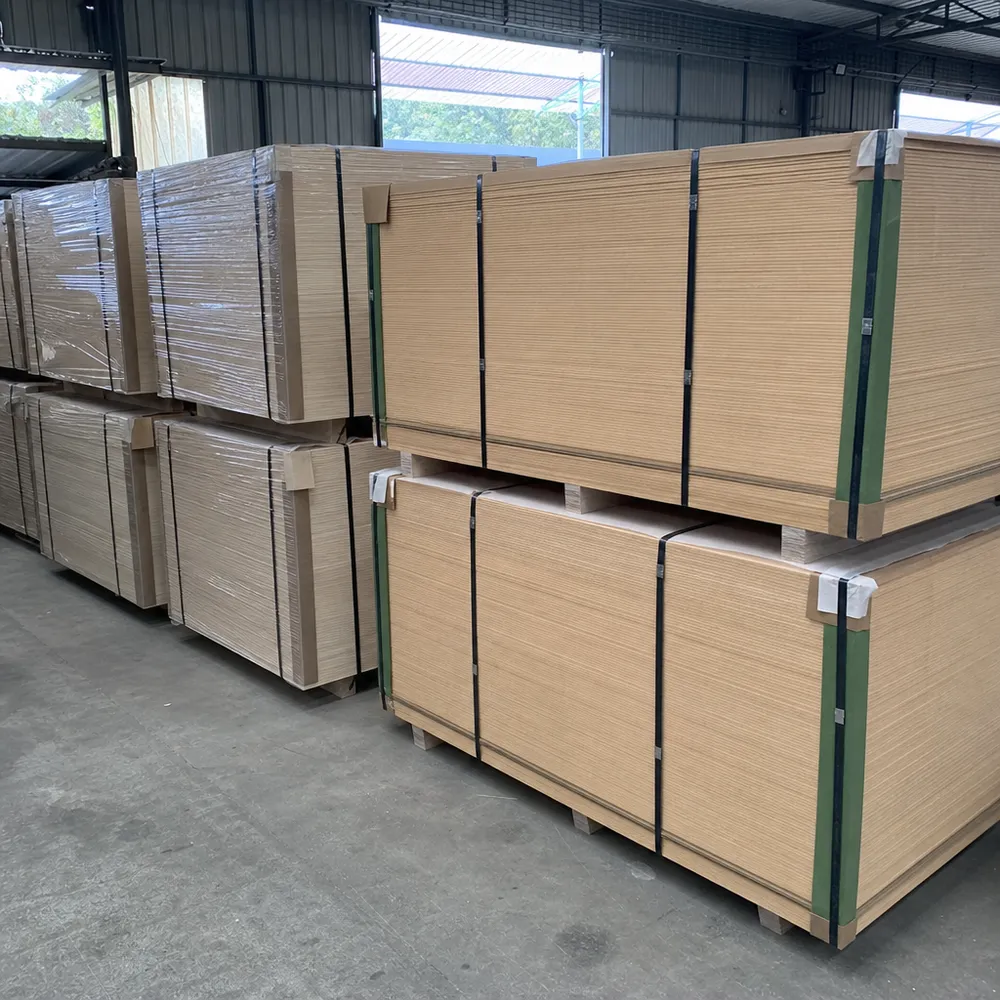
Bundle Packaging Standards
Bundles of 50–100 sheets depending on thickness, strapped and edge-protected with corner boards
Export-grade panels wrapped in moisture-resistant film before bundling — this matters for ocean transit, where humidity fluctuations inside a container can cause surface staining on unprotected panels
Each bundle marked with product specification, thickness, grade, quantity, batch number, and destination port
Loading plan provided with each shipment so your receiving team knows the exact count and stacking configuration before the container arrives
Container Loading Capacity
Standard 1220×2440mm panels at 18mm thickness. Thinner panels load more sheets per container; thicker panels fewer.
Port Loading & Transit Times
We load from Xuzhou to Qingdao, Shanghai, or Lianyungang port depending on routing and destination. Actual transit depends on carrier and routing.
18–22 days
28–32 days
25–30 days
18–22 days
20–25 days
Export Documentation Package
We've been through enough customs clearance cycles in these markets to know what documentation gaps cause delays. The paperwork is prepared to avoid them, not to satisfy a checklist.
Interior Plywood vs. Sibling Products — Choosing the Right Panel for Your Application
Interior plywood is one of several commercial plywood grades we produce. The right choice depends on the end application's moisture exposure, structural requirements, and surface finish needs.
| Product | Adhesive | Moisture Resistance | Best For |
|---|---|---|---|
| Interior Plywood | UF resin | Dry indoor environments only | Furniture, cabinetry, interior joinery, flooring underlayment |
| Exterior Plywood | MF/PF resin | Moderate weather exposure | Exterior cladding, covered outdoor structures, construction sheathing |
| Marine Plywood | WBP phenolic | Continuous moisture/water contact | Boat building, wet rooms, high-humidity industrial environments |
| Moisture Resistant Plywood | MR/MF resin | Intermittent humidity | Kitchens, bathrooms, humid climates — where interior grade is borderline |
| Furniture Plywood | UF resin | Dry indoor | Furniture-specific surface grades and core constructions |
When Interior Grade Is the Right Call
Climate-controlled environments: offices, retail interiors, residential furniture in temperate climates. Interior grade is optimized for these conditions — the adhesive system, emission calibration, and surface grades are all tuned for dry indoor use.
When to Consider Moisture-Resistant Instead
If your application is in a climate where indoor humidity regularly exceeds 70% — Gulf states, coastal Southeast Asia, tropical markets — interior grade is borderline. We'd recommend discussing moisture-resistant plywood instead.
Explore Related Products
Frequently Asked Questions
Answers to the specification, compliance, and logistics questions we hear most from buyers sourcing interior plywood at volume.
The adhesive system. Interior plywood uses urea-formaldehyde (UF) resin, which bonds well in dry conditions and allows low formaldehyde emissions. Exterior plywood uses melamine-formaldehyde (MF) or phenolic resin, which resists moisture and delamination under weather exposure.
Interior grade panels should not be used in applications with regular moisture exposure — the bond will degrade over time. If your application involves any outdoor exposure or high-humidity environments, specify exterior or moisture-resistant grade.
Yes. We produce to CARB P2 as the standard across our interior plywood range — ≤0.05 ppm formaldehyde for hardwood plywood. CARB documentation is included as standard for US-bound shipments.
We don't run a separate CARB-compliant line; the entire production is calibrated to that standard. If you need test reports or the CARB TPC (Third Party Certifier) documentation for your customs or retail compliance, we provide it with the shipment.
Standard thickness and dimension panels: typically one container load (20GP or 40HQ) for the most efficient pricing. Smaller trial orders are possible — most new buyers start with a sample order of 2–5 sheets per specification to verify quality before committing to a container.
For custom thickness or non-standard dimensions, minimum order is typically one full container load. Contact us with your target volume and we'll confirm the MOQ and pricing structure.
Poplar Face
Standard. Covers most furniture and joinery applications.
Birch Face
Finer, more consistent grain. Common in Scandinavian-style furniture and high-end cabinetry.
Okoume Face
Reddish-brown natural veneer for applications where that aesthetic is preferred.
Other Species
Pine, ash, oak face veneer available for OEM programs with specific aesthetic requirements.
Face veneer species affects price and lead time — confirm at the inquiry stage.
Warping after delivery is almost always a moisture content issue — either the panels arrived outside the target moisture range, or they were stored in conditions that caused uneven moisture absorption. Our panels ship at 8–12% moisture content.
Storage protocol at destination:
- Store panels flat on a level surface in a climate-controlled environment
- Allow 48–72 hours to acclimatize before processing
- Do not store panels on edge or in direct contact with concrete floors
If you're seeing warping on arrival, the first thing to check is whether the container was sealed properly during transit — moisture ingress during ocean shipping is the most common cause.
Yes. FSC chain-of-custody certification covers our interior plywood production. FSC-certified orders require confirmation at the inquiry stage so we can allocate from the certified material stream and prepare the chain-of-custody documentation.
If your buyers or end customers have sustainability sourcing requirements, or if you're supplying into markets where FSC documentation is a procurement gate, confirm the FSC requirement when you send your inquiry.
Get a Quote for Interior Plywood
Send us your specification and we'll come back with a detailed quote, relevant certification documentation, and a loading plan for your container.
What to Include in Your Inquiry
-
Thickness
Specify your required panel thickness (2.5–25mm range available)
-
Face Veneer
Poplar, birch, eucalyptus, or hardwood face species preference
-
Surface Grade
BB/BB, BB/CC, or CC/CC depending on your downstream application
-
Panel Dimensions
Standard 4×8 ft / 1220×2440mm or custom cut-to-size requirements
-
Target Volume
Estimated container quantity or CBM per order cycle
-
Destination Market
Import market determines which emission and certification standard applies
What We Send Back
Most buyers in this category start with a sample order to verify thickness tolerance, surface grade, and emission compliance before committing to a full container. We can ship samples within 5–7 working days of specification confirmation.
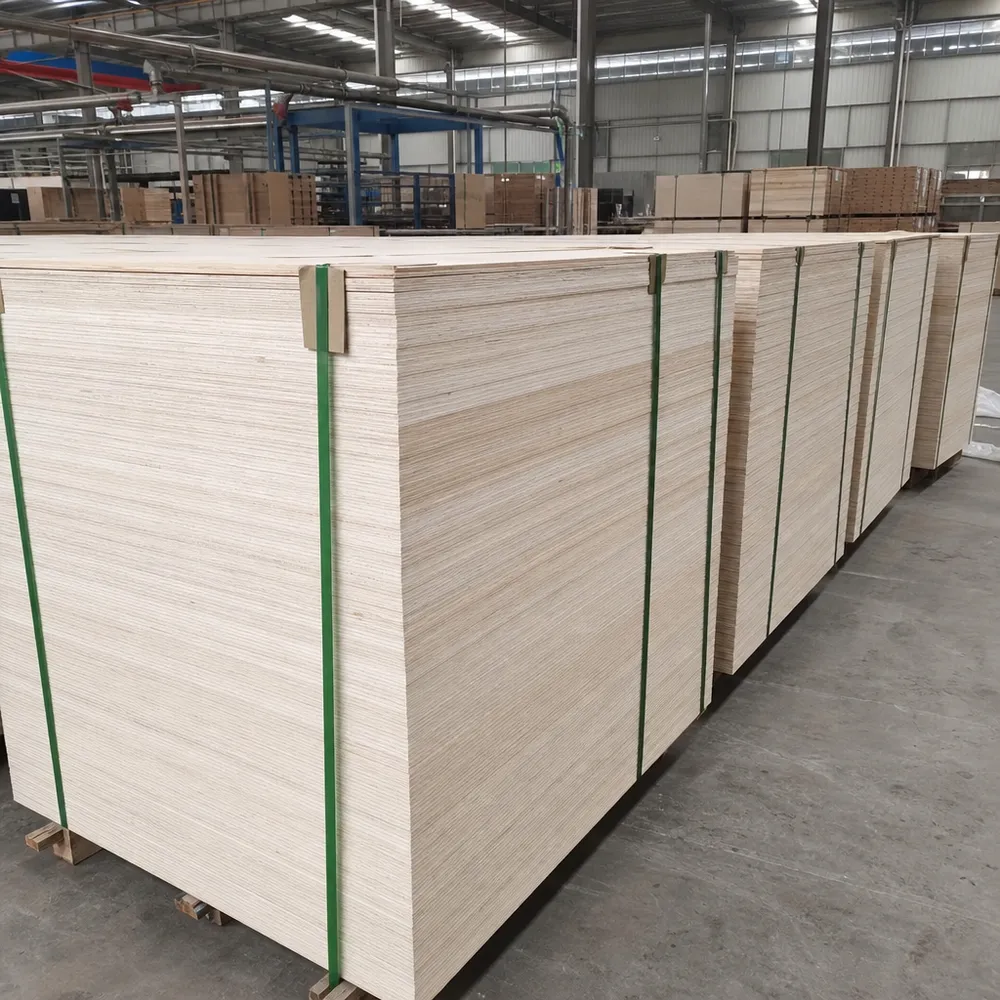
Xuzhou, Jiangsu Province, 221116, China
Explore Related Products
Compare interior plywood with other panels in our commercial range