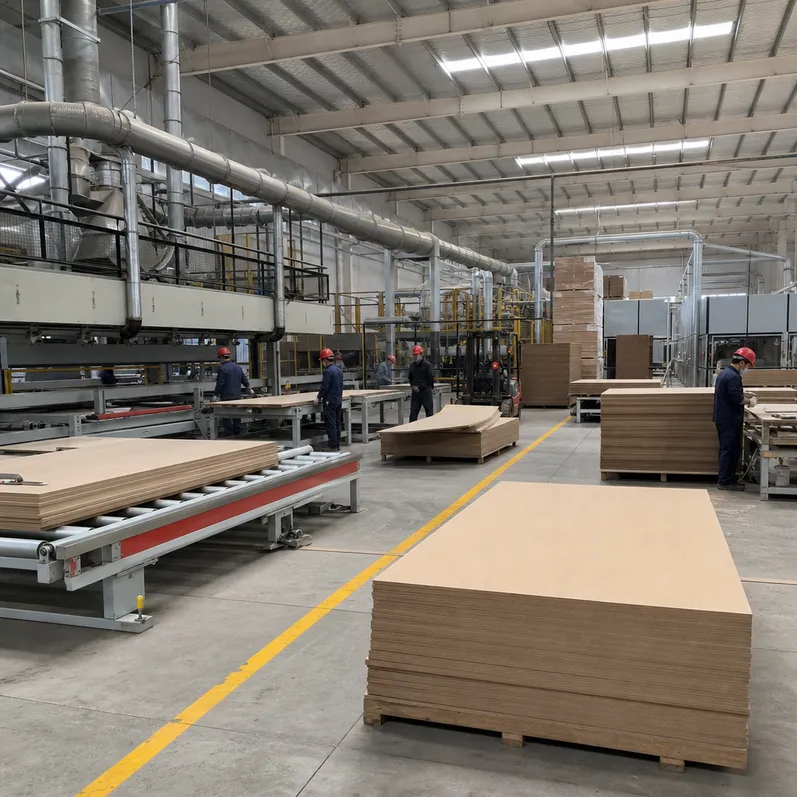
MDF Board Manufacturer — Factory-Direct
Xuzhou QD Wood Industry — MDF manufacturer since 2008, supplying distributors, furniture makers, and project buyers across North America, Europe, the Middle East, Southeast Asia, and Australia.
Five MDF product lines covering standard board, HDF, CNC-grade, furniture-grade, and 18mm — all produced under ISO 9001:2015, CARB P2, and FSC certification. Factory-direct pricing, no trading company markup.
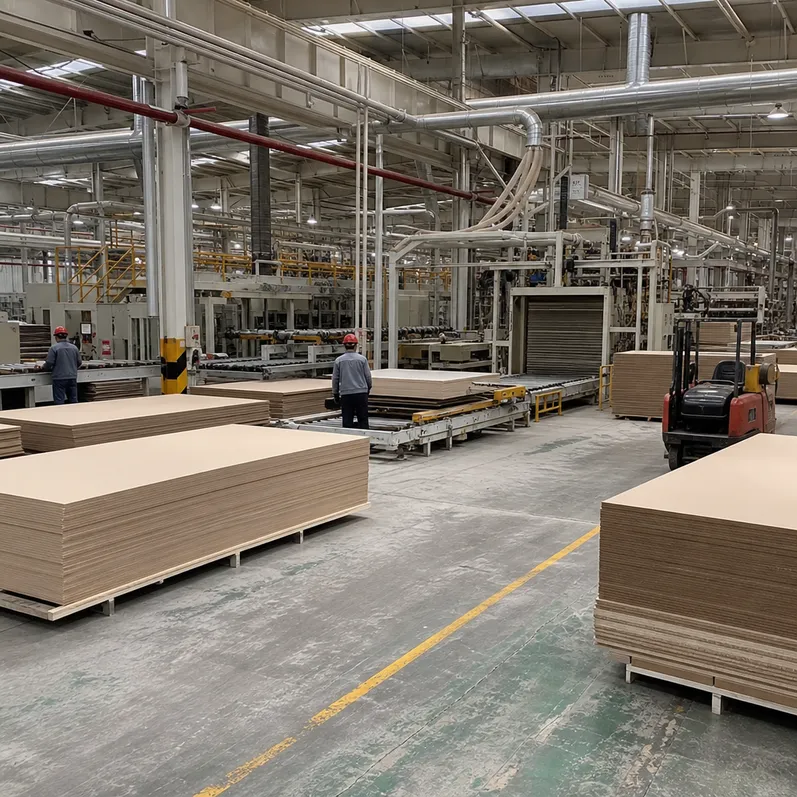
What We Manufacture and Why It Matters to Your Supply Chain
We produce medium density fiberboard at our 18,000 m² facility in Xuzhou, Jiangsu Province — the same factory that has been running export-grade engineered wood panels since 2008. MDF is one of the core product lines here, not a sideline we added to fill container space. The fiber processing, resin systems, and press parameters for MDF are distinct from plywood production, and we run them as a dedicated operation.
The commercial case for sourcing MDF from a manufacturer rather than a trading company comes down to two things: formaldehyde compliance and thickness consistency. Both are process-controlled variables — they're determined by what happens inside the factory, not by what's written on a certificate.
CARB P2 compliance, for instance, requires that the resin system and press conditions are engineered to hit the emission target, not just that a sample batch passes a lab test. We formulate to CARB P2 as the baseline across our MDF range, so every container you receive is built to the same standard, not just the one that got tested.
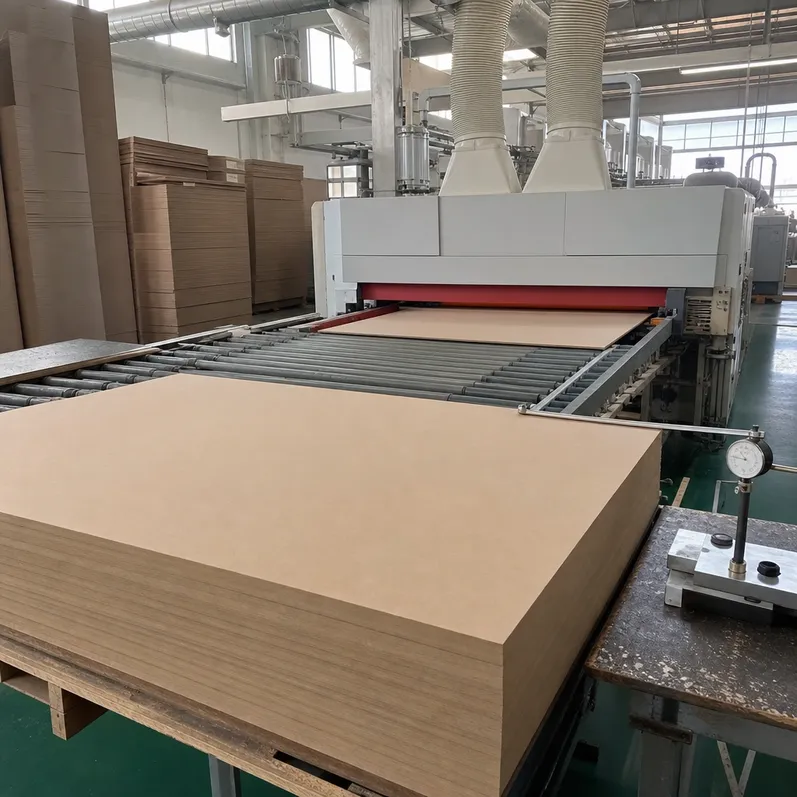
Thickness Tolerance: ±0.2mm Across the Full Panel
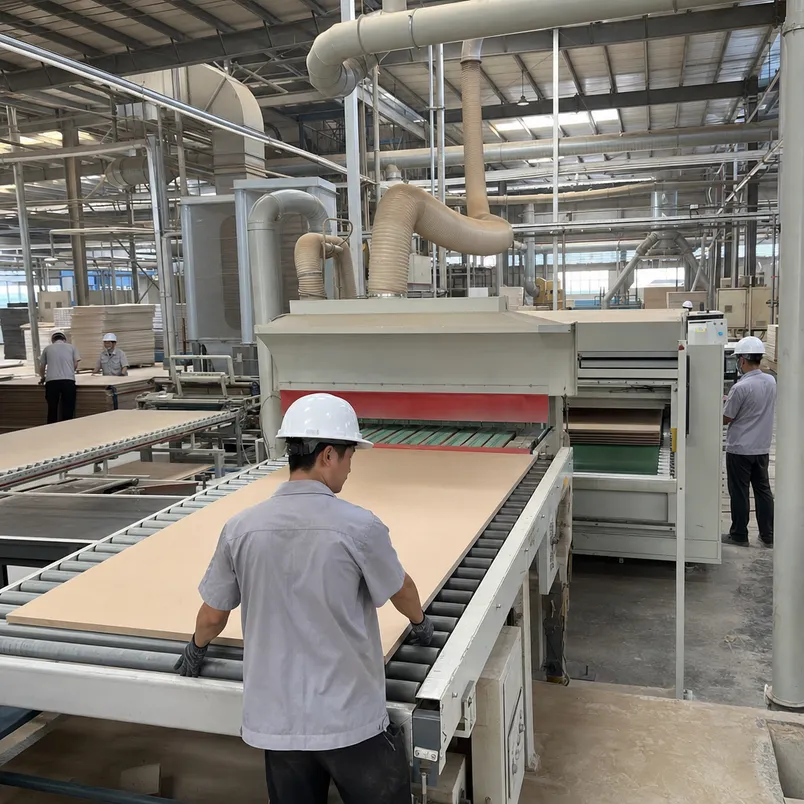
MDF going into CNC routing, cabinet carcass production, or lamination lines needs to run within ±0.2mm across the panel — outside that range, you get feed errors on automated equipment and visible gaps at joints. Our wide-belt sanding line is calibrated to hold that tolerance across the full 1220×2440mm sheet.
We've had buyers come to us specifically after a previous supplier's MDF caused reject rates on their customer's CNC line — the tolerance issue is more common than most people expect.
Formaldehyde Compliance — Process-Controlled
CARB P2 compliance is engineered into the resin system and press conditions — not achieved by testing a sample batch. We formulate to CARB P2 as the baseline across our entire MDF range. Every container ships to the same standard, not just the one that got tested.
Thickness Consistency — Sanding Line Calibrated
Our wide-belt sanding line holds ±0.2mm tolerance across the full 1220×2440mm sheet. This is the specification that CNC routing lines, cabinet carcass production, and lamination equipment require to run without feed errors, reject rates, or visible joint gaps.
This is a factory-direct operation. Learn more about how we run the facility
MDF Product Lines
Five product lines, each positioned for a specific application segment and buyer type. The differences between them are real — density, resin system, surface preparation, and thickness range all vary by line.
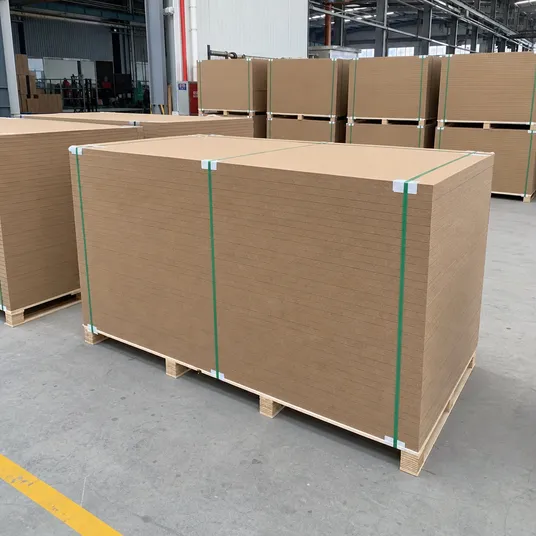
MDF Board
StandardStandard medium density fiberboard for general-purpose applications. The workhorse of the range — suitable for interior fit-out, shelving, door cores, and substrate applications where a consistent, paintable surface is the primary requirement.
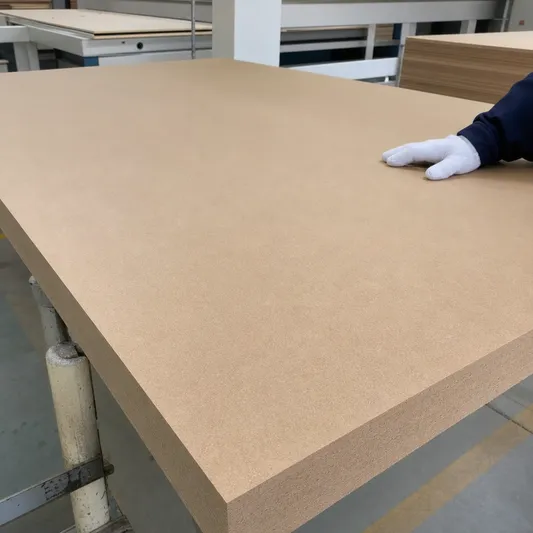
MDF Furniture Board
Furniture-grade MDF with tighter surface quality control and consistent density across the panel cross-section. Cabinet manufacturers and furniture OEMs who run high-volume lamination lines need this consistency — a surface that's too rough or too variable causes adhesion failures and visible texture bleed-through on finished panels.
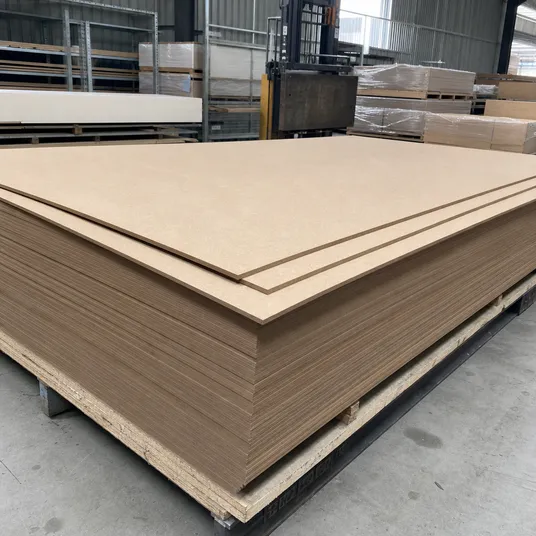
HDF MDF Board
High DensityHigh density fiberboard at 800–900 kg/m³. The higher density gives you better screw-holding strength, harder surface resistance, and improved moisture performance — relevant for flooring underlayment, door skins, and applications where the panel takes mechanical load or surface abrasion. Standard MDF at 3mm is too soft for most flooring applications — HDF at the same thickness holds up.
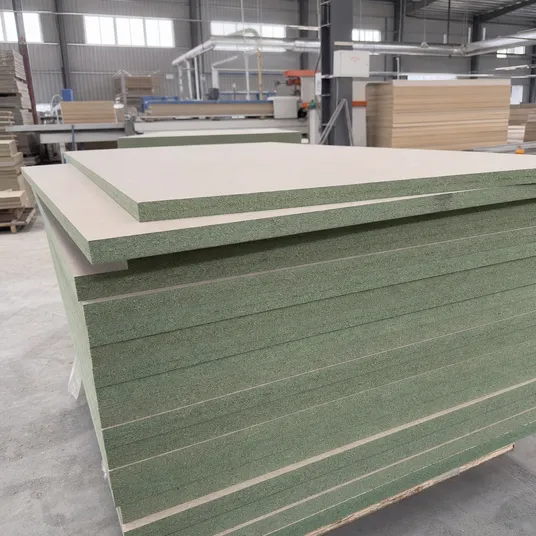
Moisture Resistant MDF
MR GradeMoisture resistant MDF formulated with a modified resin system that reduces water absorption and swelling in humid conditions. Used in kitchen carcasses, bathroom vanities, and commercial fit-out where ambient humidity is elevated. Not waterproof — but it holds dimensional stability where standard MDF would swell and delaminate.
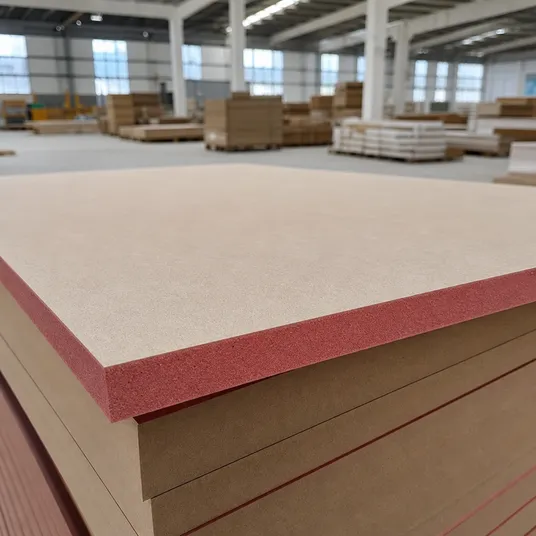
Fire Retardant MDF
FR GradeFire retardant MDF treated through the full panel cross-section — not a surface coating. The FR chemistry is integrated into the fiber mat before pressing, so the fire performance is consistent through the thickness. Required for commercial interiors, public buildings, and hospitality fit-out where building codes specify Class B or equivalent fire ratings.
Not sure which line fits your application? The spec pages for each product include a direct comparison table. If you're sourcing for a specific end-use, the fastest route is to send us the application details and we'll confirm the right grade.
Confirm Your GradeTechnical Specifications Across the MDF Range
The table below covers the parameter ranges across our MDF product lines. Individual product pages carry the exact specifications for each line.
| Parameter | Standard MDF | Furniture MDF | HDF | CNC MDF | 18mm MDF |
|---|---|---|---|---|---|
| Density (kg/m³) | 680–750 | 720–760 | 800–900 | 700–750 | 700–750 |
| Thickness Range | 2.5–25mm | 6–25mm | 2.5–6mm | 6–25mm | 18mm (stocked) |
| Standard Panel Size | 1220×2440mm | 1220×2440mm | 1220×2440mm | 1220×2440mm | 1220×2440mm |
| Surface Finish | Sanded both sides | Ra ≤ 1.6μm | Sanded both sides | Ra ≤ 1.2μm | Sanded both sides |
| Thickness Tolerance | ±0.2mm | ±0.2mm | ±0.15mm | ±0.15mm | ±0.2mm |
| Formaldehyde Emission | E1 / CARB P2 | E1 / CARB P2 | E1 / CARB P2 | E1 / CARB P2 | E1 / CARB P2 |
| Moisture Content | 5–9% | 5–8% | 5–8% | 5–8% | 5–9% |
| Internal Bond Strength | ≥0.55 N/mm² | ≥0.60 N/mm² | ≥0.80 N/mm² | ≥0.60 N/mm² | ≥0.55 N/mm² |
| Modulus of Rupture | ≥28 N/mm² | ≥30 N/mm² | ≥38 N/mm² | ≥30 N/mm² | ≥28 N/mm² |
| Certifications |
ISO 9001 CARB P2 FSC
|
ISO 9001 CARB P2 FSC
|
ISO 9001 CARB P2
|
ISO 9001 CARB P2
|
ISO 9001 CARB P2 FSC
|
Custom dimensions are available on confirmed orders. Non-standard thicknesses (e.g., 15mm, 22mm, 25mm) are produced to order with standard lead times.
How MDF Density and Resin System Determine What You Can Sell
Most buyers treat MDF as a commodity — same product, different price. The reality is that density and resin system are the two variables that determine whether your downstream customers have problems or don't.
Density
Density affects screw-holding, surface hardness, edge machinability, and weight. The right density depends on what your customer is actually building.
Appropriate for painted interior applications where the panel isn't taking mechanical load. Cost-effective for high-volume interior fit-out.
Better screw retention for hinges and drawer slides — relevant when your customer is building cabinets that will be used daily for years.
A different product category: used where surface hardness and load resistance matter. Not simply a denser version of standard MDF.
Resin System
Resin system determines formaldehyde emission and moisture performance. The right choice depends on your destination market's regulations and end-use environment.
Cost-effective and produces panels that meet E1 and CARB P2 limits when the resin-to-fiber ratio and press conditions are controlled correctly. Our standard system for interior MDF.
Improves moisture resistance and can achieve E0 emission levels. Higher material cost. Available for buyers who need moisture-resistant MDF for kitchen or bathroom applications.
Matching Resin System to Your Destination Market
If you're supplying into markets with strict formaldehyde regulations — California, Germany, Japan — you need CARB P2 or E0 documentation, not just a supplier's claim. We carry the certification and can provide the test reports.
If your market is less regulated, standard E1 is sufficient and costs less. We'll spec the right resin system for your destination market rather than defaulting to the most expensive option.
Where MDF Moves: Market Segments Worth Sourcing For
MDF is one of the most widely distributed engineered wood products globally — the market segments are well-established and demand is predictable. The segments below represent where our buyers are currently moving volume.
Furniture Manufacturing Supply
Largest Segment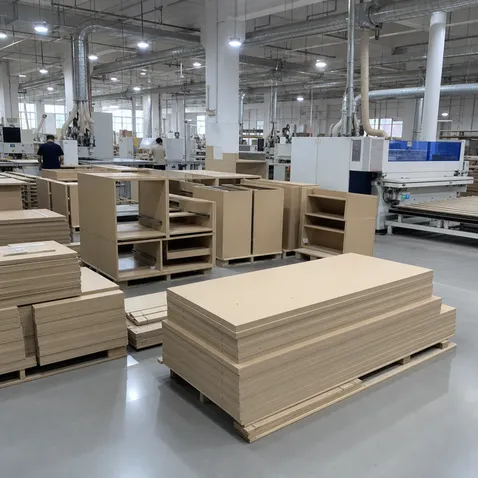
Cabinet carcasses, drawer boxes, shelving, and door panels all run on MDF in high-volume furniture factories. Buyers supplying furniture manufacturers need consistent surface quality and tight thickness tolerance — the furniture factory's lamination and CNC equipment is calibrated to a specific panel spec, and variation creates production downtime.
Interior Fit-Out and Construction
High Volume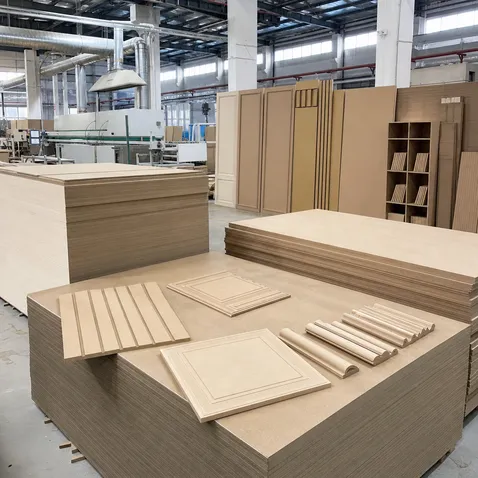
Wall paneling, ceiling tiles, door cores, skirting boards, and decorative moldings. Standard MDF is the workhorse here — the surface takes paint, primer, and foil well, and the consistent density makes it easy to machine. This segment tends to order in larger volumes with less specification complexity, which makes it efficient to supply.
Kitchen and Bathroom Cabinetry
Moisture Resistance Required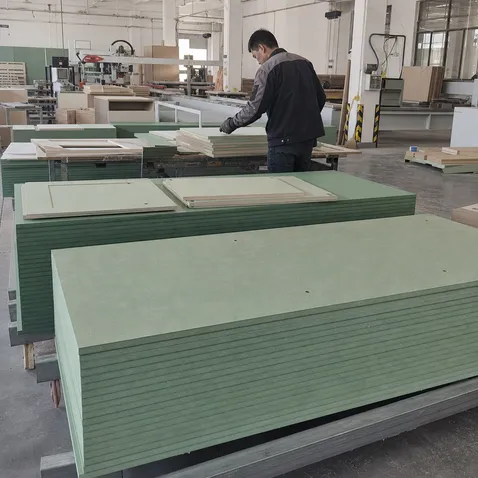
Standard MDF will swell and delaminate in high-humidity environments if it's not properly sealed or if the resin system isn't moisture-resistant. Buyers supplying kitchen cabinet manufacturers should specify MUF resin or moisture-resistant MDF — we produce this on request.
Standard MDF in a kitchen environment without proper sealing will fail within two to three years — a common source of warranty claims for buyers who don't specify correctly.
CNC Routing and Decorative Fabrication
Growing Segment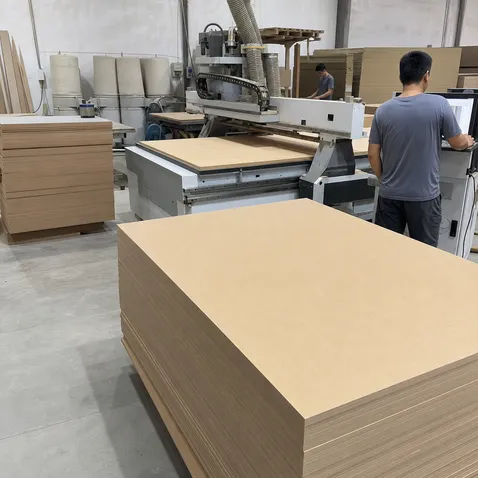
A growing segment driven by the expansion of CNC furniture workshops in Southeast Asia, the Middle East, and Eastern Europe. CNC MDF with homogeneous cross-section density is the specification these workshops need — inconsistent density causes tool chatter and uneven cut edges that show up in the finished product.
Buyers supplying CNC workshops can differentiate their offering by stocking CNC-grade MDF rather than standard board.
Flooring Underlayment and Door Skin Production
HDF Primary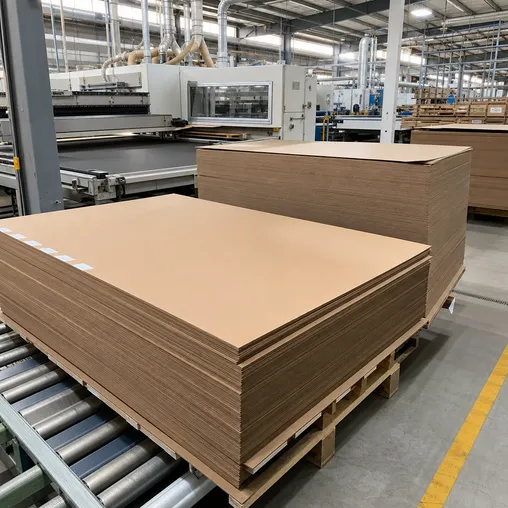
Uses HDF primarily. The higher density provides the surface hardness and dimensional stability that flooring applications require. Door skin manufacturers use HDF in 2.5–4mm thickness for the face panels of hollow-core interior doors — a high-volume, repeatable segment.
The Three MDF Quality Failures That Create Buyer Problems
We've been manufacturing and exporting MDF long enough to know exactly where the quality problems come from. These are the three failure modes that generate buyer complaints and warranty claims — and the process decisions we've made to prevent them.
Formaldehyde Emission Non-Compliance
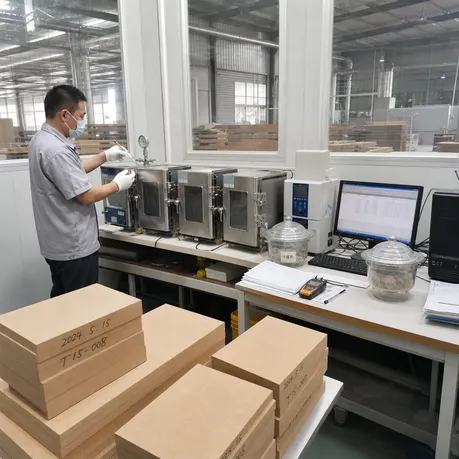
A container of MDF that fails CARB P2 testing at the US port of entry gets detained, tested, and potentially destroyed — the buyer absorbs the cost of the shipment, the testing, and the delay. This happens when a supplier uses a resin system that passes a sample test but isn't consistently controlled across production batches.
- Automated resin mixing with batch-level logging
- Press temperature and time parameters controlled and recorded per production run
- Process control prevents the problem — we don't rely on periodic testing to catch it
Thickness Variation Across a Batch
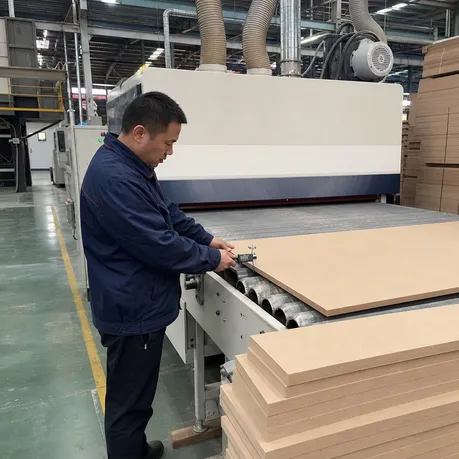
MDF going into automated lamination lines, CNC equipment, or cabinet assembly needs to be within ±0.2mm across the panel and consistent across panels in the same batch. Variation outside this range causes feed errors, adhesion failures, and visible gaps at joints.
The source of thickness variation is usually the sanding line — specifically, the calibration of the sanding heads and the consistency of the conveyor speed.
- Wide-belt sanding line calibrated at the start of each production shift
- Thickness checks every 30 minutes during production
- Panels outside tolerance are pulled before packing
Surface Delamination and Swelling in Service
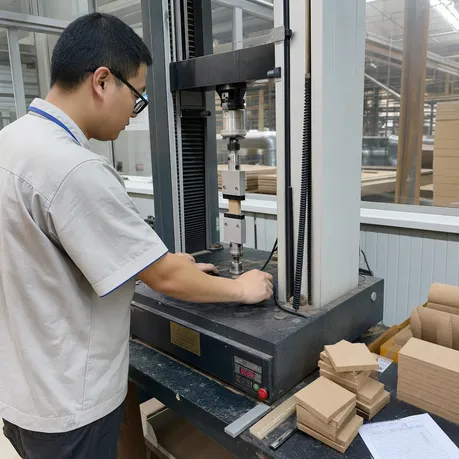
The failure that generates the most end-user complaints and warranty claims. It happens when the internal bond strength of the panel is insufficient — either because the resin-to-fiber ratio was too low, the press conditions were inadequate, or the moisture content of the fiber going into the press was too high.
- Tested on every production batch — not periodically
- Standard MDF: minimum 0.55 N/mm²
- Furniture-grade MDF: minimum 0.60 N/mm²
- Panels that don't meet the IB target don't ship
The IB test is destructive — a 50×50mm sample is cut and pulled apart in a tensile tester. It's not a test you can fake, which is why we run it on every batch rather than periodically.
Process Control, Not Periodic Testing
The difference between a supplier that passes tests and a supplier that doesn't generate failures is process discipline. Automated resin mixing, shift-start sanding calibration, and per-batch IB testing are not marketing claims — they are the specific process controls that prevent the three failure modes above from reaching your customers.
Selecting the Right MDF Grade for Your Market
The five product lines cover different application requirements. Here's the decision logic we use when buyers ask us to recommend a specification.
Furniture Manufacturers Running Lamination Lines
The Ra ≤ 1.6μm surface finish is the critical parameter — thinner foils and high-gloss laminates will telegraph surface roughness through the finish if the substrate isn't smooth enough. The tighter density range also means more consistent glue spread and adhesion across the panel.
CNC Routing Workshops
The homogeneous cross-section density is what matters here, not just the surface finish. A panel with density variation across its thickness will cut differently at different depths — you get inconsistent edge quality and tool wear. Standard MDF is not the right specification for CNC applications, even if the surface looks similar.
The US or California Market
CARB P2 certification is non-negotiable. Specify CARB P2 on your purchase order and request the test report with each shipment. We include CARB documentation as standard for US-bound shipments.
Kitchen or Bathroom Cabinetry
Standard MDF in high-humidity environments will swell at the edges and delaminate at joints within a few years. The moisture-resistant specification costs more, but it eliminates the warranty claims that come back to you.
Your primary high-volume specification
It's stocked as a standard run, which means faster availability and more consistent lead times than made-to-order thicknesses.
HDF for Flooring or Door Skin Applications
The density range (800–900 kg/m³) and thinner gauge availability (2.5–6mm) are the parameters to confirm. HDF at 3mm for door skins and 4–6mm for flooring underlayment are the most common specifications we run.
Quick Reference: Application to Grade
| Application | Recommended Grade | Critical Parameter |
|---|---|---|
| Lamination / foil wrapping | Furniture-Grade MDF | Ra ≤ 1.6μm surface finish |
| CNC routing / profiling | CNC MDF | Homogeneous cross-section density |
| US / California market | CARB P2 Certified | CARB P2 test report per shipment |
| Kitchen / bathroom cabinetry | Moisture-Resistant MDF | MUF resin system |
| High-volume standard panels | 18mm MDF | Stocked standard run — faster lead times |
| Door skins / flooring underlayment | HDF | 800–900 kg/m³ density; 2.5–6mm gauge |
Certifications That Open Markets
The certification stack we carry covers the primary import markets for MDF. Every document is prepared as part of the shipment process — we don't make buyers chase paperwork.
California Air Resources Board Phase 2
The formaldehyde emission standard required for MDF sold in California and increasingly adopted as the de facto US national standard. Required for any MDF entering the US market through major retailers or distributors.
FSC Chain of Custody
Required by buyers with sustainability sourcing policies and for supply into markets where deforestation-linked supply chains are a regulatory or reputational risk. FSC certification means the wood fiber in our panels can be traced to certified forests.
ISO 9001:2015 Quality Management
Covers our production processes, QC procedures, and documentation systems. Audit reports available on request.
CE Marking
Covers European construction and building material applications. Required for MDF used in certain construction applications in EU markets.
E1 / E0 Formaldehyde Emission
European standard emission classifications. E1 (≤0.1 ppm) is the standard for interior MDF in European markets. E0 (≤0.05 ppm) is available on request for buyers who need the lower emission specification.
Documentation Prepared With Every Shipment
Certification documents are available on request. We don't make buyers chase paperwork — the documentation package is prepared as part of the shipment process.
Standard Dimensions & Physical Properties
Reference specifications for our standard MDF range. Custom dimensions, thicknesses, and density profiles are available — contact us with your requirements.
Standard Sheet Sizes
| Format | Dimensions (mm) | Primary Market |
|---|---|---|
| Standard | 2440 × 1220 | US / Global |
| Euro | 2800 × 2070 | Europe |
| Euro Large | 3050 × 1830 | Europe / Middle East |
| Jumbo | 3660 × 1830 | Furniture / Industrial |
| Custom | On request | Any market |
Available Thickness Range
Physical & Mechanical Properties
| Property | Standard MDF | MR MDF | HDF |
|---|---|---|---|
| Density | 680–750 kg/m³ | 700–760 kg/m³ | 800–900 kg/m³ |
| Modulus of Rupture | ≥28 N/mm² | ≥30 N/mm² | ≥40 N/mm² |
| Internal Bond | ≥0.60 N/mm² | ≥0.65 N/mm² | ≥0.80 N/mm² |
| Thickness Swelling (24h) | ≤12% | ≤8% | ≤10% |
| Formaldehyde Emission | E1 / CARB P2 | E1 / CARB P2 | E1 / CARB P2 |
| Moisture Resistance | Standard | Enhanced (MUF resin) | Standard |
Custom specifications available. Density profiles, surface finish, edge treatment, and resin systems can be adjusted for specific applications. Contact our technical team with your requirements and we'll confirm feasibility and lead time.
Export Logistics Built for Volume
We ship FCL and LCL from Vietnamese ports to major import hubs globally. Lead times, MOQs, and Incoterms are confirmed at the quotation stage — no surprises at booking.
Shipping Formats
- FCL (20ft & 40ft containers)
- LCL consolidation available for smaller orders
- Flat-rack for oversized or jumbo sheets
- Palletised or bundle-strapped to buyer spec
Indicative Lead Times
- Stocked 18mm MDF: 2–3 weeks ex-works
- Standard production run: 4–6 weeks ex-works
- Custom spec / MR MDF: 5–7 weeks ex-works
- Transit time varies by destination port — confirmed at booking
Incoterms & MOQ
- FOB Ho Chi Minh City / Hai Phong
- CIF available to major destination ports
- MOQ: 1 × 20ft FCL (standard grades)
- LCL MOQ negotiable for new buyers
Active Export Destinations
OEM and Custom MDF: What We Can Produce to Your Specification
Custom MDF production is a standard part of our operation, not a special service. The variables we can adjust on confirmed orders are listed below — no tooling costs, no minimum order premiums for non-standard dimensions.
Thickness
Any thickness from 2.5mm to 25mm. Non-standard thicknesses (e.g., 12mm, 15mm, 22mm) are produced to order. No tooling cost — MDF thickness is a press and sanding parameter, not a mold dimension.
Panel Dimensions
Standard 1220×2440mm is the default. Custom panel sizes available on confirmed orders — common requests include 1220×2800mm for tall cabinet applications and 1830×2440mm for markets that use the larger format.
Resin System
Selected to match your certification and end-use requirements:
Surface Preparation
Density Specification
We can target specific density ranges within the capability of each product line — relevant for buyers who need to match a specific weight or mechanical performance requirement.
Private Label and OEM Marking
Panels can be marked with your brand, specification, and destination market information. We handle the marking as part of the packing process.
Sample-to-Production Timeline
Ready to confirm a specification? Send us your thickness, dimensions, resin requirement, and target market — we'll confirm feasibility and lead time within one business day.
Request OEM Specification ReviewContainer Loading and Export Logistics
MDF ships efficiently in standard 20HQ and 40HQ containers. The panel dimensions (1220×2440mm standard) are designed for container loading without cutting or reorientation.
Typical Loading Quantities — 18mm MDF (1220×2440mm)
Thinner panels (6mm, 9mm) load at proportionally higher sheet counts per container. We provide loading plans with each shipment so your receiving team knows the exact configuration.
Ocean Transit Packaging
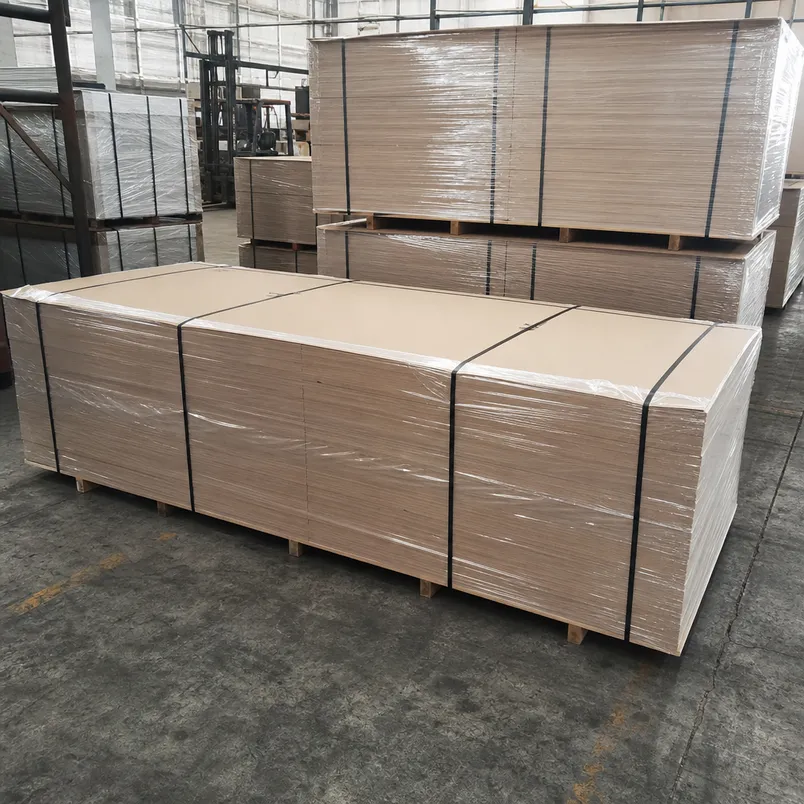
MDF is more sensitive to moisture ingress than plywood during transit. We standardized moisture-resistant wrapping after learning early on that MDF arriving with edge swelling from condensation is entirely preventable. We've had zero moisture-related claims since we standardized the packaging protocol.
Export Documentation
All documentation is prepared before container loading — we don't send incomplete paperwork and ask buyers to follow up.
Transit Times from Xuzhou
Connecting to Qingdao, Shanghai, and Lianyungang ports
Frequently Asked Questions
Answers to the specification and sourcing questions we hear most often from importers, distributors, and OEM buyers.
MOQ is one 20HQ container for standard specifications. For custom thickness or resin system specifications, MOQ is one 40HQ container to cover the production run economics. Sample orders (5–10 sheets) are available before committing to a container order.
E1 is the European standard (≤0.1 ppm formaldehyde emission, measured by the perforator method). CARB P2 is the California standard (≤0.11 ppm for MDF, measured by the large chamber test method).
The two standards use different test methods, so a panel that passes E1 doesn't automatically pass CARB P2 — they need to be tested separately.
For buyers supplying both European and US markets: specify both certifications on your purchase order. We carry both and can provide documentation for each.
Dry interior applications — furniture, shelving, wall paneling, door cores in climate-controlled environments.
Kitchens, bathrooms, laundry rooms, or any space with regular humidity above 70%.
The moisture-resistant specification costs 8–12% more but eliminates the edge swelling and delamination failures that generate warranty claims in humid environments.
High-gloss lacquer and UV coating applications require a fine-sanded surface. Standard MDF sanded to Ra ≤ 2.0μm will show surface texture through a high-gloss finish.
Specify furniture-grade or CNC-grade MDF for these applications and confirm the surface finish specification on your purchase order.
Standard MDF is not suitable for exterior use — it will absorb moisture, swell, and delaminate when exposed to weather.
Even moisture-resistant MDF (MUF resin) is rated for high-humidity interior environments, not exterior exposure. For exterior applications, film-faced plywood or exterior-grade plywood is the correct specification.
If you're unsure which product fits your application, send us the project details and we'll recommend the right substrate.
Edge swelling in installed MDF is almost always a moisture issue — either the panel was exposed to humidity during transit or storage, or the application environment has higher humidity than the panel specification allows.
Specify moisture-resistant MDF for humid environments
Seal all cut edges with edge banding or sealant before installation
Ensure panels are stored in a dry environment before use
If you're seeing edge swelling on panels that were correctly specified and installed, the issue may be transit moisture — check that the packaging was intact on arrival.
Request MDF Samples or a Production Quote
Most buyers start with a sample order — 5–10 sheets of the specification they're evaluating — before committing to a container. We ship samples to your warehouse so you can test with your own customers or run the panels through your production equipment before placing a volume order.
Send us your target specification (thickness, density, resin system, surface finish, certifications required) and destination market. We'll come back with a detailed quote, the relevant certification documentation, and a sample shipment timeline.