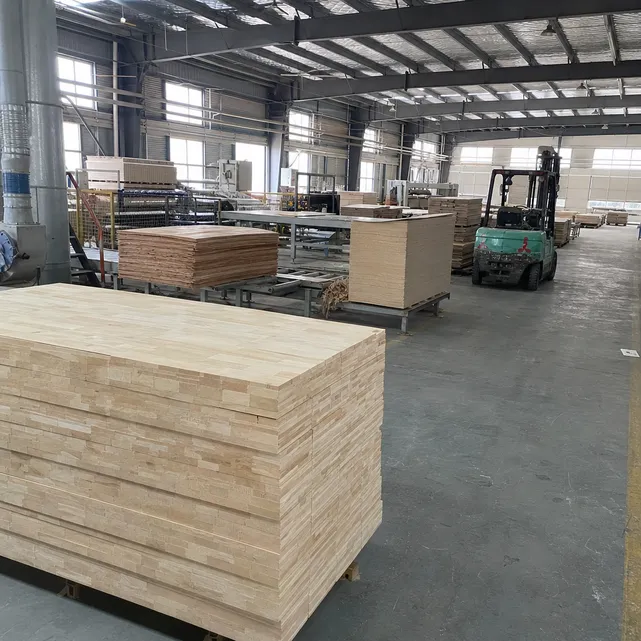
Blockboard Cabinet Board — Factory-Direct from QDPlywood.com
Solid-core blockboard engineered for cabinet carcass construction — dimensionally stable, screw-holding, and export-compliant.
18+ years manufacturing blockboard for furniture factories and distributors across North America, Europe, and the Middle East. CARB P2 certified, FSC available, custom dimensions on confirmed orders.
What Makes Blockboard the Right Core for Cabinet Carcasses
Blockboard cabinet board sits in a specific performance window that matters for cabinet manufacturing: it holds screws better than MDF, machines more cleanly than particleboard, and costs less than solid-wood panels at the same thickness.
How the Core Construction Works
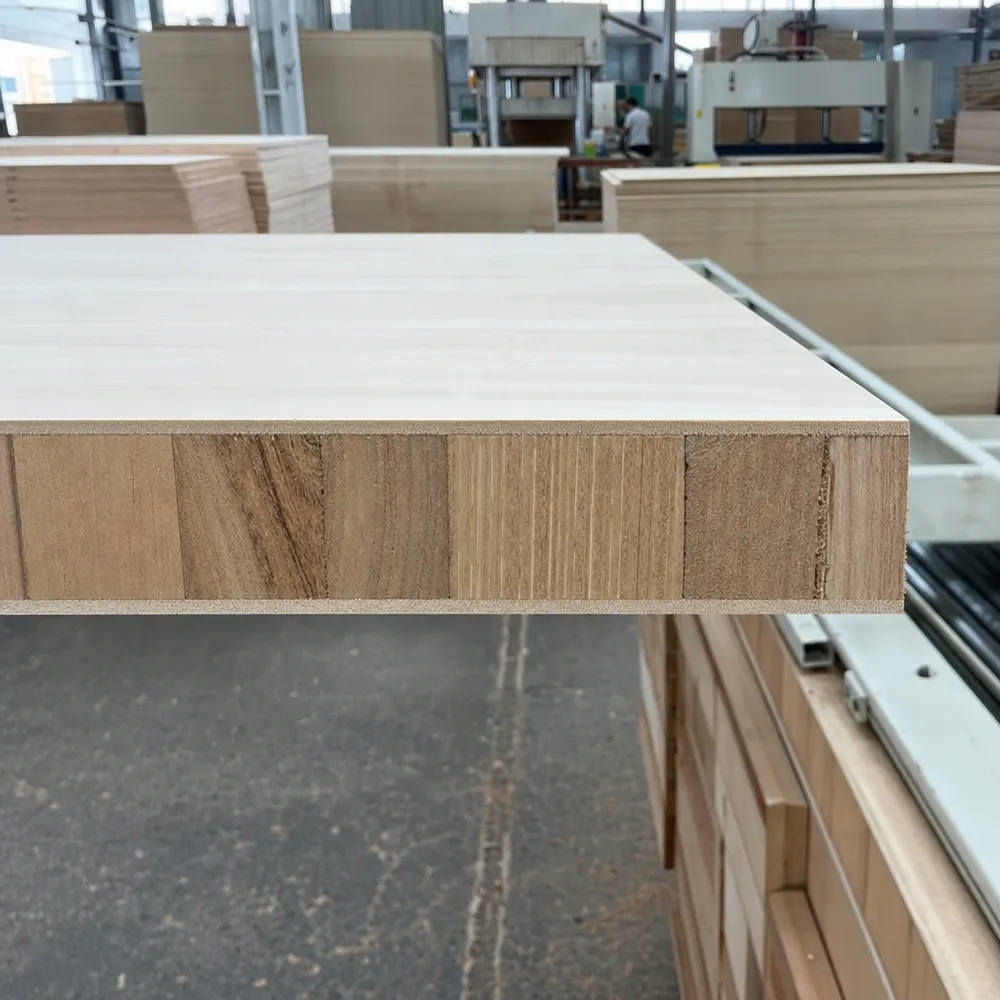
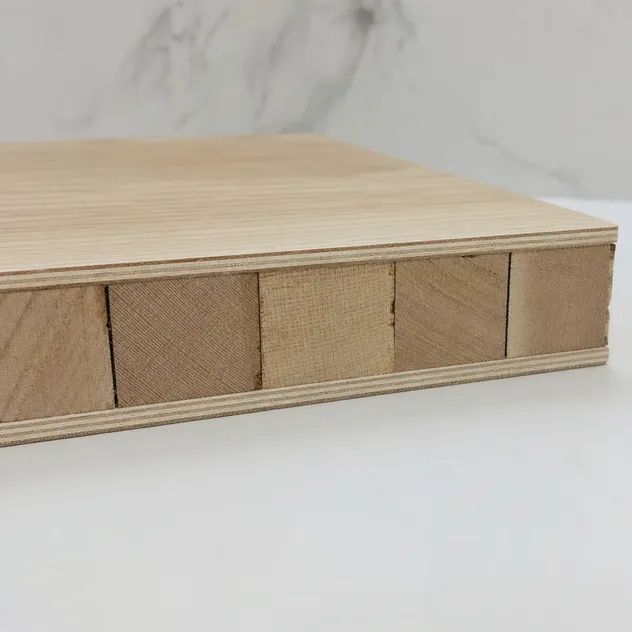
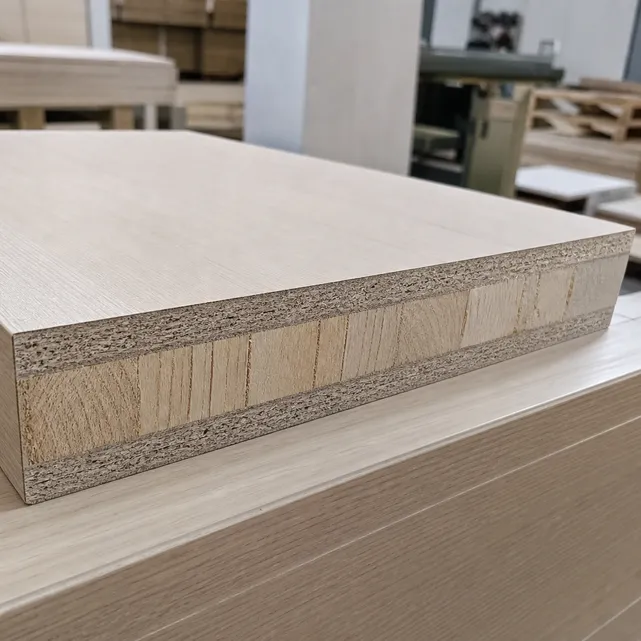
The core is built from solid wood strips — typically poplar, pine, or eucalyptus depending on the specification — glued edge-to-edge and sandwiched between cross-grain veneer layers. That construction is what gives blockboard its screw-holding advantage: the wood strips provide real fiber density at the fastener point, so hinges and drawer slides stay put through years of daily use.
What Matters for Cabinet Carcass Work
For cabinet carcass work specifically, the relevant performance characteristics are flatness, screw retention, and surface quality for lamination or veneer application. Blockboard delivers on all three when it's made correctly — and "made correctly" is where the variation between suppliers shows up. The core strip quality, the moisture content at pressing, and the veneer bonding process all affect whether the panel stays flat after it's cut and assembled.
The Failure Modes We've Engineered Against
We've been running blockboard production since 2008, and the failure modes we've seen from poorly made panels are consistent. Our production process is built around preventing these three specific failures:
-
Core gaps that cause surface telegraphing after lamination
-
Moisture-driven warping after the panel reaches a humid destination market
-
Delamination at the face veneer bond line
View all blockboard products for the full range, including furniture-grade and melamine-faced options.
Performance Comparison at Cabinet Carcass Thickness
Technical Specifications
Standard production values for blockboard cabinet board. Contact us for exact data sheets and to confirm specifications for your order.
Standard Specification Sheet
All values are standard production. Custom specs available on confirmed orders.
Weight vs. Plywood
At equivalent thickness
Blockboard runs 15–25% lighter than standard plywood at the same thickness. For large cabinet carcasses, that difference is meaningful during installation and shipping.
Screw Holding Strength
Face and edge
Face screws bite into solid wood strips and hold reliably. Edge screws perform best when driven perpendicular to the core strips — avoid driving parallel to the strip grain on edges.
Thickness Tolerance
Production standard
Standard tolerance is ±0.5mm on thickness. For CNC-heavy workflows, request sanded-to-thickness panels and confirm tolerance with us before ordering.
Need a full data sheet?
We can provide detailed technical documentation for your procurement or engineering team.
Request Data SheetCabinet Applications
Blockboard cabinet board is used across residential and commercial joinery wherever a stable, lightweight carcass panel is needed. Here's where it performs best.
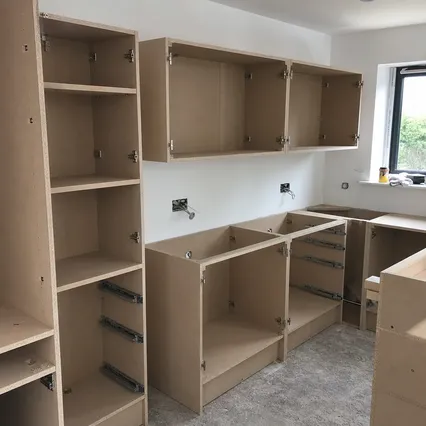
Kitchen Cabinet Carcasses
The most common application. Blockboard's screw-holding strength handles hinge plates, drawer runners, and shelf pins reliably across the full cabinet run.
- Base units, wall units, and tall larder cabinets
- Handles repeated hinge and runner fixings without strip-out
- 18mm standard; 15mm for back panels and light shelving
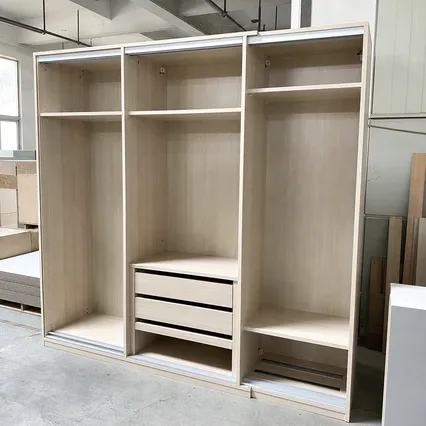
Wardrobe & Bedroom Furniture
Tall wardrobe carcasses benefit from blockboard's stiffness-to-weight ratio. Panels stay flat over height without the sag risk of MDF at equivalent thickness.
- Floor-to-ceiling fitted wardrobes and walk-in units
- Lighter panels reduce structural load on wall fixings
- Accepts sliding door track hardware without reinforcement
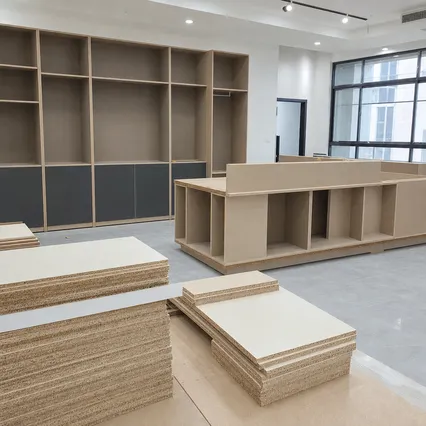
Office & Commercial Joinery
Reception desks, storage walls, and built-in office units all benefit from blockboard's dimensional stability and ability to hold repeated hardware fixings over time.
- Reception counters, credenzas, and storage walls
- Stable under air-conditioned interior environments
- Compatible with laminate and veneer face finishes
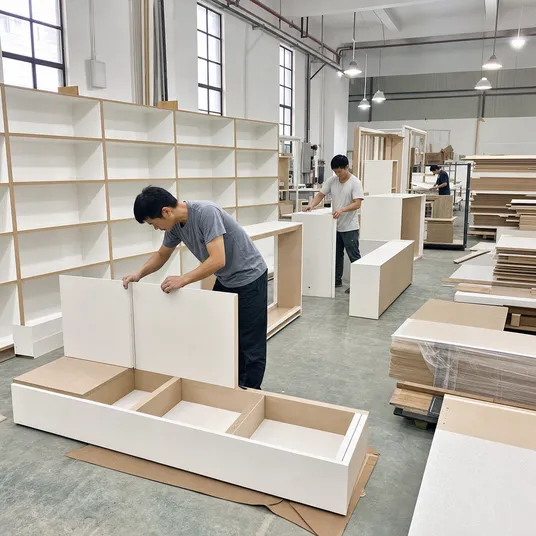
Retail Display & Fixtures
Retail fit-outs demand panels that are easy to handle on-site, hold fixings under repeated use, and accept a variety of surface finishes. Blockboard meets all three.
- Display plinths, gondola shelving, and back-wall units
- Lighter weight speeds up installation in live retail environments
- Melamine-faced options available for clean, finished look
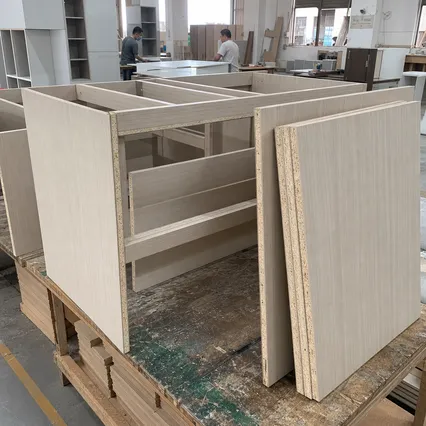
Bathroom Vanity Units
For dry-area bathroom cabinetry, blockboard with a moisture-resistant glue line and sealed edges performs well. Not recommended for direct water exposure without full sealing.
- Vanity carcasses in dry-area bathroom zones
- Specify E0 or MR glue line for humid environments
- Seal all cut edges before installation
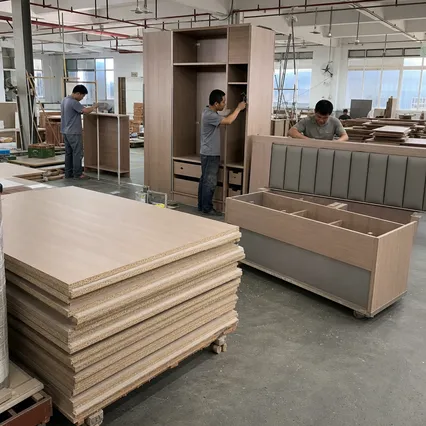
Hospitality & Hotel Joinery
High-volume hotel fit-outs use blockboard for its consistent quality across large orders, ease of handling during installation, and compatibility with premium veneer finishes.
- Guestroom wardrobes, minibar units, and headboard panels
- Consistent spec across large-volume orders
- FSC-certified supply available for green building projects
Where blockboard is not the right choice
Blockboard is not suitable for wet or submerged environments, exterior applications, or anywhere the panel will be exposed to standing water. For high-humidity areas like wet rooms, specify marine-grade plywood or moisture-resistant MDF with appropriate sealing. Blockboard is also not ideal for very thin profiles below 12mm — at that thickness, plywood or MDF offers better structural consistency.
How We Build the Core — and Why It Affects Your Downstream Quality
Core construction is where blockboard quality is actually determined. It's also the part of the process that's hardest to evaluate from a finished panel — which is why we document it in detail.
Core Species Selection
We run poplar as our default core species for cabinet-grade blockboard. It's dimensionally stable, takes glue well, and machines cleanly — without the resin pockets you get in some pine cores that cause adhesion problems when your customer applies a laminate or veneer face.
For buyers who need a denser core for heavier hardware loads — full-extension drawer systems, heavy-duty hinges — we can specify eucalyptus strips, which run about 15–20% denser than poplar at the same moisture content.
Strip Width: The Stability Trade-off
Core strip preparation starts with kiln-dried lumber cut to consistent width. We target 25–30mm strip width for standard cabinet-grade panels. Narrower strips mean more glue lines in the core — adds cost but improves dimensional stability. Wider strips are more economical but can telegraph surface irregularities if moisture content isn't tightly controlled.
Why We Settled on 25–30mm
We've landed on the 25–30mm range as the right balance for export-grade cabinet board — stable enough to ship to humid markets without warping, economical enough to keep your landed cost competitive.
We tried running 40mm strips for a period to reduce core material cost. The panels were fine in dry climates, but we saw warping complaints from buyers in Southeast Asia and the Gulf. We went back to the narrower spec.
Cross-Grain Veneer Construction
After core assembly, the panel goes through our hot press system with cross-grain veneer layers on both faces. The face veneers run perpendicular to the core strips — any tendency for the core to move in one direction is countered by the veneer's grain running the other way. This is what resists the wood movement that causes warping.
Logged Press Parameters
Press parameters — temperature, pressure, and dwell time — are logged per batch. If a bonding issue surfaces after delivery, we can trace it back to the specific production run and identify whether it was a press parameter deviation or a glue spread issue.
Calibrated Wide-Belt Sanding
Post-press, panels go through calibrated wide-belt sanding to ±0.2mm thickness tolerance. That tolerance matters when your customer is running panels through CNC equipment — thickness variation causes feed errors and inconsistent dado depths, which creates rework and waste on their production floor. Consistent thickness doesn't show up in a visual inspection, but shows up immediately when the panel hits a machine.
Formaldehyde Compliance: What CARB P2 Means for Your Market Access
Cabinet board is a formaldehyde-sensitive product category. It goes into enclosed spaces — kitchen cabinets, wardrobes, built-in storage — where off-gassing accumulates. Getting the emission standard wrong creates customs holds, product recalls, and liability exposure.
CARB P2 — Our Export Baseline
California Air Resources Board Phase 2We formulate to CARB P2 as our baseline for export-grade blockboard cabinet board. CARB P2 is the most stringent formaldehyde emission limit in our major export markets, including the US, Canada, and increasingly Australia.
Panels certified to CARB P2 are pre-qualified for the US market without additional testing — which eliminates a common customs friction point for importers.
European Market: E1 and E0
For European buyers, our E1 and E0 options cover the EU's emission requirements under EN 717-1. FSC chain-of-custody certification is available for buyers with sustainability sourcing requirements or who supply into markets where deforestation-linked supply chains create regulatory or reputational risk.
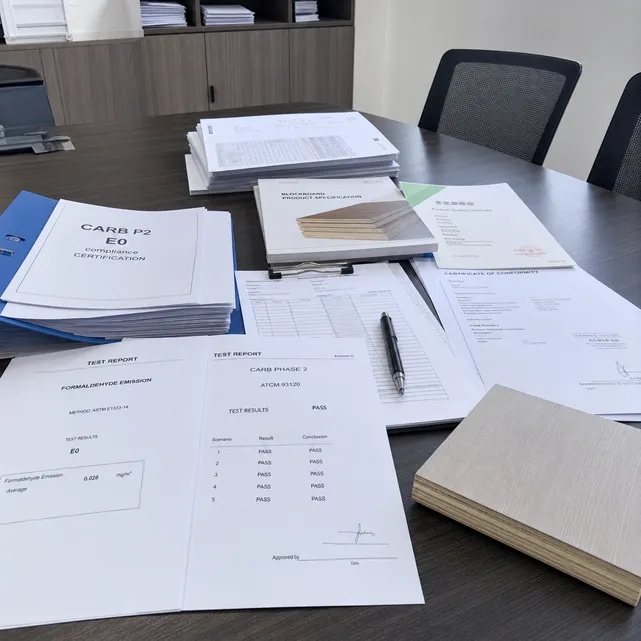
Certification Stack — Key Export Markets
One Supplier Relationship, Multiple Market Qualifications
When you source blockboard cabinet board from us, you're not managing a separate compliance qualification process for each destination market. The certification stack — CARB P2, FSC, CE, ISO 9001:2015 — covers your key import markets in a single supplier relationship.
Cabinet Manufacturing Segments: Where Blockboard Fits Commercially
Blockboard cabinet board serves four distinct buyer segments — each with different order patterns, specification priorities, and downstream requirements. Understanding which segment you're supplying shapes how you specify and source.
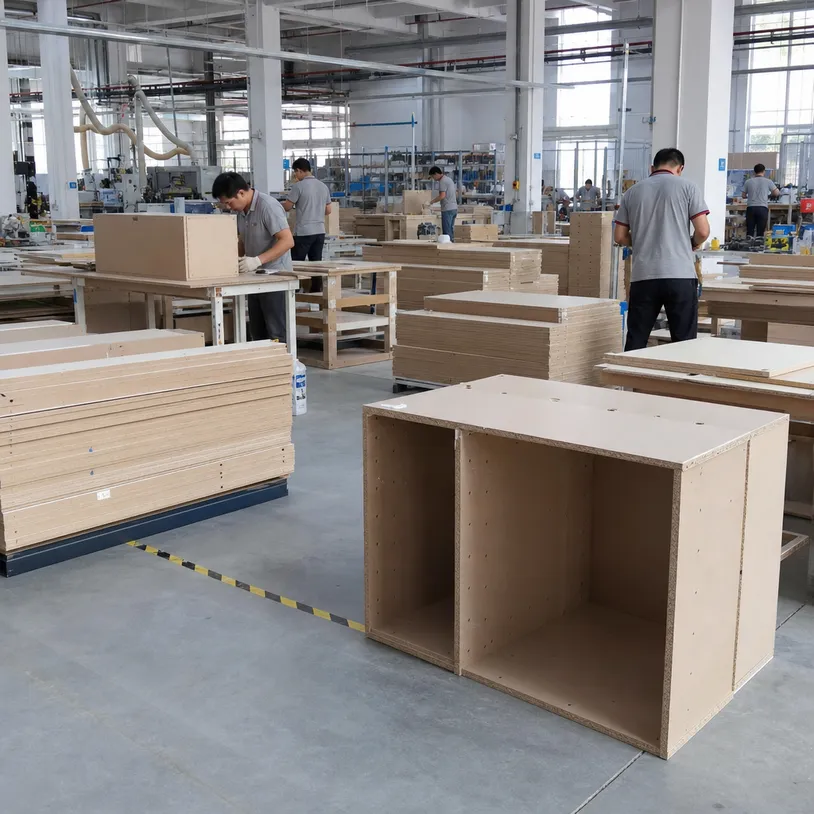
Kitchen Cabinet Manufacturing
Highest VolumeKitchen cabinet factories — whether producing RTA flat-pack or assembled units — use blockboard for carcass panels: sides, tops, bottoms, and shelves. The screw-holding advantage over MDF is critical here because kitchen cabinets carry real loads (dishes, appliances, cookware) and the hinge and drawer slide hardware is stressed daily.
Furniture factories supplying kitchen cabinet components to branded kitchen manufacturers typically order in container quantities — 40HQ loads of 18mm blockboard are a standard reorder pattern for this segment. If you're distributing to kitchen cabinet factories, blockboard cabinet board is a high-frequency, high-volume SKU.
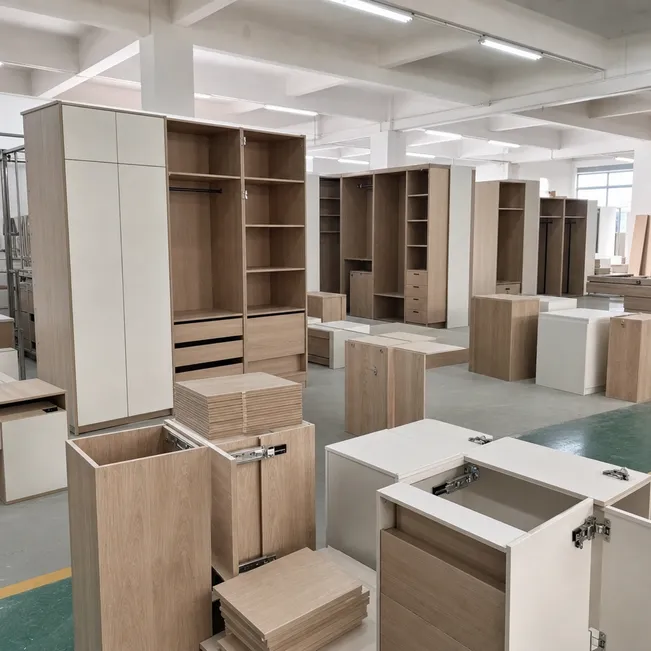
Wardrobe & Storage Furniture
Mixed-Spec OrdersBuilt-in wardrobe systems, freestanding wardrobes, and modular storage units all use blockboard carcass panels for the same reasons as kitchen cabinets — screw retention for hinges and drawer hardware, flatness for door alignment, and surface quality for the melamine or veneer face that the end customer sees.
The wardrobe segment tends to order in mixed specifications — 18mm for carcass panels, 15mm for back panels and shelves — so buyers in this segment often consolidate multiple thicknesses in a single container load.
Discuss container loading configuration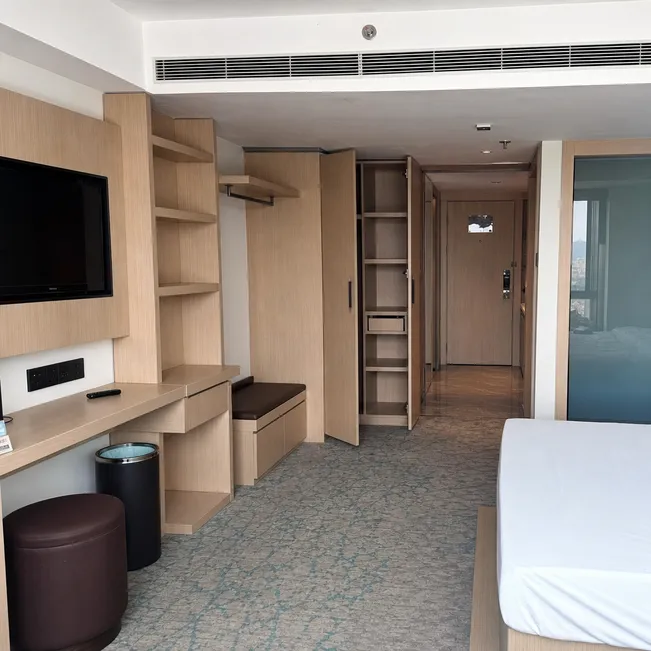
Commercial Joinery & Fit-Out
Growing SegmentA growing segment particularly in the Middle East and Southeast Asia, where commercial construction activity drives demand for built-in joinery in hotels, offices, and retail spaces. Commercial joinery contractors typically work from project specifications that define panel thickness, emission standard, and surface finish.
Blockboard cabinet board with CARB P2 or E1 compliance and a sanded face ready for lamination is the standard specification for this work. Project orders tend to be larger single orders (one or two containers per project) rather than ongoing reorder patterns, but the margin on project-specified material is typically better than commodity distribution.
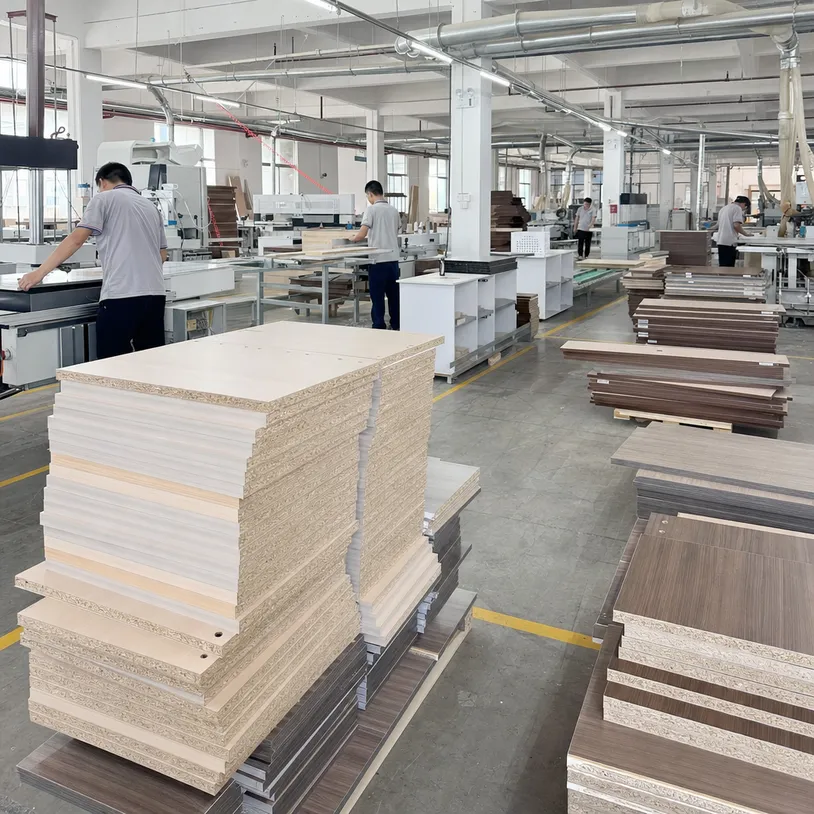
OEM Furniture Manufacturing
Export-FocusedFactories producing branded furniture for export use blockboard cabinet board as a substrate for melamine-faced or veneer-faced cabinet components. The OEM segment values consistent thickness tolerance and surface quality above all else, because their production lines are calibrated to specific panel dimensions and any variation creates downstream rework.
Our ±0.2mm thickness tolerance and consistent veneer surface quality are the specs that matter most for this buyer type.
Surface Options and What They Mean for Your Production Process
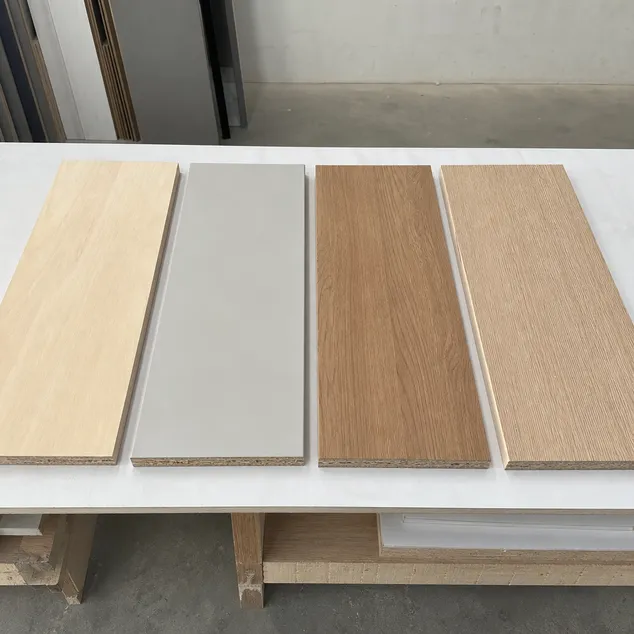
The surface specification on blockboard cabinet board determines how much processing your customer — or you — needs to do before the panel is ready for its final application. We offer four surface configurations.
Raw Sanded Veneer
Standard for Furniture FactoriesCalibrated to ±0.2mm, ready for lamination, painting, or veneer application. This is the standard specification for furniture factories that apply their own surface treatment.
The sanded face provides a consistent substrate for adhesive bonding. We use a fine-grit final pass (typically 120-grit) to leave a surface that bonds well without being so smooth that adhesive can't grip.
Melamine-Faced Blockboard
Ready-to-UseMelamine paper pressed directly onto the blockboard substrate in our facility. This is the ready-to-use specification for cabinet manufacturers who want to skip the lamination step. We can press standard white, woodgrain, or solid-color melamine papers; custom colors and textures are available on runs of 200+ panels.
The melamine surface is pressed at the same time as the face veneer bonding, so the adhesion is integral to the panel rather than a secondary lamination — this matters for edge treatment, because the melamine face won't peel back from the edge the way a post-applied laminate can.
Natural Wood Veneer Face
High-End Furniture & JoineryFor cabinet applications where the visible surface needs a real wood appearance. We can apply a range of face veneer species on confirmed orders: oak, walnut, teak, and others depending on availability.
Natural veneer-faced blockboard is typically used for high-end furniture and joinery where the end customer is paying for visible wood grain.
Unfinished (Raw Veneer, Unsanded)
For In-House CalibrationFor buyers who run their own sanding and calibration equipment and want to control the final surface preparation themselves. Less common for cabinet applications but available on request.
Surface Option Quick Reference
Discuss Surface Specification
Not sure which surface configuration fits your production process? Contact us to discuss your downstream requirements and we'll recommend the right spec for your order.
Contact Us to Discuss Your OrderCustomization Parameters and MOQ
Blockboard cabinet board is one of the more customizable products in our range — the core species, strip width, thickness, panel size, surface treatment, and emission standard can all be specified independently. Here's what's practical:
| Parameter | Standard Options | Custom Options | Notes |
|---|---|---|---|
| Thickness | 15mm, 18mm, 25mm | Other thicknesses available | Confirm MOQ for non-standard thickness |
| Panel Size | 1220 × 2440mm | Custom dimensions available | Cut-to-size on confirmed orders |
| Core Species | Poplar (default) | Pine, eucalyptus | Eucalyptus adds ~10–15% to panel cost |
| Surface | Raw sanded, melamine-faced | Natural veneer, custom melamine | Custom melamine: 200+ panel minimum |
| Emission Standard | E1 (default) | CARB P2, E0 | CARB P2 requires MUF or PF resin — confirm on order |
| Certification | ISO 9001:2015 | FSC, CARB P2, CE | FSC requires chain-of-custody documentation |
Standard MOQ
One container load (typically 40HQ) for standard specifications. For sample orders to evaluate quality before committing to a full container, we can arrange sample panels — contact us to discuss.
Standard Lead Time
15–20 working days from order confirmation to container loading for standard specifications. Custom surface treatments or non-standard dimensions may add 5–7 working days.
Custom Melamine MOQ
Custom melamine surface patterns require a minimum of 200 panels. CARB P2 emission standard requires MUF or PF resin — this must be confirmed at the time of order placement.
Container Loading and Export Logistics
A standard 40HQ container loads approximately 18–22 m³ of blockboard cabinet board at 18mm thickness in 1220×2440mm panels, depending on stacking configuration and packaging. At 15mm, the same container carries proportionally more volume.
Packaging and Protection
Panels are bundled in stacks of 50–100 sheets depending on thickness, strapped with steel banding, and edge-protected with corner boards. We provide a loading plan with each shipment so your receiving team knows the exact bundle count, panel count per bundle, and stacking sequence.
For melamine-faced panels, we add interleaving paper between sheets to prevent surface contact damage during transit.
Export packaging includes moisture-resistant film wrap on each bundle — relevant for ocean transit to humid destination ports where condensation inside the container is a real risk. We've seen surface damage on competitor product that arrived without moisture protection — it's a small cost that prevents a significant claim.
Port Access and Transit Times
Xuzhou connects to Qingdao, Shanghai, and Lianyungang ports. Estimated transit times to major destination ports:
Export Documentation Package
Blockboard Cabinet vs. Sibling Products: Choosing the Right Panel
Under our blockboard range, several products serve overlapping applications. Here's how to navigate the choice.
| Product | Best For | Key Difference from Blockboard Cabinet |
|---|---|---|
| Blockboard Cabinet (this page) | Cabinet carcasses, kitchen cabinets, wardrobe frames | Optimized for screw retention and surface flatness; standard sanded or melamine-faced |
| Melamine Blockboard | Ready-to-assemble furniture, visible interior surfaces | Pre-finished melamine surface in a wider color/texture range; higher surface specification |
| Laminate Blockboard | High-traffic commercial joinery, surfaces requiring HPL durability | HPL or decorative laminate face; higher surface hardness and scratch resistance |
| Blockboard Furniture | General furniture carcasses, shelving, structural panels | Broader application range; less specific to cabinet hardware requirements |
| 18mm Blockboard | Buyers specifying by thickness rather than application | Standard 18mm specification; same core construction |
Cabinet Carcass Construction + CARB P2
If your application is specifically kitchen cabinet or wardrobe carcass construction and you need CARB P2 compliance for the US market, blockboard cabinet board is the right starting point.
Pre-Finished Surface in Specific Color or Texture
If you need a pre-finished surface in a specific color or texture, melamine blockboard gives you more surface options.
High-Traffic Surfaces Needing Scratch Resistance
If the application involves high-traffic surfaces that need scratch and impact resistance, laminate blockboard is worth evaluating.
Frequently Asked Questions
Technical and commercial questions from cabinet manufacturers, importers, and procurement teams — answered with the specifics that matter for sourcing decisions.
18mm is the industry standard for kitchen cabinet sides, tops, and bottoms. 15mm is used for shelves and back panels where load requirements are lower. Some high-end cabinet manufacturers specify 25mm for base cabinet carcasses to support countertop loads, but 18mm with proper internal bracing handles most residential and light commercial applications.
If your downstream customers are building base cabinets that will carry stone countertops, confirm the load specification — 18mm blockboard with a solid wood edge band handles typical countertop loads, but very heavy stone (>50kg/m²) may warrant 25mm carcass panels or additional internal support.
The practical difference is screw retention and machinability. Blockboard holds screws significantly better than MDF at the same thickness — the solid wood core provides real fiber density at the fastener point, while MDF's uniform fiber structure strips more easily under repeated load cycling. For cabinet hinges and drawer slides that are opened and closed thousands of times, that difference shows up as warranty claims over time.
MDF machines to a cleaner edge profile and is better for routed decorative profiles, but for structural carcass panels where hardware is attached, blockboard is the more durable choice. The cost difference between the two narrows when you factor in the hardware failure rate over the product's service life.
Yes — our export-grade blockboard cabinet board is produced with MUF (melamine-urea-formaldehyde) resin systems that meet CARB Phase 2 emission limits. We provide the CARB documentation package as standard for US-bound shipments.
If you need third-party test reports for your own compliance documentation, we can provide SGS or Bureau Veritas test results on request. Specify CARB P2 on your order — it's not the default for all markets, so confirming it at the order stage ensures the correct resin system is used.
For natural wood veneer faces, MOQ depends on the veneer species and availability — contact us with your specification.
Warping in blockboard after delivery is almost always a moisture content issue — either the panels arrived with moisture content outside the 8–12% export range, or they were stored in conditions that allowed moisture uptake before installation. Our panels ship at 8–12% moisture content with moisture-resistant packaging.
Get a Quote for Blockboard Cabinet Board
Send us your specification and we'll come back with a detailed quote and the relevant certification documentation for your import requirements.
What to Include in Your Enquiry
The more detail you provide upfront, the faster we can return an accurate quote with the right certification documentation for your destination market.
-
Thickness — e.g. 18mm, 25mm, custom
-
Panel Size — standard 1220×2440mm or custom dimensions
-
Surface Treatment — raw, melamine, veneer, or film-faced
-
Emission Standard — CARB P2, E0, E1, or market-specific
-
Destination Market — country and port of discharge
-
Target Volume — CBM or container count per order cycle
Start with a Sample Order
Most new buyers in this category start with a sample order to evaluate core quality and surface consistency before committing to a full container. We can arrange sample panels — contact us to discuss.
Explore Related Blockboard Products
Xuzhou QD Wood Industry Co., Ltd.
No. 88 Sanbao Industrial Park, Tongshan District, Xuzhou, Jiangsu Province, 221116, China
Xuzhou, Jiangsu Province, 221116, China