

HDF MDF Board Manufacturer — Factory-Direct High Density Fiberboard
800–900 kg/m³ density, 2.5–6mm gauge range, CARB P2 certified. Built for applications where standard MDF simply doesn't hold up.
We produce high density fiberboard in the thin gauges where density advantage matters most: flooring underlayment, door skin panels, and surface-abrasion applications that generate warranty claims when the wrong spec is used.
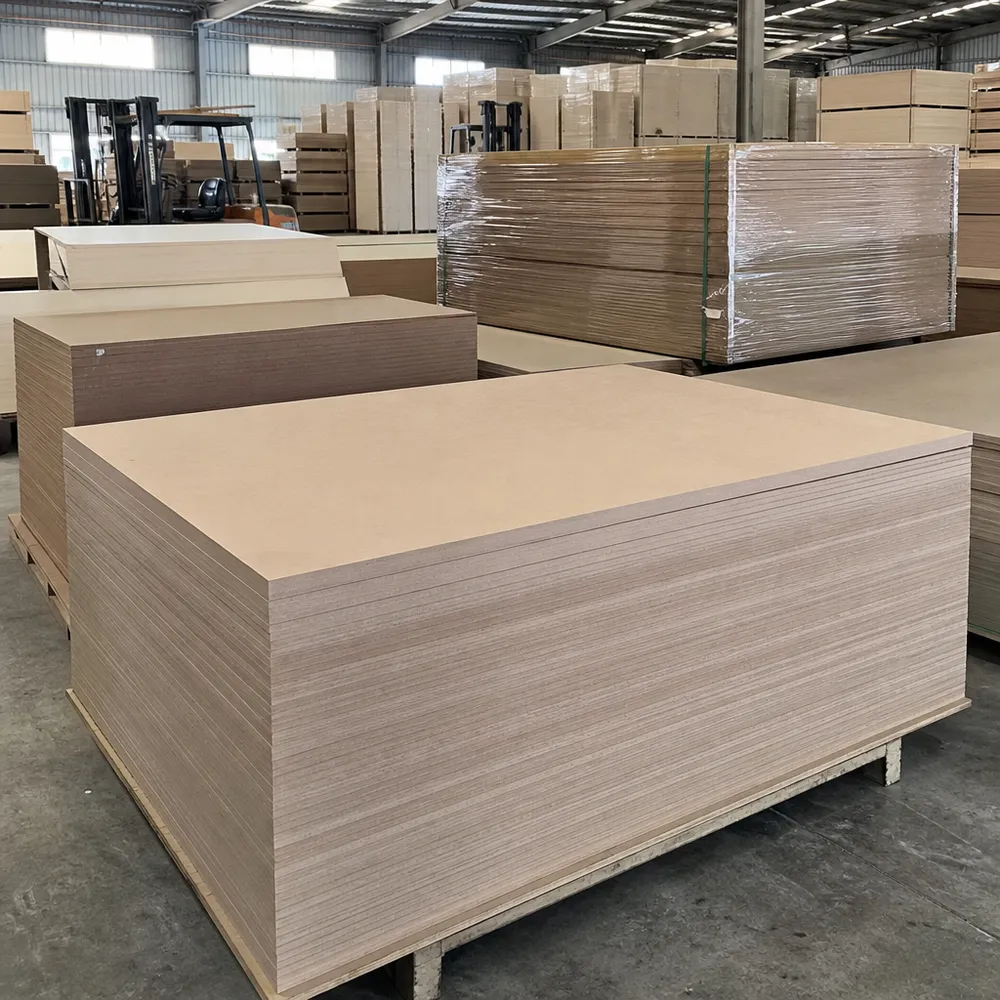
Why HDF Is a Different Product Category, Not Just Denser MDF
HDF MDF sits in our range as a distinct product line, not a premium version of standard board. The density difference changes the mechanical behavior of the panel in ways that matter commercially.
The density difference — 800–900 kg/m³ versus 680–750 kg/m³ for standard MDF — changes the mechanical behavior of the panel in ways that matter commercially. Screw-holding strength increases significantly. Surface hardness improves enough to resist indentation under foot traffic and mechanical contact. Internal bond strength runs at ≥0.80 N/mm², compared to ≥0.55 N/mm² for standard MDF. And in thin gauges — 2.5mm to 6mm — HDF holds dimensional stability that standard MDF at the same thickness simply cannot match.
The commercial implication is straightforward: if your downstream customers are running flooring underlayment, hollow-core door skin production, or any application where a thin panel takes surface load or abrasion, standard MDF at 3mm or 4mm will generate complaints. The surface dents, the edges chip, and the panel deflects under load. HDF at the same thickness holds. That difference is what your customers are paying for when they specify high density fiberboard, and it's what protects your margin when they reorder.
We produce HDF primarily in the 2.5–6mm thickness range because that's where the density advantage is commercially significant. At 12mm or 18mm, the density difference between standard MDF and HDF matters less for most applications — the panel has enough mass to perform adequately regardless. At 3mm or 4mm, it's the difference between a product that works and one that generates returns.
"We've had buyers come to us after switching from standard MDF to HDF on door skin production and cutting their rejection rate at the lamination stage by more than half — the harder surface holds the adhesive bond more consistently."
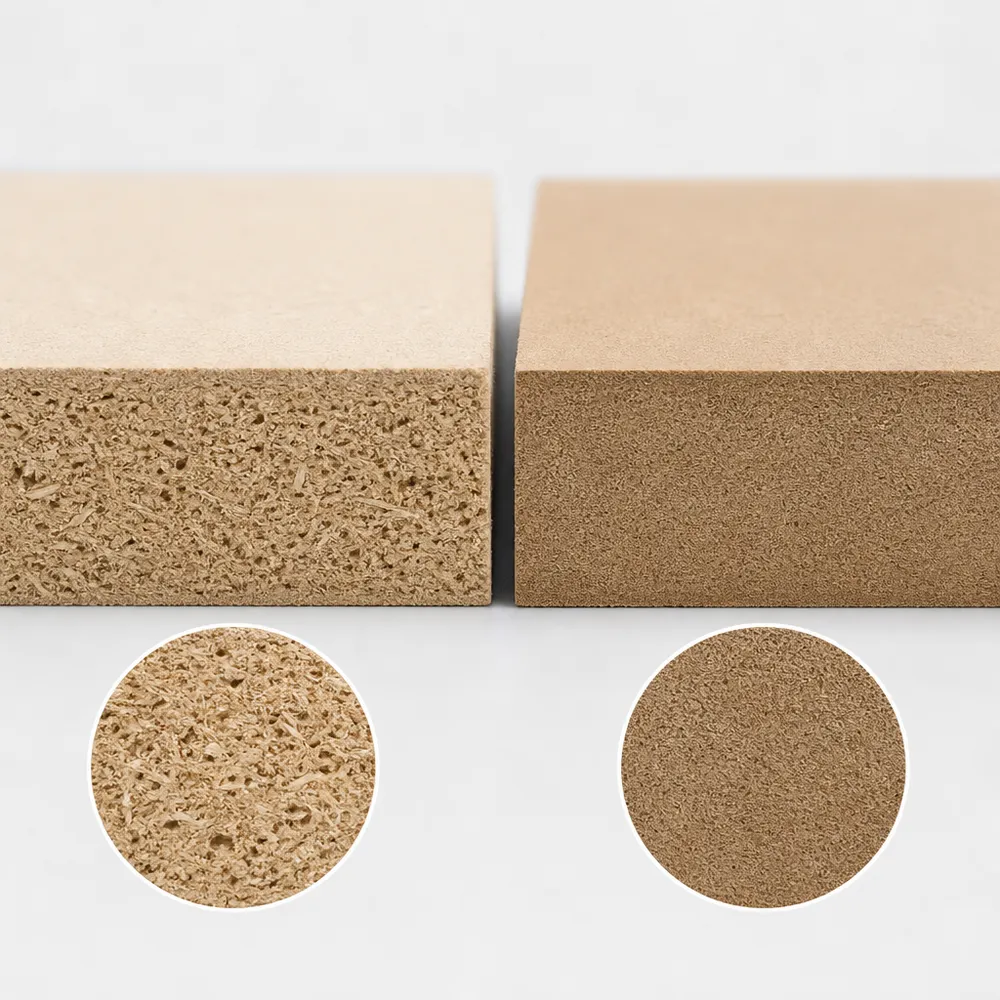
Mechanical Property Comparison
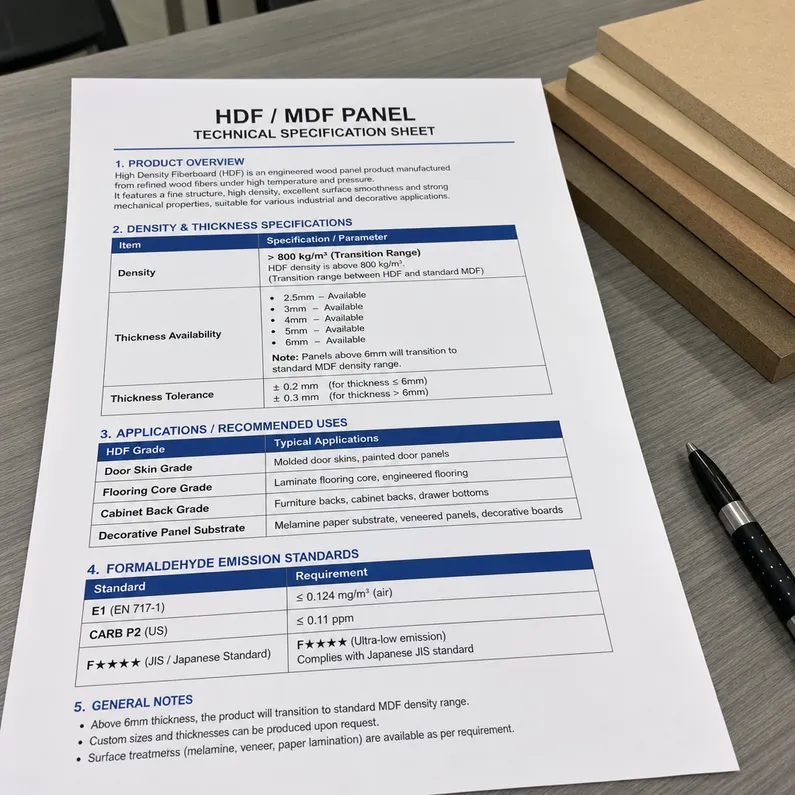
HDF MDF Technical Specifications
Full parameter sheet for factory-direct HDF MDF. Contact us for detailed product data sheets and current test reports.
Thickness Availability Notes
- 2.5mm & 3mm — primary HDF grades; highest density, used for door skins and flooring cores
- 4mm & 5mm — transition range; density maintained above 800 kg/m³ throughout
- 6mm — upper HDF boundary; suitable for cabinet backs and decorative panel substrates
- Thicknesses above 6mm transition to standard MDF density range; confirm requirements before ordering
Formaldehyde Emission Standards
≤0.124 mg/m³ air — standard export grade, meets EU and most Asian market requirements
≤0.11 ppm — required for California and US market entry; available on confirmed orders with lead time adjustment
Japanese JIS standard — available on request for Japan-bound shipments
Where HDF MDF Is Specified
HDF MDF earns its place in applications where standard MDF fails under load, abrasion, or tight dimensional tolerances. These are the categories where buyers consistently reorder.
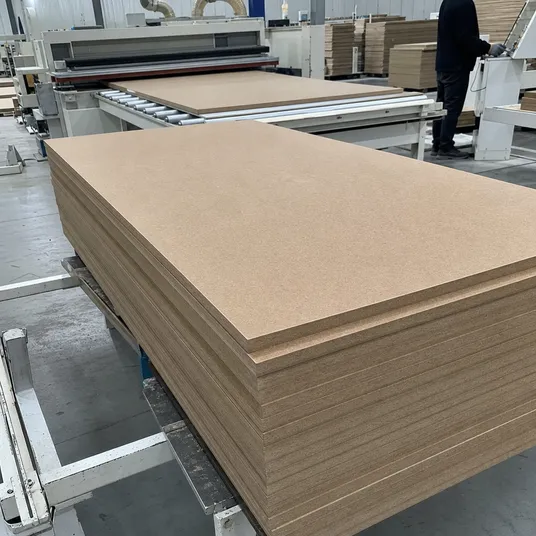
Laminate Flooring Core
The dominant application for HDF MDF globally. High density resists indentation from furniture legs and foot traffic. Tight thickness tolerance ensures click-lock joints engage cleanly across the full panel run.
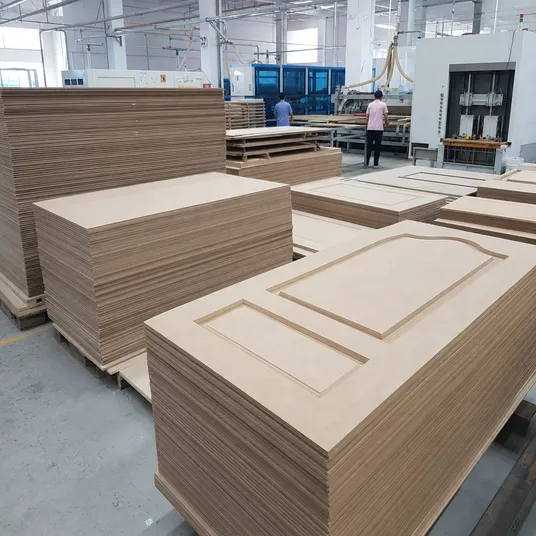
Door Skin Panels
Moulded and flat door skins require a substrate that holds fine profile detail without edge crumbling. HDF MDF's dense, uniform fibre structure accepts deep embossing and bonds reliably with PVC, paper, and veneer overlays.
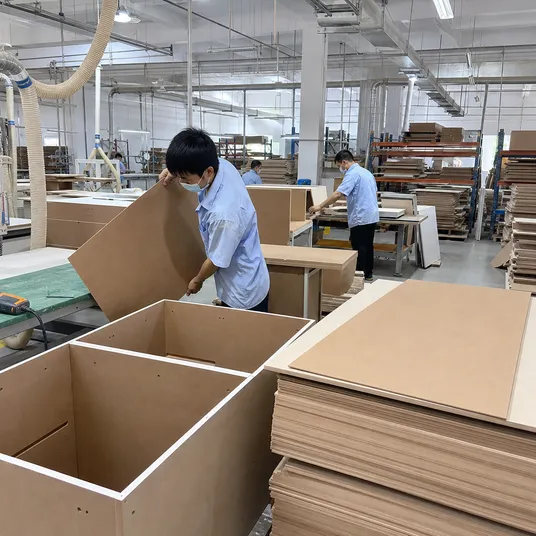
Furniture Back Panels
Cabinet and wardrobe backs cut from HDF MDF at 3–5mm resist bowing under load and provide a flat, stable surface for foil or paper lamination. Reduces racking in flat-pack furniture compared to standard MDF or hardboard.
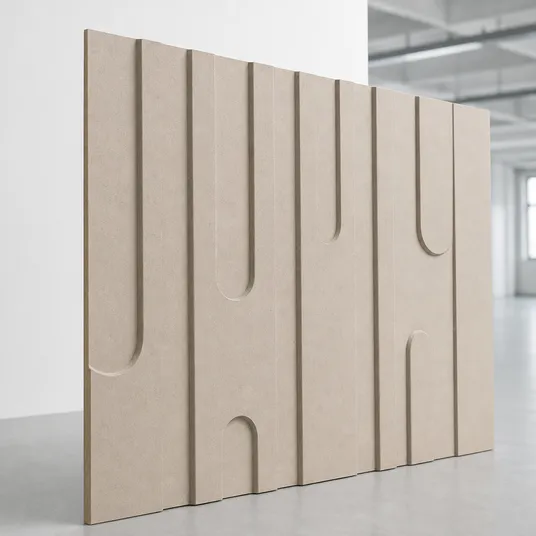
Decorative Wall Panels
Routed groove patterns and 3D surface profiles cut cleanly into HDF MDF without fibre tear-out. The hard, smooth surface accepts paint, UV coating, and digital print with minimal sealer coats, reducing finishing cost per panel.
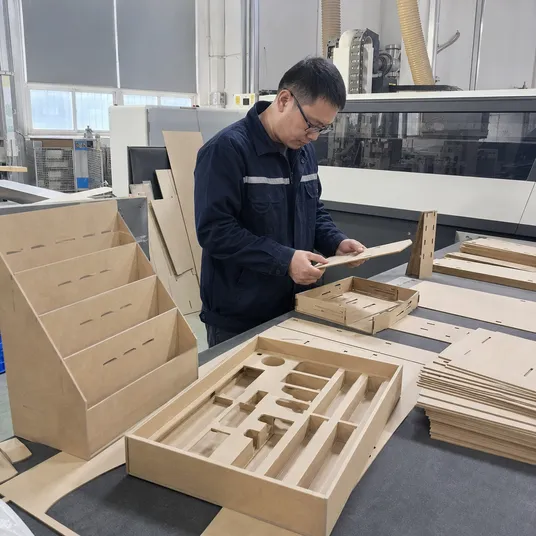
Retail Display & Packaging
Point-of-sale displays and premium product packaging use HDF MDF for its weight-to-stiffness ratio at thin gauges. Laser cutting and CNC profiling produce clean edges without secondary sanding, speeding up production runs.
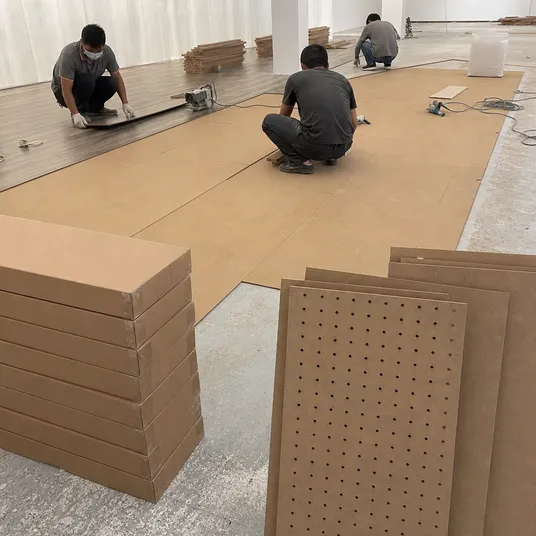
Acoustic & Underlayment
Dense fibre mass improves impact sound insulation when used as underlayment beneath hard floor finishes. Perforated HDF MDF panels are also specified in acoustic ceiling and wall systems where mass and absorption are both required.
Not sure which thickness fits your application?
Send us your end-use spec and we'll confirm the right grade, thickness, and emission standard before you commit to an order.
Where HDF MDF Moves: Market Segments With Repeatable Volume
The applications for high density fiberboard are narrower than standard MDF, but the buyers in these segments order in consistent volume because the specification is non-negotiable for their production process.
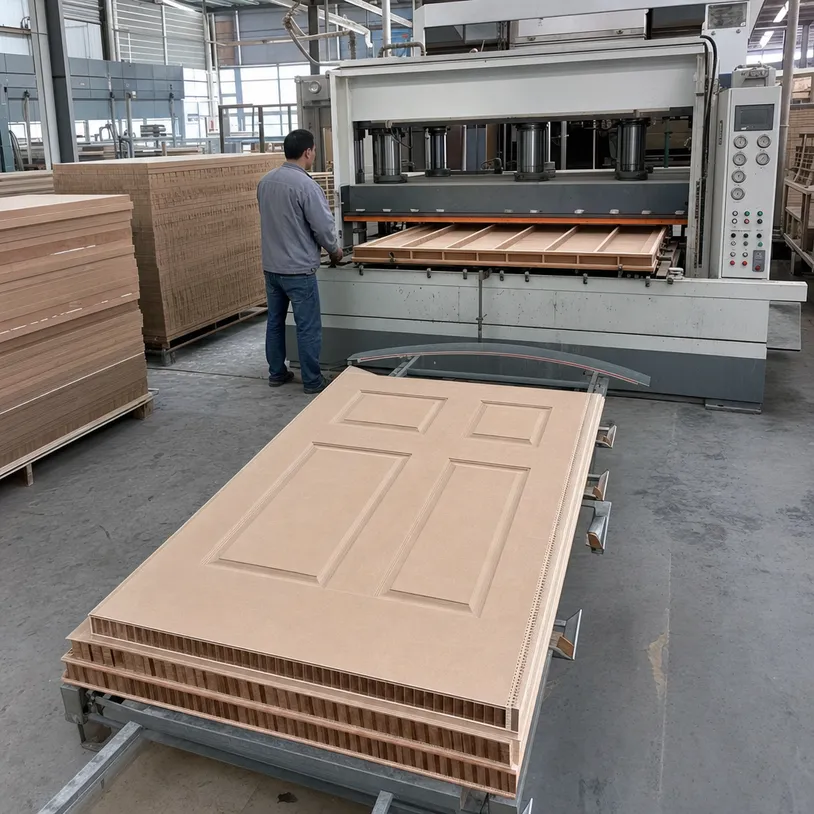
Door Skin Manufacturing
2.5–4mmPrimary volume segment
Hollow-core interior door manufacturers use HDF face panels pressed onto a timber or honeycomb core — the face panel needs to be hard enough to resist surface damage during handling and installation, and dimensionally stable enough to stay flat after pressing.
Door skin production runs in high volume: a mid-size door manufacturer might consume 50,000–100,000 panels per month. Buyers supplying door manufacturers need a supplier who can hold the density and thickness tolerance consistently across large batches, because the door manufacturer's press is calibrated to a specific panel spec.
We run HDF as a dedicated production line rather than a modified standard MDF run, which is how we hold the density range across batches.
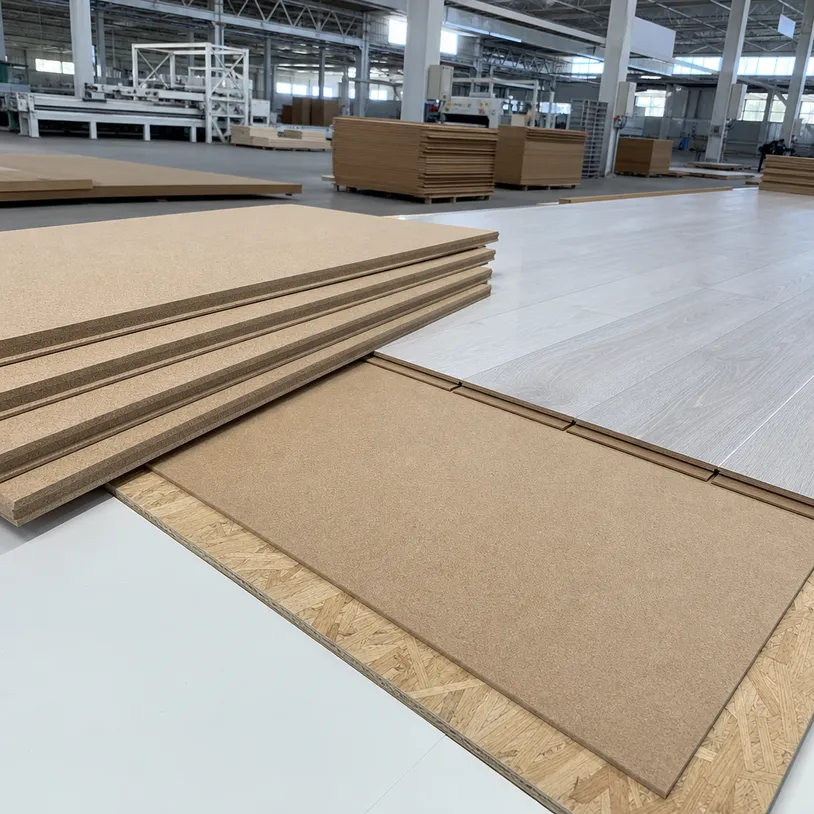
Flooring Underlayment
4–6mmPredictable reorder pattern
The panel sits between the subfloor and the finished flooring surface, taking compressive load and providing a smooth, stable base. Standard MDF compresses and deforms under foot traffic load at these thicknesses — HDF at 800+ kg/m³ holds its geometry.
Flooring distributors and underlayment manufacturers in Southeast Asia, the Middle East, and Eastern Europe are active buyers in this segment. The specification is consistent and the reorder pattern is predictable, which makes it an efficient segment to supply.
Laminate Flooring Substrate
Core LayerClick-lock joint integrity
HDF is used as the core layer in engineered laminate flooring products. The density provides the click-lock joint strength that laminate flooring systems require — a lower-density core will crack at the joint under repeated foot traffic.
Buyers manufacturing laminate flooring panels need HDF with tight density consistency across the panel cross-section, not just at the surface. We test density uniformity as part of our production QC for this reason.
Furniture Back Panels & Drawer Bottoms
3–4mmContract & commercial grade
Higher-end furniture production uses HDF in 3–4mm thickness where the application requires a harder, more rigid panel than standard MDF provides. Furniture manufacturers supplying commercial or contract markets — hotels, offices, retail fit-out — often specify HDF for these components because the furniture takes heavier use than residential pieces.
Buyers supplying furniture factories in these segments can differentiate their offering by stocking HDF alongside standard MDF.
Ready to discuss your volume requirement?
Door skins, flooring underlayment, laminate substrate, or contract furniture components — we supply all four segments from dedicated HDF production lines.
How We Produce HDF: The Process Decisions That Determine Density Consistency
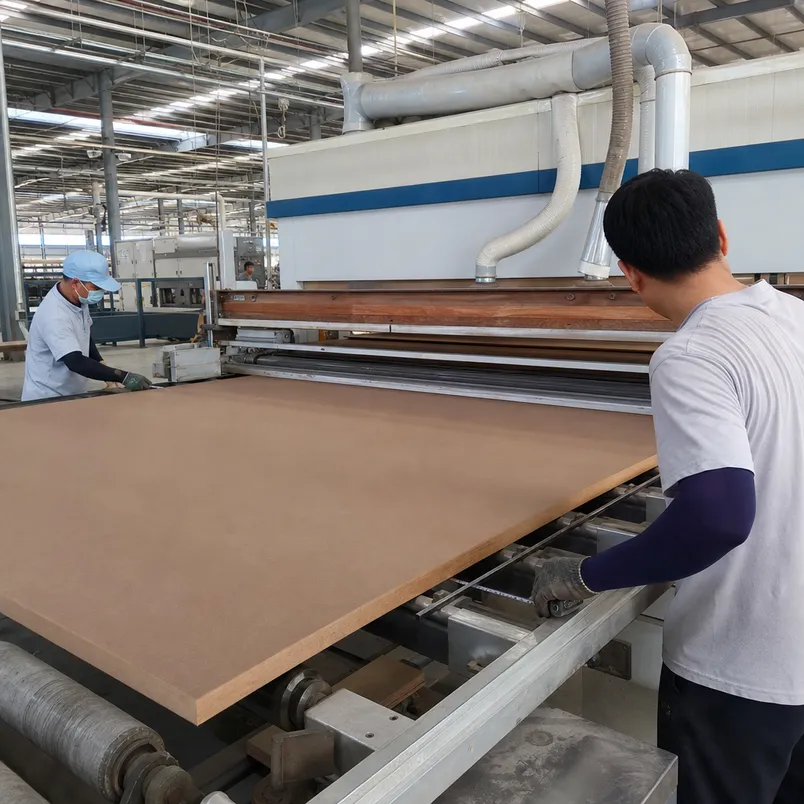
Achieving consistent 800–900 kg/m³ density across a production batch requires specific process control at three points: fiber preparation, resin loading, and press parameters. This is where HDF production diverges from standard MDF, and where the quality differences between suppliers originate.
Fiber Preparation
Finer fraction, tighter moisture control
HDF uses a finer fiber fraction than standard MDF. The refining process — where wood chips are broken down into fiber under heat and pressure — is run at higher intensity to produce shorter, finer fibers that pack more densely in the mat before pressing.
HDF Moisture
8–10%
Fiber moisture into mat former
Standard MDF
10–12%
Wider tolerance range
The higher press pressure used for HDF is less forgiving of moisture variation — steam pockets form more easily at high press pressure, which creates density voids in the finished panel.
Resin Loading
Higher ratio, CARB P2 formulation
HDF runs at a higher resin-to-fiber ratio than standard MDF. The higher resin content contributes to the density and internal bond strength, but it also increases the formaldehyde emission potential.
HDF Resin Load
10–12%
UF resin by dry fiber weight
Standard MDF
8–10%
Standard board loading
CARB P2 compliance for HDF requires careful resin system selection and press parameter control. We use a low-emission UF resin formulation for our CARB P2 HDF production and log the resin batch and press parameters for every production run.
This is the part that trading companies can't verify — they can show you a certificate, but they can't show you the resin batch records. We can.
Press Parameters
Thickness-specific programs, tighter tolerance
HDF runs at higher specific pressure than standard MDF to achieve the target density. The press temperature and closing speed are calibrated to the panel thickness: thinner panels (2.5–3mm) require faster closing to prevent pre-cure of the surface layers before the core reaches temperature.
HDF Press Pressure
3.5–4.5
N/mm² specific pressure
Standard MDF
2.5–3.5
N/mm² specific pressure
We run thickness-specific press programs rather than a single program across the HDF range, which is how we hold the ±0.15mm thickness tolerance at 2.5mm that we can't achieve with a generic press cycle.
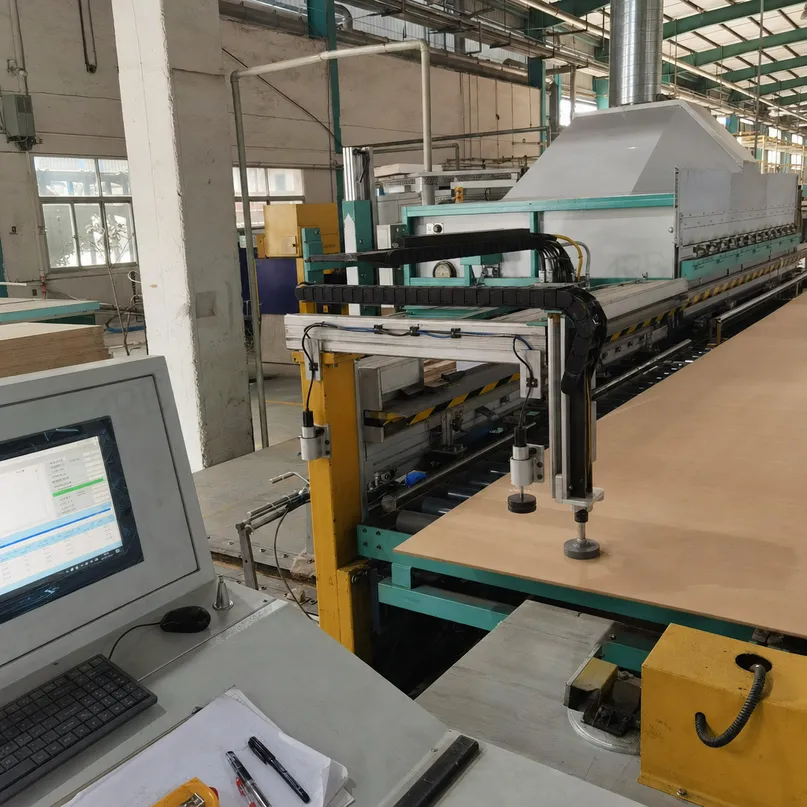
Cross-Section Density Consistency
The result is a panel where the density is consistent from the surface to the core, not just at the face layers. That cross-section consistency is what matters for door skin lamination and flooring underlayment — applications where the panel is machined, bonded, or loaded through its full thickness.
HDF vs. Standard MDF: Key Process Differences
Where the density and quality gap originates
| Process Stage | HDF (800–900 kg/m³) | Standard MDF (650–750 kg/m³) |
|---|---|---|
| Fiber fraction | Finer, higher-intensity refining | Standard refining intensity |
| Fiber moisture | 8–10% (tighter range) | 10–12% |
| Resin loading | 10–12% UF by dry fiber weight | 8–10% |
| Press pressure | 3.5–4.5 N/mm² | 2.5–3.5 N/mm² |
| Press programs | Thickness-specific per SKU | Single program across range |
| Thickness tolerance | ±0.15mm at 2.5mm | ±0.2–0.3mm typical |
| Batch traceability | Resin batch + press params logged per run | Certificate only |
Compliance Documentation for Your Import Market
HDF MDF sold into regulated markets requires specific documentation. Here's what we carry and what it covers for your destination.
California Air Resources Board Phase 2
Required for HDF entering the US market through major distributors, retailers, or any buyer with California exposure. We carry CARB P2 certification and provide the documentation package with every US-bound shipment.
Test reports available per production batch on request — not just a blanket certificate.
Quality Management System
Covers our quality management system, production process controls, and documentation procedures.
Audit reports available on request.
Formaldehyde Emission — European Standard
E1 (≤0.1 ppm) is the standard specification for HDF entering European markets. E0 (≤0.05 ppm) is available on request for buyers who need the lower emission specification for specific market requirements.
E0 requires longer lead time due to resin sourcing requirements.
European Construction Applications
Covers European construction and building material applications where CE marking is required.
Required for building material applications in EU member states.
Japan, Australia, and Other Regulated Markets
For buyers supplying into Japan, Australia, or other markets with specific formaldehyde or material safety requirements, send us your destination market and we'll confirm which documentation applies and what we can provide. We've been exporting to these markets long enough to know the documentation requirements without needing to look them up.
HDF MDF Customization: What We Can Adjust on Confirmed Orders
The standard HDF range covers 2.5–6mm in 1220×2440mm panels. Beyond that, the variables we can adjust:
Thickness
Any thickness from 2.5mm to 6mm. Non-standard thicknesses (e.g., 3.5mm, 4.5mm) are produced to order. No tooling cost — thickness is a press and sanding parameter.
Panel Dimensions
Custom sizes available on confirmed orders. Common requests include 1220×2800mm for tall door applications and 915×2135mm for markets using imperial-adjacent sizing. We'll confirm yield efficiency and any minimum order implications before committing.
Density Targeting
We can target specific density ranges within the 800–900 kg/m³ band — relevant if your customer's production process is calibrated to a specific density specification. Tighter density targeting (e.g., 840–860 kg/m³) requires a dedicated production run and higher MOQ.
Formaldehyde Specification
Standard E1 or CARB P2. E0 available on request with longer lead time due to resin sourcing requirements.
Surface Preparation
Standard sanded finish (both sides) is the default. Fine-sanded finish for lamination applications (Ra ≤ 1.2μm) is available on request — relevant if you're supplying door skin manufacturers who apply thin decorative foil directly to the HDF surface.
Private Label and OEM Marking
Panels can be marked with your brand, specification, and destination market information as part of the packing process.
Get a quote for your HDF MDF spec
| Parameter | Standard | Custom Option | Notes |
|---|---|---|---|
| Thickness | 2.5–6mm | Any in range | No tooling cost |
| Panel Size | 1220×2440mm | Custom on order | Yield efficiency confirmed before commit |
| Density | 800–900 kg/m³ | Tight band (e.g. 840–860) | Dedicated run + higher MOQ |
| Formaldehyde | E1 / CARB P2 | E0 on request | Longer lead time |
| Surface Finish | Standard sanded (both sides) | Fine-sanded Ra ≤ 1.2μm | For thin foil lamination |
| Marking | Standard packing | Private label / OEM | Brand + spec + destination |
Container Loading and Transit to Your Port
HDF in the 2.5–6mm range loads at significantly higher sheet counts per container than thicker MDF, which affects your per-unit landed cost calculation.
Typical Loading Quantities — 1220×2440mm HDF Panels
| Thickness | 20HQ (approx. sheets) | 40HQ (approx. sheets) |
|---|---|---|
| 2.5mm | 1,800–2,200 | 3,800–4,400 |
| 3mm | 1,500–1,800 | 3,200–3,600 |
| 4mm | 1,100–1,400 | 2,400–2,800 |
| 5mm | 900–1,100 | 1,900–2,200 |
| 6mm | 750–900 | 1,600–1,900 |
Loading quantities vary with stacking configuration and packing method. We provide a loading plan with each shipment.
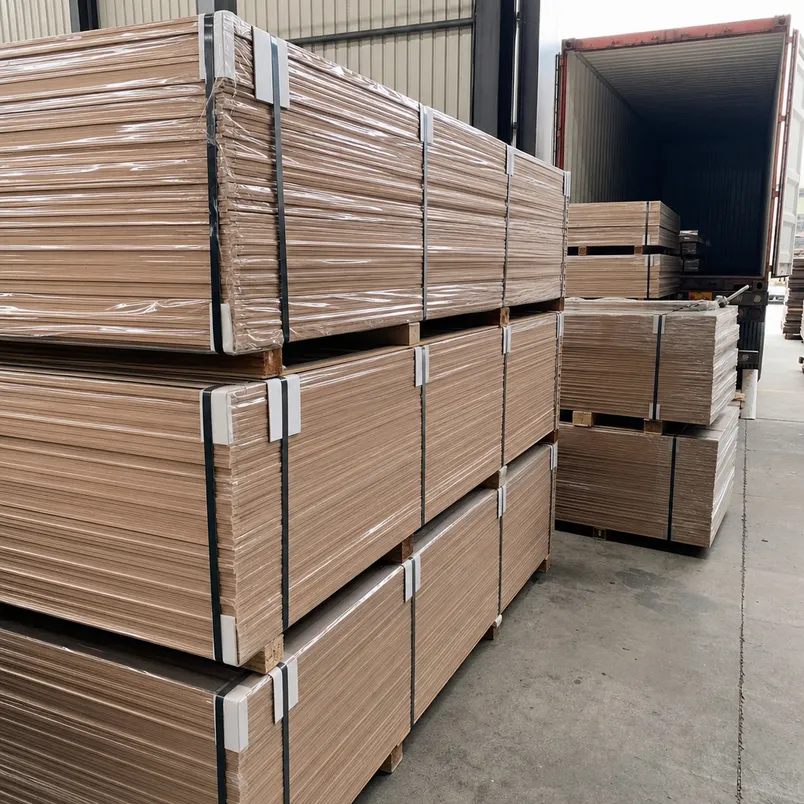
Packaging for Ocean Transit
HDF panels are bundled in packs of 50–100 sheets, steel-banded, corner-protected, and wrapped in moisture-resistant film. Thin HDF panels (2.5–3mm) are particularly susceptible to edge damage during transit — we use additional edge board protection on these gauges and limit bundle height to prevent stack pressure deformation.
We standardized the edge protection protocol after seeing corner damage on a 3mm shipment to the Middle East — the fix added about 0.3% to packaging cost and eliminated the damage claims entirely.
Transit Times from Xuzhou
Via Qingdao, Shanghai, or Lianyungang
- US West Coast 18–22 days
- US East Coast 28–35 days
- Rotterdam 25–30 days
- Dubai 18–22 days
- Sydney 20–25 days
Export Documentation
Prepared before container loading
- Commercial invoice
- Packing list
- Bill of lading
- Certificate of origin
- Phytosanitary certificate (where required)
- CARB P2 documentation for US shipments
- CE declaration for EU shipments
HDF vs. Standard MDF vs. CNC MDF: Choosing the Right Grade for Your Market
The three grades overlap in some applications and diverge sharply in others. Here's the decision logic we use when buyers ask us to recommend a specification.
| Parameter | HDF MDF | Standard MDF | CNC MDF |
|---|---|---|---|
| Density | 800–900 kg/m³ | 680–750 kg/m³ | 700–750 kg/m³ |
| Thickness range | 2.5–6mm | 2.5–25mm | 6–25mm |
| Internal bond | ≥0.80 N/mm² | ≥0.55 N/mm² | ≥0.60 N/mm² |
| Surface hardness | High | Standard | Standard |
| Thickness tolerance | ±0.15mm | ±0.2mm | ±0.15mm |
| Primary applications | Door skins, flooring underlayment, laminate flooring core | Interior fit-out, shelving, door cores, general substrate | CNC routing, laser cutting, decorative carving |
| Key differentiator | Density and surface hardness in thin gauges | Versatility and cost efficiency | Cross-section density uniformity for clean cut edges |
Choose HDF
When the application involves thin panels taking surface load, abrasion, or lamination pressure — door skins, flooring underlayment, laminate flooring core.
Best for
Choose Standard MDF
When the application is general interior use at standard thicknesses and surface hardness is not a critical parameter — shelving, wall paneling, door cores in standard hollow-core doors.
Best for
Choose CNC MDF
When the panel will be routed, carved, or laser-cut and clean edge definition is the priority — the homogeneous cross-section density is what matters here, not surface hardness.
Best for
Consolidating SKUs Across Multiple Segments
If you're supplying into multiple segments and need to consolidate SKUs, HDF covers the door skin and flooring applications that standard MDF can't handle, while standard MDF covers the general-purpose volume. Most buyers in this range carry both.
Frequently Asked Questions
Answers to the technical and compliance questions buyers ask before placing HDF orders.
What is the difference between HDF and standard MDF for door skin applications?
Door skin production requires a panel that holds flat under lamination press pressure, bonds consistently with decorative foil or paper, and resists surface damage during door handling and installation.
Standard MDF at 3–4mm has insufficient surface hardness and internal bond strength for these requirements — the surface dents under press platens, and the bond between the foil and the panel face is less consistent because the softer surface has more variation in porosity.
HDF at 800–900 kg/m³ provides the surface hardness and bond strength that door skin production requires. The density difference also means HDF holds its flatness better after pressing — standard MDF at 3mm can bow slightly after the lamination press releases, which causes fit problems when the door is assembled.
Does HDF MDF meet CARB P2 formaldehyde requirements for the US market?
Yes. We carry CARB P2 certification for our HDF production and provide the documentation package with every US-bound shipment.
CARB P2 compliance for HDF requires specific resin system selection and press parameter control — the higher resin loading used in HDF production increases the formaldehyde emission potential compared to standard MDF, so the resin formulation has to be engineered to compensate.
We use a low-emission UF resin system for CARB P2 HDF and log the resin batch and press parameters per production run. Test reports are available per batch on request.
What thickness of HDF do I need for flooring underlayment?
The standard specification for flooring underlayment is 4–6mm HDF. 4mm is the most common thickness for residential flooring applications where the subfloor is reasonably flat and the compressive load is moderate.
5–6mm is used where the subfloor has more variation or where the flooring system will take heavier commercial traffic. Below 4mm, HDF can be used as underlayment but the compressive performance under point loads decreases — 3mm HDF is more appropriate for door skin applications than flooring.
Confirm the thickness specification with your flooring manufacturer customer before ordering, as their installation system may have a specific underlayment thickness requirement.
What is the minimum order quantity for HDF MDF?
MOQ is one 20HQ container for standard HDF specifications (2.5–6mm, 1220×2440mm, E1 or CARB P2). For custom density targeting, non-standard dimensions, or E0 specification, MOQ is one 40HQ container.
Sample orders (10–20 sheets) are available before committing to a container — we can ship samples to your warehouse so you can test with your own production equipment or customers.
Can HDF MDF be used for exterior applications?
No. HDF, like all MDF variants, is an interior product. The wood fiber and resin system are not rated for exterior exposure — the panel will absorb moisture, swell, and delaminate when exposed to weather.
Even moisture-resistant MDF (MUF resin) is rated for high-humidity interior environments, not exterior use. For exterior applications, film-faced plywood or exterior-grade plywood is the correct specification.
If you're evaluating substrates for a semi-exposed application (covered outdoor areas, high-humidity interiors), send us the project details and we'll recommend the right product.
How does HDF compare to hardboard (Masonite) for door skin applications?
Both HDF and hardboard are used for door skin production, but they're produced differently and have different performance characteristics. Hardboard is produced by wet-process or dry-process fiber compression without added resin — the fiber bonds through lignin activation under heat and pressure. HDF uses a resin-bonded dry process similar to standard MDF.
HDF generally offers better thickness consistency and more predictable formaldehyde emission control than wet-process hardboard, and it's easier to specify to CARB P2 compliance. Hardboard has a harder, smoother face surface on the press side, which some door manufacturers prefer for certain decorative foil applications.
The right choice depends on your customer's lamination process and surface finish requirements — we can supply both and help you evaluate which specification fits your market.
| Attribute | HDF | Hardboard |
|---|---|---|
| Bond mechanism | Resin-bonded dry process | Lignin activation (wet/dry) |
| Thickness consistency | Better | Variable |
| CARB P2 compliance | Easier to specify | Less predictable |
| Face surface | Smooth, consistent | Harder, smoother press side |
| Foil lamination | Standard | Preferred by some manufacturers |
Request HDF MDF Samples or a Production Quote
Most buyers evaluating HDF for the first time start with a sample order — 10–20 sheets of the thickness they're considering — before committing to a container. We ship samples to your warehouse so you can run them through your own production equipment or test them with your customers.
Send Your Target Specification
Include thickness, density range, formaldehyde standard (E1 or CARB P2), panel size, and destination market. We'll come back with a detailed quote, the relevant certification documentation, and a sample shipment timeline.
Not Sure Which Spec Fits?
Send us the end-use details — door skin production, flooring underlayment, laminate flooring core, or something else — and we'll recommend the right thickness and density range based on what we've seen work in that segment.
Receive Samples at Your Warehouse
We ship 10–20 sheets of your chosen thickness directly to your facility. Run them through your own production equipment or test them with your customers before committing to a full container order.
What to Include in Your Inquiry
- Target thickness (2.5mm, 3mm, 4mm, 5mm, or 6mm)
- Density range required (800–900 kg/m³ or specify tighter tolerance)
- Formaldehyde standard: E1 or CARB P2
- Panel size and destination port / market
- End-use application (door skins, flooring core, laminate substrate, etc.)
Xuzhou QD Wood Industry Co., Ltd.
Factory-direct HDF MDF supplier since 2008 · Xuzhou, Jiangsu, China
Xuzhou, Jiangsu Province, 221116, China
Explore More MDF Products
Standard MDF for furniture, cabinetry, and interior applications.
Furniture-grade MDF optimized for surface finishing and machining.
Precision CNC MDF for routing, engraving, and detailed millwork.
18mm structural MDF for shelving, partitions, and load-bearing panels.