

Melamine Blockboard Manufacturer
Melamine faced blockboard with solid wood core — ready-to-use surface, structural rigidity, export-grade consistency. Factory direct from Xuzhou, China.
We manufacture melamine blockboard for furniture producers, cabinet distributors, and building material importers who need a panel that arrives flat, machines cleanly, and holds screw torque across the full sheet.
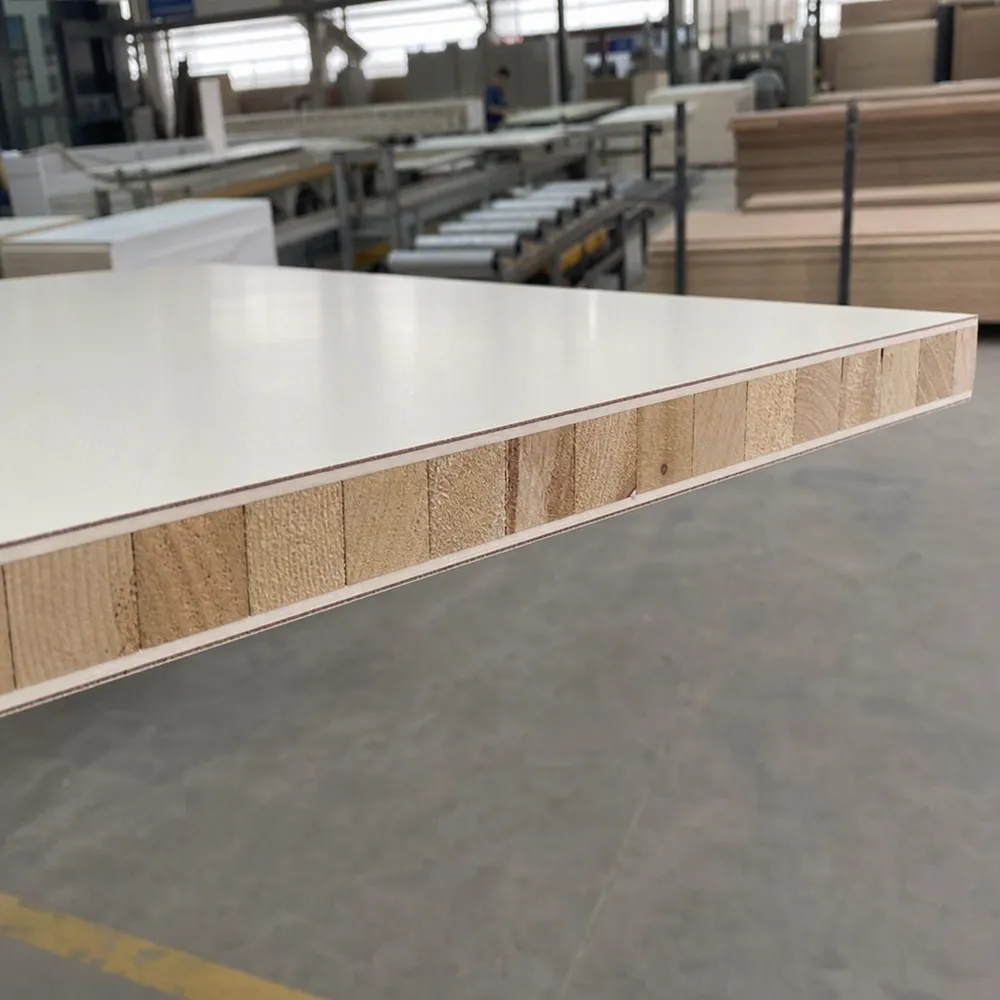
What Melamine Blockboard Is — and Where It Fits in Your Product Line
Blockboard is a solid wood core panel — strips of softwood or hardwood lumber glued edge-to-edge, sandwiched between face and back veneers. Melamine blockboard takes that structural core and bonds a melamine-impregnated paper surface directly to it, delivering a panel that is ready for use without secondary finishing. No painting, no laminating, no edge-banding the face — the surface comes off the press ready to cut, drill, and assemble.
That combination is what makes melamine blockboard commercially distinct from plain blockboard or melamine plywood. Plain blockboard needs a surface treatment before it reaches the end user. Melamine plywood uses a cross-laminated veneer core, which gives it different bending and screw-holding characteristics. Melamine blockboard sits in the middle: the dimensional stability and screw-holding depth of a solid wood core, with the finished surface of a melamine panel.
For furniture manufacturers and cabinet shops, that means fewer production steps and a lower total cost per finished piece — which is the margin argument your downstream buyers will respond to.
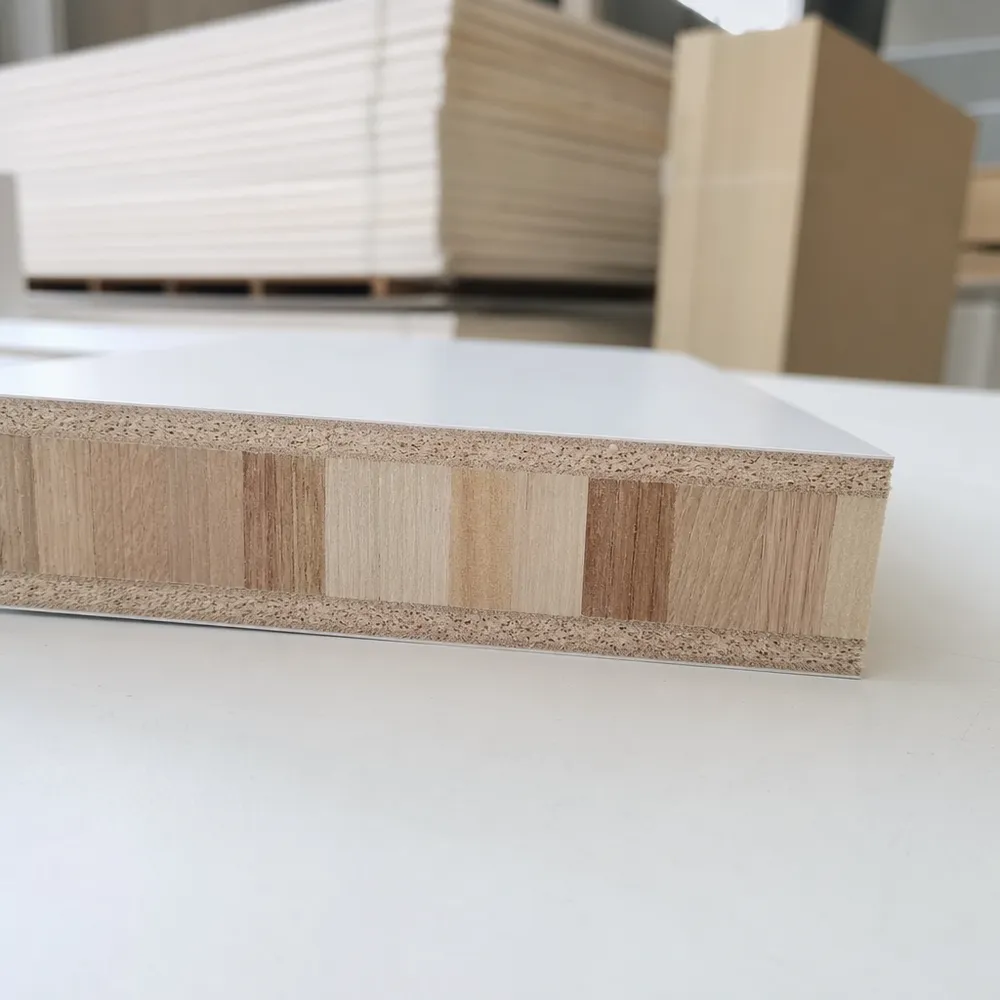
How It Compares
Technical Specifications
The table below reflects industry-standard values for commercial-grade melamine blockboard. Actual specifications are confirmed per order — contact us with your target application and we'll provide exact parameters.
| Parameter | Standard Value |
|---|---|
| Core material | Poplar, pine, or eucalyptus solid wood strips (species confirmed per order) |
| Face/back veneer | 0.3–0.5mm hardwood veneer (poplar, birch, or eucalyptus) |
| Melamine paper weight | 80–120 g/m² (surface density confirmed per specification) |
| Standard thickness |
15mm 17mm 18mm 25mm Custom available
|
| Standard panel size |
1220 × 2440mm 1220 × 2745mm
|
| Custom sizing | Non-standard dimensions on confirmed orders |
| Surface finish |
Matte Woodgrain Solid color White Beige Walnut Oak + others
|
| Surface hardness | ≥ 3H pencil hardness (Taber abrasion resistance per EN 438) |
| Formaldehyde emission |
E1 standard (≤ 1.5 mg/L) E0 available CARB P2 available
|
| Moisture content | 8–12% (export-grade target) |
| Glue type | Urea-formaldehyde (E1/E0); melamine-urea for enhanced moisture resistance |
| Screw-holding strength |
Face:
Edge:
Varies by core density
|
| Certifications |
ISO 9001 CARB FSC available CE available
|
| MOQ | 1 × 20ft container (mixed specs negotiable) |
| Lead time | 15–25 days from order confirmation (subject to spec and volume) |
Need exact tolerances, test reports, or third-party certification documents? Request the full spec sheet for your target market.
Request Spec SheetWhere Melamine Blockboard Gets Used
The combination of a rigid solid-wood core and a durable melamine surface makes this panel a practical choice across a wide range of furniture and interior applications. Below are the most common end uses our customers specify it for.
Cabinet carcasses, door panels, and drawer fronts. The melamine surface handles daily contact, moisture from cooking, and cleaning agents without requiring additional finishing. Screw-holding strength in the solid core supports hinge and hardware loads.
Wardrobe side panels, shelves, and internal dividers. The flat, consistent surface takes edge banding cleanly and presents well in finished interiors. Lighter than solid wood at equivalent thickness, which reduces load on mounting hardware.
Desks, workstation panels, storage units, and reception counters. Commercial environments demand surfaces that resist scratching and repeated cleaning. The melamine layer provides that without adding cost from secondary finishing operations.
Fixed and adjustable shelving in retail, residential, and library settings. The solid core resists sag under sustained load better than hollow-core alternatives. Melamine surface is easy to clean and maintains appearance over time.
Hotel room furniture, restaurant seating surrounds, and retail interior fit-out. High-volume projects benefit from consistent panel dimensions and surface finish across large quantities. Custom colors and woodgrain patterns available for brand-matched interiors.
Ready-to-assemble furniture components for retail and e-commerce. Consistent thickness tolerances and pre-finished surfaces reduce assembly complexity. The solid core supports cam-lock and dowel joinery reliably across repeated assembly cycles.
Different end uses have different requirements for thickness, emission grade, surface texture, and core species. Send us your application details and target market — we'll recommend the right configuration and provide a sample or spec sheet before you commit to an order.
Discuss your applicationCore Construction: Why the Wood Strip Core Matters for Your Buyers
The structural story of melamine blockboard is the core — and it's the argument your downstream customers will use to justify the price over cheaper alternatives.
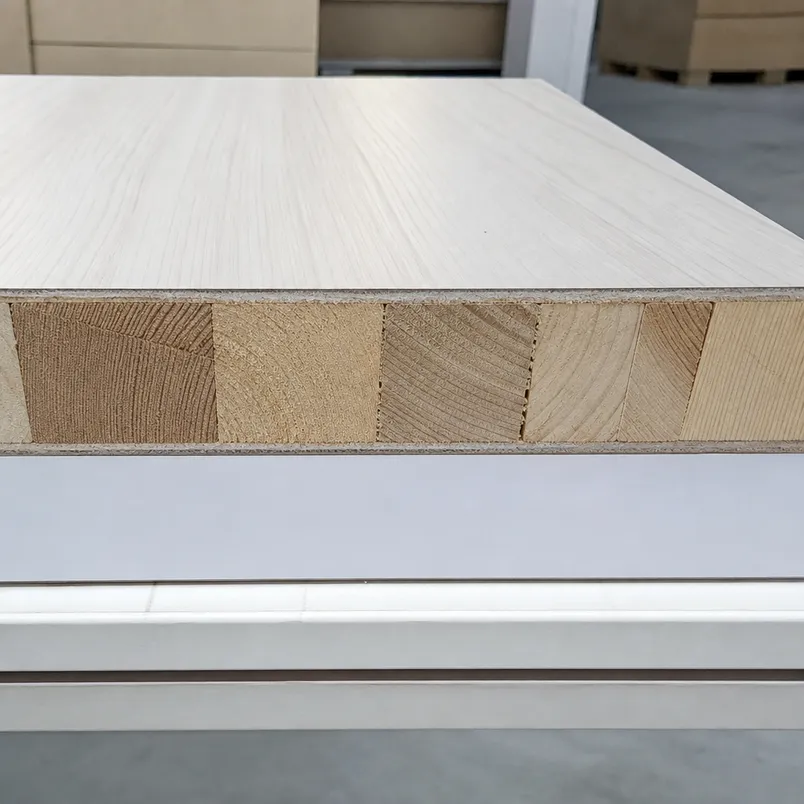
Screw-Holding Depth MDF Can't Match
Solid wood strip cores — we typically run poplar or pine depending on the target market and density requirement — give blockboard a screw-holding depth that MDF and particleboard can't match. When a cabinet hinge or shelf pin goes into a blockboard panel, it's threading into actual wood fiber, not compressed particles. That means the fastener holds under repeated load cycles, which matters in kitchen cabinets, wardrobe carcasses, and any furniture that gets opened and closed daily.
We've had buyers come to us specifically after warranty claims on MDF-core furniture — the hinge pull-out failure rate drops significantly when you switch to a solid core.
Where Quality Variation Actually Lives
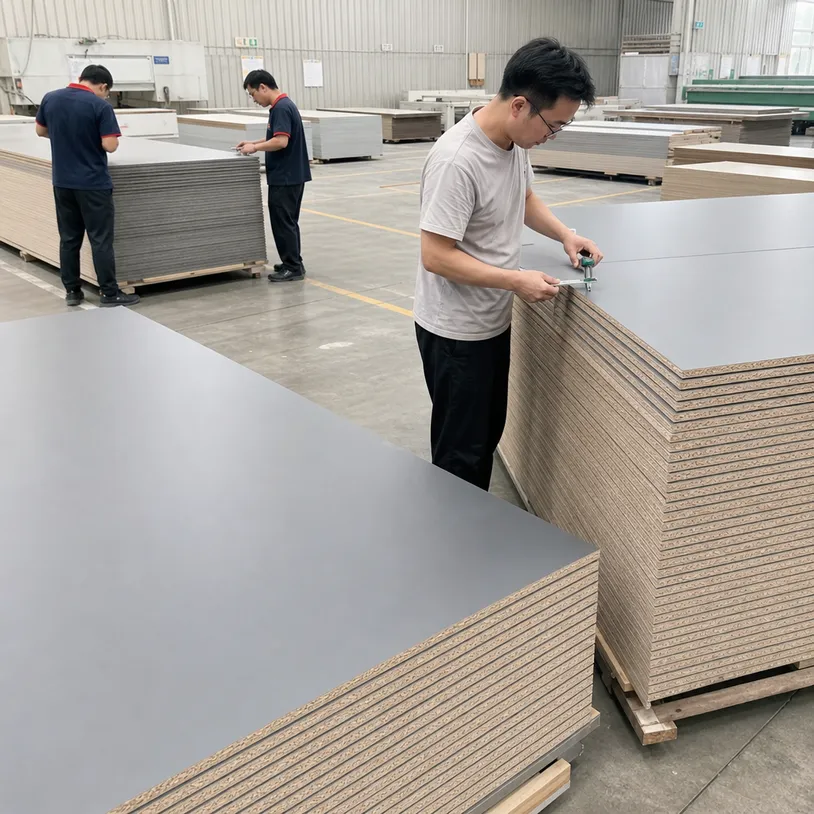
The core strip width and gap tolerance are where quality variation actually lives in blockboard manufacturing. Strips that are too wide or poorly dried will telegraph through the face veneer as surface waviness — you can see it under raking light, and your downstream customers will see it too. We run core strips at 25–40mm width, kiln-dried to target moisture before assembly, and the layup is checked for gap consistency before pressing.
The face veneer covers the core, but it doesn't hide a bad core — it just makes the defect show up later, after the panel is already in your customer's hands.
Two Distinct Press Operations
The melamine surface is pressed onto the face veneer in a separate hot-press cycle, not co-pressed with the core. This matters because the temperature and pressure parameters for melamine paper bonding are different from those for veneer-to-core bonding. Running both in a single press cycle is a shortcut that produces acceptable-looking panels that fail adhesion tests under humidity cycling. We run them as two distinct operations, which adds time but produces a surface bond that holds through the humidity swings your buyers will encounter in Southeast Asian and Middle Eastern markets.
Core-to-Surface Manufacturing Sequence
Melamine Surface Options: What You Can Specify
The melamine surface is where your buyers make their selection decision, so the range of options matters commercially. Here's what we offer and what each option means for your product line.
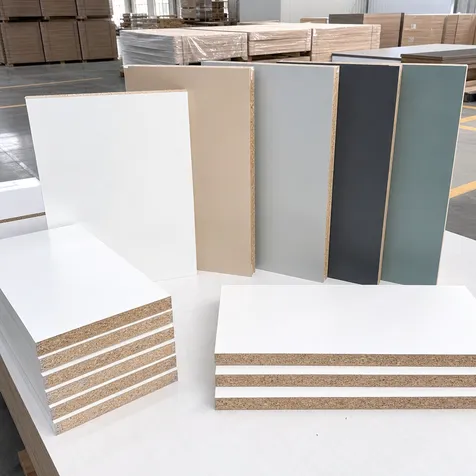
Solid Colors
White (the dominant SKU in most markets), beige, light grey, anthracite, and custom RAL colors on confirmed orders. White melamine blockboard is the standard specification for flat-pack furniture and kitchen cabinet carcasses across most of our export markets — it's the SKU that moves in volume.
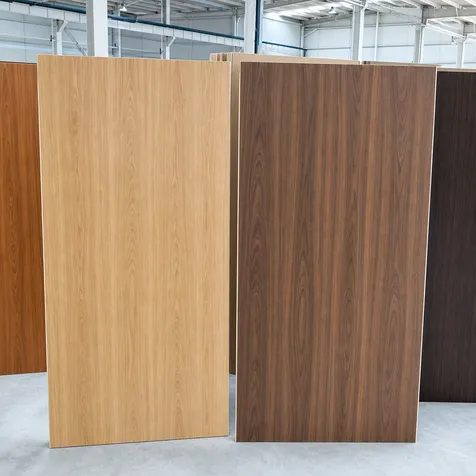
Woodgrain Decors
Oak, walnut, teak, wenge, and others. The mid-market option for buyers who want the visual of a wood surface without the cost of real veneer. Decor paper is sourced from established paper mills with consistent color matching across batches.
Color drift between orders is a real problem with lower-grade paper suppliers — it creates returns when your customer's second order doesn't match the first.
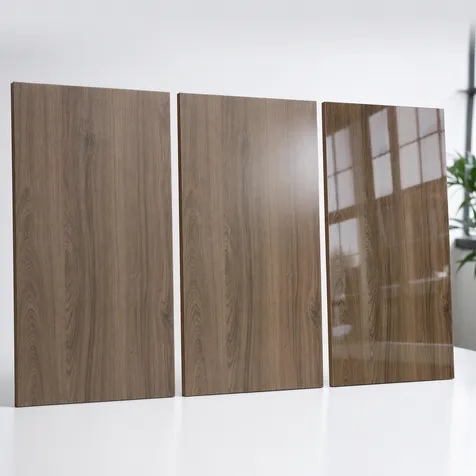
Gloss Levels
Standard matte (the most common), satin, and high-gloss. High-gloss melamine blockboard commands a price premium and is used in contemporary kitchen and wardrobe designs where the surface is a visible design element.
High-gloss surfaces show fingerprints and micro-scratches more readily — worth flagging to your buyers so they set appropriate end-user expectations.
Double-Sided vs. Single-Sided
Double-sided melamine is standard for furniture panels where both faces are visible. Single-sided with a backing paper is available for applications where one face is concealed — it reduces cost without affecting structural performance.
Custom Decor Papers for OEM Programs
Custom decor papers can be sourced for OEM programs with sufficient volume. Minimum order quantities for custom decors are higher than standard SKUs — confirm with us before committing to a custom color in your product catalog.
Surface Option Quick Reference
| Option | Variants | Typical Application | MOQ Note |
|---|---|---|---|
| Solid Colors | White, beige, grey, anthracite, custom RAL | Flat-pack furniture, kitchen cabinet carcasses | Standard MOQ |
| Woodgrain Decors | Oak, walnut, teak, wenge, others | Mid-market furniture, wardrobe panels | Standard MOQ |
| Gloss Levels | Matte, satin, high-gloss | Contemporary kitchens, visible wardrobe interiors | Varies by finish |
| Double / Single-Sided | Double-sided standard; single-sided with backing paper | Visible panels vs. concealed-face applications | Standard MOQ |
| Custom OEM Decors | Any decor paper with sufficient volume | Branded product lines, exclusive catalog colors | Higher MOQ — confirm first |
Market Segments Where Melamine Blockboard Moves
Understanding which buyers drive volume — and what they actually need — is the foundation of a profitable stocking strategy. Each segment below has distinct order patterns, specification requirements, and margin dynamics.
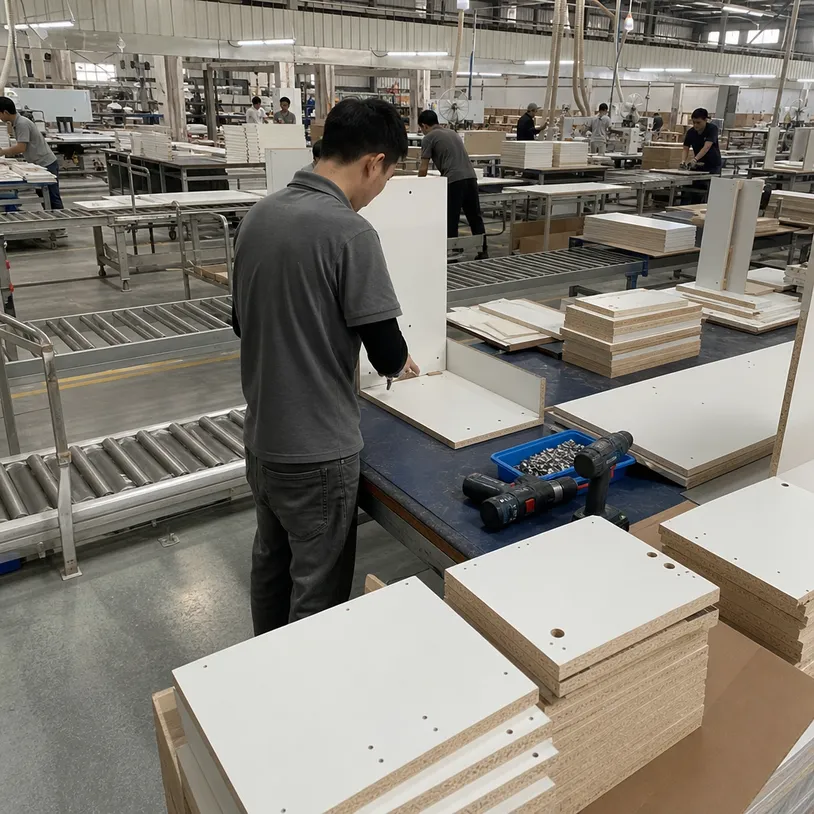
Flat-Pack Furniture Manufacturing
High-volume · Repeat cycleFurniture factories in Southeast Asia, Eastern Europe, and the Middle East use melamine blockboard as the primary carcass material for wardrobes, TV units, and storage furniture. The ready-to-use surface eliminates a finishing step in the production line, and the solid core handles the cam-lock and dowel fasteners that flat-pack assembly depends on.
For distributors supplying furniture factories, this is a high-volume, repeat-order segment — factories run continuous production and reorder on predictable cycles.
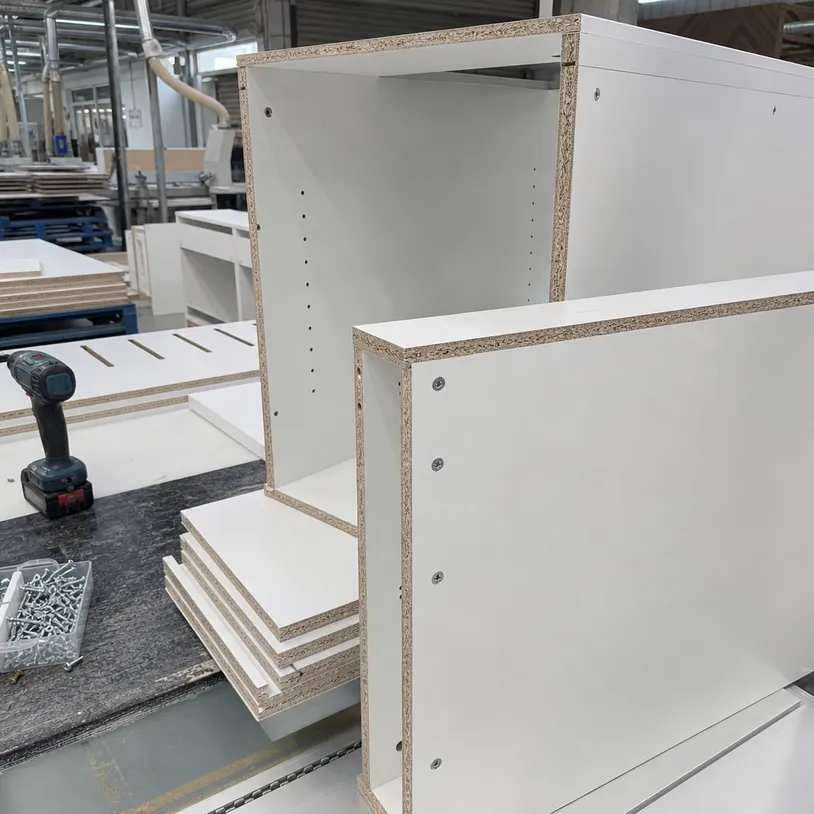
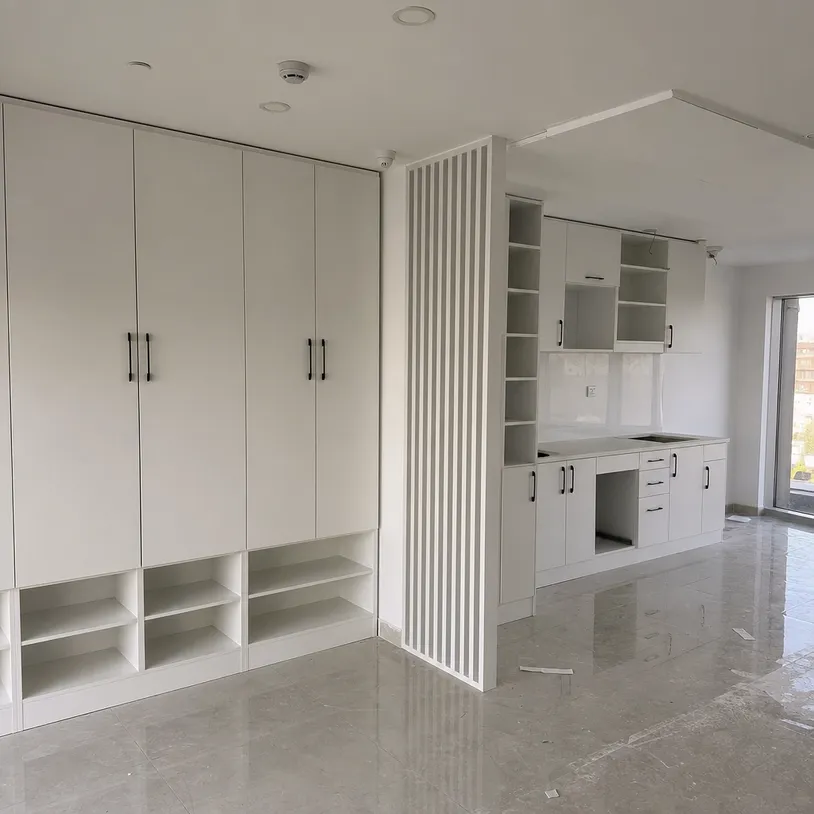
Kitchen and Wardrobe Cabinet Supply
Medium-volume · Consistent reorderCabinet shops and kitchen manufacturers use melamine blockboard for carcass panels — the box structure that holds the doors, drawers, and hardware. The screw-holding strength of the solid core is the functional requirement here; the melamine surface is the finish.
Buyers in this segment typically specify 18mm for carcass panels and 15mm for internal shelving. A reliable segment for distributors building a stable SKU base.
Building Material Distribution
Middle East · SE Asia · AfricaIn markets where melamine blockboard is sold through timber merchants and building material distributors — common in the Middle East, Southeast Asia, and parts of Africa — the product is purchased by contractors and fit-out companies for interior joinery, built-in furniture, and partition systems.
Distribution in this channel typically involves stocking a limited range of standard sizes and colors, with the ability to special-order other specifications.
OEM Supply for Furniture Brands
Compliance-driven · Audit-readyFurniture brands that outsource manufacturing to contract factories often specify melamine blockboard as the substrate for their carcass components. OEM supply in this segment requires consistent color matching across production runs, tight thickness tolerance, and documentation for the brand's supplier audit requirements.
Thickness tolerance held to ±0.2mm. Our FSC and CARB P2 certifications cover compliance requirements for brands selling into North American and European retail channels.
Thickness and Size: What to Stock, What to Special-Order
For most distribution businesses, the practical stocking range for melamine blockboard covers three core thicknesses. Here's how to think about each one — and when to special-order rather than hold inventory.
Core Stocking Thicknesses
18mm
The dominant thickness for furniture carcasses, cabinet boxes, and general joinery. This is the SKU that moves in volume across all markets.
15mm
Internal shelving, drawer bottoms in heavier applications, and markets where 18mm is over-specified for the end use.
25mm
Worktops, heavy-duty shelving, and applications where the panel carries significant load. Less common but worth stocking if your buyers include commercial fit-out contractors.
17mm note: Available and used in some European markets where it's the standard carcass thickness. Confirm the local market norm before building your initial order.
Panel Sizes and Container Efficiency
Standard Panel: 1220 × 2440mm
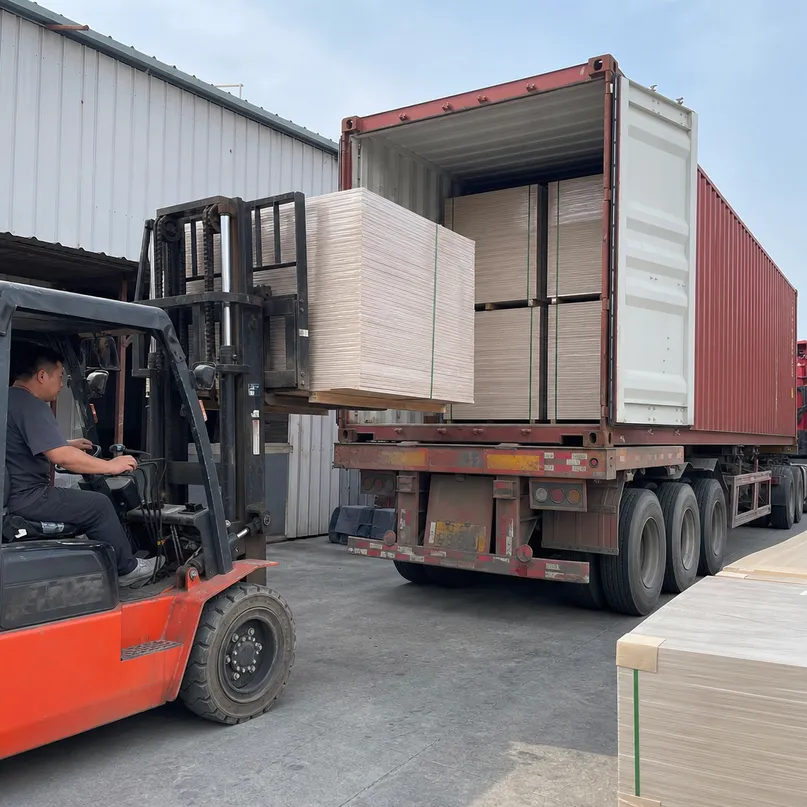
Loads efficiently into 40HQ containers and is the format that downstream cutting equipment is calibrated for. This is the default format for most markets.
Long Format: 1220 × 2745mm
Available for markets where the longer format reduces waste in specific furniture dimensions. Confirm demand before ordering — this format is not universally stocked.
Custom Panel Sizes
Available on confirmed orders — there's no tooling cost for custom dimensions in panel production. However, non-standard sizes affect container loading efficiency, which adds to your landed cost per panel.
Container Loading Consideration
Standard 1220 × 2440mm panels are optimized for 40HQ container loading. Custom dimensions reduce packing density and increase your landed cost per panel — factor this into your pricing before committing to non-standard sizes.
Formaldehyde Compliance: Matching the Panel to Your Market
This is the specification decision that determines which markets your product can enter, so it's worth being precise about.
E1
Baseline Standard≤ 1.5 mg/L (perforator) · ≤ 0.124 ppm (chamber)
Standard for most Asian and Middle Eastern markets. This is the baseline specification we produce to. Meets requirements for general furniture and interior applications in these markets.
E0
Low-Emission≤ 0.5 mg/L
Required for some Japanese and Korean market specifications and for buyers with stricter indoor air quality requirements. We produce E0 specification using low-formaldehyde UF resin systems — it's not a different product, it's a tighter resin formulation and press parameter set.
CARB P2
≤ 0.05 ppm — California Air Resources Board
The most stringent formaldehyde emission limit in our export markets. We hold CARB P2 certification and produce to this standard for US-bound shipments. If your buyers include US retailers or brands selling into California, CARB P2 documentation is a procurement gate — we include it as standard for US-market orders.
FSC Chain-of-Custody
SustainabilityFull product range including melamine blockboard
Available for buyers with sustainability sourcing requirements or for supply into markets where deforestation-linked supply chains carry regulatory or reputational risk. Our FSC certification covers the full product range including melamine blockboard.
| Standard | Limit Value | Test Method | Primary Markets | Our Status |
|---|---|---|---|---|
| E1 | ≤ 1.5 mg/L · ≤ 0.124 ppm | Perforator / Chamber | Asia, Middle East | Baseline production |
| E0 | ≤ 0.5 mg/L | Perforator | Japan, Korea | Available on order |
| CARB P2 | ≤ 0.05 ppm | Large Chamber (ASTM E1333) | United States | Certified, standard for US |
| FSC CoC | — | Chain-of-custody audit | Global sustainability | Certified, full range |
Practical Note: CARB P2 vs. E0 Are Not Directly Comparable
CARB P2 and E0 specifications use different test methods and different limit values — they're not directly comparable. If your buyer asks for "CARB P2 equivalent" for a non-US market, confirm what test method and limit they actually need before specifying.
Container Loading and Export Logistics
Melamine blockboard ships efficiently in standard containers. Here's what to expect from loading capacity through to port transit times.
Container Loading Capacity (18mm, 1220 × 2440mm)
Standard 20-foot general purpose. Suitable for smaller orders or mixed-product shipments.
High-cube 40-foot. Most efficient per-panel freight cost for full-container orders.
Thickness note: Thinner panels (15mm) load proportionally more per container; 25mm loads less. We provide a loading plan with each shipment so your receiving team knows the exact count and stacking configuration.
Ocean Transit Packaging
Bundle Packing
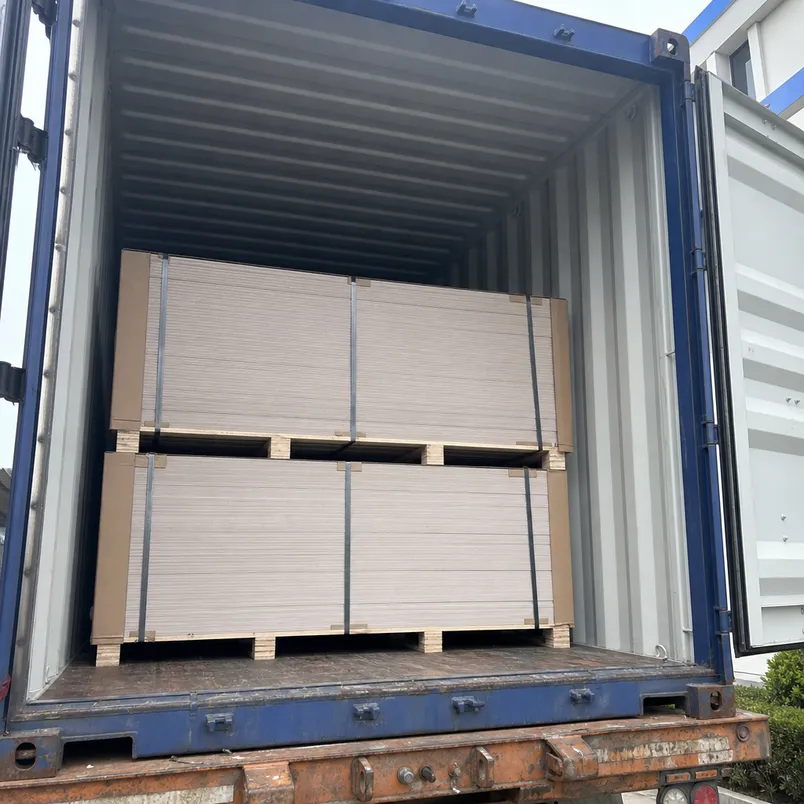
50–100 sheets per bundle depending on thickness, strapped with steel banding and edge-protected with corner boards.
Moisture Protection
Wrapped in moisture-resistant film. Melamine surface protected from transit abrasion by interleaving paper between panels in the top layers of each bundle.
Why We Added Interleaving
We added the interleaving step after seeing surface micro-scratches on high-gloss panels from bundle movement during rough sea passages — it adds a small cost but eliminates a returns conversation.
Export Documentation
Standard document set
US-bound shipments: CARB P2 documentation package included as standard.
Port Connections & Transit Times
Xuzhou connects to Qingdao, Shanghai, and Lianyungang ports
OEM and Custom Specification Capability
We handle OEM programs for melamine blockboard across several dimensions. If your product line requires specifications outside our standard range, we can produce to your exact requirements.
Custom Decor & Color
Specific woodgrain patterns, solid colors, or surface textures not in our standard range. We source the decor paper and produce to your specification.
Custom Core Species
Standard production runs poplar or pine core. Alternative species available for buyers with specific performance requirements.
Custom Dimensions
Non-standard panel sizes produced on confirmed orders. No tooling cost — it's a cutting and yield question.
Private Label & Branding
Bundle marking, custom packaging, and documentation under your brand name. We've run private-label programs for distributors in Europe and the Middle East.
Thickness Tolerance
Standard production holds ±0.3mm. Tighter tolerance available for OEM programs where downstream automated cutting equipment requires it.
Engineering & First-Article Approval
Our engineering team handles specification development and first-article approval for all OEM programs.
What to Confirm at the Specification Stage
OEM programs run smoothly when the specification is locked before production starts. The items that most often cause delays or rework if left open:
- Decor paper reference or sample — color and texture must be confirmed before paper is sourced
- Core species — poplar/pine standard, or eucalyptus/hardwood if fastener performance is a requirement
- Thickness tolerance — state ±0.2mm if your cutting equipment requires it; standard is ±0.3mm
- Formaldehyde emission standard — CARB P2, E0, or E1 — determines adhesive system and testing protocol
- Private-label marking requirements — bundle labels, packaging copy, and any documentation under your brand
Quality Control at the Melamine Pressing Stage
The QC process for melamine blockboard runs three stages, with the melamine surface being the most inspection-intensive because it's the visible face of the finished product.
Core Assembly Inspection
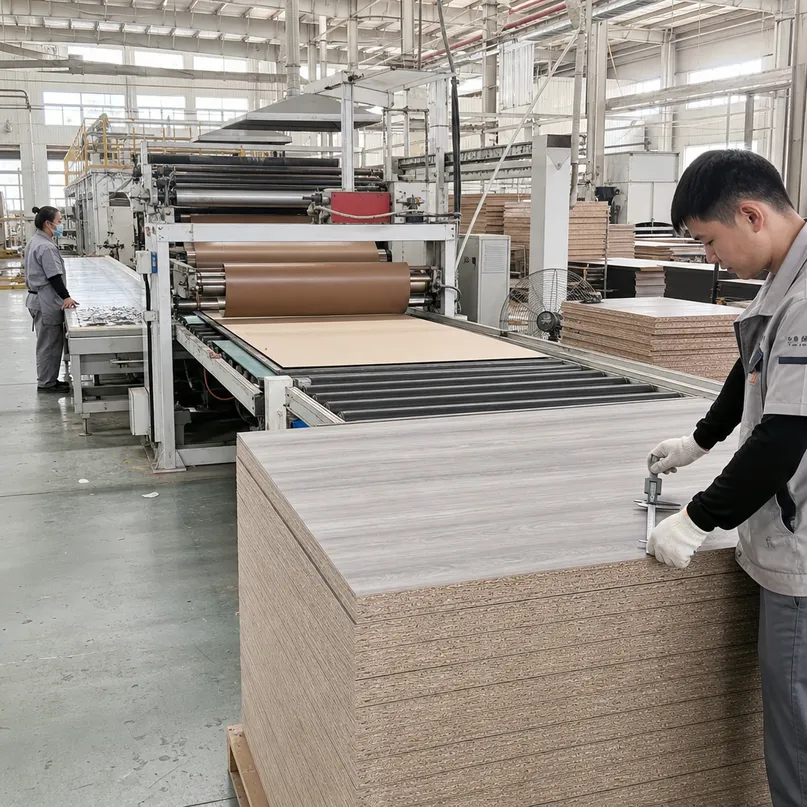
Core strips are checked for moisture content before layup. Gap consistency in the core assembly is checked visually and by probe before the face veneer is applied.
Post-Press Inspection
After the melamine pressing cycle, panels are checked for surface defects and adhesion quality. Thickness is measured at five points per panel on a sample basis.
Outgoing Inspection
Full panel check before packing. Export batches are inspected against the purchase order specification before the container is loaded.
Third-Party Inspection Available
SGS and Bureau Veritas inspection available on request. We coordinate access for buyers who require independent pre-shipment inspection.
ISO 9001:2015 Certified Process
Our ISO 9001:2015 certification covers the full QC process — from core assembly through outgoing inspection. Learn more about our manufacturing capabilities and certifications.
Why the Melamine Surface Gets the Most Inspection Attention
The melamine surface is the visible face of the finished product. Defects that are acceptable in a structural panel — minor surface variation, slight color inconsistency — are not acceptable in a melamine-faced panel that will be used as a finished interior surface.
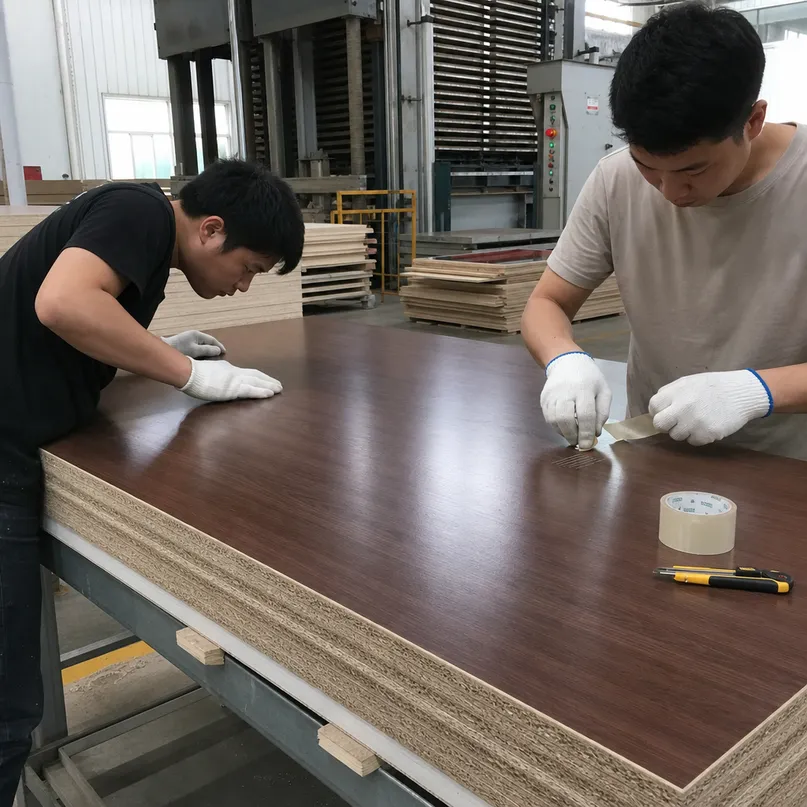
The cross-cut adhesion test is the most critical check at the post-press stage. It directly tests the bond between the melamine paper and the face veneer under the conditions that matter: a sharp edge and a peel force. A batch that passes visual inspection but fails the tape-pull test indicates a bonding problem that will show up in the field as edge delamination.
Catching core assembly defects before the full pressing cycle is cheaper than catching them after. Our three-stage process is structured to catch problems at the earliest possible point — before value is added to a defective substrate.
Melamine Blockboard vs. Other Blockboard Products
If you're evaluating the full blockboard range, here's how melamine blockboard positions relative to the other products we produce.
| Product | Core | Surface | Best Fit |
|---|---|---|---|
| Melamine Blockboard Current page | Solid wood strips | Melamine paper (ready-to-use) | Furniture carcasses, cabinets, joinery where surface finish is required |
| Laminate Blockboard | Solid wood strips | HPL laminate | High-wear surfaces, commercial fit-out, applications needing impact resistance |
| Blockboard Cabinet | Solid wood strips | Veneer or melamine | Cabinet-specific dimensions and configurations |
| 18mm Blockboard | Solid wood strips | Raw veneer (unfinished) | Applications where secondary finishing is applied downstream |
| Blockboard Furniture | Solid wood strips | Various | Furniture-grade specifications with tighter surface grading |
Choose Melamine Blockboard when…
Your buyers need a panel that goes directly into production without a finishing step. The surface is ready-to-use out of the box.
Choose Laminate Blockboard when…
They need a harder, more impact-resistant surface for commercial applications. HPL laminate outperforms melamine paper in high-wear environments.
View Laminate BlockboardChoose 18mm Blockboard when…
They're applying their own finish or veneer. Plain blockboard gives them the core without paying for a surface they'll cover.
View 18mm BlockboardSourcing Melamine Blockboard from QDPlywood.com
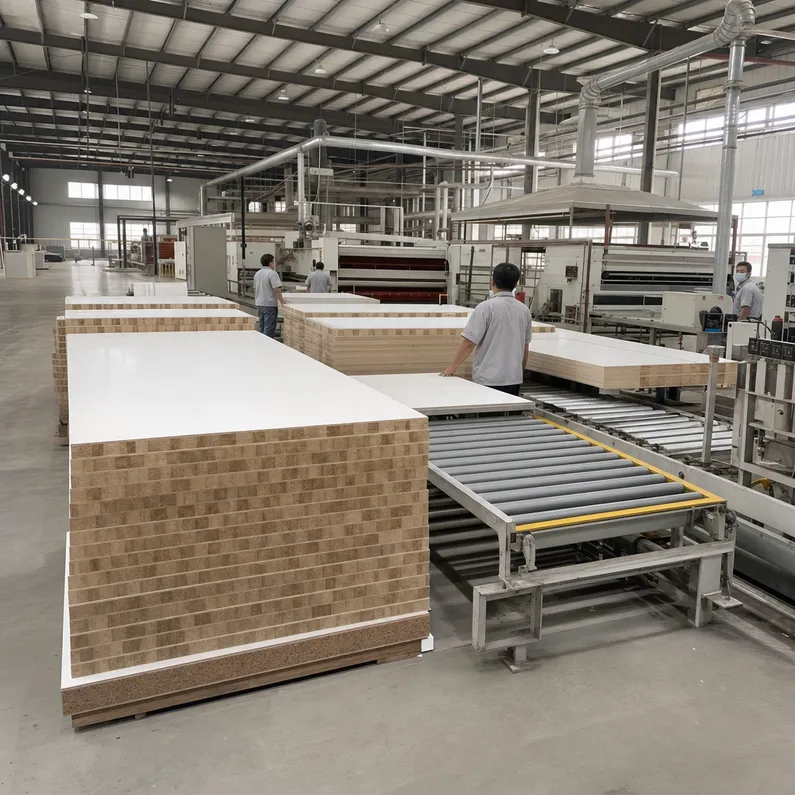
We've been manufacturing export-grade panels since 2008. The melamine blockboard we ship to distributors in Europe, the Middle East, and Southeast Asia is produced on the same lines, to the same moisture and emission standards, as the rest of our certified product range.
Why factory-direct matters
Factory-direct means no trading company markup between our production cost and your landed cost. It also means when you have a specification question or a quality issue, you're talking to the people who made the panels — not an intermediary who has to relay the question.
Most new buyers start with a sample order to verify surface quality, color consistency, and thickness tolerance against their own requirements before committing to a container. We support sample orders — send us your target specification and we'll confirm availability and lead time.
To get a quote, send us:
- Target thickness and panel size
- Surface color/decor and gloss level
- Formaldehyde emission standard (E1, E0, or CARB P2)
- Destination market and port
- Target volume (monthly or per order)
We'll come back with a detailed quote, the relevant certification documentation, and a loading plan for your container.
Xuzhou QD Wood Industry Co., Ltd.
Frequently Asked Questions
Technical and sourcing questions we hear most often from importers, distributors, and OEM buyers. If your question isn't covered here, contact us directly.
The core construction is different. Melamine blockboard uses solid wood strips glued edge-to-edge as the core — this gives it higher screw-holding strength and better resistance to sagging under point loads. Melamine plywood uses cross-laminated veneers as the core, which gives it better bending strength and more uniform structural properties across the panel.
For furniture carcasses and cabinet boxes where fastener performance matters, blockboard is typically the better choice. For applications requiring consistent bending strength or where the panel spans a longer unsupported distance, plywood core is more appropriate.
If you're unsure, tell us your destination market and end application and we'll confirm the appropriate specification.
Standard SKUs (white 18mm, common woodgrain decors) are available in smaller quantities suitable for trial orders.
Custom colors, custom dimensions, and OEM specifications have higher minimums — typically one container load (approximately 1,400–1,600 panels of 18mm in a 40HQ) as a practical minimum for custom production runs.
Contact us with your target volume and we'll confirm what's feasible.
Surface delamination in melamine blockboard is almost always a bonding failure at the melamine-to-veneer interface, caused by either insufficient press temperature/pressure or moisture ingress after production.
For humid climate markets (Southeast Asia, the Gulf, coastal regions), specify melamine-urea (MUF) glue rather than standard UF — it has better moisture resistance.
Confirm that panels are edge-sealed before shipment; exposed core edges absorb moisture faster than the melamine face. We apply edge sealing on export-grade panels as standard.
If you're seeing delamination in the field, the most common cause is cut edges left unsealed during installation — worth flagging to your downstream buyers.
Yes. Our FSC chain-of-custody certification covers the full product range including melamine blockboard. For buyers supplying into retail channels or brands with sustainability sourcing policies, we include FSC documentation as part of the standard export package.
Confirm the FSC requirement at the order stage so we can ensure the correct chain-of-custody documentation is prepared.
The ±0.2mm tolerance is relevant if your buyers are running panels through CNC nesting machines where thickness variation causes feed errors or affects cut depth consistency. Confirm at the specification stage as it affects the production schedule.
Talk to a product specialist before you specify.
Our team handles technical specification questions, sample requests, and container-load pricing. Response within one business day.
Explore Related Blockboard Products
Other blockboard specifications from QDPlywood.com
Blockboard Furniture Board
Furniture-grade blockboard optimized for cabinet and case goods production.
View product18mm Blockboard
The dominant thickness for furniture carcasses and cabinet boxes — full specification detail.
View productBlockboard Cabinet Board
Cabinet-specific blockboard grades for kitchen, wardrobe, and storage applications.
View productLaminate Blockboard
HPL and laminate-faced blockboard for higher-wear surface applications.
View productView the full blockboard range at QDPlywood.com/blockboard
All blockboard products