

Paper Overlaid Plywood Sheet Factory-Direct Manufacturer
Custom overlay weight, core construction, and dimensions from a single source. 18+ years manufacturing export-grade overlaid panels — every sheet pressed to spec, moisture-controlled to 8–12%, and documented for CARB P2 and FSC compliance before it leaves the factory.
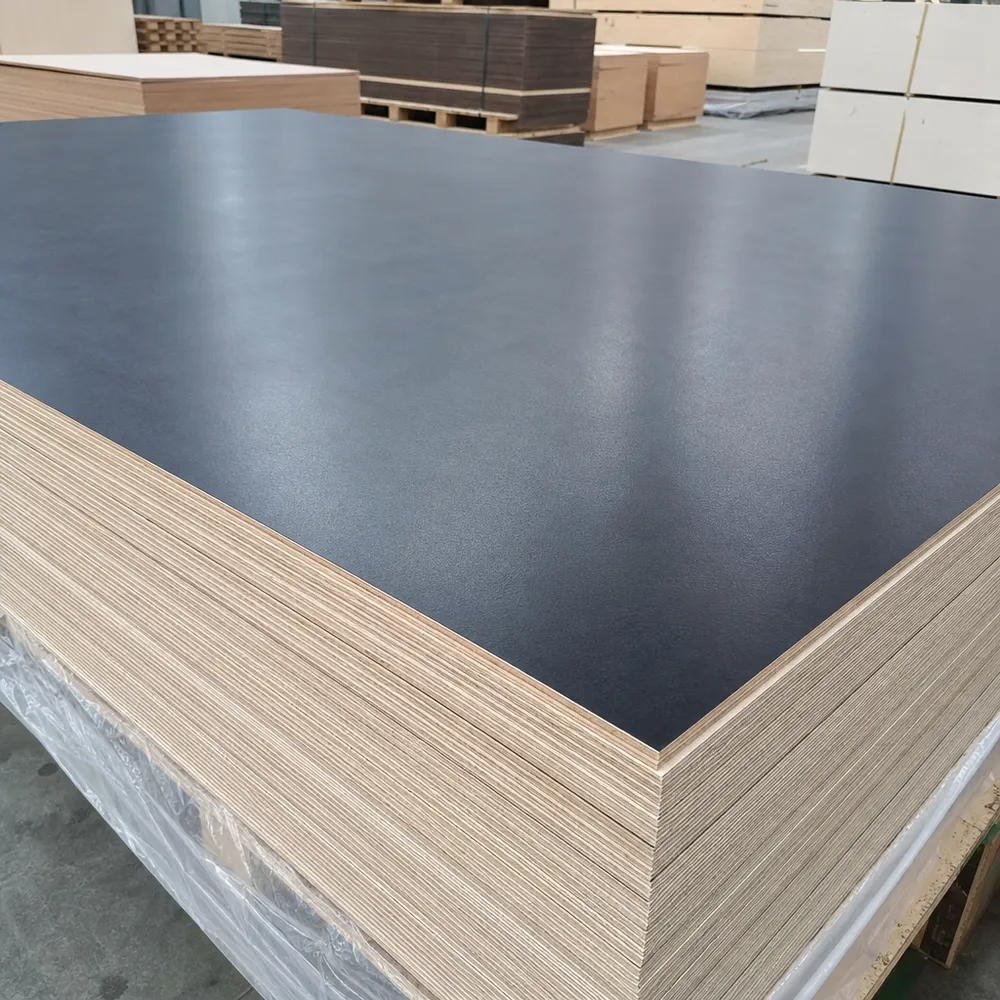
What Makes a Paper Overlaid Plywood Sheet Different from Standard Plywood
A paper overlaid plywood sheet is a structural plywood panel with a resin-impregnated paper overlay bonded to one or both faces under heat and pressure. Understanding what the overlay actually does — and what it doesn't — is the starting point for sourcing the right panel.
What the Overlay Does
The overlay does two things: it seals the face veneer against moisture and surface damage, and it creates a dimensionally stable, paintable surface that raw veneer can't reliably provide.
The commercial distinction matters when you're sourcing for buyers who need a panel that accepts paint, primer, or coating without the grain telegraphing through. Raw plywood faces — even sanded to B-grade — have open grain, knot pockets, and veneer joint lines that show through paint. The paper overlay fills and seals those irregularities. What your downstream customer gets is a flat, consistent surface that holds paint the way a primed substrate should.
Two Overlay Weight Categories
We produce two overlay weight categories. Understanding the difference is critical for matching the panel to the end application:
Standard Overlay
120–160 g/m²For applications where the primary need is surface sealing and paint adhesion. Provides a consistent, paintable face without the heavier resin loading of MDO.
Medium-Density Overlay (MDO)
200–220 g/m²For applications requiring higher abrasion resistance and a harder surface. This is what most North American buyers mean when they say "MDO plywood" — if you're sourcing for the US market, this is the configuration to specify.
The core construction — species, number of plies, glue type — is selected based on the end application and your target market's structural requirements. Contact us with your application details and we'll recommend the right configuration.
Related Product Pages
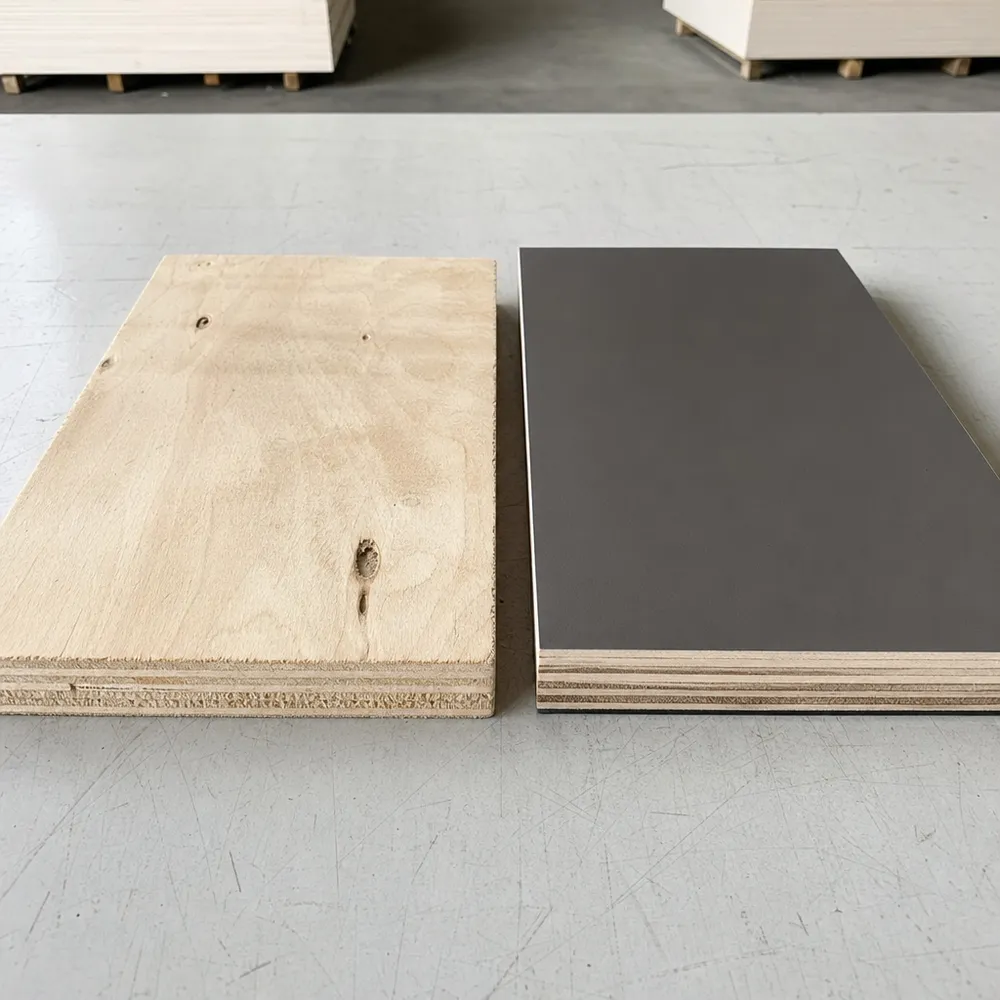
Raw Plywood vs. Paper Overlaid Sheet
Technical Specifications
The table below reflects industry-standard parameters for commercial paper overlaid plywood sheet. Actual specifications are confirmed at order stage — contact us with your target application and we'll provide a detailed data sheet.
Paper Overlaid Plywood Sheet — Standard Specification Range
All values are indicative industry ranges. Confirmed specifications are provided in the product data sheet issued at order stage. Testing standards referenced: GB/T 9846, EN 636, PS 1-09.
Certifications & Standards
CARB Phase 2
California Air Resources Board — required for US market import
E1 / E0 Emission Class
European formaldehyde emission standard per EN 13986
FSC® / PEFC Chain of Custody
Certified sustainable timber sourcing — available on request
GB/T 9846
Chinese national standard for plywood — base manufacturing reference
EN 636 / PS 1-09
European and US structural plywood standards
Need a full data sheet?
We issue product-specific technical data sheets at order stage. Share your application requirements and target market and we'll confirm the exact specification, certification scope, and test reports available.
Request a data sheetCommon Export Thicknesses
9mm
Signage / light form
12mm
General construction
15mm
Concrete forming
18mm
Heavy formwork
21mm
Structural / floor
25mm
Heavy-duty use
Applications
Paper overlaid plywood sheet is specified wherever a smooth, paintable, or dimensionally stable surface is required. The overlay eliminates the prep work that raw plywood demands — making it the practical choice across construction, signage, and industrial fabrication.
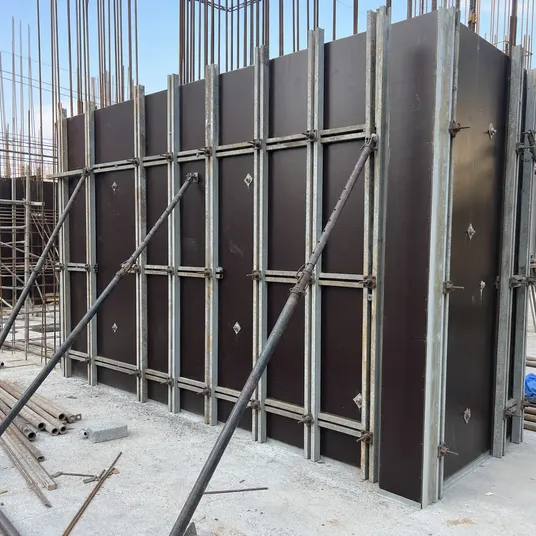
Concrete Formwork
The overlay face releases cleanly from cured concrete, reducing stripping effort and leaving a smoother cast surface. WBP glue and phenolic overlay allow multiple pours before the panel degrades — a key cost factor for contractors.
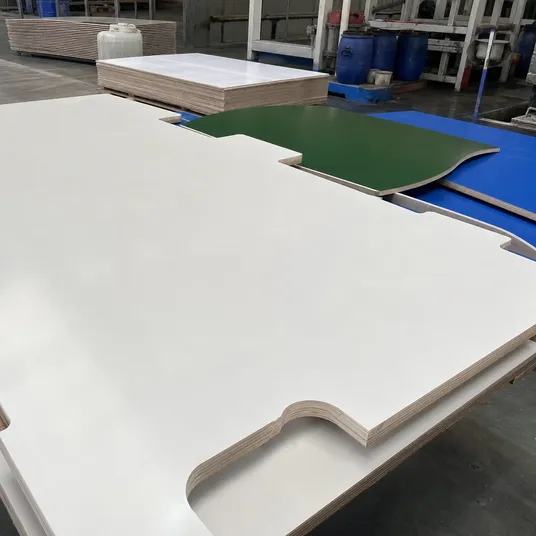
Signage & Display Boards
The flat, grain-free surface accepts paint, vinyl, and digital print without bleed-through or telegraphing. MDO-weight overlay is the standard specification for highway signs and outdoor advertising boards in North America.
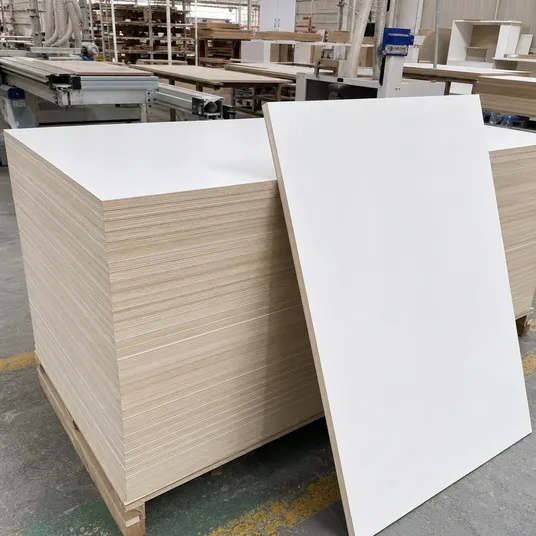
Furniture & Cabinetry
Painted furniture and cabinet carcasses benefit from the overlay's consistent surface — no filler coats needed before topcoat. The overlay also reduces edge chipping during CNC routing compared to raw veneer faces.
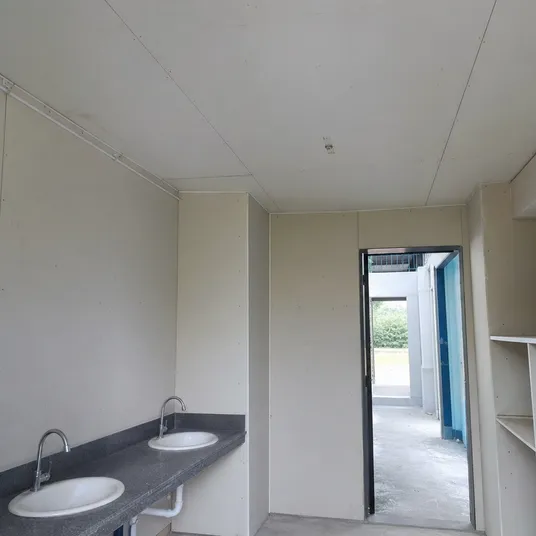
Wall & Ceiling Panels
Interior wall linings and ceiling panels painted on-site benefit from the overlay's ready-to-paint surface. The sealed face also reduces moisture absorption in humid environments such as bathrooms and commercial kitchens when combined with WBP glue.
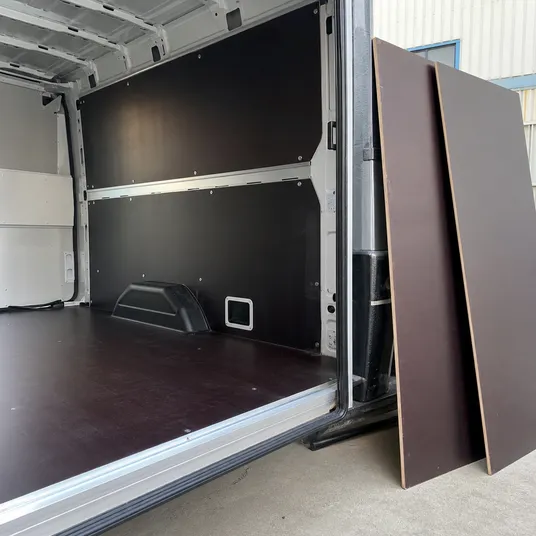
Trailer & Vehicle Lining
Trailer sidewalls and van interior linings use paper overlaid sheet for its smooth, cleanable surface and resistance to scuffing. The overlay protects the face veneer from abrasion during loading and unloading cycles.
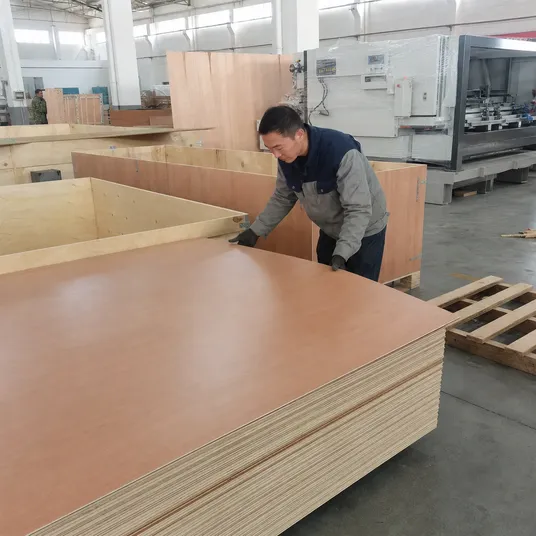
Packaging & Industrial Crating
Heavy machinery and export crating applications use paper overlaid sheet where a smooth, splinter-free interior surface is required. The overlay reduces moisture ingress during ocean freight, protecting sensitive cargo.
Matching overlay weight to application
Lighter overlays (120–160 g/m²) suit interior applications where paint adhesion is the primary requirement. Heavier MDO-weight overlays (200–220 g/m²) are specified for exterior exposure, repeated forming cycles, or applications where the overlay itself must resist abrasion. If you're unsure which weight suits your use case, share the application details and we'll advise.
Overlay Bonding: Where Most Failures Happen
and How We Prevent Them
The most common failure mode in paper overlaid plywood isn't the core — it's overlay delamination. The paper lifts at the edges, bubbles under the surface, or peels when the panel is cut. Every one of those failures is a warranty claim for your customer and a return for you.
The Three Variables That Must Be Right Simultaneously
Overlay adhesion depends on three variables that have to be right simultaneously: the resin saturation level of the paper, the press temperature profile, and the moisture content of the core veneer going into the press.
Core Moisture Content
If the core is too wet, steam pressure during pressing creates micro-blisters under the overlay that aren't visible until the panel is cut or exposed to humidity cycling.
Press Temperature Profile
If press temperature is uneven across the panel surface, you get zones of good adhesion and zones of marginal adhesion — the panel passes a surface check but fails in the field.
Resin Saturation Level
The resin saturation level of the paper must be calibrated to the core species and overlay weight. Under-saturated paper bonds poorly; over-saturated paper becomes brittle at the interface.
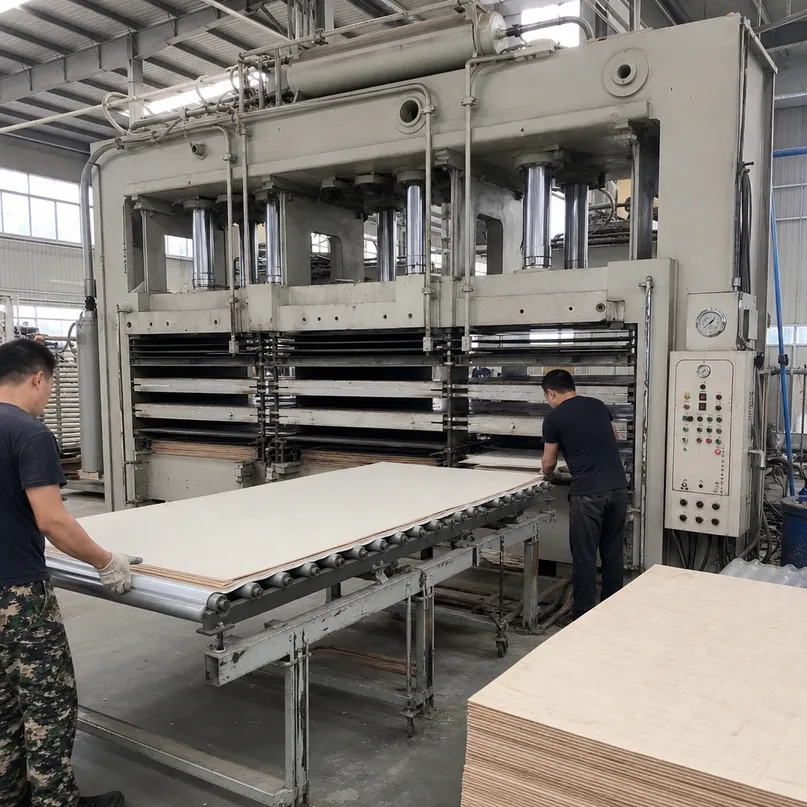
Our Press Process
- Multi-daylight hydraulic hot presses calibrated to maintain uniform pressure and temperature across the full 1220×2440mm panel surface
- Press parameters — temperature, pressure, dwell time — are logged per batch
- Core veneers dried to target moisture before layup and checked again at the press feed — we don't rely on the press to drive out residual moisture
- After pressing, panels are checked for overlay adhesion by cross-cut and peel test before they move to the sanding line
- Any panel that shows delamination at that stage is pulled — not shipped
What Happens When Factories Skip the Pre-Press Moisture Check
We've seen what happens when factories skip the pre-press moisture check and rely on visual inspection of the finished panel. The blistering shows up three weeks later in a humid warehouse, not on the production floor. That's a container of returns, not a production defect.
The result of our process is an overlay bond that holds through ocean transit, warehouse storage, and the humidity cycling your buyers' markets will put it through. For buyers supplying into coastal markets — Southeast Asia, the Gulf, Florida — that bond consistency is the difference between zero warranty claims and a recurring problem.
Surface Performance: What Your Buyers
Can Do With This Panel
The paper overlay creates a surface that accepts paint, primer, and coating systems that raw plywood can't reliably support. The practical commercial value depends on what your downstream buyers are doing with the panels.
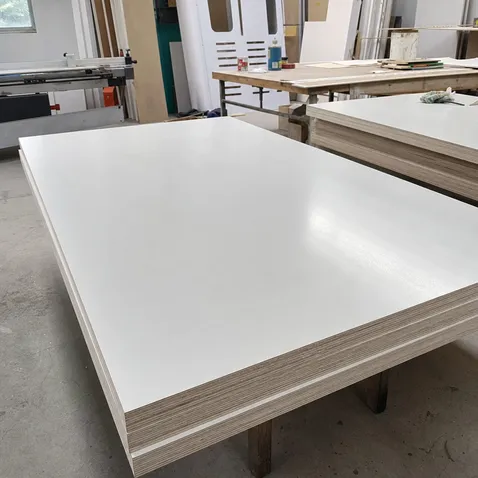
Painted Signage & Display Fabrication
The overlay provides a flat, grain-free surface that holds paint without telegraphing veneer joints or knot pockets. Sign fabricators and display manufacturers use this panel specifically because it eliminates the surface prep step that raw plywood requires. For distributors supplying sign shops or display fabricators, this is a panel they'll reorder consistently — the surface quality is the product.
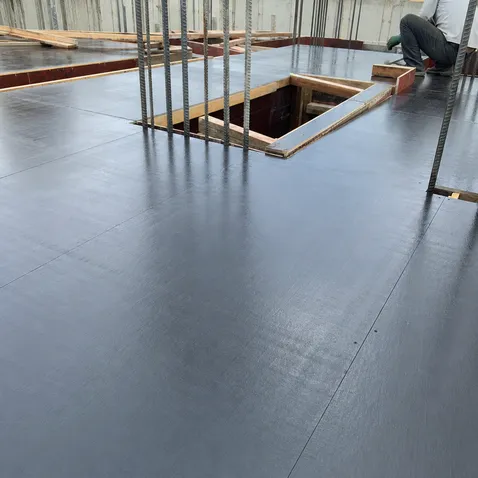
Concrete Formwork with Painted Release
In markets where contractors paint the form face with release agent rather than using film-faced plywood, the overlaid surface holds the paint coat better than raw veneer and releases more cleanly. The panel can typically be reused 3–5 times with proper maintenance, which is the commercial argument your contractor buyers will make to their project managers.
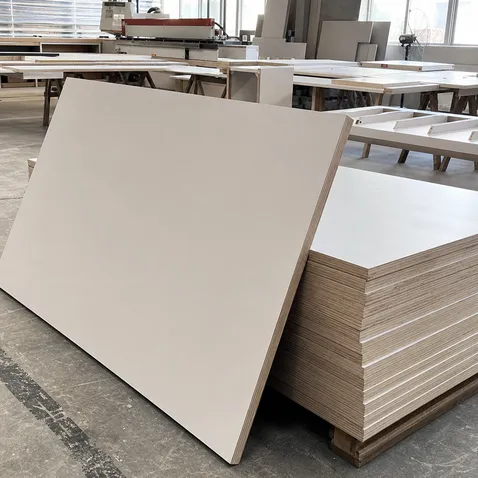
Furniture & Cabinet Substrate for Paint Finish
Furniture manufacturers who paint rather than veneer their panels use overlaid plywood as a substrate because the overlay eliminates the grain-filling step. The surface is ready for primer directly. For buyers supplying furniture manufacturers, this is a margin-positive product — the overlay adds value that justifies a price premium over standard plywood.
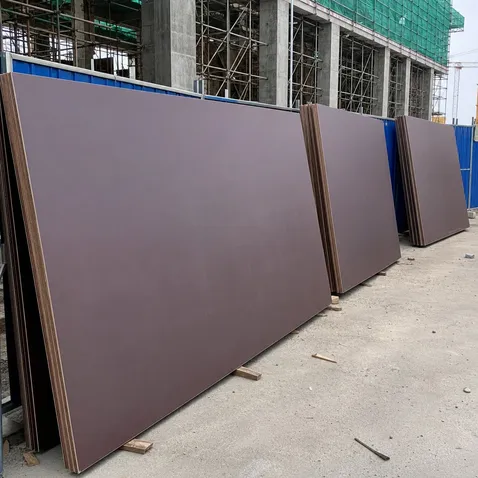
Exterior Hoarding & Site Boarding
Construction site hoarding panels need a surface that holds paint through weather exposure. The WBP-glued overlaid panel with phenolic resin overlay handles outdoor exposure better than MR-glued alternatives. Contractors in markets with wet seasons — Southeast Asia, the UK, coastal Australia — specify this configuration specifically.
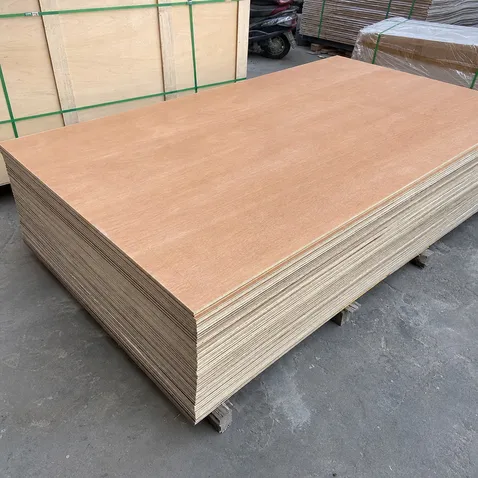
Packaging & Industrial Panel Applications
Lighter overlay weight panels (120–160 g/m²) are used in industrial packaging, pallet tops, and equipment crating where a sealed, splinter-resistant surface matters more than paint adhesion. The overlay prevents surface fiber pickup and reduces splinter risk in handling.
Not Sure Which Application Fits Your Market?
Different downstream buyers need different overlay specs. Tell us your target market and buyer type — we'll recommend the right overlay weight, resin system, and glue type for your specific distribution channel.
Customization Parameters: What You Can Specify
Paper overlaid plywood sheet is one of the more customizable products in our range, because the overlay weight, resin system, core construction, and dimensions are all independent variables. Here's what you can specify and what the practical limits are.
Overlay Weight & Resin System
Standard overlay (120–160 g/m²) uses a phenolic or melamine resin system. MDO weight (200–220 g/m²) is available with phenolic resin for harder surface performance.
Single-Face vs. Double-Face Overlay
Single-face overlay (one face overlaid, one face raw or sanded) is available for applications where only one face is exposed. Double-face overlay is standard for formwork and sign applications.
Core Species & Construction
Poplar core is the standard export configuration — lighter for freight cost and machines cleanly. Eucalyptus core is available for buyers who need higher density and screw-holding strength. Hardwood mix core is available for structural applications.
The number of plies is determined by thickness. We don't reduce ply count to hit a price point — that's where thickness variation and delamination problems originate.
Thickness & Panel Dimensions
The standard range runs 2.5mm to 25mm. Common export thicknesses are 9mm, 12mm, 15mm, and 18mm — these load efficiently into 40HQ containers and match the dimensional expectations of most markets.
Non-standard thicknesses and custom panel dimensions are available on confirmed orders. Custom dimensions are a scheduling question for us, not a tooling question — plywood is cut to size, so there's no capital cost for non-standard dimensions.
Formaldehyde Emission Standard
CARB P2 is our baseline for export. E1 and E0 are available for buyers supplying into markets with stricter emission requirements.
The resin system is selected at the specification stage — this isn't a post-production certification, it's a production parameter.
Branding & OEM Marking
OEM marking — your brand name, product code, or destination market labeling — is available on confirmed orders. We've handled private-label programs for distributors in North America and Europe who sell overlaid panels under their own brand.
Ready to Specify Your Order?
Minimum order quantities and lead times vary by specification. Contact us with your target spec and volume — we'll confirm feasibility and provide a detailed quote.
Compliance Documentation for Your Import Market
CARB P2, FSC chain-of-custody, CE declaration of conformity, and ISO 9001:2015 certification are held at the factory level and apply to this product. Documentation is prepared as standard with each shipment — you don't need to request it separately.
US-Bound Shipments
CARB P2 Documentation Package
For US-bound shipments, the CARB P2 documentation package is included: the composite wood product (CWP) certification, formaldehyde emission test reports, and the required labeling.
EU-Bound Shipments
CE Declaration of Conformity
For EU shipments, CE declaration of conformity is included. FSC chain-of-custody documentation is available for buyers with sustainability sourcing requirements or for supply chains where deforestation-linked sourcing is a regulatory or reputational risk.
Third-Party Pre-Shipment Inspection
SGS, Bureau Veritas, or Your Preferred Agency
Third-party pre-shipment inspection is available through SGS, Bureau Veritas, or your preferred agency. We coordinate access — buyers who require independent inspection can arrange it without adding lead time to the shipment schedule.
Other Market Requirements
TSCA Title VI, GCC, Australian Standards & More
The certification stack covers the markets where documentation is a procurement gate. If your target market has specific requirements not listed here — contact us before placing an order and we'll confirm compliance status.
Questions About Your Market's Requirements?
Contact us before placing an order if your target market has specific documentation requirements not listed above. We'll confirm compliance status and ensure the right documentation package is prepared for your shipment.
Container Loading and Export Packaging
Every shipment leaves with a loading plan, full export documentation, and packaging engineered to protect the overlay surface — not just the panel.
40HQ Container Capacity
Standard loading reference for 18mm panels at 1220×2440mm
We provide a loading plan with each shipment so your receiving team knows the exact count and stacking configuration before the container arrives.
Export Documentation Package
We've been through enough customs clearance cycles in North America, Europe, the Middle East, and Southeast Asia to know what documentation gaps cause delays. The paperwork is prepared to avoid them.
- Commercial invoice
- Packing list
- Bill of lading
- Certificate of origin
- Phytosanitary certificate (where required)
- Full certification package for your destination market
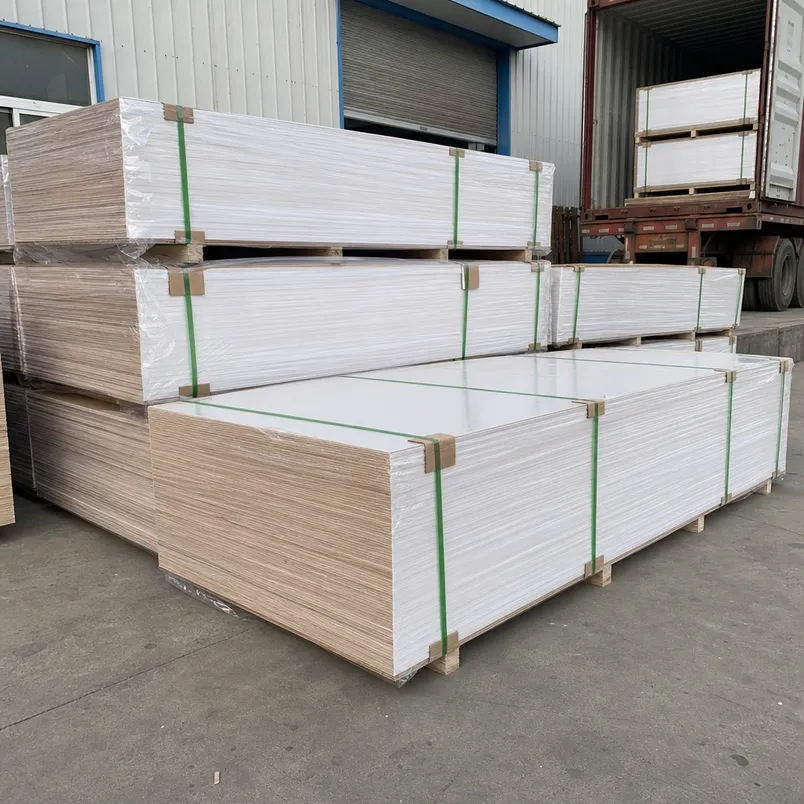
Packaging Specification
Panels are bundled and strapped with edge-protected corner boards. The overlay face is never in bare contact with bundle strapping — strapping marks transfer to the overlay surface and create a quality complaint at your end.
Wrapped in moisture-resistant film to protect panels during ocean transit and port handling.
For buyers ordering mixed product types — overlaid sheet alongside film-faced plywood or commercial plywood — we coordinate consolidated loads to reduce your per-unit freight cost.
We don't ship overlaid panels with bare face contact against bundle strapping. This sounds obvious, but we've seen it done wrong enough times that it's worth stating explicitly. Strapping marks on the overlay surface are a quality complaint that arrives at your buyer's dock, not ours.
Paper Overlaid Plywood Sheet vs. Sibling Products: Choosing the Right Format
Three products sit under our paper overlaid plywood category. They share the same overlay technology but serve different commercial purposes. Use this comparison to match the right panel to your buyer's application.
Paper Overlaid Plywood Sheet
Paintable surface, formwork, signage, furniture substrate
Buyers needing a flat, paintable panel in standard sheet format
Paper Overlaid Plywood Panel
Decorative and interior panel applications
Buyers supplying interior fit-out or decorative panel markets
MDO Plywood
High-performance formwork, signage, exterior applications
Buyers specifically sourcing MDO-grade panels for North American or high-spec markets
Sourcing for North American construction or signage markets?
If your buyer needs the MDO specification by name — common in North American construction and signage markets — the MDO plywood page covers that product in detail, including the 200–220 g/m² overlay spec and relevant certifications.
Sourcing for interior fit-out or decorative panel markets?
If your buyer needs a decorative or interior-facing overlaid panel, the paper overlaid plywood panel is the relevant product — lighter overlay weight, decorative finish, suited to interior fit-out supply chains.
Frequently Asked Questions
Specification and sourcing questions we hear most often from importers and distributors.
What overlay weight should I specify for a painted signage application?
For painted signage, specify the MDO weight (200–220 g/m²) with phenolic resin. The heavier overlay provides a harder, denser surface that holds paint more uniformly and resists edge chipping when the panel is cut. Lighter overlay (120–160 g/m²) is adequate for interior applications where the panel won't be cut frequently, but for sign fabricators who are routing and cutting panels regularly, the MDO surface holds up better at the cut edge.
What's the difference between phenolic and melamine resin overlay?
Phenolic resin overlay is harder, more moisture-resistant, and better suited for exterior or high-humidity applications. Melamine resin overlay is lighter in color, smoother, and better suited for interior applications where a white or light-colored surface is preferred.
- Exterior / high-humidity
- Formwork applications
- Harder, more durable
- Interior applications
- Furniture substrate
- White / light surface
Can paper overlaid plywood sheet be used for concrete formwork?
Yes, with the right specification. For formwork use, specify WBP (waterproof boil-proof) glue, phenolic resin overlay at MDO weight (200–220 g/m²), and a minimum thickness of 15mm for standard residential formwork or 18mm for commercial applications.
- Glue: WBP (waterproof boil-proof)
- Overlay: Phenolic resin, MDO weight 200–220 g/m²
- Thickness: 15mm residential / 18mm commercial minimum
- Expected reuse: 3–5 cycles with release agent and edge sealing
For higher reuse counts, film-faced plywood is more appropriate — the phenolic film overlay is more durable than paper overlay for high-cycle formwork.
What is the MOQ for customized paper overlaid plywood sheet?
MOQ varies by specification. Standard configurations (1220×2440mm, common thicknesses, CARB P2) can typically be ordered in smaller quantities. Custom overlay weights, non-standard dimensions, or OEM-branded panels generally require a minimum of one container (approximately 18–22 m³).
1220×2440mm, common thicknesses, CARB P2 — smaller quantities available
Custom overlay, non-standard dims, OEM branding — typically 1 container (18–22 m³)
Contact us with your target specification and volume — we'll confirm the MOQ and lead time for your exact configuration.
Does the paper overlay affect the panel's structural properties?
The overlay adds minimal weight and does not meaningfully change the panel's structural properties — bending strength, stiffness, and screw-holding capacity are determined by the core construction, not the overlay. The overlay's contribution is surface performance: paint adhesion, moisture resistance at the face, and dimensional stability of the surface layer.
- Bending strength
- Panel stiffness
- Screw-holding capacity
- Load ratings / span tables
- Paint adhesion quality
- Face moisture resistance
- Surface dimensional stability
- Edge performance when cut
If your buyer has structural requirements (load ratings, span tables), specify those at the order stage and we'll confirm the appropriate core construction.
Get a Quote for Paper Overlaid Plywood Sheet
Send us your target specification — overlay weight, core species, thickness, dimensions, emission standard, and destination market — and we'll come back with a detailed quote and the relevant certification documentation for your import requirements.
-
1
Overlay weight — e.g. 120–160 g/m² (light) or 200–220 g/m² (MDO)
-
2
Core species — poplar, eucalyptus, combi, or hardwood
-
3
Thickness and dimensions — standard or custom sheet size
-
4
Emission standard — CARB P2, E0, E1, or TSCA Title VI
-
5
Destination market — for certification documentation requirements
Most new buyers in this category start with a sample order to test the overlay adhesion and surface quality with their own customers before committing to a container. We can ship samples ahead of a production order.
Xuzhou, Jiangsu Province, 221116, China