

HPL Plywood Countertop Manufacturer
Factory-direct HPL plywood countertop panels built for commercial volume — hard-wearing laminate surface bonded to a stable plywood core, ready for your downstream market.
We manufacture to your thickness, size, and laminate spec. CARB P2 and FSC certified for North American and European import compliance.
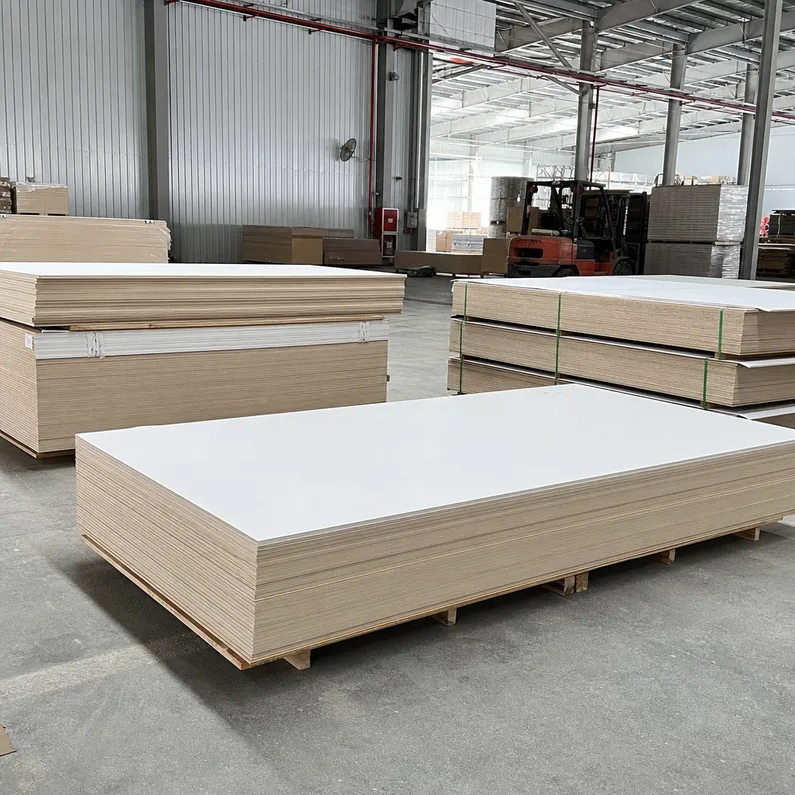
What Makes an HPL Plywood Countertop Different from Standard HPL Board
An HPL plywood countertop panel is a purpose-built substrate — not a generic HPL sheet you cut down to size. The plywood core is selected and oriented specifically for countertop loading conditions: horizontal span, point load resistance, and the dimensional stability that matters when a worktop is fixed to a cabinet carcass and exposed to daily moisture cycling.
The HPL laminate layer on top is bonded under heat and pressure, not cold-glued, which is the difference between a surface that stays flat through a decade of commercial use and one that starts lifting at the edges after the first humid season.
We produce these panels for buyers who are supplying kitchen manufacturers, commercial fitout contractors, laboratory furniture producers, and retail display fabricators. The product sits at the intersection of structural plywood and decorative surfacing — and the manufacturing process has to get both right simultaneously.
Process note: Most factories are good at one or the other. Getting the press parameters right for both the core bond and the laminate adhesion in a single cycle is where the process discipline shows.
The distinction from our HPL plywood sheet is application focus: the sheet product covers general-purpose HPL-faced panels for wall cladding, furniture panels, and partitions. The countertop product is engineered specifically for horizontal work surface applications — thicker core options, tighter flatness tolerance, and laminate grades selected for abrasion and impact resistance rather than just visual finish.
Purpose-Built Core Orientation
Core plies selected and oriented for horizontal span and point load resistance — not repurposed from a general-purpose panel run.
Heat-and-Pressure Laminate Bond
HPL bonded under heat and pressure in a single press cycle — not cold-glued. The bond integrity is what keeps the surface flat through years of moisture cycling.
Tighter Flatness Tolerance
±1.5mm over full panel length — tighter than general HPL sheet spec. Required for countertop installation against cabinet carcasses where gaps are visible.
Abrasion-Grade Laminate Selection
Laminate grades specified for abrasion and impact resistance — not just visual finish. The difference matters in commercial kitchen and laboratory environments.
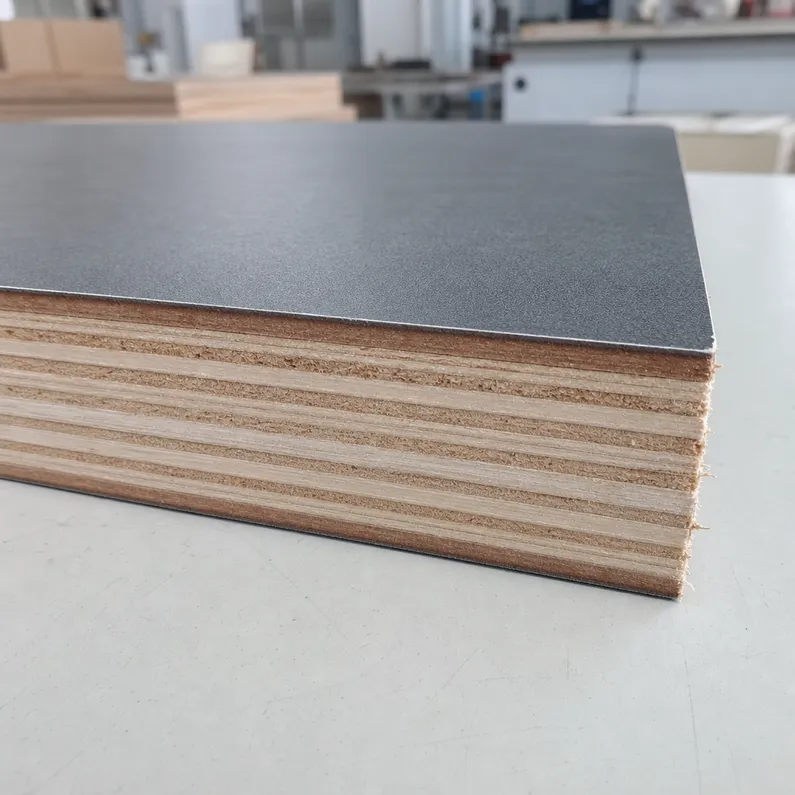
Core Specifications
Standard production values for HPL plywood countertop panels. Custom thickness, core species, laminate grade, and panel dimensions are available on confirmed orders.
Standard Production Specifications
| Parameter | Specification |
|---|---|
| Core material | Hardwood plywood (poplar, eucalyptus, or mixed hardwood core) |
| Face laminate | High Pressure Laminate (HPL), 0.6mm–1.2mm typical |
| Standard thickness |
18mm 25mm 30mm custom available
|
| Standard panel size | 1220×2440mm (custom sizes on confirmed orders) |
| Moisture content | 8–12% (export-grade controlled drying) |
| Flatness tolerance | ±1.5mm over full panel length |
| Thickness tolerance | ±0.3mm |
| Glue type |
MR (moisture resistant) WBP (waterproof boil-proof)
|
| Formaldehyde emission |
CARB P2 E1
|
| Surface finish options |
Matte Satin Gloss Textured Woodgrain Stone Solid color
|
| Edge treatment | Square edge standard; post-formed edge available on request |
| Certifications |
ISO 9001:2015 CARB P2 FSC CE
|
Specifications shown are standard production values. Custom thickness, core species, laminate grade, and panel dimensions are available on confirmed orders. Contact us for a detailed product data sheet.
Thickness Guide
Light-duty countertops, display surfaces, low-traffic residential
Commercial kitchens, laboratory benches, high-traffic retail counters
Heavy-duty industrial, long unsupported spans, structural countertop applications
Glue Bond Selection
Interior dry environments. Suitable for residential kitchens and office countertops with controlled humidity.
Commercial kitchens, laboratories, and any environment with steam, spills, or high humidity. Recommended for most countertop applications.
Need a full data sheet?
We can send product data sheets, test reports, and sample swatches for your project review.
Request Data SheetWhere HPL Plywood Countertops Are Specified
From commercial kitchens to laboratory benches, HPL plywood countertops are specified wherever durability, hygiene, and consistent surface quality are non-negotiable.
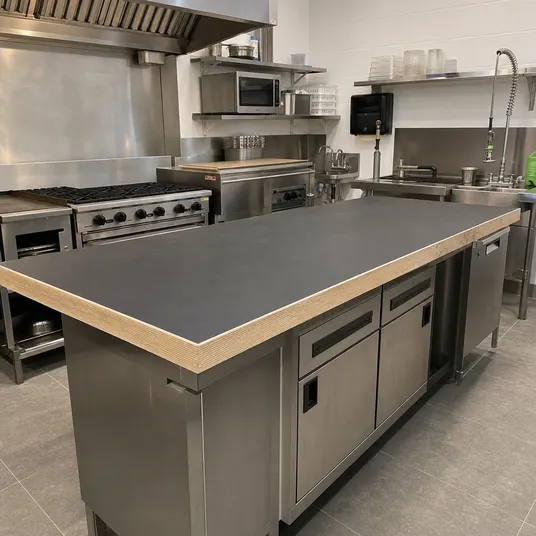
Commercial Kitchens
WBP-bonded cores and abrasion-grade HPL surfaces handle steam, spills, and heavy daily use. Meets food-safe surface requirements for prep counters and pass-through stations.
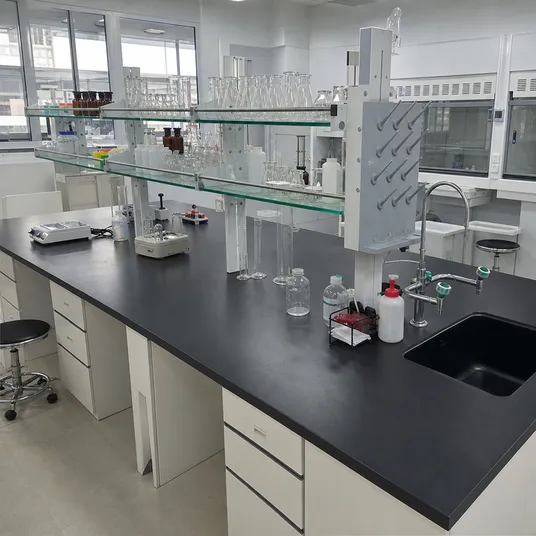
Laboratory Benches
Chemical-resistant HPL grades protect against reagent spills. Tight flatness tolerance ensures instrument stability. Specified in school labs, research facilities, and quality-control stations.
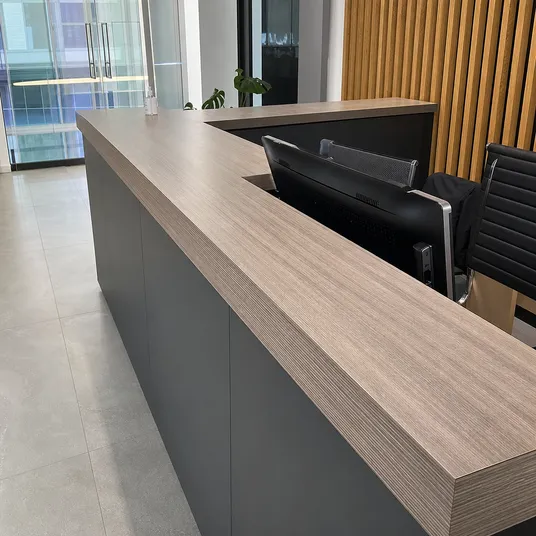
Retail & Hospitality
Wide decor range — woodgrain, stone, solid color — matches brand interiors. Scratch and impact resistance holds up in high-traffic checkout counters, reception desks, and bar tops.
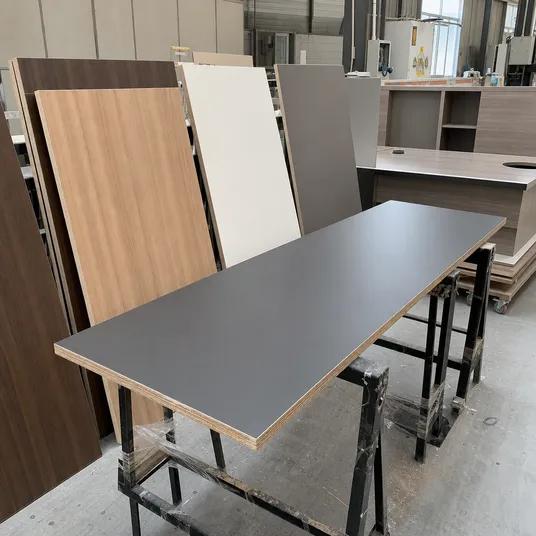
Office Furniture
Workstation tops, reception counters, and built-in desking. MR or WBP core depending on environment. Consistent color and texture across large orders for open-plan fit-outs.
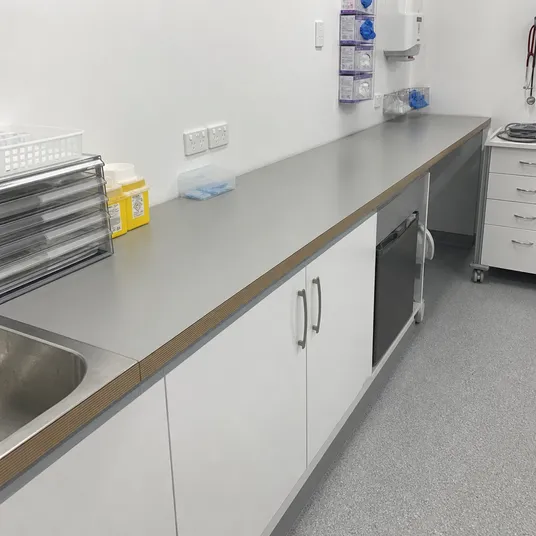
Healthcare & Clinical
Non-porous HPL surface resists bacteria and withstands disinfectant cleaning cycles. CARB P2 / E1 emission compliance supports indoor air quality requirements in clinical settings.
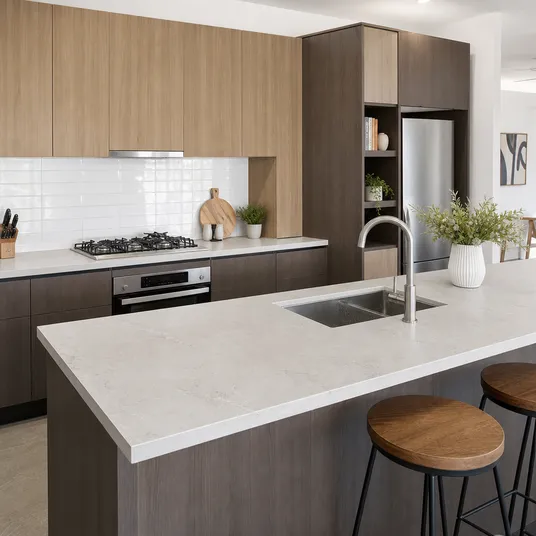
Residential Kitchens
Cost-effective alternative to stone with comparable scratch and stain resistance. Wide decor selection suits modern and traditional kitchen designs. Available in 18mm and 25mm for standard cabinet carcasses.
Not sure which spec fits your application?
Share your project details — environment, load requirements, surface area, and finish preference — and we'll confirm the right thickness, glue type, and laminate grade before you order.
Discuss your applicationHow We Build the Panel: Core Selection and Press Process
The plywood core is the part buyers rarely ask about — and it's where most countertop panel failures originate. Here's what we control at each stage, and why it matters for your downstream customers.
Core Veneer Selection
We select core veneers for countertop panels based on two criteria that don't apply to wall panel or furniture sheet production: cross-grain stability under sustained load, and surface smoothness before lamination. A core with voids or surface irregularities will telegraph through the HPL face under pressure — you get a surface that looks fine in the factory and develops a rippled texture after installation.
We run a pre-lamination surface check on every core panel before it goes to the HPL press.
Short-Cycle Hot Press Calibration
The HPL bonding process uses a short-cycle hot press calibrated for the specific combination of core thickness and laminate grade. Press temperature, pressure, and dwell time are set per product specification — not a single universal setting applied to everything.
Why this matters commercially: HPL laminate bonded at incorrect temperature or pressure will pass a visual inspection but fail a cross-cut adhesion test. We run adhesion checks on every production batch, not just on first-article samples. Any panel that shows edge lifting or delamination at the adhesion check is pulled before packing.
Moisture Content Control: 8–12%
Moisture content in the core is controlled to 8–12% before lamination. This is the same export-grade moisture standard we apply across our full plywood range — it's the number that determines whether your panels arrive flat and stay flat after installation in a climate different from Xuzhou's.
We've shipped to buyers in the Gulf, Southeast Asia, and coastal Australia where ambient humidity is high. The panels that cause problems are always the ones where the core moisture wasn't controlled before lamination — the HPL face acts as a vapor barrier on one side, and if the core is wet, it moves.
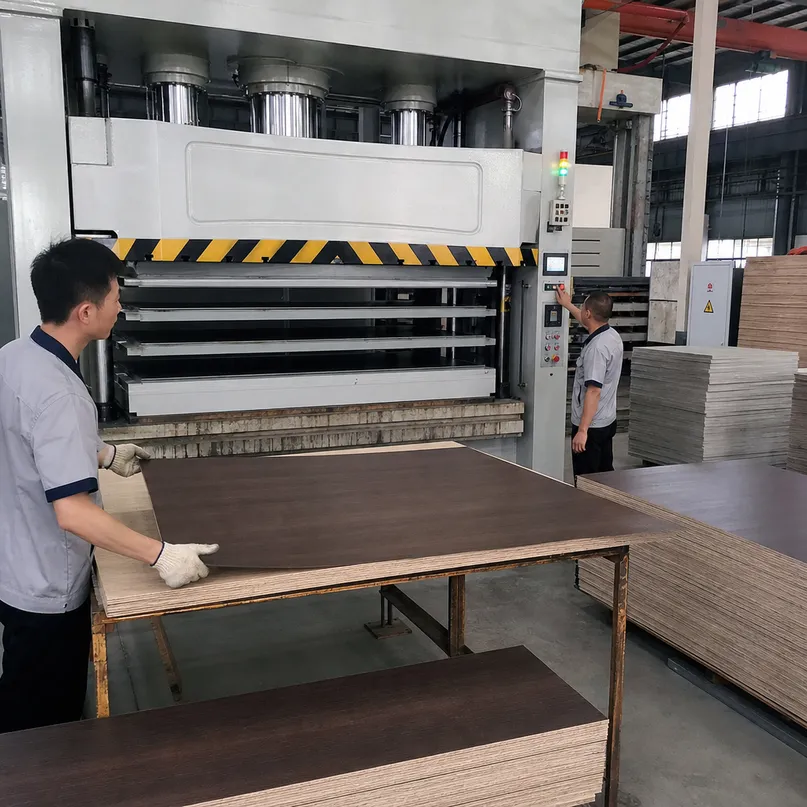
Quality Control at Every Stage
- Pre-lamination surface check on every core panel before HPL press
- Press parameters set per product spec — temperature, pressure, and dwell time calibrated per core/laminate combination
- Cross-cut adhesion test on every production batch, not just first-article samples
- Core moisture controlled to 8–12% — export-grade standard applied across full plywood range
- Panels with edge lifting or delamination at adhesion check are pulled before packing
Why Core Quality Is the Hidden Variable in HPL Panel Performance
Most HPL panel failures that surface after installation — rippling, delamination, warping in humid climates — trace back to core selection and moisture control decisions made before the laminate was ever applied. Visual inspection at the factory won't catch these. The only reliable check is adhesion testing on production batches and verified moisture content before lamination. These are the controls we run as standard, not as premium options.
Laminate Options and What They Mean for Your Market
The HPL layer is where your downstream customer sees the product. Understanding what each finish option means for your margin and market positioning helps you stock the right SKUs and sell with confidence.
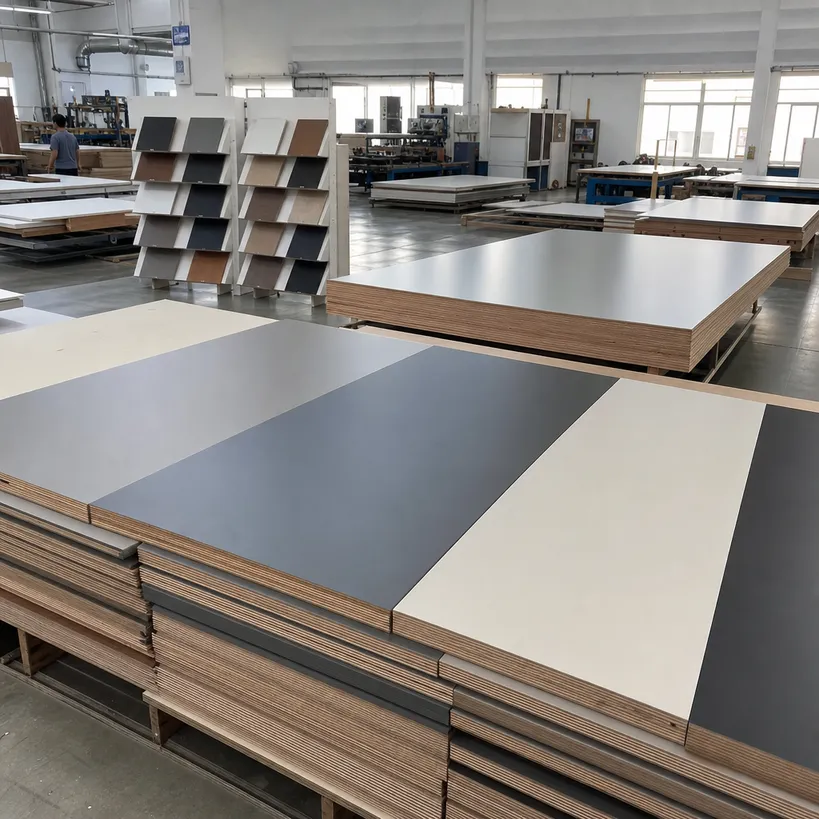
Matte and Satin Finishes
Volume MoversThe volume movers in commercial fitout — offices, hospitality, healthcare, and education projects specify these because they hide fingerprints and minor surface wear better than gloss.
Best for:
If you're supplying to commercial interior contractors or furniture manufacturers serving institutional buyers, this is your core SKU.
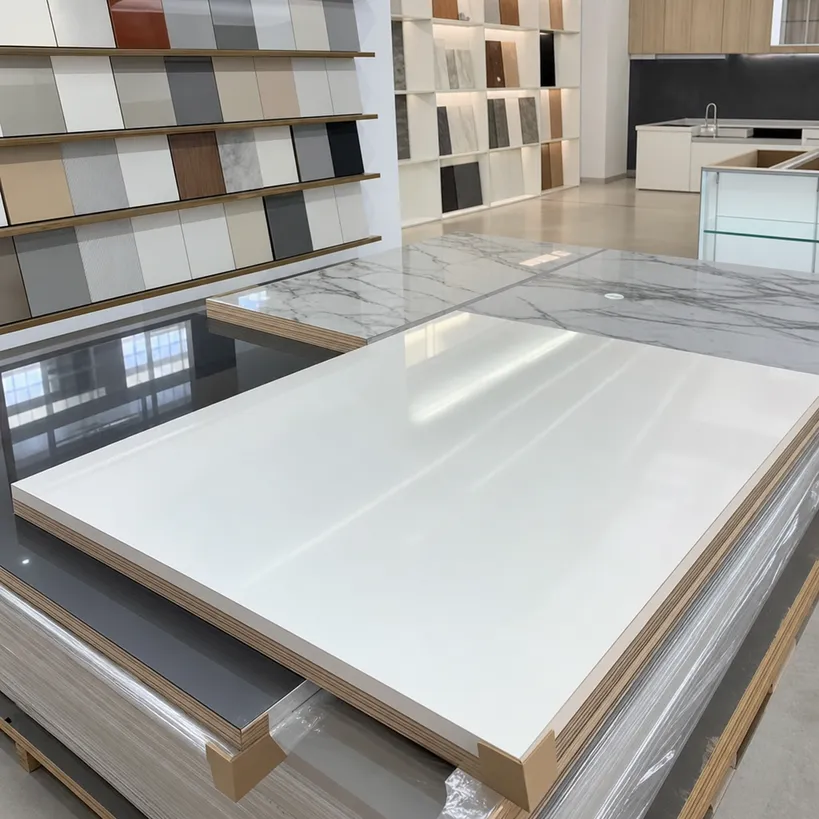
Gloss Finish
Price PremiumCommands a price premium in residential kitchen and retail display applications. The surface is more demanding to handle and install without scratching, which means your buyers need to understand packaging and site handling requirements.
Packaging note:
We pack gloss-finish panels with interleaving protective film and reinforced corner protection. Communicate site handling requirements to your buyers before delivery.
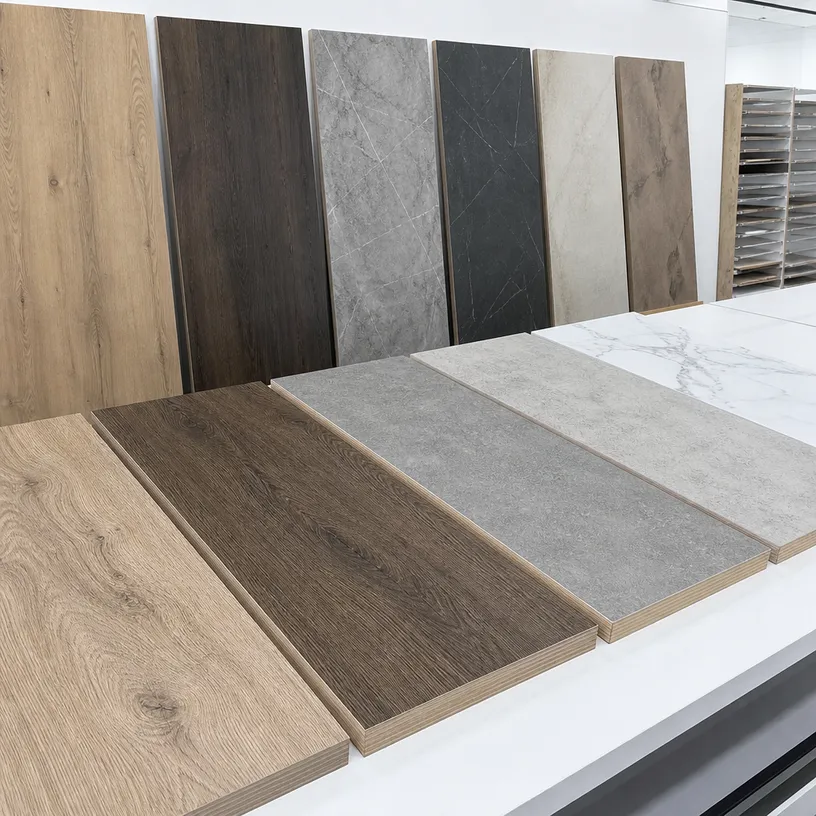
Textured Finishes
Woodgrain · Stone · ConcreteThe fastest-growing segment in our HPL countertop orders over the last three years. Buyers supplying kitchen manufacturers and retail display fabricators are using these to offer a premium aesthetic at a fraction of solid stone or real wood cost.
The texture is embossed into the HPL surface during manufacture — it's durable, not a printed film that wears through. This is a key selling point for your downstream customers comparing against film-wrapped or foil-laminated alternatives.
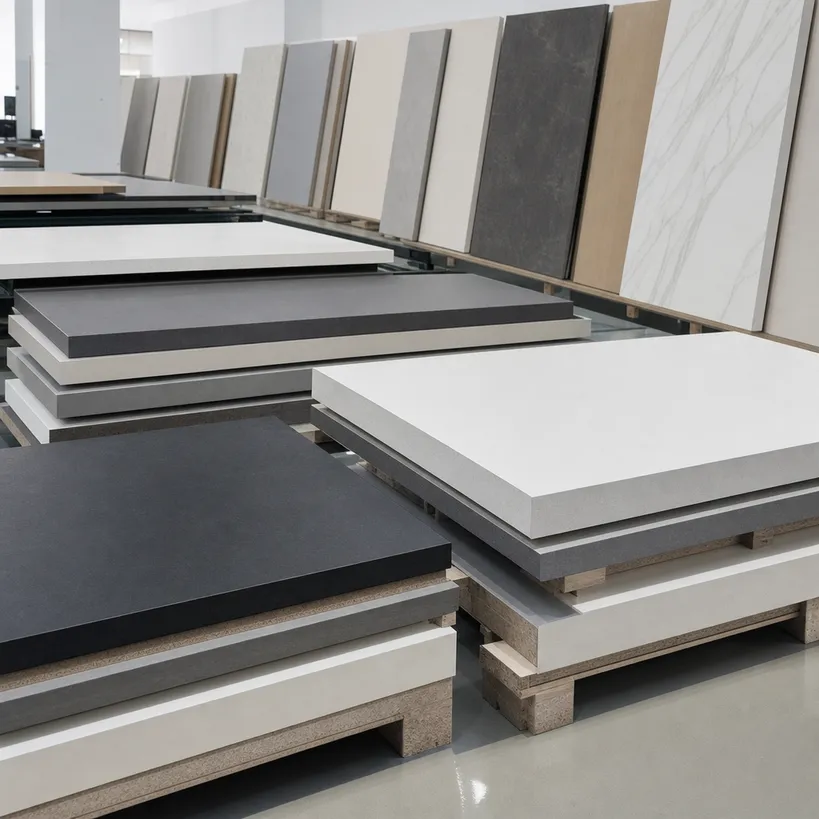
Solid Color
Easiest to StockStandard HPL color ranges — white, grey, black, and common neutrals — are the easiest to stock and reorder. If you're building a distribution inventory, starting with 3–5 solid colors in 18mm and 25mm covers the majority of commercial project demand.
Recommended starter inventory:
Custom Color Matching
We source HPL laminate from established suppliers and can match specific brand color references on orders with sufficient volume.
Minimum quantity for custom color match
Typically 200 sheets. Below that threshold, the laminate sourcing cost doesn't make commercial sense for either side. For standard color ranges, no minimum applies beyond normal order quantities.
Market Segments Where This Product Generates Repeatable Orders
HPL plywood countertops serve a narrow set of segments — but within those segments, reorder rates are high. Here's where the volume comes from and what each segment actually needs from a supplier.
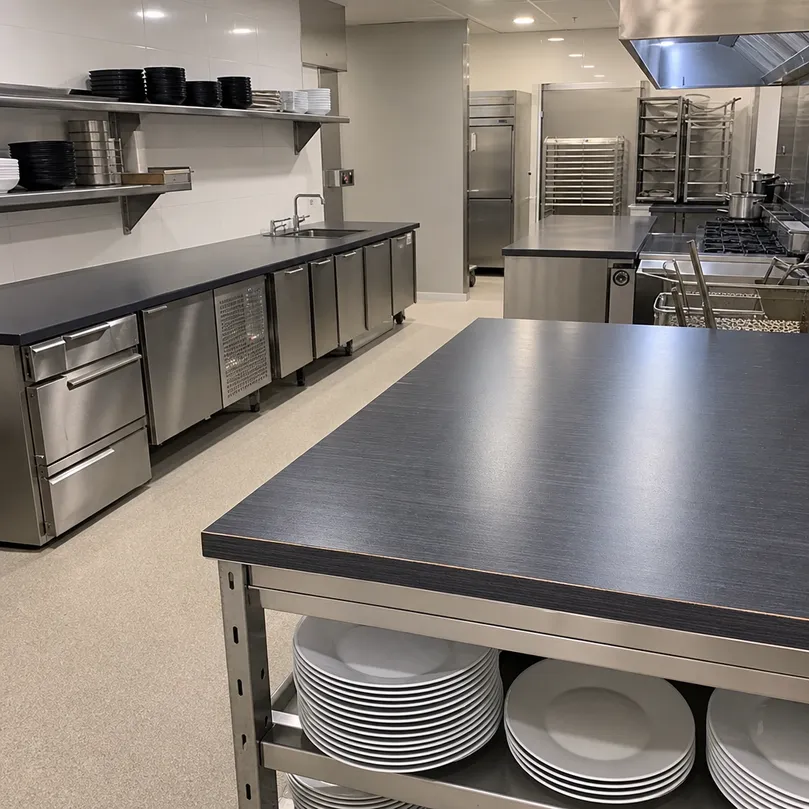
Commercial Kitchen & Hospitality Fitout
Highest Volume SegmentRestaurant chains, hotel renovations, and commercial kitchen suppliers specify HPL worktops because the surface handles heat, moisture, and cleaning chemicals better than most alternatives at the price point. Contractors in this segment order in project quantities — 50 to 500 panels per project — and return for the next project if the first one goes smoothly.
What drives loyalty: Your margin comes from reliable supply and consistent flatness, not from the lowest unit price. Contractors who find a supplier that delivers on spec stay with them.
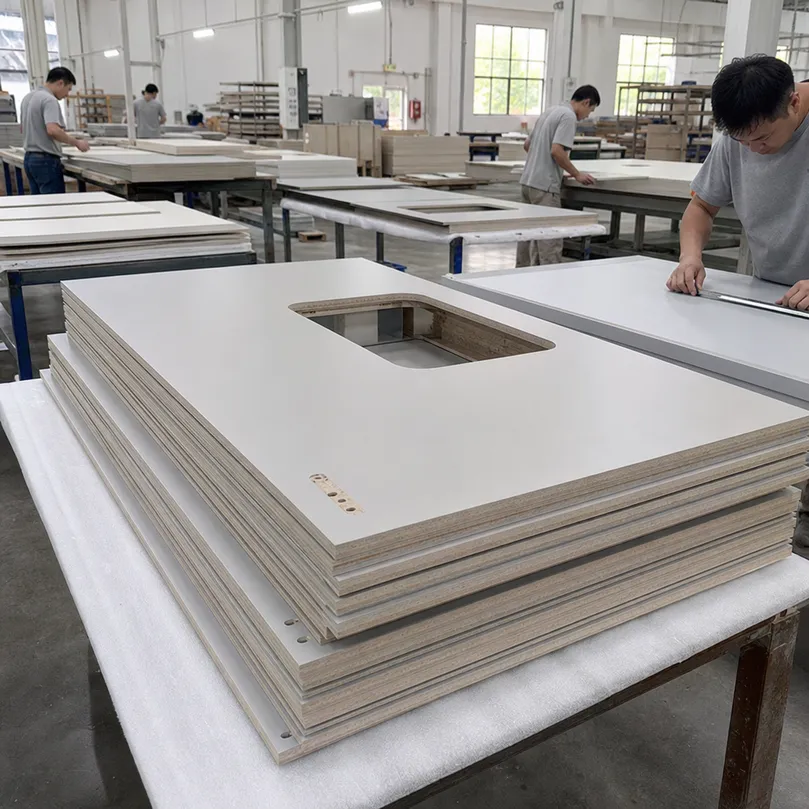
Laboratory & Technical Furniture
Higher Margin SegmentLaboratory benchtops require chemical resistance, dimensional stability, and compliance documentation. HPL plywood countertops with WBP core glue and CARB P2 certification cover the compliance requirements for most laboratory furniture manufacturers in North America and Europe.
What drives margin: Orders tend to be smaller in volume but more specification-driven. Buyers will pay a premium for documented compliance and consistent tolerances.
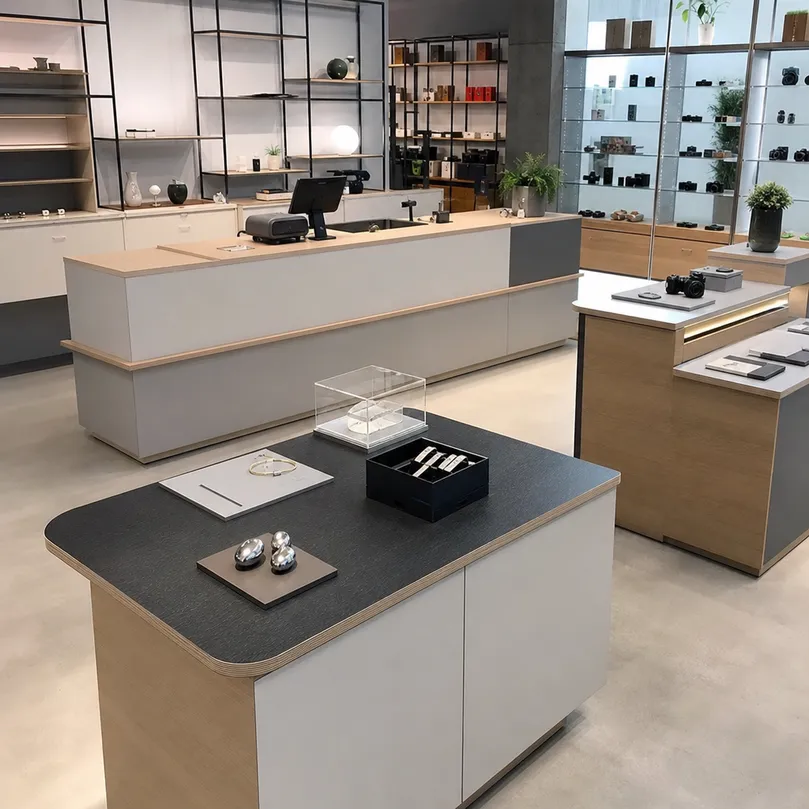
Retail Display & Shopfitting
Aesthetics & TurnaroundCheckout counters, display plinths, and service desks. This segment values surface aesthetics and fast turnaround — retail fitout projects run on tight schedules. If you're supplying shopfitters or retail display manufacturers, the textured and gloss finish options are your differentiation angle.
What drives selection: Surface finish variety and the ability to hit a project deadline. Buyers in this segment are less price-sensitive than schedule-sensitive.
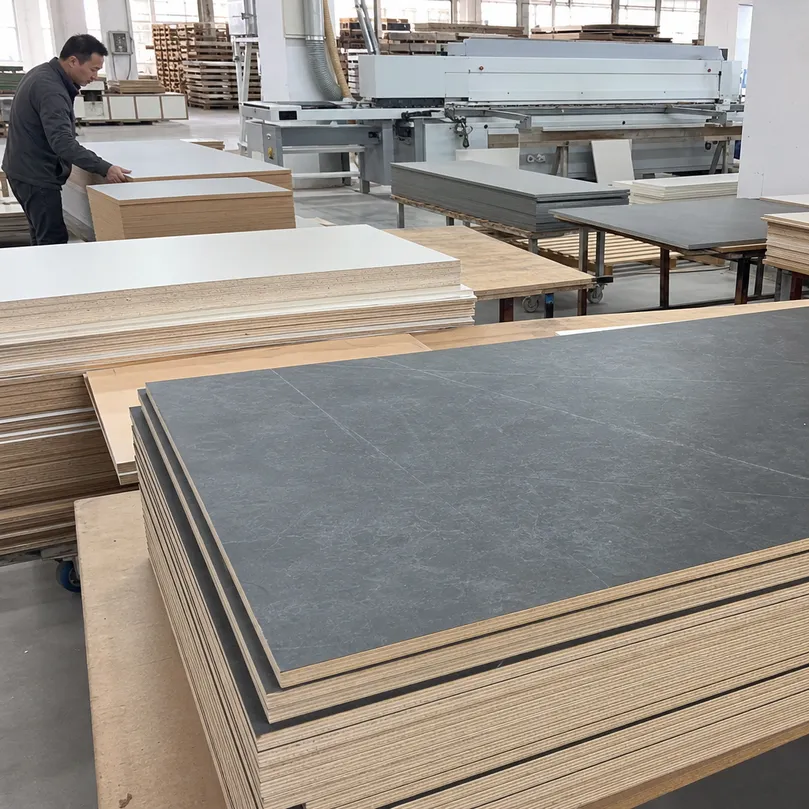
Kitchen Cabinet Manufacturers
High-Reorder SegmentMid-market manufacturers supplying residential and light commercial projects use HPL plywood countertops as a cost-effective alternative to solid surface or stone. The plywood core gives them a substrate they can cut, edge-band, and install with standard woodworking equipment.
What drives loyalty: A kitchen manufacturer running 50–200 kitchens per month needs a consistent countertop supply. Switching suppliers mid-production is disruptive enough that they stay loyal once they find one that works.
Discuss Your Target Market and Volume Requirements
Tell us which segment you're supplying and we'll confirm the right specification, lead time, and MOQ for your order profile.
Customization Parameters
HPL plywood countertops are one of the more customizable products in our range because the two main components — core and laminate — can be specified independently. The parameters below cover the full scope of what can be adjusted on a confirmed order.
Core Thickness
Standard production runs 18mm, 25mm, and 30mm. Custom thickness from 15mm to 40mm is available on confirmed orders.
Buyer note: 30mm panels are roughly 65% heavier than 18mm — a meaningful factor when calculating landed cost for a container order.
Panel Dimensions
Standard 1220×2440mm. Custom widths and lengths are available without tooling cost — plywood is cut to size, not molded, so custom dimensions are a scheduling question.
Buyer note: Maximum panel size is limited by our press bed dimensions. Contact us for the current maximum before specifying oversized panels.
Core Species
Poplar core is standard for most commercial applications — stable, consistent, and cost-effective. Eucalyptus and birch cores are available for higher-demand specifications.
Poplar — standard, stable, cost-effective
Eucalyptus — higher density, better screw-holding (lab & heavy-use)
Birch — premium specifications
Laminate Grade & Brand
We work with standard commercial HPL grades. For buyers with specific brand requirements — Formica, Wilsonart, or equivalent — we can laminate using customer-supplied HPL on confirmed orders.
Common use case: Buyers supplying branded kitchen programs where the end customer specifies the laminate brand by name.
Glue Specification
MR (moisture resistant, E1/CARB P2) is standard. WBP (waterproof boil-proof, phenolic resin) is available for laboratory, outdoor-covered, and high-humidity applications.
OEM / Private Label
We can apply your brand marking to panel bundles and documentation. Custom packaging with your company name and product codes is available on orders above our standard MOQ.
Includes: Brand marking on bundles, custom documentation, product codes on packaging.
Standard Specification Lead Time
Standard specifications ship from stock or within 10–15 working days. Stock availability varies by thickness and laminate — confirm before placing a time-sensitive order.
10–15 working days from stockCustom Specification Lead Time
Customization lead time is 15–25 working days from specification confirmation, depending on laminate sourcing. Custom dimensions and core species do not add lead time beyond laminate sourcing.
15–25 working days customSend Your Customization Requirements
Specify thickness, dimensions, core species, laminate grade, and glue type. We'll confirm availability, lead time, and pricing by return.
Compliance Documentation for Your Import Market
The certifications we hold cover the main procurement gates your buyers will encounter. Each one is available as a documentation package — not a special-order item.
CARB P2
US MarketFormaldehyde Emission Standard
The formaldehyde emission standard required for wood composite products sold in California and increasingly referenced across the US market. Our HPL plywood countertops are produced with CARB P2-compliant resin systems as standard — not as a special option.
Documentation included: TPC certificate and test reports are included with all US-bound shipments.
FSC Chain of Custody
GlobalCertified Forest Traceability
FSC Chain of Custody certification means the wood fiber in our panels can be traced to certified forests. If your buyers have sustainability sourcing policies — common in European retail, hospitality chains, and institutional procurement — FSC documentation is the compliance evidence they need.
Documentation included: FSC certificates provided with orders where chain-of-custody documentation is requested.
CE Marking
EU MarketEuropean Construction Product Requirements
CE marking covers European construction product requirements. For buyers supplying into EU markets, CE documentation is available for applicable product specifications.
Availability: CE documentation available on request for applicable product specifications.
ISO 9001:2015
Quality SystemQuality Management System
ISO 9001:2015 covers our quality management system — the process controls, inspection records, and corrective action procedures that sit behind the product certifications. Third-party inspection (SGS, Bureau Veritas) is available on request; we coordinate access for buyers who require independent pre-shipment inspection.
Third-party inspection: SGS and Bureau Veritas access coordinated on request.
Laboratory Furniture Applications
For laboratory furniture applications, we can provide additional test documentation on request: chemical resistance test results, surface hardness (Brinell), and impact resistance data for the specific HPL grade specified.
Packaging, Container Loading, and Landed Cost Factors
Standard packaging and container loading data for your landed cost calculations — including the factors buyers don't always factor in upfront.
Standard Export Packaging
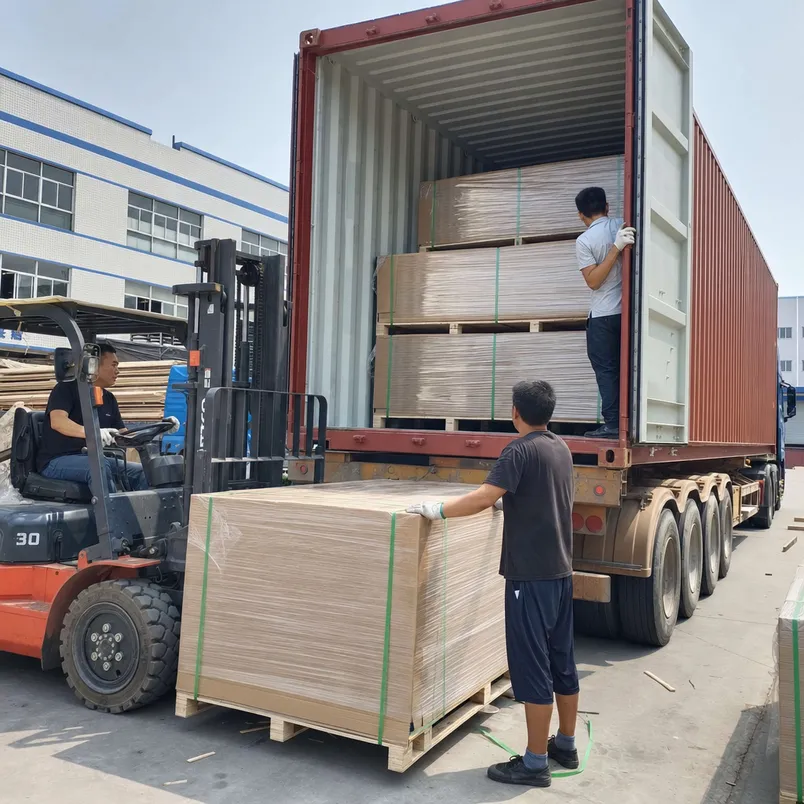
Panels stacked face-to-face with interleaving protective film between sheets
Bundled and strapped, edge-protected with corner boards
Wrapped in moisture-resistant film for ocean transit protection
Gloss and textured finish panels receive an additional layer of surface protection film applied at the factory
Edge sealing applied to all export-grade panels before packing — prevents moisture ingress at panel edges during ocean transit, the most common cause of edge swelling on HPL panels arriving at humid destination ports
Container Loading — 1220×2440mm Panels
Approximate Sheet Counts by Container Type
| Container | 18mm | 25mm | 30mm |
|---|---|---|---|
| 20HQ | 280–320 sheets | 200–230 sheets | 165–190 sheets |
| 40HQ | 580–650 sheets | 410–460 sheets | 340–380 sheets |
Loading quantities are approximate and depend on packaging configuration and mixed-product loading. A loading plan is provided with each shipment.
Landed Cost Factors Buyers Don't Always Factor In
A few things that affect your landed cost calculation that are easy to miss when running initial numbers.
Thickness Affects Per-Sheet Freight
Thicker panels load fewer sheets per container, which increases your per-sheet freight cost. This is a direct impact on your landed unit economics that doesn't show up in the FOB price.
Mixed-Thickness Containers
If your market primarily uses 25mm, running a mixed 18mm/25mm container can improve your overall cubic utilization. We can model this for you when you send your volume requirements.
Edge Sealing on All Export Panels
Edge sealing is applied to all export-grade panels before packing. This prevents moisture ingress at panel edges during ocean transit — the most common cause of edge swelling on HPL panels arriving at humid destination ports.
Need a container utilization model? Send us your volume requirements and target thickness mix — we'll run the loading plan and landed cost estimate for your specific market and port.
HPL Plywood Countertop vs. Other Worktop Substrates
Buyers evaluating HPL plywood countertops are usually comparing against two alternatives: solid HPL (compact laminate) and post-formed MDF-core worktops. Here's how the decision typically breaks down.
Comparison 01
HPL Plywood Countertop vs. Compact Laminate (Solid HPL)
Compact laminate is HPL all the way through — no substrate. It's heavier, more expensive, and offers better edge durability for high-traffic applications.
Choose HPL Plywood Countertop when:
You need a cost-effective substrate that can be cut, edged, and installed with standard woodworking tools, and where the edge will be covered by edge banding or a profile.
Choose Compact Laminate when:
Exposed-edge applications in very high-abuse environments — canteen counters, public toilet vanities — where edge durability is the primary specification driver.
HPL Plywood
Lower Cost
Standard tooling
Compact Laminate
Higher Cost
Exposed-edge grade
Comparison 02
HPL Plywood Countertop vs. MDF-Core Worktop
MDF core is cheaper and machines cleanly, but it's heavier per panel and significantly less moisture-resistant than plywood core.
Choose HPL Plywood Countertop when:
The countertop will see regular moisture — commercial kitchens, bathrooms, laboratory benches. Plywood core with WBP glue outperforms MDF core over time in these environments.
MDF-Core Worktops are acceptable for:
Dry office environments and residential kitchens with normal use, where moisture exposure is minimal and cost is the primary driver.
Specifier Note
If your buyers are supplying commercial or institutional applications, plywood core is the safer specification. The moisture-resistance advantage of WBP-bonded plywood core compounds over the product's service life.
Quick Substrate Decision Reference
| Application Type | HPL Plywood Core | Compact Laminate | MDF Core |
|---|---|---|---|
| Commercial kitchen worktops | Recommended | Viable | Not Recommended |
| Laboratory benches | Recommended | Viable | Not Recommended |
| Canteen counters (exposed edge) | Viable | Recommended | Viable |
| Dry office furniture | Recommended | Overkill | Acceptable |
| Residential kitchen (normal use) | Recommended | Overkill | Acceptable |
Frequently Asked Questions
Specification and sourcing questions we hear most often from importers, kitchen program buyers, and fabricators.
25mm is the most common specification for commercial kitchen worktops — it provides sufficient rigidity for spans up to 600mm between supports without additional bracing, and it's the thickness most commercial kitchen equipment suppliers design their installations around.
18mm is used where the countertop will be fully supported (e.g., over a full-height cabinet run with no unsupported spans). 30mm is specified for heavy-use applications like butcher blocks or laboratory benches where point load resistance matters.
If you're unsure which thickness your market requires, send us the application details and we'll recommend based on the span and load conditions.
Handles normal indoor humidity cycling. Standard for residential kitchens, offices, and dry commercial environments.
Maintains bond integrity under sustained moisture and temperature cycling. Specify for commercial kitchens, lab benches, bathrooms, and steam-exposed applications.
The price difference between MR and WBP core is modest relative to the risk of delamination claims from your downstream customers.
Yes, with conditions. For standard commercial HPL color ranges (whites, greys, blacks, common woodgrain patterns), we stock or can source quickly.
Formica, Wilsonart, Abet Laminati, or equivalent — we can laminate using customer-supplied HPL on orders above our minimum quantity, typically 200 sheets per color.
Lead time extends to 30–45 working days depending on the laminate supplier's production schedule.
Send us your color reference and target volume and we'll confirm feasibility and lead time.
CARB P2 is the primary compliance requirement for formaldehyde emissions — it applies to composite wood products sold in California and is increasingly referenced in federal procurement specifications. Our HPL plywood countertops are produced to CARB P2 as standard.
We include both CARB P2 and FSC documentation packages with US-bound shipments on request. For laboratory furniture applications, additional chemical resistance and surface hardness test data may be required — we can provide these on request for the specific HPL grade specified.
18mm or 25mm, 1220×2440mm, standard laminate colors
Non-standard thickness, custom dimensions, specific laminate color or brand
Sample panels for specification approval are available before committing to a full container order.
Get a Quote for
HPL Plywood Countertop Panels
Send us your target specification — thickness, panel size, laminate finish, glue type, and destination market — and we'll come back with a detailed quote, the relevant certification documentation, and a container loading plan.
Most buyers in this product category start with a sample order to test the specification with their own customers or fabricators before committing to container volume. We can ship samples within 5–7 working days.
No. 88 Sanbao Industrial Park, Tongshan District
Xuzhou, Jiangsu Province, 221116, China
What to Include in Your Specification
Sample Order Process
Send your specification and we confirm feasibility and pricing within 1 business day.
Sample panels ship within 5–7 working days for your fabricator or customer to test.
On approval, confirm container order. Standard specs ship in 10–15 working days.
Xuzhou QD Wood Industry Co., Ltd.
Related Products
Other HPL plywood formats and panel types from our factory