Most certification problems don't show up at the factory. They show up at the port, or six months later when your customer's project gets flagged during a green building audit. By then, the container is long gone and the supplier is offering you a discount on the next order.
I've managed CARB P2 and FSC compliance for our film-faced plywood lines for over a decade. The documentation side of this is genuinely confusing — not because the standards are complicated, but because there's a wide gap between what a certificate looks like and what it actually covers. This article closes that gap.
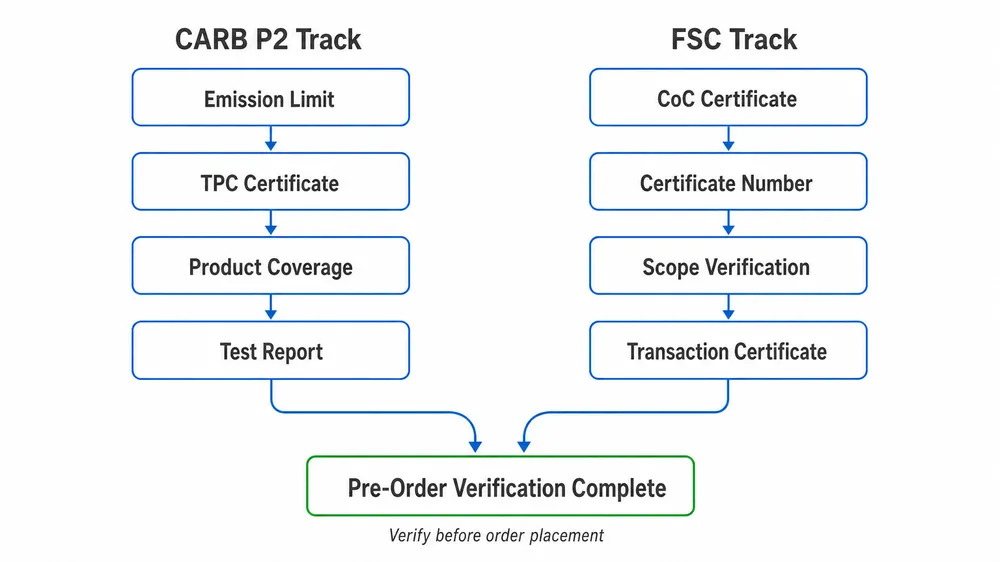
What CARB P2 Actually Requires — and What the Limit Numbers Mean
CARB ATCM (Airborne Toxic Control Measure) Phase 2 sets formaldehyde emission limits for composite wood products sold or used in California. The regulation covers hardwood plywood, particleboard, and MDF. For hardwood plywood with a veneer core — which includes most film-faced plywood — the Phase 2 limit is 0.05 ppm measured by the large chamber test method (ASTM E1333) or the small chamber method (ASTM D6007).
That 0.05 ppm figure is worth understanding in context. The Phase 1 limit was 0.08 ppm. The European E1 standard allows up to 0.1 ppm. So CARB P2 is roughly twice as stringent as E1, and the gap matters when you're sourcing from a factory that produces for multiple markets. A factory that formulates its resin to E1 and then claims CARB P2 compliance is either running a separate production line for US orders or the certificate doesn't mean what you think it means.
The regulation applies to finished composite wood products and to products that contain composite wood components — which means film-faced plywood used in concrete formwork, truck flooring, or construction panels all falls under CARB if it's sold into California or to a California-based distributor. The "California" framing is slightly misleading at this point: most major US distributors require CARB P2 compliance regardless of end destination, because managing two inventory streams (CARB and non-CARB) isn't worth the operational complexity.
(One thing that trips up first-time importers: CARB P2 compliance is a product-level requirement, not a factory-level certification. A factory can be CARB-certified for one product line and not another. More on this below.)
How to Read a CARB TPC Certificate — and What to Actually Check
CARB compliance is verified through a Third Party Certifier (TPC) — an accredited organization that audits the manufacturer's production process and emission testing. The TPC issues a certificate to the manufacturer, and that certificate is what you need to see before placing an order.
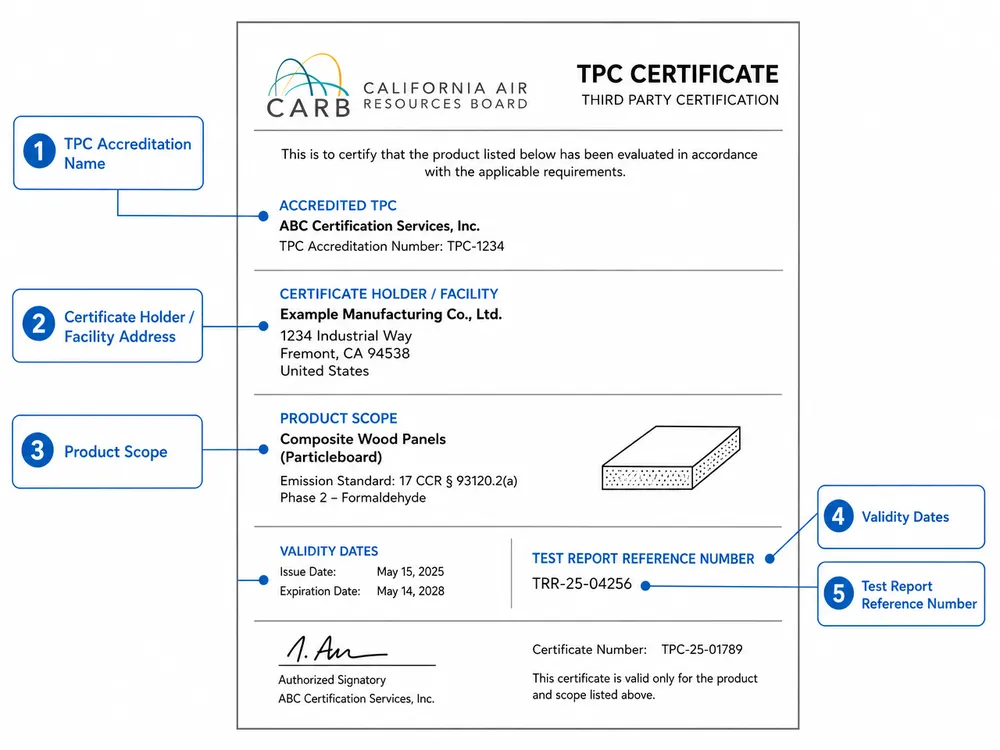
Here's what to look for when a supplier sends you their CARB certificate:
1. TPC accreditation status. The TPC must be listed on CARB's approved TPC list. Common accredited TPCs include HPVA (Hardwood Plywood & Veneer Association), SCS Global Services, and UL Environment. If the certificate is issued by an organization you don't recognize, verify it against CARB's published list at ww2.arb.ca.gov before proceeding.
2. Certificate holder name and facility address. The certificate must name the manufacturing facility, not a trading company. If the certificate names a trading company in Shanghai but your supplier is a factory in Xuzhou, that certificate does not cover your product. This is the most common documentation gap we see when buyers come to us after a compliance problem with a previous supplier.
3. Product scope. The certificate lists the specific product types covered — hardwood plywood, particleboard, MDF, or combinations. Confirm that film-faced plywood (typically classified as hardwood plywood with a veneer core) is explicitly within scope. A certificate that covers "MDF panels" does not cover film-faced plywood.
4. Certificate validity dates. CARB TPC certificates require annual renewal. An expired certificate is not compliant, regardless of when it was issued. Check the expiration date, not just the issue date.
5. Emission test report reference. The certificate should reference the underlying emission test report. For a thorough verification, request the actual test report — it will show the test method used (ASTM E1333 or D6007), the test result in ppm, and the product tested. The test result should be at or below 0.05 ppm for hardwood plywood.
FSC Chain of Custody vs. FSC Forest Management — the Distinction That Matters for Importers
FSC certification has two distinct tracks, and confusing them is a real sourcing risk.
FSC Forest Management (FM) certifies that a specific forest is managed according to FSC standards. This is a certification held by forest owners and managers, not by manufacturers.
FSC Chain of Custody (CoC) certifies that a manufacturer can trace the wood fiber in their products back through the supply chain to certified sources. This is the certification you need to see from a plywood supplier.
When a supplier says "we are FSC certified," ask specifically: "Do you hold FSC Chain of Custody certification?" The certificate number format for CoC certificates follows the pattern [country code]-CoC-[number] — for example, C-CoC-123456. If the certificate number doesn't contain "CoC," it's not a chain-of-custody certificate.
What FSC CoC certification means in practice: the supplier has been audited by an FSC-accredited certification body, their wood procurement records have been reviewed, and they can issue FSC-labeled products with a transaction certificate that traces the certified content. When you receive an FSC-certified shipment, you should receive a transaction certificate (sometimes called a sales invoice with FSC claim) that references the supplier's CoC certificate number and states the FSC claim for that specific shipment.
What FSC CoC certification does not mean: it doesn't guarantee that every panel in every order contains 100% FSC-certified fiber. FSC allows "mixed sources" and "recycled" claims alongside "100% FSC" claims. If your buyers or projects require 100% FSC-certified content, specify that explicitly in your purchase order and confirm the supplier can meet it for your product.
(We hold FSC CoC certification for our film-faced plywood lines. When buyers need FSC documentation for a specific shipment, we issue the transaction certificate as part of the standard export documentation package — it doesn't require a separate request.)
| FSC Certification Type | Held By | What It Covers | What Importers Need |
|---|---|---|---|
| Forest Management (FM) | Forest owners | Sustainable forest practices | Not directly relevant |
| Chain of Custody (CoC) | Manufacturers, traders | Traceability through supply chain | Yes — request CoC certificate |
| Controlled Wood | Manufacturers | Avoidance of controversial sources | Partial — not equivalent to CoC |
CARB P2 vs. E1/E0: Emission Standards Compared
If you're sourcing film-faced plywood for multiple markets — US, Europe, Australia — understanding how CARB P2 relates to other emission standards saves you from over-specifying for some markets and under-specifying for others.
| Standard | Market | Hardwood Plywood Limit | Test Method |
|---|---|---|---|
| CARB P2 | USA (California + de facto national) | 0.05 ppm | ASTM E1333 / D6007 |
| E1 | Europe (EN 13986) | 0.1 ppm | EN 717-1 (chamber) |
| E0 | Europe / Japan (stricter) | 0.05 ppm | EN 717-1 |
| F★★★★ | Japan (JIS A 5908) | 0.02 mg/L | Desiccator method |
| NAF/ULEF | USA (ultra-low / no added formaldehyde) | < 0.05 ppm | ASTM E1333 |
A few practical notes on this table:
CARB P2 and E0 have the same numerical limit (0.05 ppm) but use different test methods. A product that passes CARB P2 testing under ASTM E1333 is not automatically E0 compliant — the test methods produce different results for the same product. Don't assume cross-compliance without separate test reports.
E1 is significantly less stringent than CARB P2. A supplier who quotes you "E1 compliant" product for a US order is quoting you the wrong standard. This happens more often than it should, particularly with suppliers who primarily serve European markets.
NAF (No Added Formaldehyde) and ULEF (Ultra-Low Emitting Formaldehyde) are CARB categories for products using specific resin systems. Film-faced plywood typically uses phenolic resin for the film layer and urea-formaldehyde or melamine-urea-formaldehyde for the core glue lines. Phenolic resin itself is low-emission, but the core glue lines are what CARB testing actually measures.
What Happens at US Customs Without Proper CARB Documentation
CARB enforcement at the border is handled through CBP (US Customs and Border Protection) in coordination with CARB's own enforcement program. The practical consequences of arriving without proper documentation:
Hold and examination. CBP can hold a shipment pending documentation review. A hold on a 40HQ container of plywood means demurrage charges accumulating while you chase paperwork from a supplier 12 time zones away.
Penalty exposure. CARB penalties for selling non-compliant composite wood products in California run up to $10,000 per day per violation. The importer of record carries this liability, not the Chinese manufacturer.
Re-export or destruction. If a shipment is found non-compliant after entry, CARB can require re-export or destruction of the product. Neither outcome is recoverable from a margin standpoint.
Downstream liability. If non-compliant product reaches your customers and is later identified in a project audit (common in LEED-certified construction), the liability traces back through the supply chain. Your customer's problem becomes your problem.
The documentation CARB requires for US-bound composite wood products includes: the supplier's TPC certificate, the product's emission test report, and labeling on the product or packaging that identifies the TPC and certificate number. For film-faced plywood, the CARB label is typically applied to the panel edge or the bundle packaging.
We prepare the full CARB documentation package as standard for all US-bound shipments — TPC certificate, test report reference, and labeled packaging. Buyers who need to provide documentation to their own customers or for project compliance can request the complete package at any point.
The 6-Document Verification Checklist Before You Place an Order
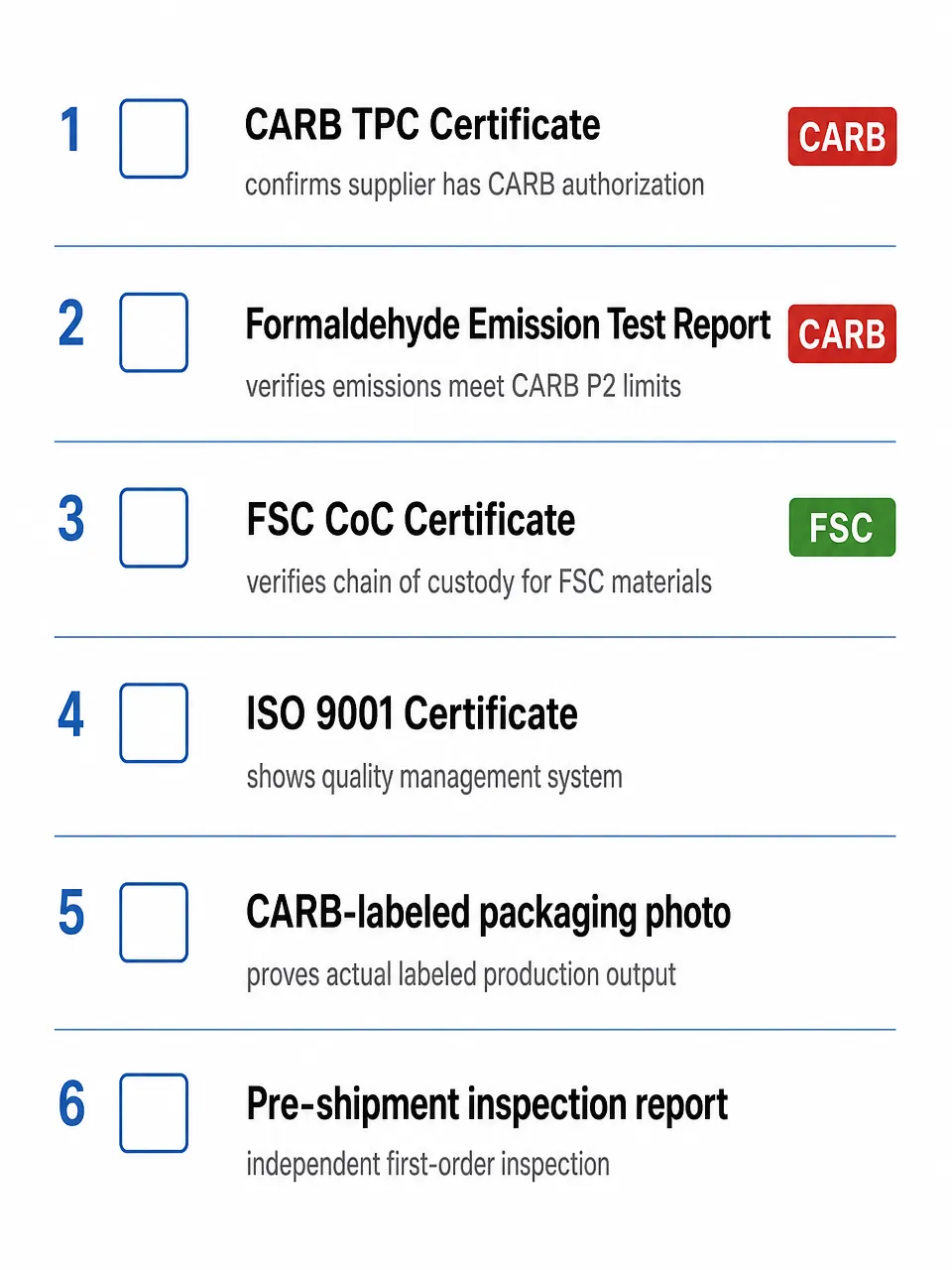
Before committing to a purchase order with any film-faced plywood supplier for US import, request these six documents:
1. CARB TPC Certificate — current, naming the manufacturing facility (not a trading company), with film-faced plywood or hardwood plywood within the product scope. Check the expiration date.
2. Formaldehyde Emission Test Report — the underlying test report referenced by the TPC certificate. Confirm the test result is ≤ 0.05 ppm for hardwood plywood, and that the test method is ASTM E1333 or D6007.
3. FSC Chain of Custody Certificate — if FSC is required. Confirm the certificate number contains "CoC," check the certificate holder name matches the manufacturing facility, and verify the certificate is current.
4. ISO 9001 Certificate — confirms the factory operates under a documented quality management system. Not a compliance requirement for CARB or FSC, but a meaningful indicator of process discipline.
5. Sample CARB-labeled packaging or panel photo — confirms the factory actually applies CARB labeling to production output, not just holds a certificate. A supplier who can't show you a photo of labeled product is a supplier whose CARB compliance exists on paper only.
6. Pre-shipment inspection report (for first orders) — arrange third-party inspection through SGS, Bureau Veritas, or your preferred agency. For a first order from a new supplier, independent pre-shipment inspection is the most cost-effective risk mitigation available.

Why CARB P2 Compliance Has to Be Engineered In, Not Tested In
This is the part that separates factories that hold CARB P2 certificates from factories that are actually CARB P2 compliant in production.
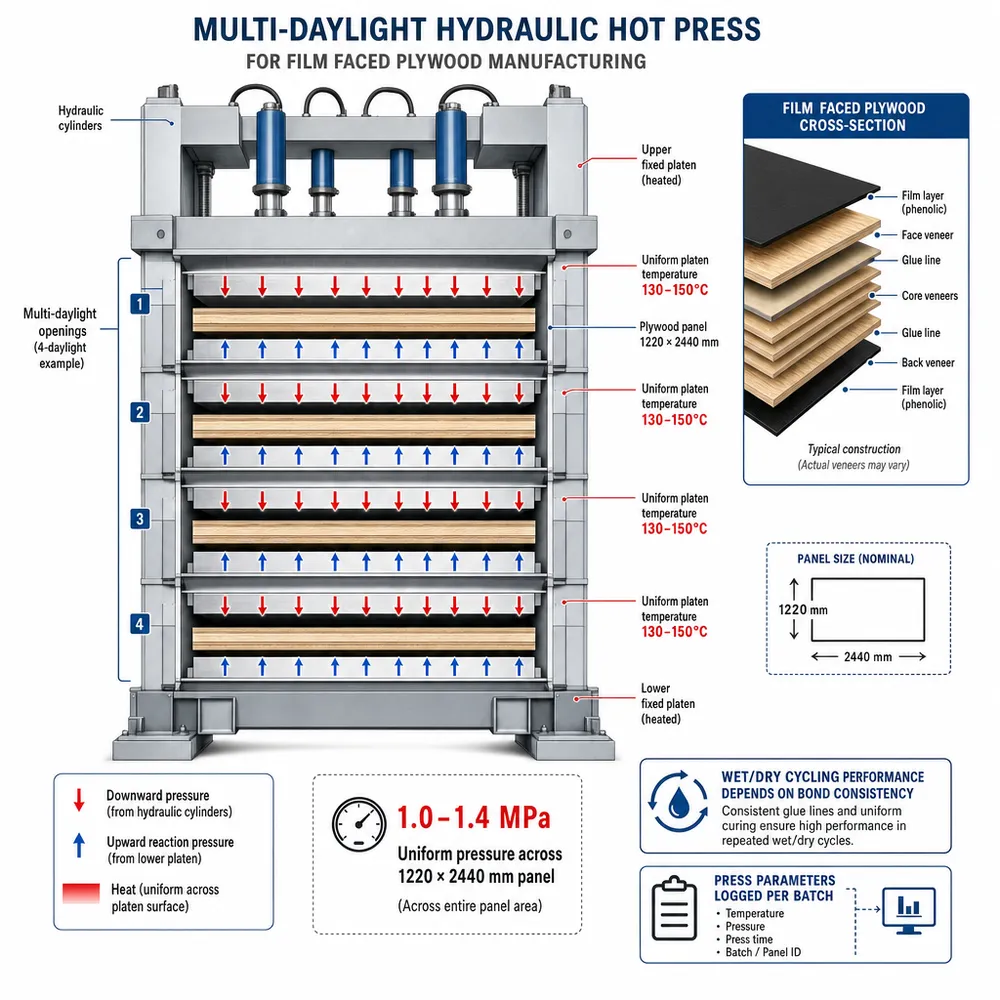
Formaldehyde emissions from plywood come primarily from the urea-formaldehyde (UF) resin used in the core glue lines. The emission level is determined by the resin formulation (molar ratio of formaldehyde to urea), the glue spread weight, the press temperature and time, and the post-press conditioning period. All of these variables interact — you can't optimize one in isolation and expect consistent results.
We switched to a low-mole-ratio UF resin system specifically for our CARB P2 production lines. The resin formulation is fixed by specification, not adjusted batch-to-batch based on availability or cost. Press parameters — temperature, pressure, and dwell time — are logged per production run and held within defined tolerances. (We tightened our press temperature tolerance from ±5°C to ±3°C after seeing emission variability in early CARB compliance testing. That's the kind of process adjustment that doesn't show up in a certificate but shows up in consistent test results.)
Post-press conditioning matters too. Freshly pressed panels have higher emission levels that decrease over the first 72–96 hours as residual formaldehyde off-gasses. Panels tested immediately after pressing will show higher emissions than panels tested after proper conditioning. Our production schedule includes mandatory conditioning time before outgoing inspection and before packing for export.
The practical implication for importers: a supplier who can show you consistent test results across multiple production batches — not just a single certificate — is demonstrating process control, not just compliance. Ask for test results from the last three to five production runs. A supplier with genuine process control will have them. A supplier who only has the certificate will not.
For our film-faced plywood product line, CARB P2 compliance is built into the production specification, not treated as a special option. Every batch produced for US-bound orders runs on the same resin formulation and press parameters that the TPC audit covers.
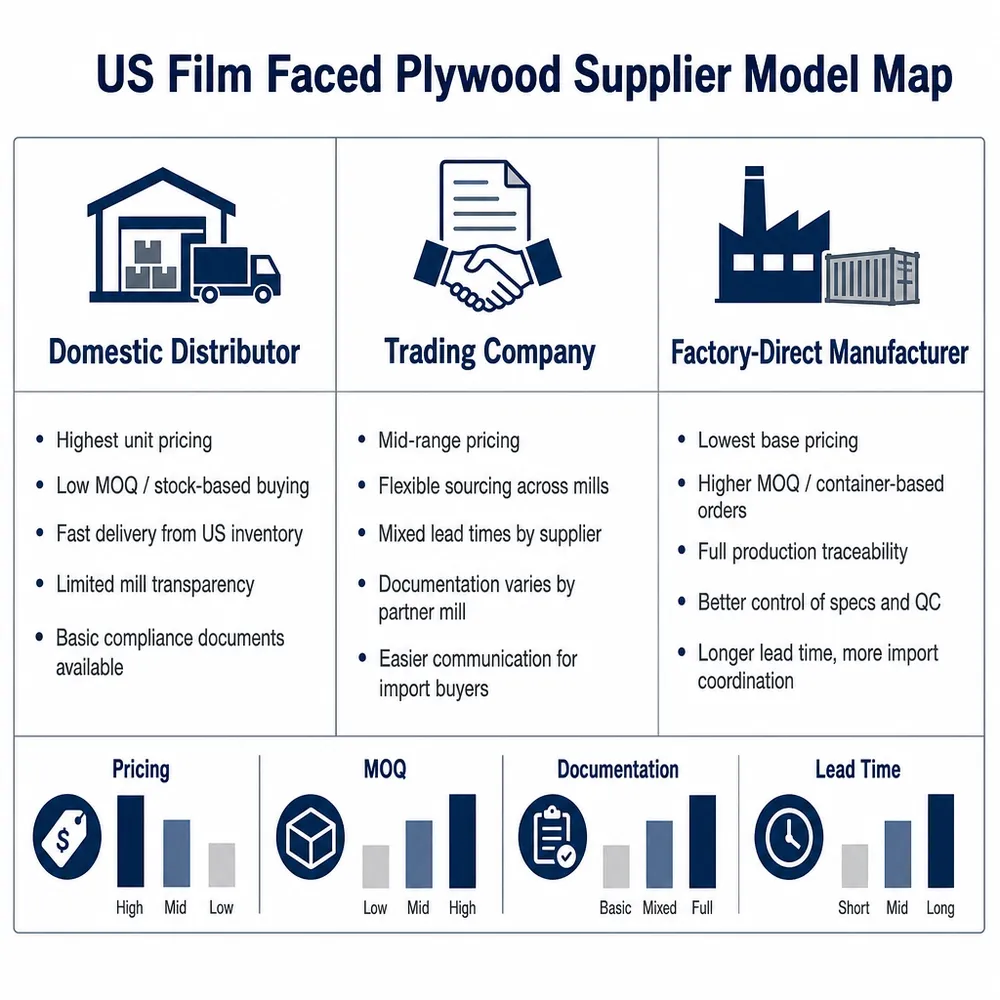
Trading Company Certificates vs. Factory-Direct Certificates
One sourcing risk that doesn't get enough attention: the difference between a certificate held by a trading company and a certificate held by the manufacturing facility.
A trading company can hold an FSC CoC certificate that covers its own trading activity — buying FSC-certified product from a factory and reselling it with FSC claims. But the trading company's CoC certificate does not cover the factory's production process. If the factory itself doesn't hold CARB P2 certification, the trading company cannot pass CARB compliance through to you regardless of what their documentation says.
The test is simple: the CARB TPC certificate must name the manufacturing facility — the physical address where the panels are produced. If the certificate names a trading company, ask for the factory's own CARB certificate. If the trading company can't produce it, the CARB compliance chain is broken.
We operate factory-direct — no trading company layer between our production facility and your purchase order. Our CARB TPC certificate names our Xuzhou facility. Our FSC CoC certificate covers our production operation. When you request our certification documentation, you're getting the source documents, not a pass-through from an intermediary.
This matters beyond documentation. When a compliance question comes up — and in 13 years of export work, they do come up — a factory-direct supplier can answer it from production records. A trading company can only forward your question to the factory and wait.
Sourcing CARB P2 and FSC Certified Film Faced Plywood: What to Prioritize
If you're building a sourcing relationship for US-bound film-faced plywood, the certification verification process above is the starting point, not the finish line. A few practical priorities:
Verify before you order, not after. Request the six documents above during the RFQ stage. A supplier who delays or deflects on documentation requests before the order is placed will not improve after you've committed.
Confirm product-specific coverage. CARB and FSC certificates cover specific products. Confirm that film-faced plywood — specifically, the thickness and construction you're ordering — is within the scope of the certificates you receive.
Ask for batch-level test data. A single emission test report proves the product can pass. Multiple test reports across production batches prove the process is consistent. For a supplier you're qualifying for ongoing orders, the latter matters more.
Understand your downstream requirements. If your customers supply into LEED projects, green building specifications, or sustainability-audited supply chains, FSC CoC documentation and CARB compliance records need to be available for project documentation. Confirm your supplier can provide these in a format your customers can use.
For a broader look at sourcing decisions beyond certification, the film faced plywood buying guide covers thickness selection, film grade, and core construction for different applications.
If you're evaluating suppliers specifically for the US market, film faced plywood suppliers in the USA covers the sourcing landscape and what to look for when comparing factory-direct and distribution-based options.
Frequently Asked Questions
Does CARB P2 apply to film-faced plywood used outside California?
Technically, CARB ATCM is California state regulation. In practice, most US distributors and large retailers require CARB P2 compliance for all composite wood products regardless of end destination — managing separate CARB and non-CARB inventory streams isn't operationally practical. If you're selling to US distributors, assume CARB P2 is required.
Can a supplier's CARB certificate cover multiple product types?
Yes. A single TPC certificate can cover hardwood plywood, particleboard, and MDF if the factory produces all three and has been audited for each. Check the product scope section of the certificate to confirm which products are covered. Film-faced plywood should appear as hardwood plywood (veneer core) in the scope.
What's the difference between CARB P2 and TSCA Title VI?
TSCA Title VI is the federal equivalent of CARB P2, enacted in 2016 and administered by the EPA. The emission limits are identical to CARB P2. TSCA Title VI applies nationally; CARB P2 applies in California. In practice, a product that meets CARB P2 meets TSCA Title VI, and most TPC certificates cover both. Confirm with your supplier that their TPC certificate references TSCA Title VI compliance if you need federal documentation.
How often does a CARB TPC certificate need to be renewed?
Annual renewal is required. The TPC conducts an annual audit of the manufacturer's production process and emission testing. An expired certificate — even by one day — means the product is not currently certified. Always check the expiration date on the certificate you receive, not just the issue date.
If I'm sourcing FSC-certified film-faced plywood, what documentation do I receive with each shipment?
For each FSC-certified shipment, you should receive a transaction certificate (or FSC sales invoice) that references the supplier's CoC certificate number, states the FSC claim for the shipment (100% FSC, FSC Mix, or FSC Recycled), and identifies the product. This document is what you pass to your customers or use for project compliance documentation. If your supplier doesn't issue transaction certificates per shipment, their FSC CoC certification is not being properly administered.
What's the minimum order quantity for CARB P2 and FSC certified film-faced plywood?
Certification doesn't change MOQ — it's a production specification, not a special run. For our film-faced plywood lines, standard MOQ applies regardless of whether the order requires CARB P2, FSC, or both. Request a quote with your specification and volume, and we'll confirm availability and lead time with the full documentation package.