

Moisture Resistant Plywood Manufacturer
MR-grade moisture resistant plywood built for humid climates — panels that arrive flat and stay flat.
Manufacturing export-grade moisture resistant plywood since 2008. We target 8–12% moisture content as a process standard, not a final inspection target. Available in 2.5mm–25mm, custom sizes on confirmed orders.
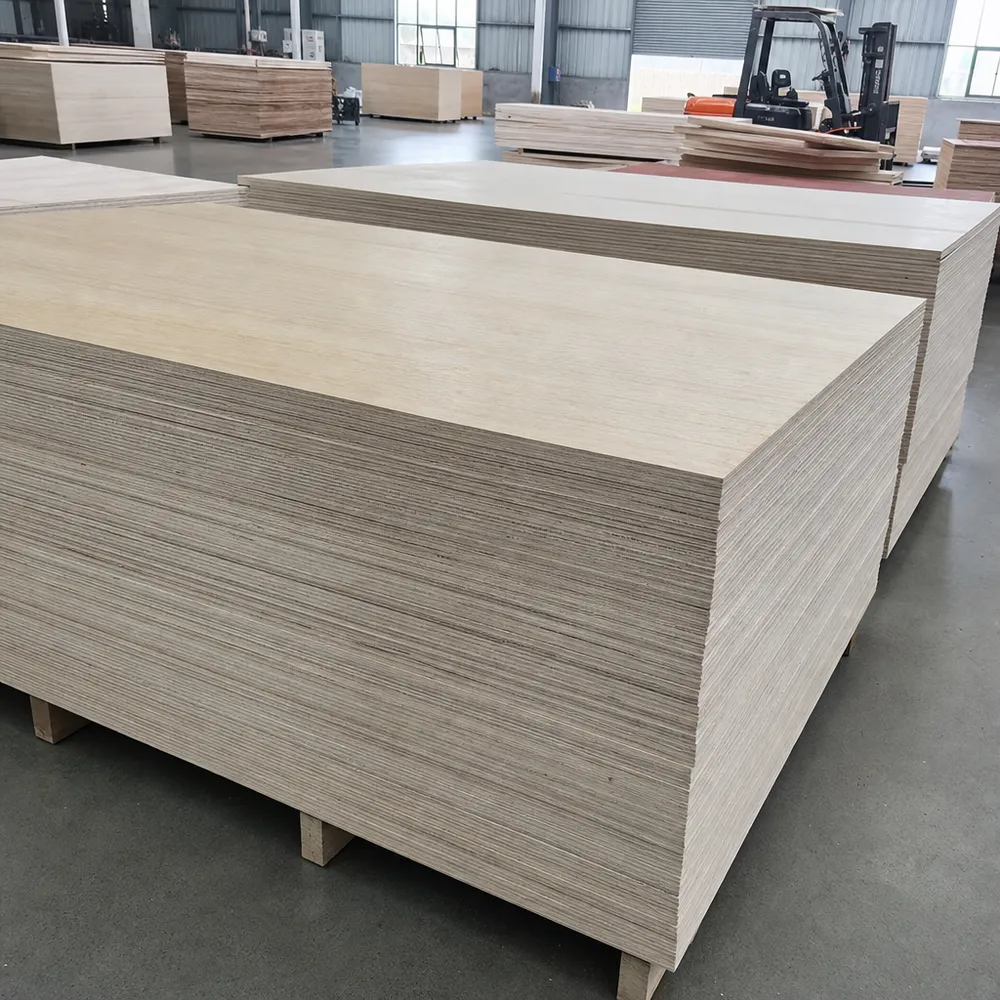
What Moisture Resistant Plywood Actually Is — and Where the Spec Matters
Moisture resistant plywood uses MR-grade (moisture resistant) urea-formaldehyde adhesive in its core construction, engineered to withstand intermittent humidity exposure without delaminating. It sits between standard interior-grade plywood and fully waterproof WBP (weather and boil proof) marine plywood on the performance spectrum.
The distinction matters commercially: MR-grade panels carry a lower cost basis than WBP, which means better margin when your downstream application doesn't require full waterproofing — kitchens, bathrooms, humid-climate furniture, interior construction in tropical markets.
The Failure Mode That Kills MR Plywood Orders
The failure mode that kills MR plywood orders is not the adhesive — it's moisture content at the time of pressing. If veneers go into the hot press carrying 15–18% MC (common in factories that skip pre-press drying), the panel may pass a surface check but will warp or delaminate within weeks of reaching a humid environment.
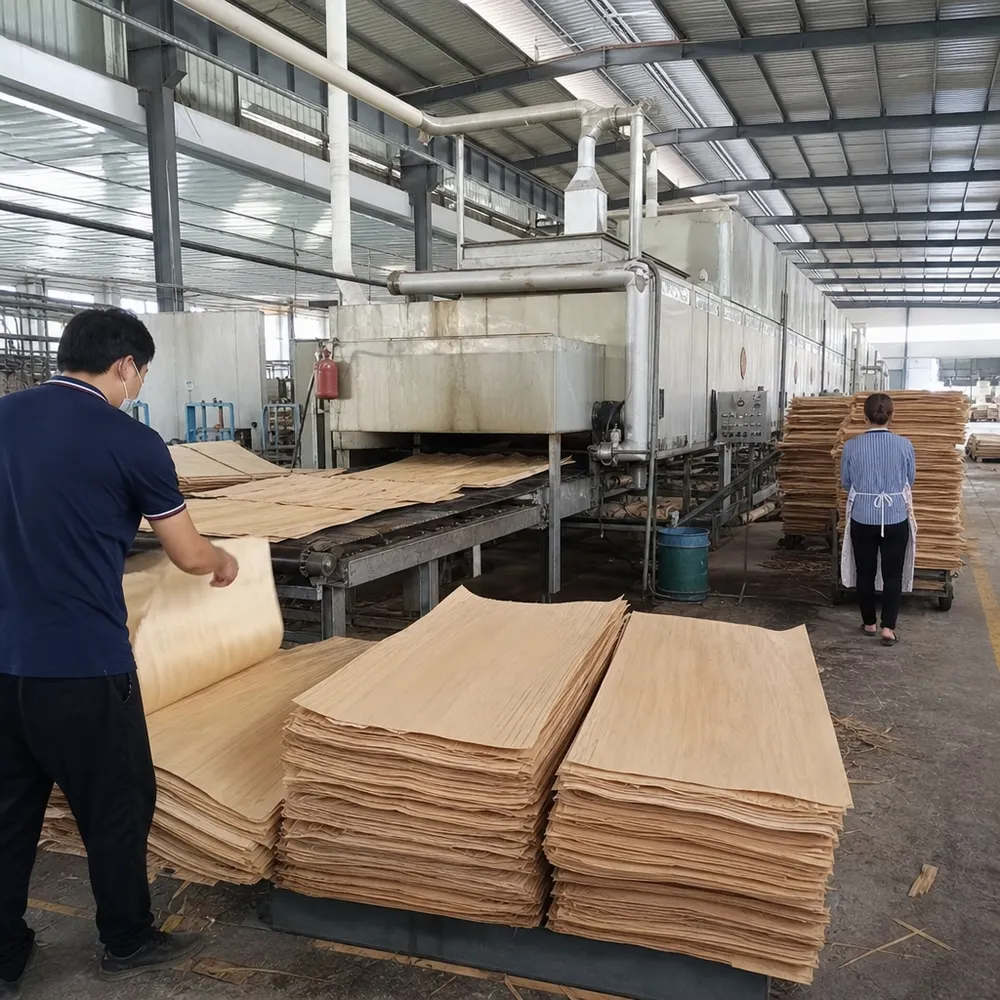
How We Address This at the Process Level
Veneers are dried to target moisture content before layup — not just checked at final inspection.
We verify MC at the layup stage — the point where it actually determines panel performance.
Panels ship at 8–12% MC and hold their dimensions through ocean transit and into humid destination markets.
We've been shipping to Southeast Asia and the Gulf since 2008 — those are the markets where MR plywood failures show up fastest. The 8–12% MC target came directly from watching what happened to panels that shipped outside that range.
MR Plywood on the Performance Spectrum
Technical Specifications
Standard production values for our MR-grade moisture resistant plywood. Actual parameters may vary by order specification.
MR-Grade Plywood — Standard Specification Table
| Parameter | Specification |
|---|---|
| Product Type | Moisture Resistant (MR-grade) Plywood |
| Adhesive | MR-grade urea-formaldehyde resin |
| Thickness Range |
2.5mm – 25mm
2.5mm 3mm 6mm 9mm 12mm 15mm 18mm 25mm
|
| Standard Panel Size | 1220 × 2440mm (4' × 8') |
| Custom Sizes | Available on confirmed orders |
| Core Construction | Hardwood or softwood veneer core, cross-grain layup |
| Face/Back Veneer |
Poplar, eucalyptus, hardwood species (buyer-specified)
Poplar Eucalyptus Hardwood
|
|
Moisture Content (MC)
Process standard
|
8–12% (export standard) |
| Thickness Tolerance | ±0.2mm (calibrated sanding) |
| Formaldehyde Emission |
E1 standard (≤1.5 mg/L); CARB P2 available
E1 CARB P2
|
| Surface Finish | Sanded both sides (S2S); one-side sanded (S1S) available |
| Grade Options |
BB/BB BB/CC CC/CC Custom
|
| Glue Bond Test | Cyclic boil test per IS:1659 / GB/T 9846 |
| MOE (Bending Stiffness) | ≥ 4,000 MPa (face grain direction) |
| MOR (Bending Strength) | ≥ 30 MPa (face grain direction) |
| Minimum Order Quantity | 1 × 20ft container (approx. 18–22 CBM) |
| Lead Time | 15–25 days ex-works (standard spec) |
| Packing | Palletised, corner-protected, stretch-wrapped; fumigation certificate available |
Certifications & Standards
Indicative Panel Weights
1220 × 2440mm panel, hardwood core
Weights are indicative. Actual weight varies by species density and MC at time of shipment.
Custom thickness, panel size, or face species are available on confirmed orders. Send us your spec sheet and we'll confirm feasibility within 24 hours.
Send Spec SheetApplications
MR plywood is the workhorse of interior construction — specified wherever humidity is a factor but full waterproofing isn't required.
Kitchen Cabinetry
Cabinet carcasses, shelving, and drawer boxes in residential and commercial kitchens. MR adhesive handles steam and splash exposure without delaminating.
Bathroom Furniture
Vanity units, under-sink cabinets, and wall panels in bathrooms where ambient humidity is consistently elevated.
Interior Wall Panelling
Feature walls, wainscoting, and decorative panelling in tropical climates where standard plywood would swell and buckle seasonally.
Furniture Manufacturing
Flat-pack and ready-to-assemble furniture destined for humid markets. Consistent thickness tolerance keeps CNC cutting and edge-banding reliable.
Retail & Commercial Fit-Out
Shop fixtures, display units, and partition systems in air-conditioned retail environments across Southeast Asia and the Gulf.
Flooring Substrate
Underlay for engineered wood flooring and tile backer in ground-floor applications where sub-floor humidity is a concern.
MR plywood resists intermittent humidity and moisture vapour. It is not rated for direct water contact, prolonged wet exposure, or exterior use. For those applications, specify WBP-bonded marine plywood instead.
Manufacturing Process
Every step in our process is oriented around one outcome: panels that perform consistently when they reach your market.
Log Selection & Peeling
Logs are graded for density and defect before rotary peeling. Veneer thickness is set to spec at the lathe — variation here compounds through every subsequent layer.
Veneer Drying
Green veneers are dried in roller dryers to a controlled MC before gluing. Drying to the right MC at this stage is what makes the 8–12% export target achievable.
MR Glue Application & Layup
MR-grade urea-formaldehyde resin is applied by glue spreader at a controlled spread rate. Veneers are cross-laid to balance the panel and resist warping.
Hot Press Bonding
Panels are pressed at controlled temperature and pressure for a timed cycle. Press parameters are logged per batch — temperature, pressure, and dwell time are all recorded.
Conditioning & Sanding
Post-press panels are stacked and conditioned before sanding. Calibrated wide-belt sanding brings panels to ±0.2mm thickness tolerance and prepares the surface for finishing.
QC, Grading & Packing
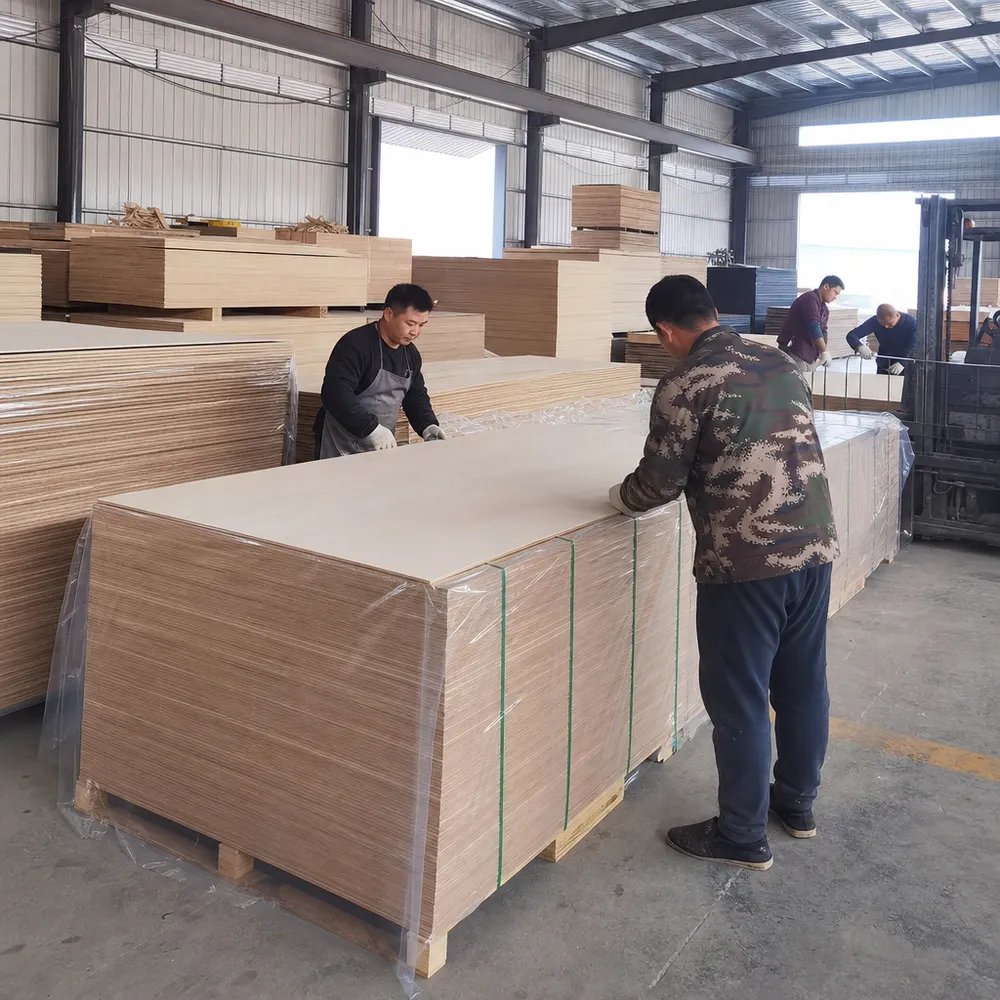
Each panel is visually graded, measured, and checked for delamination before packing. Panels are palletised, corner-protected, and stretch-wrapped for container loading.
The Production Process Behind the Moisture Resistance
MR plywood's performance in the field comes down to three variables: adhesive formulation, veneer MC at layup, and press consistency. We control all three as process parameters, not as inspection checkpoints.
Adhesive Application
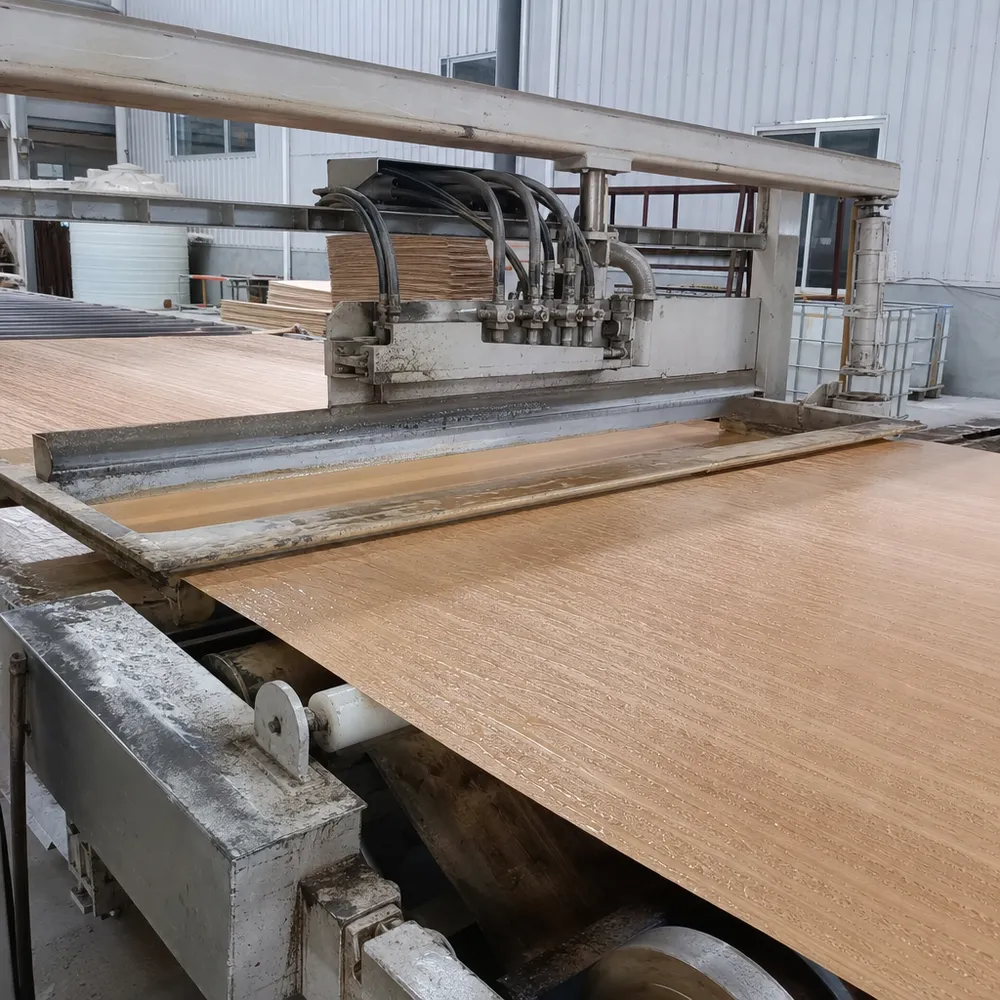
Adhesive application runs through automated glue spreaders calibrated to apply consistent resin weight across the full veneer surface. Uneven glue spread is the most common cause of localized delamination — you get a panel that passes a peel test at the center but fails at the edges where glue coverage was thin.
- Spreaders checked and recalibrated at the start of each shift
- MR-grade resin sourced from approved suppliers
- Each batch tested for viscosity and pH before production
Veneer Moisture Control
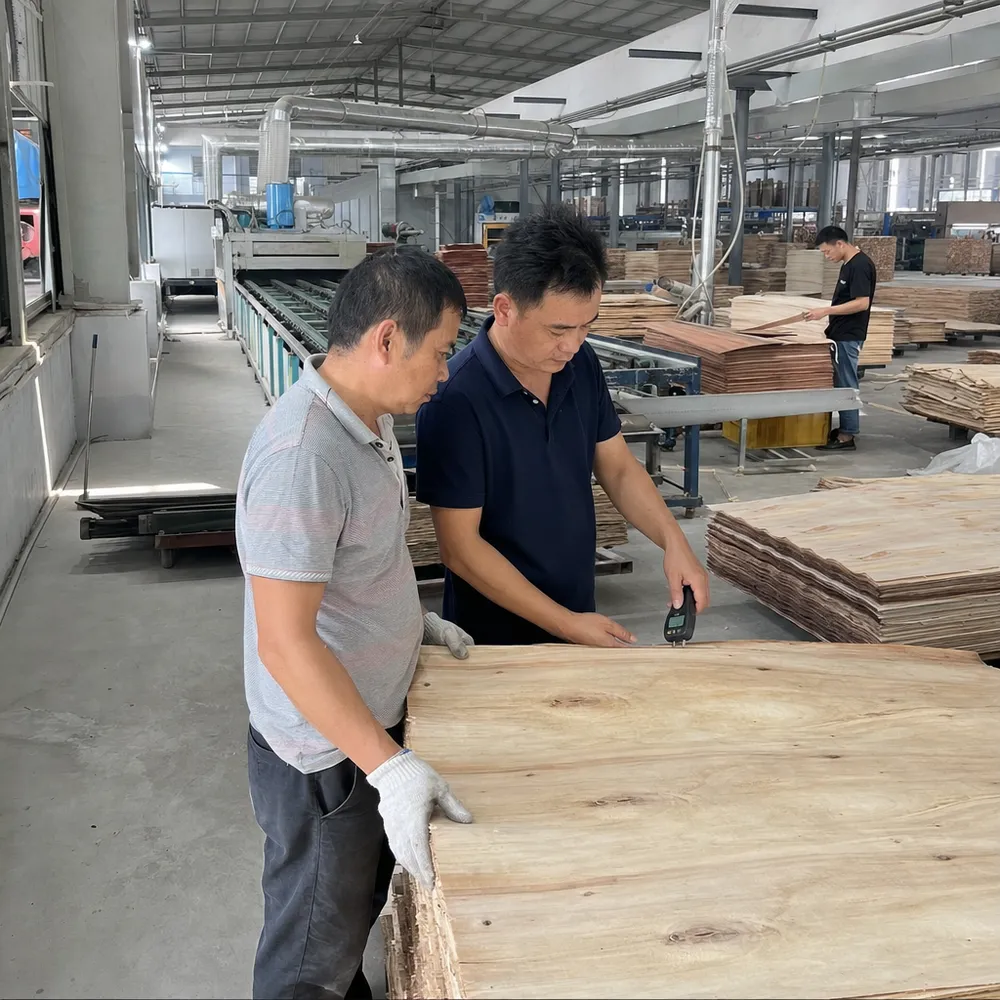
This is where we've invested the most process discipline. Incoming veneers are sorted by species and MC on arrival, then run through our dedicated drying line to reach target MC before layup. We don't mix wet and dry veneers in the same panel — that's a common shortcut that produces panels with internal stress gradients, which show up as warping after the panel acclimates to a new humidity environment.
- Sorted by species and MC on arrival
- Dedicated drying line to reach target MC before layup
- Each veneer stack checked with pin-type moisture meter before layup table
Hot Press Parameters
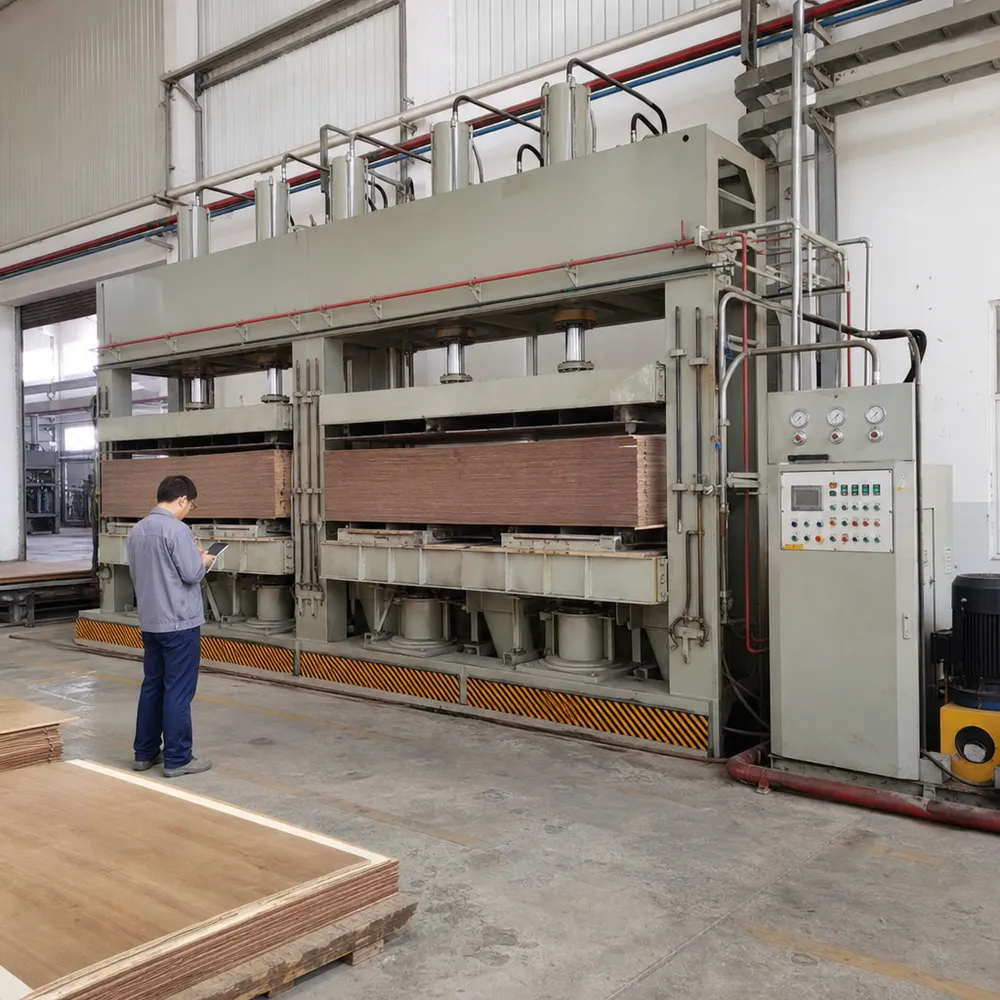
Temperature, pressure, and press time are logged per batch on our multi-daylight hydraulic press systems. The press cycle for MR plywood is calibrated to achieve full resin cure without over-pressing, which can cause surface checking on thinner face veneers. If a batch shows any delamination or blister at the post-press inspection stage, it's pulled before it reaches the sanding line.
- Temperature, pressure, and press time logged per batch
- Calibrated for full resin cure without over-pressing
- Delamination or blister at post-press inspection = pulled before sanding
The Output
Panels with ±0.2mm thickness tolerance across the full surface, consistent bond strength from edge to edge, and MC in the 8–12% range that holds through ocean transit.
Market Segments Where This Product Moves
MR plywood is not a specialty item in most of these markets — it's the baseline SKU. Understanding where volume concentrates helps you position inventory and forecast reorder cycles accurately.
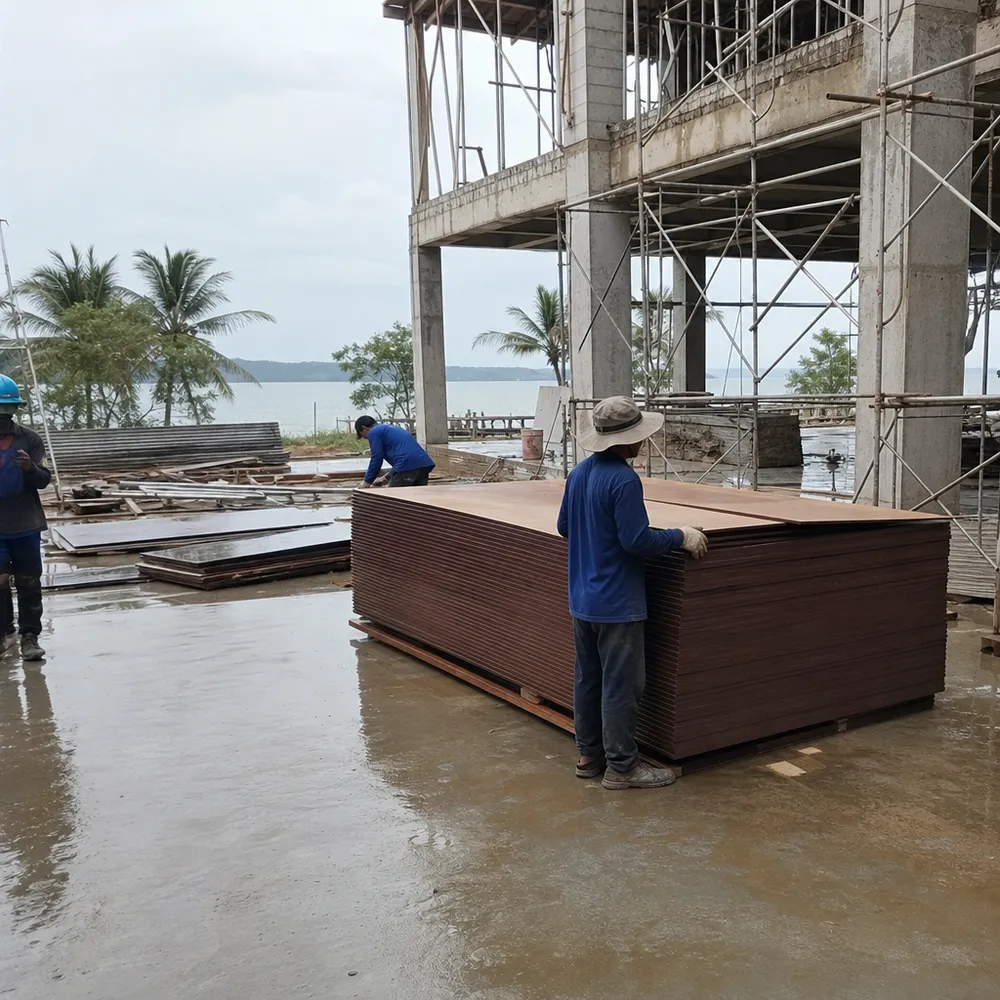
Tropical & Humid-Climate Construction
Southeast Asia, the Gulf states, coastal Australia, and West Africa all have year-round humidity conditions that rule out standard interior-grade plywood for most applications. Distributors in these markets carry MR plywood as a baseline SKU — it's not a specialty item, it's the standard.
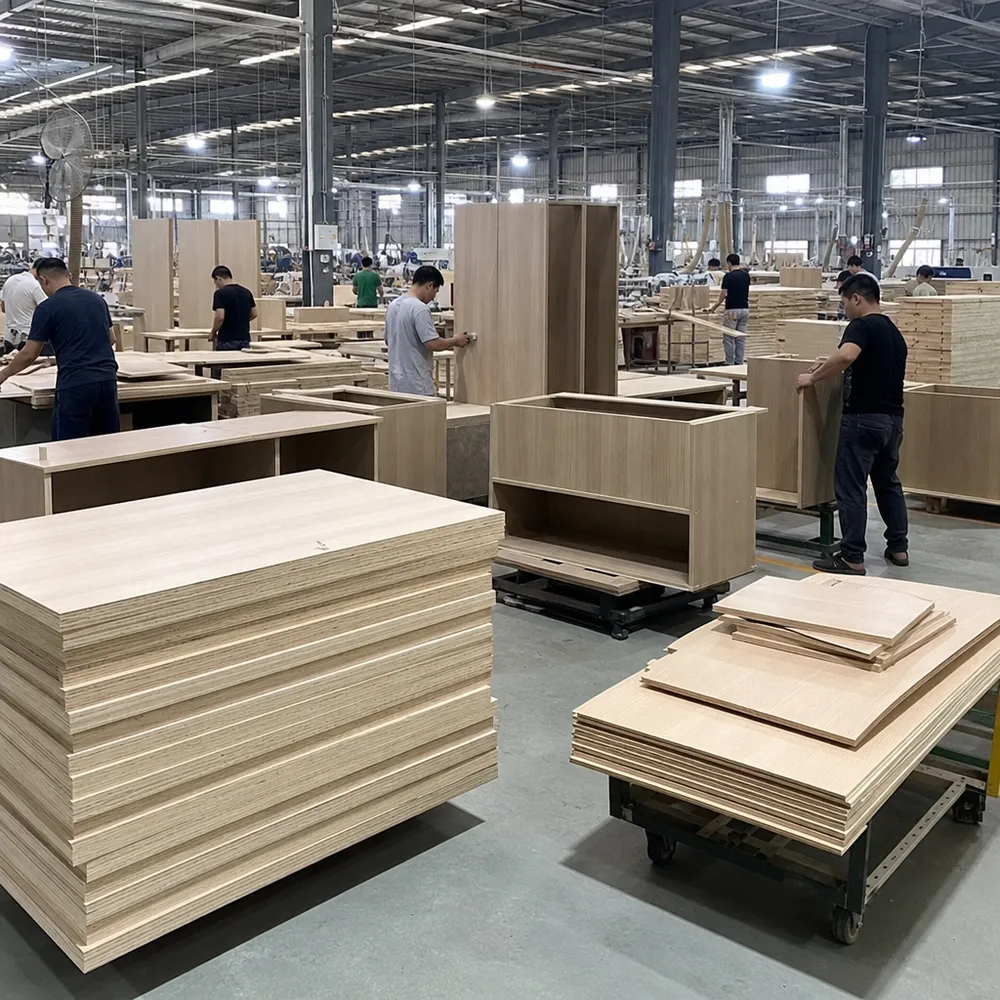
Furniture Manufacturing in Humid Climates
Cabinet carcasses, wardrobe panels, and kitchen furniture built for tropical markets need MR-grade core material to prevent swelling and joint failure. Furniture manufacturers in Vietnam, Indonesia, and Malaysia source MR plywood in high volumes — typically 12mm and 18mm thicknesses for cabinet work, 9mm for drawer bottoms and back panels.
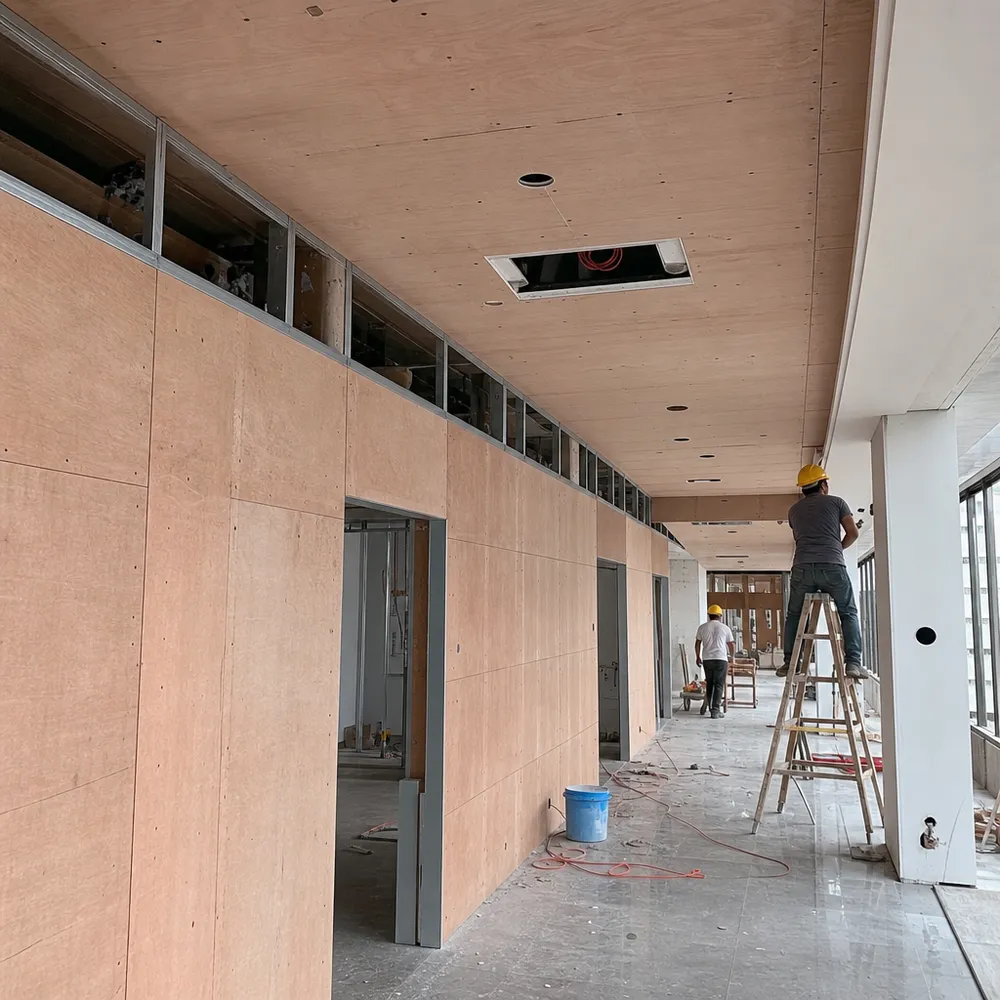
Interior Fit-Out & Commercial Construction
Hotel rooms, retail interiors, and office partitions in humid regions use MR plywood for wall paneling, ceiling substrates, and flooring underlayment. Contractors in these segments specify MR-grade as a minimum for any application where the panel will be enclosed in a wall or ceiling cavity where humidity can accumulate.
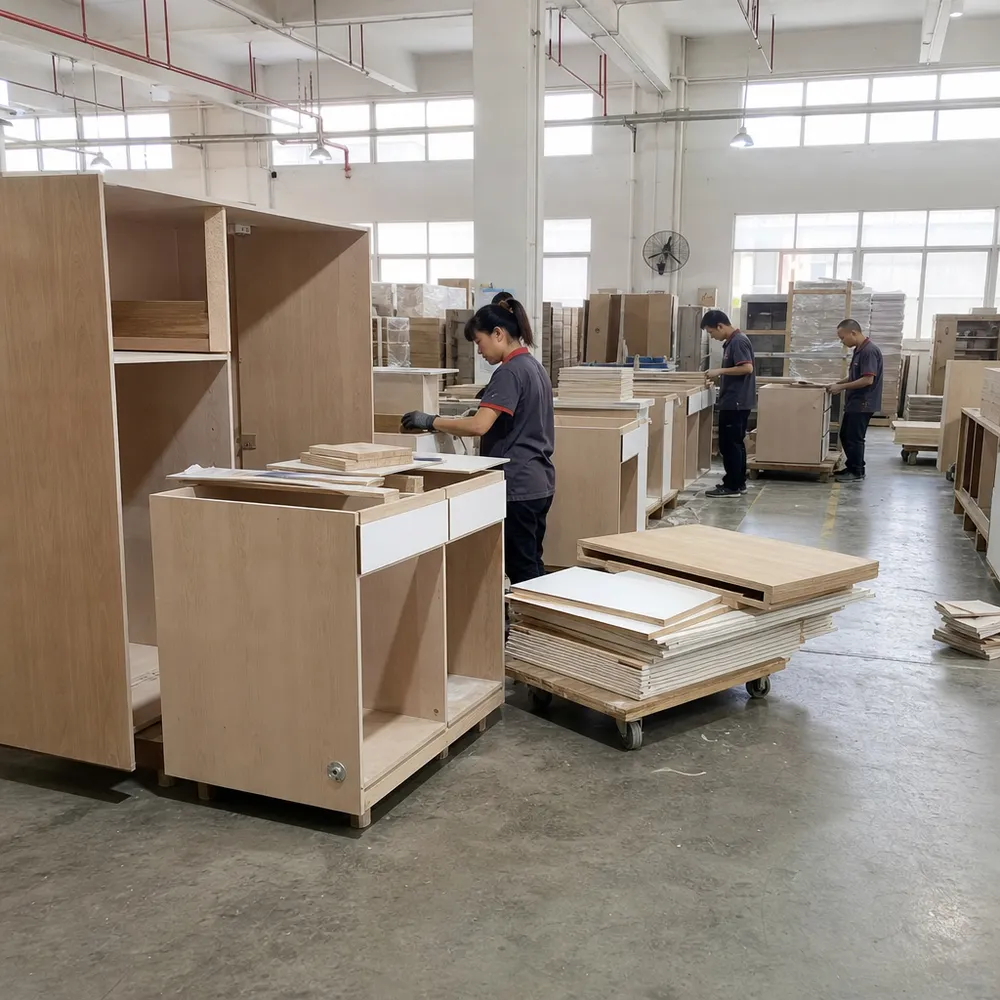
Kitchen & Bathroom Cabinetry for Export Markets
Cabinet manufacturers supplying North American and European markets increasingly specify MR-grade core material for kitchen and bathroom applications, even when the finished product will be installed in temperate climates — the MR spec provides a margin of safety against installation environments that vary from the controlled conditions of a furniture factory.
This spec requirement has increased significantly in the last three years, particularly from buyers supplying the US market.
Tell Us Your Target Market
Order patterns, thickness requirements, and spec priorities differ by segment. Share your target market and application and we'll spec the right configuration for your order.
Customization Options for Your Order
Moisture resistant plywood is one of the more configurable products in our range. The core construction variables — veneer species, thickness, panel size, and surface finish — can all be adjusted without changing the fundamental MR-grade adhesive system.
Thickness
Standard and non-standard runs
Non-standard thicknesses available on confirmed orders with sufficient volume. Minimum for a non-standard thickness run is typically one full container load.
Panel Dimensions
Standard and extended lengths
Non-standard lengths available on confirmed orders. Custom widths are more constrained by press width — confirm with us before specifying non-standard widths.
Face Veneer Species
Surface appearance and hardness
Poplar face is standard for most export markets. Hardwood face veneers are available for orders requiring specific surface appearance or hardness. Face veneer species affects both cost and lead time — confirm availability for your target species before finalizing your order spec.
Core Construction
Density, weight, and screw-holding
Standard. Lighter weight, cost-efficient.
Eucalyptus or mixed tropical hardwood. Higher density and screw-holding strength.
Hardwood face plies with poplar center. Surface quality of hardwood veneer with the weight and cost profile of poplar core.
Surface Finish
From raw to film-faced
Film-faced MR plywood is used where the panel surface will be exposed to direct moisture contact — kitchen cabinet interiors, bathroom wall panels.
Formaldehyde Emission Grade
Market-specific compliance
≤1.5 mg/L — standard production baseline
≤0.05 ppm for hardwood plywood — available for US-bound shipments
≤0.5 mg/L — available for markets with stricter indoor air quality requirements
OEM / Private Label
Custom grade stamps, bundle marking, and private label packaging are available. Most OEM buyers in this product category use custom bundle marking to differentiate their product in the downstream market.
Certifications and Compliance for Your Import Market
The certification stack we hold covers the major import markets for moisture resistant plywood.
ISO 9001:2015
Quality ManagementFull production process coverage
Quality management system certification covering our full production process, from incoming veneer inspection through outgoing shipment verification. Audit reports available on request.
FSC Chain of Custody
SustainabilityWood fiber traceability
Wood fiber traceability to certified forests. Required for buyers supplying into markets with sustainability sourcing policies, or for buyers whose downstream customers carry FSC-certified product claims. FSC documentation is included with shipment on FSC-specified orders.
CARB P2
US MarketCalifornia Air Resources Board Phase 2 — ≤0.05 ppm formaldehyde
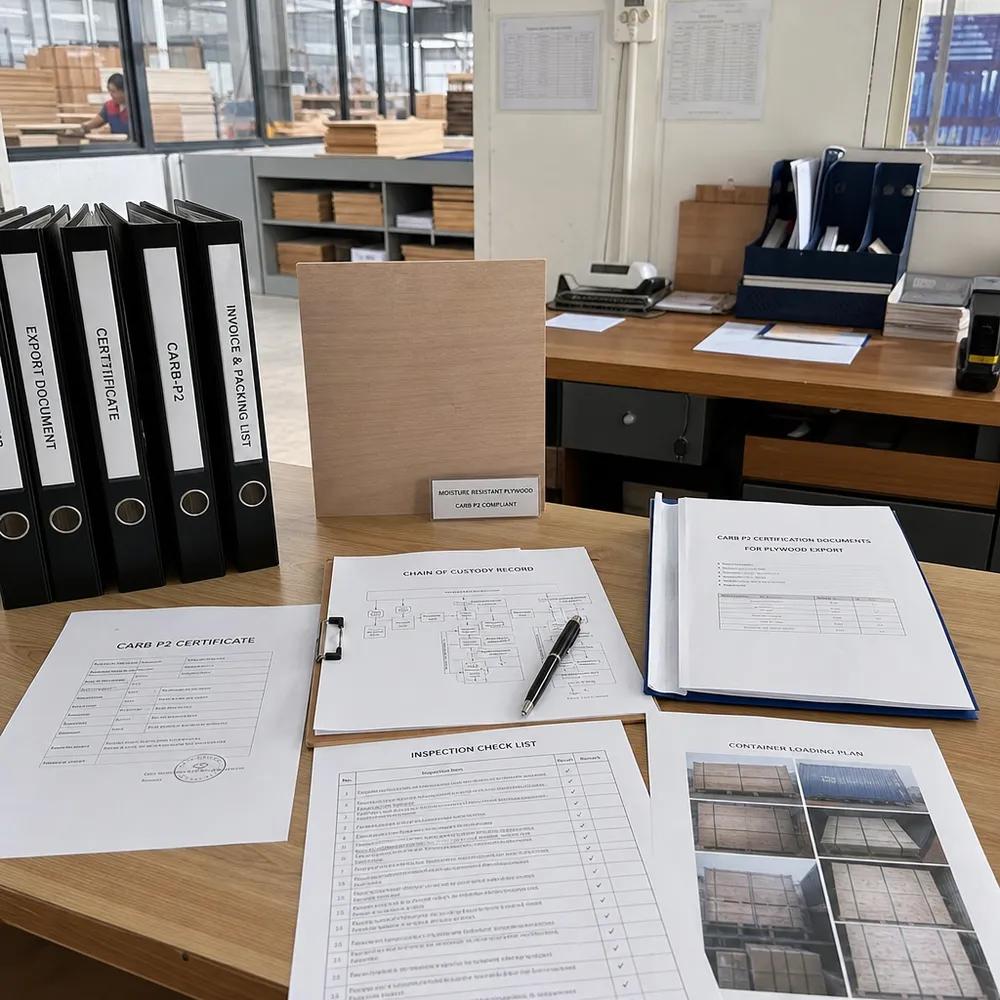
This is the most stringent formaldehyde limit in our export markets, and we formulate to meet it as a production baseline for US-bound shipments. The CARB documentation package — including the composite wood product (CWP) label and chain-of-custody records — is prepared as standard for US shipments.
CARB compliance is a procurement gate for most US distributors and retailers. We've been through enough US customs cycles to know what documentation gaps cause holds.
CE Marking
EU MarketEuropean construction applications
Covers European construction and building material applications. CE declaration of conformity is included with EU-bound shipments.
Other Market Standards
Japan F★★★★ and beyond
For buyers supplying into markets with specific formaldehyde emission requirements beyond E1 — Japan's F★★★★ standard, for example — confirm your target standard at the inquiry stage and we'll verify production capability and documentation.
Packaging, Container Loading, and Landed Cost Factors
Understanding how MR plywood ships — bundle configuration, container utilization, and transit times — helps you model landed cost accurately before placing an order.
Bundle Configuration
Panels are stacked, strapped, and edge-protected with corner boards. For export shipments, bundles are wrapped in moisture-resistant film — this matters for MR plywood specifically, because panels that absorb moisture during ocean transit will arrive outside the 8–12% MC target range, which defeats the purpose of the moisture control process.
Port Departure & Mixed Loads
We ship from Xuzhou to Qingdao, Shanghai, and Lianyungang ports. For mixed-product container loads — MR plywood combined with other panel products — we coordinate consolidated loading to maximize cubic utilization and reduce your per-unit freight cost.
A loading plan is provided with each shipment.
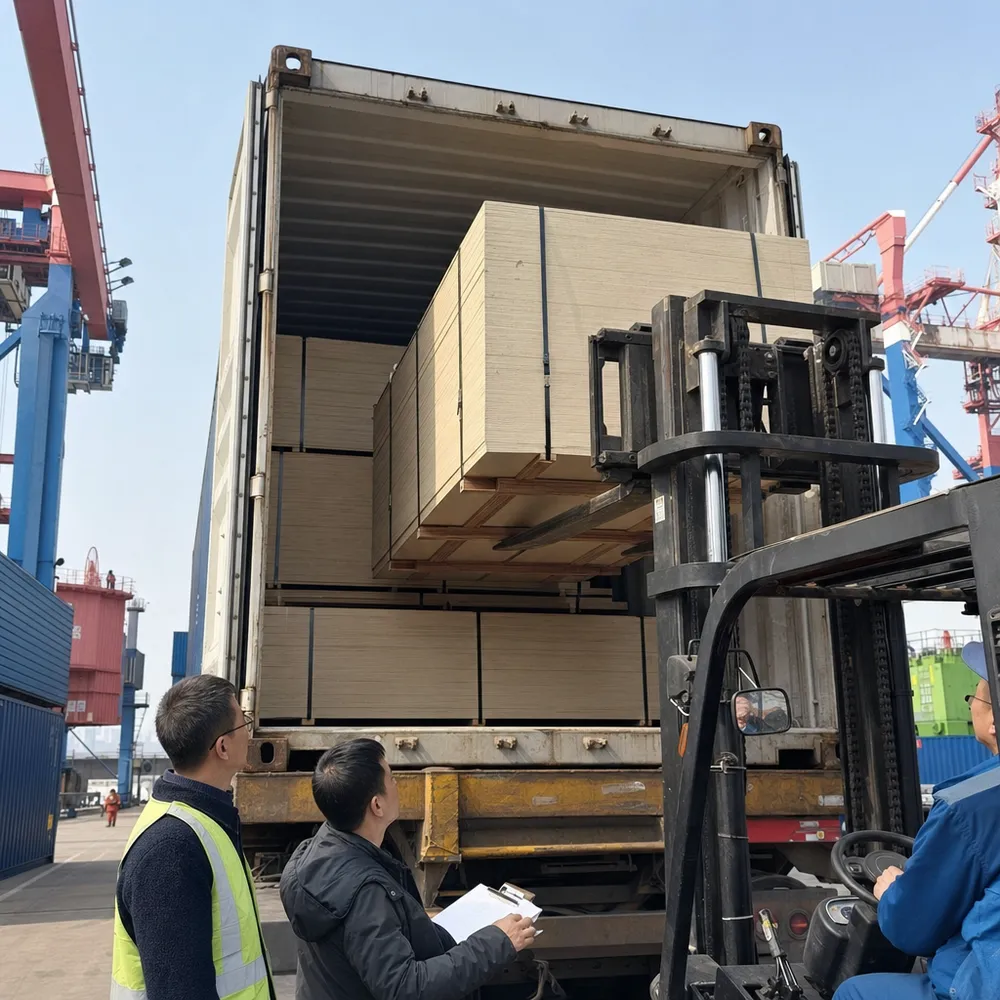
Loading Plan Included
Every shipment comes with a detailed container loading plan showing panel count, stacking configuration, and cubic utilization — so you can verify quantities before the container seals.
Container Loading Quantities — Standard 1220 × 2440mm Panels
| Thickness | Sheets per 40HQ (approx.) |
|---|---|
| 9mm | 2,800 – 3,200 sheets |
| 12mm | 2,100 – 2,400 sheets |
| 15mm | 1,700 – 1,900 sheets |
| 18mm | 1,400 – 1,600 sheets |
Loading quantities vary by panel size and stacking configuration. We provide a loading plan with each shipment.
Transit Times to Major Destination Ports
Moisture Resistant vs. Other Plywood Types: Choosing the Right Spec
If you're sourcing across multiple plywood types, here's how MR plywood sits relative to the sibling products in our commercial plywood range — and the practical decision logic for each application.
| Product | Adhesive | Moisture Performance | Typical Application | Cost Basis |
|---|---|---|---|---|
| Moisture Resistant Plywood Current page | MR-grade UF resin | Intermittent humidity exposure | Furniture, interior construction, humid climates | Mid |
| Marine Plywood | WBP phenolic resin | Continuous water exposure | Boat building, wet areas, exterior | Higher |
| Exterior Plywood | WBP or MR+ resin | Weather exposure, not submersion | Exterior cladding, roofing substrate | Mid-high |
| Interior Plywood | Standard UF resin | Dry interior conditions only | Furniture, cabinetry in temperate climates | Lower |
| Hardwood Plywood | MR or WBP | Varies by spec | Premium furniture, decorative applications | Higher |
The Practical Decision
Choose MR Plywood When:
- Kitchens, bathrooms, or humid-climate construction
- Tropical market distribution
- Intermittent humidity exposure — not direct water contact
- Mid-range cost-performance balance is the priority
Step Up to Marine / Exterior When:
- Direct water contact or submersion is involved
- Exterior weather exposure (rain, UV, freeze-thaw cycles)
- Boat building or marine-grade structural applications
Step Down to Interior When:
- Dry interior furniture in a temperate climate
- No humidity exposure risk in the end-use environment
- Lower cost basis is the primary sourcing driver
Sourcing across multiple plywood types?
Browse the full commercial plywood range to compare specs and request a consolidated quote.
Sourcing Reliability: What 6 Lines and 450,000 m³ Capacity Means for Your Order
Capacity numbers only matter if they translate to consistent execution on your specific order. Here's how our production infrastructure maps to your sourcing requirements.
Dedicated Line Production
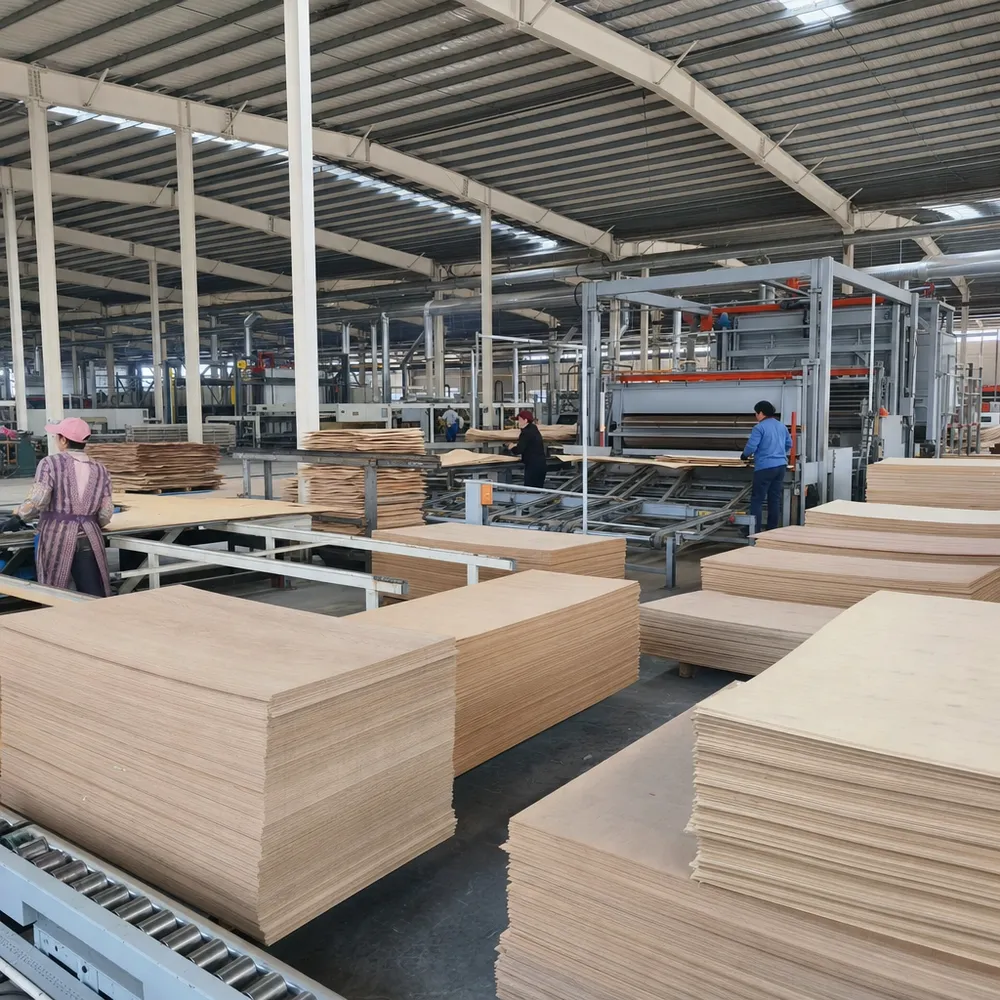
6 production lines running at 450,000 m³ annual capacity means your container-volume order runs on a dedicated line without competing with other buyers' schedules.
For MR plywood specifically — where batch-to-batch MC consistency is the critical variable — dedicated line production also means consistent press parameters across your full order volume. We don't split a single order across lines with different calibration states.
Three-Stage QC Process
220 employees across production, QC, logistics, and technical support. The QC team runs three inspection stages:
-
1
Incoming Veneer
Species verification, MC measurement, surface grading
-
2
In-Process
Glue spread weight at layup, delamination and blister check post-press
-
3
Outgoing
Thickness at multiple points, surface grade, formaldehyde emission, MC verification
Export batches are inspected against the purchase order specification before container loading.
Port Access & Logistics
Our facility in Sanbao Industrial Park, Xuzhou, has direct rail and road access to Qingdao, Shanghai, and Lianyungang ports — the logistics infrastructure that keeps transit time predictable and freight cost competitive for your market.
Direct rail access
Road access
Direct rail and road access
What This Means for Your Order
No schedule competition. Container-volume orders run on a dedicated line. Your MC spec and press parameters don't drift mid-order because another buyer's run is sharing the same line.
Spec-verified before loading. Every export batch is inspected against your purchase order specification before the container is loaded — not after it arrives at your port.
Predictable transit. Multi-port access means we route your container through the most cost-efficient and schedule-reliable option for your destination market.
Technical support on spec questions. 220 employees includes technical staff who can answer specification questions before and after your order — not just a sales team.
Frequently Asked Questions
Specification and sourcing questions we hear from importers, distributors, and procurement teams. If your question isn't here, contact us directly.
MR (moisture resistant) plywood uses urea-formaldehyde adhesive that resists intermittent humidity and moisture exposure — it won't delaminate in a humid environment under normal use conditions.
WBP (weather and boil proof) plywood uses phenolic resin adhesive that withstands continuous water exposure and exterior weather conditions.
For interior applications in humid climates — kitchens, bathrooms, tropical market furniture — MR-grade is the right spec and carries a lower cost basis than WBP. For applications involving direct water contact, submersion, or exterior exposure, specify WBP or marine grade.
Intermittent humidity, interior humid climates, kitchens, bathrooms, furniture
Direct water contact, submersion, exterior exposure, continuous wet conditions
Target MC range
8–12% MC is the target range for export-grade MR plywood going to humid destination markets.
Panels shipped above 12% MC will continue to dry after arrival, causing shrinkage and potential joint gaps in furniture applications. Panels shipped below 8% MC will absorb ambient humidity at the destination, causing swelling.
The 8–12% range is tight enough to remain dimensionally stable through the humidity cycling typical of tropical and Gulf climates.
Confirm MC specification at the inquiry stage — not all suppliers hold this range as a production standard.
CARB P2 is the applicable standard for hardwood plywood sold in California and, effectively, across the US market — most distributors and retailers require CARB compliance regardless of destination state.
Formaldehyde (hardwood plywood)
Our standard MR production
Our standard MR plywood production meets E1 (≤1.5 mg/L). CARB P2 production is available and we prepare the full CARB documentation package for US-bound shipments.
Specify CARB P2 at the inquiry stage to ensure correct production grade and documentation.
Standard production runs are container-load quantities — one 40HQ container is the typical minimum for a first order.
For buyers evaluating the product before committing to container volume, we can arrange sample panels for specification verification.
Contact us to discuss sample arrangements for your target specification before placing a container-load order.
Yes — this is one of the primary applications. 18mm MR plywood is the standard specification for cabinet carcasses in tropical and humid-climate markets. The MR-grade adhesive prevents delamination from kitchen humidity cycling; the 8–12% MC target prevents swelling at joints.
If the cabinet interior will be exposed to direct water splash — under-sink cabinets, for example — consider film-faced MR plywood or step up to WBP-grade for those specific components.
working days
Standard production lead time for MR plywood from order confirmation, depending on specification and current production schedule.
Custom specifications — non-standard thickness, specific face veneer species, CARB P2 grade — may require additional lead time for material sourcing.
Lead time is confirmed at the quotation stage based on your specific order requirements. Contact us with your specification to get an accurate timeline.
Related Plywood Products
Request a Quote
Ready to Source MR Plywood?
Send us your specification — thickness, sheet size, face grade, and destination market — and we'll return a detailed quotation with lead time and documentation options within one business day.
Get a Quote for Moisture Resistant Plywood
Send us your target specification and we'll come back with a detailed FOB quote and the relevant certification documentation for your import requirements.
What to Include in Your Enquiry
Send us your target specification and we'll come back with a detailed FOB quote and the relevant certification documentation for your import requirements.
-
Thickness — e.g. 12mm, 18mm, 25mm
-
Panel size — standard 4×8 ft or custom dimensions
-
Face veneer species — poplar, eucalyptus, hardwood face
-
Emission grade — E0, E1, CARB P2, or F★★★★
-
Destination market — country and port of discharge
-
Estimated volume — container quantity or m³ per order
New to Sourcing MR Plywood from China?
Tell us your target market and the application your downstream customers are using it for — we'll recommend the right spec and suggest a starter order configuration based on what's moving for our existing distributors in that region.
Xuzhou QD Wood Industry Co., Ltd.
Sanbao Industrial Park, Tongshan District, Xuzhou, Jiangsu Province, China
Xuzhou, Jiangsu Province, 221116, China
Certifications & Compliance
Explore More Commercial Plywood