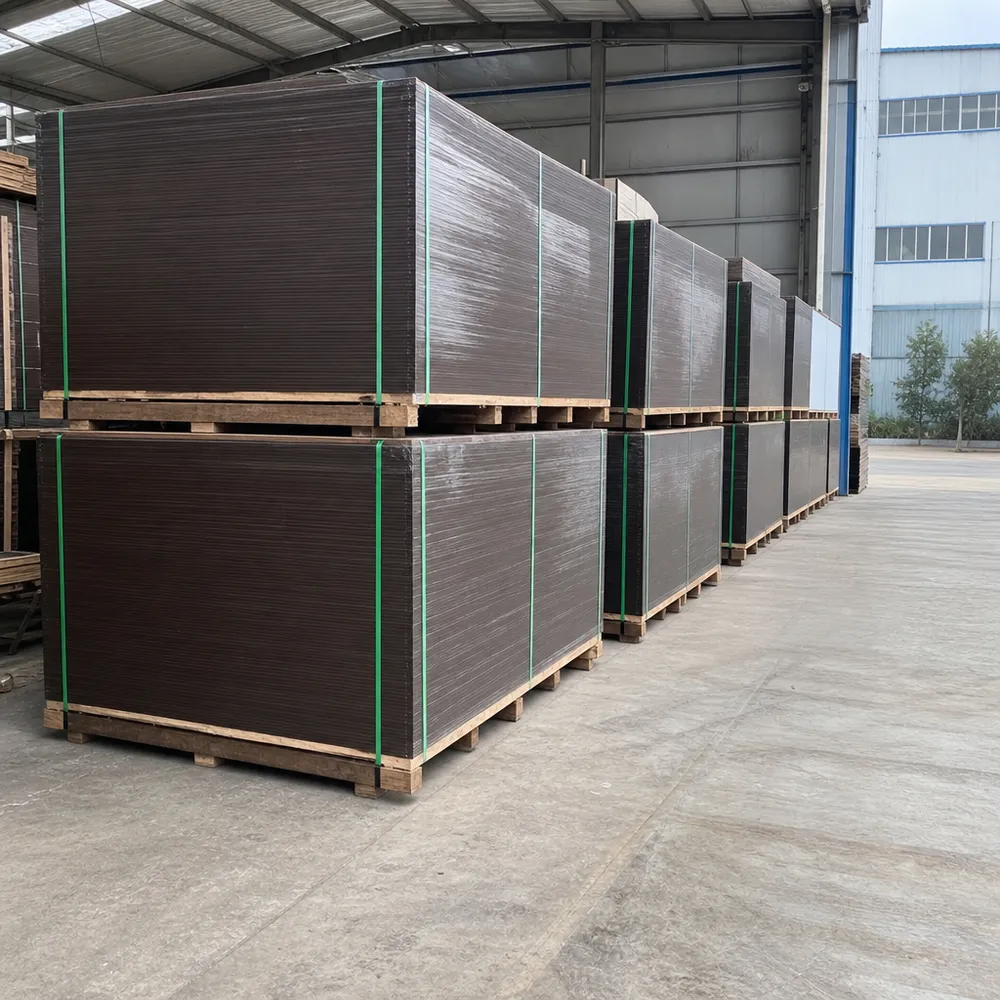
Shuttering Film Faced Plywood Manufacturer
Factory-direct shuttering film faced plywood built for concrete formwork — consistent release, structural rigidity, and reuse cycles that protect your project margin.
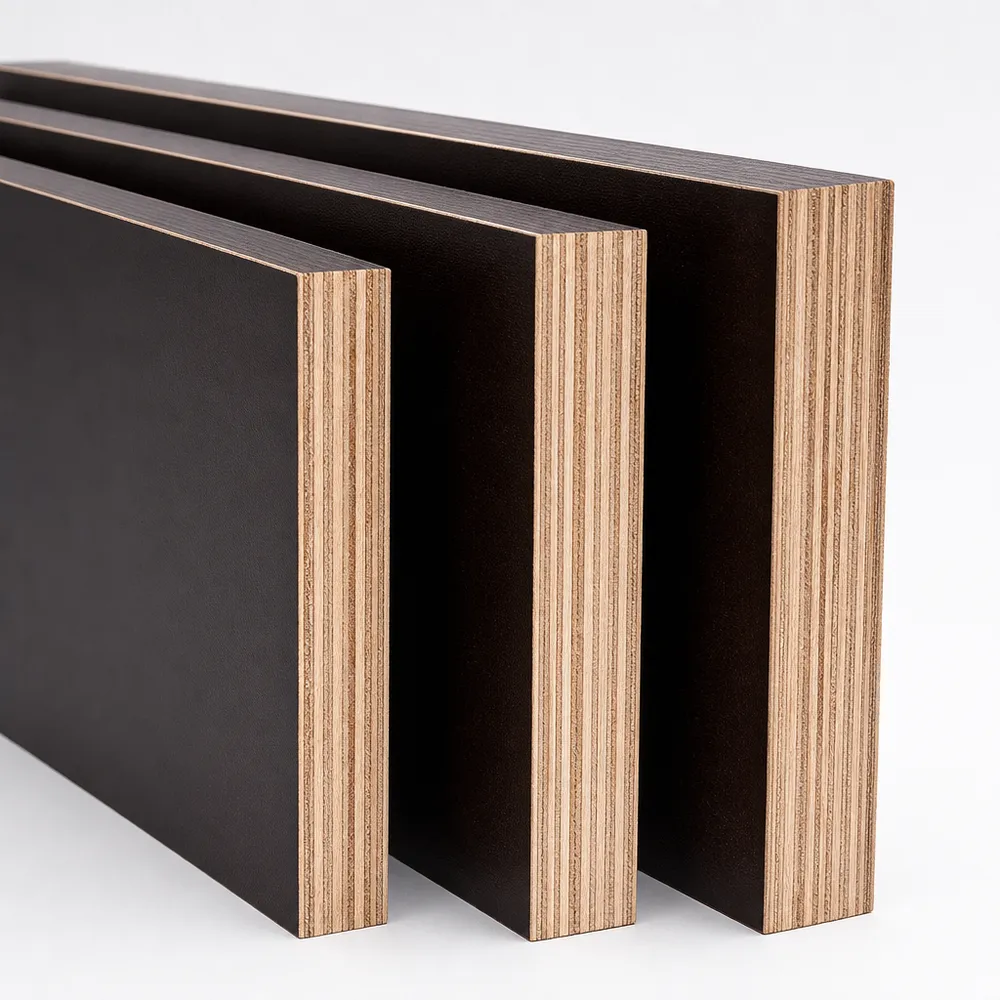
Phenolic film surface, WBP-bonded hardwood core, 12–21mm thickness range. ISO 9001:2015, CE, and FSC certified.
What Shuttering Film Faced Plywood Is — and Where It Sits in the Film-Faced Range
Understanding the structural and commercial position of shuttering plywood within the broader film-faced category — so you source the right specification for your application.
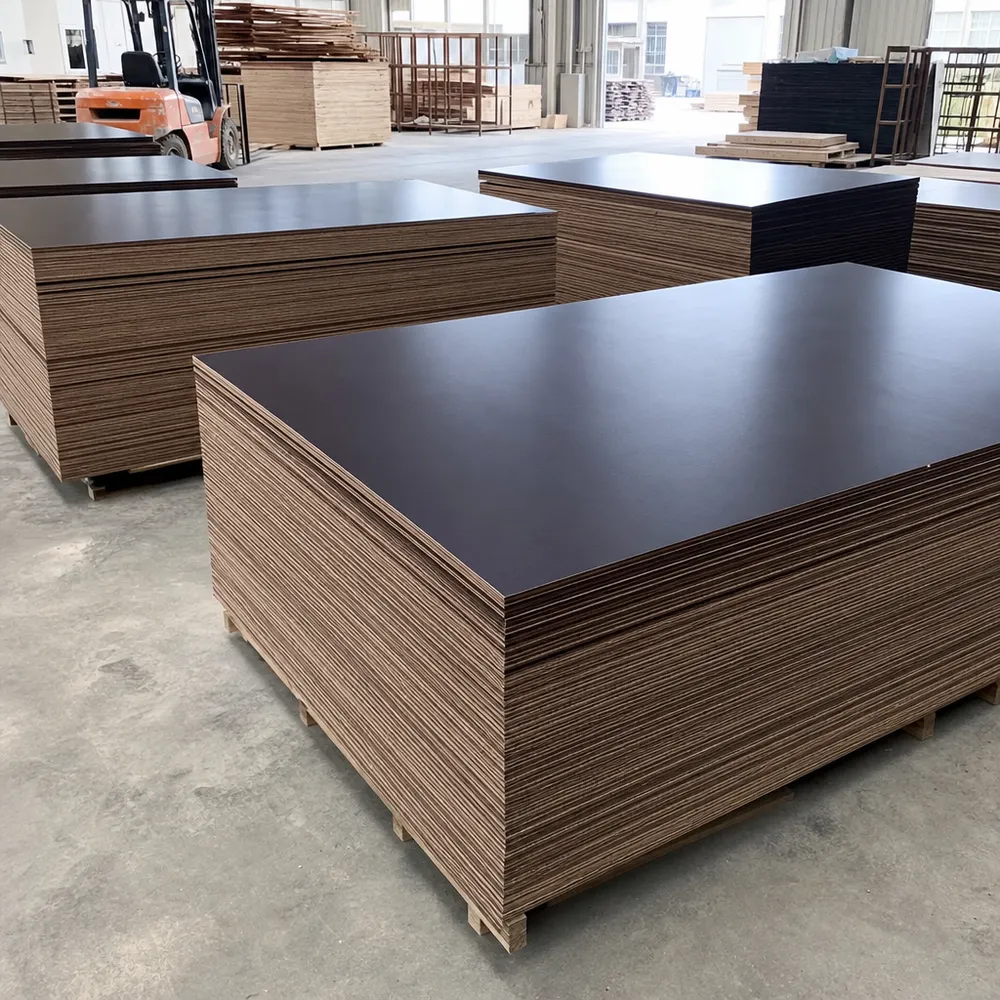
Shuttering film faced plywood is the construction-grade variant of film-faced plywood, engineered specifically for concrete formwork applications where the panel must withstand repeated pour cycles, moisture exposure, and the mechanical stress of stripping without surface failure. The defining characteristic is the phenolic resin film bonded to both faces — it creates a hard, non-absorbent surface that releases cleanly from cured concrete and resists the alkaline chemistry of cement paste.
Within our film-faced plywood range, shuttering plywood occupies the structural-use tier. It's not the same product as decorative film-faced plywood or melamine-overlaid panels — the film weight is heavier (typically 120–220 g/m²), the core construction prioritizes cross-grain rigidity over surface aesthetics, and the glue system is WBP (weather and boil proof) phenolic resin throughout, not just at the face layers.
If you're sourcing for concrete formwork, scaffolding decking, or slab shuttering, this is the product. If your application is furniture backing or interior cladding, our waterproof film faced plywood or phenolic film faced plywood pages cover those use cases.
The Commercial Logic for Your Business
Shuttering plywood is a consumable in construction supply chains, but the reuse count per panel directly determines your buyer's cost-per-pour. A panel that delivers 8–12 clean release cycles versus one that delaminates after 3–4 cycles is not a marginal quality difference — it's a 2–3× difference in the effective unit cost your customer is paying. That's the number your downstream buyers are calculating when they evaluate suppliers.
Technical Specifications
Industry-standard parameters for shuttering film faced plywood. Actual specifications are confirmed at order stage — contact us for a detailed product data sheet.
Standard Specification Table
Values shown are industry-standard for this product type
Specifications shown are industry-standard values for this product type. Actual specifications may vary by order. Contact us for detailed product data sheets and test reports.
Thickness Selection Guide
Which spec moves in which market — and why
Moves heavily into Southeast Asian markets for slab decking on elevated scaffolding where panel weight is a handling constraint.
The dominant global specification. Balances stiffness, weight, and reuse cycles for column boxing, wall panels, and beam sides across most commercial construction markets.
Specified for high-pressure pours, deep beams, and infrastructure projects where deflection under load is the primary engineering concern.
Formwork Applications
Shuttering film faced plywood is specified across concrete construction wherever a smooth release surface, dimensional stability, and multi-cycle reuse are required.
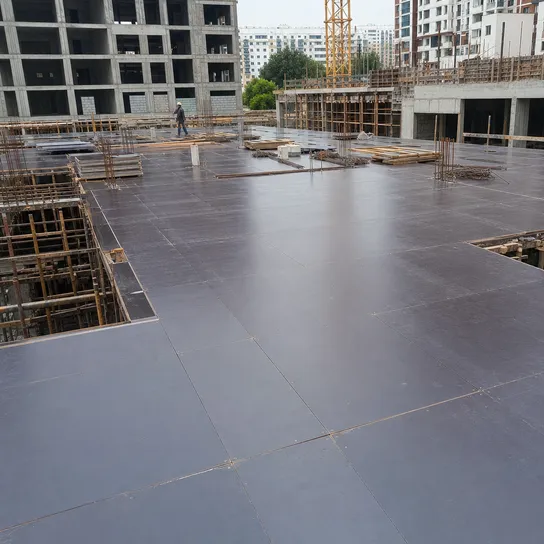
Slab Formwork
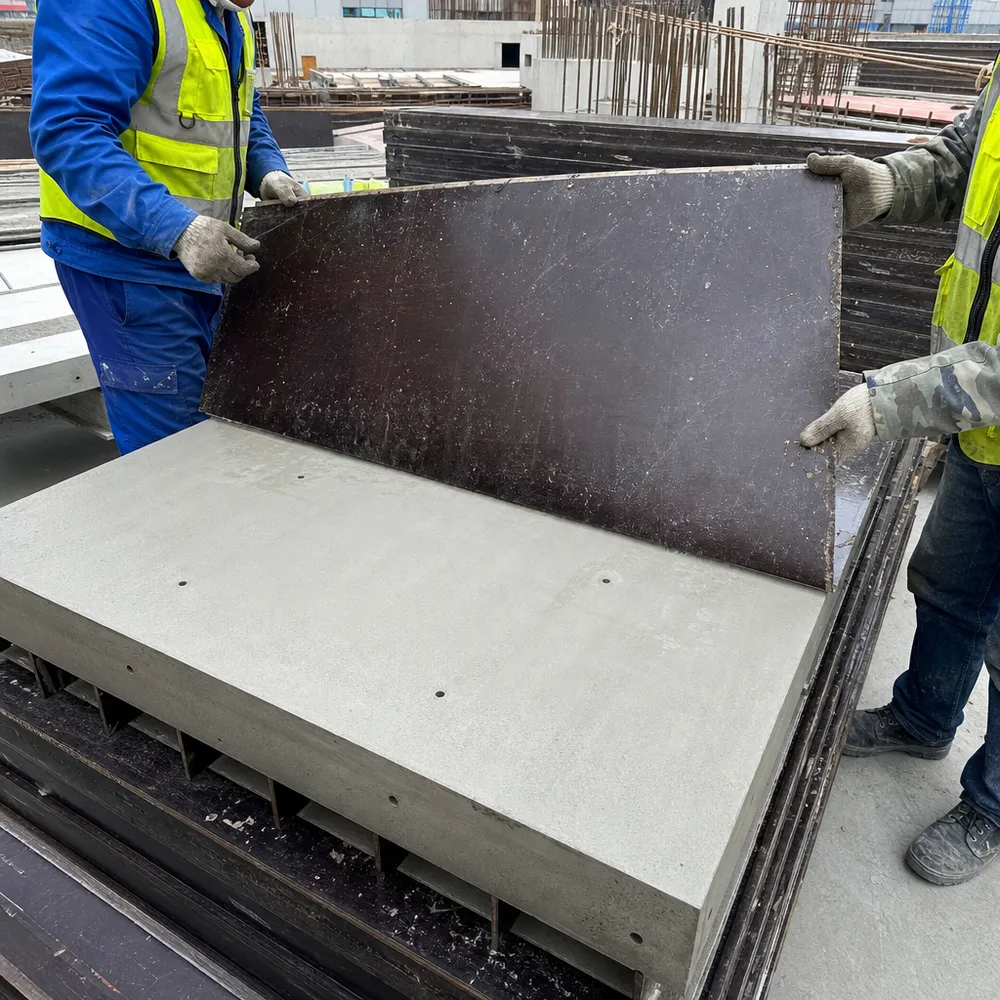
Horizontal deck panels for suspended slabs and ground-floor pours. The smooth phenolic surface releases cleanly without chemical agents, reducing cycle time between pours.
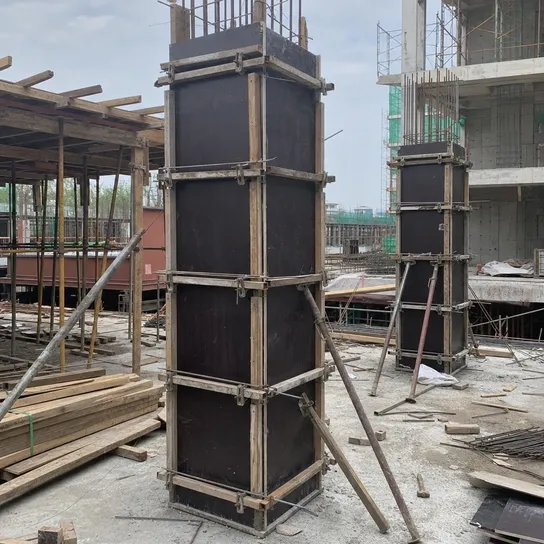
Column Boxing
Square and rectangular column forms where panel rigidity prevents bulging under lateral concrete pressure. 18mm is the standard specification for most column heights.
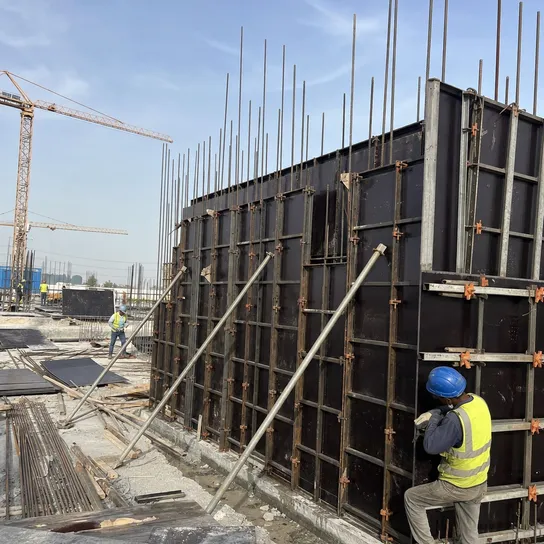
Wall Panels
Vertical wall forms for shear walls, retaining walls, and core walls. The WBP glue system ensures panels remain stable through repeated wet-dry cycles on site.
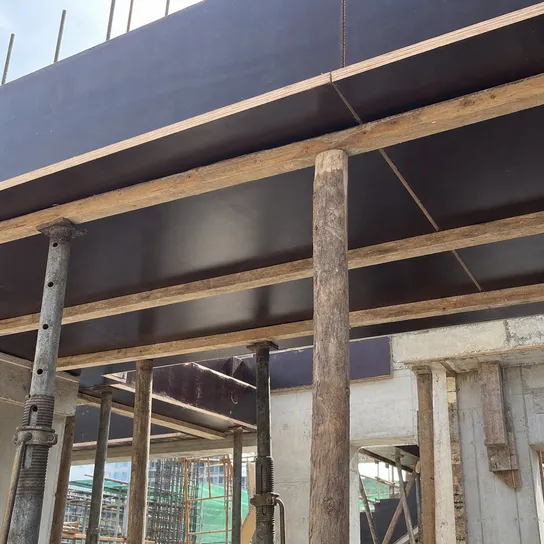
Beam Sides & Soffits
Beam bottom boards and side cheeks where a fair-faced concrete finish is required. The film surface produces a consistent texture that minimises remedial work after striking.
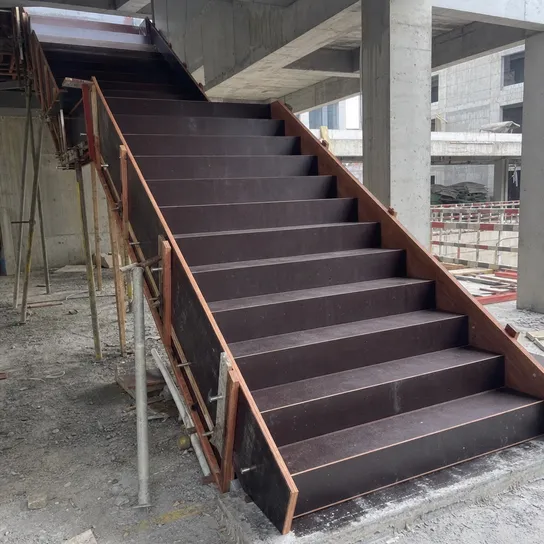
Staircase Formwork
Soffit and riser boards for in-situ concrete staircases. Panels are cut to profile on site — the sealed edge treatment on export-grade panels reduces moisture ingress at cut edges.

Infrastructure & Civil
Bridge decks, culverts, retaining structures, and tunnel linings where high pour pressures and extended form-in-place periods demand maximum panel rigidity and moisture resistance.
Shuttering film faced plywood is an engineered structural panel for concrete formwork. The phenolic film surface is optimised for concrete release, not aesthetics. For interior cladding, furniture, or decorative applications, see our Phenolic Film Faced Plywood range.
Sourcing & Supply
We source shuttering film faced plywood from audited mills in China, Indonesia, and Vietnam — markets where hardwood veneer supply, phenolic film technology, and export infrastructure are mature.
Mill Auditing
Production facilities are assessed against film weight consistency, glue penetration depth, and veneer grading before orders are placed. We do not source from mills that cannot provide third-party test reports.
Pre-Shipment Inspection
Third-party inspection at origin covers thickness calibration, film adhesion, moisture content, and panel squareness before container loading. Inspection reports are available on request.
Container & Packing
Panels are palletised, corner-protected, and stretch-wrapped for 20ft and 40ft container loading. Standard packing lists, phytosanitary certificates, and fumigation records are included with each shipment.
Order Parameters
Typical MOQ, lead times, and container volumes — confirmed at enquiry stage
Lead times and container volumes are indicative. Confirmed figures are provided at enquiry stage based on current mill capacity and destination port.
How We Manufacture Shuttering Plywood —
and Why the Process Decisions Matter
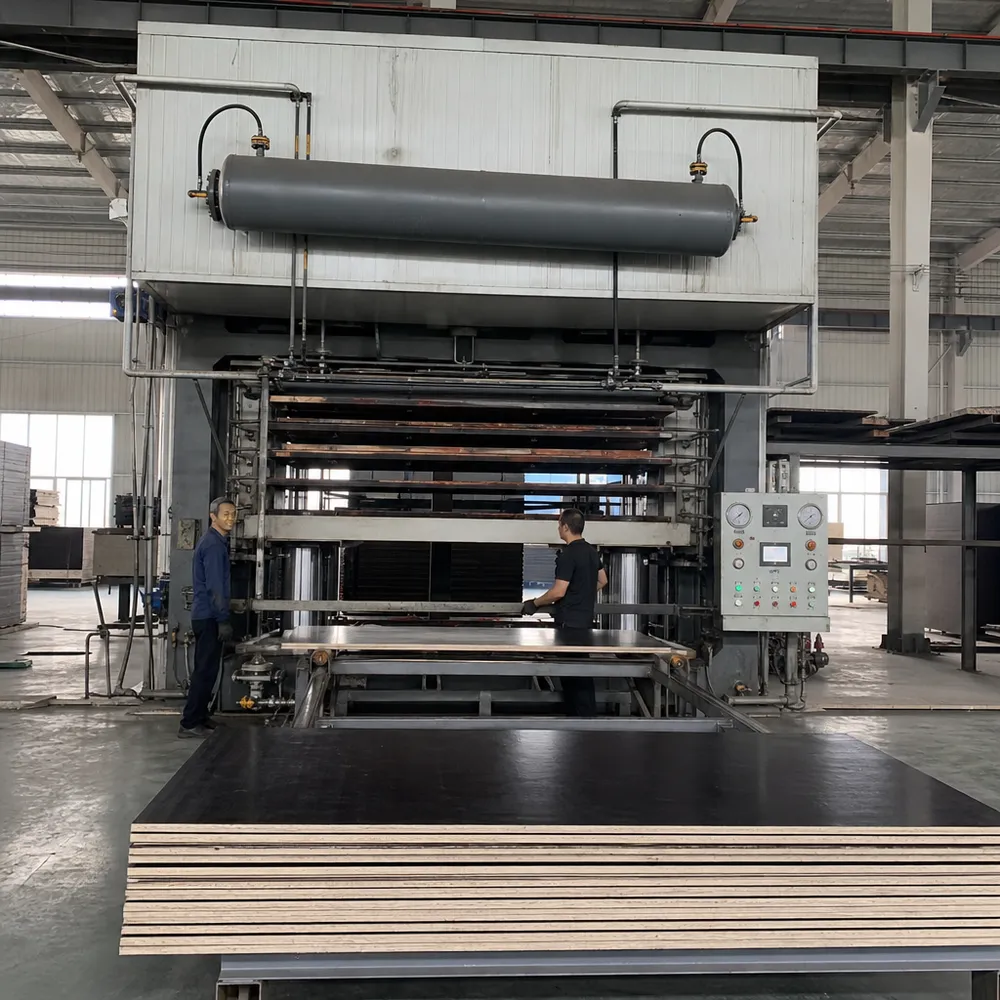
The reuse performance of shuttering plywood comes down to three manufacturing variables: film adhesion quality, core veneer moisture at press time, and glue spread consistency. We've been running this product since 2008, and the failure modes we've seen in the market almost always trace back to one of these three.
Film Adhesion Quality
This is where most low-cost shuttering plywood fails. The phenolic film has to be pressed onto the face veneer at the right temperature and pressure to achieve a chemical bond, not just a mechanical one. A mechanically bonded film will peel at the edges after the first few pour cycles — you'll see it as film lifting at the corners and along cut edges.
We run our film overlay lamination line at controlled press temperatures with calibrated pressure distribution across the full 1220×2440mm panel surface.
Cross-cut adhesion test on every batch: a grid of cuts is made through the film, tape is applied and pulled, and any film lift fails the panel. It catches adhesion failures before panels leave the factory — not on your customer's job site.
Core Veneer Moisture
This is the variable that causes thickness instability and delamination in the field. We dry core veneers to target moisture content before layup — the same controlled drying process we use across our full film-faced range.
Panels pressed with wet core veneers will pass a visual inspection at the factory but develop internal stress as the moisture equalizes after pressing, which shows up as warping or delamination under the thermal cycling of a concrete pour.
Press parameters are logged per batch. If a bonding issue surfaces downstream, we can trace it to the specific production run and identify whether it was a veneer moisture deviation or a press parameter issue.
Glue Spread Consistency
We use automated glue spreading on the core veneer layers — the spread weight is checked against specification at the start of each production run.
- Too light: bond failure under the shear stress of concrete stripping
- Too heavy: bleed-through that contaminates the face veneer before the film overlay goes on
The automated spreader holds tighter tolerances than manual application — one of the reasons our delamination rate on export batches is consistently low.
What This Means for Your Buyers
The result is a panel that performs predictably across its reuse cycle — not just on the first pour. For your buyers, that predictability is what justifies the price premium over commodity shuttering plywood.
Traceability on Every Export Batch
Press parameters, veneer moisture logs, and adhesion test records are retained per production run. If a quality question arises after delivery, we can pull the batch record and identify the root cause — not just offer a replacement.
Application Segments and the Commercial Opportunity Behind Each
Shuttering film faced plywood moves through several distinct channels, and the commercial dynamics differ enough that it's worth understanding which segment your business is targeting.
Infrastructure & Civil Construction Supply
Road bridges, tunnels, retaining walls, and large-scale concrete structures consume shuttering plywood in bulk — a single bridge project can run 5,000–15,000 sheets. Buyers in this segment are typically specialist formwork contractors or construction material distributors supplying to them.
The key commercial variable is reuse count: contractors on long-duration projects amortize panel cost across many pours, so they pay attention to panel quality in a way that smaller residential contractors often don't.
Our 8–12 reuse cycle performance is a direct margin argument here, not just a spec point. Buyers in this segment will calculate cost-per-pour and compare suppliers on that basis.
Residential & Commercial Building Contractors
Slab formwork, column boxing, wall shuttering — standard construction applications where 18mm shuttering plywood is the default specification. Distributors supplying this segment typically stock 18mm in 1220×2440mm as their core SKU and supplement with 12mm and 15mm for specific applications.
Reorder frequency is high and relatively predictable, which makes this a stable distribution business once you've established the supply relationship.
Precast Concrete Manufacturers
Precast plants run high-volume, repetitive pour cycles — the same form used dozens of times per week. Panel consistency matters more here than in site-poured applications because dimensional variation in the shuttering translates directly into dimensional variation in the precast element.
This segment is particularly active in markets with ongoing infrastructure investment.
Our ±0.2mm thickness tolerance and consistent film adhesion are directly relevant to this buyer's quality requirements — not just marketing language.
Export & Re-Distribution
Shuttering plywood is a commodity in terms of specification, but not in terms of quality consistency — the market has significant variation in actual reuse performance versus claimed performance. Buyers who've been burned by low-reuse panels are actively looking for a reliable source.
That's a margin opportunity for distributors who can credibly differentiate on quality. This segment has grown steadily over the past several years as construction activity in the Middle East and Southeast Asia has expanded — worth paying attention to if you're building your distribution footprint in those regions.

Choosing the Right Segment Focus
Most distributors start with residential and commercial building supply — it's the most accessible entry point with predictable reorder cycles. Infrastructure and precast segments require more technical selling but offer larger order sizes and stickier customer relationships once established.
If you're building a regional distribution business, the export and re-distribution segment rewards suppliers who can demonstrate consistent quality across batches — which is exactly where our batch traceability and QC documentation become a commercial differentiator, not just a compliance checkbox.
Customization Parameters and What They Mean for Your Order
Standard shuttering plywood is a relatively constrained product — the core specification is well-established and most buyers are working within it. But there are several customization dimensions that come up regularly and are worth understanding before you inquire.
Film Color and Weight
120–220 g/m² rangeBrown phenolic film is the standard. Black film is available and is common in certain markets (parts of Europe and the Middle East) where it's associated with premium positioning.
Film weight can be specified within the 120–220 g/m² range — heavier film improves abrasion resistance and extends reuse cycles, lighter film reduces panel weight and cost.
Panel Dimensions
Cut-to-size availableStandard 1220×2440mm loads efficiently into 20HQ and 40HQ containers and is the default for most markets.
Core Species
Confirmed ordersHardwood core is standard. Buyers targeting premium positioning or specific structural performance requirements sometimes specify alternative species.
Higher density and bending stiffness — suited to structural performance requirements
Lower weight — useful where panel handling and transport weight matter
Branding and Marking
OEM availableOEM branding (logo, specification marking, color coding) is available. Some distributors use branded panels as a differentiation tool in their market.
OEM branding doesn't affect lead time significantly — it's a low-friction differentiation option for distributors building market position.
Volume Thresholds and Lead Time
Customization below certain volume thresholds affects lead time and MOQ. Contact us with your specific requirements and we'll confirm feasibility and lead time.
Certifications and Compliance for Your Import Market
The certifications we hold on shuttering film faced plywood: ISO 9001:2015, CE, FSC (Chain of Custody), CARB P2. Here's what each one means for your import documentation and buyer requirements.
CE Marking
EU Construction ProductsCE marking covers European construction product regulations. For shuttering plywood sold into EU markets, CE marking under EN 13986 (wood-based panels for use in construction) is the compliance gate.
Our CE certification covers this product category, so your EU import documentation is straightforward.
FSC Chain of Custody
Sustainability SourcingFSC Chain of Custody is relevant if your buyers have sustainability sourcing policies or if you're supplying into markets where deforestation-linked supply chains are a procurement or reputational risk.
The FSC certificate covers the wood fiber traceability from certified forests through our production process.
P2
CARB P2
US Market StandardCARB P2 covers formaldehyde emission limits for the US market. Our shuttering plywood meets CARB P2 as standard — we formulate to this limit across our product range rather than as a special option.
For US-bound shipments, we prepare the CARB documentation package as standard — no special request needed.
ISO 9001:2015
Quality Management SystemISO 9001:2015 covers our quality management system — the process controls, inspection protocols, and batch traceability that underpin the product-level certifications above.
It's the operational foundation that makes the CE, FSC, and CARB certifications credible and auditable.
Third-Party Inspection
Available on request
We work with SGS, Bureau Veritas, and similar agencies. Third-party inspection can be arranged on request for buyers who require independent verification before shipment.
Documentation Policy
We don't make buyers chase paperwork
Audit reports and test certificates are available on request. We prepare documentation proactively — CARB packages for US shipments, CE documentation for EU shipments — without requiring buyers to follow up repeatedly.
For a full overview of our certification infrastructure and quality process, see our manufacturing capabilities page.
Manufacturing CapabilitiesPackaging, Container Loading, and Landed Cost Efficiency
How panels are bundled, loaded, and documented directly affects your landed cost and customs clearance speed. Here's what to expect from every shipment.
Bundle Specification
Shuttering plywood ships in bundles of 50–100 sheets depending on thickness, strapped and edge-protected with corner boards, wrapped in moisture-resistant film. Each bundle is marked with:
- Product specification and thickness
- Quantity and batch number
- Destination port
Edge sealing is applied on export-grade panels to prevent moisture ingress during ocean transit — relevant for shipments to humid climates where panels may sit in port storage before delivery.
Port Connections from Xuzhou
Xuzhou connects to Qingdao, Shanghai, and Lianyungang ports. Transit times to major destination ports run 18–35 days depending on routing and destination.
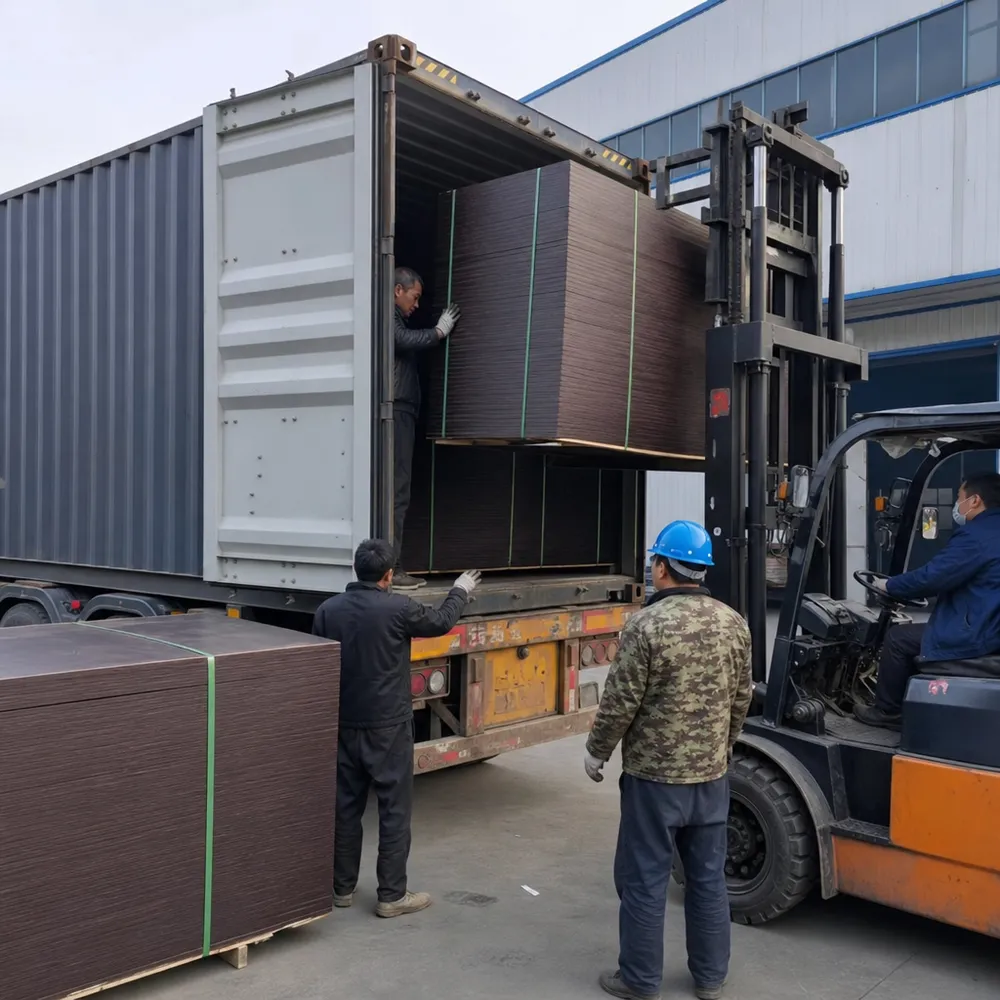
We provide loading plans with each shipment so your receiving team knows exactly what to expect. For buyers ordering mixed thicknesses or mixed product types, we coordinate consolidated loads to reduce per-unit freight cost.
Container Loading Capacity
Standard 1220×2440mm panels. Loading quantities are approximate and depend on bundle configuration.
| Container Type | Panel Thickness | Approx. Sheet Count |
|---|---|---|
| 20HQ | 12mm | ~1,100 sheets |
| 20HQ | 18mm | ~750 sheets |
| 40HQ | 12mm | ~2,300 sheets |
| 40HQ | 18mm | ~1,550 sheets |
Export Documentation Package
We've been through enough customs clearance cycles in these markets to know what documentation gaps cause delays. The paperwork is prepared to avoid them.
Shuttering Plywood vs. Other Film-Faced Products: Choosing the Right Specification
If you're evaluating shuttering film faced plywood alongside other products in our film-faced range, here's how the positioning breaks down — and when to recommend each to your buyers.
Shuttering Film Faced Plywood
Concrete formwork, repeated pour cycles
WBP glue throughout, heavy phenolic film, structural rigidity. Right choice when reuse cycle performance in standard concrete formwork is the primary concern.
Phenolic Film Faced Plywood
High-performance formwork, premium applications
Higher film weight options, tighter tolerances. Worth considering when buyers need a higher-specification product for premium or structural applications.
Brown Film Faced Plywood
General construction, cost-sensitive markets
Standard brown film, competitive price point. Covers the position when buyers are price-sensitive and reuse count is less critical.
Waterproof Film Faced Plywood
Wet environments, marine-adjacent applications
Enhanced moisture resistance, edge sealing. Specified when the application involves sustained water exposure beyond standard formwork conditions.
Structural Film Faced Plywood
Load-bearing structural applications
Higher density core, engineered for structural loads. Step up from shuttering when the application demands certified load-bearing performance.
18mm Film Faced Plywood
Standard wall and column formwork
Thickness-specific sourcing, most common construction spec. Useful when buyers are sourcing to a specific thickness requirement rather than a product category.
Three decision paths cover most buyer scenarios in this product range.
Shuttering plywood is the right choice. WBP glue and heavy phenolic film are built for repeated pour cycles.
Consider phenolic or structural variants. Higher film weight, tighter tolerances, engineered load ratings.
Brown film-faced covers this position. Standard film, competitive price point, general construction use.
Frequently Asked Questions
Practical answers to the questions buyers ask before specifying or ordering shuttering film faced plywood.
Under normal site conditions — proper stripping technique, no mechanical damage, adequate cleaning between pours — our shuttering plywood delivers 8–12 reuse cycles. The actual number depends on site handling more than panel quality.
Panels that are pried off with steel bars rather than proper stripping tools, or left exposed to weather between pours without protection, will underperform regardless of panel quality.
The film adhesion and WBP glue system we use are designed to hold through the full reuse cycle. The limiting factor in most cases is mechanical damage at the edges and corners — not film or glue failure.
The distinction is in the specification, not the product category — shuttering plywood is film-faced plywood specified for concrete formwork use. The key differences from general-purpose film-faced plywood are:
- Heavier phenolic film — 120–220 g/m² vs. lighter decorative films
- WBP phenolic glue throughout all veneer layers — not just face layers
- Core construction optimized for structural rigidity under concrete load rather than surface aesthetics
If a supplier is selling "film faced plywood" for formwork use without specifying WBP glue and phenolic film weight, ask for clarification — those are the parameters that determine reuse performance.
Standard for wall and column formwork in most markets. Provides rigidity to resist concrete pressure without excessive deflection between support points.
Common for slab decking on elevated scaffolding where weight is a constraint. Support spacing needs to be tighter at these thicknesses.
Used for bridge decking, tunnel forms, and heavy civil applications where design loads are higher and deflection limits are tighter.
If you're specifying for a project with defined load requirements, send us the formwork design parameters and we can confirm the appropriate thickness.
Yes. Our shuttering film faced plywood carries CE marking under EN 13986 (wood-based panels for use in construction).
For EU-bound shipments, we include the CE declaration of conformity in the export documentation package as standard.
If your buyer requires specific test reports or declaration documentation for a project submission, we can provide them on request.
MOQ varies by specification and customization requirements. For standard specifications (18mm, 1220×2440mm, brown film), we can accommodate smaller trial orders for new buyers.
For custom dimensions, film colors, or OEM branding, higher MOQs apply.
Contact us with your target volume and specification — we'll confirm MOQ and lead time for your specific requirements.
Get a Quote for
Shuttering Film Faced Plywood
Send us your specification — thickness, panel size, film weight if you have a preference, destination port, and target volume. We'll come back with a detailed quote, the relevant certification documentation for your import market, and a loading plan showing container utilization for your order size.
Most new buyers in this category start with a sample order to verify panel quality against their own site conditions before committing to a full container. We can arrange samples — contact us to discuss.
What to include in your enquiry
- Thickness required (12mm, 15mm, 18mm, or 21mm)
- Panel size (standard 1220×2440mm or custom dimensions)
- Film weight preference if specified (120–220 g/m²)
- Destination port and target volume
- Any certification requirements for your import market (CE, FSC, etc.)
Xuzhou, Jiangsu Province, 221116, China