

Hardwood Plywood Manufacturer — Factory-Direct from Xuzhou, China
Hardwood veneer plywood built for commercial-grade performance — consistent face quality, tight moisture control, and the certification stack your import market requires.
We've manufactured hardwood plywood for export since 2008. Every panel ships with documented moisture content, species-verified veneers, and CARB P2 / FSC compliance as standard — not as an upgrade.
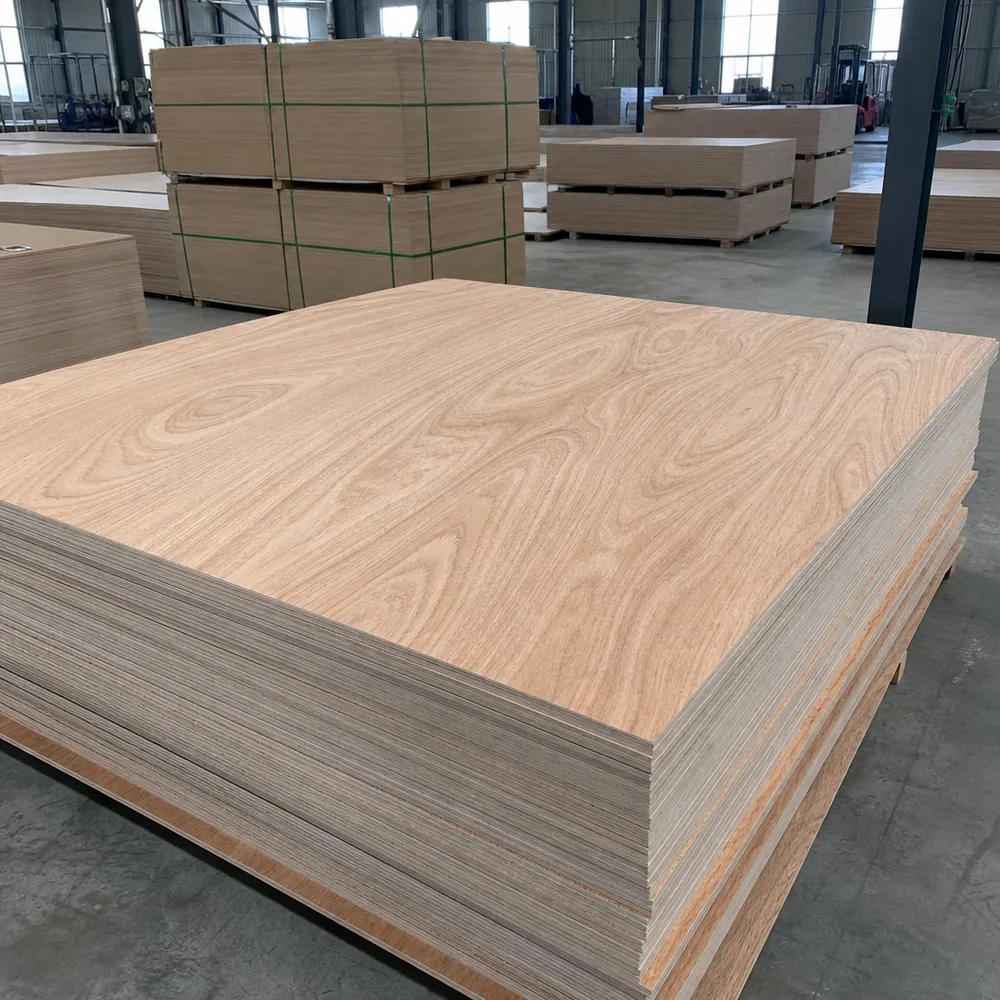
What Hardwood Plywood Is — and Where It Sits in the Commercial Range
Hardwood plywood is a structural and decorative panel built with hardwood veneer faces over a cross-laminated core. The face veneers — typically species like birch, poplar, eucalyptus, or oak depending on the application — give the panel its surface character and workability. The cross-laminated core construction is what gives it dimensional stability under load and humidity cycling that solid wood can't match at commercial scale.
Within our commercial plywood range, hardwood plywood occupies the segment where surface appearance and workability matter alongside structural performance. It's not the same product as structural plywood (which prioritizes load-bearing over face quality) or furniture plywood (which is optimized for paint and laminate adhesion). Hardwood veneer plywood is the choice when your downstream customer needs a panel that machines cleanly, holds fasteners well, and presents a consistent face — whether that's going into cabinetry, wall paneling, architectural millwork, or furniture components.
The distinction matters for your sourcing decision: if you're supplying into markets where the face veneer species and grade are part of the product specification — and where your buyers will reject panels with face defects — this is the product line to quote from. If the application is purely structural and the face is going to be covered, structural plywood is the more cost-efficient route.
How it compares within the commercial range
Hardwood Veneer Plywood
Face appearance + workability + structural performance. Species-verified veneers, consistent face grade. For cabinetry, millwork, wall paneling, furniture components.
Structural Plywood
Prioritizes load-bearing over face quality. More cost-efficient when the face will be covered. Choose this if the application is purely structural.
Furniture Plywood
Optimized for paint and laminate adhesion. Smooth, consistent surface for finishing. Choose this when the face veneer will be covered by a laminate or paint system.
Technical Specifications
We produce hardwood plywood across a range of constructions. The parameters below reflect industry-standard values for commercial export-grade hardwood veneer plywood — contact us for exact specifications on your target application.
Standard Export Specifications
Face Grade Reference
Smooth, tight-cut veneer. Minimal repairs, no open defects. Suitable for clear-coat or stain finishes where the natural wood face is the final appearance.
Solid surface with minor repairs permitted. Small knots and color variation acceptable. Standard for paint-grade cabinetry and millwork where a paint system will be applied.
Back face only. Tight knots and limited open defects permitted. Used on the non-visible face to reduce cost while maintaining structural integrity.
Certifications & Compliance
California Air Resources Board — required for US market entry
European formaldehyde emission standards for EU market compliance
Chain-of-custody certification available on confirmed orders
Japanese JIS standard — ultra-low emission for Japan market
Species Guide
Face veneer species determines grain character, finishing behavior, and downstream buyer expectations. The right species choice depends on your end market and application — not just aesthetics.
Birch
Fine, uniform grain with pale cream tone. Machines exceptionally cleanly and accepts paint and stain evenly. The benchmark species for European and North American cabinet buyers.
Poplar
Lightweight, consistent, and cost-efficient. Widely used as both face veneer and core material. Ideal when laminate or paint will cover the face and weight reduction matters.
Eucalyptus
Dense, hard, and dimensionally stable. Higher Janka hardness than birch. Preferred for flooring substrates, heavy-duty shelving, and applications requiring impact resistance.
Oak
Pronounced open grain with strong visual character. High demand in North American architectural millwork and furniture. Specify red or white oak depending on buyer market and stain system.
Cherry
Warm reddish-brown tone that deepens with light exposure. Fine, straight grain with occasional figure. Premium furniture and high-end cabinetry applications where natural patina is a selling point.
Walnut
Rich chocolate-brown with straight to wavy grain. The highest-value face veneer in the hardwood plywood category. Specified for luxury furniture, executive interiors, and high-end architectural paneling.
The species above represent our standard export range. We can source and produce panels with other face veneer species on confirmed orders — including maple, ash, teak, and sapele. Contact us with your target species and application for availability and lead time.
Sourcing & Quality Control
Face grade consistency and species verification are the two most common failure points in hardwood veneer plywood sourcing. Here is how we address both.
Face veneer logs are sourced from verified suppliers with documented species origin. We do not blend species or substitute lower-grade veneers without buyer notification.
Veneers are sliced to consistent thickness and graded by trained inspectors against the agreed face grade standard before pressing. Off-grade sheets are pulled before assembly.
Cross-laminated core construction with controlled glue spread and press parameters. Glue type (MR or WBP) is confirmed per order. Press cycles are logged for traceability.
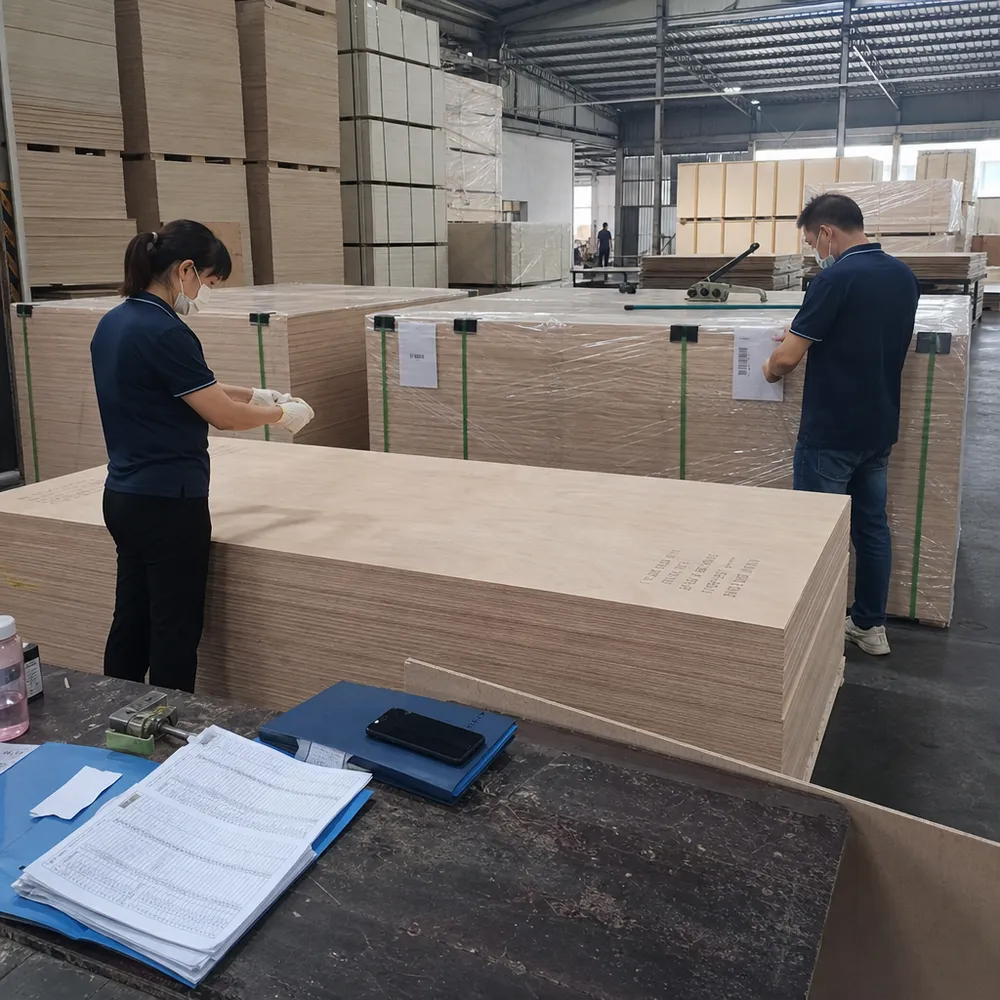
Panels are sanded to specified finish (S2S or touch-sanded) and checked for thickness tolerance (±0.2mm), squareness, and surface defects before palletizing.
Third-party pre-shipment inspection available on request. We provide mill test reports, moisture content readings, and formaldehyde emission test certificates with each shipment.
What Buyers Receive With Each Order
Common Sourcing Failure Points
Lower-cost species passed off as specified face veneer. Causes buyer rejection and downstream warranty claims. We provide species documentation with every shipment.
Mixed grades within a single order. The most common complaint in hardwood plywood imports. Our pre-press grading step eliminates off-grade sheets before assembly.
Panels failing CARB or E1 limits at port of entry. Results in customs holds and destruction costs. We test and certify emission levels before shipment, not after.
Veneer Grading and Face Quality: Where the Commercial Value Lives
For hardwood plywood, the face veneer is the product. The core construction is the engineering — it's what keeps the panel flat and stable. But what your buyers are paying for, and what determines whether your panels command a margin premium or compete on price alone, is the face veneer quality.
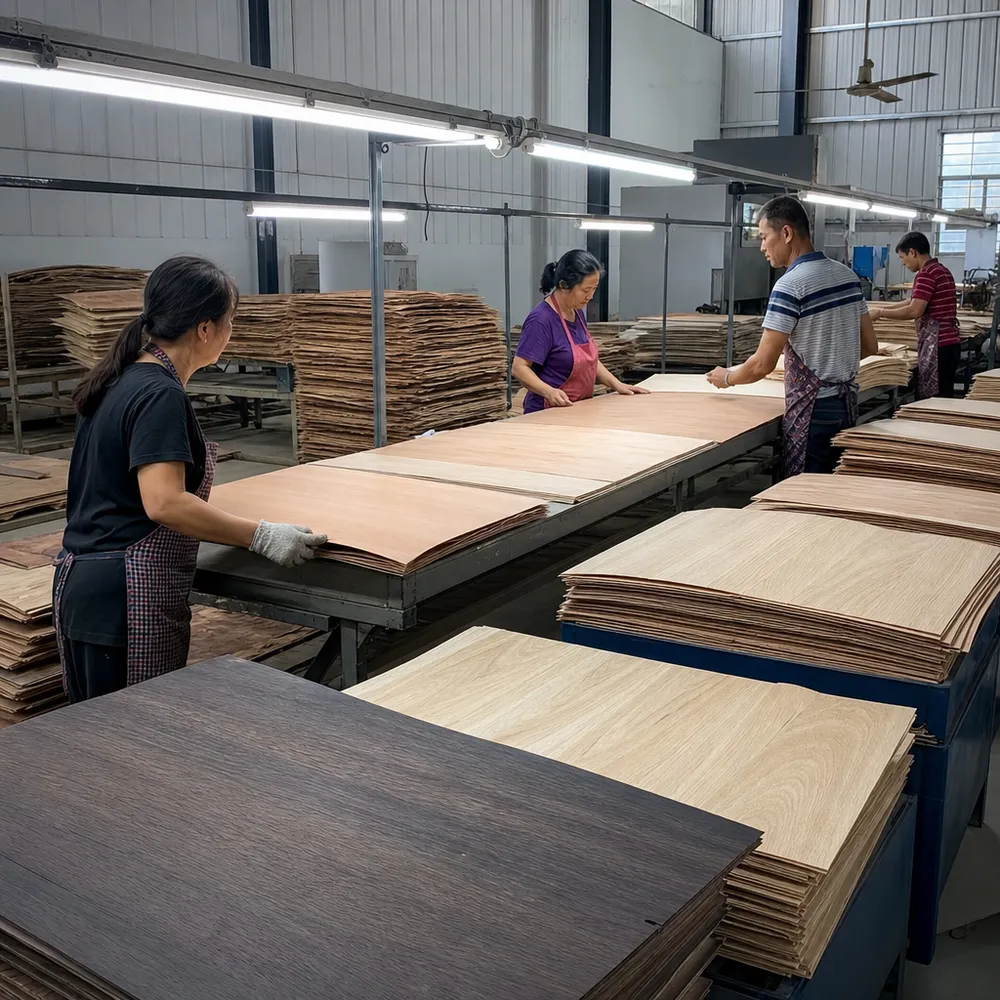
How Our Grading Line Works
We run a dedicated veneer grading line before any panel reaches the press. Incoming veneers are sorted by species, moisture content, and surface grade. Face veneers are graded separately from core veneers — we don't mix grades within a panel unless the specification explicitly calls for it.
For A-grade face veneers, we check for knots, splits, color variation, and grain consistency. B-grade faces allow for minor defects within defined limits. The grading criteria we apply follow HPVA (Hardwood Plywood and Veneer Association) standards as the baseline, with tighter tolerances available for orders where your downstream customer has specific appearance requirements.
What Consistent Grading Means Commercially
When you quote A/B hardwood plywood to a cabinetry manufacturer or architectural millwork supplier, the face grade is consistent across the batch. You're not sorting panels on arrival or fielding complaints about face defects on panels that were labeled A-grade.
That consistency is what protects your margin and your relationship with your downstream customer — and it's what separates a reliable hardwood plywood supplier from one that ships to grade on paper but not in practice.
Grade Criteria at a Glance
Our CARB P2 certification covers the formaldehyde emission requirements that apply to hardwood plywood sold in California and increasingly across the US. The certification is held at the factory level and documented per production batch — you get the compliance paperwork as part of the standard export documentation package, not as a special request.
Market Segments Where Hardwood Plywood Moves Volume
Three distinct buyer segments drive the majority of commercial hardwood plywood volume. Each has different qualification thresholds, margin profiles, and reorder dynamics — understanding where your customers sit shapes how you spec and source.
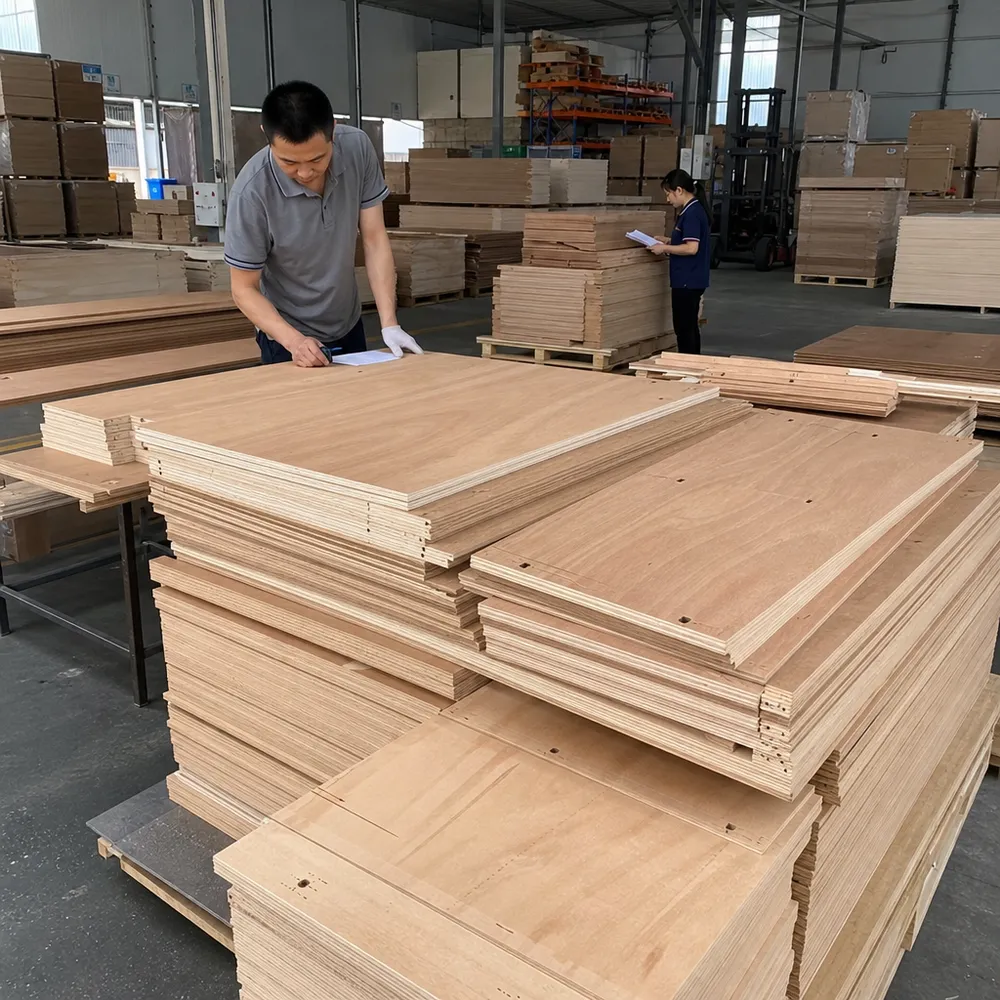
Cabinetry and Furniture Manufacturing
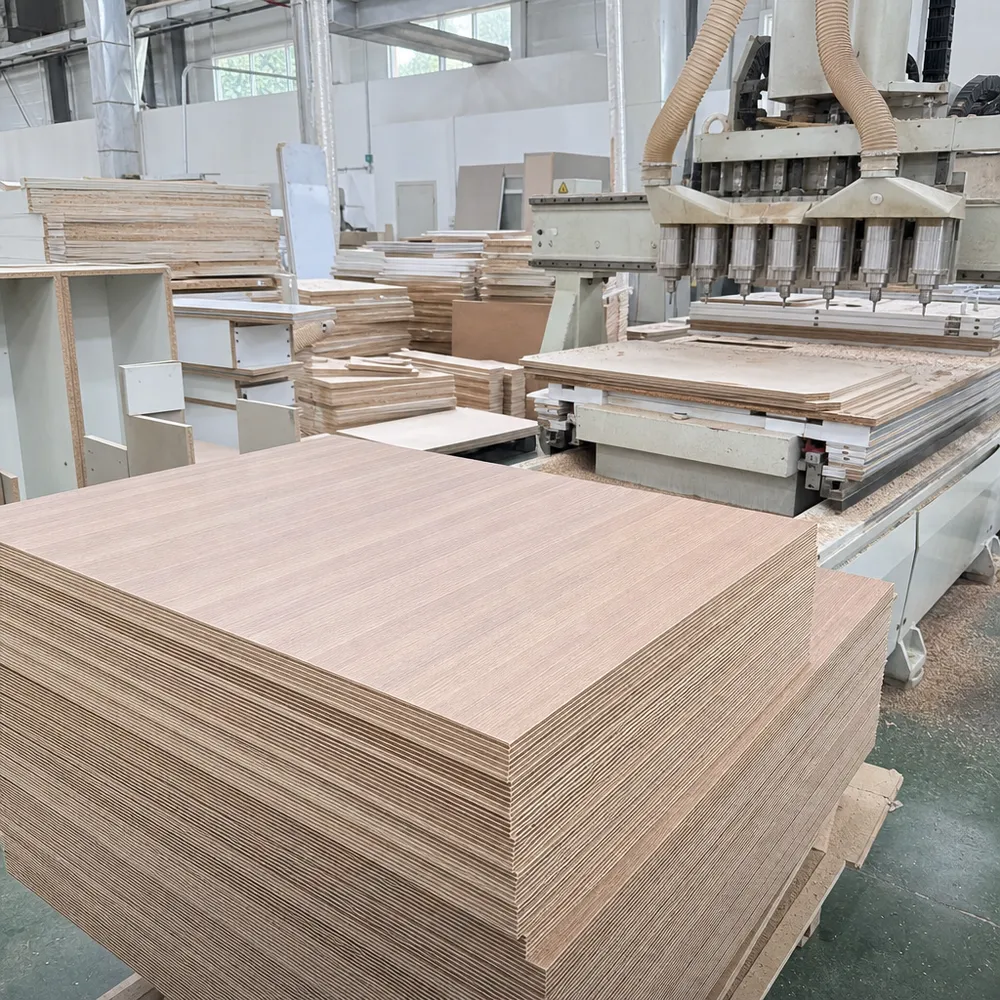
Cabinet box construction and furniture components are the highest-volume application for hardwood plywood in North America and Europe. Manufacturers spec 18mm and 15mm panels for cabinet sides, shelves, and drawer boxes — typically in B/B or B/C face grade where the surface will be painted or laminated.
The key requirement here is thickness consistency: automated panel processing equipment (CNC routers, edge banders) is calibrated to a specific panel thickness, and variation beyond ±0.3mm causes feed errors and edge quality problems. Our calibrated sanding holds ±0.2mm, so your manufacturing customers can run our panels without recalibrating their equipment.
For distributors supplying cabinet shops and furniture manufacturers, this segment runs on repeat orders with predictable volume — a mid-size cabinet manufacturer might consume 2,000–5,000 sheets per month. Once you're qualified as a supplier and the panels run clean through their equipment, the reorder cycle is reliable.
Architectural Millwork and Interior Fit-Out
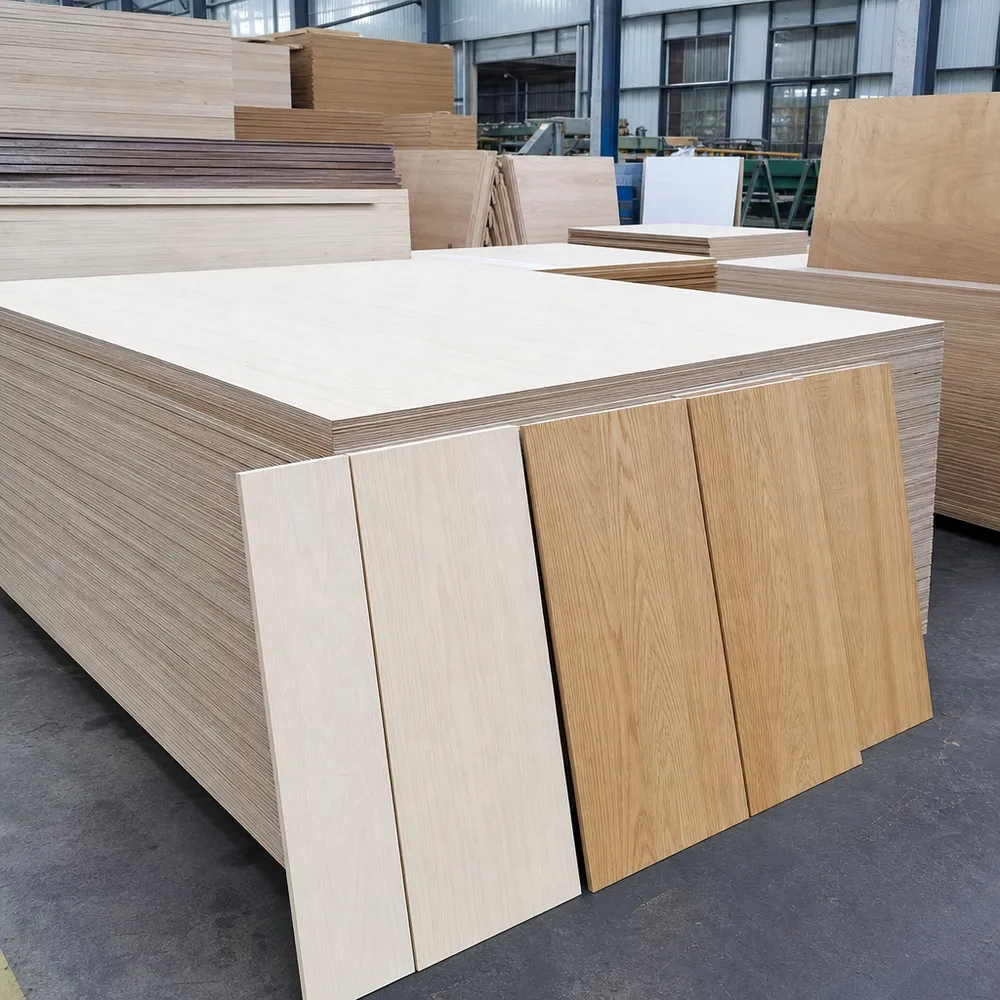
Higher-grade hardwood plywood — A/B birch or oak face — goes into architectural millwork: wall paneling, built-in cabinetry, reception desks, retail fixture construction. This segment is more specification-driven: the architect or interior designer specifies the veneer species and face grade, and the contractor sources to that spec.
Margins are higher than commodity cabinet-grade panels, and the volume per project is smaller but the price sensitivity is lower.
For distributors serving the commercial fit-out market, the ability to supply consistent face-grade hardwood plywood with documented species verification is the qualification threshold. FSC certification matters here — many commercial fit-out projects in Europe and North America require FSC-certified materials for LEED or BREEAM compliance. Our FSC chain-of-custody covers this requirement.
Overseas Furniture Manufacturers Sourcing Panel Components
Furniture manufacturers in Southeast Asia, the Middle East, and Eastern Europe who produce for export to North America and Europe often source hardwood plywood as a panel component rather than manufacturing their own. The requirement is consistent face quality, CARB P2 compliance for US-bound finished goods, and reliable supply at commercial volume.
This segment has grown significantly over the past several years — manufacturers who used to source domestically are finding that factory-direct Chinese hardwood plywood at CARB P2 standard is more cost-effective than local alternatives once you account for the certification overhead.
For buyers in this segment, the key question is whether the hardwood plywood supplier can maintain face grade consistency across multiple production runs — because your finished goods quality depends on it. Our batch-level QC documentation and the ability to reference specific production runs gives you traceability if a quality issue surfaces downstream.
Segment Comparison at a Glance
- Predictable repeat orders
- 2,000–5,000 sheets/month typical
- Thickness tolerance is the qualifier
- B/B or B/C face grade typical
- Spec-driven, lower price sensitivity
- Smaller per-project volume
- FSC + species verification required
- A/B face grade standard
- CARB P2 non-negotiable
- Multi-run consistency critical
- Batch traceability required
- Cost-effective vs. local sourcing
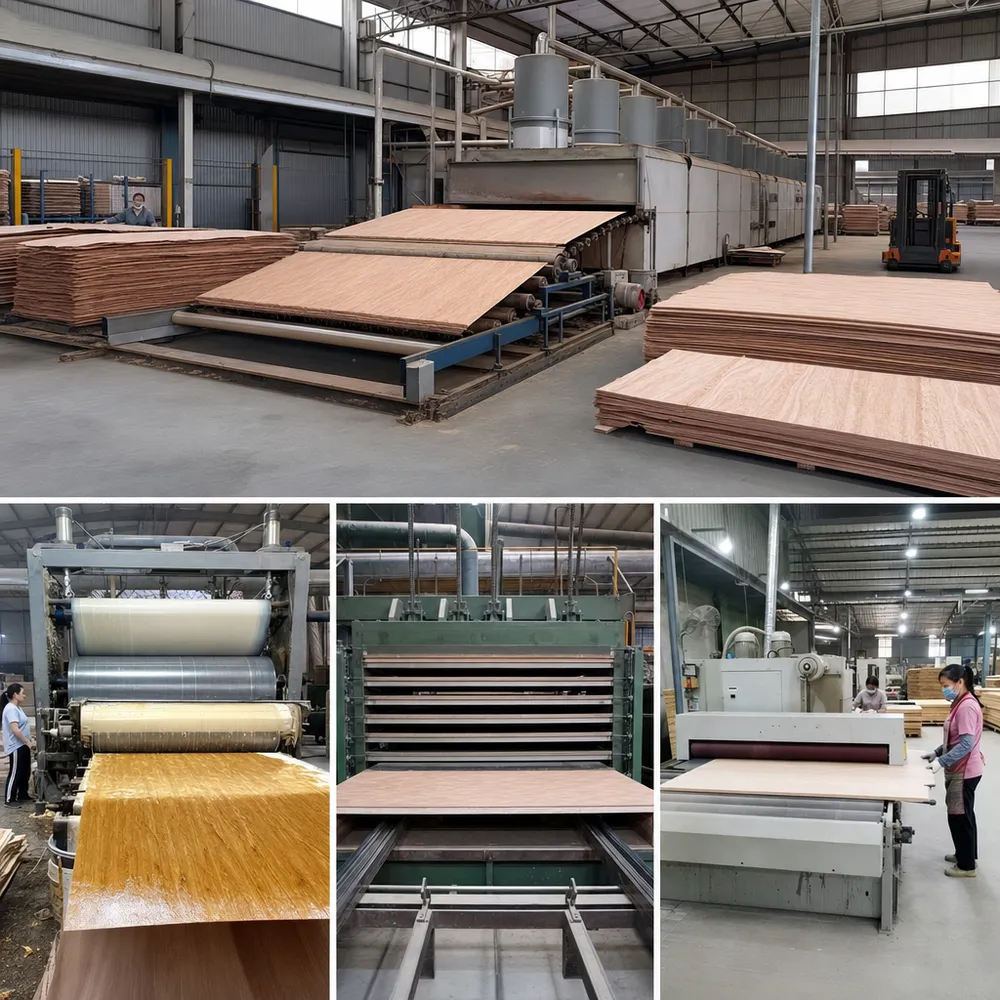
How We Make Hardwood Plywood: The Process Decisions That Affect Your Order
The manufacturing sequence for hardwood plywood involves more steps than commodity plywood, and the decisions made at each step determine whether the finished panel performs to grade or just looks like it does.
Veneer Preparation
Species sorting · Separate drying passes
Veneer preparation starts with species-sorted incoming material. For face veneers, we run a separate drying pass to bring moisture content to the target range before grading — face veneers that are too wet will show grain raise after pressing, which affects surface finish quality.
Core veneers are dried to a slightly different target moisture than face veneers because the core's job is dimensional stability, not surface appearance. Getting this right requires running separate drying parameters for face and core material — but it's the difference between a panel that stays flat and one that cups after it acclimates to the destination environment.
Glue Application
Automated spreaders · Calibrated spread weight
Glue application uses automated spreaders calibrated to the target spread weight for the panel construction. For WBP-grade hardwood plywood, we use phenolic resin; for MR-grade, urea-formaldehyde resin formulated to CARB P2 emission limits.
Too Light
Bond failure at the glue line
Too Heavy
Bleed-through staining on A-grade faces
Spread weight is checked at the start of each production run.
Hot Pressing
Multi-daylight hydraulic presses · Logged parameters
Hot pressing runs on multi-daylight hydraulic presses with logged temperature and pressure parameters per batch. The press parameters for hardwood plywood are different from film-faced plywood — the face veneer species and thickness affect the heat transfer rate, and the press cycle has to be calibrated accordingly.
We maintain press parameter records by product specification. If a bonding issue surfaces on a specific batch, we can trace it back to the production run and identify whether it was a press parameter deviation or a material issue.
Post-Press Sanding
Calibrated wide-belt sanding · ±0.2mm tolerance
Post-press, panels go through calibrated wide-belt sanding to achieve the ±0.2mm thickness tolerance. For A-grade face panels, the sanding sequence is lighter on the face side to preserve veneer thickness.
Over-sanding a thin face veneer exposes the core — a defect that can't be corrected downstream. The sanding line is calibrated daily.
Customization Parameters and What They Mean for Your Order
Hardwood plywood customization at our factory covers four dimensions: veneer species, panel dimensions, face grade combination, and glue type. Here's what's actually adjustable and what the constraints are.
Veneer Species
Face & back veneer selection
We stock birch, poplar, and eucalyptus face veneers as standard. Oak, cherry, walnut, and other species are available on confirmed orders with sufficient lead time for material sourcing.
Non-standard species: add 10–15 working days to standard lead time. OEM programs with consistent volume can maintain dedicated veneer stock.
Panel Dimensions
Standard & custom sizing
Standard is 1220×2440mm. Custom dimensions are available on confirmed orders — plywood is cut-to-size, so custom dimensions are a yield and scheduling question, not a tooling question.
Minimum order quantity for custom dimensions is typically one full container load to make the yield calculation work for both sides.
Face Grade Combinations
Standard & custom grading criteria
A/B, B/B, B/C, and C/D are standard. Custom grading criteria — tighter knot limits, specific color matching requirements, grain direction specifications — are available for OEM programs.
Custom grading criteria must be defined in writing before the first production run so the grading line has a clear acceptance standard.
Glue Type & Emission Standard
MR · WBP · CARB P2 · E0
MR (E1) is standard. WBP (waterproof boil-proof, phenolic resin) is available for applications requiring higher moisture resistance. CARB P2 is our standard formaldehyde emission specification for export.
MR / E1
Standard — urea-formaldehyde resin, CARB P2 compliant
WBP
Waterproof boil-proof — phenolic resin, higher moisture resistance
CARB P2
Standard export emission spec
E0
Ultra-low emission — available on request for stricter markets
OEM & Private-Label Programs
For OEM and private-label programs, we handle custom panel marking, packaging labels, and documentation in your brand name. Consistent volume OEM programs can maintain dedicated veneer stock for your specification, locking in material consistency across production runs.
- Custom panel marking and packaging labels in your brand name
- Export documentation issued under your brand
- Dedicated veneer stock for consistent OEM volume programs
- Written grading acceptance standards defined before first run
Certifications and Compliance for Your Import Market
The certification stack we hold covers the primary compliance gates for hardwood plywood in our main export markets. Documentation is prepared per shipment as standard — you don't need to chase it separately.
Required for hardwood plywood sold in California; increasingly the de facto standard for US market entry. Our CARB P2 certification covers formaldehyde emissions at ≤0.05 ppm — the most stringent tier. Documentation is provided per shipment as standard.
Required for buyers with sustainability sourcing policies or supplying into LEED/BREEAM-certified projects. FSC documentation traces the wood fiber back to certified forest sources.
Quality management system certification covering our production and QC processes. Provides the documented process framework behind every shipment.
Covers European construction and building material applications. For projects requiring EN 636 structural classification or specific formaldehyde class (E1/E0), confirm the requirement at inquiry stage.
For North American Buyers
CARB P2 documentation is prepared as part of the standard export package for every US-bound shipment. You don't need to request it separately — it's included by default.
For European Buyers
CE declaration of conformity is included as standard. For projects requiring EN 636 structural classification or a specific formaldehyde class (E1/E0), confirm the requirement at the inquiry stage and we'll specify accordingly.
Third-Party Pre-Shipment Inspection
Third-party pre-shipment inspection is available through SGS, Bureau Veritas, or your preferred agency. We coordinate access — buyers who require independent inspection can arrange it without adding lead time if it's confirmed before production completion.
Container Loading and Export Logistics
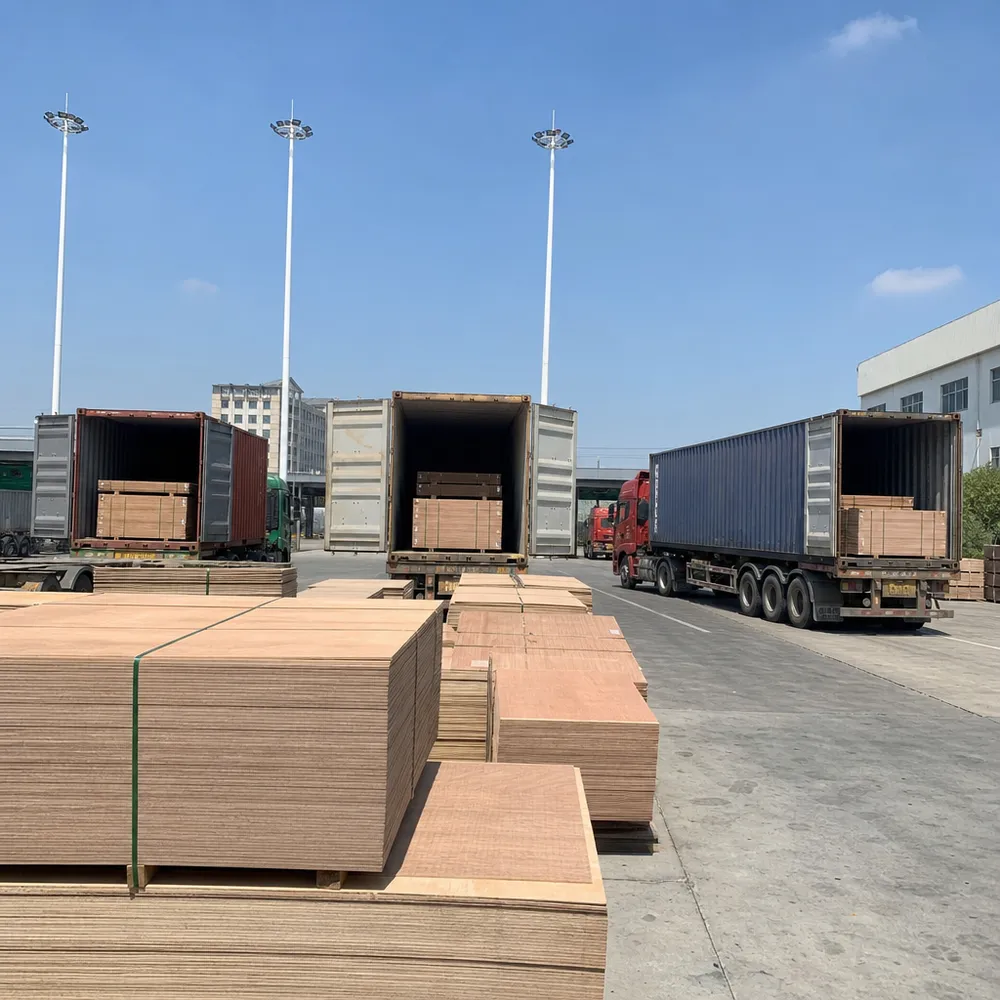
Standard 1220×2440mm hardwood plywood panels load efficiently into 20HQ and 40HQ containers. Here's what to expect from loading quantities through to port transit times.
Typical Container Loading Quantities
| Container | Panel Thickness | Approx. Sheet Count |
|---|---|---|
| 20HQ | 18mm | ~600–650 sheets |
| 20HQ | 12mm | ~900–950 sheets |
| 40HQ | 18mm | ~1,300–1,400 sheets |
| 40HQ | 12mm | ~1,900–2,000 sheets |
Approximate figures based on standard panel dimensions and stacking configuration. Actual quantities depend on packaging method and any mixed-thickness loading. A loading plan is provided with each shipment. For buyers who require specific bundle sizes for warehouse handling equipment, bundle configuration can be adjusted on confirmed orders.
Transit Times to Major Destination Ports
Xuzhou connects to Qingdao, Shanghai, and Lianyungang ports. Port selection is optimized per order based on routing and schedule.
Ocean Transit Packaging
Panels are bundled and strapped, edge-protected with corner boards, and wrapped in moisture-resistant film. Each bundle is marked with species, face grade, thickness, quantity, batch number, and destination port.
Standard Export Documentation
We've been through enough customs clearance cycles in North America, Europe, and Australia to know what documentation gaps cause delays. The paperwork is prepared to avoid them.
Port Connections from Xuzhou
Xuzhou connects to three major export ports — Qingdao, Shanghai, and Lianyungang — giving us routing flexibility to match your schedule and destination. We select the optimal port per order.
Hardwood Plywood vs. Sibling Products: Choosing the Right Panel
Hardwood plywood is one of several panel types in our commercial plywood range. Use this guide to match the product to the application — or send us your end-use specification and we'll recommend the right panel construction directly.
| If your application requires… | Consider… |
|---|---|
| Hardwood veneer face, consistent appearance, cabinetry/millwork | Hardwood plywood (this page) |
| Maximum moisture resistance, marine or wet-area use | Marine plywood |
| Exterior exposure, construction sheathing | Exterior plywood |
| Paint/laminate substrate, furniture box construction | Furniture plywood |
| Load-bearing structural applications | Structural plywood |
| Humid environment, moisture-sensitive installation | Moisture resistant plywood |
Not sure which panel fits your application?
Send us the end-use specification and we'll recommend the right panel construction. That's a faster path than working through the product range yourself.
Frequently Asked Questions
Specification, compliance, and ordering questions answered directly — no marketing language.
Standard stock species are birch, poplar, and eucalyptus. Oak, cherry, walnut, maple, and other species are available on confirmed orders — lead time depends on material sourcing, typically 10–15 additional working days.
For OEM programs with consistent volume, we can maintain dedicated veneer stock for your specification. If you have a specific species requirement, confirm it at the inquiry stage so we can verify availability and pricing.
MR (moisture-resistant) glue uses urea-formaldehyde resin and is suitable for interior applications where the panel won't be exposed to sustained moisture. WBP (waterproof boil-proof) uses phenolic resin and is specified for applications with intermittent moisture exposure or where higher bond durability is required.
Standard cabinetry and interior millwork. Specify CARB P2 emission standard for US market.
Kitchen cabinetry near sinks, bathroom vanities, or any application with regular moisture exposure.
Both are available in our hardwood plywood range.
Yes. CARB P2 is our standard formaldehyde emission specification for hardwood plywood exported to North America — it's not an upgrade option. The certification is held at the factory level, and CARB documentation is included in the standard export package for every US-bound shipment.
Standard MOQ is one container load (20HQ or 40HQ depending on thickness and panel size). For custom specifications — non-standard dimensions, specific veneer species, custom face grade criteria — MOQ is typically one 40HQ container to make the production run economically viable.
Contact us with your target specification and volume to get a specific MOQ and lead time.
Calibrated wide-belt sanding after hot pressing holds thickness tolerance to ±0.2mm across the panel. The sanding line is calibrated daily.
For buyers supplying into CNC routing or edge banding environments, ±0.2mm is the relevant spec — it's what determines whether your customer's equipment runs clean or requires constant adjustment. Thickness measurement data from outgoing inspection is available on request.
Yes. Our FSC chain-of-custody certification covers hardwood plywood production. FSC documentation is available for orders where the buyer requires it.
Specify FSC at the inquiry stage so we can confirm material sourcing and include the chain-of-custody records in the export documentation package.
Get a Quote for Hardwood Plywood
Send us your specification and we'll return a detailed quote, relevant certification documentation, and a lead time based on current production scheduling.
Full Specification Quote
If you have a complete specification ready, include the following in your message:
- Veneer species — e.g., oak, birch, poplar, eucalyptus
- Face grade — A/B, B/BB, C/D, or equivalent
- Thickness — from 2.5mm to 25mm
- Panel size — standard 4×8 ft or custom dimensions
- Target volume — container quantity or m³ per order
- Destination market — determines certification requirements
Not Sure of the Full Spec?
Send us what you have. We'll recommend the right construction and confirm what documentation your import market requires.
- Target application — furniture, cabinetry, flooring substrate, wall paneling, etc.
- End market — country or region of final sale
- Approximate volume — even a rough estimate helps us size the quote correctly
Certification Documentation Included
Every quote includes the relevant certification documentation for your import requirements — CARB P2, FSC, E0/E1, or others as applicable.
Xuzhou QD Wood Industry Co., Ltd.
No. 88 Sanbao Industrial Park, Tongshan District,
Xuzhou, Jiangsu Province, 221116, China
Explore Related Products
Other commercial plywood grades and thicknesses from the same production line.
Marine Plywood
WBP-bonded, void-free construction for high-moisture and structural applications.
View productExterior Plywood
Weather-resistant bonding for cladding, hoarding, and outdoor structural use.
View productFurniture Plywood
Smooth, consistent faces optimised for lacquer, veneer overlay, and CNC routing.
View productStructural Plywood
Load-rated panels for flooring, roofing, and wall sheathing in construction.
View product