

HPL Plywood Manufacturer — Factory-Direct
High pressure laminate plywood built for commercial interiors: surface hardness, moisture resistance, and dimensional stability in one panel. Five product variants. Every panel ships with CARB P2 and FSC documentation as standard.

What HPL Plywood Is and Where We Fit as a Manufacturer
HPL plywood is a plywood substrate — typically hardwood or poplar core — bonded under high heat and pressure to a high pressure laminate surface layer. The laminate itself is a resin-saturated paper composite pressed at 1,000–1,400 psi, which produces a surface that is significantly harder, more scratch-resistant, and more moisture-tolerant than standard melamine-faced panels. The result is a panel that performs in environments where melamine would chip, swell, or delaminate within a few years.
We've been manufacturing HPL plywood at our Xuzhou facility since the early part of our operation, and it's one of the categories where the substrate quality matters as much as the laminate. A well-bonded HPL surface on a poorly dried plywood core will still warp — the laminate can't compensate for dimensional instability in the wood underneath.
Our moisture control process targets 8–12% moisture content in the plywood substrate before lamination, which is the same standard we apply to all our export-grade panels. That's the baseline that keeps your panels flat after they clear customs and reach your customer's warehouse.
As an HPL plywood manufacturer, we supply distributors, furniture manufacturers, kitchen cabinet producers, and project importers across North America, Europe, the Middle East, Southeast Asia, and Australia. Factory-direct — no trading company layer between our production floor and your purchase order.

Why Substrate Quality Determines Panel Performance
A well-bonded HPL surface on a poorly dried core will still warp — the laminate cannot compensate for dimensional instability in the wood underneath.
Our 8–12% pre-lamination moisture target is the same standard applied to all export-grade panels — the baseline that keeps panels flat after customs clearance.
Factory-direct supply — no trading company layer between our production floor and your purchase order.
HPL vs. Melamine: Why the Difference Matters for Commercial Applications
| Property | HPL Plywood | Standard Melamine |
|---|---|---|
| Surface hardness | High — resin-saturated composite at 1,000–1,400 psi | Lower — thinner resin layer, chips under impact |
| Scratch resistance | Significantly higher | Moderate — scratches visible in high-traffic use |
| Moisture tolerance | High — rated for kitchen and wet environments | Low — swells and delaminates with repeated exposure |
| Commercial lifespan | Long — performs where melamine fails within years | Shorter in demanding environments |
HPL Plywood Product Line
Five product variants cover the main commercial applications for high pressure laminate plywood. Each is built on the same substrate and lamination process; the differences are in surface specification, thickness range, and the downstream application they're optimized for.
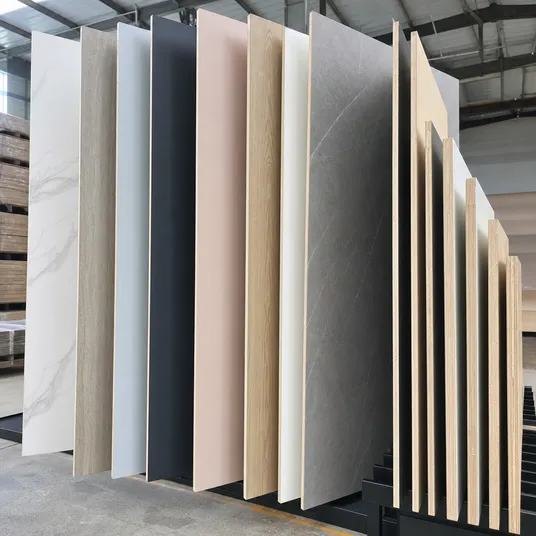
HPL Plywood Sheet
Full-size panels in standard 1220×2440mm dimensions, 6mm to 25mm thickness. Surface options include solid colors, wood-grain textures, and stone-effect patterns in matte, satin, and gloss finishes. Thickness tolerance held to ±0.2mm — critical for buyers running panels through CNC equipment.
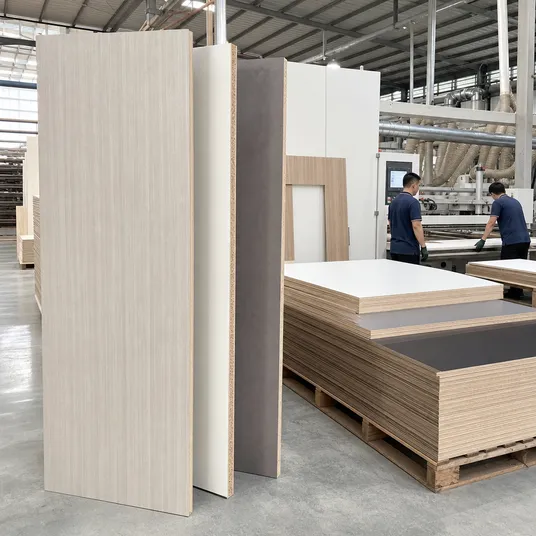
HPL Plywood Cabinet Board
Optimized for cabinet carcass and door panel production. Typically 15mm, 18mm, and 25mm, with HPL applied to one or both faces. Single-face for carcass interiors; double-face for doors and visible side panels. Matching or contrasting face and back laminates available on confirmed orders. OEM program available for branded kitchen lines specifying proprietary colors.
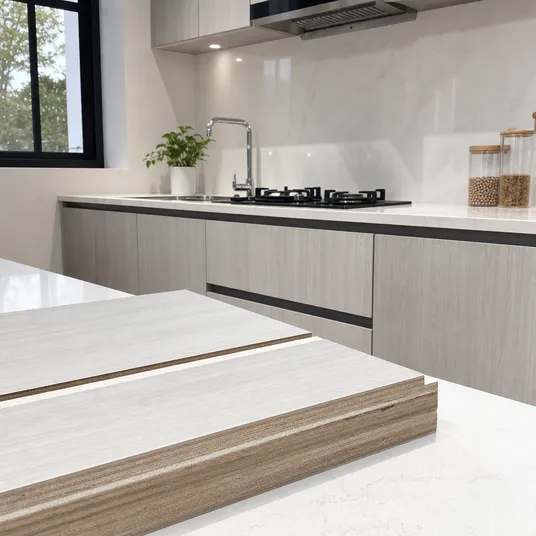
Kitchen HPL Plywood
Kitchen environments demand specific performance: repeated moisture exposure, cleaning chemical contact, and thermal cycling from cooking heat. Uses a higher-density 0.8mm HPL surface bonded to a moisture-resistant plywood core with MR glue. The combination handles humidity and cleaning cycles that standard HPL panels aren't rated for.
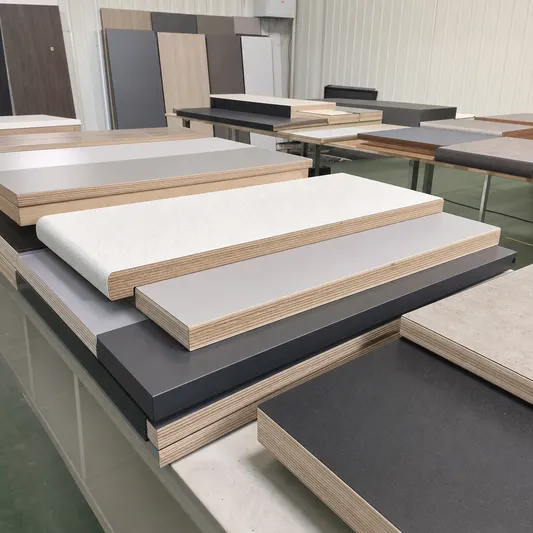
HPL Plywood Countertop
Worksurface-grade panels built for countertop and desk applications. Typically 25mm to 38mm, with a 1.0mm or 1.2mm HPL face bonded under high pressure to a dense plywood substrate. Post-formed edge profiles available on confirmed orders. Suitable for commercial kitchens, laboratory benches, office desks, and retail counters where surface durability is the primary specification.
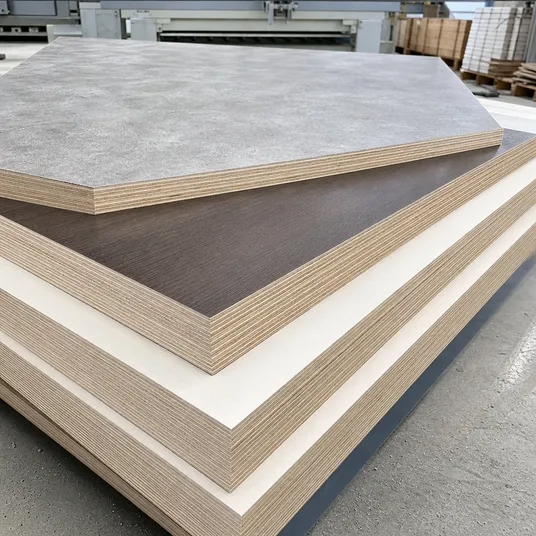
HPL Plywood Furniture Board
Designed for flat-pack and contract furniture manufacturers who need consistent panel dimensions, stable HPL adhesion, and predictable screw-holding strength across large production runs. Available in 12mm, 15mm, and 18mm. Double-face lamination standard for shelving and carcass components. Dimensional consistency across batches is held tighter than standard sheet stock to support automated assembly lines.
Share your application and thickness requirements — we'll confirm which product fits and what lead time looks like for your volume.
Dimensions, Tolerances & Performance Data
Specifications below reflect standard production parameters. Custom dimensions, non-standard thicknesses, and modified surface grades are available on confirmed orders with minimum quantity requirements. All figures are nominal unless otherwise noted.
Dimensions & Sizes
HPL Surface Specification
Core & Substrate
Mechanical Performance
Commercial & Residential Applications
HPL plywood is specified across a wide range of commercial and residential applications where surface durability, moisture resistance, and consistent panel quality are non-negotiable. The following covers the primary end-use categories our buyers work in.
Kitchen & Cabinetry
Cabinet carcasses, door panels, drawer fronts, and interior shelving. The moisture-resistant core handles humidity from cooking and dishwashing; the HPL surface resists cleaning chemicals and grease. Specified by kitchen manufacturers supplying residential and commercial fit-out projects.
Commercial Interiors
Retail fit-out, hospitality joinery, office partitioning, and reception counters. High-traffic surfaces need a finish that holds up to daily contact without showing wear. HPL plywood delivers the surface hardness and consistent appearance that commercial interior contractors specify for long-cycle installations.
Worksurfaces & Countertops
Laboratory benches, office desks, commercial kitchen counters, and retail service counters. Thicker panels (25–38mm) with 1.0mm or 1.2mm HPL face provide the rigidity and surface hardness required for worksurface applications. Post-formed edge profiles available for seamless countertop installations.
Furniture Manufacturing
Flat-pack furniture, contract shelving, and storage systems. Manufacturers running automated assembly lines need panels with tight dimensional tolerances and consistent HPL adhesion across batches. Double-face lamination for shelving components; single-face for back panels and internal carcass parts.
Healthcare & Education
Hospital casework, clinic cabinetry, school furniture, and laboratory fit-out. These environments require surfaces that withstand repeated disinfectant cleaning with harsh chemicals. HPL's non-porous surface prevents bacterial ingress and tolerates bleach-based cleaners without delamination or surface degradation. Low-emission cores (E0/CARB P2) meet indoor air quality requirements for occupied healthcare and educational spaces.
Wall Cladding & Panelling
Interior wall panels, feature walls, lift cab linings, and corridor cladding. Large-format panels with consistent grain or solid-colour HPL faces create seamless wall installations. The plywood substrate provides dimensional stability and easy mechanical fixing compared to MDF-backed alternatives.
How We Source & Supply HPL Plywood
We work directly with a vetted network of mills across Southeast Asia and China. Every supplier is audited for production consistency, emission compliance, and export documentation capability before we place orders. Here's how the supply chain works from mill to your warehouse.
Mill Selection & Audit
Suppliers are pre-qualified on production capacity, QC systems, emission certifications, and export track record. We do not work with spot mills or unaudited intermediaries.
Order & Production
Orders are placed against confirmed specifications. Production lead times are 15–25 days for standard configurations; custom sizes or HPL patterns may require 30–40 days.
Pre-shipment Inspection
Third-party or in-house inspection covers dimensional checks, surface quality, delamination testing, and emission batch reports before containers are loaded.
Export & Documentation
Full export documentation: commercial invoice, packing list, bill of lading, phytosanitary certificate, fumigation certificate, and emission test reports. Lacey Act and EUDR compliance documentation available on request.
MOQ, Lead Times & Container Loads
| Order Type | MOQ | Production Lead Time | Transit (to US/EU) |
|---|---|---|---|
| Standard stock configuration | 1 × 20ft container | 15–20 days | 18–28 days |
| Custom size / thickness | 1 × 20ft container | 25–35 days | 18–28 days |
| Custom HPL pattern / colour | 2 × 20ft containers | 30–40 days | 18–28 days |
| Mixed-spec container | 1 × 40ft container | 20–30 days | 18–28 days |
Common Questions from Buyers & Specifiers
What is the difference between HPL plywood and melamine-faced plywood?
What core species and grades are available?
Can I order custom HPL colours, textures, or patterns?
What emission standards do your panels meet?
Do you supply samples before a container order?
What documentation is provided for customs clearance?
Request Pricing & Samples
Send us your specification — thickness, panel size, HPL surface, core type, emission standard, and target volume — and we'll come back with pricing, lead times, and available mill options within one business day.
- Container-volume pricing with mill options
- Physical samples for qualified buyers
- Full documentation package included
- Response within one business day
Send a Specification Request
Technical Specifications: What to Specify When You Order
The table below covers the category-wide parameter ranges for our HPL plywood line. Individual product pages carry the exact specifications for each variant.
| Parameter | Range / Options |
|---|---|
| Substrate | Hardwood core, poplar core, combi core (hardwood face + poplar inner) |
| Thickness | 6mm – 40mm (standard: 12mm, 15mm, 18mm, 25mm) |
| Panel Size | 1220×2440mm standard; custom sizes on confirmed orders |
| HPL Surface Thickness |
0.5mm — standard 0.8mm — kitchen/countertop grade 1.0mm — heavy-duty
|
| Surface Finish | Matte, satin, gloss, textured (linen, wood grain, stone effect) |
| Face Options | Single-face HPL, double-face HPL, HPL face + balancing paper back |
| Core Glue | MR (moisture-resistant, E1), WBP (waterproof, E0/CARB P2) |
| Formaldehyde Emission |
CARB P2 ≤0.05 ppm E0 ≤0.05 ppm E1 ≤0.1 ppm
|
| Thickness Tolerance | ±0.2mm |
| Surface Hardness | EN 438 compliant (abrasion, impact, scratch resistance) |
| Certifications |
CARB P2 ISO 9001:2015 FSC CE
|
| MOQ | 1×20GP container (mixed thickness and surface options available) |
Custom Colors and Textures
Surface color and texture options are available in our standard catalog range. Custom colors and textures are available on OEM orders with minimum run quantities — contact us with your target specification and we'll confirm feasibility and lead time.
Explore Specific HPL Plywood Products
Lamination Process: Where the Bond Either Holds or Fails
The performance difference between HPL plywood that lasts a decade in a commercial kitchen and HPL plywood that starts delaminating at the edges within two years comes down to three variables: substrate moisture content, glue spread consistency, and press parameters. We control all three.

Multi-daylight hydraulic presses maintain uniform pressure across the full 1220×2440mm panel surface. Press temperature, pressure, and dwell time are logged per batch — giving us the traceability to diagnose any bonding issue against the production record.
Press Log Traceability
If a bonding issue surfaces on a shipment, we can pull the press log for that production run and identify whether the parameters were within spec. That traceability is what separates a factory that can diagnose problems from one that just apologizes and reships.
Substrate Preparation
Panels are dried to 8–12% moisture content and verified by moisture meter before entering the lamination line. This is the step most factories skip or rush — they press wet panels and rely on the heat to drive out moisture during the lamination cycle. That works well enough for a surface check, but the residual moisture gradient in the panel creates internal stress that shows up as edge lifting or surface bubbling six months after installation.
We've seen enough of those warranty claims from buyers who switched to us from other suppliers to know exactly what the failure looks like.
Glue Spread and Assembly
Glue spread on the substrate surface is controlled by a roller coater calibrated to apply consistent adhesive weight across the full panel width. Uneven glue spread produces bond strength variation — the areas with light coverage are where edge delamination starts. After glue application, the HPL sheet is positioned and the assembly goes into the hot press.
Hot Press Cycle
Multi-daylight hydraulic presses maintain uniform pressure across the full 1220×2440mm panel surface. Press temperature, pressure, and dwell time are logged per batch. If a bonding issue surfaces on a shipment, we can pull the press log for that production run and identify whether the parameters were within spec.
Controlled Post-Press Cooling
Post-press, panels are cooled under controlled conditions before trimming and sanding. Rapid cooling after pressing can introduce surface stress that causes micro-cracking in the laminate — we hold panels in a conditioning area until they reach ambient temperature before moving them to the finishing line.
Trimming, Inspection, and Packing
Edge trimming is done on precision saws to ±0.5mm dimensional tolerance. For double-face panels, both surfaces are inspected for bubbles, delamination, and surface defects before the panel is approved for packing.
What Skipped Steps Look Like in the Field
Caused by residual moisture gradient in the substrate. Appears 3–6 months after installation, typically at panel corners and long edges first.
Caused by uneven glue spread or trapped moisture during pressing. Visible as raised blisters under the laminate surface, often in the panel center.
Caused by rapid post-press cooling. Hairline cracks in the HPL surface that compromise scratch and moisture resistance over time.
Market Segments Where HPL Plywood Generates Repeat Orders
HPL plywood sits in a commercial performance tier that generates consistent reorder volume from buyers who've established it in their product line. The segments below are where our existing distributors and importers see the most reliable demand.
Kitchen and Bathroom Cabinet Manufacturing
Largest Volume Segment
Cabinet manufacturers need panels that hold up to moisture, cleaning chemicals, and the mechanical stress of hinge and drawer hardware installation. HPL plywood at 18mm and 25mm is the standard substrate for cabinet doors and carcass panels in mid-to-high-end kitchen lines.
Buyer pattern: Annual volume contracts once a supplier is qualified. Color and texture consistency requirements make switching suppliers costly — your first container is the audition for a long-term relationship.
Commercial Fit-Out and Interior Contracting
Project-Based Volume
Covers office fit-out, retail store interiors, hospitality renovation, and healthcare facility interiors. These projects specify HPL panels for wall cladding, reception desks, built-in furniture, and partition systems. Project volumes run 50–500 sheets per project, with multiple projects per year for active contractors.
Key buying criterion: Surface consistency across a project — all panels for a single project need to come from the same laminate lot to ensure color matching. We document lot numbers on packing lists and can hold stock from a single lot for phased project deliveries.
Furniture Manufacturing for Export Markets
EU & US Compliance Required
Manufacturers supplying European and North American retail chains use HPL plywood for office desks, shelving systems, and display furniture where the surface needs to meet EN 438 standards. These buyers are often sourcing to a retail chain's specification, which means the panel needs to pass the chain's own incoming inspection.
Documentation: Our CARB P2 and CE documentation covers the compliance requirements for these markets without requiring additional testing on your end.
Distributor Stocking Programs
SE Asia · Middle East · Australia
Distributors in Southeast Asia, the Middle East, and Australia typically carry HPL plywood sheets in 3–5 standard colors and 2–3 thicknesses as a catalog item. The reorder pattern is predictable once the product is established in the local market.
Margin profile: Better than commodity plywood because HPL panels compete on performance rather than price alone. Established catalog items generate predictable reorder cycles.
Selecting the Right HPL Variant for Your Market
The five variants in our line cover different performance tiers and application requirements. Here's how to match them to what your buyers actually need.
Kitchen Cabinet Manufacturers & Fit-Out Contractors

Specify kitchen HPL plywood with 0.8mm laminate surface and MR or WBP core glue. Standard HPL at 0.5mm surface thickness will show wear in kitchen environments within 2–3 years — the thicker laminate grade is what holds up to daily cleaning and moisture exposure.
The price difference between 0.5mm and 0.8mm surface is modest; the warranty claim difference is significant. Specify the thicker grade for any kitchen application.
Countertop Fabricators

The countertop variant with postforming-grade laminate gives fabricators the flexibility to produce both flat-edge and bullnose profiles from the same panel. Specify 25mm or 30mm substrate thickness.
Thinner panels flex under load on long countertop spans, which causes the laminate bond to stress at the edges over time. Do not specify below 25mm for countertop applications.
Building a Distributor Stocking Program
HPL plywood sheets in 18mm are the highest-velocity SKU in most markets. Start with 4–6 surface options covering neutral tones and one or two wood-grain textures — these move across the widest range of downstream applications.
| Phase | SKU Range | Thickness |
|---|---|---|
| Launch | White, light grey, beige + 1–2 wood-grain textures | 18mm |
| Expand | Add furniture-grade variant once base range is established | 15mm 25mm |
Commercial Fit-Out Contractors

Furniture HPL plywood at 18mm and 25mm covers most built-in furniture and partition applications. Confirm that your supplier documents laminate lot numbers on packing lists — this is the detail that prevents color mismatch complaints on multi-phase projects.
We document lot numbers on packing lists and can hold stock from a single lot for phased project deliveries. Request lot-matched stock when placing your order.
Sourcing for Export to the US or EU
Verify CARB P2 and CE documentation before committing to a supplier. These are procurement gates in those markets, not optional certifications. Our documentation is prepared as standard for all export shipments — you don't need to request it separately.
Variant Quick-Reference
Dimensions, Grades & Tolerances
Standard production parameters for our HPL plywood range. Custom dimensions and substrate grades are available on request for container-quantity orders.
Panel Dimensions
Laminate Surface
Substrate & Glue Line
Flatness & Squareness Tolerances
Panels are pressed with a balancing HPL sheet on the reverse face to control bow. Flatness tolerance is ≤ 1.5 mm/m under standard storage conditions (15–25°C, 45–65% RH). Squareness tolerance is ≤ 2 mm per 1000 mm of panel length. Store panels flat on a level surface — vertical storage against a wall will induce bow within days in humid climates.
Need the Full Technical Data Sheet?
Includes bond strength, surface hardness, abrasion resistance, and fire classification data.
How HPL Plywood Is Made
Understanding the production sequence helps you evaluate supplier quality claims. Each stage has a measurable output — ask for data at the stages that matter for your application.
Veneer Peeling & Drying
Logs are rotary-peeled to produce continuous veneer sheets. Moisture content is dried to 8–12% before lay-up. Veneer moisture above 14% at lay-up is the single most common cause of delamination in service — ask your supplier for their incoming MC specification and how it is verified.
Glue Application & Lay-Up
Adhesive is applied by roller or curtain coater at a controlled spread rate. Veneers are assembled in cross-banded odd-ply configuration to balance panel movement. Glue spread rate and open assembly time are the two variables that most affect bond quality — both should be documented in the supplier's process control records.
Cold & Hot Press
Panels are cold-pressed to consolidate the assembly, then hot-pressed at 120–140°C under controlled pressure to cure the adhesive. Press time, temperature, and pressure are the three parameters that determine final bond strength. Suppliers with automated press monitoring can provide batch-level press records on request.
Sanding & Substrate Preparation
Pressed panels are sanded to achieve a consistent surface profile for laminate bonding. Surface roughness (Ra) is controlled to the laminate supplier's specification — too smooth reduces mechanical adhesion; too rough telegraphs through the laminate surface. This is a step where low-cost production often cuts corners.
HPL Lamination
HPL sheets are bonded to the prepared substrate face and balancing sheet to the reverse using a contact adhesive or hot-press lamination process. Hot-press lamination produces a more consistent bond than cold contact adhesive for high-humidity applications. Confirm which process your supplier uses if the panels are destined for kitchens or bathrooms.
Trimming, QC & Packing
Panels are trimmed to final dimensions, inspected for surface defects, delamination, and squareness, then packed with interleaving paper to prevent surface damage in transit. Ask for the supplier's AQL sampling level for surface inspection — this tells you how rigorously the outgoing quality check is applied.
Compliance Documentation
The certifications that matter depend on your destination market. Here is what each one covers and when you need it.
CARB Phase 2
US Market — Required
California Air Resources Board Phase 2 limits formaldehyde emissions to ≤ 0.05 ppm for hardwood plywood. Mandatory for composite wood products sold or used in the US. Verify the TPC (Third Party Certifier) name on the certificate — not just the claim on the spec sheet.
CE / EN 636
EU Market — Required
CE marking under EN 636 covers structural and non-structural plywood for the EU market. Confirms the panel meets dimensional, bond quality, and formaldehyde emission requirements. Required for products entering EU distribution channels.
EN 438
HPL Surface Standard
The European standard for high-pressure decorative laminates. Covers surface hardness, abrasion resistance, impact resistance, and resistance to staining and moisture. Specifying EN 438 compliance on the laminate surface gives you a defined performance baseline regardless of supplier.
E1 / E0 Emission Class
Indoor Air Quality
E1 limits formaldehyde to ≤ 0.1 ppm; E0 to ≤ 0.05 ppm. E0 aligns with CARB P2 and is the appropriate specification for residential interiors, children's furniture, and healthcare environments. Specify E0 by default for any enclosed interior application.
FSC / PEFC
Chain of Custody
Forest Stewardship Council and Programme for the Endorsement of Forest Certification provide chain-of-custody documentation for sustainably sourced timber. Required for green building rating schemes (LEED, BREEAM) and increasingly specified by corporate procurement policies.
ISO 9001
Quality Management
ISO 9001 certification confirms the manufacturer operates a documented quality management system. It does not guarantee product quality directly, but it does mean process deviations are recorded and corrective actions are tracked — which matters when you need to trace a batch issue.
All Certifications Supplied as Standard
CARB P2, CE, EN 438, E1/E0, and FSC documentation is included with every export shipment. You do not need to request these separately — they ship with the commercial documents.
Quality Failures We've Engineered Out of Our Process
HPL plywood has a few well-known failure modes that show up in the field. Buyers who've been burned by them know exactly what to ask about. Here's where they come from and what we do differently.
Edge Delamination
The most common complaint. HPL surface lifts away from the substrate, usually within 6–18 months of installation. Caused by substrate moisture content too high at lamination, or insufficient glue spread at panel edges where the roller coater applies less pressure.
- Substrate moisture verified before lamination
- Roller coater calibrated for consistent spread to within 20mm of panel edge
- Edge sealing applied on export-grade panels to prevent moisture ingress during ocean transit
Surface Bubbling
Small raised areas under the laminate surface, typically within the first few months after installation. A press parameter problem — insufficient dwell time or uneven pressure distribution leaves air pockets between the laminate and substrate.
- Press parameters set for full dwell time at rated pressure
- Multi-daylight hydraulic system maintains uniform pressure across the full panel surface
- Post-press tap inspection — hollow sound indicates a bubble, those panels are pulled before packing
Color Variation Within a Batch
A problem for buyers supplying furniture manufacturers or fit-out contractors who need consistent color across a project. Laminate color can vary between production lots from the laminate supplier.
- Color-matched batches run from the same laminate lot
- Lot number documented on packing lists for traceability
- For large orders, stock can be reserved from a single lot to cover the full order quantity
Thickness Variation
Causes feed errors in CNC cutting equipment and visible gaps in assembled furniture. Inconsistent sanding or substrate preparation allows panels to fall outside the tolerance range buyers depend on.
- Calibrated wide-belt sanding line holds thickness tolerance to ±0.2mm across the panel
- Thickness measured at five points per panel during outgoing inspection — center and four corners
- Panels falling outside tolerance are rejected before packing
These aren't marketing claims — they're the specific calibration steps, inspection protocols, and packaging decisions we made after seeing what goes wrong in the field. Ask us for the QC checklist on any order.
Container Loading and Export Logistics
HPL plywood ships efficiently in standard containers. Here's the practical data for your landed cost calculations.
Container Capacity — Standard 1220×2440mm Panels
| Thickness | Sheets / 20GP | Notes |
|---|---|---|
| 18mm | 280–320 sheets | Depends on stacking config and packaging |
| 25mm | 200–240 sheets | Reduced capacity at greater thickness |
| Mixed | Per loading plan | Loading plan provided with each shipment |
Mixed thickness loads are possible. We provide a loading plan with each shipment so your receiving team knows the exact configuration.
Packaging Specification
20–50 sheets per bundle depending on thickness, strapped with steel banding and edge-protected with corner boards.
Export-grade packaging includes moisture-resistant film wrap on each bundle. HPL panels are susceptible to surface damage from condensation during ocean transit, particularly on routes through tropical ports. We added the film wrap as standard after seeing surface staining on a shipment to Singapore that sat in a humid container for three weeks — the cost of the film is negligible compared to a claim.
Transit Times from Xuzhou

We ship through Qingdao, Shanghai, and Lianyungang ports depending on routing and schedule.
Export Documentation
- Commercial invoice
- Packing list
- Bill of lading
- Certificate of origin
- Phytosanitary certificate (where required)
- US shipments: CARB P2 documentation prepared as standard
- EU shipments: CE declaration of conformity included
- FSC chain-of-custody documentation available for buyers with sustainability sourcing requirements
Certifications That Cover Your Import Markets
All four certifications are held at the factory level and apply to our HPL plywood production. Audit reports and certification documents are available on request — we don't make buyers chase paperwork.
Formaldehyde emissions ≤0.05 ppm for plywood. California Air Resources Board standard — de facto national requirement for US-bound shipments. CARB documentation package prepared as standard.
Wood fiber traceable to certified forests. Required by sustainability-audited buyers across EU and North American markets. Covers the full chain from forest to finished panel.
Conformity with EU construction product regulations. CE declaration of conformity included as standard with all EU-bound shipments. No additional paperwork request required.
Quality management system certification. Global procurement qualification requirement. Covers our full HPL plywood production process from raw material intake through finished panel dispatch.
Documentation by Destination
Certification Coverage Summary
OEM and Custom HPL Plywood Programs
Custom HPL plywood is a significant part of our business, and it's where the factory-direct relationship creates the most value. Trading companies can't do this — they're reselling stock panels, not running production to your specification.
Customization Dimensions Available
Custom colors, textures, and patterns from our laminate supplier catalog, or buyer-supplied laminate on confirmed orders.
Hardwood core, poplar core, combi core, or specific species combinations for structural or aesthetic requirements.
Any thickness from 6mm to 40mm in 1mm increments on confirmed orders. No minimum step constraint within that range.
Non-standard sizes cut to your specification — no tooling cost, just a yield and scheduling consideration.
MR, WBP, or CARB P2-compliant formulations depending on your market requirements. Specified at order confirmation.
Custom marking, labeling, and packaging for OEM programs. Full private-label capability from panel to export carton.

Program Timeline
Building a Private-Label HPL Plywood Line?
For buyers building a private-label HPL plywood line, we handle the full program: specification development, sample production, first-article approval, production, and export documentation under your brand.
Sourcing HPL Plywood: Questions Buyers Ask Before They Commit
These are the specification and sourcing questions that come up in nearly every inquiry. Direct answers, no hedging.
What is the difference between HPL plywood and melamine plywood, and when does it matter?
Melamine-faced plywood uses a paper-based melamine resin surface pressed at relatively low pressure — typically 300–500 psi. HPL (high pressure laminate) is pressed at 1,000–1,400 psi, which produces a denser, harder surface with significantly better abrasion, scratch, and moisture resistance.
| Factor | Melamine Plywood | HPL Plywood |
|---|---|---|
| Press pressure | 300–500 psi | 1,000–1,400 psi |
| Surface density | Lower | Significantly higher |
| Abrasion resistance | Adequate | Superior |
| Moisture resistance | Adequate | Superior |
| Best for | Interior carcass, concealed shelving | Cabinets, countertops, commercial furniture, retail fixtures |
| Cost tier | Lower | Premium — justified where surface sees daily contact |
The decision framework: For applications where the panel surface sees daily mechanical contact — kitchen cabinets, countertops, commercial furniture, retail fixtures — HPL outperforms melamine on durability. For applications where the surface is protected or rarely touched — interior carcass panels, concealed shelving — melamine is adequate and costs less. The decision is about the performance tier your buyers need, not about one being universally better than the other.
What HPL surface thickness should I specify for kitchen cabinet applications?
For kitchen cabinet doors and visible panels, specify 0.8mm HPL surface thickness minimum. Standard 0.5mm HPL is adequate for office furniture and general commercial interiors, but kitchen environments — repeated moisture exposure, cleaning chemicals, thermal cycling — will show wear on 0.5mm surfaces within 2–3 years.
- Office furniture
- General commercial interiors
- Not recommended for kitchens
- Kitchen cabinet doors & panels
- Moisture & chemical exposure
- Thermal cycling environments
- Countertop applications
- Heavy-use work surfaces
- Industry standard specification
The price difference between 0.5mm and 0.8mm surface is typically 8–12% on the panel cost — a small premium relative to the warranty claim risk of specifying the wrong grade. Kitchen environments with repeated moisture exposure, cleaning chemicals, and thermal cycling will show wear on 0.5mm surfaces within 2–3 years. Specifying 0.8mm eliminates that failure mode.
How do I verify that HPL plywood meets CARB P2 formaldehyde emission requirements?
CARB P2 compliance requires that the plywood substrate meets the ≤0.05 ppm formaldehyde emission limit under the CARB ATCM 93120 standard. The laminate surface itself is inert — the emission comes from the substrate's adhesive system.
What to request from your supplier
- Request the CARB P2 certificate for the plywood substrate, not just a general formaldehyde test report — these are not the same document.
- The certificate must identify the specific product category (hardwood plywood, composite wood product) and the certifying third-party body.
- Verify the certificate covers the exact substrate used in the HPL panels you are ordering — not a different product line from the same factory.
We hold CARB P2 certification at the factory level and include the full documentation package with all US-bound shipments. The certificate identifies the product category and the accredited third-party certifying body, so your customs broker and importer of record have everything needed for entry.
What causes HPL plywood to delaminate at the edges, and how do I evaluate a supplier's process?
Edge delamination has two main causes: substrate moisture content above 12% at the time of lamination, and insufficient glue spread at the panel edges.
Substrate moisture above 12%
Moisture trapped in the substrate at lamination time creates vapor pressure during pressing that breaks the bond at the panel perimeter — the weakest point of glue coverage.
Insufficient glue spread at edges
Roller coaters that are not calibrated to maintain consistent spread to the panel edge leave the perimeter under-bonded. The center holds; the edges peel under thermal cycling or humidity exposure.
Two questions that separate controlled processes from uncontrolled ones
Question to ask
Do you verify substrate moisture content before lamination — not just after pressing?
Controlled answer
States a specific moisture target range (e.g., 8–10%) and the point in the process where it is measured.
Uncontrolled answer
"We use quality materials and experienced workers." No target range, no measurement point.
Question to ask
Is your roller coater calibrated to maintain consistent glue spread to the panel edge?
Controlled answer
States the coater calibration tolerance and how frequently it is verified during production runs.
Uncontrolled answer
Vague reassurance about equipment quality without specifying calibration intervals or tolerance values.
Ask about edge sealing for export panels
Edge sealing is a separate failure pathway from the lamination process itself. Even a correctly laminated panel can absorb moisture through exposed substrate edges during ocean transit — particularly in high-humidity shipping lanes. Ask whether export panels receive edge sealing as a standard step, not an optional upgrade. We apply edge sealing to all export-bound HPL plywood as part of the standard production sequence.
What is the minimum order quantity for HPL plywood, and can I mix surface options in one container?
Our MOQ is one 20GP container. Mixed surface options — different colors, textures, and thicknesses — are available within a single container order, subject to minimum quantities per SKU (typically 20–30 sheets per surface option to maintain batch consistency).
For buyers building a stocking program, we can help you structure the initial container mix based on what moves in your market.
Most distributors in Southeast Asia and the Middle East start with 4–6 surface options at 18mm and add variants based on sell-through data from the first container.
Does HPL plywood require any special handling or storage to prevent damage before installation?
Store panels flat, in a dry environment, away from direct sunlight and moisture. HPL panels stored on edge or leaning against a wall will develop a bow over time — the laminate surface has different expansion characteristics than the wood substrate, and uneven support accelerates this.
In humid climates, store panels in a climate-controlled warehouse or keep them in their original moisture-resistant packaging until installation.
For project deliveries where panels will be stored on-site before installation, advise your buyers to keep them in the original bundles and off the ground.
Field note: We've seen panels arrive in perfect condition and develop surface staining from being stored directly on a wet concrete floor for two weeks — the packaging protects against transit moisture, not post-delivery mishandling.
About the Factory Behind These Panels
We are Xuzhou QD Wood Industry Co., Ltd., operating under the brand QDPlywood.com. Since 2008, we've manufactured commercial-grade plywood and engineered wood panels from our 18,000 m² facility in Sanbao Industrial Park, Xuzhou, Jiangsu Province.
Port Access & Export Logistics
The facility has direct rail and road access to Qingdao, Shanghai, and Lianyungang ports — the geography that keeps your transit times and freight costs predictable.
Annual Production Capacity
Six production lines running in parallel give us the throughput to handle large-volume orders without compromising lead times or QC consistency.
This is a factory-direct operation; there's no trading company layer between our production floor and your purchase order. You deal with the people who make the panels.

Facility at a Glance
-
Location: No. 88 Sanbao Industrial Park, Tongshan District, Xuzhou, Jiangsu Province, 221116, China
-
Facility size: 18,000 m² production floor
-
Production lines: 6 lines, 450,000 m³ annual capacity
-
Workforce: 220 full-time employees
-
Port access: Direct rail and road to Qingdao, Shanghai, Lianyungang
-
Supply model: Factory-direct, no trading company intermediary
Get Pricing for Your HPL Plywood Requirement
Send us your specification — thickness, surface finish, core type, destination market, and target volume — and we'll come back with a detailed quote and the relevant certification documentation within 48 hours.
If you're not sure which variant fits your market, tell us what your buyers are currently using and what they're complaining about — we'll recommend the configuration that solves the problem.
What to include in your inquiry
Xuzhou QD Wood Industry Co., Ltd.
- [email protected]
- +86 18361278885
- No. 88 Sanbao Industrial Park, Tongshan District, Xuzhou, Jiangsu Province, 221116, China

Explore HPL Plywood Products
Browse our specific HPL plywood product pages for detailed specifications, application guidance, and configuration options by end-use category.
Send your specification and we'll return a detailed quote with relevant certification documentation within 48 hours. Not sure which variant fits your market? Tell us what your buyers are using and what they're complaining about — we'll recommend the right configuration.